
Internal Audit Transformation into a Talent Pipeline LDR
- Slides: 21
Internal Audit: Transformation into a Talent Pipeline LDR Leadership Development Rotation Chuck Pfister Vice President, Internal Audit 1
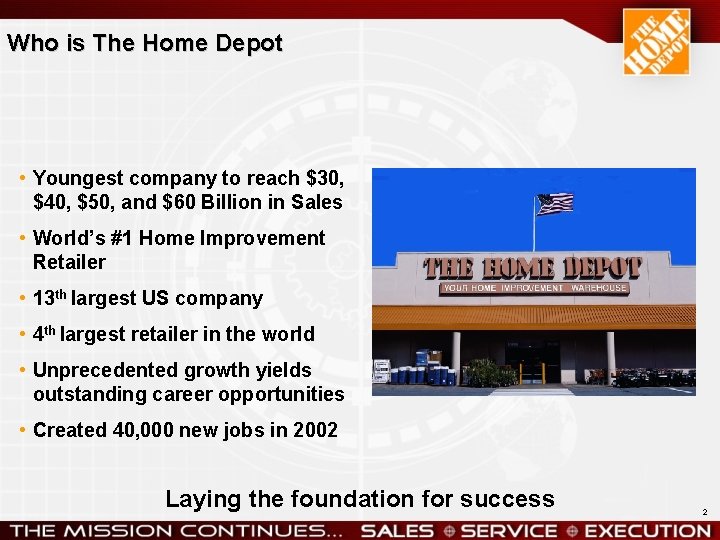
Who is The Home Depot • Youngest company to reach $30, $40, $50, and $60 Billion in Sales • World’s #1 Home Improvement Retailer • 13 th largest US company • 4 th largest retailer in the world • Unprecedented growth yields outstanding career opportunities • Created 40, 000 new jobs in 2002 Laying the foundation for success 2
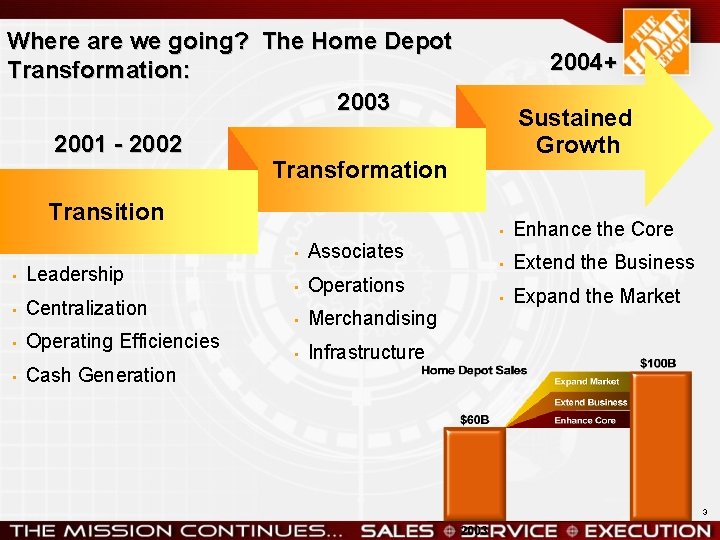
Where are we going? The Home Depot Transformation: 2003 2001 - 2002 Leadership • Centralization • Operating Efficiencies • Cash Generation Sustained Growth Transformation Transition • 2004+ • Associates • Operations • Merchandising • Infrastructure • Enhance the Core • Extend the Business • Expand the Market 3
The Home Depot Internal Audit’s Charter LDR Vision To assure The Home Depot Is positioned to achieve its strategic objectives by delivering the best auditing and business solutions to the Company and its shareholders Leadership Development Rotation Mission DELIVER outstanding customer service to all company associates and shareholders by assuring the goals of the company and the financial interests of the shareholders are being achieved through effective, efficient, and well-controlled processes DRIVE continuous improvement by conducting independent and objective business reviews and partnering with our customers to improve company operations DEVELOP future management talent for the company by offering diverse business experiences and by providing a rigorous learning curriculum Independence • Conducts all work uninhibited, to arrive at conclusions objectively, to recommend changes when changes are necessary, and to eliminate any conflict of interest potential • Reports functionally to the Audit Committee Board of Directors and administratively to the Chief Financial Officer 4
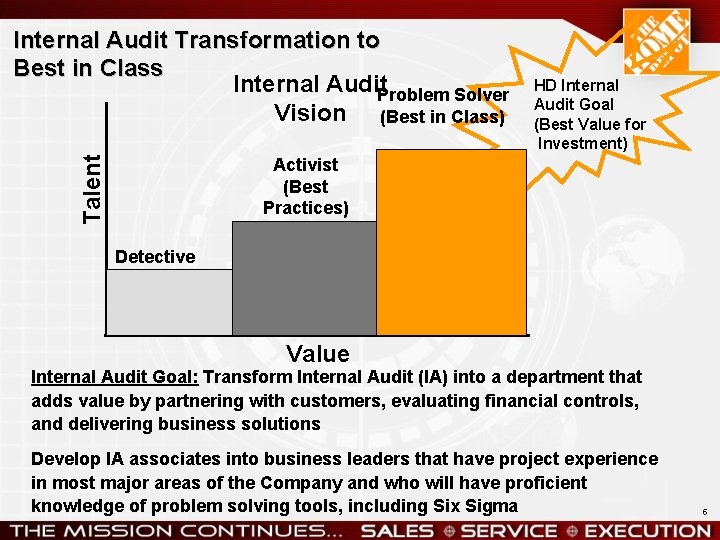
Talent Internal Audit Transformation to Best in Class Internal Audit. Problem Solver Vision (Best in Class) HD Internal Audit Goal (Best Value for Investment) Activist (Best Practices) Detective Value Internal Audit Goal: Transform Internal Audit (IA) into a department that adds value by partnering with customers, evaluating financial controls, and delivering business solutions Develop IA associates into business leaders that have project experience in most major areas of the Company and who will have proficient knowledge of problem solving tools, including Six Sigma 5
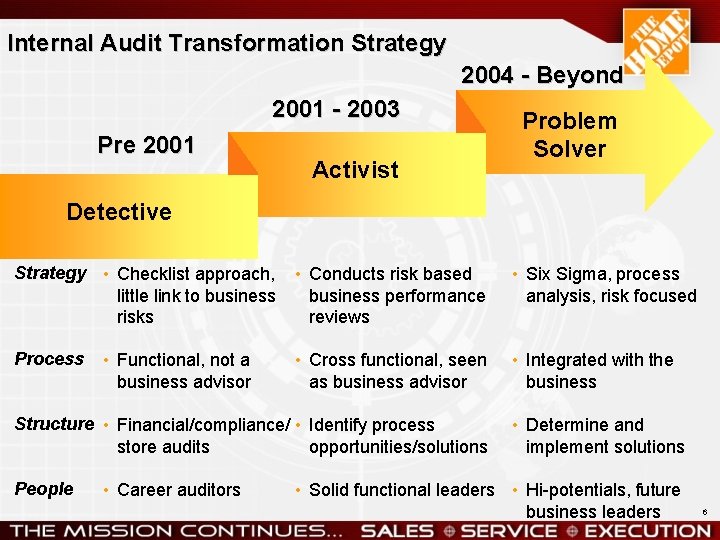
Internal Audit Transformation Strategy 2004 - Beyond 2001 - 2003 Pre 2001 Activist Problem Solver Detective Strategy • Checklist approach, little link to business risks • Conducts risk based business performance reviews • Six Sigma, process analysis, risk focused Process • Cross functional, seen as business advisor • Integrated with the business • Functional, not a business advisor Structure • Financial/compliance/ • Identify process opportunities/solutions store audits People • Career auditors • Determine and implement solutions • Solid functional leaders • Hi-potentials, future business leaders 6
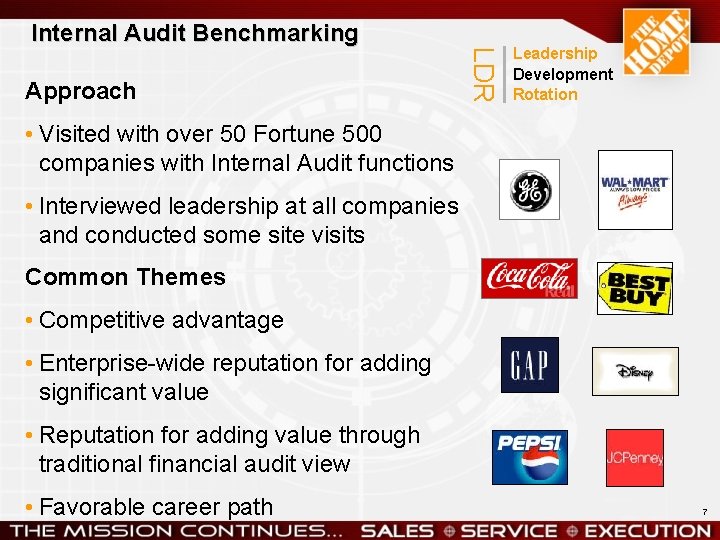
Approach LDR Internal Audit Benchmarking Leadership Development Rotation • Visited with over 50 Fortune 500 companies with Internal Audit functions • Interviewed leadership at all companies and conducted some site visits Common Themes • Competitive advantage • Enterprise-wide reputation for adding significant value • Reputation for adding value through traditional financial audit view • Favorable career path 7
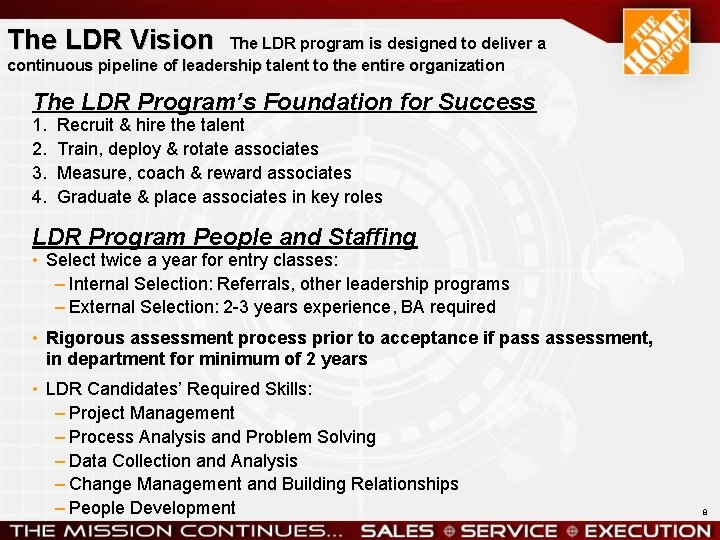
The LDR Vision The LDR program is designed to deliver a continuous pipeline of leadership talent to the entire organization The LDR Program’s Foundation for Success 1. 2. 3. 4. Recruit & hire the talent Train, deploy & rotate associates Measure, coach & reward associates Graduate & place associates in key roles LDR Program People and Staffing • Select twice a year for entry classes: – Internal Selection: Referrals, other leadership programs – External Selection: 2 -3 years experience, BA required • Rigorous assessment process prior to acceptance if pass assessment, in department for minimum of 2 years • LDR Candidates’ Required Skills: – Project Management – Process Analysis and Problem Solving – Data Collection and Analysis – Change Management and Building Relationships – People Development 8
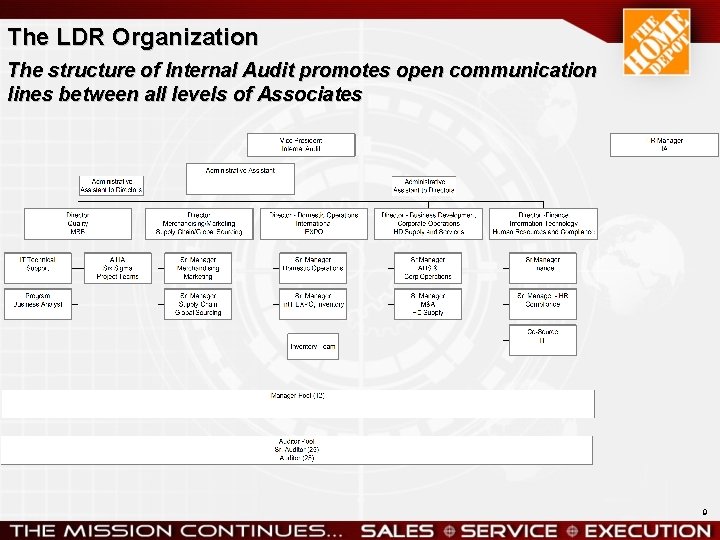
The LDR Organization The structure of Internal Audit promotes open communication lines between all levels of Associates 9
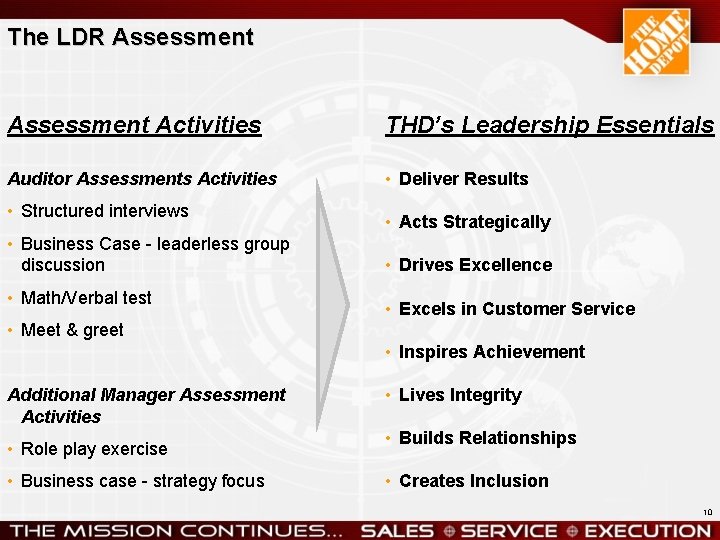
The LDR Assessment Activities THD’s Leadership Essentials Auditor Assessments Activities • Deliver Results • Structured interviews • Business Case - leaderless group discussion • Math/Verbal test • Acts Strategically • Drives Excellence • Excels in Customer Service • Meet & greet • Inspires Achievement Additional Manager Assessment Activities • Role play exercise • Business case - strategy focus • Lives Integrity • Builds Relationships • Creates Inclusion 10
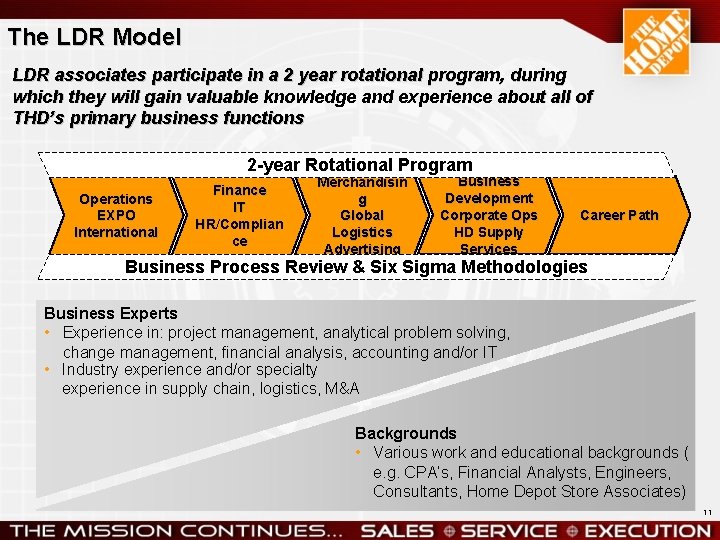
The LDR Model LDR associates participate in a 2 year rotational program, during which they will gain valuable knowledge and experience about all of THD’s primary business functions 2 -year Rotational Program Operations EXPO International Finance IT HR/Complian ce Merchandisin g Global Logistics Advertising Business Development Corporate Ops HD Supply Services Career Path Business Process Review & Six Sigma Methodologies Business Experts • Experience in: project management, analytical problem solving, change management, financial analysis, accounting and/or IT • Industry experience and/or specialty experience in supply chain, logistics, M&A Backgrounds • Various work and educational backgrounds ( e. g. CPA’s, Financial Analysts, Engineers, Consultants, Home Depot Store Associates) 11
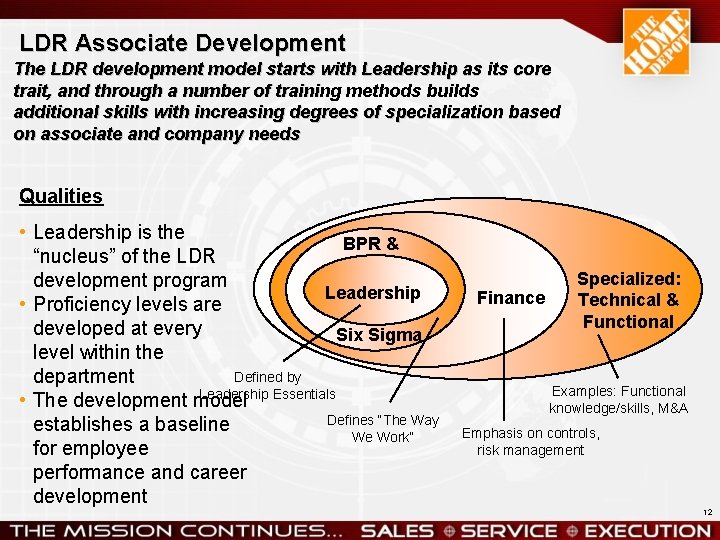
LDR Associate Development The LDR development model starts with Leadership as its core trait, and through a number of training methods builds additional skills with increasing degrees of specialization based on associate and company needs Qualities • Leadership is the BPR & “nucleus” of the LDR development program Leadership • Proficiency levels are developed at every Six Sigma level within the Defined by department Leadership Essentials • The development model Defines “The Way establishes a baseline We Work” for employee performance and career development Finance Specialized: Technical & Functional Examples: Functional knowledge/skills, M&A Emphasis on controls, risk management 12
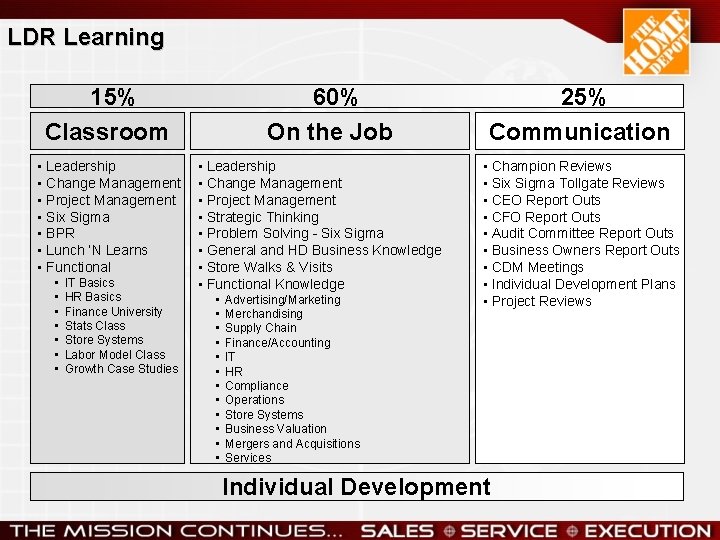
LDR Learning 15% Classroom • Leadership • Change Management • Project Management • Six Sigma • BPR • Lunch ‘N Learns • Functional • • IT Basics HR Basics Finance University Stats Class Store Systems Labor Model Class Growth Case Studies 60% On the Job • Leadership • Change Management • Project Management • Strategic Thinking • Problem Solving - Six Sigma • General and HD Business Knowledge • Store Walks & Visits • Functional Knowledge • • • Advertising/Marketing Merchandising Supply Chain Finance/Accounting IT HR Compliance Operations Store Systems Business Valuation Mergers and Acquisitions Services 25% Communication • Champion Reviews • Six Sigma Tollgate Reviews • CEO Report Outs • CFO Report Outs • Audit Committee Report Outs • Business Owners Report Outs • CDM Meetings • Individual Development Plans • Project Reviews Individual Development
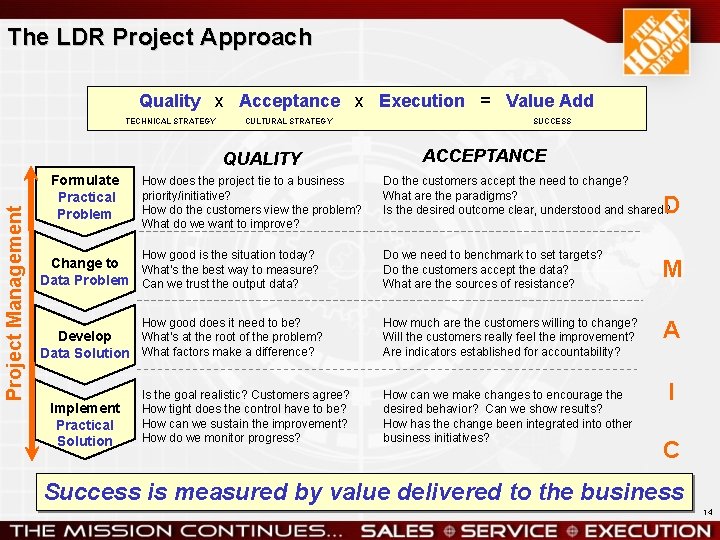
The LDR Project Approach Quality x Acceptance x Execution = Value Add TECHNICAL STRATEGY CULTURAL STRATEGY Project Management QUALITY Formulate Practical Problem SUCCESS ACCEPTANCE How does the project tie to a business priority/initiative? How do the customers view the problem? What do we want to improve? Do the customers accept the need to change? What are the paradigms? Is the desired outcome clear, understood and shared? Change to What’s the best way to measure? Data Problem Can we trust the output data? How good is the situation today? Do we need to benchmark to set targets? Do the customers accept the data? What are the sources of resistance? How good does it need to be? What’s at the root of the problem? Develop Data Solution What factors make a difference? How much are the customers willing to change? Will the customers really feel the improvement? Are indicators established for accountability? Implement Practical Solution Is the goal realistic? Customers agree? How tight does the control have to be? How can we sustain the improvement? How do we monitor progress? D How can we make changes to encourage the desired behavior? Can we show results? How has the change been integrated into other business initiatives? M A I C Success is measured by value delivered to the business 14
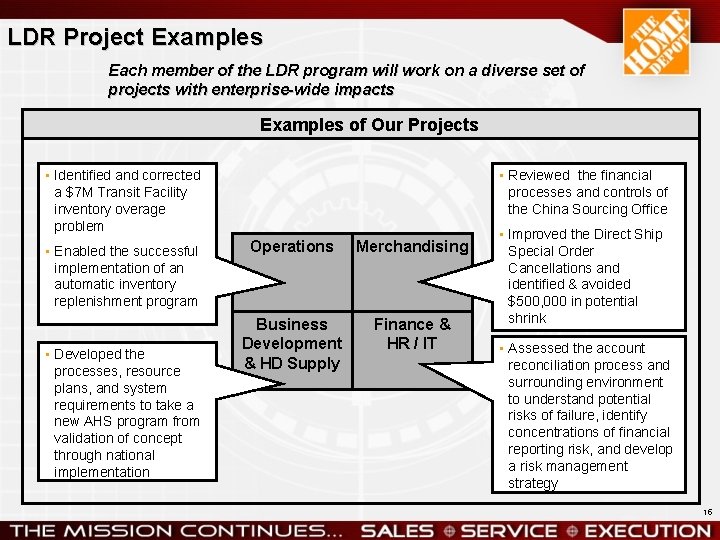
LDR Project Examples Each member of the LDR program will work on a diverse set of projects with enterprise-wide impacts Examples of Our Projects • Identified and corrected a $7 M Transit Facility inventory overage problem • Enabled the successful implementation of an automatic inventory replenishment program • Developed the processes, resource plans, and system requirements to take a new AHS program from validation of concept through national implementation • Reviewed the financial processes and controls of the China Sourcing Office Operations Merchandising Business Development & HD Supply Finance & HR / IT • Improved the Direct Ship Special Order Cancellations and identified & avoided $500, 000 in potential shrink • Assessed the account reconciliation process and surrounding environment to understand potential risks of failure, identify concentrations of financial reporting risk, and develop a risk management strategy 15
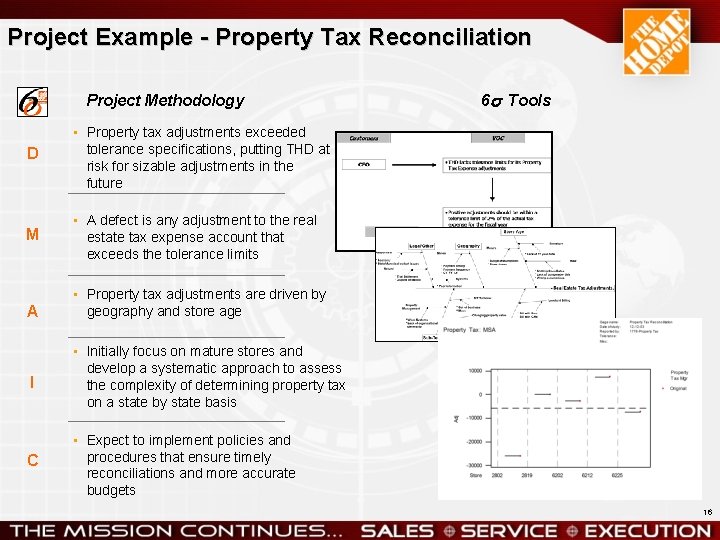
Project Example - Property Tax Reconciliation Project Methodology D • Property tax adjustments exceeded tolerance specifications, putting THD at risk for sizable adjustments in the future M • A defect is any adjustment to the real estate tax expense account that exceeds the tolerance limits A 6 s Tools • Property tax adjustments are driven by geography and store age I • Initially focus on mature stores and develop a systematic approach to assess the complexity of determining property tax on a state by state basis C • Expect to implement policies and procedures that ensure timely reconciliations and more accurate budgets 16
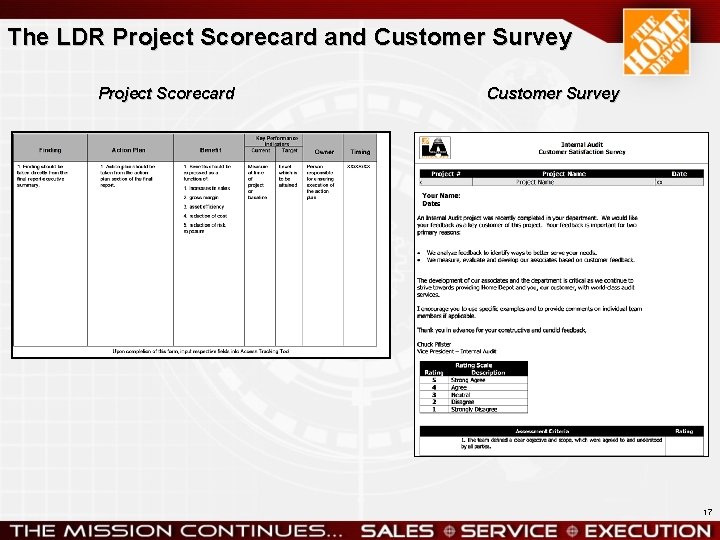
The LDR Project Scorecard and Customer Survey Project Scorecard Customer Survey 17
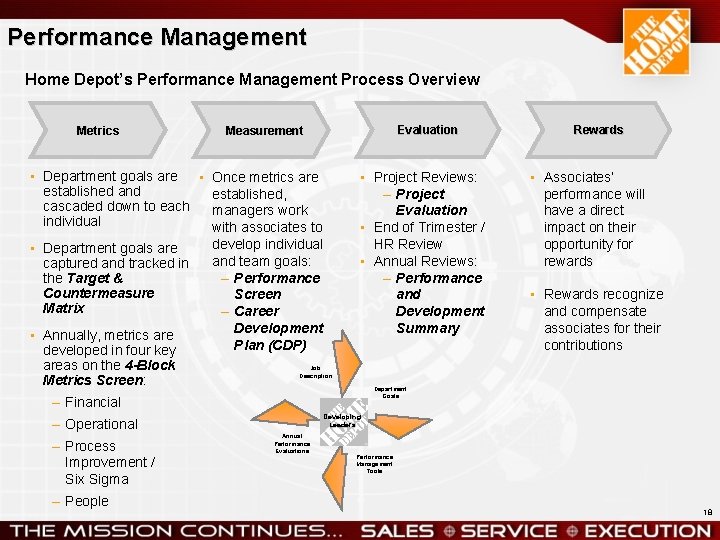
Performance Management Home Depot’s Performance Management Process Overview Metrics Evaluation Measurement • Department goals are • Once metrics are established and established, cascaded down to each managers work individual with associates to develop individual • Department goals are and team goals: captured and tracked in – Performance the Target & Countermeasure Screen Matrix – Career Development • Annually, metrics are Plan (CDP) developed in four key areas on the 4 -Block Job Description Metrics Screen: – Financial – People • Associates’ performance will have a direct impact on their opportunity for rewards • Rewards recognize and compensate associates for their contributions Department Goals Developing Leaders – Operational – Process Improvement / Six Sigma • Project Reviews: – Project Evaluation • End of Trimester / HR Review • Annual Reviews: – Performance and Development Summary Rewards Annual Performance Evaluations Performance Management Tools 18
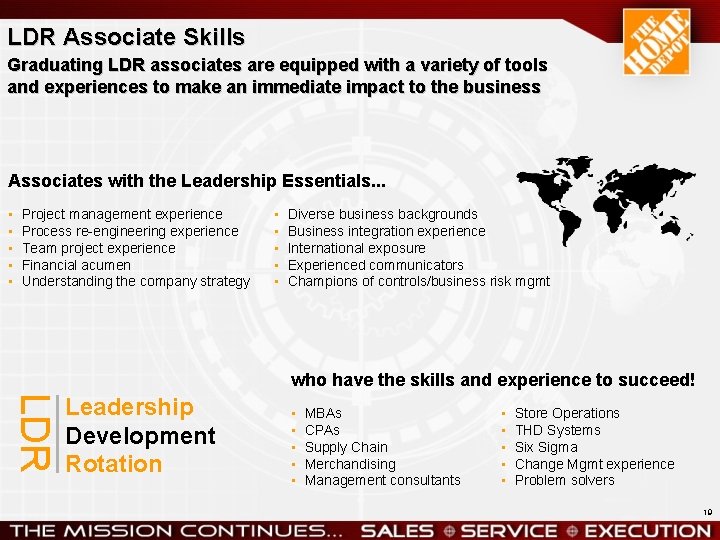
LDR Associate Skills Graduating LDR associates are equipped with a variety of tools and experiences to make an immediate impact to the business Associates with the Leadership Essentials. . . • • • Project management experience Process re-engineering experience Team project experience Financial acumen Understanding the company strategy • • • Diverse business backgrounds Business integration experience International exposure Experienced communicators Champions of controls/business risk mgmt who have the skills and experience to succeed! LDR Leadership Development Rotation • • • MBAs CPAs Supply Chain Merchandising Management consultants • • • Store Operations THD Systems Six Sigma Change Mgmt experience Problem solvers 19
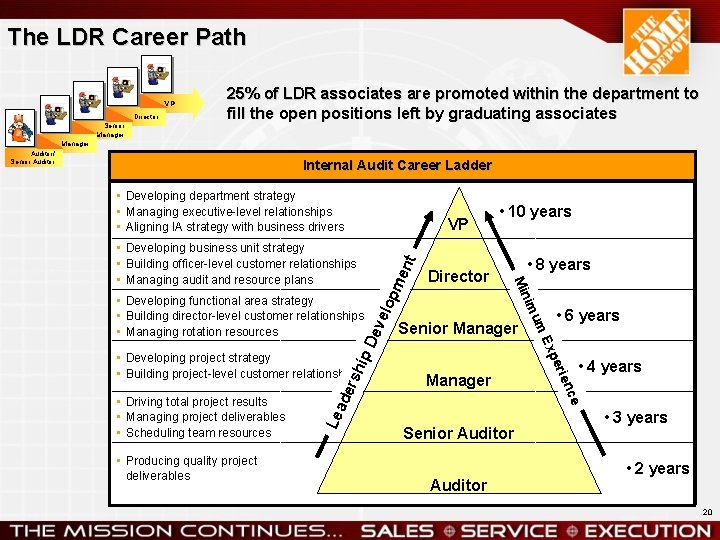
The LDR Career Path VP Director Senior Manager 25% of LDR associates are promoted within the department to fill the open positions left by graduating associates Manager Auditor/ Senior Auditor Internal Audit Career Ladder • Developing department strategy • Managing executive-level relationships • Aligning IA strategy with business drivers VP Lea der nt me lop shi • Producing quality project deliverables Senior Auditor • 4 years nce • Driving total project results • Managing project deliverables • Scheduling team resources Manager rie • Developing project strategy • Building project-level customer relationships • 6 years xpe p. D Senior Manager m. E eve • 8 years imu • Developing functional area strategy • Building director-level customer relationships • Managing rotation resources Director Min • Developing business unit strategy • Building officer-level customer relationships • Managing audit and resource plans • 10 years • 3 years • 2 years 20
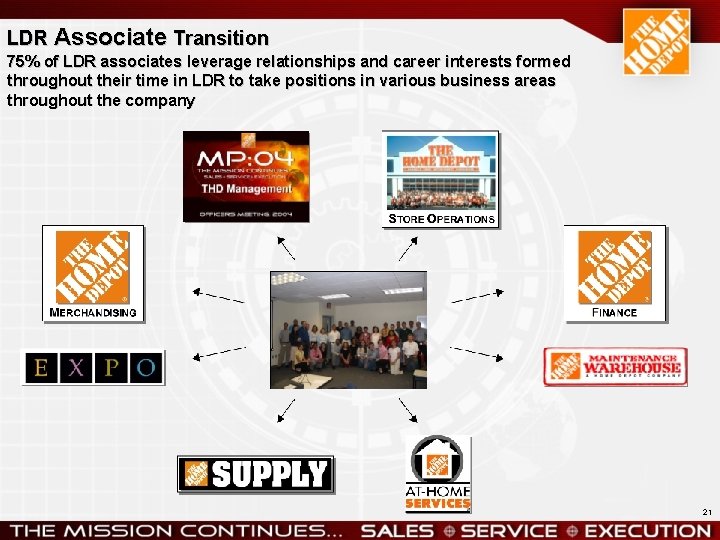
LDR Associate Transition 75% of LDR associates leverage relationships and career interests formed throughout their time in LDR to take positions in various business areas throughout the company 21