
Internal Audit Capability Model IACM for the Public
Internal Audit Capability Model (IA-CM) for the Public Sector Using the IA-CM as a Self-assessment Tool IA-CM www. theiia. org/research
Agenda IA-CM • What is the IA-CM? – Underlying principles. • • • Structure of the IA-CM. Self-assessment steps. Considerations. Communicate results. More information. 2 www. theiia. org/research
What is the IA-CM? IA-CM • Communication vehicle. • Framework for assessment. • A road map for orderly improvement. 3 www. theiia. org/research
Why Public Sector? IA-CM • Internal auditing (IA) varies widely from country to country. • Differences in culture, management practices, and processes. • Need for a governance model, including IA. • Opportunities to: – Modernize/evolve IA. – Improve its effectiveness. – Deliver added value. • Critical need for a developmental model, especially in developing countries. 4 www. theiia. org/research
Underlying Principles IA-CM IA Activity’s Obligations • Be an integral component of effective governance in the public sector. • Help organizations achieve their objectives and account for their results. Organization’s Obligations • Determine optimum level of IA capability to support required governance structures. • Achieve and maintain the desired capability. 5 www. theiia. org/research
Underlying Principles IA-CM Selecting Optimum Capability • Three variables: – Environment. – Organization. – IA activity. • Different capability required. • Auditing must be cost-effective. • No “one size fits all. ” 6 www. theiia. org/research
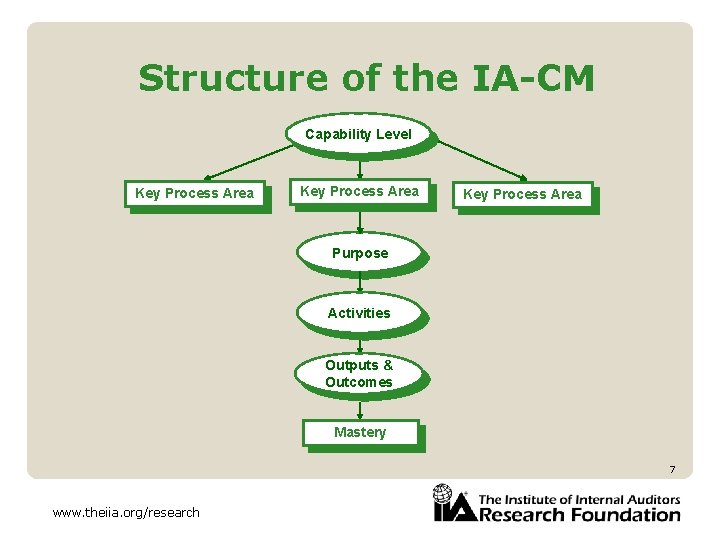
Structure of the IA-CM Capability Level Key Process Area Purpose Activities Outputs & Outcomes Mastery 7 www. theiia. org/research
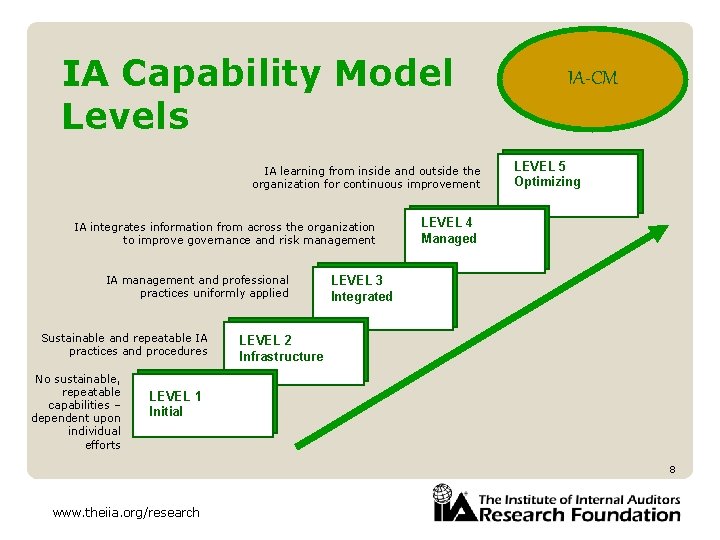
IA Capability Model Levels IA learning from inside and outside the organization for continuous improvement IA integrates information from across the organization to improve governance and risk management IA management and professional practices uniformly applied Sustainable and repeatable IA practices and procedures No sustainable, repeatable capabilities – dependent upon individual efforts IA-CM LEVEL 5 Optimizing LEVEL 4 Managed LEVEL 3 Integrated LEVEL 2 Infrastructure LEVEL 1 Initial 8 www. theiia. org/research
Why Levels? IA-CM • Different performance expectations and measures in current practice. • Capability gets built in steps/stages. • Need a common map/conceptual framework. • Help select the capability level appropriate for an organization. 9 www. theiia. org/research
IA Activity Elements IA-CM The IA activity consists of the following six elements: – Services and role of IA. – People management. – Professional practices. – Performance management and accountability. – Organizational relationships and culture. – Governance structures. 10 www. theiia. org/research
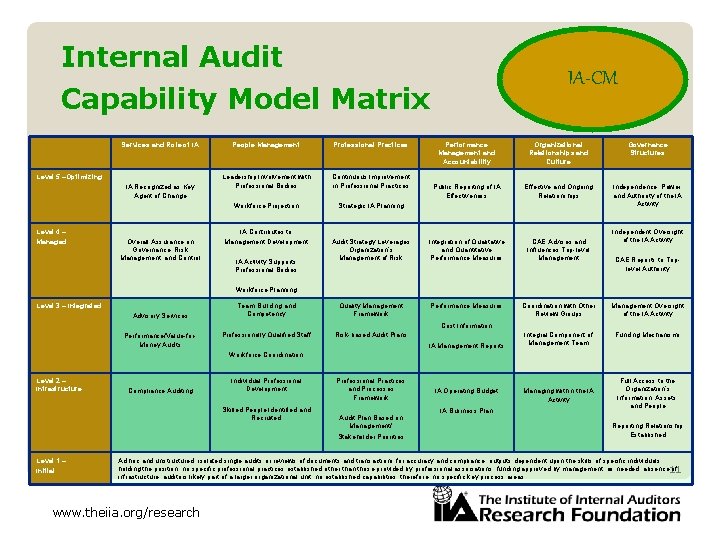
Internal Audit Capability Model Matrix Services and Role of IA Level 5 –Optimizing IA Recognized as Key Agent of Change Level 4 – Managed Overall Assurance on Governance, Risk Management, and Control People Management Professional Practices Leadership Involvement with Professional Bodies Continuous Improvement in Professional Practices Workforce Projection Strategic IA Planning IA-CM Performance Management and Accountability Organizational Relationships and Culture Governance Structures Public Reporting of IA Effectiveness Effective and Ongoing Relationships Independence, Power, and Authority of the IA Activity Audit Strategy Leverages Organization’s Management of Risk Integration of Qualitative and Quantitative Performance Measures CAE Advises and Influences Top-level Management Team Building and Competency Quality Management Framework Performance Measures Coordination with Other Review Groups Management Oversight of the IA Activity Professionally Qualified Staff Risk-based Audit Plans Integral Component of Management Team Funding Mechanisms IA Contributes to Management Development IA Activity Supports Professional Bodies Independent Oversight of the IA Activity CAE Reports to Toplevel Authority Workforce Planning Level 3 – Integrated Advisory Services Cost Information Performance/Value-for. Money Audits IA Management Reports Workforce Coordination Level 2 – Infrastructure Compliance Auditing Individual Professional Development Skilled People Identified and Recruited Level 1 – Initial Professional Practices and Processes Framework Audit Plan Based on Management/ Stakeholder Priorities IA Operating Budget IA Business Plan Managing within the IA Activity Full Access to the Organization’s Information, Assets, and People Reporting Relationship Established Ad hoc and unstructured; isolated single audits or reviews of documents and transactions for accuracy and compliance; outputs dependent upon the skills of specific individuals holding the position; no specific professional practices established other than those provided by professional associations; funding approved by management, as needed; absence 11 of infrastructure; auditors likely part of a larger organizational unit; no established capabilities; therefore, no specific key process areas www. theiia. org/research
Using the IA-CM • Not prescriptive — what should be done rather than how to do it. • A universal model with comparability around principles, practices, and processes to improve IA and be applied globally. 12 www. theiia. org/research
Self-assessment Steps IA-CM • Understand the IA-CM. • Identify KPAs that appear to be institutionalized by the IA activity. • Review documentation re: IA activity, organization, and environment. • Interview managers/stakeholders. • Confirm actual KPAs institutionalized. • Determine capability level. • Communicate results. 13 www. theiia. org/research
Considerations IA-CM • Apply professional judgment. • Consider environmental and organizational factors. • Is Level 3 sufficient? • Can capability levels be skipped? • Can KPAs be ignored? • Must all elements be at the same capability level? 14 www. theiia. org/research
Communicate Results IA-CM • Identify strengths and areas for improvement of the IA activity. • Identify “leading practices” of the IA activity. 15 www. theiia. org/research
Internal Audit Capability Model (IA-CM) for the Public Sector For more information, visit: www. theiia. org/research/ia-cm IA-CM 16 www. theiia. org/research
- Slides: 16