
INTERNAL ASSESSMENT Enhancement Program for Division Trainers on


- Slides: 29
INTERNAL ASSESSMENT Enhancement Program for Division Trainers on Strategic and Operational Planning Process and Content July 5, 2013 – Dep. Ed NCR Conference Hall
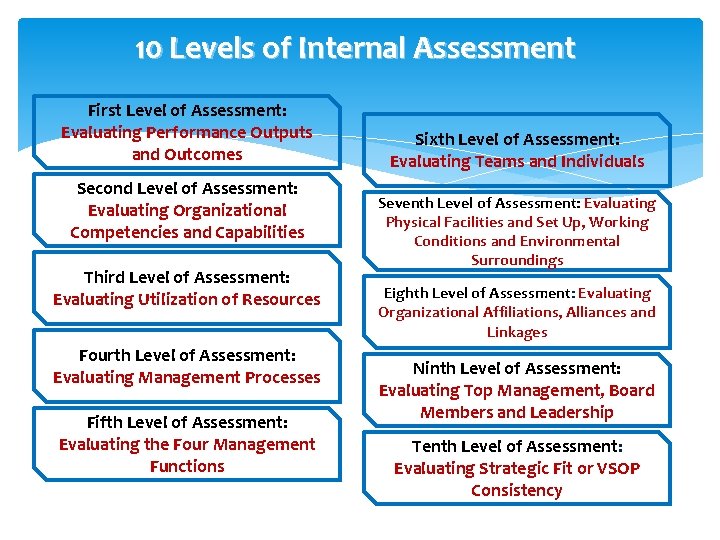
10 Levels of Internal Assessment First Level of Assessment: Evaluating Performance Outputs and Outcomes Second Level of Assessment: Evaluating Organizational Competencies and Capabilities Third Level of Assessment: Evaluating Utilization of Resources Fourth Level of Assessment: Evaluating Management Processes Fifth Level of Assessment: Evaluating the Four Management Functions Sixth Level of Assessment: Evaluating Teams and Individuals Seventh Level of Assessment: Evaluating Physical Facilities and Set Up, Working Conditions and Environmental Surroundings Eighth Level of Assessment: Evaluating Organizational Affiliations, Alliances and Linkages Ninth Level of Assessment: Evaluating Top Management, Board Members and Leadership Tenth Level of Assessment: Evaluating Strategic Fit or VSOP Consistency
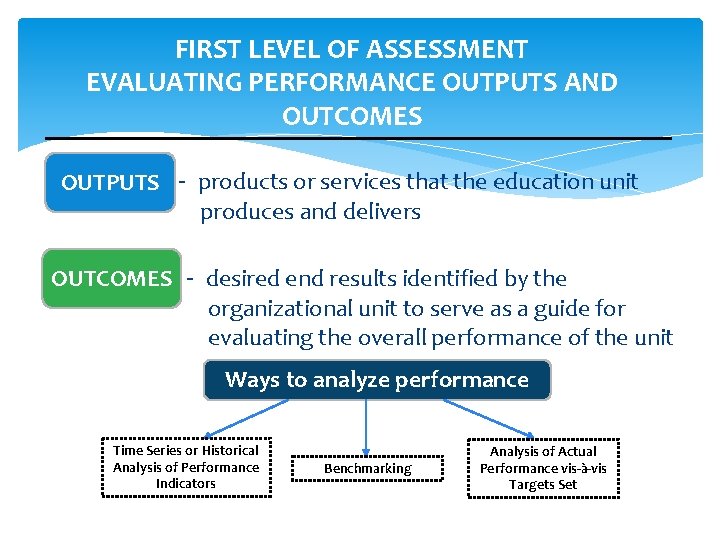
FIRST LEVEL OF ASSESSMENT EVALUATING PERFORMANCE OUTPUTS AND OUTCOMES OUTPUTS - products or services that the education unit produces and delivers OUTCOMES - desired end results identified by the organizational unit to serve as a guide for evaluating the overall performance of the unit Ways to analyze performance Time Series or Historical Analysis of Performance Indicators Benchmarking Analysis of Actual Performance vis-à-vis Targets Set
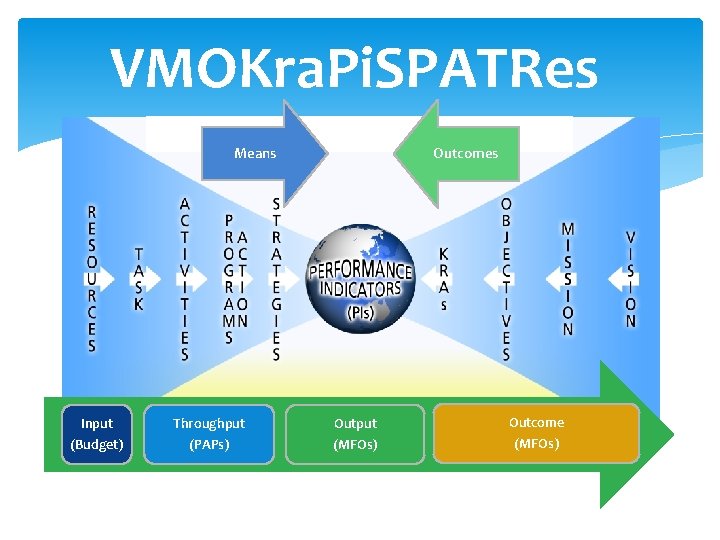
VMOKra. Pi. SPATRes Means Input (Budget) Throughput (PAPs) Outcomes Output (MFOs) Outcome (MFOs)
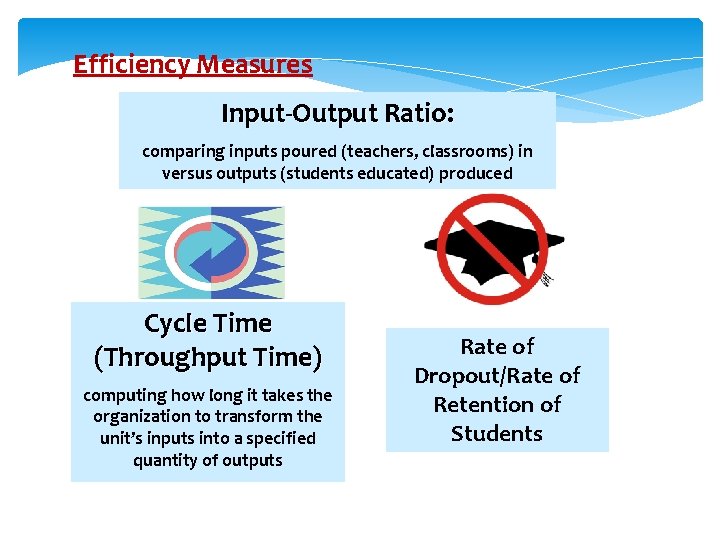
Efficiency Measures Input-Output Ratio: comparing inputs poured (teachers, classrooms) in versus outputs (students educated) produced Cycle Time (Throughput Time) computing how long it takes the organization to transform the unit’s inputs into a specified quantity of outputs Rate of Dropout/Rate of Retention of Students
Efficiency Ratios (Input-Output) q Full Time Teacher: Pupil/Student Ratio q Classroom: Pupil/Student Ratio q Textbook: Pupil/Student Ratio q Space per pupil/student q Others
Economic Measures Cost Benefit Ratio: Investment Return Ratio: comparing the costs of producing a product or rendering a service to the benefits it generates comparing programs or projects investments to economic returns Economy Ratio q Cost per Pupil/Student per Year q Cost per Organizational Unit q Cost to Educate Students for Entire K to 12 Duration q Cost per Square Meter of Facilities Built
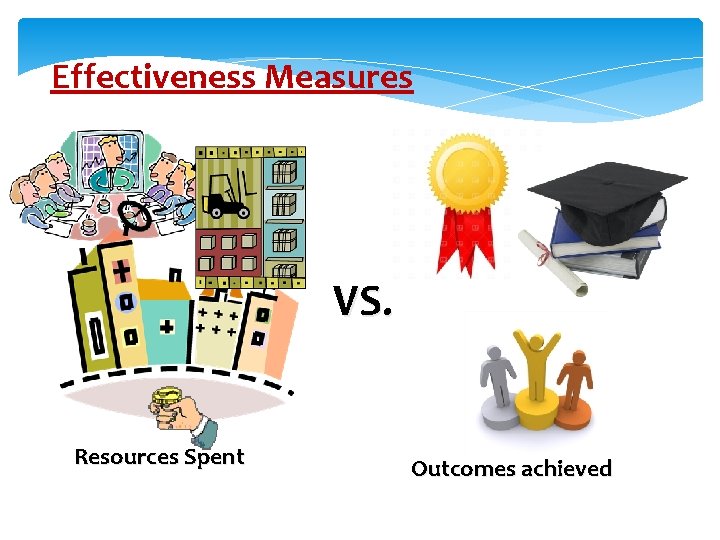
Effectiveness Measures VS. Resources Spent Outcomes achieved
Effectiveness Measures q. Resources Utilized (people, pesos, physical facilities) versus Student Outcomes Attained q. Percentage of Students Employed Six Months after Graduating q. Others
SECOND LEVEL OF ASSESSMENT EVALUATING ORGANIZATIONAL COMPETENCIES AND CAPABILITIES looks at the capabilities and competencies of the organization Capabilities and Competencies
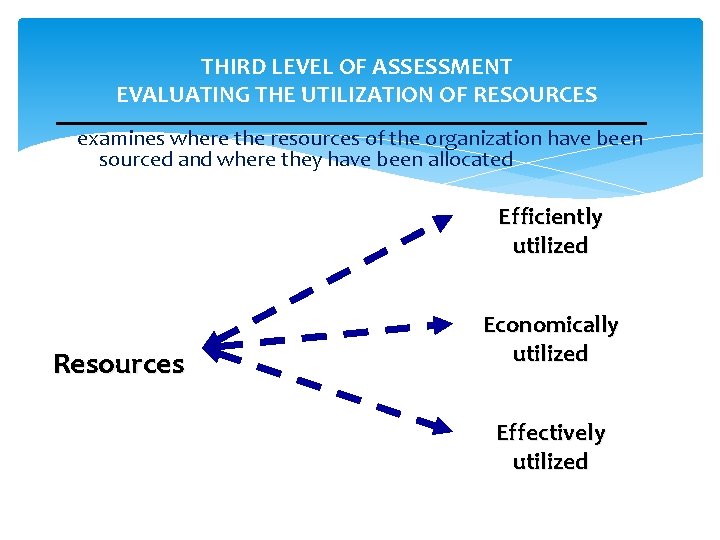
THIRD LEVEL OF ASSESSMENT EVALUATING THE UTILIZATION OF RESOURCES examines where the resources of the organization have been sourced and where they have been allocated Efficiently utilized Resources Economically utilized Effectively utilized
FOURTH LEVEL OF ASSESSMENT EVALUATING MANAGEMENT PROCESSES examines and evaluates the organization's management processes. These processes are the formal and informal systems and procedures of the unit In assessing management processes, the top-most concern is to gauge whether or not they were crafted, carried out, coordinated, monitored and conducted well in terms of their effectiveness
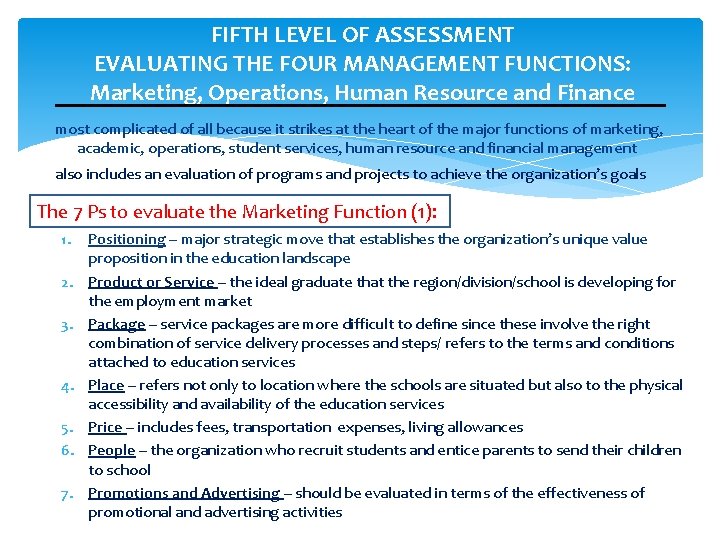
FIFTH LEVEL OF ASSESSMENT EVALUATING THE FOUR MANAGEMENT FUNCTIONS: Marketing, Operations, Human Resource and Finance most complicated of all because it strikes at the heart of the major functions of marketing, academic, operations, student services, human resource and financial management also includes an evaluation of programs and projects to achieve the organization’s goals The 7 Ps to evaluate the Marketing Function (1): 1. 2. 3. 4. 5. 6. 7. Positioning – major strategic move that establishes the organization’s unique value proposition in the education landscape Product or Service – the ideal graduate that the region/division/school is developing for the employment market Package – service packages are more difficult to define since these involve the right combination of service delivery processes and steps/ refers to the terms and conditions attached to education services Place – refers not only to location where the schools are situated but also to the physical accessibility and availability of the education services Price – includes fees, transportation expenses, living allowances People – the organization who recruit students and entice parents to send their children to school Promotions and Advertising – should be evaluated in terms of the effectiveness of promotional and advertising activities
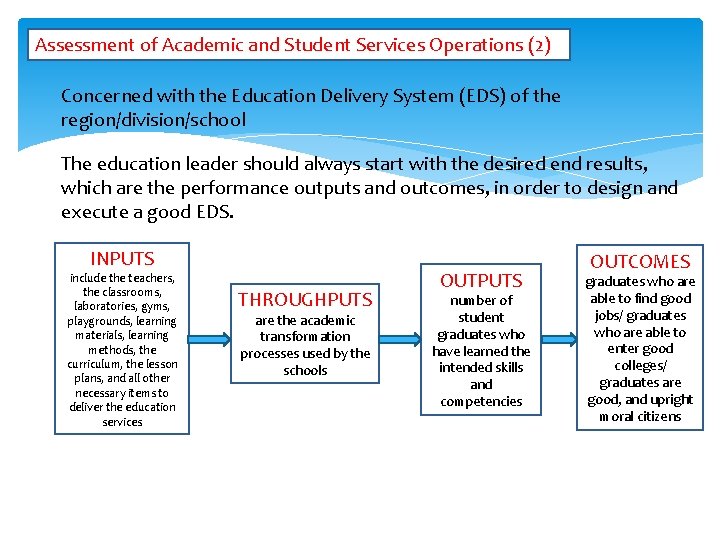
Assessment of Academic and Student Services Operations (2) Concerned with the Education Delivery System (EDS) of the region/division/school The education leader should always start with the desired end results, which are the performance outputs and outcomes, in order to design and execute a good EDS. INPUTS include the teachers, the classrooms, laboratories, gyms, playgrounds, learning materials, learning methods, the curriculum, the lesson plans, and all other necessary items to deliver the education services THROUGHPUTS are the academic transformation processes used by the schools OUTPUTS number of student graduates who have learned the intended skills and competencies OUTCOMES graduates who are able to find good jobs/ graduates who are able to enter good colleges/ graduates are good, and upright moral citizens
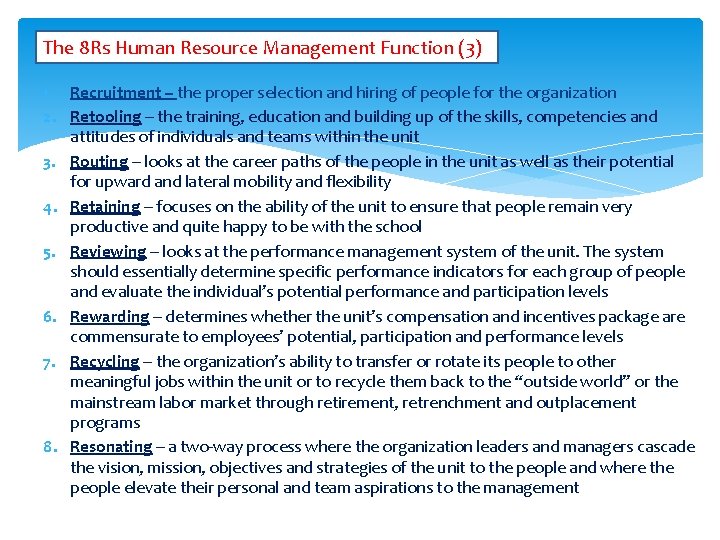
The 8 Rs Human Resource Management Function (3) 1. Recruitment – the proper selection and hiring of people for the organization 2. Retooling – the training, education and building up of the skills, competencies and attitudes of individuals and teams within the unit 3. Routing – looks at the career paths of the people in the unit as well as their potential for upward and lateral mobility and flexibility 4. Retaining – focuses on the ability of the unit to ensure that people remain very productive and quite happy to be with the school 5. Reviewing – looks at the performance management system of the unit. The system should essentially determine specific performance indicators for each group of people and evaluate the individual’s potential performance and participation levels 6. Rewarding – determines whether the unit’s compensation and incentives package are commensurate to employees’ potential, participation and performance levels 7. Recycling – the organization’s ability to transfer or rotate its people to other meaningful jobs within the unit or to recycle them back to the “outside world” or the mainstream labor market through retirement, retrenchment and outplacement programs 8. Resonating – a two-way process where the organization leaders and managers cascade the vision, mission, objectives and strategies of the unit to the people and where the people elevate their personal and team aspirations to the management
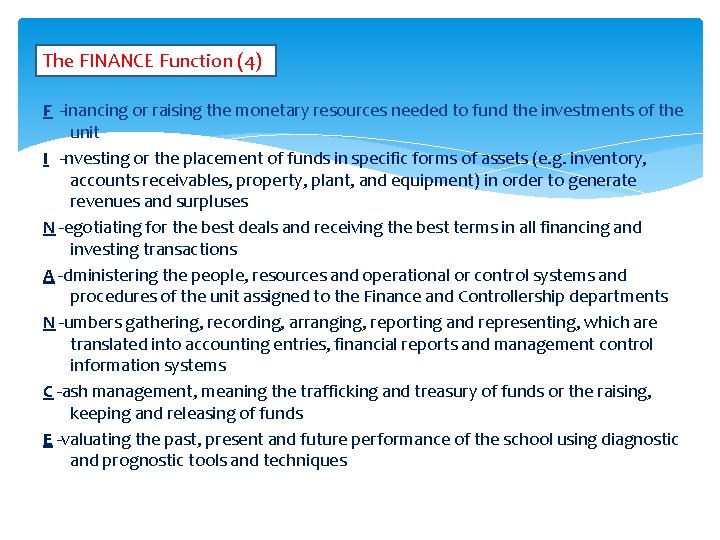
The FINANCE Function (4) F -inancing or raising the monetary resources needed to fund the investments of the unit I -nvesting or the placement of funds in specific forms of assets (e. g. inventory, accounts receivables, property, plant, and equipment) in order to generate revenues and surpluses N -egotiating for the best deals and receiving the best terms in all financing and investing transactions A -dministering the people, resources and operational or control systems and procedures of the unit assigned to the Finance and Controllership departments N -umbers gathering, recording, arranging, reporting and representing, which are translated into accounting entries, financial reports and management control information systems C -ash management, meaning the trafficking and treasury of funds or the raising, keeping and releasing of funds E -valuating the past, present and future performance of the school using diagnostic and prognostic tools and techniques
SIXTH LEVEL OF ASSESSMENT EVALUATING TEAMS AND INDIVIDUALS Assessment of teams and individuals should not be conducted on an absolute ü Different potentials must be determined basis ü Evaluate teams and individuals based on their relative performance
SEVENTH LEVEL OF ASSESSMENT EVALUATING PHYSICAL FACILITIES AND SET-UP, WORKING CONDITIONS AND ENVIRONMENT The competitiveness of an organization can be determined by the state of its physical assets, working conditions and environmental surroundings particularly the facilities, grounds and equipment it owns for education purposes.
EIGHTH LEVEL OF ASSESSMENT EVALUATING ORGANIZATIONAL AFFILIATIONS, ALLIANCES AND LINKAGES The organization's strength lies not just within itself but the network of stakeholders it is linked, allied, and affiliated with.
NINTH LEVEL OF ASSESSMENT EVALUATING TOP MANAGEMENT, BOARD MEMBERS AND LEADERS This level is the most sensitive part of internal assessment. More often, the evaluator of the organizational leadership is the leader himself or herself or a subordinate just below the leader.
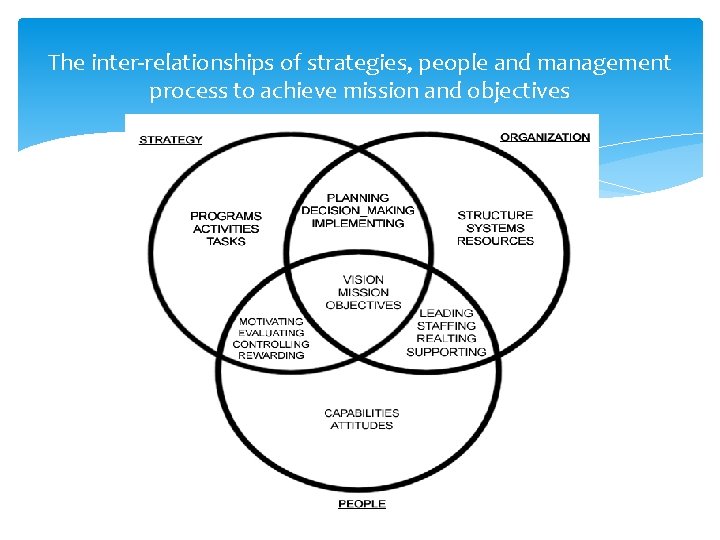
TENTH LEVEL OF ASSESSMENT EVALUATING STRATEGIC FIT OR VSOP (Vision-Mission-Objectives, Strategies, Organization and People) CONSISTENCY
The inter-relationships of strategies, people and management process to achieve mission and objectives
INTERNAL ANALYSIS
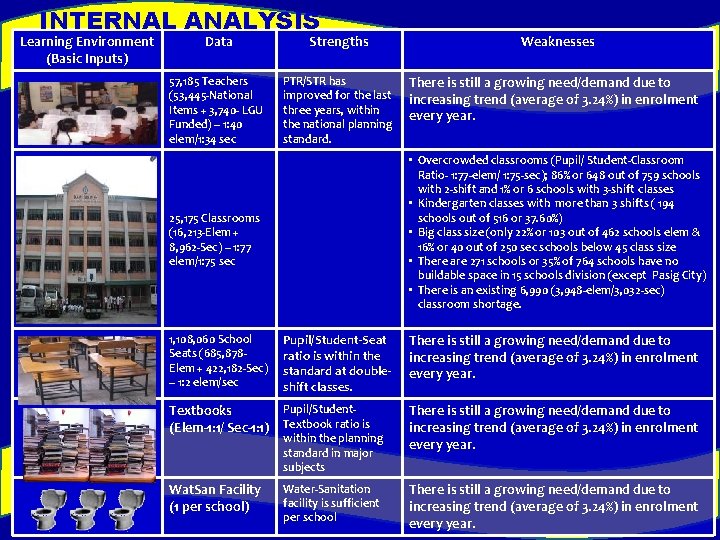
INTERNAL ANALYSIS Learning Environment (Basic Inputs) Data Strengths 57, 185 Teachers (53, 445 -National Items + 3, 740 - LGU Funded) – 1: 40 elem/1: 34 sec PTR/STR has improved for the last three years, within the national planning standard. Weaknesses There is still a growing need/demand due to increasing trend (average of 3. 24%) in enrolment every year. • Overcrowded classrooms (Pupil/ Student-Classroom Ratio- 1: 77 -elem/ 1: 75 -sec); 86% or 648 out of 759 schools with 2 -shift and 1% or 6 schools with 3 -shift classes • Kindergarten classes with more than 3 shifts ( 194 schools out of 516 or 37. 60%) • Big class size (only 22% or 103 out of 462 schools elem & 16% or 40 out of 250 sec schools below 45 class size • There are 271 schools or 35% of 764 schools have no buildable space in 15 schools division (except Pasig City) • There is an existing 6, 990 (3, 948 -elem/3, 032 -sec) classroom shortage. 25, 175 Classrooms (16, 213 -Elem + 8, 962 -Sec) – 1: 77 elem/1: 75 sec 1, 108, 060 School Seats (685, 878 Elem + 422, 182 -Sec) – 1: 2 elem/sec Pupil/Student-Seat ratio is within the standard at doubleshift classes. There is still a growing need/demand due to increasing trend (average of 3. 24%) in enrolment every year. Textbooks (Elem-1: 1/ Sec-1: 1) Pupil/Student. Textbook ratio is within the planning standard in major subjects There is still a growing need/demand due to increasing trend (average of 3. 24%) in enrolment every year. Wat. San Facility (1 per school) Water-Sanitation facility is sufficient per school There is still a growing need/demand due to increasing trend (average of 3. 24%) in enrolment every year.
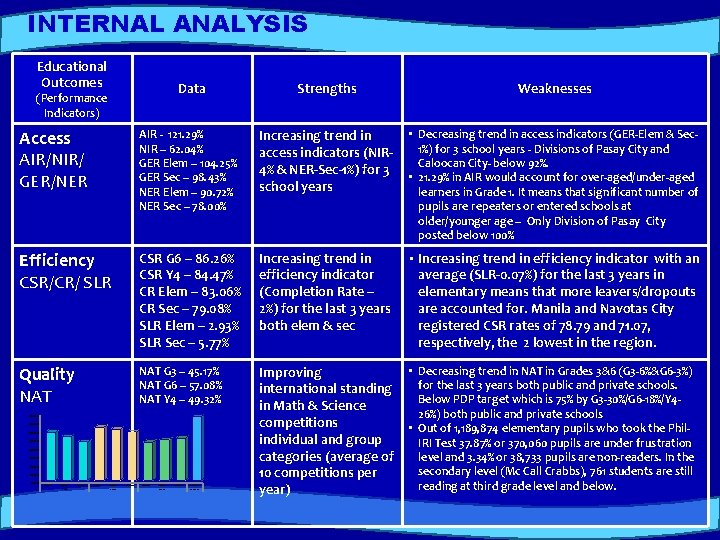
INTERNAL ANALYSIS Educational Outcomes Data (Performance Indicators) Strengths Weaknesses Access AIR/NIR/ GER/NER AIR - 121. 29% NIR – 62. 04% GER Elem – 104. 25% GER Sec – 98. 43% NER Elem – 90. 72% NER Sec – 78. 00% Increasing trend in access indicators (NIR 4% & NER-Sec-1%) for 3 school years • Decreasing trend in access indicators (GER-Elem & Sec 1%) for 3 school years - Divisions of Pasay City and Caloocan City- below 92%. • 21. 29% in AIR would account for over-aged/under-aged learners in Grade 1. It means that significant number of pupils are repeaters or entered schools at older/younger age – Only Division of Pasay City posted below 100% Efficiency CSR/CR/ SLR CSR G 6 – 86. 26% CSR Y 4 – 84. 47% CR Elem – 83. 06% CR Sec – 79. 08% SLR Elem – 2. 93% SLR Sec – 5. 77% Increasing trend in efficiency indicator (Completion Rate – 2%) for the last 3 years both elem & sec • Increasing trend in efficiency indicator with an average (SLR-0. 07%) for the last 3 years in elementary means that more leavers/dropouts are accounted for. Manila and Navotas City registered CSR rates of 78. 79 and 71. 07, respectively, the 2 lowest in the region. Quality NAT G 3 – 45. 17% NAT G 6 – 57. 08% NAT Y 4 – 49. 32% Improving international standing in Math & Science competitions individual and group categories (average of 10 competitions per year) • Decreasing trend in NAT in Grades 3&6 (G 3 -6%&G 6 -3%) for the last 3 years both public and private schools. Below PDP target which is 75% by G 3 -30%/G 6 -18%/Y 426%) both public and private schools • Out of 1, 189, 874 elementary pupils who took the Phil. IRI Test 37. 87% or 370, 060 pupils are under frustration level and 3. 34% or 38, 733 pupils are non-readers. In the secondary level (Mc Call Crabbs), 761 students are still reading at third grade level and below. 80. 00 70. 00 60. 00 50. 00 40. 00 30. 00 20. 00 10. 00 2009 -2010 -2011 Grade 3 2011 -2012 2009 -2010 -2011 Grade 6 2011 -2012 2009 -2010 -2011 Year 2/4 2011 -2012 2016 -2017 PDP Target
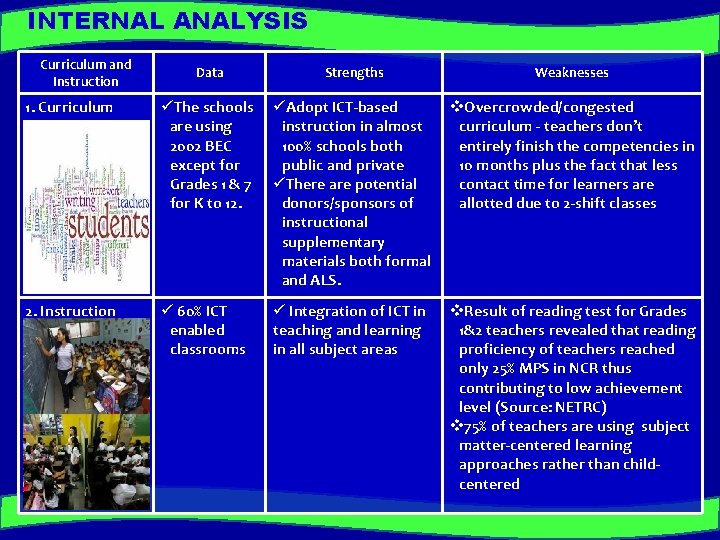
INTERNAL ANALYSIS Curriculum and Instruction Data Strengths Weaknesses 1. Curriculum üThe schools are using 2002 BEC except for Grades 1 & 7 for K to 12. üAdopt ICT-based instruction in almost 100% schools both public and private üThere are potential donors/sponsors of instructional supplementary materials both formal and ALS. v. Overcrowded/congested curriculum - teachers don’t entirely finish the competencies in 10 months plus the fact that less contact time for learners are allotted due to 2 -shift classes 2. Instruction ü 60% ICT enabled classrooms ü Integration of ICT in teaching and learning in all subject areas v. Result of reading test for Grades 1&2 teachers revealed that reading proficiency of teachers reached only 25% MPS in NCR thus contributing to low achievement level (Source: NETRC) v 75% of teachers are using subject matter-centered learning approaches rather than childcentered
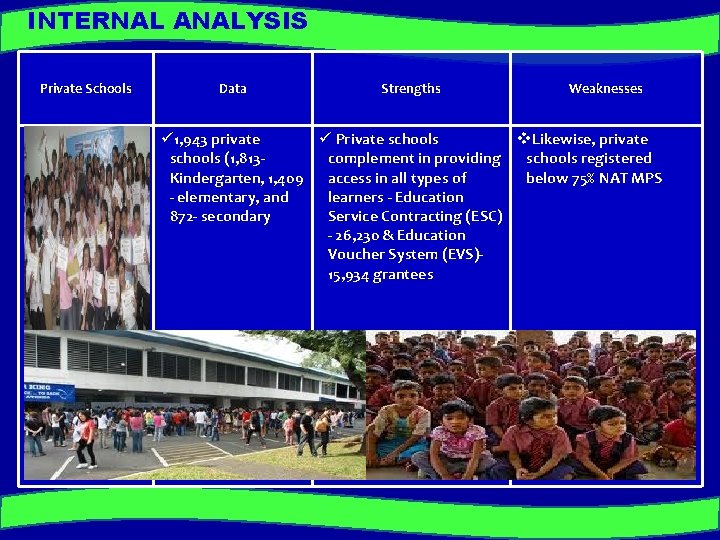
INTERNAL ANALYSIS Private Schools Data Strengths Weaknesses ü 1, 943 private ü Private schools v. Likewise, private schools (1, 813 complement in providing schools registered Kindergarten, 1, 409 access in all types of below 75% NAT MPS - elementary, and learners - Education 872 - secondary Service Contracting (ESC) - 26, 230 & Education Voucher System (EVS)15, 934 grantees
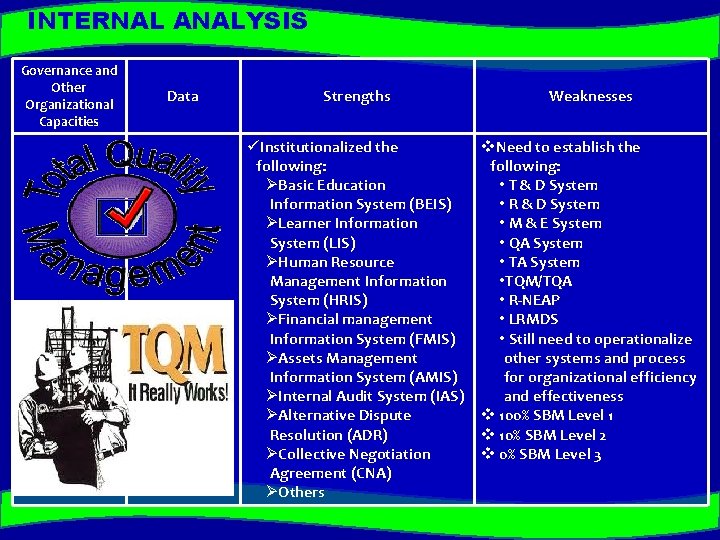
INTERNAL ANALYSIS Governance and Other Organizational Capacities Data Strengths Weaknesses üInstitutionalized the following: ØBasic Education Information System (BEIS) ØLearner Information System (LIS) ØHuman Resource Management Information System (HRIS) ØFinancial management Information System (FMIS) ØAssets Management Information System (AMIS) ØInternal Audit System (IAS) ØAlternative Dispute Resolution (ADR) ØCollective Negotiation Agreement (CNA) ØOthers v. Need to establish the following: • T & D System • R & D System • M & E System • QA System • TQM/TQA • R-NEAP • LRMDS • Still need to operationalize other systems and process for organizational efficiency and effectiveness v 100% SBM Level 1 v 10% SBM Level 2 v 0% SBM Level 3