
Intermodal Supply Chain Optimization at a Large Retailer

- Slides: 18
Intermodal Supply Chain Optimization at a Large Retailer Part 1: Model Development Scott J. Mason, Ph. D. Fluor Endowed Chair in Supply Chain Optimization and Logistics Professor of Industrial Engineering
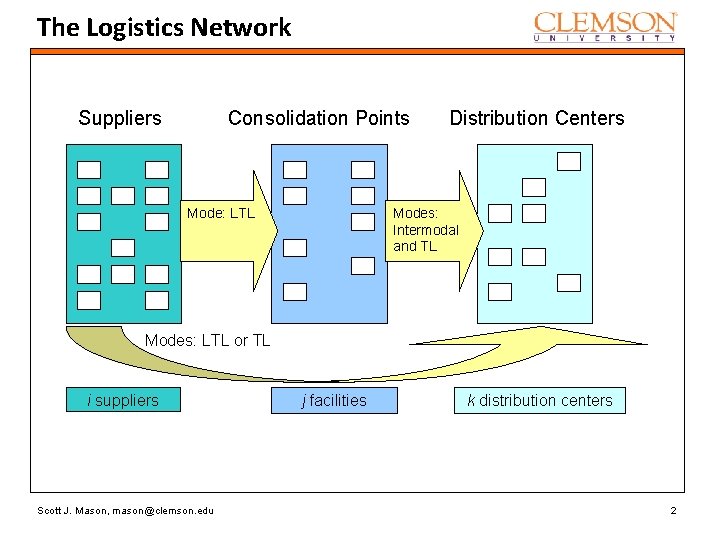
The Logistics Network Suppliers Consolidation Points Mode: LTL Distribution Centers Modes: Intermodal and TL Modes: LTL or TL i suppliers Scott J. Mason, mason@clemson. edu j facilities k distribution centers 2
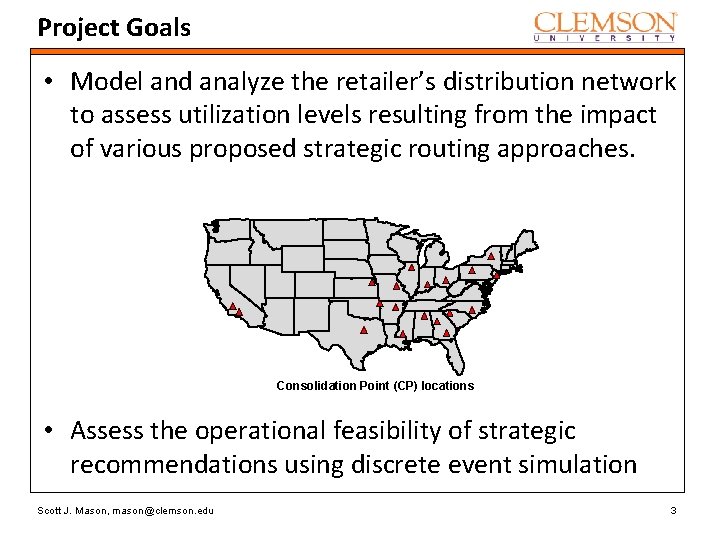
Project Goals • Model and analyze the retailer’s distribution network to assess utilization levels resulting from the impact of various proposed strategic routing approaches. Consolidation Point (CP) locations • Assess the operational feasibility of strategic recommendations using discrete event simulation Scott J. Mason, mason@clemson. edu 3
Two Phase Approach • In Phase 1, network optimization techniques used to study the CP network – Static, deterministic – Investigate strategic issues associated with long-term network configuration and growth • In Phase 2, discrete event simulation model developed to study any one CP – Dynamic, stochastic – Analyze operational feasibility of optimization model recommendations Scott J. Mason, mason@clemson. edu 4
Phase 1—Strategic Optimization Study • Develop an optimization-based approach to determine, over the next five years, which CP locations should – Be expanded – Be closed – Be opened/built • Objective is to minimize total cost of CP network transportation – Examine six month time buckets Scott J. Mason, mason@clemson. edu 5
Phase 1 Problem Formulation • Objective: Minimize Cost – Transportation costs • Truck • Intermodal (i. e. , truck and rail) • Constraints: – Meet all demand – Transportation vehicle weight and volume capacity constraints – CP capacities in terms of pounds/cube per door and number of doors current/expandable to Scott J. Mason, mason@clemson. edu 6
Data Collection—CP Information • • • Name Location Number of dock doors Capacity (lbs per dock door per week) DC serviceability Distances from suppliers Costs to ship from suppliers by modes Distance to DCs Cost of shipping to DCs by modes Scott J. Mason, mason@clemson. edu 7
Data Collection—Demand Information • For each DC, what does it demand from every supplier in terms of – Weight (pounds) – Volume (cubic feet) Scott J. Mason, mason@clemson. edu 8
Optimization Model Assumptions • Unlimited supply • Demand in pounds and cube • Infinite number of trucks and rail cars – Modes for lane shipments are fixed • Fixed transportation cost from supplier to CP – Per mile cost for distances >= 150 miles – Fixed rate for distances < 150 miles Scott J. Mason, mason@clemson. edu 9
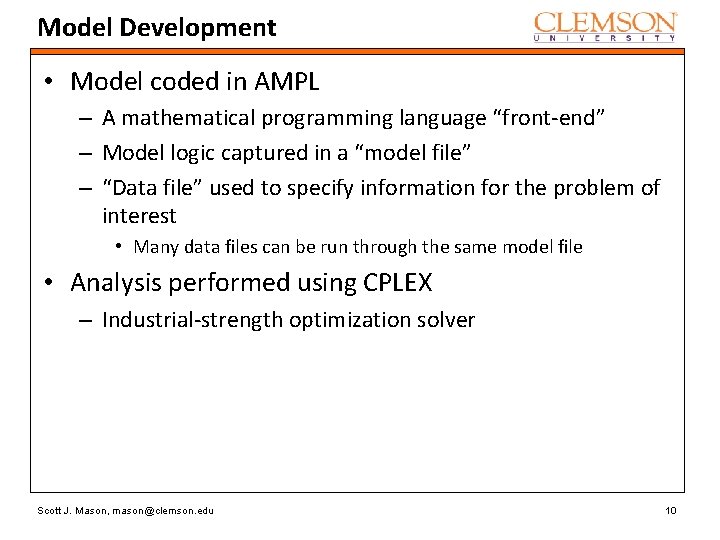
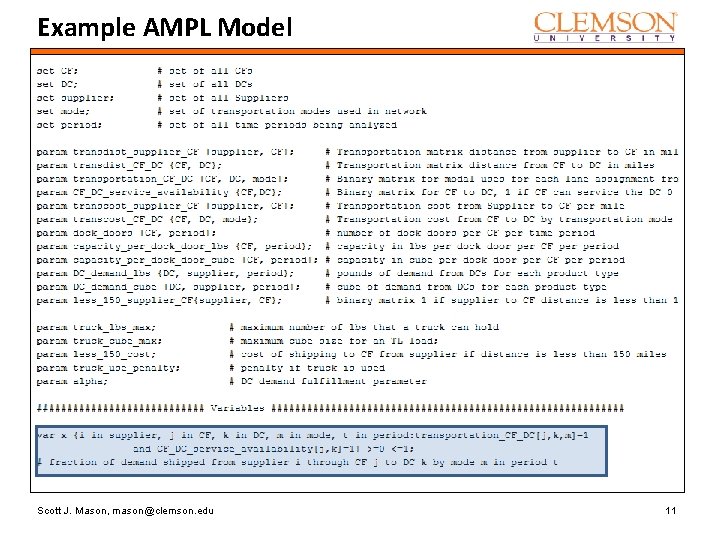
Model Development • Model coded in AMPL – A mathematical programming language “front-end” – Model logic captured in a “model file” – “Data file” used to specify information for the problem of interest • Many data files can be run through the same model file • Analysis performed using CPLEX – Industrial-strength optimization solver Scott J. Mason, mason@clemson. edu 10
Example AMPL Model Scott J. Mason, mason@clemson. edu 11
Base Model Validation • Constructed base optimization model of CP network for testing purposes – 3 CPs, 6 DCs, 10 Suppliers – All suppliers capable of shipping through all CPs to all DCs • Validated and verified base model with simple data – Compared model results with hand calculations – Produced expected results when demand, costs, and other parameters were varied Scott J. Mason, mason@clemson. edu 12
Expanding the Model • Added constraints pertaining to – Weight and volume limits on transportation • Either can restrict vehicle capacity – Calculating the number of trucks (LTL and TL) and rail cars used in the network • Expanded base optimization model to represent the retailer’s CP network – 19 CPs – 40 DCs – 2000+ suppliers Scott J. Mason, mason@clemson. edu 13
Expanding the Model, Take 2 • Even selecting the 100 highest-volume suppliers across all DCs, model solution performance was undesirable – Difference (“gap”) between optimal solution and best lower bound solution was approximately 40% after 24 hours on Pentium IV PC with 2 GB of RAM Scott J. Mason, mason@clemson. edu 14
Expanding the Model, Take 3 • Per meeting with retailer, aggregated suppliers by rolling up to 3 -digit ZIP codes – Model has 19 CPs, 40 DCs, and 412 3 -digit ZIP codes • Using the aggregated 3 -digit ZIP approach, the number of suppliers is not a concern, as there exists some finite set of 3 -digit ZIP codes – Model size should remain somewhat stable/consistent within any given time period Scott J. Mason, mason@clemson. edu 15
Improving Model Tractability • “Tightened” model formulation for improved solvability – 354 k 172 k variables (8500 are integer or binary) – 84 k 35 k constraints – Initial formulation required 24 hours to achieve 40% optimality gap – Current model reaches optimality gap of 0. 5% in 30 minutes on 2. 8 GHz Pentium IV PC with 2 GB of RAM Scott J. Mason, mason@clemson. edu 16
Promoting Model Usability • Worked with client to define a basic data file structure for time-based DC demand from various 3 digit ZIP codes – Constants file contains fixed information, such as set of CPs, set of DCs, and so on. – Input file 1 contains demand by 3 -digit supplier ZIP code for each DC (dynamic) – Input file 2 contains distances from 3 -digit supplier ZIP code to each DC (static) Scott J. Mason, mason@clemson. edu 17
Promoting Model Usability (2) • Created a C++ program to read in properly formatted data files, then automatically build the corresponding AMPL data file – Can save a considerable amount of time when performing multiple sensitivity analysis studies Scott J. Mason, mason@clemson. edu 18