
INTERMITTENCY AND SCALING OF DISLOCATION FLOW IN PLASTIC
- Slides: 49
INTERMITTENCY AND SCALING OF DISLOCATION FLOW IN PLASTIC CREEP DEFORMATION M. CARMEN MIGUEL UNIVERSITAT DE BARCELONA, SPAIN ALESSANDRO VESPIGNANI THE ABDUS SALAM ICTP, TRIESTE, ITALY STEFANO ZAPPERI UNIVERSITA LA SAPIENZA & INFM, ROME, ITALY JÉROME WEISS LGGE-CNRS, GRENOBLE, FRANCE JEAN-ROBERT GRASSO LGIT, GRENOBLE, FRANCE MICHAEL ZAISER THE UNIVERSITY OF EDINBURG, UK
OUTLINE • INTRODUCTION • DISLOCATIONS: 1. -THEIR DISCOVERY IN CRYSTALS 2. -DEFINITION 3. -BASIC FEATURES 4. -THEIR INTEREST IN STAT. MECHANICS • CREEP DEFORMATION BY GLIDE 5. -GENERAL OBSERVATIONS 6. -TIME LAWS OF CREEP 7. -ACOUSTIC EMISSION EXPERIMENTS ON ICE SINGLE CRYSTALS 8. -DYNAMIC MODEL 9. -RESULTS & DISCUSSION 10. -CONCLUSIONS & OPEN QUESTIONS
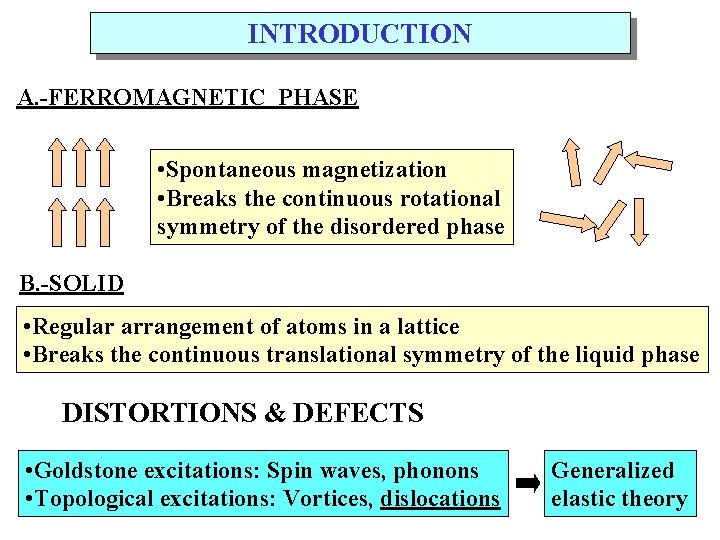
INTRODUCTION A. -FERROMAGNETIC PHASE • Spontaneous magnetization • Breaks the continuous rotational symmetry of the disordered phase B. -SOLID • Regular arrangement of atoms in a lattice • Breaks the continuous translational symmetry of the liquid phase DISTORTIONS & DEFECTS • Goldstone excitations: Spin waves, phonons • Topological excitations: Vortices, dislocations Generalized elastic theory
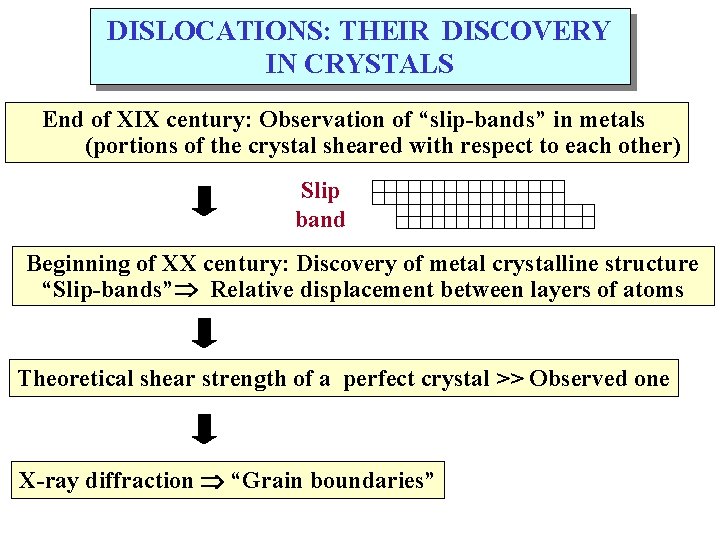
DISLOCATIONS: THEIR DISCOVERY IN CRYSTALS End of XIX century: Observation of “slip-bands” in metals (portions of the crystal sheared with respect to each other) Slip band Beginning of XX century: Discovery of metal crystalline structure “Slip-bands” Relative displacement between layers of atoms Theoretical shear strength of a perfect crystal >> Observed one X-ray diffraction “Grain boundaries”
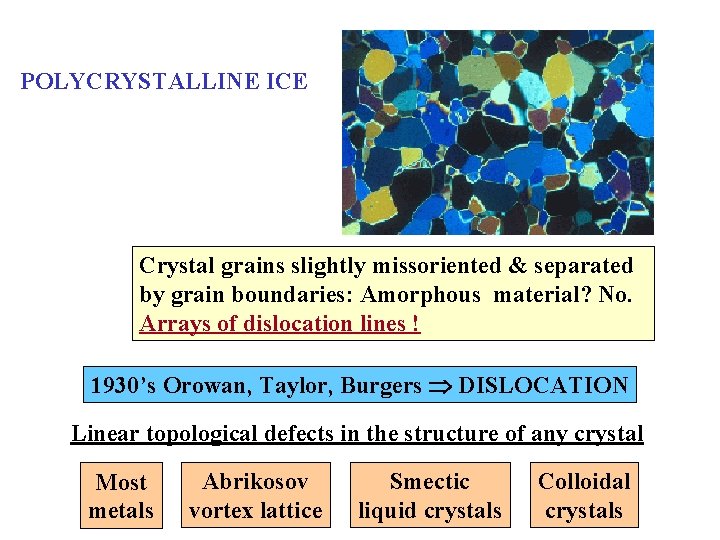
POLYCRYSTALLINE ICE Crystal grains slightly missoriented & separated by grain boundaries: Amorphous material? No. Arrays of dislocation lines ! 1930’s Orowan, Taylor, Burgers DISLOCATION Linear topological defects in the structure of any crystal Most metals Abrikosov vortex lattice Smectic liquid crystals Colloidal crystals
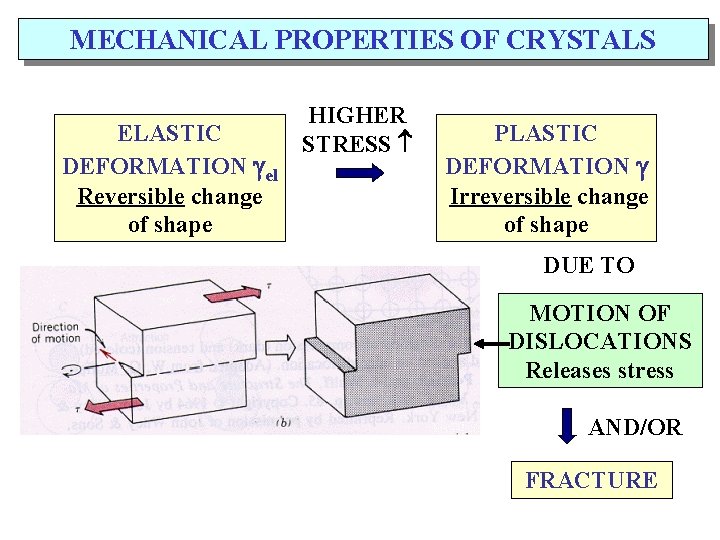
MECHANICAL PROPERTIES OF CRYSTALS ELASTIC DEFORMATION el Reversible change of shape HIGHER STRESS PLASTIC DEFORMATION Irreversible change of shape DUE TO MOTION OF DISLOCATIONS Releases stress AND/OR FRACTURE
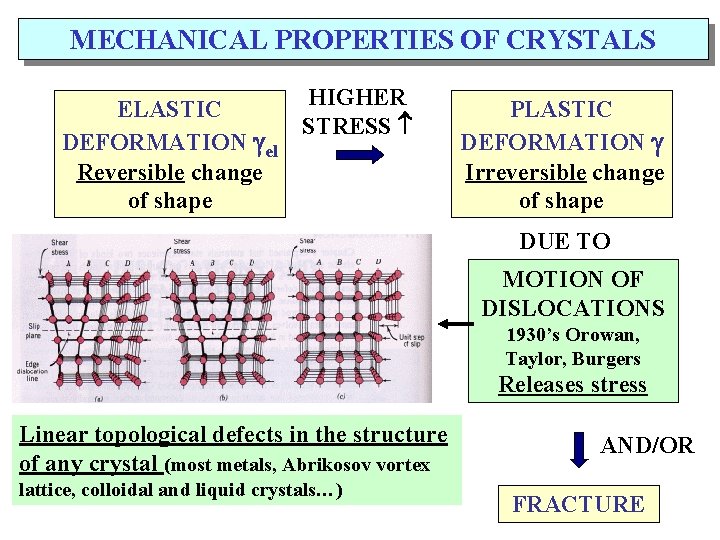
MECHANICAL PROPERTIES OF CRYSTALS ELASTIC DEFORMATION el Reversible change of shape HIGHER STRESS PLASTIC DEFORMATION Irreversible change of shape DUE TO MOTION OF DISLOCATIONS 1930’s Orowan, Taylor, Burgers Releases stress Linear topological defects in the structure of any crystal (most metals, Abrikosov vortex lattice, colloidal and liquid crystals…) AND/OR FRACTURE
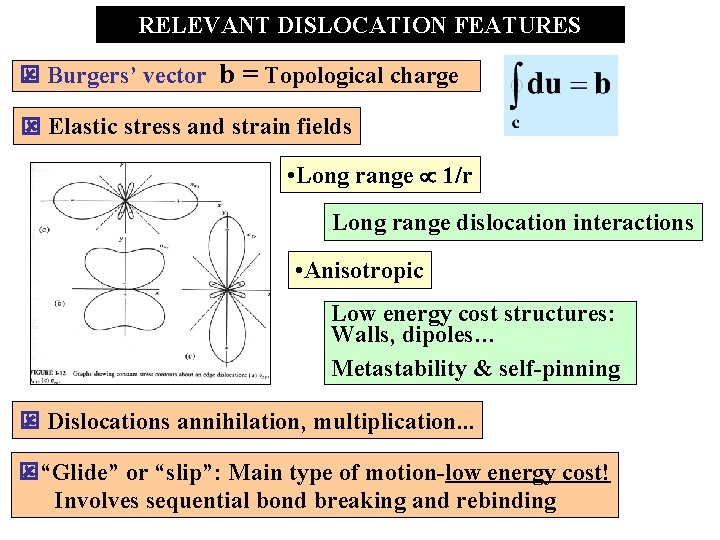
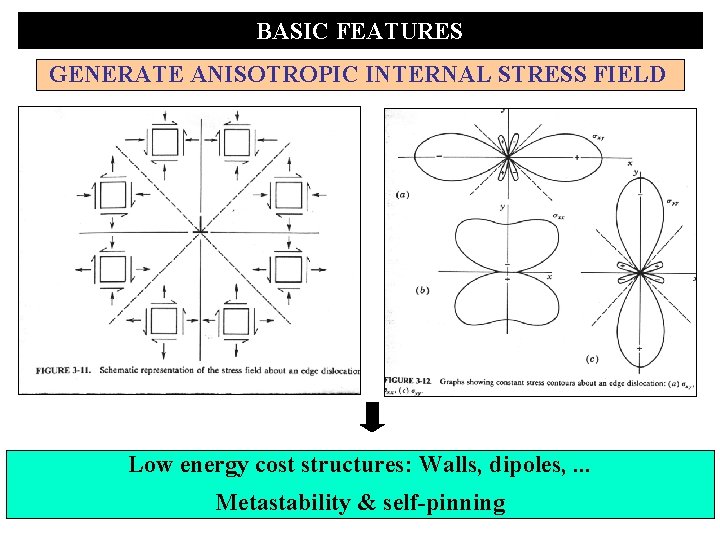
RELEVANT DISLOCATION FEATURES Burgers’ vector b = Topological charge Elastic stress and strain fields • Long range 1/r Long range dislocation interactions • Anisotropic Low energy cost structures: Walls, dipoles… Metastability & self-pinning Dislocations annihilation, multiplication. . . “Glide” or “slip”: Main type of motion-low energy cost! Involves sequential bond breaking and rebinding
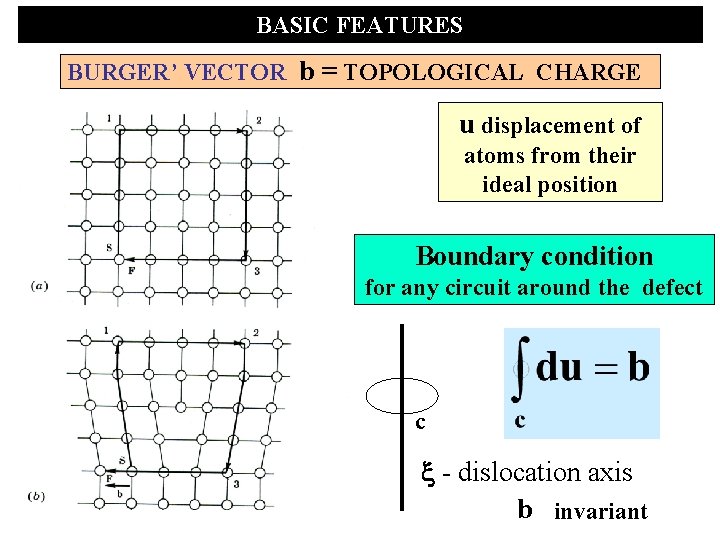
BASIC FEATURES BURGER’ VECTOR b = TOPOLOGICAL CHARGE u displacement of atoms from their ideal position Boundary condition for any circuit around the defect c - dislocation axis b invariant
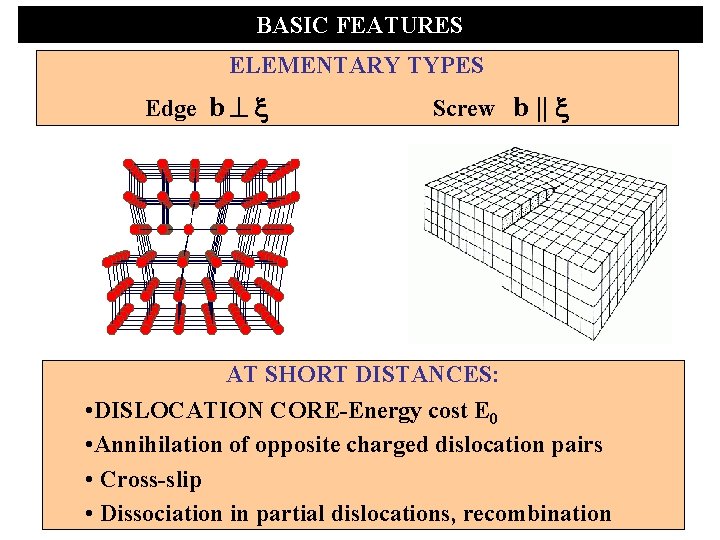
BASIC FEATURES ELEMENTARY TYPES Edge b Screw b || AT SHORT DISTANCES: • DISLOCATION CORE-Energy cost E 0 • Annihilation of opposite charged dislocation pairs • Cross-slip • Dissociation in partial dislocations, recombination
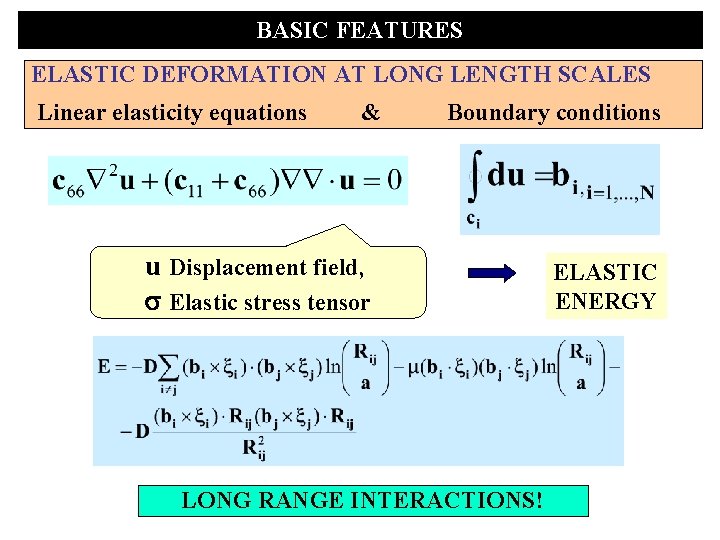
BASIC FEATURES ELASTIC DEFORMATION AT LONG LENGTH SCALES Linear elasticity equations & Boundary conditions u Displacement field, Elastic stress tensor LONG RANGE INTERACTIONS! ELASTIC ENERGY
BASIC FEATURES GENERATE ANISOTROPIC INTERNAL STRESS FIELD Low energy cost structures: Walls, dipoles, . . . Metastability & self-pinning
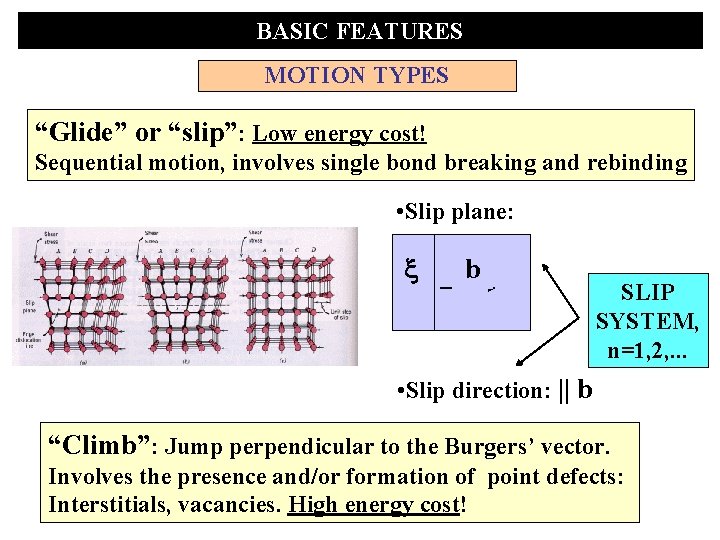
BASIC FEATURES MOTION TYPES “Glide” or “slip”: Low energy cost! Sequential motion, involves single bond breaking and rebinding • Slip plane: b SLIP SYSTEM, n=1, 2, . . . • Slip direction: || b “Climb”: Jump perpendicular to the Burgers’ vector. Involves the presence and/or formation of point defects: Interstitials, vacancies. High energy cost!
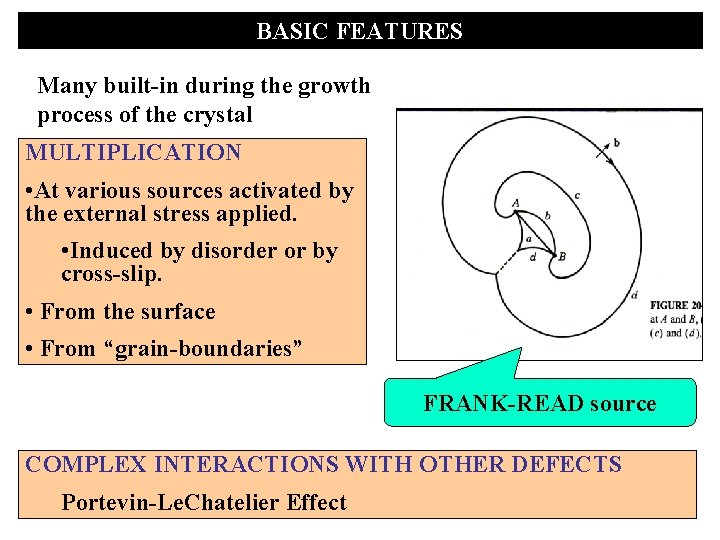
BASIC FEATURES Many built-in during the growth process of the crystal MULTIPLICATION • At various sources activated by the external stress applied. • Induced by disorder or by cross-slip. • From the surface • From “grain-boundaries” FRANK-READ source COMPLEX INTERACTIONS WITH OTHER DEFECTS Portevin-Le. Chatelier Effect
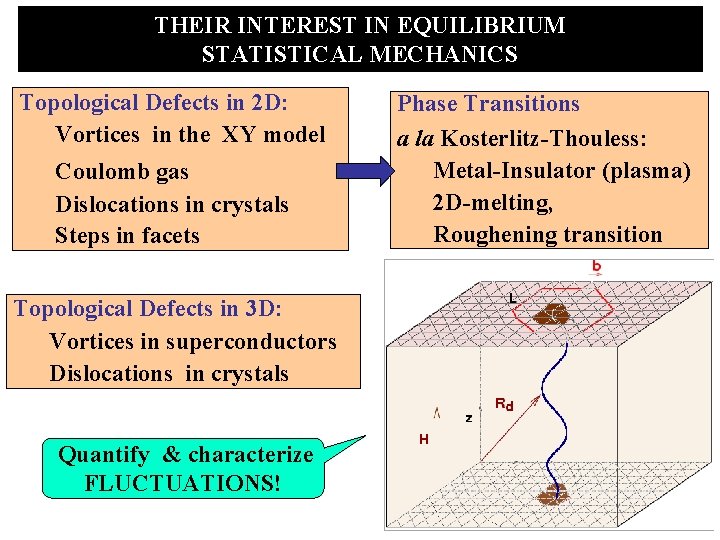
THEIR INTEREST IN EQUILIBRIUM STATISTICAL MECHANICS Topological Defects in 2 D: Vortices in the XY model Coulomb gas Dislocations in crystals Steps in facets Topological Defects in 3 D: Vortices in superconductors Dislocations in crystals Quantify & characterize FLUCTUATIONS! Phase Transitions a la Kosterlitz-Thouless: Metal-Insulator (plasma) 2 D-melting, Roughening transition
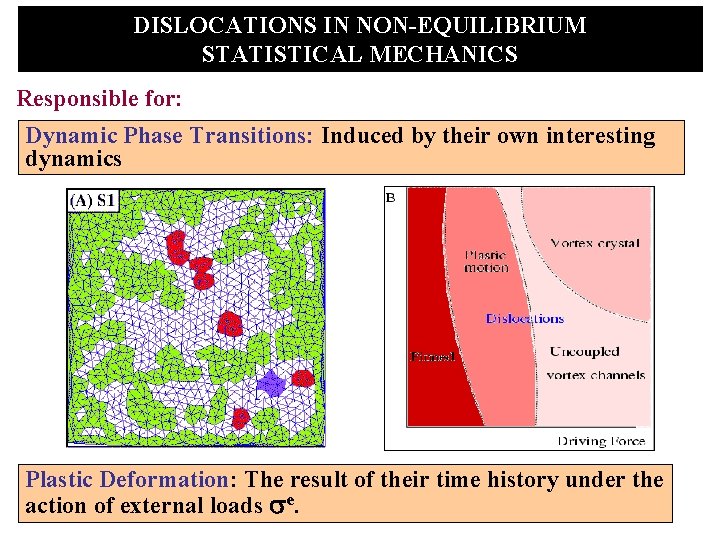
DISLOCATIONS IN NON-EQUILIBRIUM STATISTICAL MECHANICS Responsible for: Dynamic Phase Transitions: Induced by their own interesting dynamics Plastic Deformation: The result of their time history under the action of external loads e.
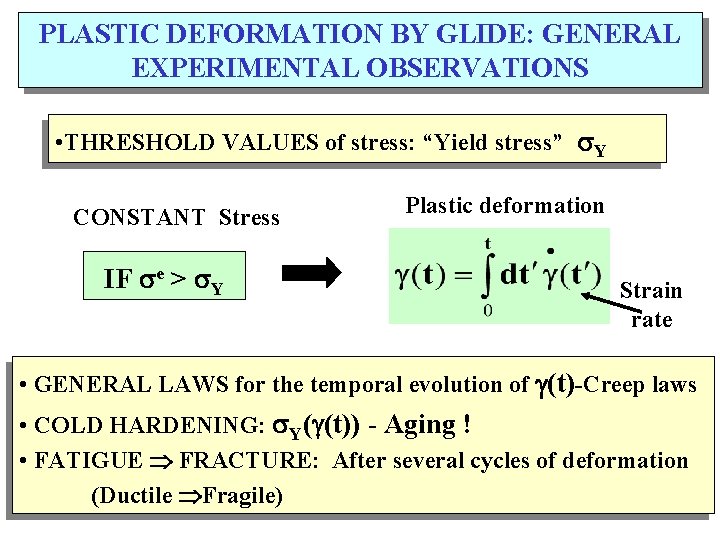
PLASTIC DEFORMATION BY GLIDE: GENERAL EXPERIMENTAL OBSERVATIONS • THRESHOLD VALUES of stress: “Yield stress” Y CONSTANT Stress IF e > Y Plastic deformation Strain rate • GENERAL LAWS for the temporal evolution of (t)-Creep laws • COLD HARDENING: Y( (t)) - Aging ! • FATIGUE FRACTURE: After several cycles of deformation (Ductile Fragile)
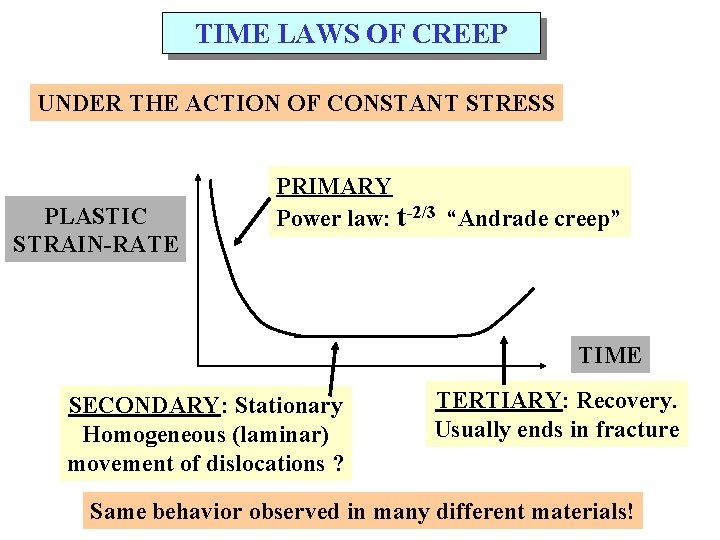
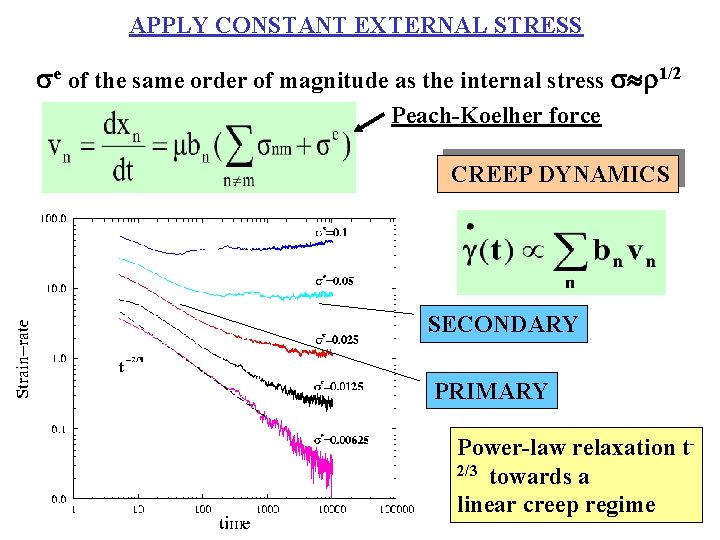
TIME LAWS OF CREEP UNDER THE ACTION OF CONSTANT STRESS PLASTIC STRAIN-RATE PRIMARY Power law: t-2/3 “Andrade creep” TIME SECONDARY: Stationary Homogeneous (laminar) movement of dislocations ? TERTIARY: Recovery. Usually ends in fracture Same behavior observed in many different materials!
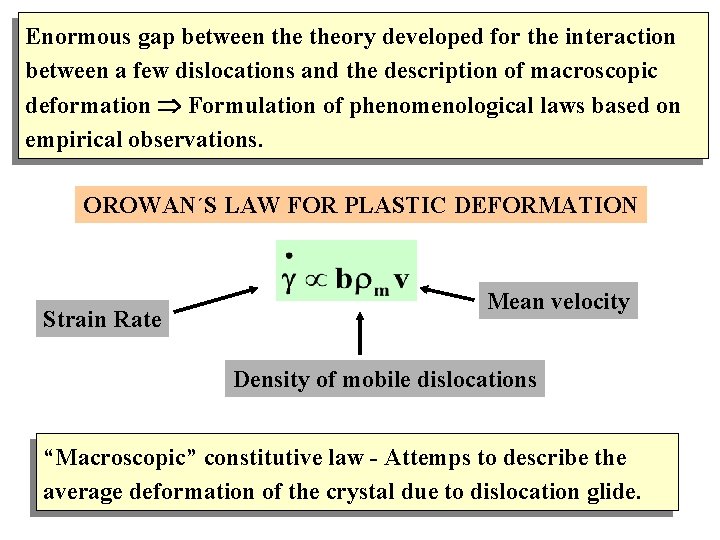
Enormous gap between theory developed for the interaction between a few dislocations and the description of macroscopic deformation Formulation of phenomenological laws based on empirical observations. OROWAN´S LAW FOR PLASTIC DEFORMATION Strain Rate Mean velocity Density of mobile dislocations “Macroscopic” constitutive law - Attemps to describe the average deformation of the crystal due to dislocation glide.
• HOW IS THE LOW-STRESS DRIVEN DYNAMICS AT THE MESOSCOPIC SCALE? (Slightly above threshold) How is the creep relaxation? Are there characteristic time scales? Does the system reach a stationary state? How is it? Does the system freeze in metastable configurations? Are there frustrated dislocations, i. e. trapped for example between dislocation clusters? • HOW DOES THE SYSTEM RESPOND TO PERTURBATIONS SUCH AS the annihilation of a pair? the addition of new dislocations?
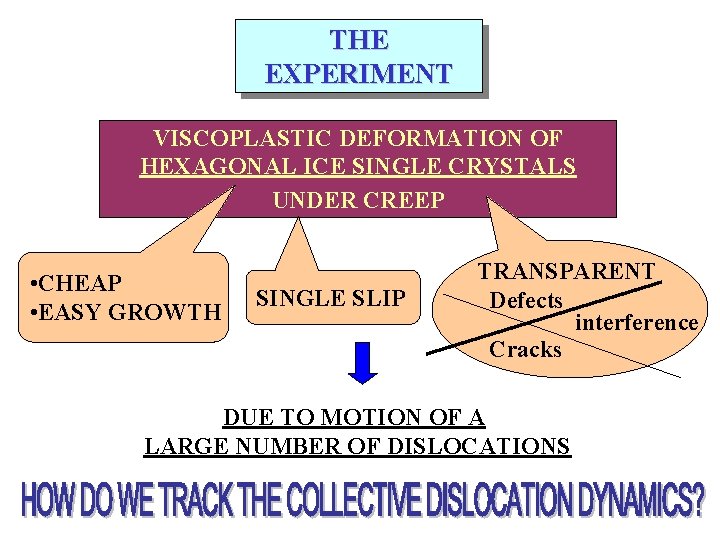
THE EXPERIMENT VISCOPLASTIC DEFORMATION OF HEXAGONAL ICE SINGLE CRYSTALS UNDER CREEP • CHEAP • EASY GROWTH SINGLE SLIP TRANSPARENT Defects interference Cracks DUE TO MOTION OF A LARGE NUMBER OF DISLOCATIONS
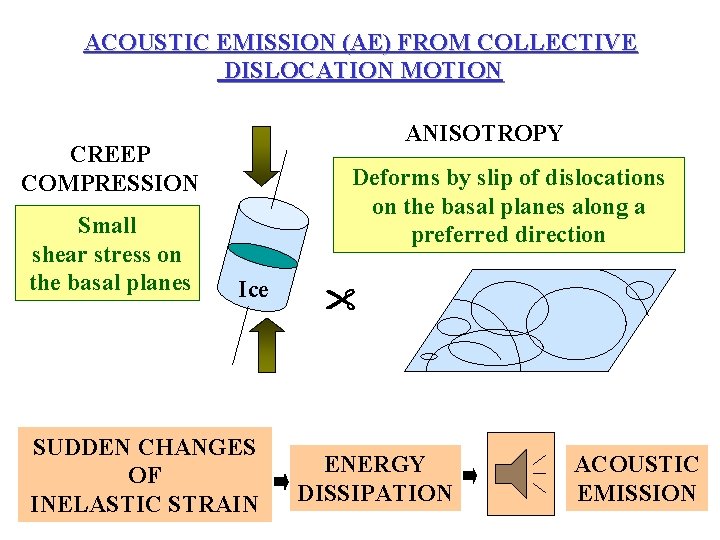
ACOUSTIC EMISSION (AE) FROM COLLECTIVE DISLOCATION MOTION ANISOTROPY CREEP COMPRESSION Ice SUDDEN CHANGES OF INELASTIC STRAIN Small shear stress on the basal planes Deforms by slip of dislocations on the basal planes along a preferred direction ENERGY DISSIPATION ACOUSTIC EMISSION
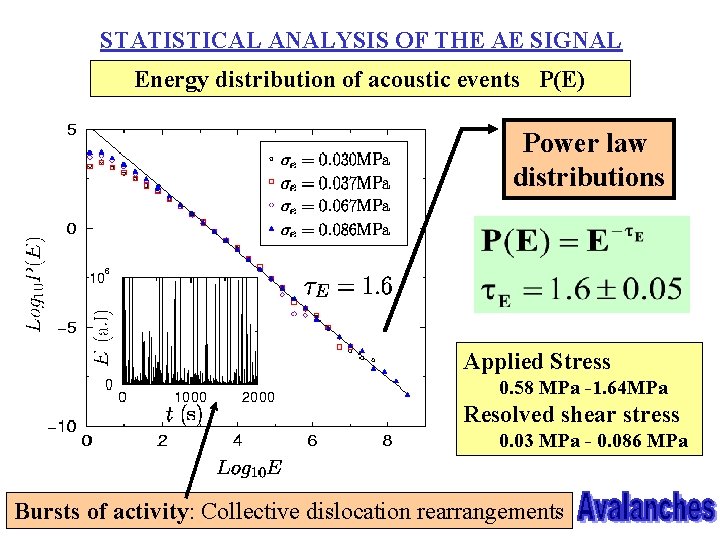
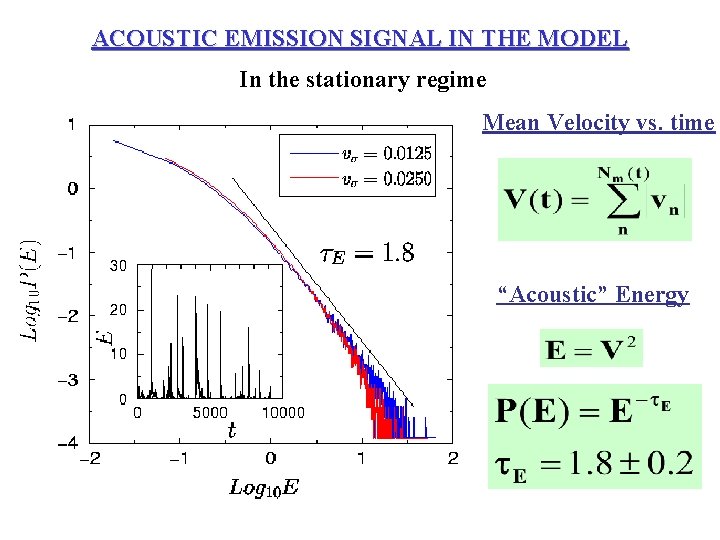
STATISTICAL ANALYSIS OF THE AE SIGNAL Energy distribution of acoustic events P(E) Power law distributions Applied Stress 0. 58 MPa -1. 64 MPa Resolved shear stress 0. 03 MPa - 0. 086 MPa Bursts of activity: Collective dislocation rearrangements
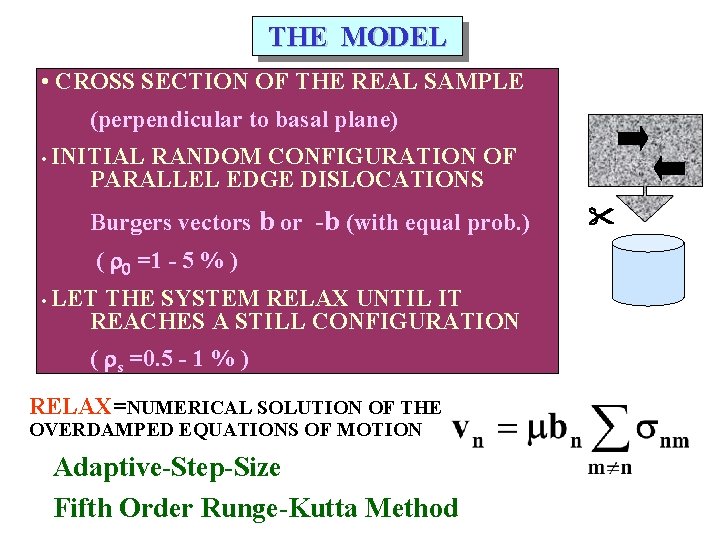
THE MODEL • CROSS SECTION OF THE REAL SAMPLE (perpendicular to basal plane) • INITIAL RANDOM CONFIGURATION OF PARALLEL EDGE DISLOCATIONS Burgers vectors b or -b (with equal prob. ) ( 0 =1 - 5 % ) • LET THE SYSTEM RELAX UNTIL IT REACHES A STILL CONFIGURATION ( s =0. 5 - 1 % ) RELAX=NUMERICAL SOLUTION OF THE OVERDAMPED EQUATIONS OF MOTION Adaptive-Step-Size Fifth Order Runge-Kutta Method
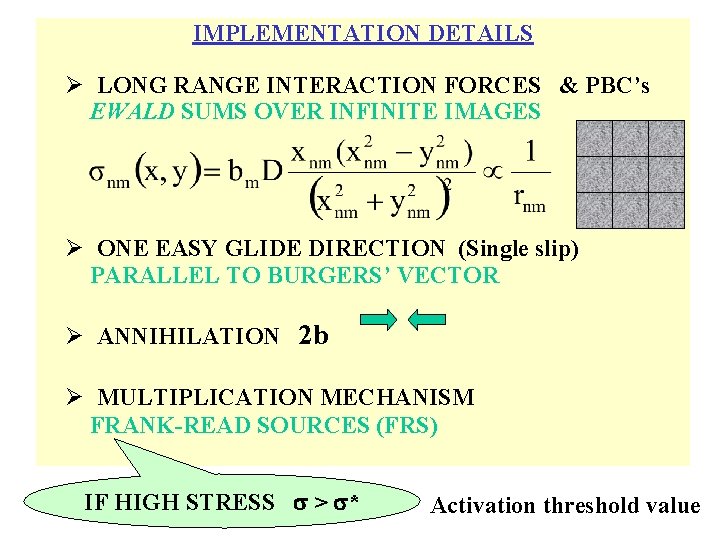
IMPLEMENTATION DETAILS Ø LONG RANGE INTERACTION FORCES & PBC’s EWALD SUMS OVER INFINITE IMAGES Ø ONE EASY GLIDE DIRECTION (Single slip) PARALLEL TO BURGERS’ VECTOR Ø ANNIHILATION 2 b Ø MULTIPLICATION MECHANISM FRANK-READ SOURCES (FRS) IF HIGH STRESS > * Activation threshold value
APPLY CONSTANT EXTERNAL STRESS e of the same order of magnitude as the internal stress 1/2 Peach-Koelher force CREEP DYNAMICS SECONDARY PRIMARY Power-law relaxation t 2/3 towards a linear creep regime
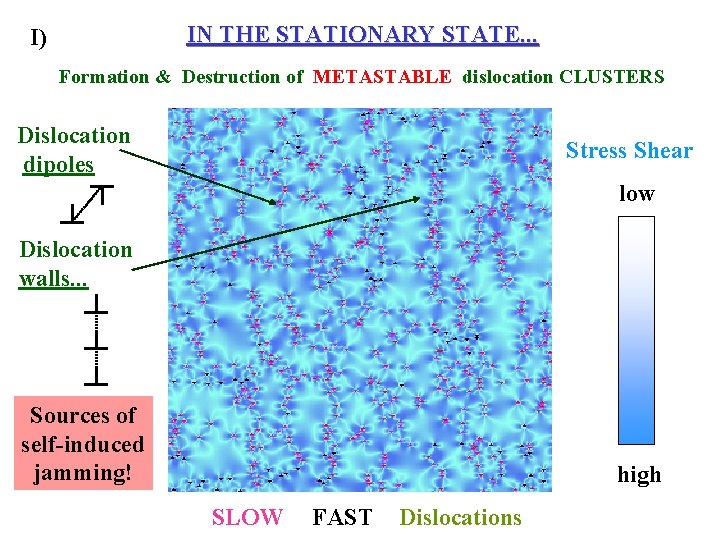
IN THE STATIONARY STATE. . . I) Formation & Destruction of METASTABLE dislocation CLUSTERS Dislocation dipoles Stress Shear low Dislocation walls. . . Sources of self-induced jamming! high SLOW FAST Dislocations
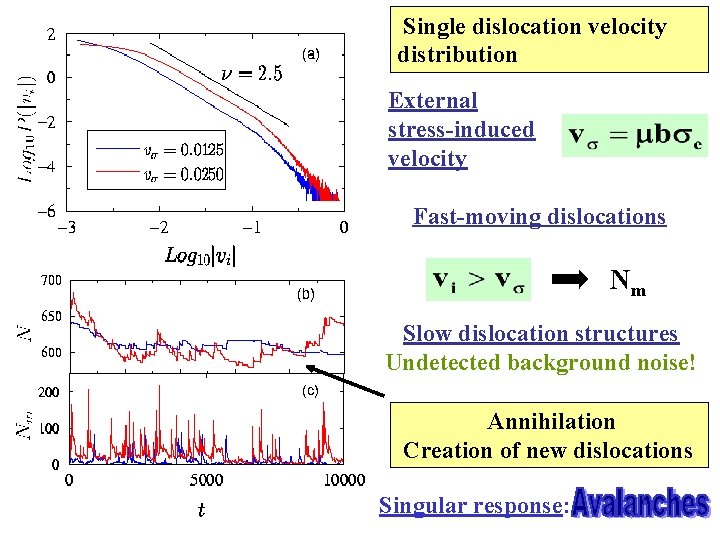
Single dislocation velocity distribution External stress-induced velocity Fast-moving dislocations Nm Slow dislocation structures Undetected background noise! Annihilation Creation of new dislocations Singular response:
ACOUSTIC EMISSION SIGNAL IN THE MODEL In the stationary regime Mean Velocity vs. time “Acoustic” Energy
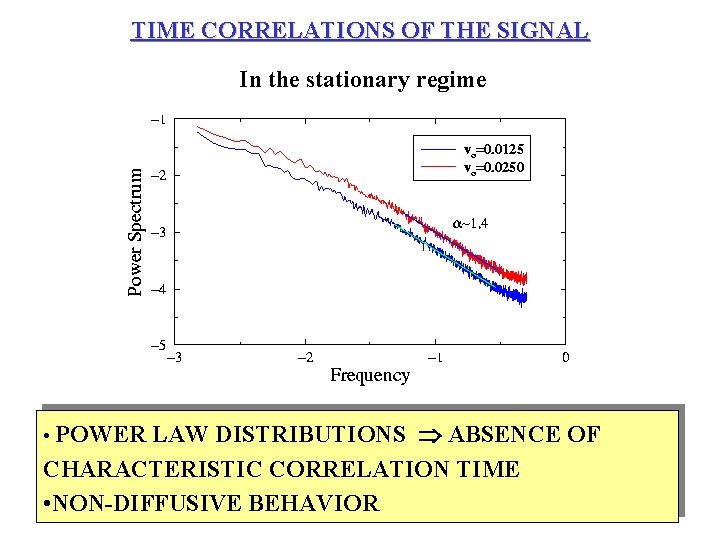
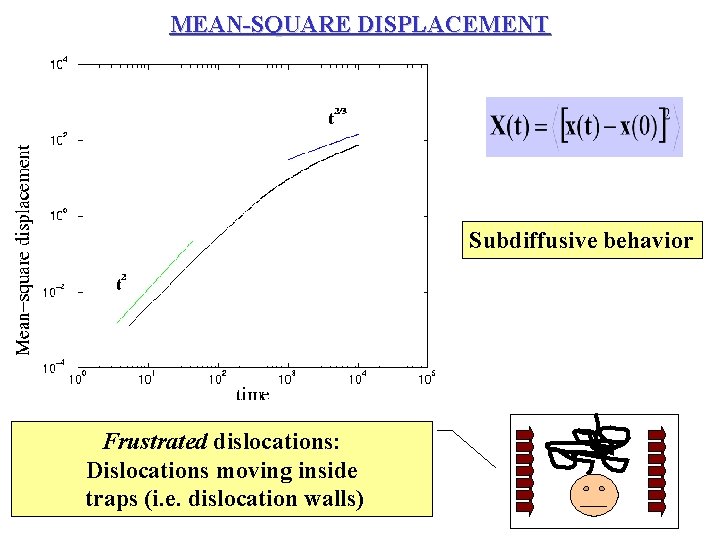
TIME CORRELATIONS OF THE SIGNAL In the stationary regime • POWER LAW DISTRIBUTIONS ABSENCE OF CHARACTERISTIC CORRELATION TIME • NON-DIFFUSIVE BEHAVIOR
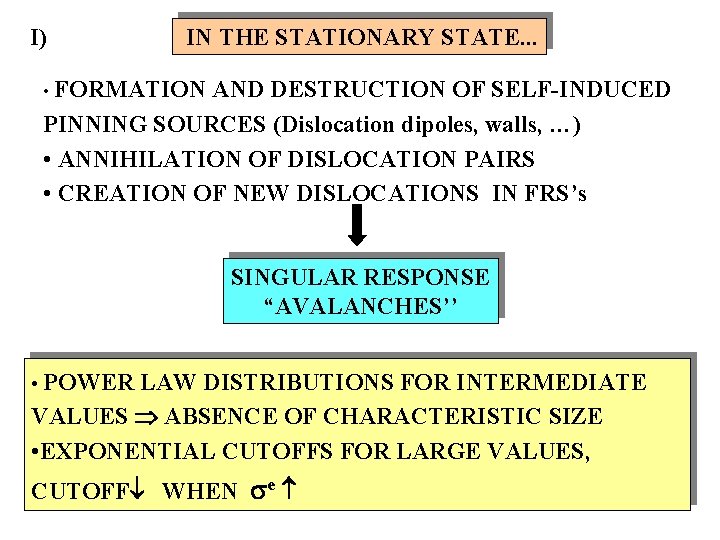
I) IN THE STATIONARY STATE. . . • FORMATION AND DESTRUCTION OF SELF-INDUCED PINNING SOURCES (Dislocation dipoles, walls, …) • ANNIHILATION OF DISLOCATION PAIRS • CREATION OF NEW DISLOCATIONS IN FRS’s SINGULAR RESPONSE “AVALANCHES’’ • POWER LAW DISTRIBUTIONS FOR INTERMEDIATE VALUES ABSENCE OF CHARACTERISTIC SIZE • EXPONENTIAL CUTOFFS FOR LARGE VALUES, CUTOFF WHEN e
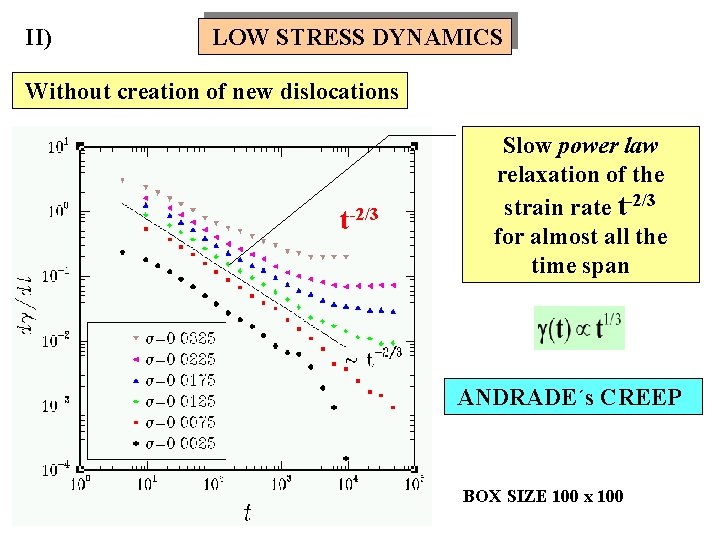
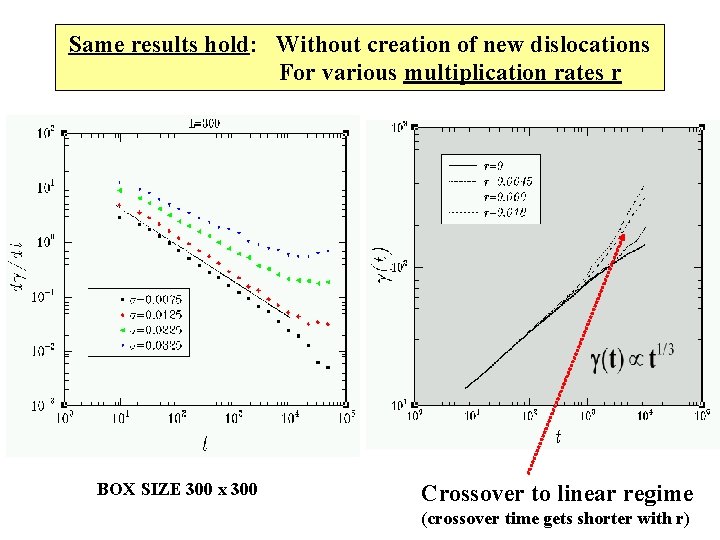
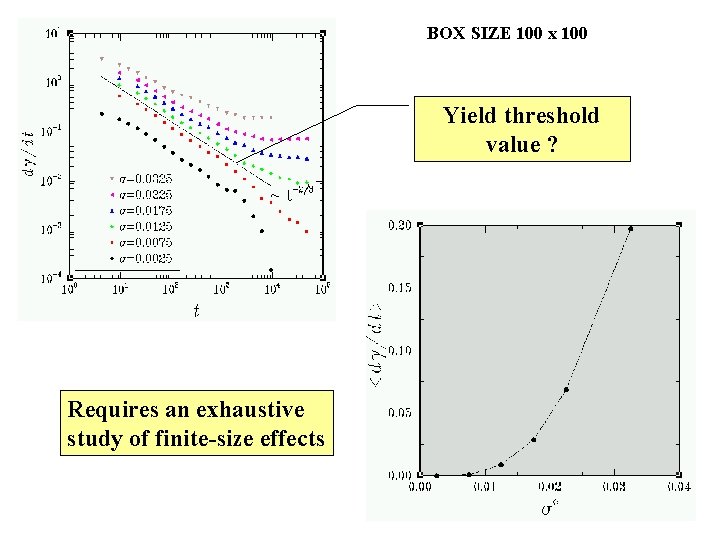
II) LOW STRESS DYNAMICS Without creation of new dislocations t-2/3 Slow power law relaxation of the strain rate t-2/3 for almost all the time span ANDRADE´s CREEP BOX SIZE 100 x 100
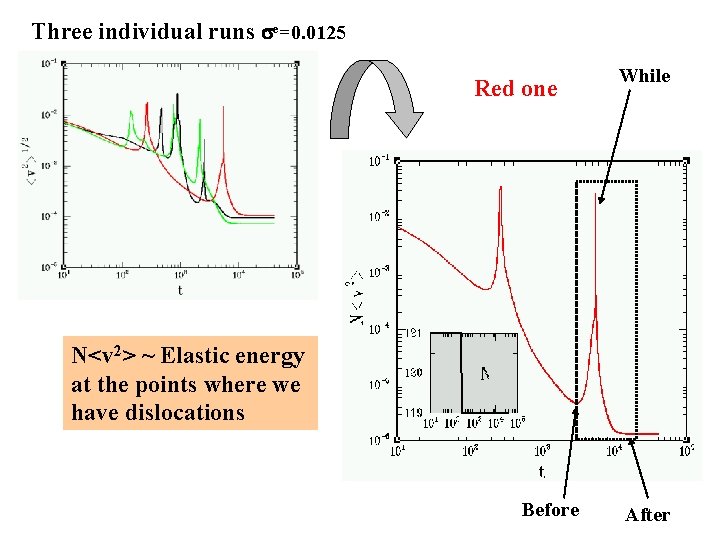
Three individual runs e=0. 0125 Red one While N<v 2> ~ Elastic energy at the points where we have dislocations Before After
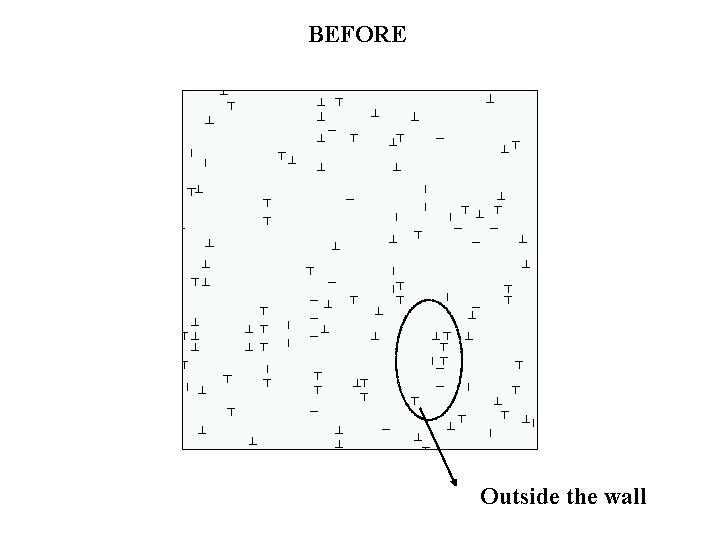
BEFORE Outside the wall
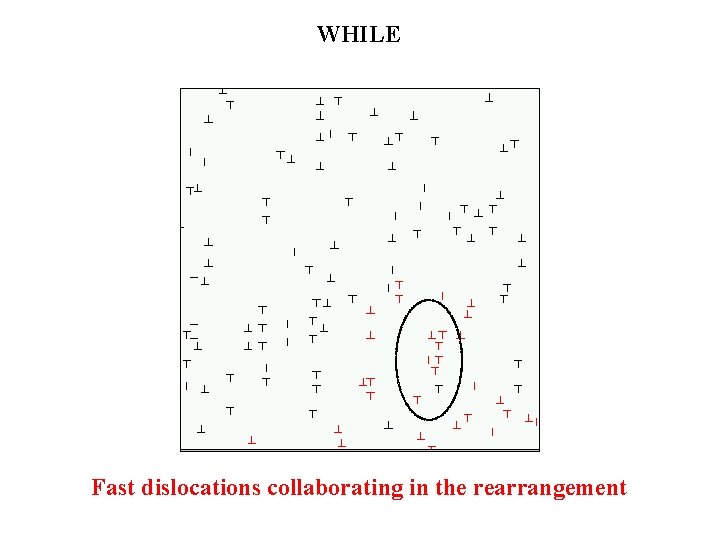
WHILE Fast dislocations collaborating in the rearrangement
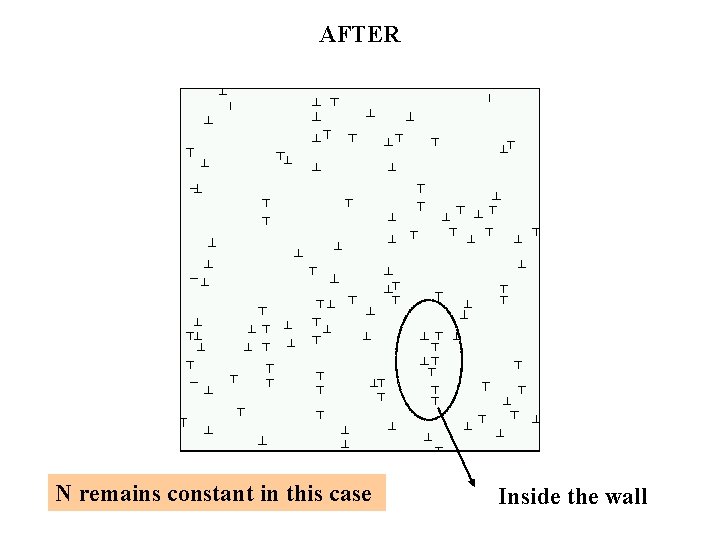
AFTER N remains constant in this case Inside the wall
Same results hold: Without creation of new dislocations For various multiplication rates r BOX SIZE 300 x 300 Crossover to linear regime (crossover time gets shorter with r)
MEAN-SQUARE DISPLACEMENT Subdiffusive behavior Frustrated dislocations: Dislocations moving inside traps (i. e. dislocation walls)
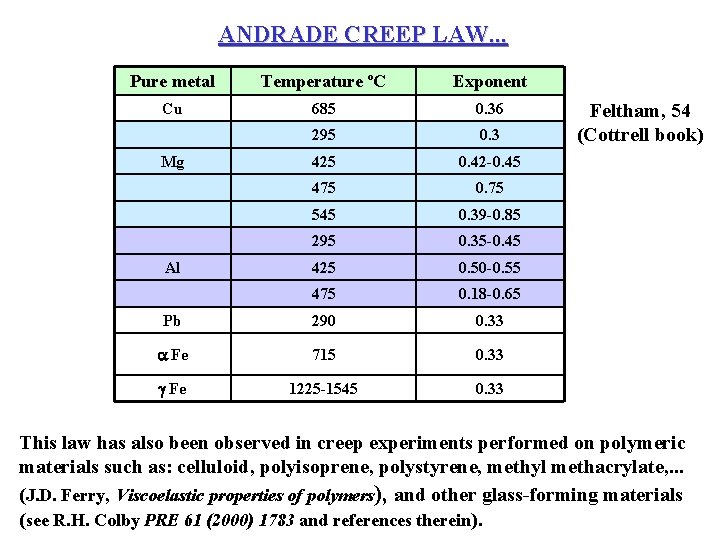
ANDRADE CREEP LAW. . . Pure metal Temperature ºC Exponent Cu 685 0. 36 295 0. 3 425 0. 42 -0. 45 475 0. 75 545 0. 39 -0. 85 295 0. 35 -0. 45 425 0. 50 -0. 55 475 0. 18 -0. 65 Pb 290 0. 33 Fe 715 0. 33 Fe 1225 -1545 0. 33 Mg Al Feltham, 54 (Cottrell book) This law has also been observed in creep experiments performed on polymeric materials such as: celluloid, polyisoprene, polystyrene, methyl methacrylate, . . . (J. D. Ferry, Viscoelastic properties of polymers), and other glass-forming materials (see R. H. Colby PRE 61 (2000) 1783 and references therein).
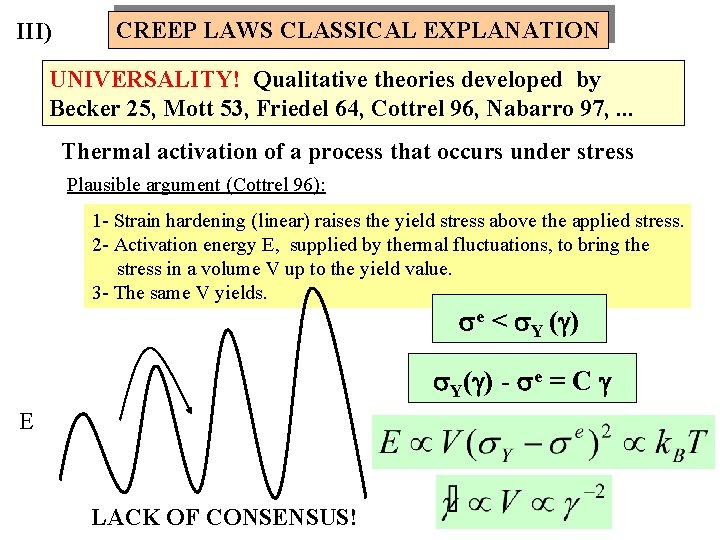
III) CREEP LAWS CLASSICAL EXPLANATION UNIVERSALITY! Qualitative theories developed by Becker 25, Mott 53, Friedel 64, Cottrel 96, Nabarro 97, . . . Thermal activation of a process that occurs under stress Plausible argument (Cottrel 96): 1 - Strain hardening (linear) raises the yield stress above the applied stress. 2 - Activation energy E, supplied by thermal fluctuations, to bring the stress in a volume V up to the yield value. 3 - The same V yields. e < Y ( ) Y( ) - e = C E LACK OF CONSENSUS!
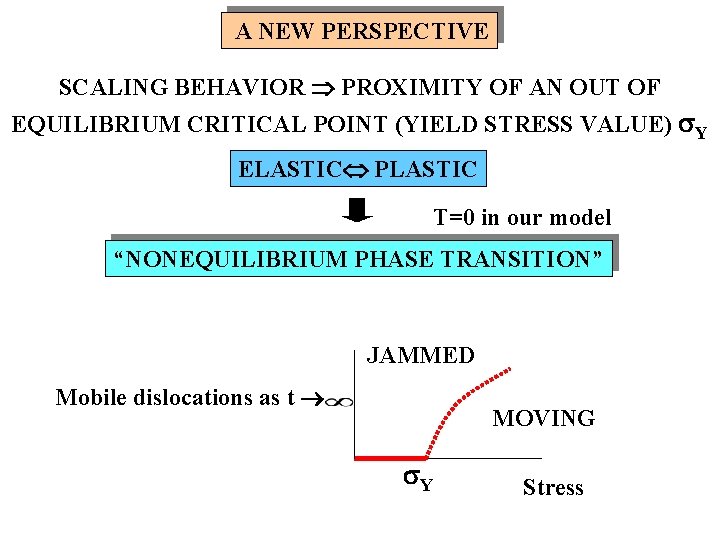
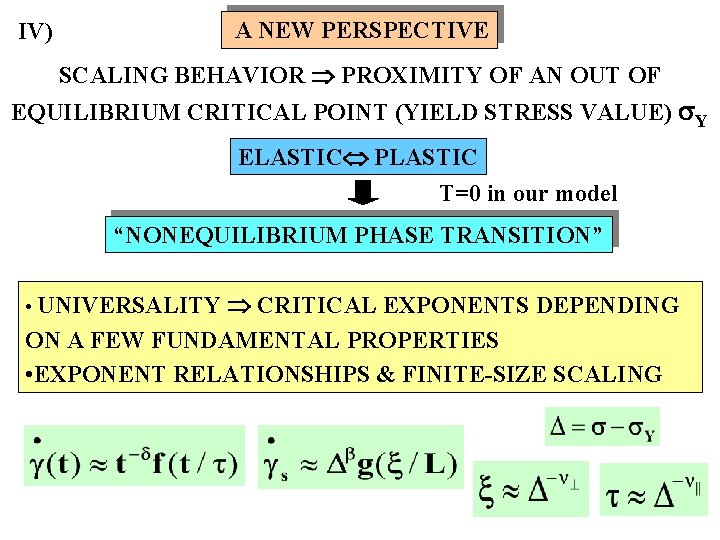
A NEW PERSPECTIVE SCALING BEHAVIOR PROXIMITY OF AN OUT OF EQUILIBRIUM CRITICAL POINT (YIELD STRESS VALUE) Y ELASTIC PLASTIC T=0 in our model “NONEQUILIBRIUM PHASE TRANSITION” JAMMED Mobile dislocations as t MOVING Y Stress
BOX SIZE 100 x 100 Yield threshold value ? Requires an exhaustive study of finite-size effects
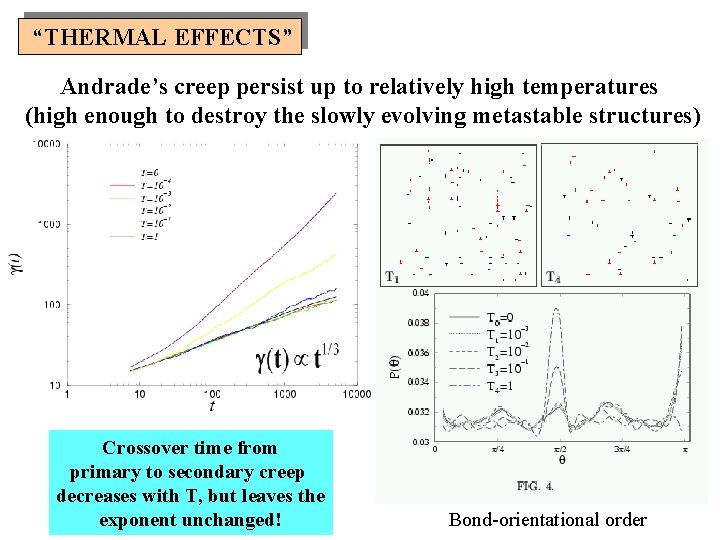
“THERMAL EFFECTS” Andrade’s creep persist up to relatively high temperatures (high enough to destroy the slowly evolving metastable structures) Crossover time from primary to secondary creep decreases with T, but leaves the exponent unchanged! Bond-orientational order
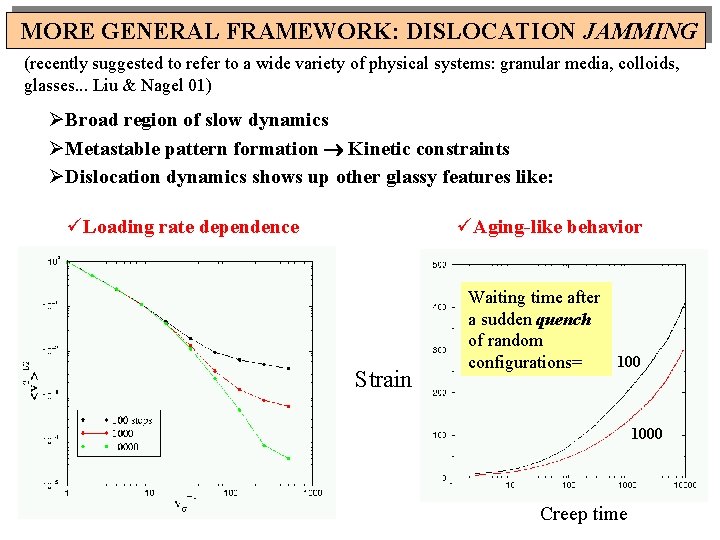
MORE GENERAL FRAMEWORK: DISLOCATION JAMMING (recently suggested to refer to a wide variety of physical systems: granular media, colloids, glasses. . . Liu & Nagel 01) ØBroad region of slow dynamics ØMetastable pattern formation Kinetic constraints ØDislocation dynamics shows up other glassy features like: üLoading rate dependence üAging-like behavior Strain Waiting time after a sudden quench of random 100 configurations= 1000 Creep time
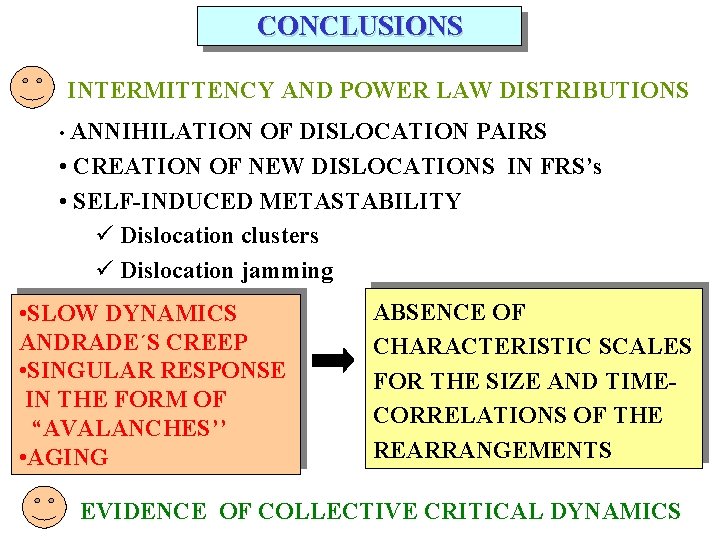
CONCLUSIONS INTERMITTENCY AND POWER LAW DISTRIBUTIONS • ANNIHILATION OF DISLOCATION PAIRS • CREATION OF NEW DISLOCATIONS IN FRS’s • SELF-INDUCED METASTABILITY ü Dislocation clusters ü Dislocation jamming • SLOW DYNAMICS ANDRADE´S CREEP • SINGULAR RESPONSE IN THE FORM OF “AVALANCHES’’ • AGING ABSENCE OF CHARACTERISTIC SCALES FOR THE SIZE AND TIMECORRELATIONS OF THE REARRANGEMENTS EVIDENCE OF COLLECTIVE CRITICAL DYNAMICS
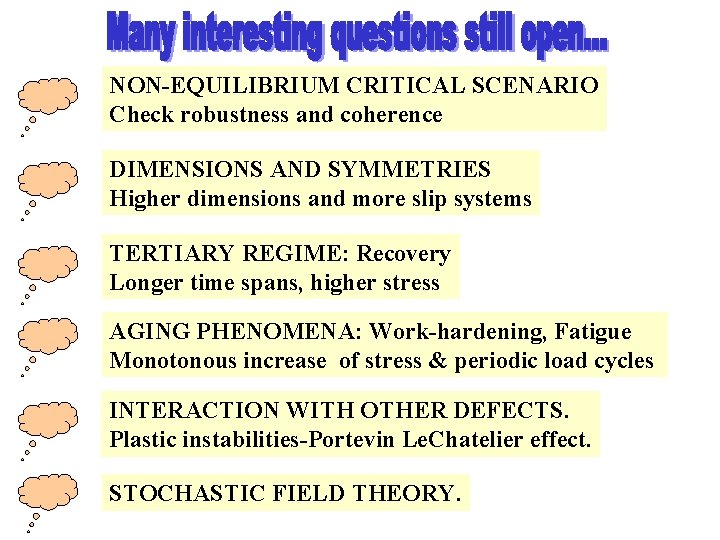
NON-EQUILIBRIUM CRITICAL SCENARIO Check robustness and coherence DIMENSIONS AND SYMMETRIES Higher dimensions and more slip systems TERTIARY REGIME: Recovery Longer time spans, higher stress AGING PHENOMENA: Work-hardening, Fatigue Monotonous increase of stress & periodic load cycles INTERACTION WITH OTHER DEFECTS. Plastic instabilities-Portevin Le. Chatelier effect. STOCHASTIC FIELD THEORY.
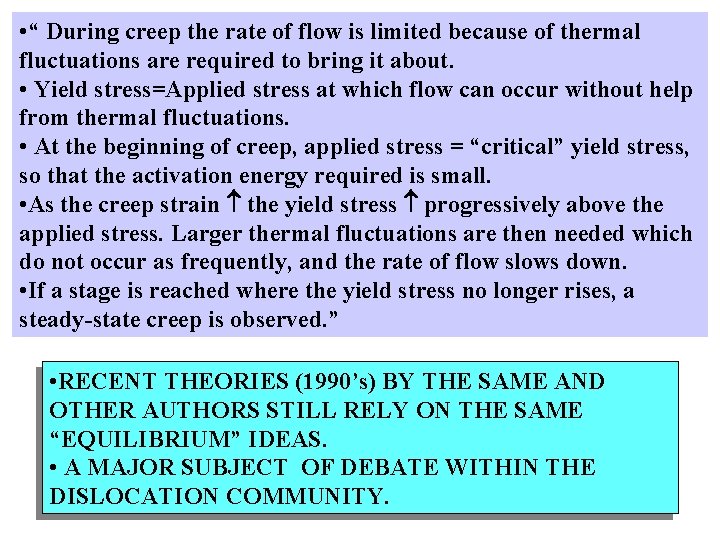
• “ During creep the rate of flow is limited because of thermal fluctuations are required to bring it about. • Yield stress=Applied stress at which flow can occur without help from thermal fluctuations. • At the beginning of creep, applied stress = “critical” yield stress, so that the activation energy required is small. • As the creep strain the yield stress progressively above the applied stress. Larger thermal fluctuations are then needed which do not occur as frequently, and the rate of flow slows down. • If a stage is reached where the yield stress no longer rises, a steady-state creep is observed. ” • RECENT THEORIES (1990’s) BY THE SAME AND OTHER AUTHORS STILL RELY ON THE SAME “EQUILIBRIUM” IDEAS. • A MAJOR SUBJECT OF DEBATE WITHIN THE DISLOCATION COMMUNITY.
IV) A NEW PERSPECTIVE SCALING BEHAVIOR PROXIMITY OF AN OUT OF EQUILIBRIUM CRITICAL POINT (YIELD STRESS VALUE) Y ELASTIC PLASTIC T=0 in our model “NONEQUILIBRIUM PHASE TRANSITION” • UNIVERSALITY CRITICAL EXPONENTS DEPENDING ON A FEW FUNDAMENTAL PROPERTIES • EXPONENT RELATIONSHIPS & FINITE-SIZE SCALING
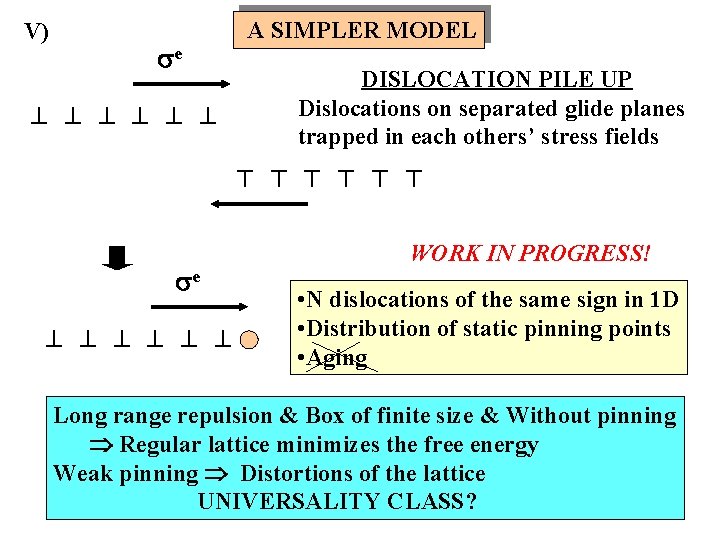
V) e A SIMPLER MODEL DISLOCATION PILE UP Dislocations on separated glide planes trapped in each others’ stress fields e WORK IN PROGRESS! • N dislocations of the same sign in 1 D • Distribution of static pinning points • Aging Long range repulsion & Box of finite size & Without pinning Regular lattice minimizes the free energy Weak pinning Distortions of the lattice UNIVERSALITY CLASS?