
Intermediate USE of FORCE TCOLE Course 2107 AND

- Slides: 52
Intermediate USE of FORCE TCOLE Course # 2107 AND BCCO PCT #4 Power. Point UNIT TWO
ADMINISTRATIVE • Please complete the BCCO PCT #4 Registration form and turn it in now. • Make sure you sign TCOLE Report of Training (PID#, Full Name and DOB). • All cell phones off please – pay attention to course materials and show common respect & courtesy.
About Your Instructor Course Facilitator - Mentor George D. Little A. S. & B. S. Criminal Justice & Sociology B. S. CJ Wayland Baptist University, San Antonio M. S. Criminology & Counter-Terrorism University of the State of New York 2012 T. C. L. E. O. S. E. Professional Achievement Award Certified Crime Prevention Specialist (C. C. P. S. ) TCLEOSE Basic Instructor Certificate 1984 TCLEOSE Master Peace Officer 1991 MP Special Operations Operator Counter-Terrorism 1988 Graduate Drug Enforcement Administration Academy 1977 43 - years Law Enforcement Experience 40 -Years Teaching & Instructor Experience
COURSE/LESSON OVERVIEW THIS LESSON IS DESIGNED TO PRESENT APPROPRIATE LEARNING OBJECTIVES, WHICH ARE REQUIRED AS MINIMUM CONTENT OF THE INTERMEDIATE PEACE OFFICERS COURSE.
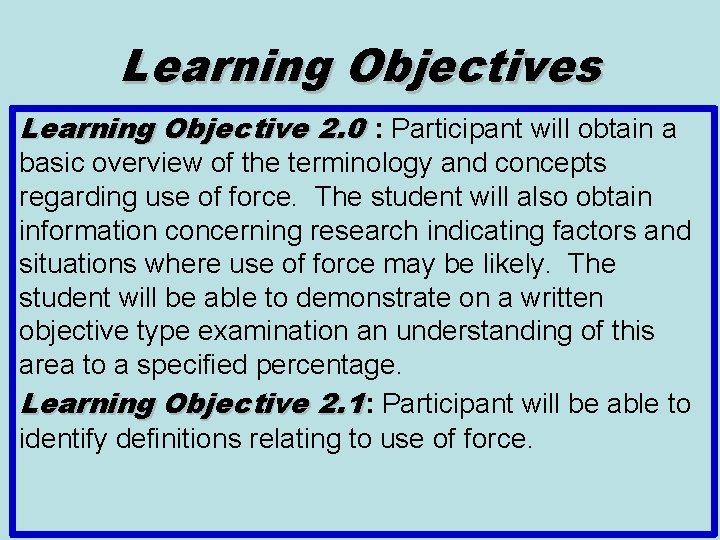
Learning Objectives Learning Objective 2. 0 : Participant will obtain a basic overview of the terminology and concepts regarding use of force. The student will also obtain information concerning research indicating factors and situations where use of force may be likely. The student will be able to demonstrate on a written objective type examination an understanding of this area to a specified percentage. Learning Objective 2. 1: Participant will be able to identify definitions relating to use of force.
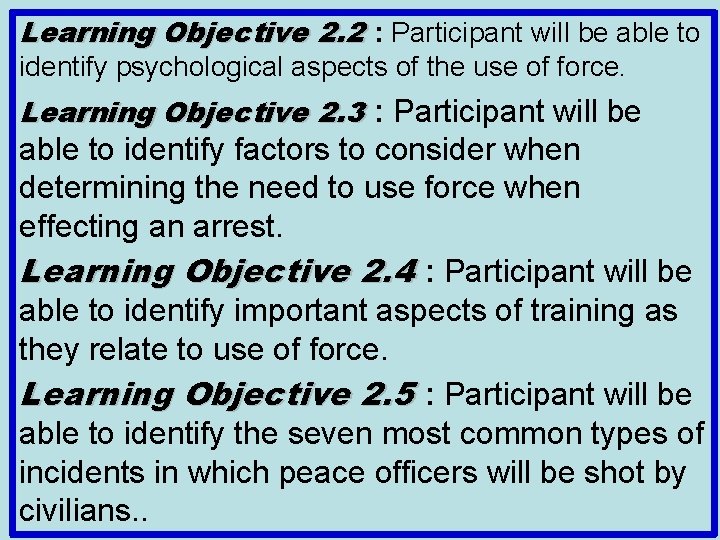
Learning Objective 2. 2 : Participant will be able to identify psychological aspects of the use of force. Learning Objective 2. 3 : Participant will be able to identify factors to consider when determining the need to use force when effecting an arrest. Learning Objective 2. 4 : Participant will be able to identify important aspects of training as they relate to use of force. Learning Objective 2. 5 : Participant will be able to identify the seven most common types of incidents in which peace officers will be shot by civilians. .
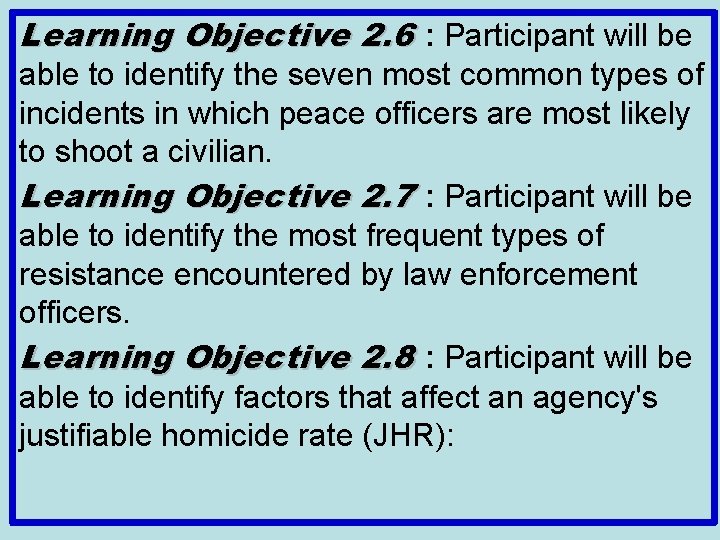
Learning Objective 2. 6 : Participant will be able to identify the seven most common types of incidents in which peace officers are most likely to shoot a civilian. Learning Objective 2. 7 : Participant will be able to identify the most frequent types of resistance encountered by law enforcement officers. Learning Objective 2. 8 : Participant will be able to identify factors that affect an agency's justifiable homicide rate (JHR):
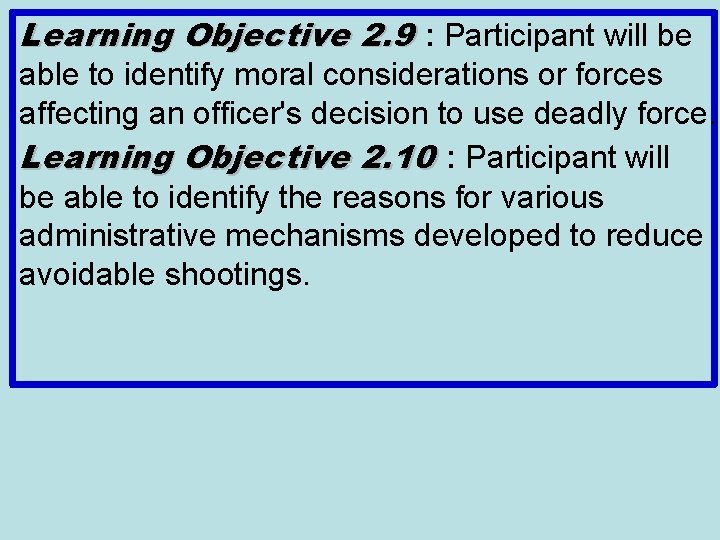
Learning Objective 2. 9 : Participant will be able to identify moral considerations or forces affecting an officer's decision to use deadly force. Learning Objective 2. 10 : Participant will be able to identify the reasons for various administrative mechanisms developed to reduce avoidable shootings.
2. 0 Intro Use of Force Participant will obtain a basic overview of the terminology and concepts regarding use of force. The participant will also obtain information concerning research indicating factors and situations where use of force may be likely.
2. 1 Definitions relating to “USE Of FORCE” A. Force - noun 1. Defined in Webster's as: as a. Strength or energy brought to Strength bear - cause of motion or change - active power; moral or mental strength; capacity to persuade or convince.
A. Force - noun 1. Defined in Webster's as: as b. Violence, compulsion, or Violence constraint exerted upon person or thing. c. The quality of conveying impressions intensely in writing or speech.
B. Force - verb 1. Defined in Webster's as: as a. To do violence to. violence b. To compel by physical, moral, or physical intellectual means. c. To make or cause through natural or logical necessity
B. Force - verb 1. Defined in Webster's as: as d. To achieve or achieve win by strength in win struggle or violence. 2. An aggressive act committed by aggressive any person which does not amount to assault, and is necessary to accomplish an objective.
B. Force - verb 3. Synonyms - compel, coerce, compel constrain, oblige. C. Deadly Force 1. Force that is intended or known by the actor to cause, or in the manner of its use or intended use is capable of causing, death or serious death bodily injury.
B. Force - verb 3. Synonyms - compel, coerce, constrain, oblige. D. Reasonable or Necessary Force Reasonable 1. The minimum amount of lawful minimum aggression sufficient to achieve a legitimate law enforcement objective.
2. 2 Psychological Aspects of the “USE Of FORCE” A. Law Enforcement Role in Arrest 1. In physical arrest, the police role is essentially defensive
A. Law Enforcement Role in Arrest 2. Webster's Dictionary defines the word defensive as "serving to protect", "devoted to resisting or protect preventing aggression or attack".
A. Law Enforcement Role in Arrest 3. It is not aggression when an aggression officer takes the initiative to confront a law violator. The officer's act is not one of hostility, it is one designed to defend and protect the community from criminality.
A. Law Enforcement Role in Arrest 4. Most of an officer's problems grow out of the use of necessary force employed against a combative but unarmed law violator.
A. Law Enforcement Role in Arrest 5. An officer needs a range of decision making tools that permits making use of exactly that degree of control which constitutes necessary force.
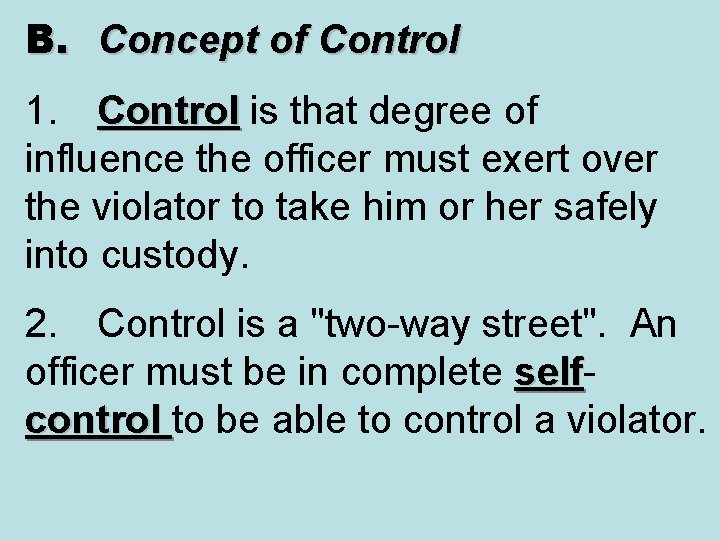
B. Concept of Control 1. Control is that degree of Control influence the officer must exert over the violator to take him or her safely into custody. 2. Control is a "two-way street". An officer must be in complete self control to be able to control a violator.
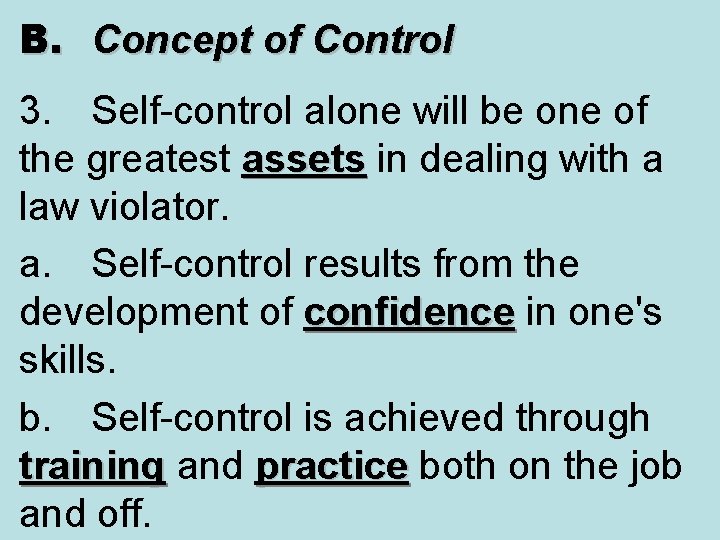
B. Concept of Control 3. Self-control alone will be one of the greatest assets in dealing with a assets law violator. a. Self-control results from the development of confidence in one's confidence skills. b. Self-control is achieved through training and practice both on the job training practice and off.
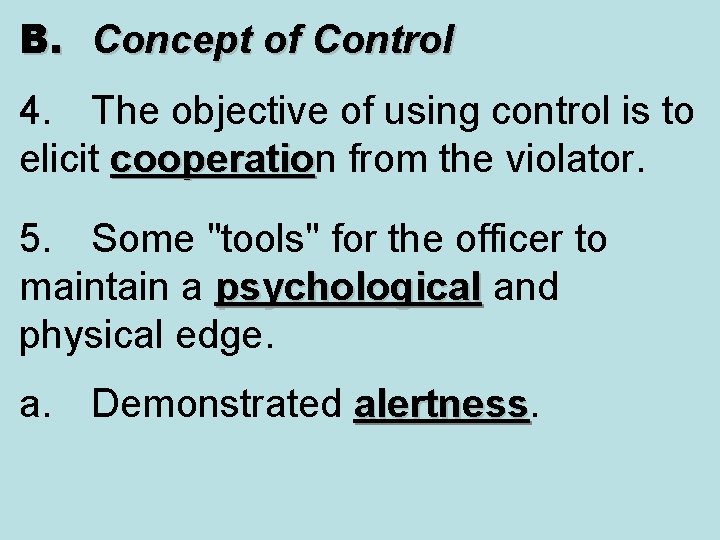
B. Concept of Control 4. The objective of using control is to elicit cooperation from the violator. cooperatio 5. Some "tools" for the officer to maintain a psychological and psychological physical edge. a. Demonstrated alertness
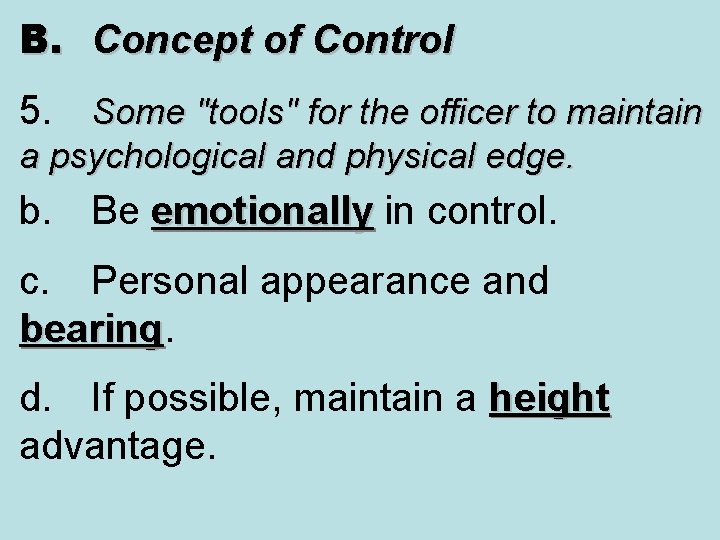
B. Concept of Control 5. Some "tools" for the officer to maintain a psychological and physical edge. b. Be emotionally in control. emotionally c. Personal appearance and bearing d. If possible, maintain a height advantage.
B. Concept of Control 5. Some "tools" for the officer to maintain a psychological and physical edge. e. Triangle interview. (Example: 2 officers and one suspect). f. Be over an arms length from suspect. g. Be prepared to step back
B. Concept of Control 5. Some "tools" for the officer to maintain a psychological and physical edge. h. Talking versus fighting. Talking C. Emotions, Attitudes, Prejudices 1. Arrest can be both an emotional and physical problem for officer and arrestee.
C. Emotions, Attitudes, Prejudices 2. Emotional response or reaction is Emotional directly involved in an encounter between an officer and a violator. 3. Attitudes or Attitudes prejudices can lead prejudices to conflict.
C. Emotions, Attitudes, Prejudices 4. An officer has the potential to reduce the problems and danger reduce associated with physical arrest if he is firm but fair with the violator.
C. Emotions, Attitudes, Prejudices 5. Emotional responses are often the direct result of uncertainty Uncertainty is likely to result in compensating behavior. compensating
C. Emotions, Attitudes, Prejudices 6. Compensating behavior may take behavior one of the following forms: a. Hesitation b. Verbal abuse c. Bluff d. Unnecessary force
C. Emotions, Attitudes, Prejudices 7. An officer must learn to control personal emotions.
2. 3 Considerations of “USE Of FORCE” during Arrest A. Use of Force 1. In every arrest situation the officer must be firm and be prepared to firm protect himself/herself and others. a. Force must be controlled and Force used wisely with a purpose.
A. Use of Force 1. In every arrest situation the officer must be firm and be prepared to protect himself/herself and others. b. Only the minimum amount of minimum force necessary to effect the arrest should be used.
A. Use of Force 2. An officer should consider the following factors when assessing the need to use force. a. Is the suspect submitting peacefully or resisting? resisting b. Is the suspect armed? armed c. What is the nature of the crime? nature
A. Use of Force 2. An officer should consider the following factors when assessing the need to use force. d. Does the suspect have a previous arrest record or history showing a arrest pattern of violence? e. What is the number of suspects number involved?
A. Use of Force 2. An officer should consider the following factors when assessing the need to use force. f. How much support from other support officers is available?
2. 4 Aspects of TRAINING related to 0 the “USE Of FORCE” A. Mental Preparation 1. An officer must prepare mentally for the use of weapons or having weapons used against him or her.
A. Mental Preparation 2. An officer must be prepared, based on training and experience, to training experience react instantly to violent acts by persons who may have little regard for the value of life.
B. Training 1. Through training and knowledge of the laws pertaining to use of force, the officer attains: a. Confidence b. Instinctive reaction c. Mental alertness. d. Control over emotions
B. Training 2. Lack of training may result in: a. Lack of confidence b. Poor marksmanship with marksmanship weapons. c. Panic and loss of control. Panic d. Civil liability
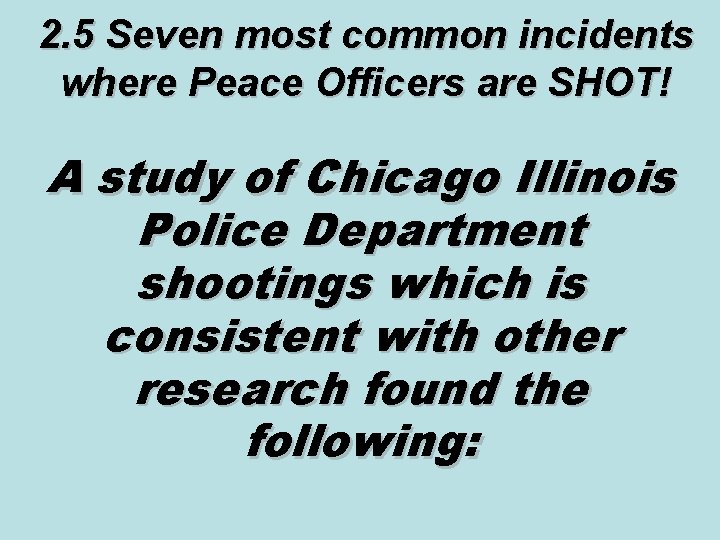
2. 5 Seven most common incidents where Peace Officers are SHOT! A study of Chicago Illinois Police Department shootings which is consistent with other research found the following:
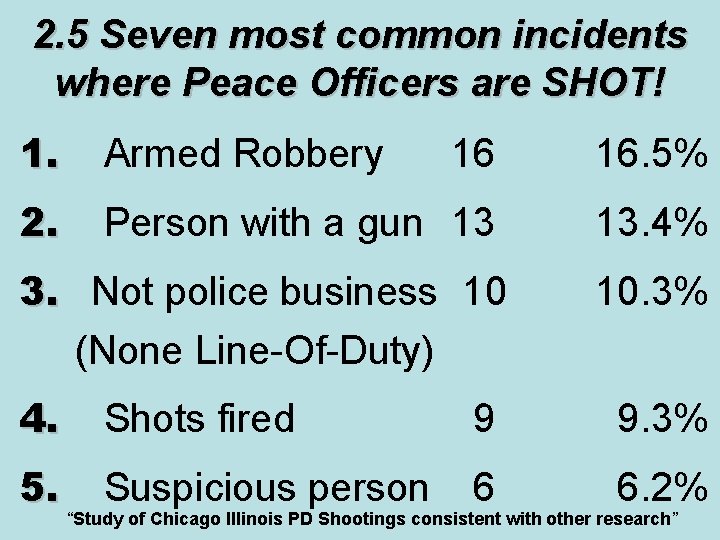
2. 5 Seven most common incidents where Peace Officers are SHOT! 1. Armed Robbery 1. 16 16. 5% 2. Person with a gun 13 13. 4% 3. Not police business 10 (None Line-Of-Duty) 10. 3% 4. Shots fired 9 9. 3% 5. Suspicious person 6 6. 2% “Study of Chicago Illinois PD Shootings consistent with other research”
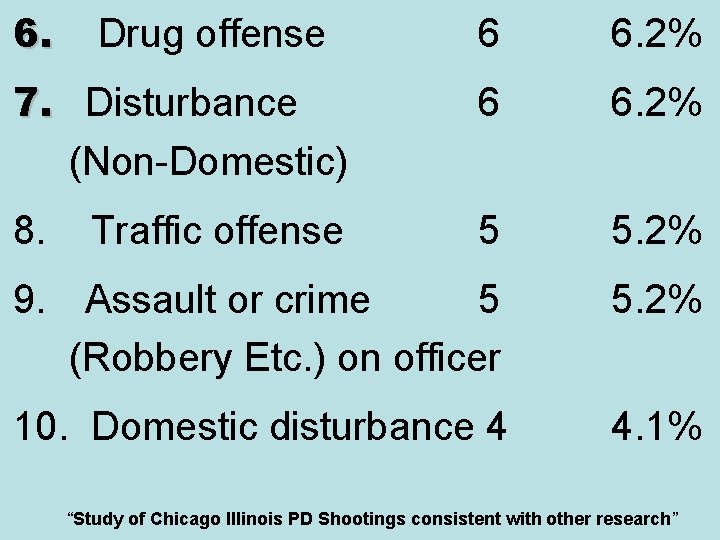
6. Drug offense 6. 6 6. 2% 7. Disturbance (Non-Domestic) 6 6. 2% 8. Traffic offense 5 5. 2% 9. Assault or crime 5 (Robbery Etc. ) on officer 5. 2% 10. Domestic disturbance 4 4. 1% “Study of Chicago Illinois PD Shootings consistent with other research”
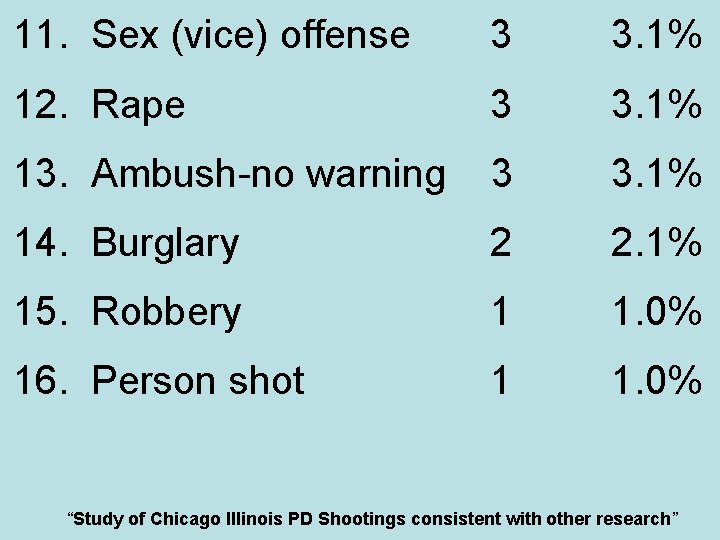
11. Sex (vice) offense 3 3. 1% 12. Rape 3 3. 1% 13. Ambush-no warning 3 3. 1% 14. Burglary 2 2. 1% 15. Robbery 1 1. 0% 16. Person shot 1 1. 0% “Study of Chicago Illinois PD Shootings consistent with other research”
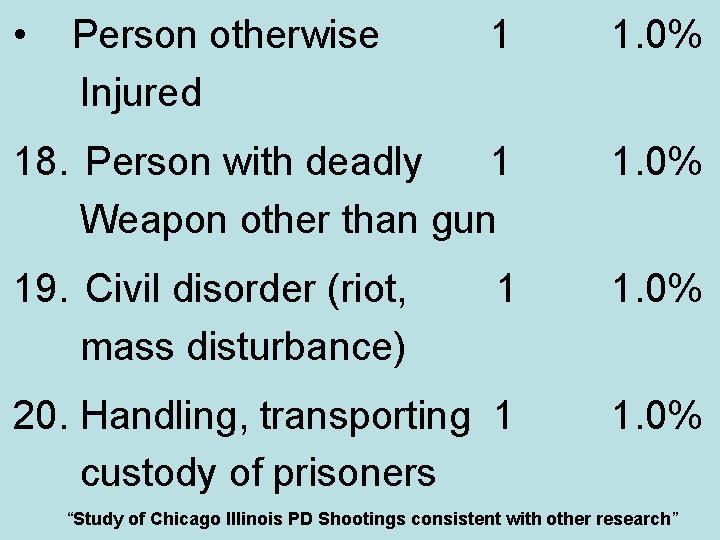
• Person otherwise Injured 1 1. 0% 18. Person with deadly 1 Weapon other than gun 1. 0% 19. Civil disorder (riot, 1 mass disturbance) 1. 0% 20. Handling, transporting 1 custody of prisoners 1. 0% “Study of Chicago Illinois PD Shootings consistent with other research”
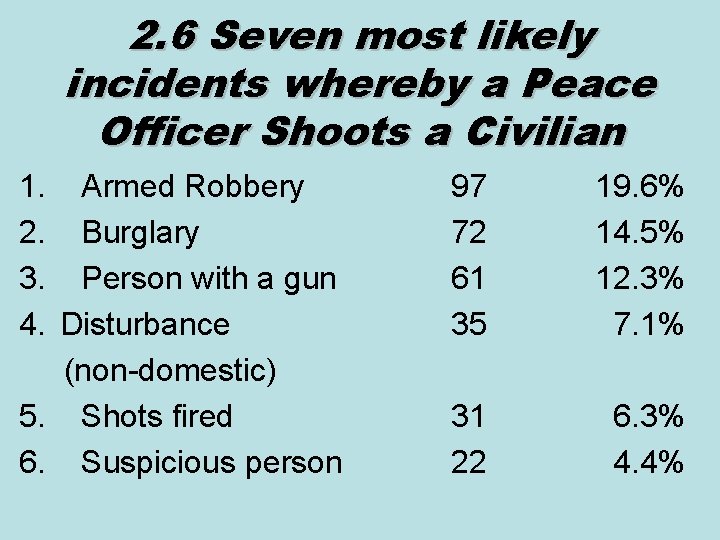
2. 6 Seven most likely incidents whereby a Peace Officer Shoots a Civilian 1. Armed Robbery 2. Burglary 3. Person with a gun 4. Disturbance (non-domestic) 5. Shots fired 6. Suspicious person 97 72 61 35 19. 6% 14. 5% 12. 3% 7. 1% 31 22 6. 3% 4. 4%
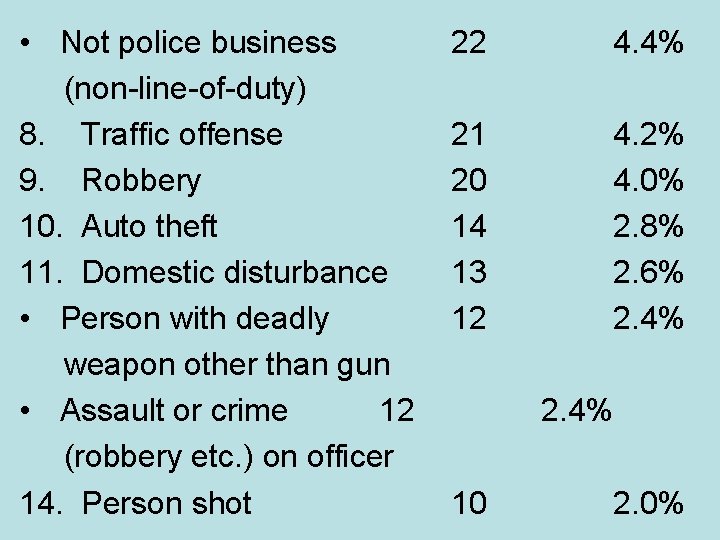
• Not police business (non-line-of-duty) 8. Traffic offense 9. Robbery 10. Auto theft 11. Domestic disturbance • Person with deadly weapon other than gun • Assault or crime 12 (robbery etc. ) on officer 14. Person shot 22 4. 4% 21 20 14 13 12 4. 2% 4. 0% 2. 8% 2. 6% 2. 4% 10 2. 0%
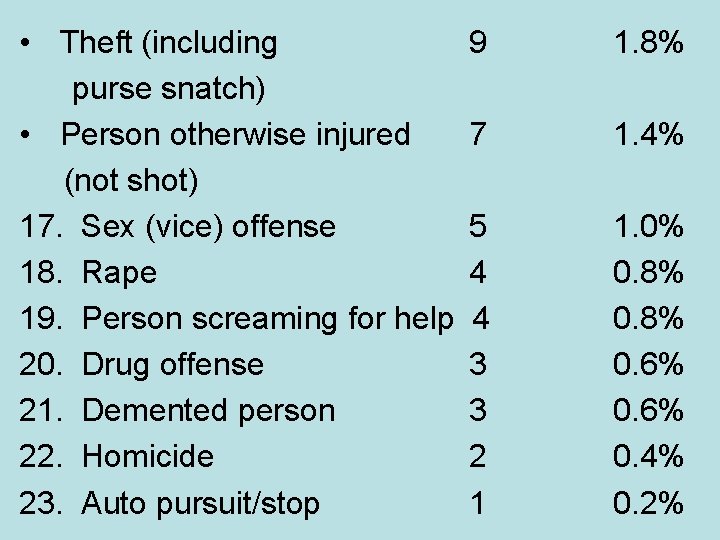
• Theft (including 9 purse snatch) • Person otherwise injured 7 (not shot) 17. Sex (vice) offense 5 18. Rape 4 19. Person screaming for help 4 20. Drug offense 3 21. Demented person 3 22. Homicide 2 23. Auto pursuit/stop 1 1. 8% 1. 4% 1. 0% 0. 8% 0. 6% 0. 4% 0. 2%
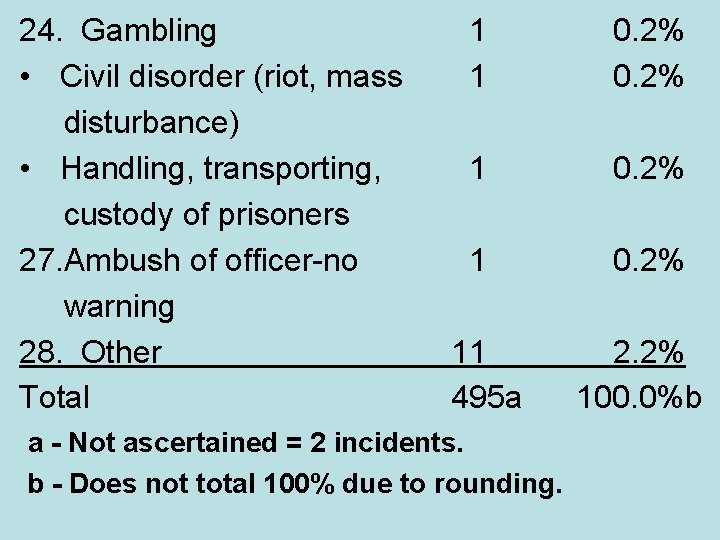
24. Gambling 1 0. 2% • Civil disorder (riot, mass 1 0. 2% disturbance) • Handling, transporting, 1 0. 2% custody of prisoners 27. Ambush of officer-no 1 0. 2% warning 28. Other 11 2. 2% Total 495 a 100. 0%b a - Not ascertained = 2 incidents. b - Does not total 100% due to rounding.
SOURCES All Course Sources and/or Resources are listed in your Participant Handout Intermediate USE OF FORCE Participant Handout TEXAS COMMISSION ON LAW ENFORCEMENT Course # 2107 TRAINING SUPPLEMENT Hosted By: Bexar County Constable Office PCT#4
Questions?
“Knowledge is “POWER” Stay informed, stay SAFE, stay Vigilant & stay Alive”