
Intermediate Microeconomics Consumer Behavior Theory and Applications Income
Intermediate Microeconomics Consumer Behavior Theory and Applications Income and Substitution Effects Hicks vs. Marshall BP – Chapter 4
Overview • Traditional Consumer Behavior Analysis n Where does demand come from? n Explain the empirical record n Things aren’t always as they seem
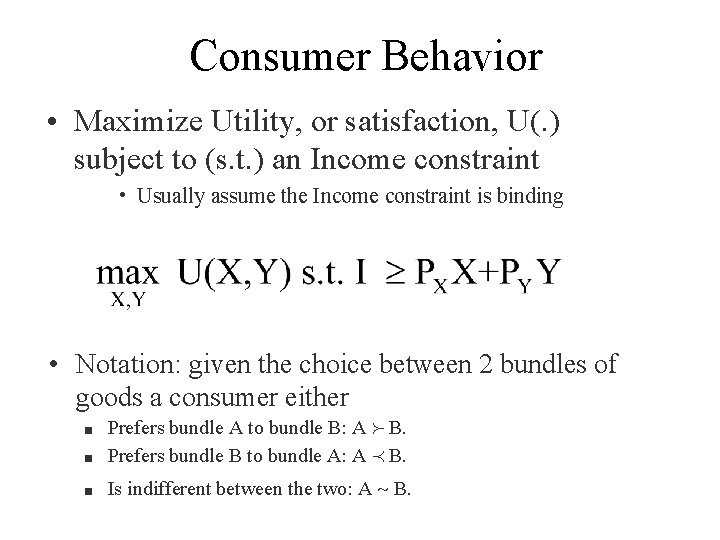
Consumer Behavior • Maximize Utility, or satisfaction, U(. ) subject to (s. t. ) an Income constraint • Usually assume the Income constraint is binding • Notation: given the choice between 2 bundles of goods a consumer either n Prefers bundle A to bundle B: A B. Prefers bundle B to bundle A: A B. n Is indifferent between the two: A B. n
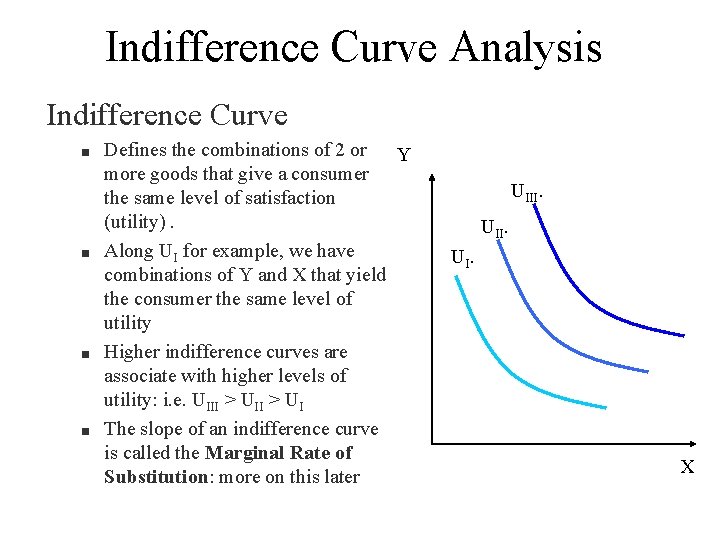
Indifference Curve Analysis Indifference Curve n n Defines the combinations of 2 or Y more goods that give a consumer the same level of satisfaction (utility). Along UI for example, we have combinations of Y and X that yield the consumer the same level of utility Higher indifference curves are associate with higher levels of utility: i. e. UIII > UI The slope of an indifference curve is called the Marginal Rate of Substitution: more on this later UIII. UI. X
Consumer Preference Ordering Properties • • Completeness More is Better Transitivity Diminishing Marginal Rate of Substitution
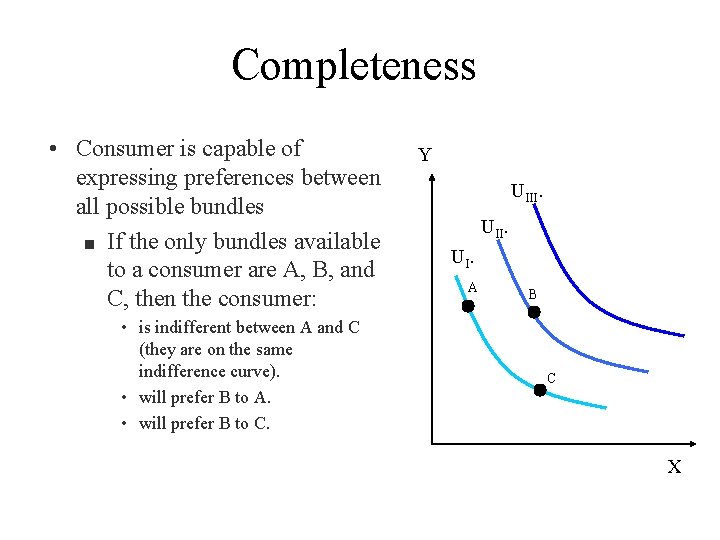
Completeness • Consumer is capable of expressing preferences between all possible bundles n If the only bundles available to a consumer are A, B, and C, then the consumer: • is indifferent between A and C (they are on the same indifference curve). • will prefer B to A. • will prefer B to C. Y UIII. UI. A B C X
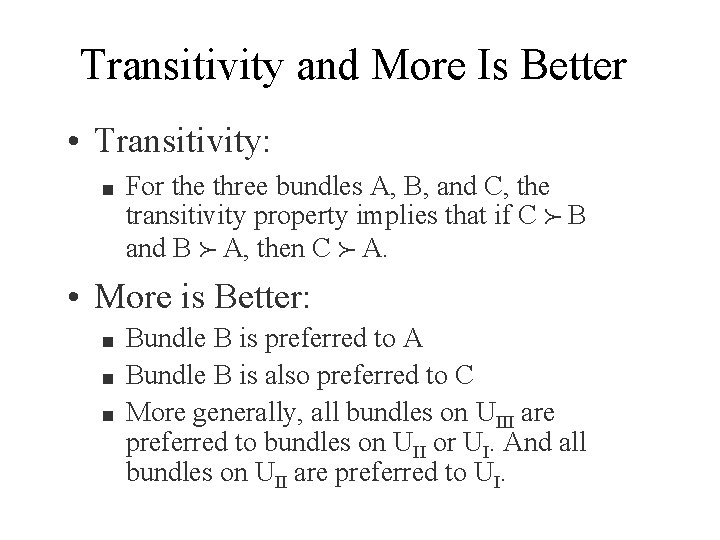
Transitivity and More Is Better • Transitivity: n For the three bundles A, B, and C, the transitivity property implies that if C B and B A, then C A. • More is Better: n n n Bundle B is preferred to A Bundle B is also preferred to C More generally, all bundles on UIII are preferred to bundles on UII or UI. And all bundles on UII are preferred to UI.
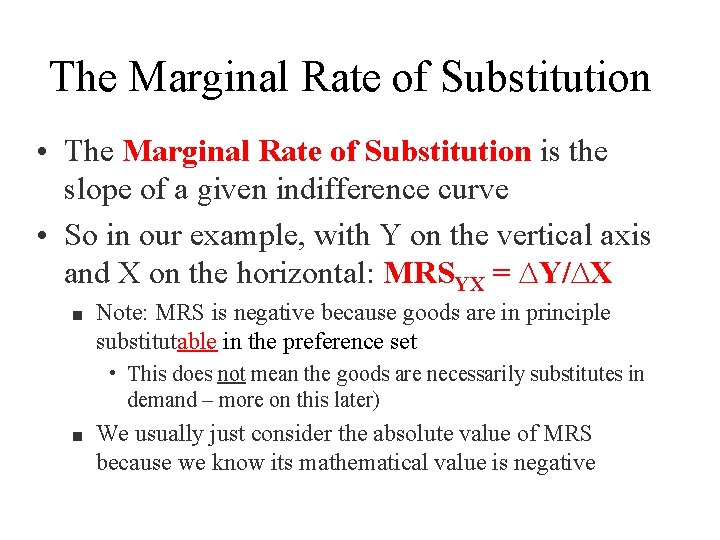
The Marginal Rate of Substitution • The Marginal Rate of Substitution is the slope of a given indifference curve • So in our example, with Y on the vertical axis and X on the horizontal: MRSYX = ∆Y/∆X n Note: MRS is negative because goods are in principle substitutable in the preference set • This does not mean the goods are necessarily substitutes in demand – more on this later) n We usually just consider the absolute value of MRS because we know its mathematical value is negative
The Marginal Rate of Substitution, cont. • It can also be shown that the MRS is directly related to the marginal products of goods Y and X. That is: • MRSYX = ∆Y/∆X = MUX/MUY • With Y on the vertical access and X on the horizontal, we read this as “the marginal rate of substitution of Y for X” n i. e. how much of Y are you willing to give up for one more unit of X
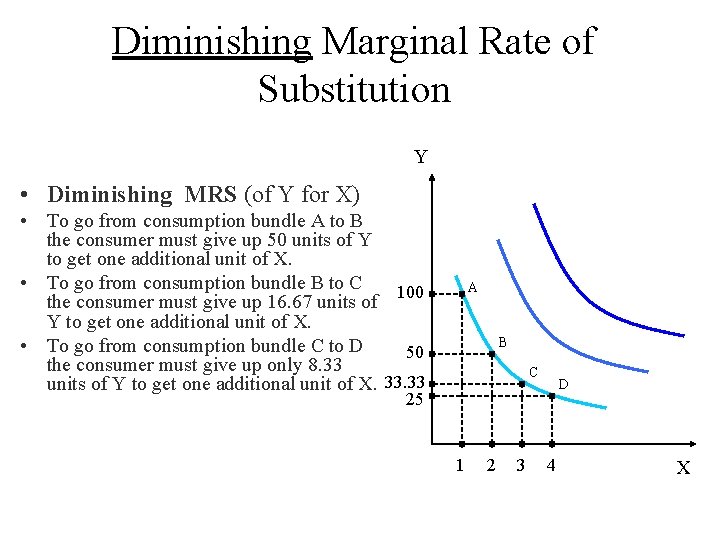
Diminishing Marginal Rate of Substitution Y • Diminishing MRS (of Y for X) • To go from consumption bundle A to B the consumer must give up 50 units of Y to get one additional unit of X. • To go from consumption bundle B to C 100 the consumer must give up 16. 67 units of Y to get one additional unit of X. • To go from consumption bundle C to D 50 the consumer must give up only 8. 33 units of Y to get one additional unit of X. 33 A B C D 25 1 2 3 4 X
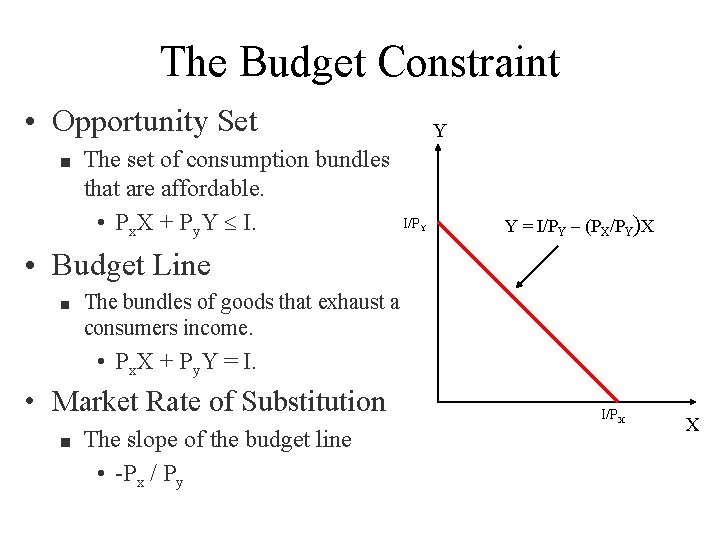
The Budget Constraint • Opportunity Set n The set of consumption bundles that are affordable. • Px. X + Py. Y I. Y I/PY Y = I/PY – (PX/PY)X • Budget Line n The bundles of goods that exhaust a consumers income. • Px. X + Py. Y = I. • Market Rate of Substitution n The slope of the budget line • -Px / Py I/PX X
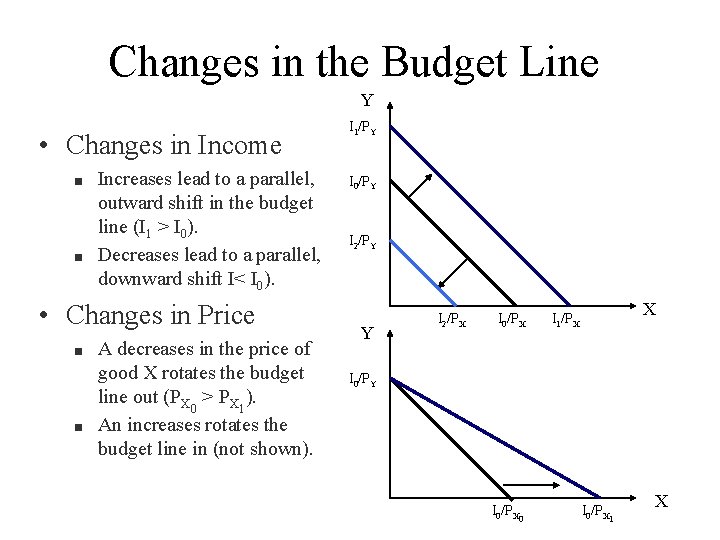
Changes in the Budget Line Y • Changes in Income n n Increases lead to a parallel, outward shift in the budget line (I 1 > I 0). Decreases lead to a parallel, downward shift I< I 0). • Changes in Price n n A decreases in the price of good X rotates the budget line out (PX 0 > PX 1). An increases rotates the budget line in (not shown). I 1/PY I 0/PY I 2/PY Y I 2/PX I 0/PX X I 1/PX I 0/PY I 0/PX 0 I 0/PX 1 X
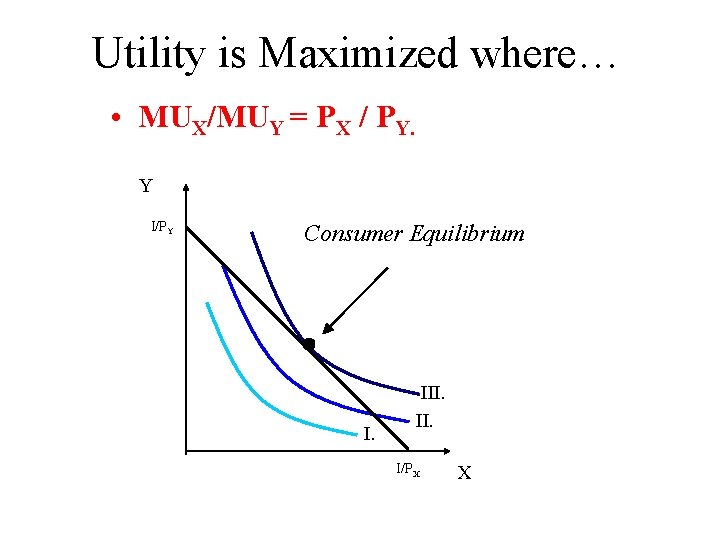
Utility is Maximized where… • MUX/MUY = PX / PY. Y I/PY Consumer Equilibrium I. III. I/PX X
Changes and Consumer Equilibrium • Income Changes n n n Normal Goods Inferior Goods The Engel Curve • Price Changes n n n Substitute Goods Complementary Goods The Consumption-Price Curve and Demand
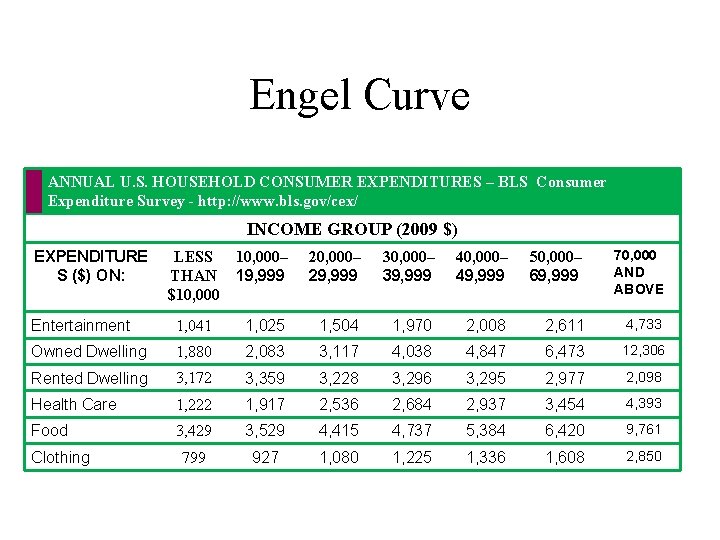
Engel Curve ANNUAL U. S. HOUSEHOLD CONSUMER EXPENDITURES – BLS Consumer Expenditure Survey - http: //www. bls. gov/cex/ INCOME GROUP (2009 $) LESS THAN $10, 000– 19, 999 20, 000– 29, 999 30, 000– 39, 999 40, 000– 49, 999 50, 000– 69, 999 70, 000 AND ABOVE Entertainment 1, 041 1, 025 1, 504 1, 970 2, 008 2, 611 4, 733 Owned Dwelling 1, 880 2, 083 3, 117 4, 038 4, 847 6, 473 12, 306 Rented Dwelling 3, 172 3, 359 3, 228 3, 296 3, 295 2, 977 2, 098 Health Care 1, 222 1, 917 2, 536 2, 684 2, 937 3, 454 4, 393 Food 3, 429 3, 529 4, 415 4, 737 5, 384 6, 420 9, 761 799 927 1, 080 1, 225 1, 336 1, 608 2, 850 EXPENDITURE S ($) ON: Clothing
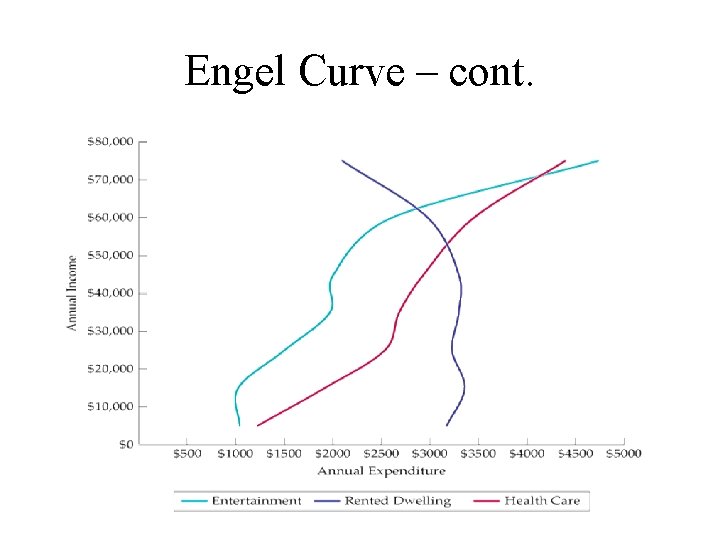
Engel Curve – cont.

Some Applications (handout - as time permits) • Taxation n Is it better to tax income or place a tax on the price of a good? • Coupons, price-cuts, free give-aways, etc. n Impact of budget constraints and utility
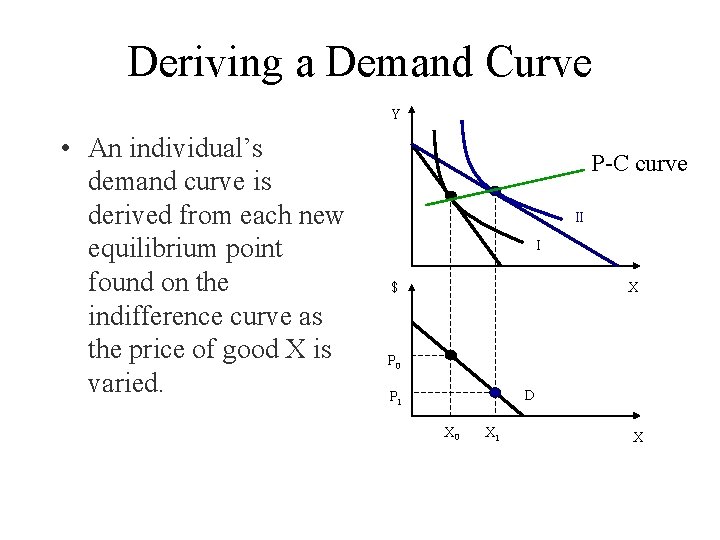
Deriving a Demand Curve Y • An individual’s demand curve is derived from each new equilibrium point found on the indifference curve as the price of good X is varied. P-C curve II I X $ P 0 D P 1 X 0 X 1 X
Additional Considerations regarding the Demand Curve • But it’s not really that simple • The above is called the Marshallian Demand Curve • This does not isolate the effect prices has on consumption! n Income and Substitution Effects
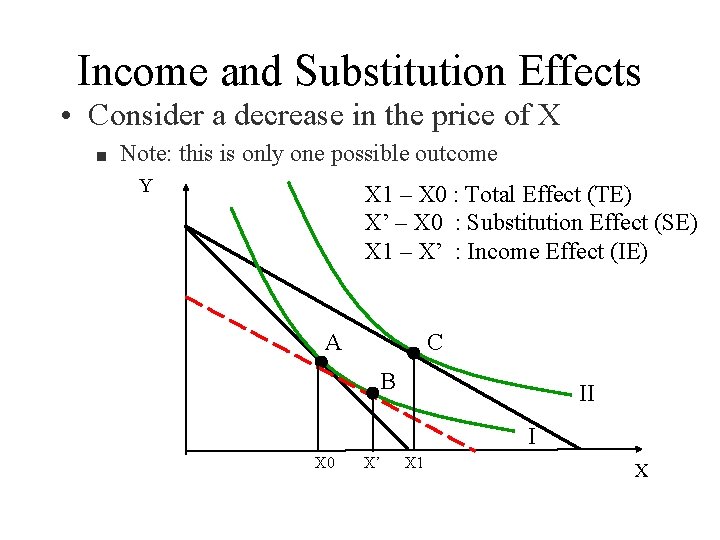
Income and Substitution Effects • Consider a decrease in the price of X n Note: this is only one possible outcome Y X 1 – X 0 : Total Effect (TE) X’ – X 0 : Substitution Effect (SE) X 1 – X’ : Income Effect (IE) A C B II I X 0 X’ X 1 X
Hicksian vs. Marshallian Demand • Marshallian Demand n n Income and Substitution Effects Giffen Good • Hicksian Demand n n Substitution Effect Only Never upward-sloping • Implications for Benefit/Cost Analysis n Impact on Consumer Surplus
Conclusion • Consumer Behavior • Hicks and Marshall • Income and Substitution Effects
- Slides: 22