
Intermediate Code Generation textbook ch 6 1 6
Intermediate Code Generation (textbook ch# 6. 1– 6. 4, 6. 5. 1– 6. 5. 3, 6. 6– 6. 8) 薛智文 cwhsueh@csie. ntu. edu. tw http: //www. csie. ntu. edu. tw/~cwhsueh/ 96 Spring /46 國立台灣大學 資訊 程學系
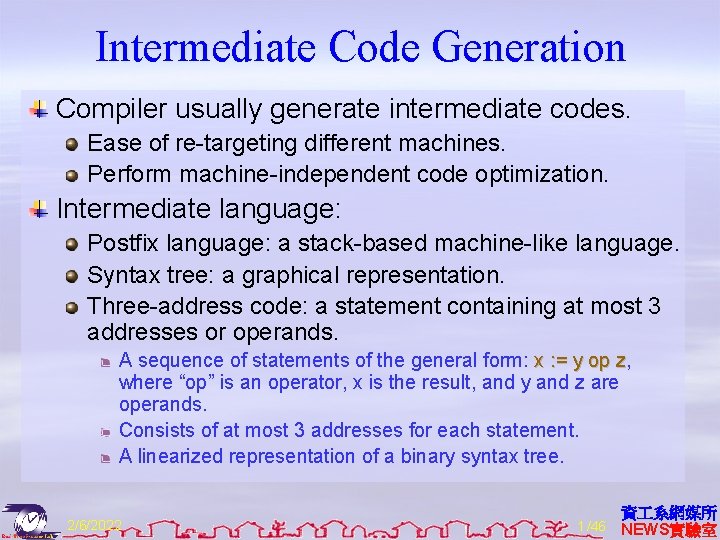
Intermediate Code Generation Compiler usually generate intermediate codes. Ease of re-targeting different machines. Perform machine-independent code optimization. Intermediate language: Postfix language: a stack-based machine-like language. Syntax tree: a graphical representation. Three-address code: a statement containing at most 3 addresses or operands. A sequence of statements of the general form: x : = y op z, z where “op” is an operator, x is the result, and y and z are operands. Consists of at most 3 addresses for each statement. A linearized representation of a binary syntax tree. 2/6/2022 1 /46 資 系網媒所 NEWS實驗室
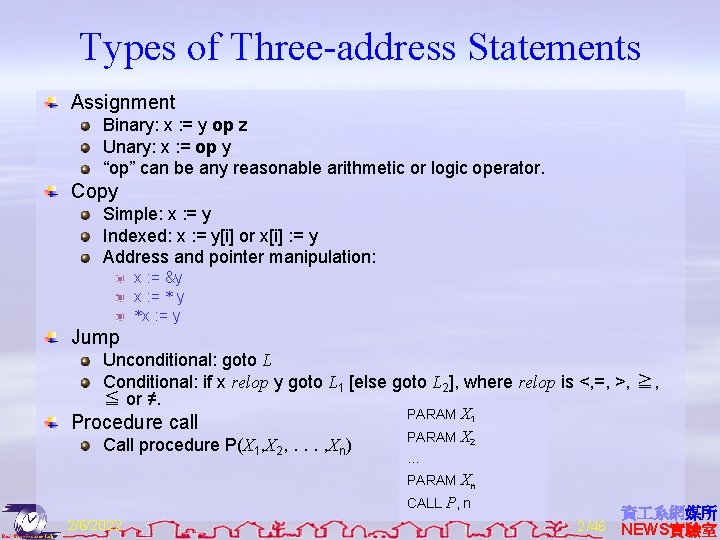
Types of Three-address Statements Assignment Binary: x : = y op z Unary: x : = op y “op” can be any reasonable arithmetic or logic operator. Copy Simple: x : = y Indexed: x : = y[i] or x[i] : = y Address and pointer manipulation: x : = &y x : = * y *x : = y Jump Unconditional: goto L Conditional: if x relop y goto L 1 [else goto L 2], where relop is <, =, >, ≧, ≦ or ≠. Procedure call Call procedure P(X 1, X 2, . . . , Xn) PARAM X 1 PARAM X 2. . . PARAM Xn CALL P, n 2/6/2022 2 /46 資 系網媒所 NEWS實驗室
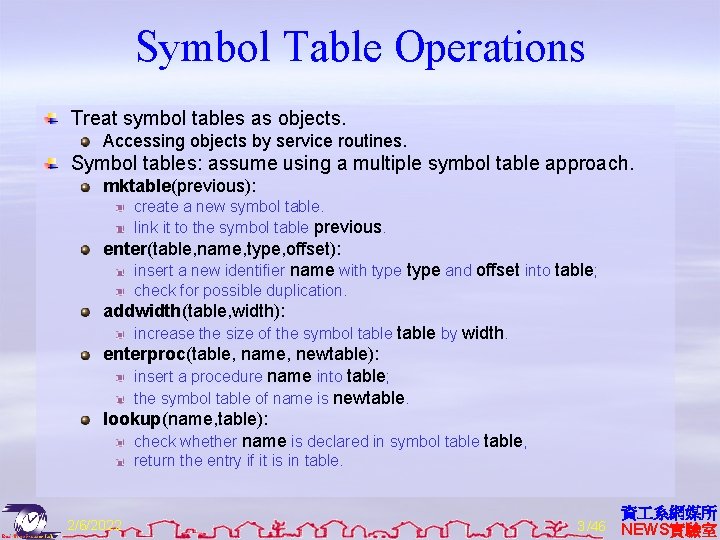
Symbol Table Operations Treat symbol tables as objects. Accessing objects by service routines. Symbol tables: assume using a multiple symbol table approach. mktable(previous): create a new symbol table. link it to the symbol table previous. enter(table, name, type, offset): insert a new identifier name with type and offset into table; check for possible duplication. addwidth(table, width): increase the size of the symbol table by width. enterproc(table, name, newtable): insert a procedure name into table; the symbol table of name is newtable. lookup(name, table): check whether name is declared in symbol table, return the entry if it is in table. 2/6/2022 3 /46 資 系網媒所 NEWS實驗室
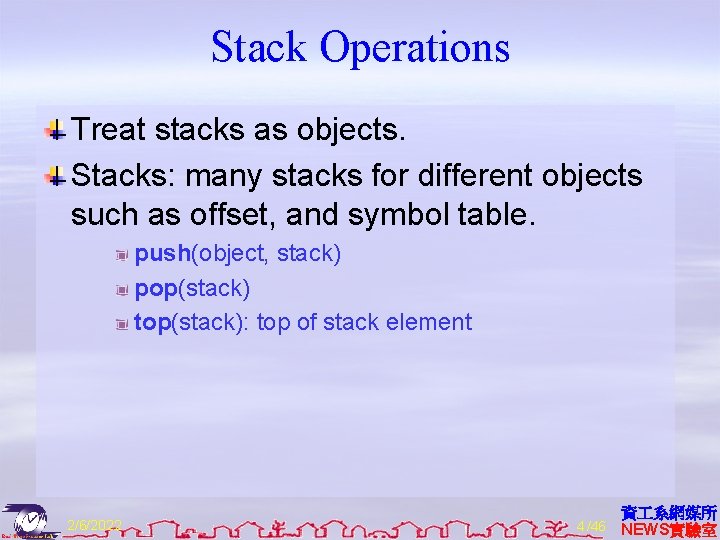
Stack Operations Treat stacks as objects. Stacks: many stacks for different objects such as offset, and symbol table. push(object, stack) pop(stack) top(stack): top of stack element 2/6/2022 4 /46 資 系網媒所 NEWS實驗室
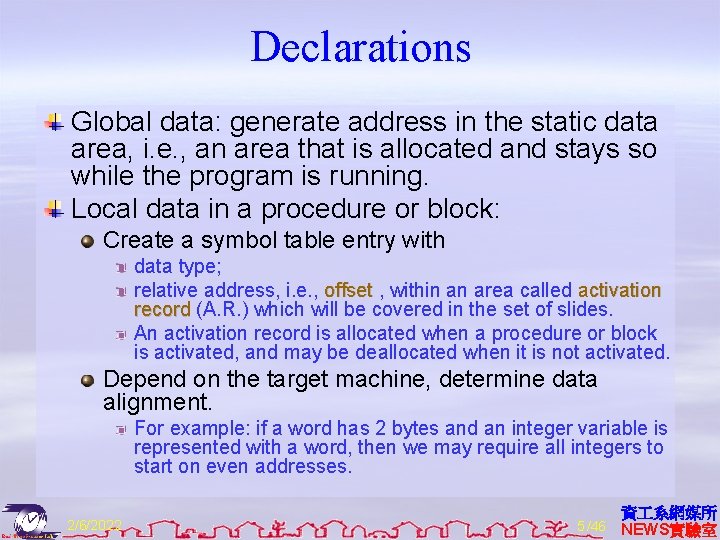
Declarations Global data: generate address in the static data area, i. e. , an area that is allocated and stays so while the program is running. Local data in a procedure or block: Create a symbol table entry with data type; relative address, i. e. , offset , within an area called activation record (A. R. ) which will be covered in the set of slides. An activation record is allocated when a procedure or block is activated, and may be deallocated when it is not activated. Depend on the target machine, determine data alignment. For example: if a word has 2 bytes and an integer variable is represented with a word, then we may require all integers to start on even addresses. 2/6/2022 5 /46 資 系網媒所 NEWS實驗室
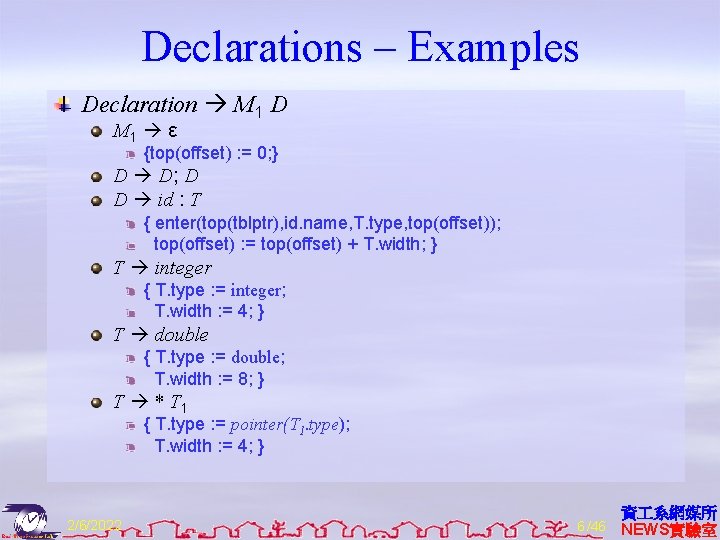
Declarations – Examples Declaration M 1 D M 1 ε {top(offset) : = 0; } D D; D D id : T { enter(top(tblptr), id. name, T. type, top(offset)); top(offset) : = top(offset) + T. width; } T integer { T. type : = integer; T. width : = 4; } T double { T. type : = double; T. width : = 8; } T * T 1 { T. type : = pointer(T 1. type); T. width : = 4; } 2/6/2022 6 /46 資 系網媒所 NEWS實驗室
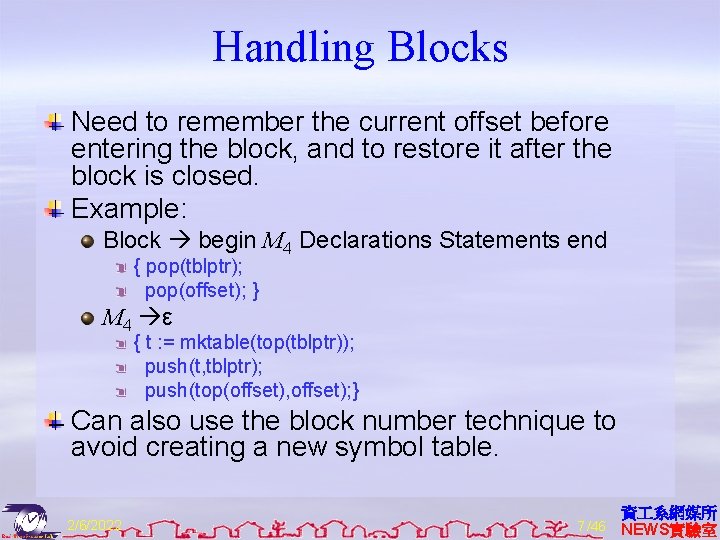
Handling Blocks Need to remember the current offset before entering the block, and to restore it after the block is closed. Example: Block begin M 4 Declarations Statements end { pop(tblptr); pop(offset); } M 4 ε { t : = mktable(top(tblptr)); push(t, tblptr); push(top(offset), offset); } Can also use the block number technique to avoid creating a new symbol table. 2/6/2022 7 /46 資 系網媒所 NEWS實驗室
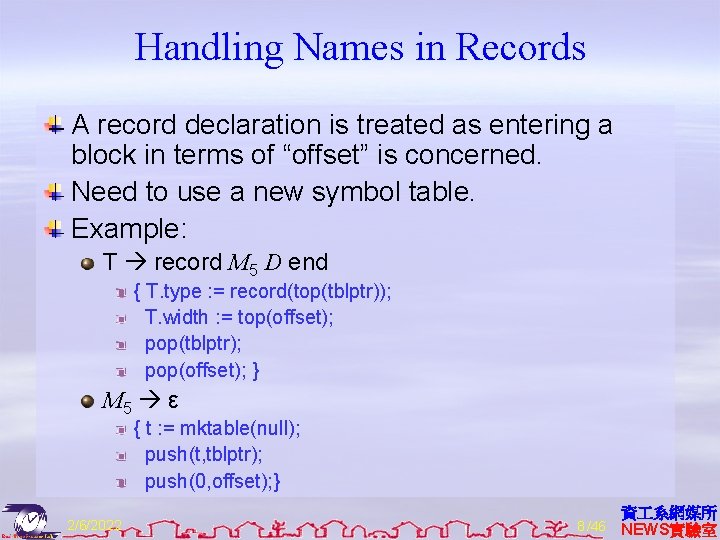
Handling Names in Records A record declaration is treated as entering a block in terms of “offset” is concerned. Need to use a new symbol table. Example: T record M 5 D end { T. type : = record(top(tblptr)); T. width : = top(offset); pop(tblptr); pop(offset); } M 5 ε { t : = mktable(null); push(t, tblptr); push(0, offset); } 2/6/2022 8 /46 資 系網媒所 NEWS實驗室
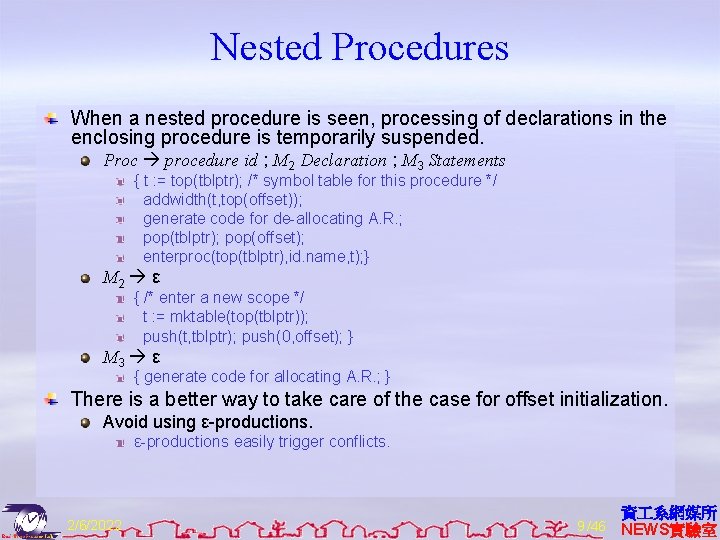
Nested Procedures When a nested procedure is seen, processing of declarations in the enclosing procedure is temporarily suspended. Proc procedure id ; M 2 Declaration ; M 3 Statements { t : = top(tblptr); /* symbol table for this procedure */ addwidth(t, top(offset)); generate code for de-allocating A. R. ; pop(tblptr); pop(offset); enterproc(top(tblptr), id. name, t); } M 2 ε { /* enter a new scope */ t : = mktable(top(tblptr)); push(t, tblptr); push(0, offset); } M 3 ε { generate code for allocating A. R. ; } There is a better way to take care of the case for offset initialization. Avoid using ε-productions easily trigger conflicts. 2/6/2022 9 /46 資 系網媒所 NEWS實驗室
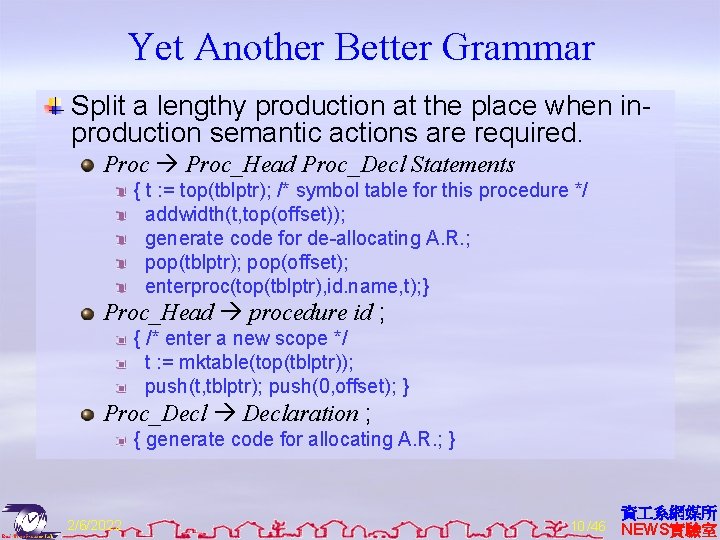
Yet Another Better Grammar Split a lengthy production at the place when inproduction semantic actions are required. Proc_Head Proc_Decl Statements { t : = top(tblptr); /* symbol table for this procedure */ addwidth(t, top(offset)); generate code for de-allocating A. R. ; pop(tblptr); pop(offset); enterproc(top(tblptr), id. name, t); } Proc_Head procedure id ; { /* enter a new scope */ t : = mktable(top(tblptr)); push(t, tblptr); push(0, offset); } Proc_Decl Declaration ; { generate code for allocating A. R. ; } 2/6/2022 10 /46 資 系網媒所 NEWS實驗室
![Code Generation Routine Code generation: gen([address #1], assignment, [address #2], operator, [address #3]); Use](http://slidetodoc.com/presentation_image_h2/a71ed3d726b28f942001bb3ae56d76be/image-12.jpg "Code Generation Routine Code generation: gen([address #1], assignment, [address #2], operator, [address #3]); Use")
Code Generation Routine Code generation: gen([address #1], assignment, [address #2], operator, [address #3]); Use switch statement to actually print out the target code; Can have different gen() for different target codes; Variable accessing: depend on the type of [address #i], generate different codes. Watch out the differences between l-address and r-address. Types of [address #i]: Local temp space. Parameter. Local variable. Non-local variable. Global variable. Registers, constants, . . . Run-time memory management, allocating of memory spaces for different types of variables during run time, is an important issue and will be discussed in the next topic. 2/6/2022 11 /46 資 系網媒所 NEWS實驗室
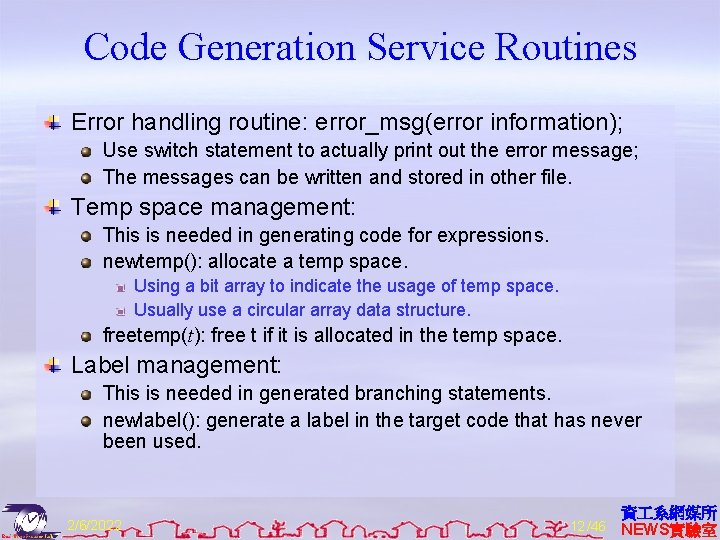
Code Generation Service Routines Error handling routine: error_msg(error information); Use switch statement to actually print out the error message; The messages can be written and stored in other file. Temp space management: This is needed in generating code for expressions. newtemp(): allocate a temp space. Using a bit array to indicate the usage of temp space. Usually use a circular array data structure. freetemp(t): free t if it is allocated in the temp space. Label management: This is needed in generated branching statements. newlabel(): generate a label in the target code that has never been used. 2/6/2022 12 /46 資 系網媒所 NEWS實驗室
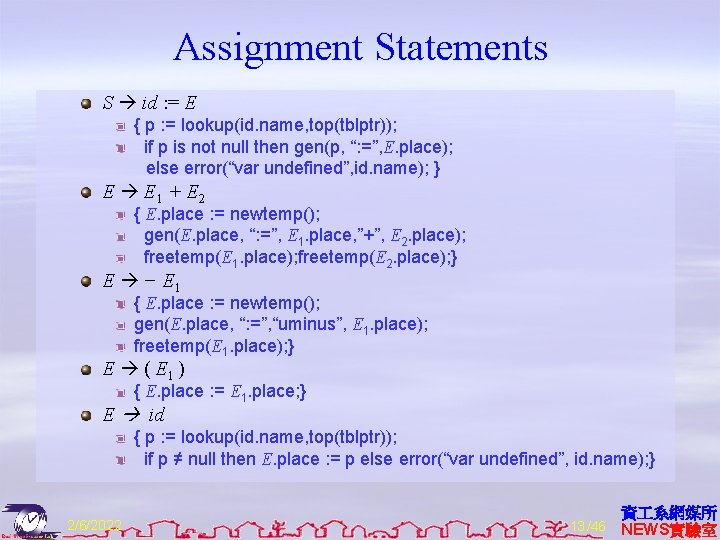
Assignment Statements S id : = E { p : = lookup(id. name, top(tblptr)); if p is not null then gen(p, “: =”, E. place); else error(“var undefined”, id. name); } E E 1 + E 2 { E. place : = newtemp(); gen(E. place, “: =”, E 1. place, ”+”, E 2. place); freetemp(E 1. place); freetemp(E 2. place); } E − E 1 { E. place : = newtemp(); gen(E. place, “: =”, “uminus”, E 1. place); freetemp(E 1. place); } E ( E 1 ) { E. place : = E 1. place; } E id { p : = lookup(id. name, top(tblptr)); if p ≠ null then E. place : = p else error(“var undefined”, id. name); } 2/6/2022 13 /46 資 系網媒所 NEWS實驗室
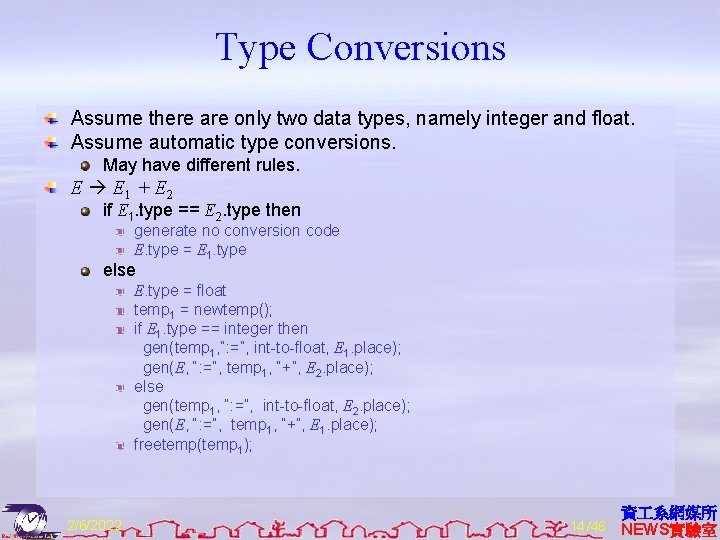
Type Conversions Assume there are only two data types, namely integer and float. Assume automatic type conversions. May have different rules. E E 1 + E 2 if E 1. type == E 2. type then generate no conversion code E. type = E 1. type else E. type = float temp 1 = newtemp(); if E 1. type == integer then gen(temp 1, “: =”, int-to-float, E 1. place); gen(E, “: =”, temp 1, “+”, E 2. place); else gen(temp 1, “: =”, int-to-float, E 2. place); gen(E, “: =”, temp 1, “+”, E 1. place); freetemp(temp 1); 2/6/2022 14 /46 資 系網媒所 NEWS實驗室
![Addressing 1 -D Array Elements 1 -D array: A[i]. Assumptions: lower bound in address](http://slidetodoc.com/presentation_image_h2/a71ed3d726b28f942001bb3ae56d76be/image-16.jpg "Addressing 1 -D Array Elements 1 -D array: A[i]. Assumptions: lower bound in address")
Addressing 1 -D Array Elements 1 -D array: A[i]. Assumptions: lower bound in address = low element data width = w starting address = start_addr Address for A[i] = start_addr + (i − low) * w = i * w + (start_addr − low * w) The value, called base, (start_addr − low * w) can be computed at compile time. PASCAL uses array [-8. . 100] of integer to declare an integer array in the range of [-8], [-7], [-6] , . . . , [-1], [0], [1], . . . , [100]. 2/6/2022 15 /46 資 系網媒所 NEWS實驗室
![Addressing 2 -D Array Elements 2 -D array A[i 1, i 2]. Row major:](http://slidetodoc.com/presentation_image_h2/a71ed3d726b28f942001bb3ae56d76be/image-17.jpg "Addressing 2 -D Array Elements 2 -D array A[i 1, i 2]. Row major:")
Addressing 2 -D Array Elements 2 -D array A[i 1, i 2]. Row major: the preferred mapping method. A[1, 1], A[1, 2], A[1, 3], A[2, 1], A[2, 2], . . . A[i] means the i-th row. Advantage: A[i, j] = A[i][j]. Column major: A[1, 1], A[2, 1], A[1, 2], A[2, 2], A[1, 3], . . . Address for A[i 1, i 2] = start_addr + ((i 1 − low 1) * n 2 + (i 2 − low 2)) * w = (i 1 * n 2 + i 2) * w + (start_addr − low 1 * n 2 * w − low 2 * w) n 2 is the number of elements in a row. low 1 is the lower bound of the first coordinate. low 2 is the lower bound of the second coordinate. The value, called base, (start_addr − low 1 * n 2 * w − low 2 * w) can be computed at compiler time. 2/6/2022 16 /46 資 系網媒所 NEWS實驗室
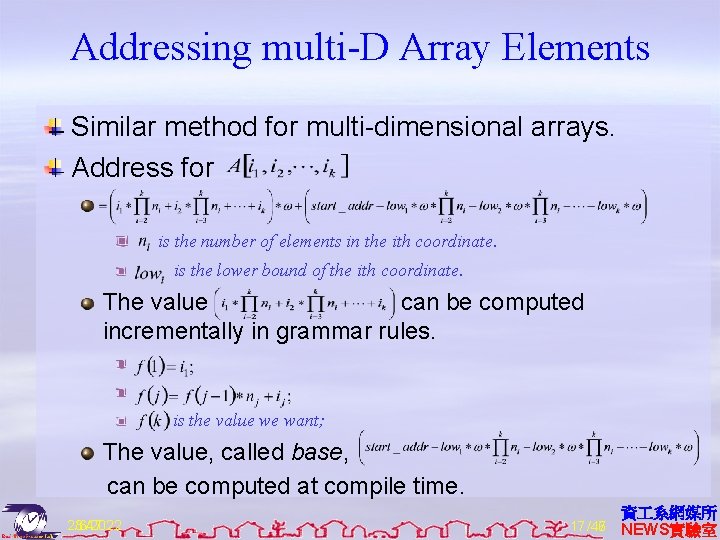
Addressing multi-D Array Elements Similar method for multi-dimensional arrays. Address for is the number of elements in the ith coordinate. is the lower bound of the ith coordinate. The value can be computed incrementally in grammar rules. is the value we want; The value, called base, can be computed at compile time. 23: 47 2/6/2022 17 /46 /47 資 系網媒所 NEWS實驗室
![Code Generation for Arrays Array Elist ] { L. offset : = newtemp(); freetemp(Elist.](http://slidetodoc.com/presentation_image_h2/a71ed3d726b28f942001bb3ae56d76be/image-19.jpg "Code Generation for Arrays Array Elist ] { L. offset : = newtemp(); freetemp(Elist.")
Code Generation for Arrays Array Elist ] { L. offset : = newtemp(); freetemp(Elist. place); gen(L. offset, “: =”, Elist. elesize, “*”, Elist. place); gen(L. offset, “: =”, L. offset, “+”, Elist. base); } Elist 1, E { t : = newtemp(); m : = Elist 1. ndim + 1; gen(t, “: =”, EList 1. place, “*”, limit(Elist 1. array, m)); gen(t, “: =”, t, “+”, E. place); freetemp(E. place); Elist. array : = Elist 1. array; Elist. place : = t; EList. ndim : = m; } Elist id [ E { Elist. place : = E. place; Elist. ndim : = 1; p : = lookup(id. name, top(tblptr)); check for id errors; Elist. elesize : = p. size; Elist. base : = p. base; EList. array : = p. place; } E id { p : = lookup(id. name, top(tblptr)); check for id errors; E. place : = p. place; } 2/6/2022 18 /46 資 系網媒所 NEWS實驗室
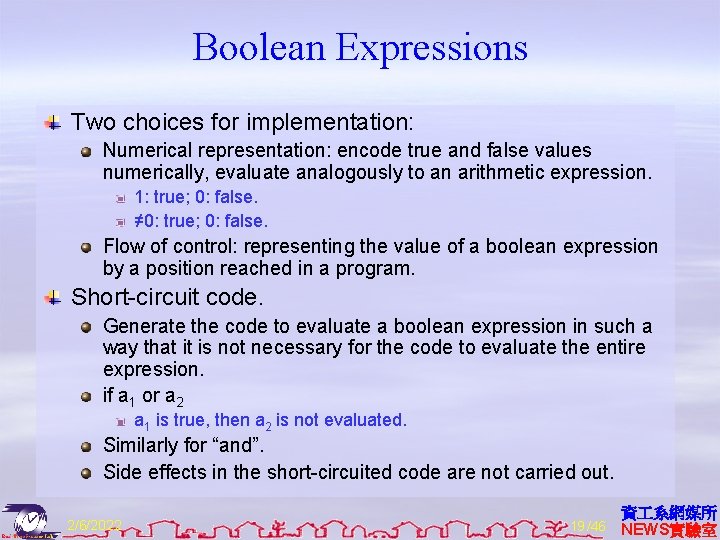
Boolean Expressions Two choices for implementation: Numerical representation: encode true and false values numerically, evaluate analogously to an arithmetic expression. 1: true; 0: false. ≠ 0: true; 0: false. Flow of control: representing the value of a boolean expression by a position reached in a program. Short-circuit code. Generate the code to evaluate a boolean expression in such a way that it is not necessary for the code to evaluate the entire expression. if a 1 or a 2 a 1 is true, then a 2 is not evaluated. Similarly for “and”. Side effects in the short-circuited code are not carried out. 2/6/2022 19 /46 資 系網媒所 NEWS實驗室
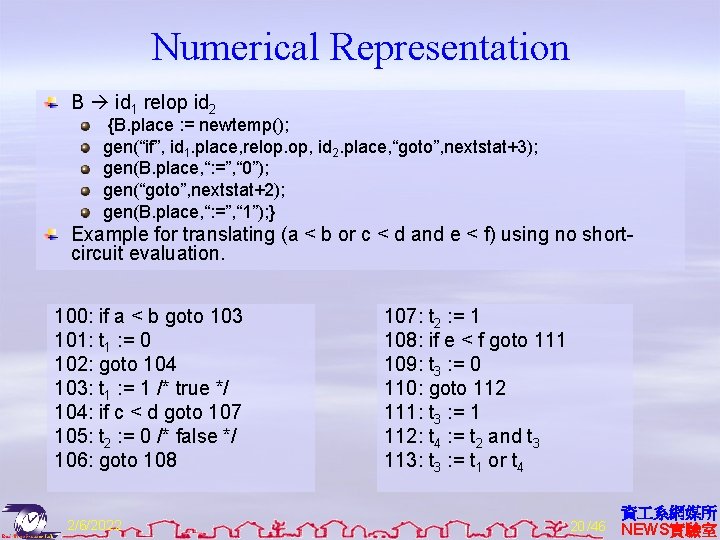
Numerical Representation B id 1 relop id 2 {B. place : = newtemp(); gen(“if”, id 1. place, relop. op, id 2. place, “goto”, nextstat+3); gen(B. place, “: =”, “ 0”); gen(“goto”, nextstat+2); gen(B. place, “: =”, “ 1”); } Example for translating (a < b or c < d and e < f) using no shortcircuit evaluation. 100: if a < b goto 103 101: t 1 : = 0 102: goto 104 103: t 1 : = 1 /* true */ 104: if c < d goto 107 105: t 2 : = 0 /* false */ 106: goto 108 2/6/2022 107: t 2 : = 1 108: if e < f goto 111 109: t 3 : = 0 110: goto 112 111: t 3 : = 1 112: t 4 : = t 2 and t 3 113: t 3 : = t 1 or t 4 20 /46 資 系網媒所 NEWS實驗室
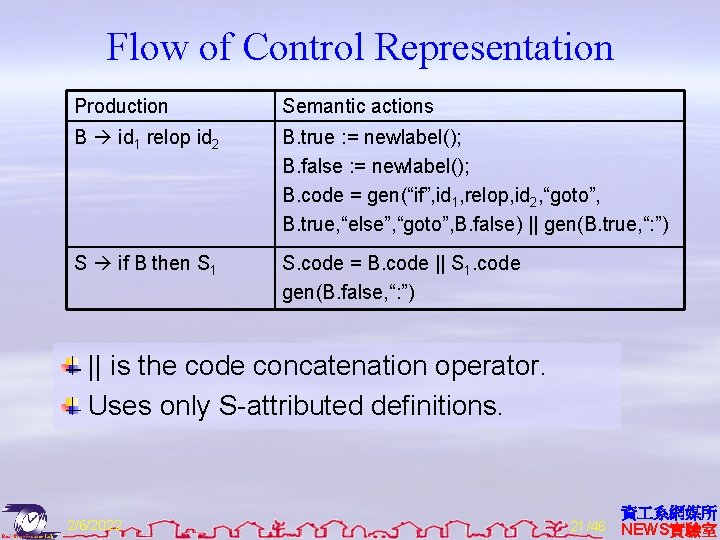
Flow of Control Representation Production Semantic actions B id 1 relop id 2 B. true : = newlabel(); B. false : = newlabel(); B. code = gen(“if”, id 1, relop, id 2, “goto”, B. true, “else”, “goto”, B. false) || gen(B. true, “: ”) S if B then S 1 S. code = B. code || S 1. code gen(B. false, “: ”) || is the code concatenation operator. Uses only S-attributed definitions. 2/6/2022 21 /46 資 系網媒所 NEWS實驗室
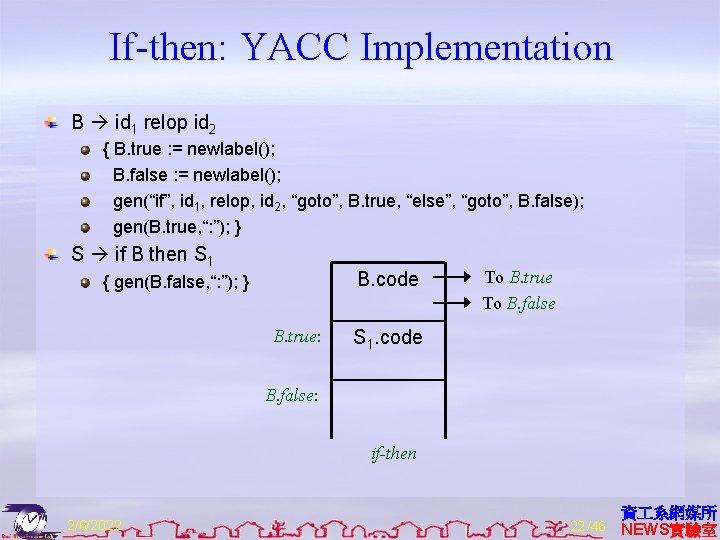
If-then: YACC Implementation B id 1 relop id 2 { B. true : = newlabel(); B. false : = newlabel(); gen(“if”, id 1, relop, id 2, “goto”, B. true, “else”, “goto”, B. false); gen(B. true, “: ”); } S if B then S 1 B. code { gen(B. false, “: ”); } B. true: To B. true To B. false S 1. code B. false: if-then 2/6/2022 22 /46 資 系網媒所 NEWS實驗室
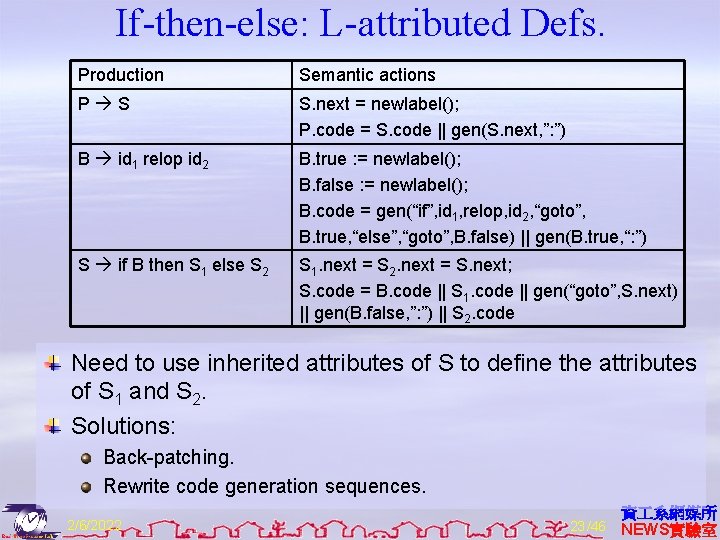
If-then-else: L-attributed Defs. Production Semantic actions P S S. next = newlabel(); P. code = S. code || gen(S. next, ”: ”) B id 1 relop id 2 B. true : = newlabel(); B. false : = newlabel(); B. code = gen(“if”, id 1, relop, id 2, “goto”, B. true, “else”, “goto”, B. false) || gen(B. true, “: ”) S if B then S 1 else S 2 S 1. next = S 2. next = S. next; S. code = B. code || S 1. code || gen(“goto”, S. next) || gen(B. false, ”: ”) || S 2. code Need to use inherited attributes of S to define the attributes of S 1 and S 2. Solutions: Back-patching. Rewrite code generation sequences. 2/6/2022 23 /46 資 系網媒所 NEWS實驗室
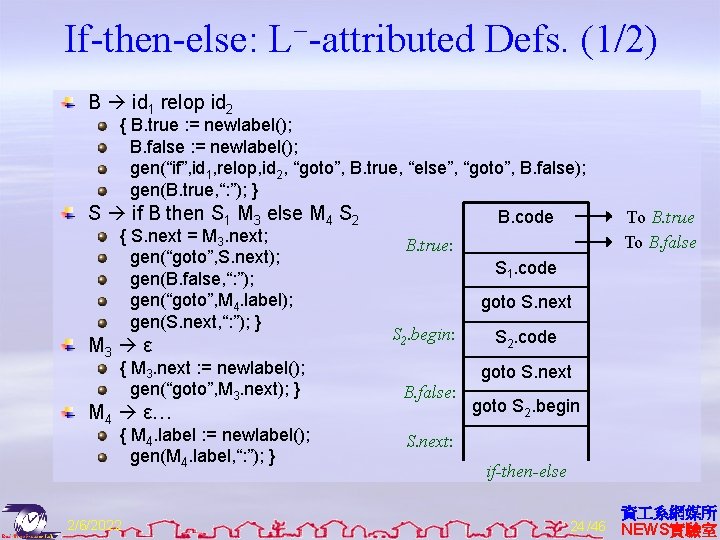
If-then-else: L−-attributed Defs. (1/2) B id 1 relop id 2 { B. true : = newlabel(); B. false : = newlabel(); gen(“if”, id 1, relop, id 2, “goto”, B. true, “else”, “goto”, B. false); gen(B. true, “: ”); } S if B then S 1 M 3 else M 4 S 2 { S. next = M 3. next; gen(“goto”, S. next); gen(B. false, “: ”); gen(“goto”, M 4. label); gen(S. next, “: ”); } M 3 ε { M 3. next : = newlabel(); gen(“goto”, M 3. next); } M 4 ε… { M 4. label : = newlabel(); gen(M 4. label, “: ”); } 2/6/2022 To B. true To B. false B. code B. true: S 1. code goto S. next S 2. begin: S 2. code goto S. next B. false: goto S 2. begin S. next: if-then-else 24 /46 資 系網媒所 NEWS實驗室
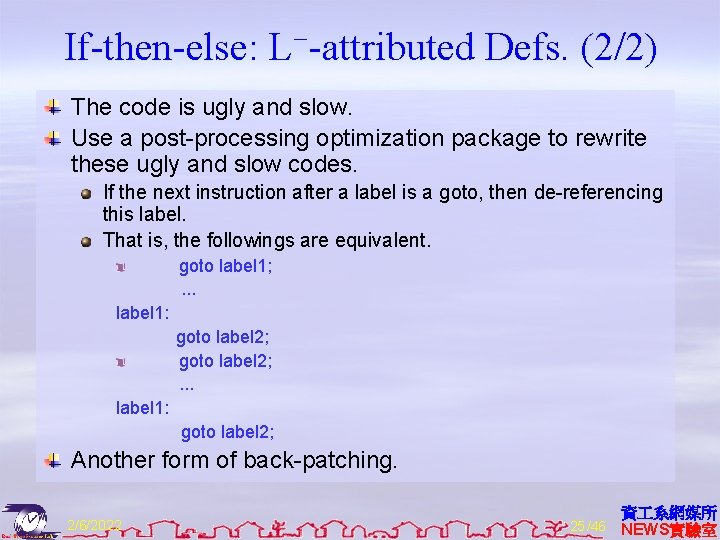
If-then-else: L−-attributed Defs. (2/2) The code is ugly and slow. Use a post-processing optimization package to rewrite these ugly and slow codes. If the next instruction after a label is a goto, then de-referencing this label. That is, the followings are equivalent. goto label 1; . . . label 1: goto label 2; Another form of back-patching. 2/6/2022 25 /46 資 系網媒所 NEWS實驗室
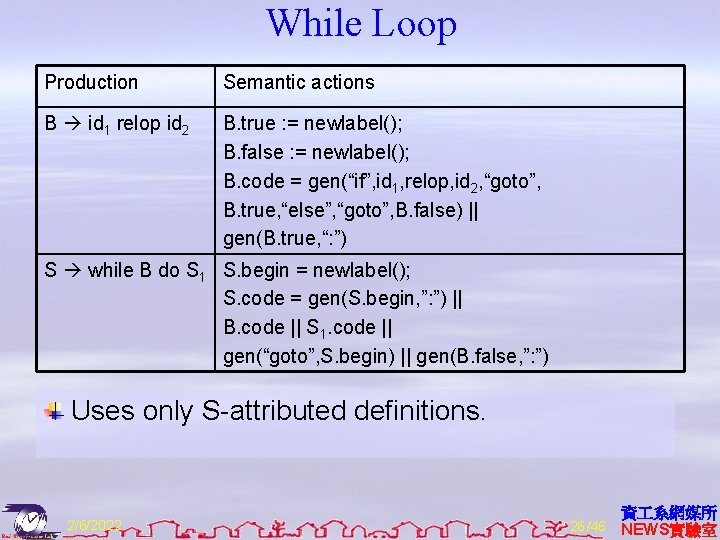
While Loop Production Semantic actions B id 1 relop id 2 B. true : = newlabel(); B. false : = newlabel(); B. code = gen(“if”, id 1, relop, id 2, “goto”, B. true, “else”, “goto”, B. false) || gen(B. true, “: ”) S while B do S 1 S. begin = newlabel(); S. code = gen(S. begin, ”: ”) || B. code || S 1. code || gen(“goto”, S. begin) || gen(B. false, ”: ”) Uses only S-attributed definitions. 2/6/2022 26 /46 資 系網媒所 NEWS實驗室
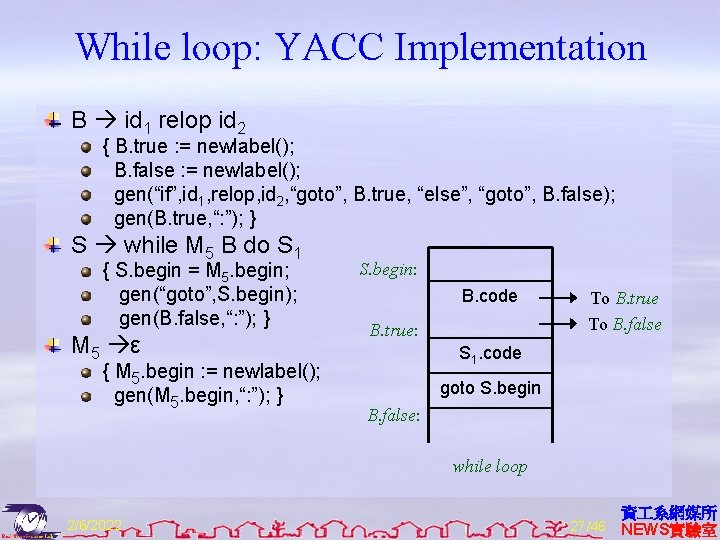
While loop: YACC Implementation B id 1 relop id 2 { B. true : = newlabel(); B. false : = newlabel(); gen(“if”, id 1, relop, id 2, “goto”, B. true, “else”, “goto”, B. false); gen(B. true, “: ”); } S while M 5 B do S 1 { S. begin = M 5. begin; gen(“goto”, S. begin); gen(B. false, “: ”); } M 5 ε { M 5. begin : = newlabel(); gen(M 5. begin, “: ”); } S. begin: B. code B. true: To B. true To B. false S 1. code goto S. begin B. false: while loop 2/6/2022 27 /46 資 系網媒所 NEWS實驗室
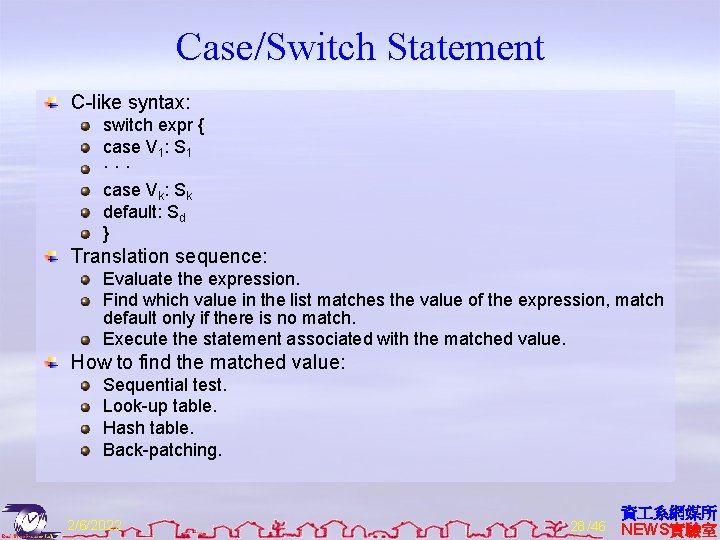
Case/Switch Statement C-like syntax: switch expr { case V 1: S 1 ··· case Vk: Sk default: Sd } Translation sequence: Evaluate the expression. Find which value in the list matches the value of the expression, match default only if there is no match. Execute the statement associated with the matched value. How to find the matched value: Sequential test. Look-up table. Hash table. Back-patching. 2/6/2022 28 /46 資 系網媒所 NEWS實驗室
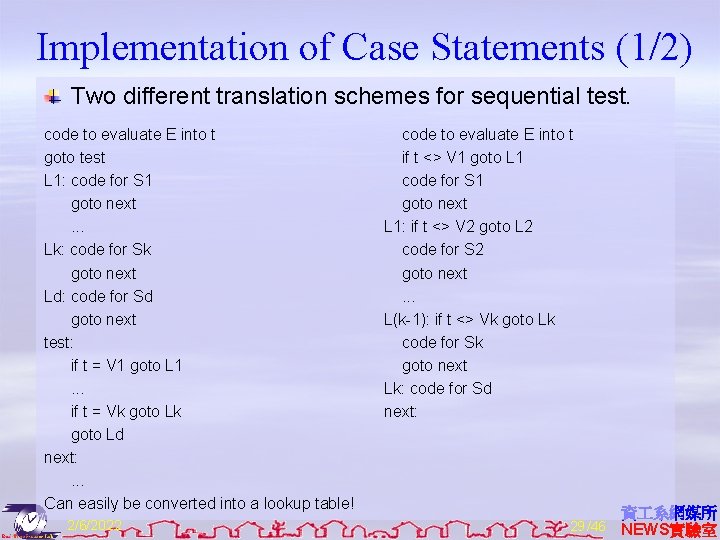
Implementation of Case Statements (1/2) Two different translation schemes for sequential test. code to evaluate E into t goto test L 1: code for S 1 goto next. . . Lk: code for Sk goto next Ld: code for Sd goto next test: if t = V 1 goto L 1. . . if t = Vk goto Ld next: . . . Can easily be converted into a lookup table! 2/6/2022 code to evaluate E into t if t <> V 1 goto L 1 code for S 1 goto next L 1: if t <> V 2 goto L 2 code for S 2 goto next. . . L(k-1): if t <> Vk goto Lk code for Sk goto next Lk: code for Sd next: 29 /46 資 系網媒所 NEWS實驗室
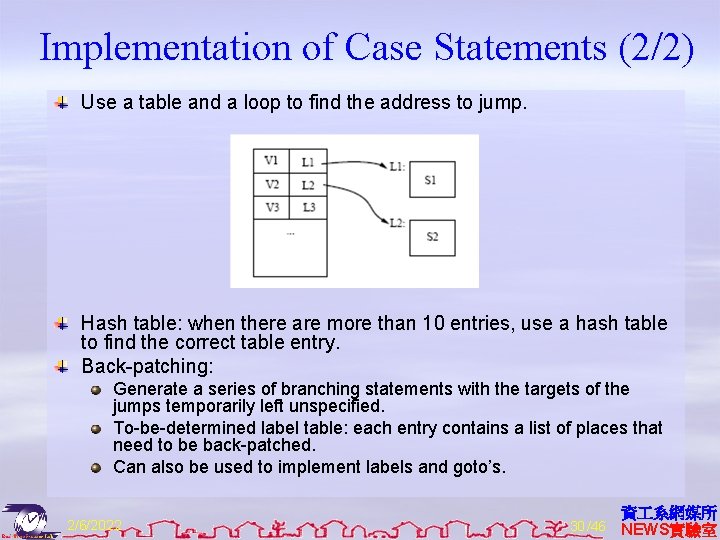
Implementation of Case Statements (2/2) Use a table and a loop to find the address to jump. Hash table: when there are more than 10 entries, use a hash table to find the correct table entry. Back-patching: Generate a series of branching statements with the targets of the jumps temporarily left unspecified. To-be-determined label table: each entry contains a list of places that need to be back-patched. Can also be used to implement labels and goto’s. 2/6/2022 30 /46 資 系網媒所 NEWS實驗室
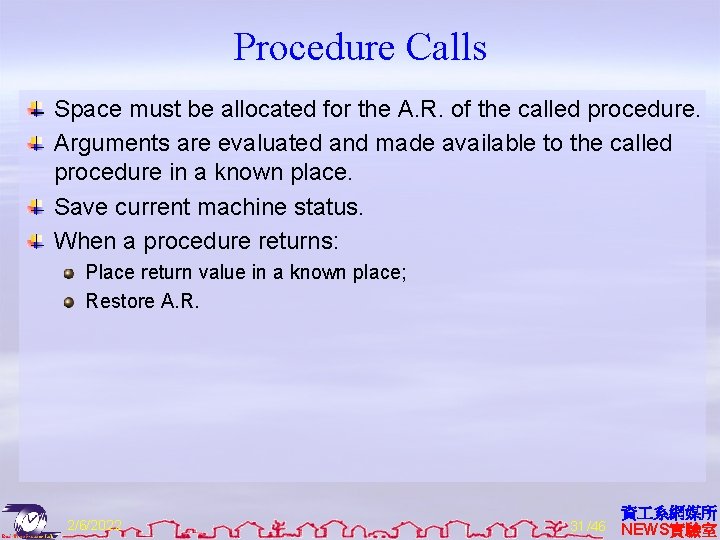
Procedure Calls Space must be allocated for the A. R. of the called procedure. Arguments are evaluated and made available to the called procedure in a known place. Save current machine status. When a procedure returns: Place return value in a known place; Restore A. R. 2/6/2022 31 /46 資 系網媒所 NEWS實驗室
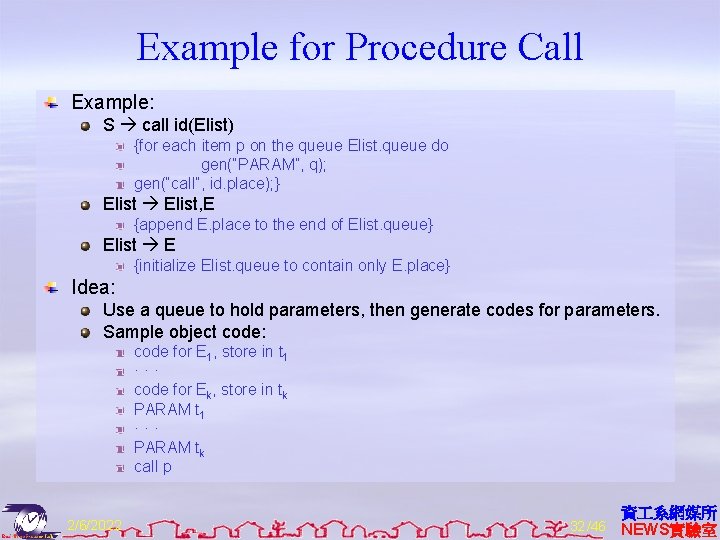
Example for Procedure Call Example: S call id(Elist) {for each item p on the queue Elist. queue do gen(“PARAM”, q); gen(“call”, id. place); } Elist, E {append E. place to the end of Elist. queue} Elist E {initialize Elist. queue to contain only E. place} Idea: Use a queue to hold parameters, then generate codes for parameters. Sample object code: code for E 1, store in t 1 ··· code for Ek, store in tk PARAM t 1 ··· PARAM tk call p 2/6/2022 32 /46 資 系網媒所 NEWS實驗室
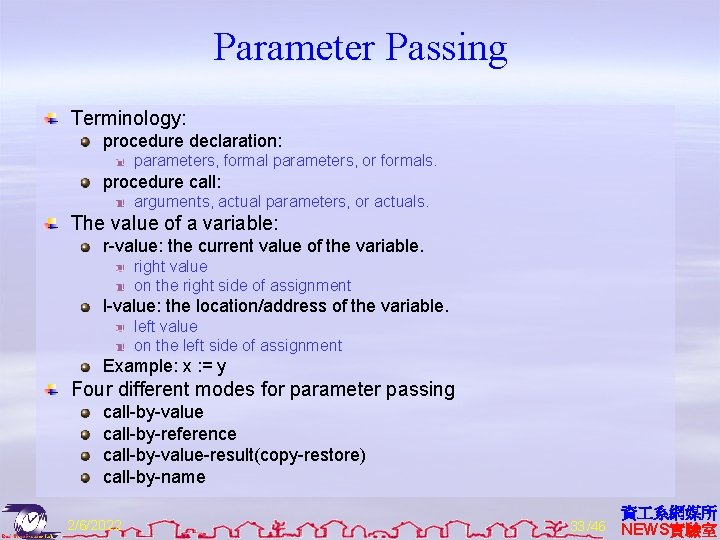
Parameter Passing Terminology: procedure declaration: parameters, formal parameters, or formals. procedure call: arguments, actual parameters, or actuals. The value of a variable: r-value: the current value of the variable. right value on the right side of assignment l-value: the location/address of the variable. left value on the left side of assignment Example: x : = y Four different modes for parameter passing call-by-value call-by-reference call-by-value-result(copy-restore) call-by-name 2/6/2022 33 /46 資 系網媒所 NEWS實驗室
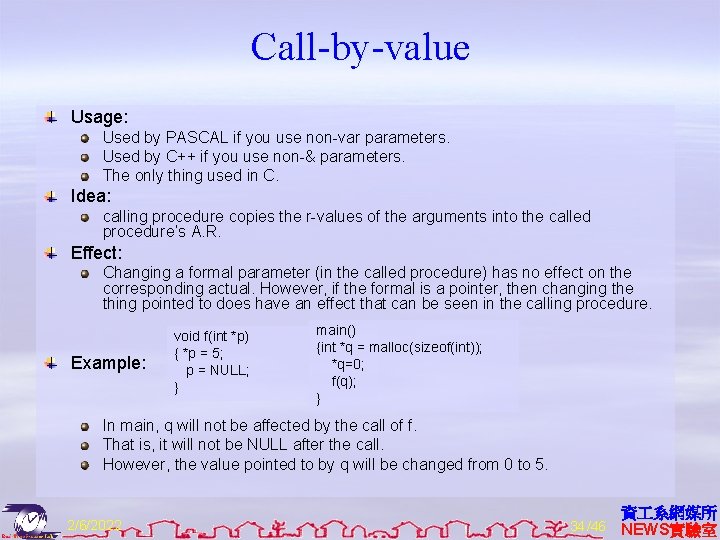
Call-by-value Usage: Used by PASCAL if you use non-var parameters. Used by C++ if you use non-& parameters. The only thing used in C. Idea: calling procedure copies the r-values of the arguments into the called procedure’s A. R. Effect: Changing a formal parameter (in the called procedure) has no effect on the corresponding actual. However, if the formal is a pointer, then changing the thing pointed to does have an effect that can be seen in the calling procedure. Example: void f(int *p) { *p = 5; p = NULL; } main() {int *q = malloc(sizeof(int)); *q=0; f(q); } In main, q will not be affected by the call of f. That is, it will not be NULL after the call. However, the value pointed to by q will be changed from 0 to 5. 2/6/2022 34 /46 資 系網媒所 NEWS實驗室
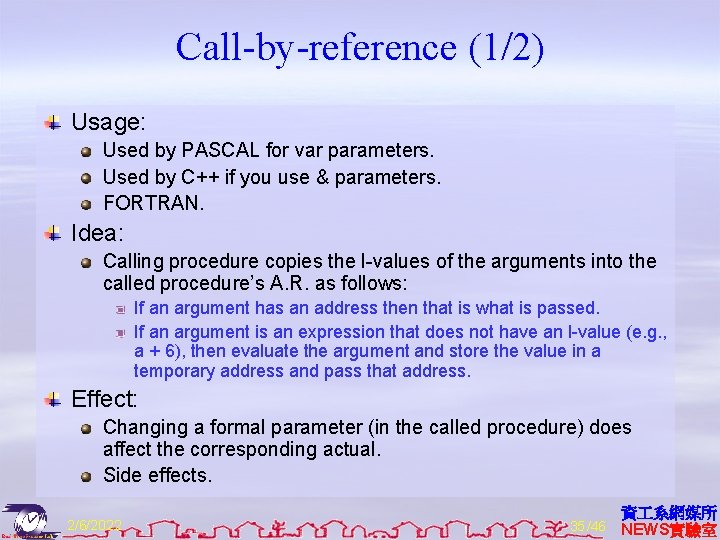
Call-by-reference (1/2) Usage: Used by PASCAL for var parameters. Used by C++ if you use & parameters. FORTRAN. Idea: Calling procedure copies the l-values of the arguments into the called procedure’s A. R. as follows: If an argument has an address then that is what is passed. If an argument is an expression that does not have an l-value (e. g. , a + 6), then evaluate the argument and store the value in a temporary address and pass that address. Effect: Changing a formal parameter (in the called procedure) does affect the corresponding actual. Side effects. 2/6/2022 35 /46 資 系網媒所 NEWS實驗室
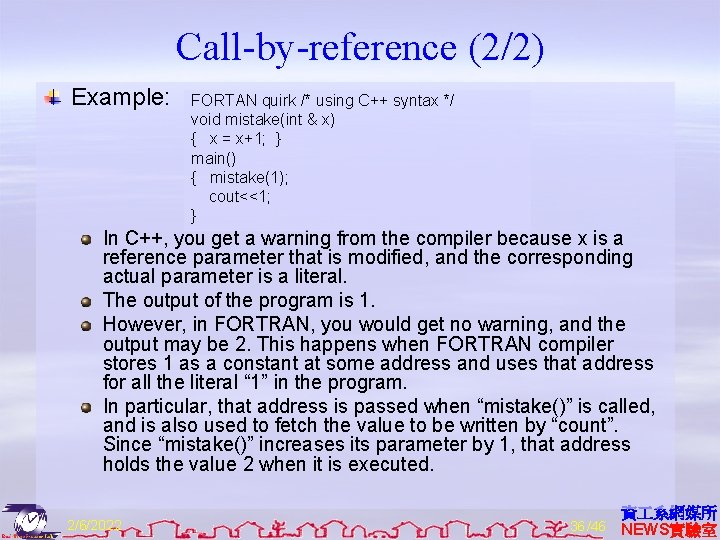
Call-by-reference (2/2) Example: FORTAN quirk /* using C++ syntax */ void mistake(int & x) { x = x+1; } main() { mistake(1); cout<<1; } In C++, you get a warning from the compiler because x is a reference parameter that is modified, and the corresponding actual parameter is a literal. The output of the program is 1. However, in FORTRAN, you would get no warning, and the output may be 2. This happens when FORTRAN compiler stores 1 as a constant at some address and uses that address for all the literal “ 1” in the program. In particular, that address is passed when “mistake()” is called, and is also used to fetch the value to be written by “count”. Since “mistake()” increases its parameter by 1, that address holds the value 2 when it is executed. 2/6/2022 36 /46 資 系網媒所 NEWS實驗室
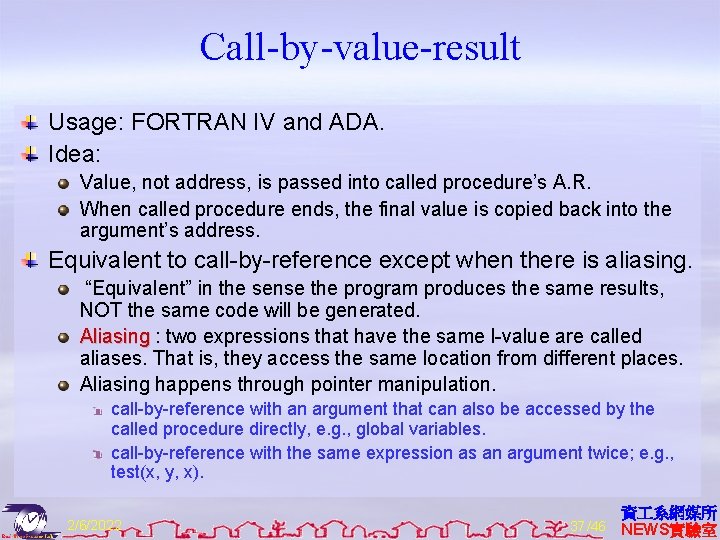
Call-by-value-result Usage: FORTRAN IV and ADA. Idea: Value, not address, is passed into called procedure’s A. R. When called procedure ends, the final value is copied back into the argument’s address. Equivalent to call-by-reference except when there is aliasing. “Equivalent” in the sense the program produces the same results, NOT the same code will be generated. Aliasing : two expressions that have the same l-value are called aliases. That is, they access the same location from different places. Aliasing happens through pointer manipulation. call-by-reference with an argument that can also be accessed by the called procedure directly, e. g. , global variables. call-by-reference with the same expression as an argument twice; e. g. , test(x, y, x). 2/6/2022 37 /46 資 系網媒所 NEWS實驗室
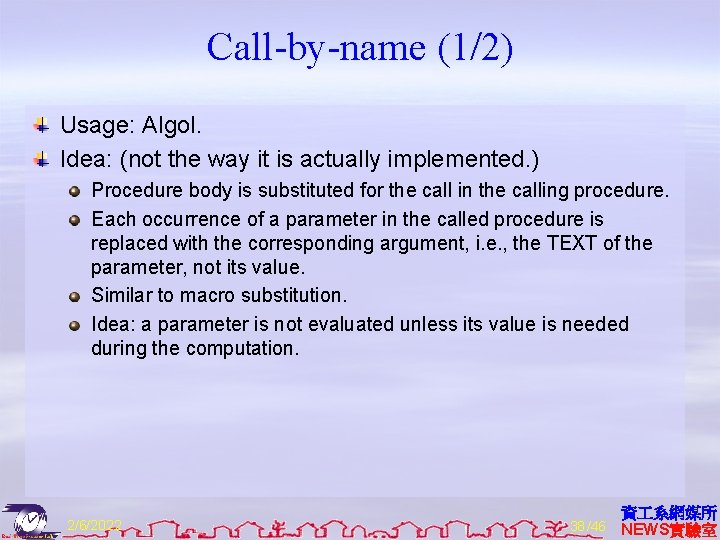
Call-by-name (1/2) Usage: Algol. Idea: (not the way it is actually implemented. ) Procedure body is substituted for the call in the calling procedure. Each occurrence of a parameter in the called procedure is replaced with the corresponding argument, i. e. , the TEXT of the parameter, not its value. Similar to macro substitution. Idea: a parameter is not evaluated unless its value is needed during the computation. 2/6/2022 38 /46 資 系網媒所 NEWS實驗室
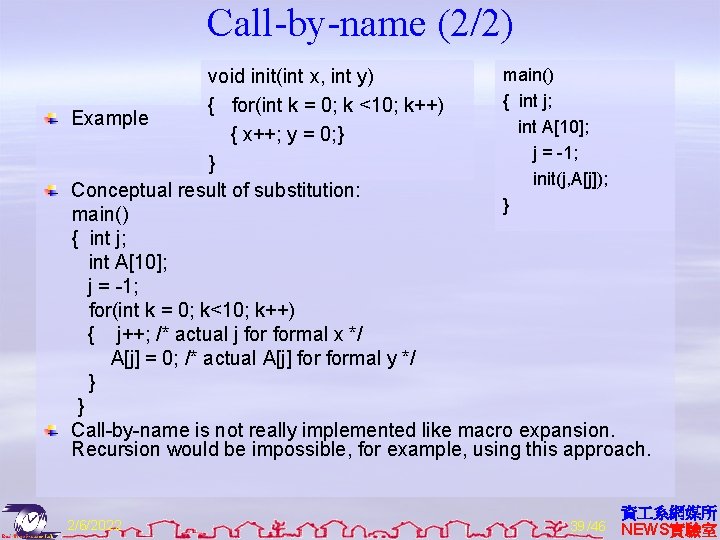
Call-by-name (2/2) main() void init(int x, int y) { int j; { for(int k = 0; k <10; k++) Example int A[10]; { x++; y = 0; } j = -1; } init(j, A[j]); Conceptual result of substitution: } main() { int j; int A[10]; j = -1; for(int k = 0; k<10; k++) { j++; /* actual j formal x */ A[j] = 0; /* actual A[j] formal y */ } } Call-by-name is not really implemented like macro expansion. Recursion would be impossible, for example, using this approach. 2/6/2022 39 /46 資 系網媒所 NEWS實驗室
How to Implement Call-by-name? Instead of passing values or addresses as arguments, a function (or the address of a function) is passed for each argument. These functions are called thunks , i. e. , a small piece of code. Each thunk knows how to determine the address of the corresponding argument. Thunk for j: find address of j. Thunk for A[j]: evaluate j and index into the array A; find the address of the appropriate cell. Each time a parameter is used, the thunk is called, then the address returned by the thunk is used. y = 0: use return value of thunk for y as the l-value. x = x + 1: use return value of thunk for x both as l-value and to get rvalue. For the example above, call-by-reference executes A[1] = 0 ten times, while call-by-name initializes the whole array. Note: call-by-name is generally considered a bad idea, because it is hard to know what a function is doing – it may require looking at all calls to figure this out. 2/6/2022 40 /46 資 系網媒所 NEWS實驗室
Advantages of Call-by-value Consider not passing pointers. No aliasing. Arguments are not changed by procedure call. Easier for static optimization analysis for both programmers and the complier. Example: x = 0; Y(x); /* call-by-value */ z = x+1; /* can be replaced by z=1 for optimization */ Compared with call-by-reference, code in the called function is faster because of no need for redirecting pointers. 2/6/2022 41 /46 資 系網媒所 NEWS實驗室
Advantages of Call-by-reference Efficiency in passing large objects. Only need to copy addresses. 2/6/2022 42 /46 資 系網媒所 NEWS實驗室
Advantages of Call-by-value-result If there is no aliasing, we can implement call-byvalue-result using call-by-reference for large objects. No implicit side effects if pointers are not passed. 2/6/2022 43 /46 資 系網媒所 NEWS實驗室
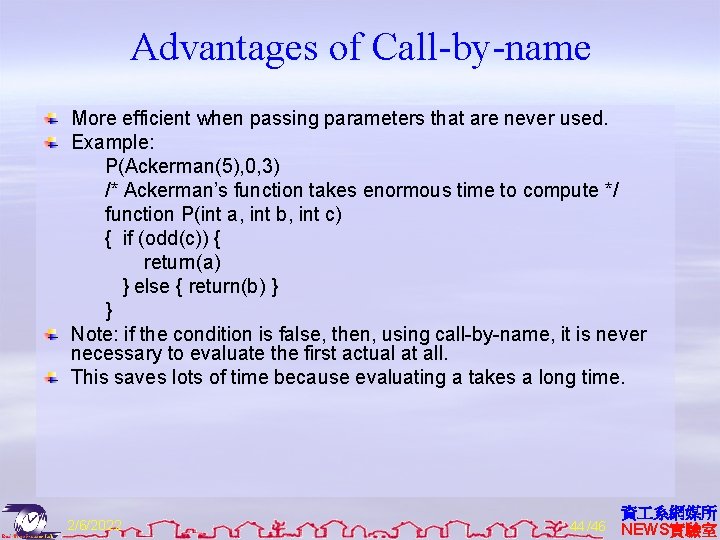
Advantages of Call-by-name More efficient when passing parameters that are never used. Example: P(Ackerman(5), 0, 3) /* Ackerman’s function takes enormous time to compute */ function P(int a, int b, int c) { if (odd(c)) { return(a) } else { return(b) } } Note: if the condition is false, then, using call-by-name, it is never necessary to evaluate the first actual at all. This saves lots of time because evaluating a takes a long time. 2/6/2022 44 /46 資 系網媒所 NEWS實驗室
- Slides: 45