
Intermediate Code Generation Reading List AhoSethiUllman Chapter 2

![(insn 8 6 9 1 (set (reg: SI 61 [ i. 0 ]) (mem/c/i:](https://slidetodoc.com/presentation_image_h/e06b8185e34458040a90dcaf0bf43cb6/image-29.jpg "(insn 8 6 9 1 (set (reg: SI 61 [ i. 0 ]) (mem/c/i:")
- Slides: 33
Intermediate Code Generation Reading List: Aho-Sethi-Ullman: Chapter 2. 3 Chapter 6. 1 ~ 6. 2 Chapter 6. 3 ~ 6. 10 (Note: Glance through it only for intuitive understanding. ) 12/4/2020 coursecpeg 621 -10 FTopic-1 a. ppt 1
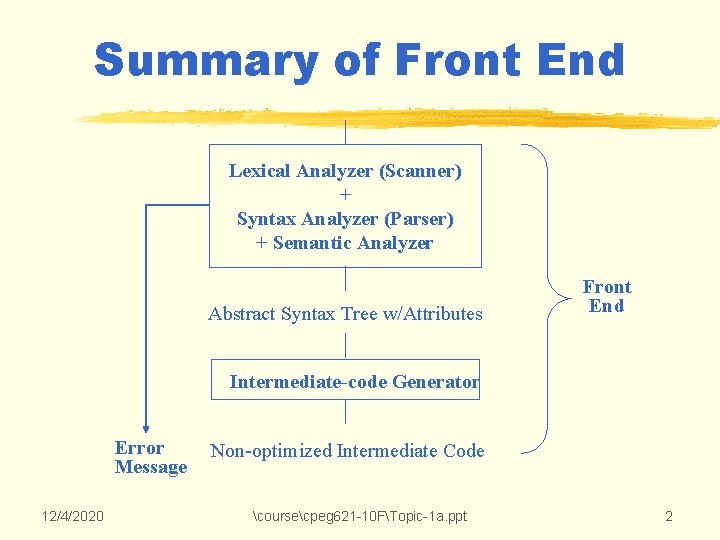
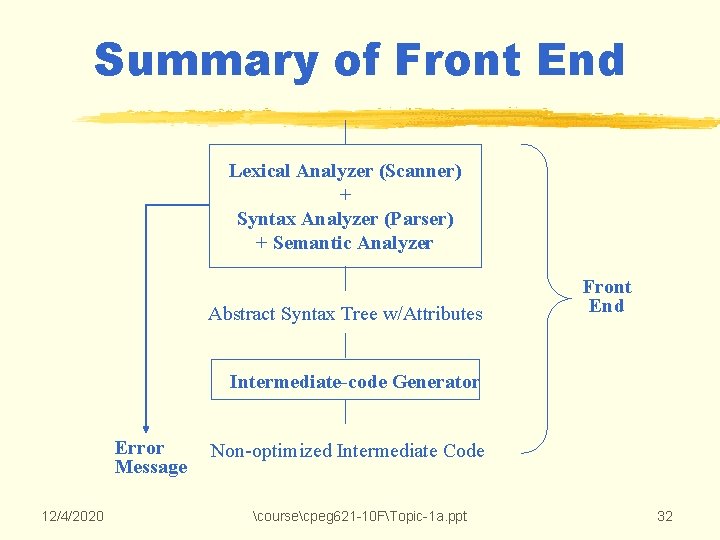
Summary of Front End Lexical Analyzer (Scanner) + Syntax Analyzer (Parser) + Semantic Analyzer Abstract Syntax Tree w/Attributes Front End Intermediate-code Generator Error Message 12/4/2020 Non-optimized Intermediate Code coursecpeg 621 -10 FTopic-1 a. ppt 2
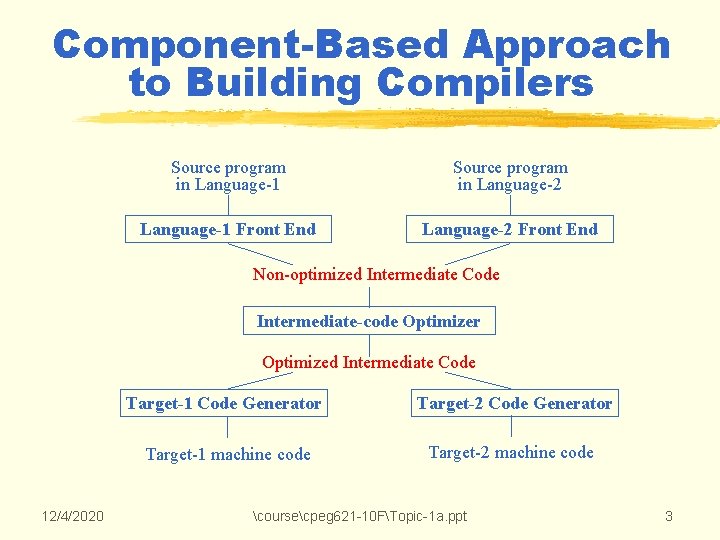
Component-Based Approach to Building Compilers Source program in Language-1 Source program in Language-2 Language-1 Front End Language-2 Front End Non-optimized Intermediate Code Intermediate-code Optimizer Optimized Intermediate Code 12/4/2020 Target-1 Code Generator Target-2 Code Generator Target-1 machine code Target-2 machine code coursecpeg 621 -10 FTopic-1 a. ppt 3
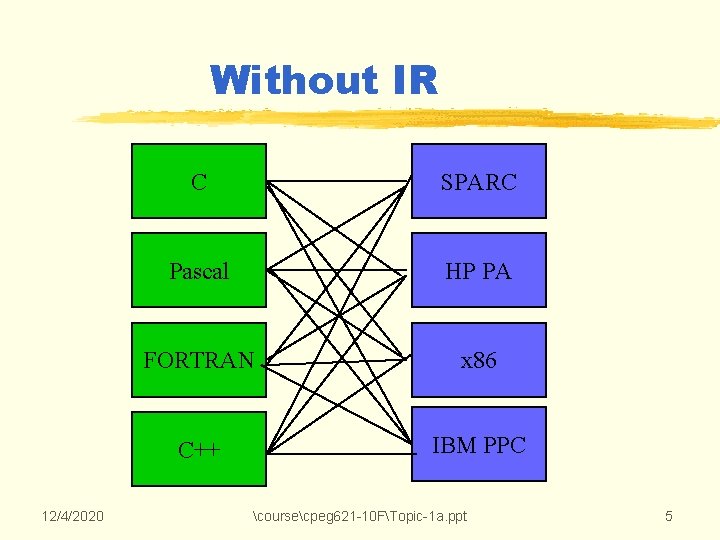
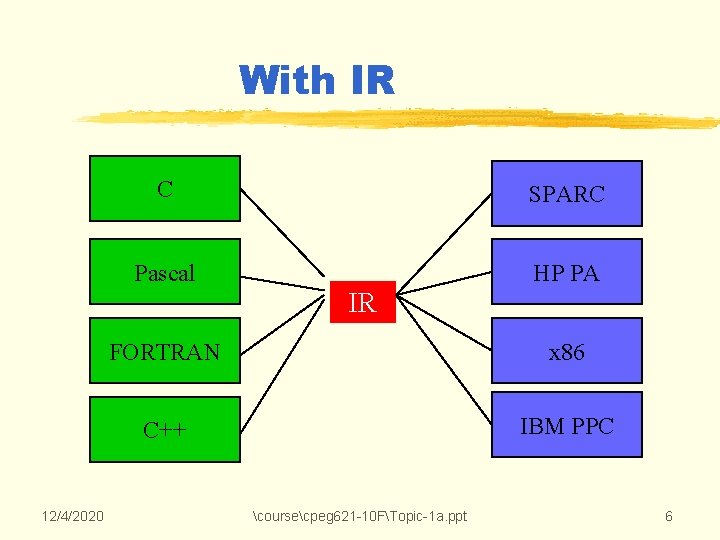
Intermediate Representation (IR) A kind of abstract machine language that can express the target machine operations without committing to too much machine details. z. Why IR ? 12/4/2020 coursecpeg 621 -10 FTopic-1 a. ppt 4
Without IR 12/4/2020 C SPARC Pascal HP PA FORTRAN x 86 C++ IBM PPC coursecpeg 621 -10 FTopic-1 a. ppt 5
With IR C SPARC Pascal HP PA IR 12/4/2020 FORTRAN x 86 C++ IBM PPC coursecpeg 621 -10 FTopic-1 a. ppt 6
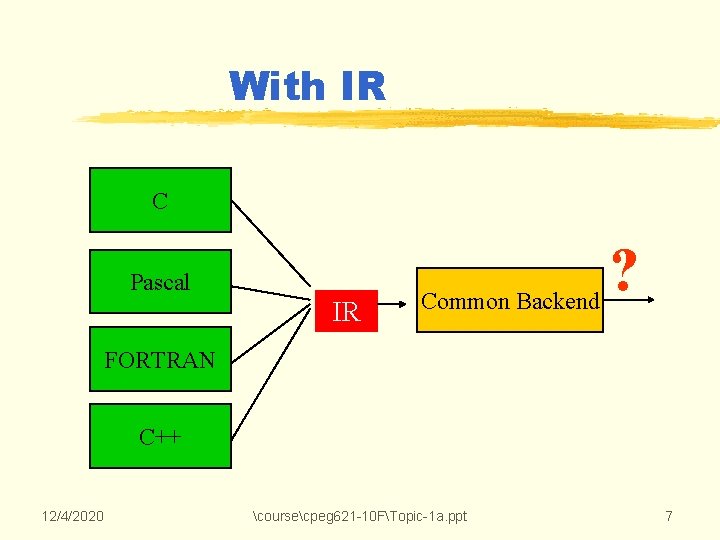
With IR C Pascal IR Common Backend ? FORTRAN C++ 12/4/2020 coursecpeg 621 -10 FTopic-1 a. ppt 7
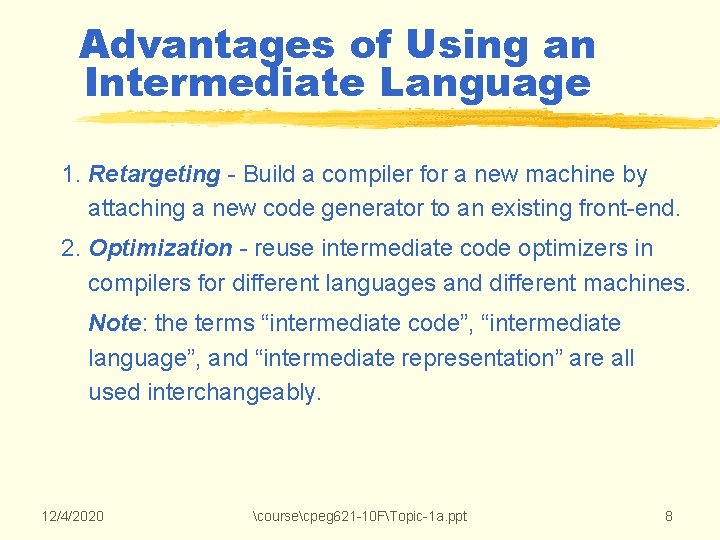
Advantages of Using an Intermediate Language 1. Retargeting - Build a compiler for a new machine by attaching a new code generator to an existing front-end. 2. Optimization - reuse intermediate code optimizers in compilers for different languages and different machines. Note: the terms “intermediate code”, “intermediate language”, and “intermediate representation” are all used interchangeably. 12/4/2020 coursecpeg 621 -10 FTopic-1 a. ppt 8
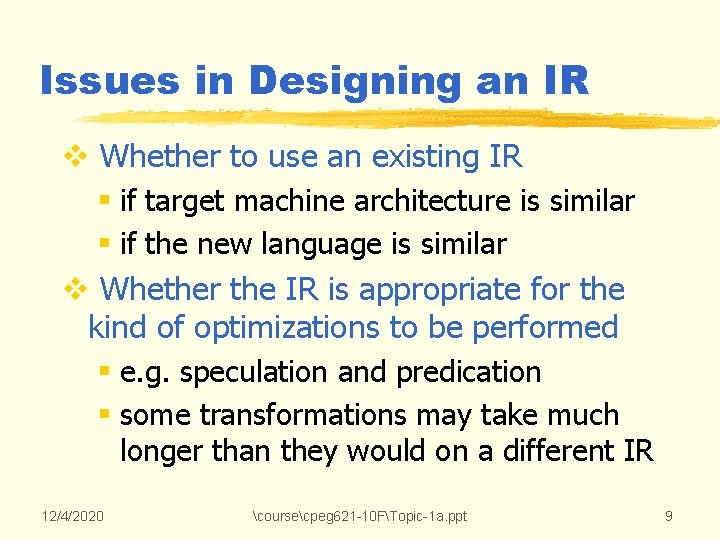
Issues in Designing an IR v Whether to use an existing IR § if target machine architecture is similar § if the new language is similar v Whether the IR is appropriate for the kind of optimizations to be performed § e. g. speculation and predication § some transformations may take much longer than they would on a different IR 12/4/2020 coursecpeg 621 -10 FTopic-1 a. ppt 9
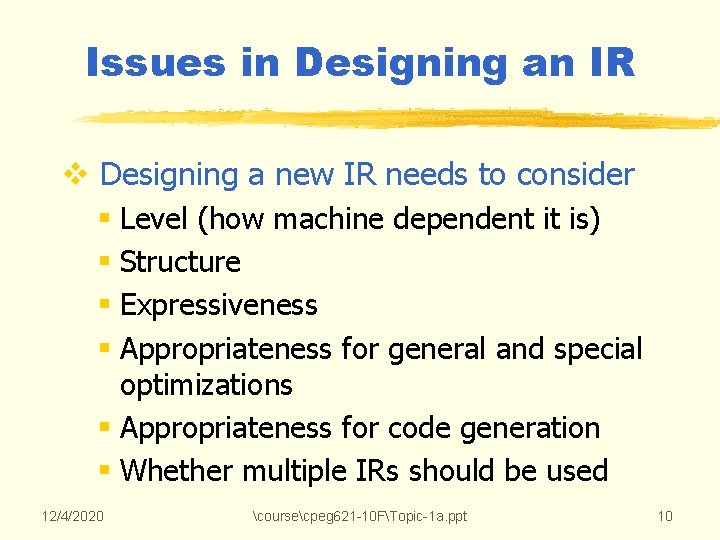
Issues in Designing an IR v Designing a new IR needs to consider § Level (how machine dependent it is) § Structure § Expressiveness § Appropriateness for general and special optimizations § Appropriateness for code generation § Whether multiple IRs should be used 12/4/2020 coursecpeg 621 -10 FTopic-1 a. ppt 10
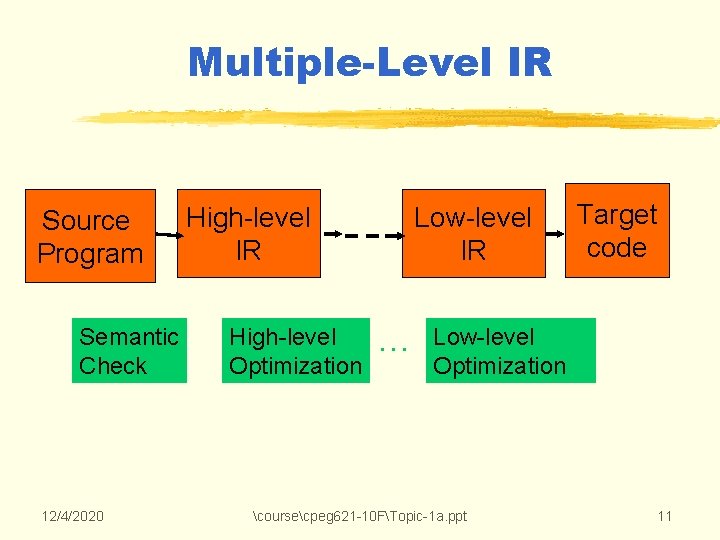
Multiple-Level IR Source Program Semantic Check 12/4/2020 High-level IR High-level Optimization Low-level IR … Target code Low-level Optimization coursecpeg 621 -10 FTopic-1 a. ppt 11
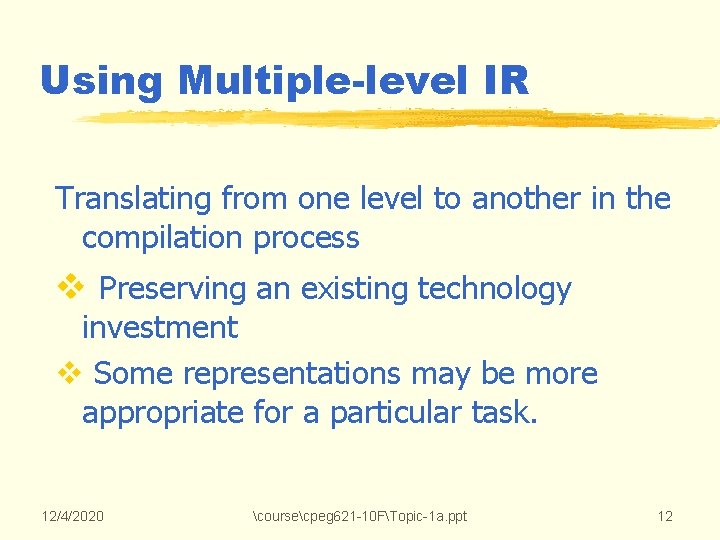
Using Multiple-level IR Translating from one level to another in the compilation process v Preserving an existing technology investment v Some representations may be more appropriate for a particular task. 12/4/2020 coursecpeg 621 -10 FTopic-1 a. ppt 12
Commonly Used IR z. Possible IR forms • Graphical representations: such as syntax trees, AST (Abstract Syntax Trees), DAG • Postfix notation • Three address code • SSA (Static Single Assignment) form z. IR should have individual components that describe simple things 12/4/2020 coursecpeg 621 -10 FTopic-1 a. ppt 13
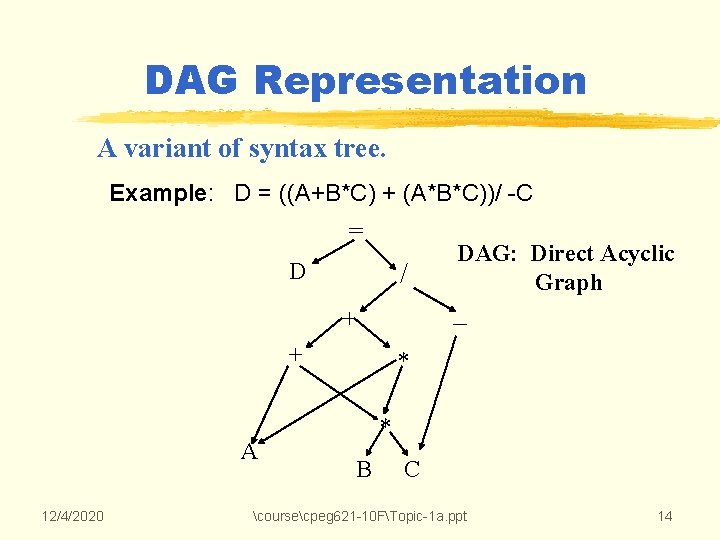
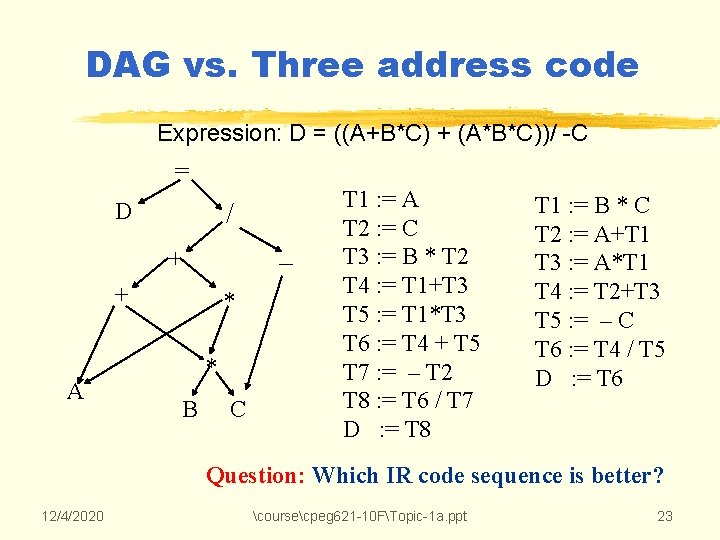
DAG Representation A variant of syntax tree. Example: D = ((A+B*C) + (A*B*C))/ -C = D / _ + + A 12/4/2020 DAG: Direct Acyclic Graph * * B C coursecpeg 621 -10 FTopic-1 a. ppt 14
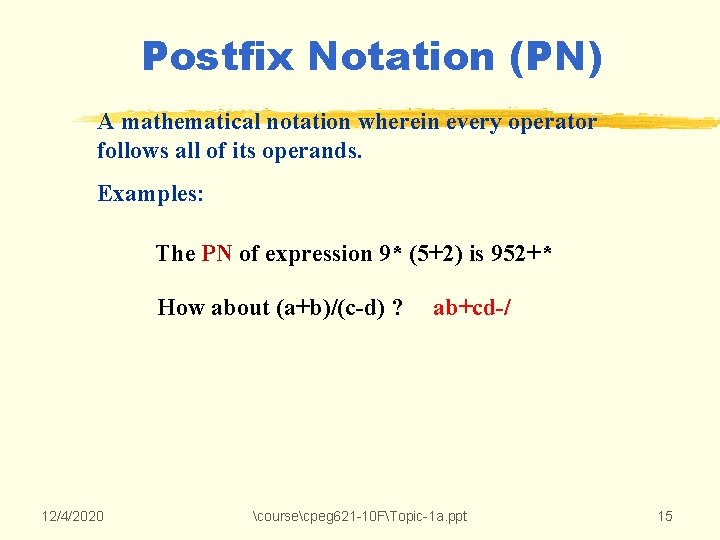
Postfix Notation (PN) A mathematical notation wherein every operator follows all of its operands. Examples: The PN of expression 9* (5+2) is 952+* How about (a+b)/(c-d) ? 12/4/2020 ab+cd-/ coursecpeg 621 -10 FTopic-1 a. ppt 15
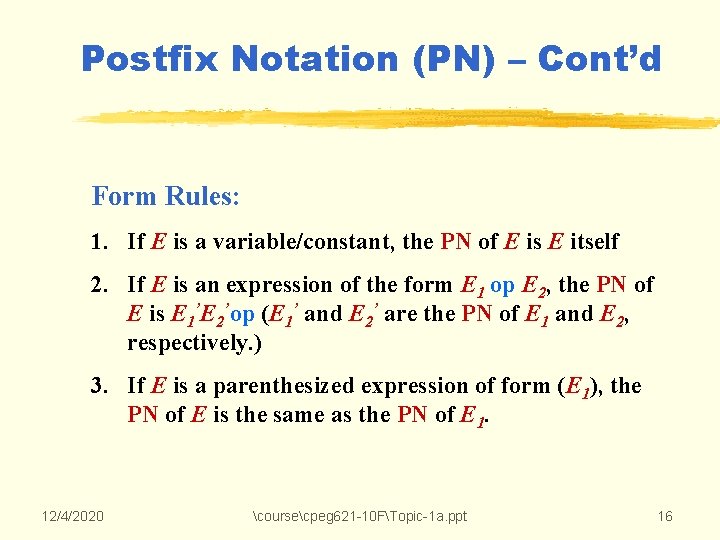
Postfix Notation (PN) – Cont’d Form Rules: 1. If E is a variable/constant, the PN of E is E itself 2. If E is an expression of the form E 1 op E 2, the PN of E is E 1’E 2’op (E 1’ and E 2’ are the PN of E 1 and E 2, respectively. ) 3. If E is a parenthesized expression of form (E 1), the PN of E is the same as the PN of E 1. 12/4/2020 coursecpeg 621 -10 FTopic-1 a. ppt 16
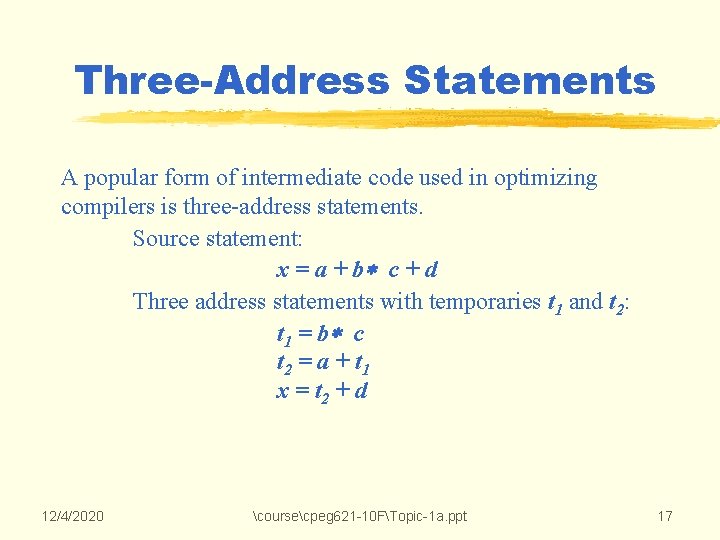
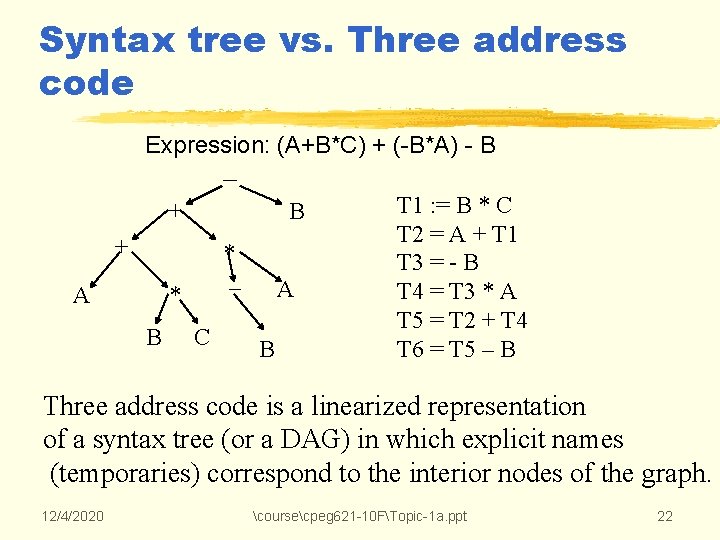
Three-Address Statements A popular form of intermediate code used in optimizing compilers is three-address statements. Source statement: x = a + b c + d Three address statements with temporaries t 1 and t 2: t 1 = b c t 2 = a + t 1 x = t 2 + d 12/4/2020 coursecpeg 621 -10 FTopic-1 a. ppt 17
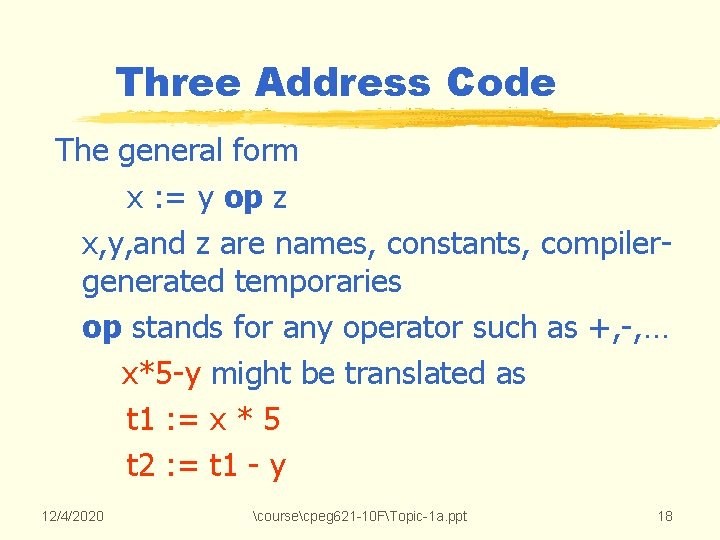
Three Address Code The general form x : = y op z x, y, and z are names, constants, compilergenerated temporaries op stands for any operator such as +, -, … x*5 -y might be translated as t 1 : = x * 5 t 2 : = t 1 - y 12/4/2020 coursecpeg 621 -10 FTopic-1 a. ppt 18
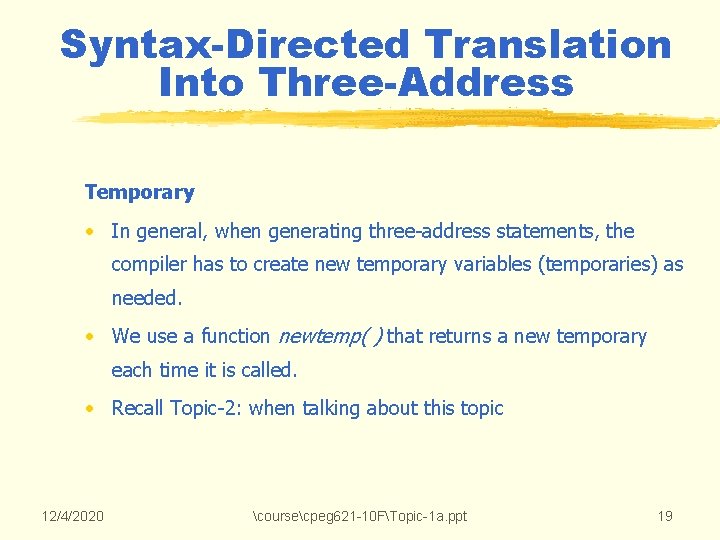
Syntax-Directed Translation Into Three-Address Temporary • In general, when generating three-address statements, the compiler has to create new temporary variables (temporaries) as needed. • We use a function newtemp( ) that returns a new temporary each time it is called. • Recall Topic-2: when talking about this topic 12/4/2020 coursecpeg 621 -10 FTopic-1 a. ppt 19
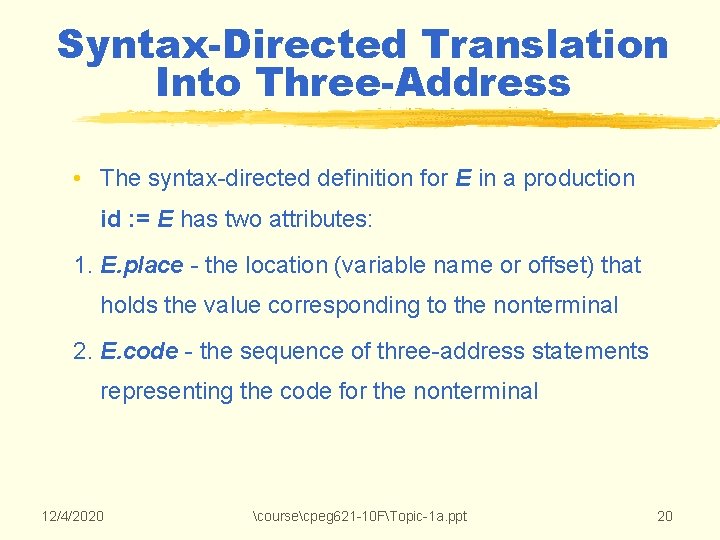
Syntax-Directed Translation Into Three-Address • The syntax-directed definition for E in a production id : = E has two attributes: 1. E. place - the location (variable name or offset) that holds the value corresponding to the nonterminal 2. E. code - the sequence of three-address statements representing the code for the nonterminal 12/4/2020 coursecpeg 621 -10 FTopic-1 a. ppt 20
Example Syntax-Directed Definition term : : = ID { term. place : = ID. place ; term. code = “” } term 1 : : = term 2 * ID {term 1. place : = newtemp( ); term 1. code : = term 2. code || ID. code ||* gen(term 1. place ‘: =‘ term 2. place ‘*’ ID. place} expr : : = term { expr. place : = term. place ; expr. code : = term. code } expr 1 : : = expr 2 + term { expr 1. place : = newtemp( ) expr 1. code : = expr 2. code || term. code ||+ gen(expr 1. place ‘: =‘ expr 2. place ‘+’ term. place } 12/4/2020 coursecpeg 621 -10 FTopic-1 a. ppt 21
Syntax tree vs. Three address code Expression: (A+B*C) + (-B*A) - B _ + B + A * _ * B C A B T 1 : = B * C T 2 = A + T 1 T 3 = - B T 4 = T 3 * A T 5 = T 2 + T 4 T 6 = T 5 – B Three address code is a linearized representation of a syntax tree (or a DAG) in which explicit names (temporaries) correspond to the interior nodes of the graph. 12/4/2020 coursecpeg 621 -10 FTopic-1 a. ppt 22
DAG vs. Three address code Expression: D = ((A+B*C) + (A*B*C))/ -C = D / _ + + A * * B C T 1 : = A T 2 : = C T 3 : = B * T 2 T 4 : = T 1+T 3 T 5 : = T 1*T 3 T 6 : = T 4 + T 5 T 7 : = – T 2 T 8 : = T 6 / T 7 D : = T 8 T 1 : = B * C T 2 : = A+T 1 T 3 : = A*T 1 T 4 : = T 2+T 3 T 5 : = – C T 6 : = T 4 / T 5 D : = T 6 Question: Which IR code sequence is better? 12/4/2020 coursecpeg 621 -10 FTopic-1 a. ppt 23
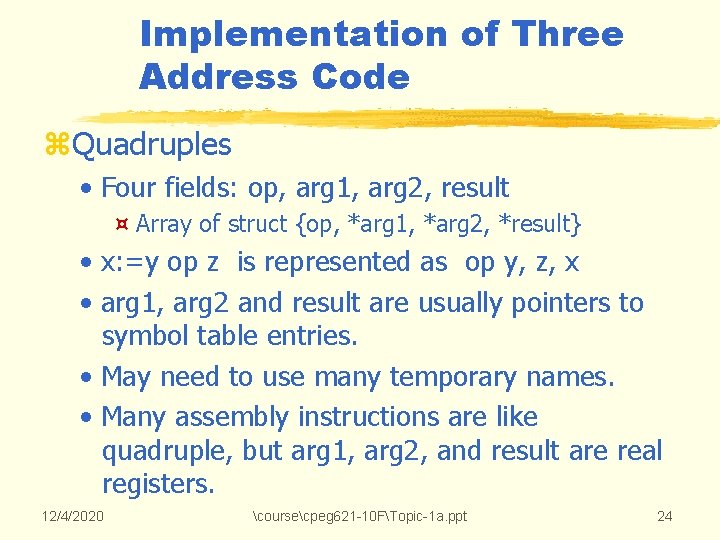
Implementation of Three Address Code z. Quadruples • Four fields: op, arg 1, arg 2, result ¤ Array of struct {op, *arg 1, *arg 2, *result} • x: =y op z is represented as op y, z, x • arg 1, arg 2 and result are usually pointers to symbol table entries. • May need to use many temporary names. • Many assembly instructions are like quadruple, but arg 1, arg 2, and result are real registers. 12/4/2020 coursecpeg 621 -10 FTopic-1 a. ppt 24
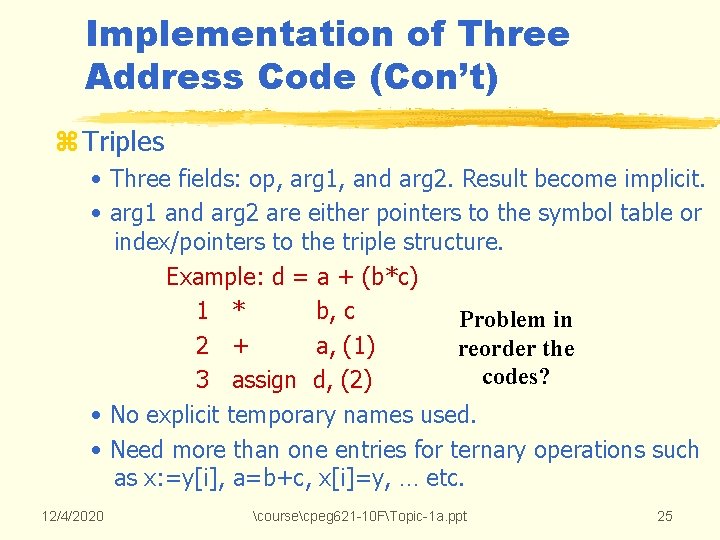
Implementation of Three Address Code (Con’t) z Triples • Three fields: op, arg 1, and arg 2. Result become implicit. • arg 1 and arg 2 are either pointers to the symbol table or index/pointers to the triple structure. Example: d = a + (b*c) 1 * b, c Problem in 2 + a, (1) reorder the codes? 3 assign d, (2) • No explicit temporary names used. • Need more than one entries for ternary operations such as x: =y[i], a=b+c, x[i]=y, … etc. 12/4/2020 coursecpeg 621 -10 FTopic-1 a. ppt 25
IR Example in Open 64 ─ WHIRL The Open 64 uses a tree-based intermediate representation called WHIRL, which stands for Winning Hierarchical Intermediate Representation Language. 12/4/2020 coursecpeg 621 -10 FTopic-1 a. ppt 26
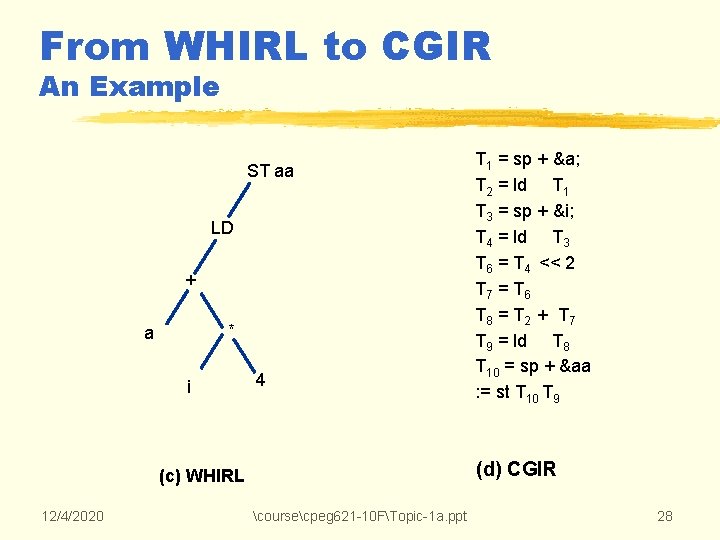
From WHIRL to CGIR An Example ST aa LD + * a i 4 (d) CGIR (c) WHIRL 12/4/2020 T 1 = sp + &a; T 2 = ld T 1 T 3 = sp + &i; T 4 = ld T 3 T 6 = T 4 << 2 T 7 = T 6 T 8 = T 2 + T 7 T 9 = ld T 8 T 10 = sp + &aa : = st T 10 T 9 coursecpeg 621 -10 FTopic-1 a. ppt 28
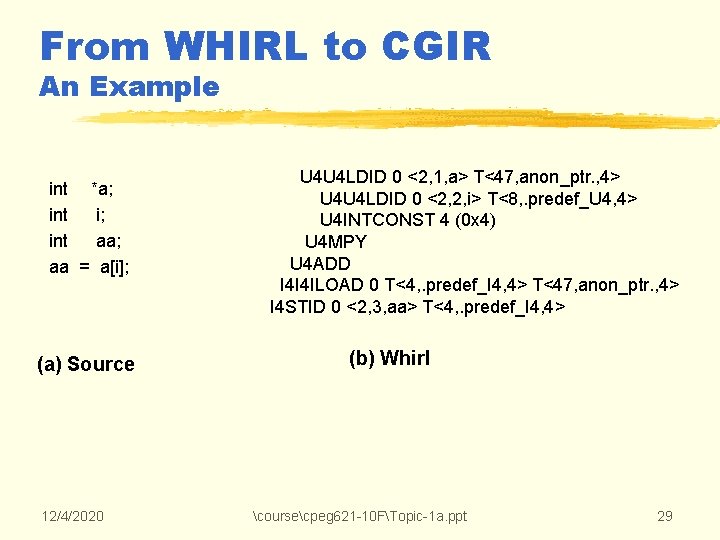
From WHIRL to CGIR An Example int *a; int i; int aa; aa = a[i]; (a) Source 12/4/2020 U 4 U 4 LDID 0 <2, 1, a> T<47, anon_ptr. , 4> U 4 U 4 LDID 0 <2, 2, i> T<8, . predef_U 4, 4> U 4 INTCONST 4 (0 x 4) U 4 MPY U 4 ADD I 4 I 4 ILOAD 0 T<4, . predef_I 4, 4> T<47, anon_ptr. , 4> I 4 STID 0 <2, 3, aa> T<4, . predef_I 4, 4> (b) Whirl coursecpeg 621 -10 FTopic-1 a. ppt 29
(insn 8 6 9 1 (set (reg: SI 61 [ i. 0 ]) (mem/c/i: SI (plus: SI (reg/f: SI 54 virtual-stack-vars) (const_int -8 [0 xffffffff 8])) [0 i+0 S 4 A 32])) -1 (nil)) U 4 U 4 LDID 0 <2, 1, a> T<47, anon_ptr. , 4> U 4 U 4 LDID 0 <2, 2, i> T<8, . predef_U 4, 4> U 4 INTCONST 4 (0 x 4) U 4 MPY U 4 ADD I 4 I 4 ILOAD 0 T<4, . predef_I 4, 4> T<47, anon_ptr. , 4> I 4 STID 0 <2, 3, aa> T<4, . predef_I 4, 4> (insn 9 8 10 1 (parallel [ (set (reg: SI 60 [ D. 1282 ]) (ashift: SI (reg: SI 61 [ i. 0 ]) (const_int 2 [0 x 2]))) (clobber (reg: CC 17 flags)) ]) -1 (nil)) (insn 10 9 11 1 (set (reg: SI 59 [ D. 1283 ]) (reg: SI 60 [ D. 1282 ])) -1 (nil)) (insn 11 10 12 1 (parallel [ (set (reg: SI 58 [ D. 1284 ]) (plus: SI (reg: SI 59 [ D. 1283 ]) (mem/f/c/i: SI (plus: SI (reg/f: SI 54 virtual-stack-vars) (const_int -12 [0 xffffffff 4])) [0 a+0 S 4 A 32]))) (clobber (reg: CC 17 flags)) ]) -1 (nil)) (insn 12 11 13 1 (set (reg: SI 62) (mem: SI (reg: SI 58 [ D. 1284 ]) [0 S 4 A 32])) -1 (nil)) (insn 13 12 14 1 (set (mem/c/i: SI (plus: SI (reg/f: SI 54 virtual-stack-vars) (const_int -4 [0 xffffffffc])) [0 aa+0 S 4 A 32]) (reg: SI 62)) -1 (nil)) WHIRL 12/4/2020 GCC RTL coursecpeg 621 -10 FTopic-1 a. ppt 30
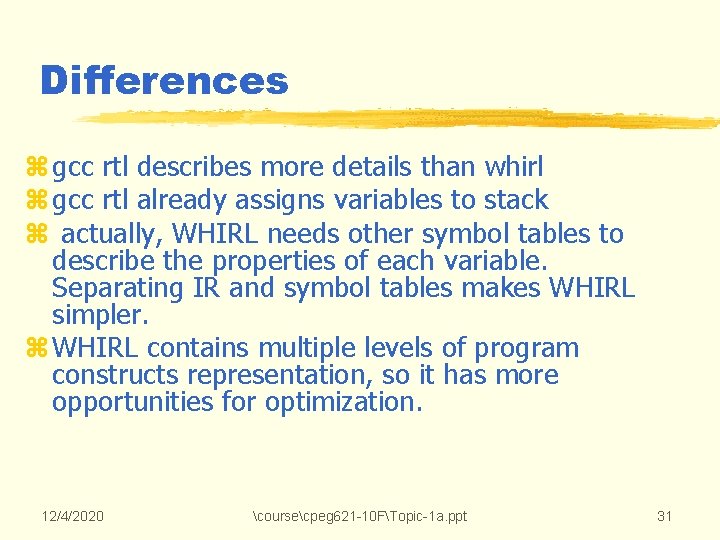
Differences z gcc rtl describes more details than whirl z gcc rtl already assigns variables to stack z actually, WHIRL needs other symbol tables to describe the properties of each variable. Separating IR and symbol tables makes WHIRL simpler. z WHIRL contains multiple levels of program constructs representation, so it has more opportunities for optimization. 12/4/2020 coursecpeg 621 -10 FTopic-1 a. ppt 31
Summary of Front End Lexical Analyzer (Scanner) + Syntax Analyzer (Parser) + Semantic Analyzer Abstract Syntax Tree w/Attributes Front End Intermediate-code Generator Error Message 12/4/2020 Non-optimized Intermediate Code coursecpeg 621 -10 FTopic-1 a. ppt 32
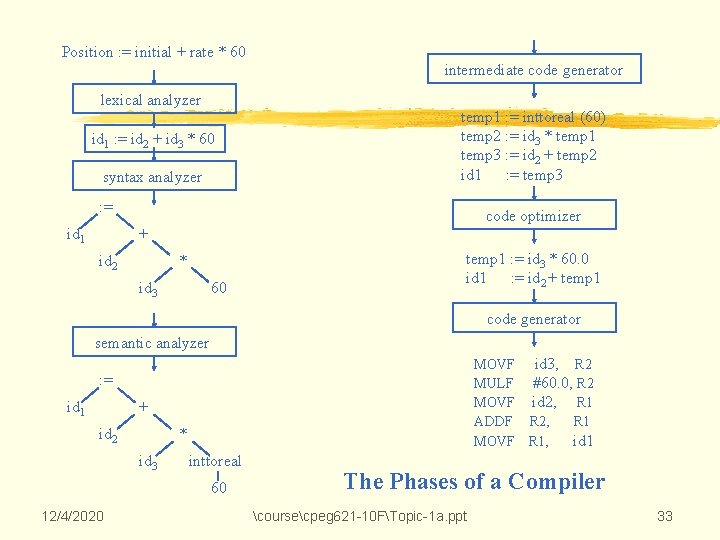
Position : = initial + rate * 60 intermediate code generator lexical analyzer id 1 : = id 2 + id 3 * 60 syntax analyzer temp 1 : = inttoreal (60) temp 2 : = id 3 * temp 1 temp 3 : = id 2 + temp 2 id 1 : = temp 3 : = id 1 code optimizer + id 2 * id 3 60 temp 1 : = id 3 * 60. 0 id 1 : = id 2 + temp 1 code generator semantic analyzer MOVF MULF MOVF ADDF MOVF : = id 1 + id 2 * id 3 inttoreal 60 12/4/2020 id 3, R 2 #60. 0, R 2 id 2, R 1 R 2, R 1, R 1 id 1 The Phases of a Compiler coursecpeg 621 -10 FTopic-1 a. ppt 33
Summary 1. Why IR 2. Commonly used IR 3. IRs of Open 64 and GCC 12/4/2020 coursecpeg 621 -10 FTopic-1 a. ppt 34