
Intermediate Code Generation Abstraction at the source level
Intermediate Code Generation • Abstraction at the source level identifiers, operators, expressions, statements, conditionals, iteration, functions (user defined, system defined or libraries) • Abstraction at the target level memory locations, registers, stack, opcodes, addressing modes, system libraries, interface to the operating systems • Code generation is mapping from source level abstractions to target machine abstractions 1
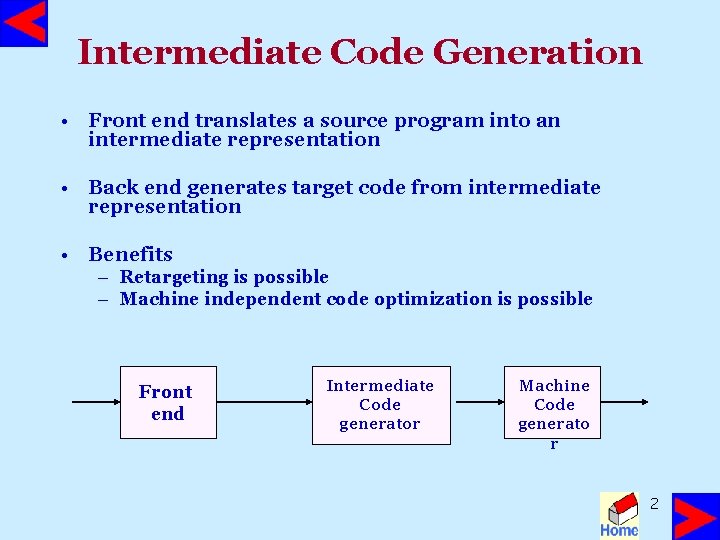
Intermediate Code Generation • Front end translates a source program into an intermediate representation • Back end generates target code from intermediate representation • Benefits – Retargeting is possible – Machine independent code optimization is possible Front end Intermediate Code generator Machine Code generato r 2
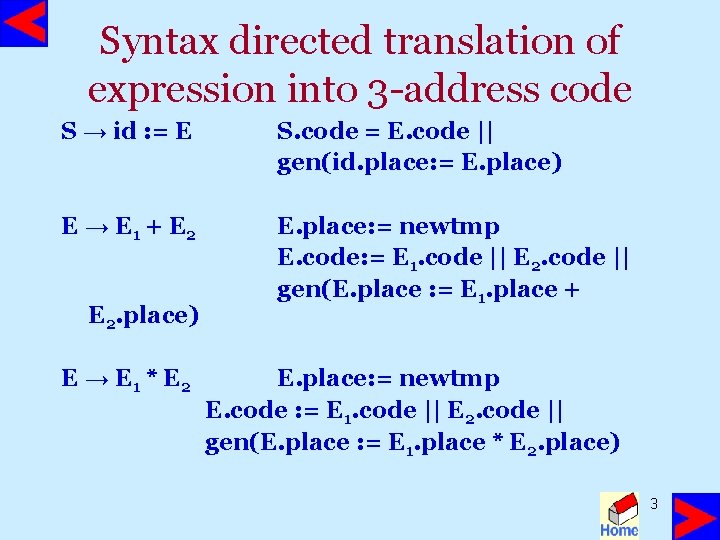
Syntax directed translation of expression into 3 -address code S → id : = E S. code = E. code || gen(id. place: = E. place) E → E 1 + E 2 E. place: = newtmp E. code: = E 1. code || E 2. code || gen(E. place : = E 1. place + E 2. place) E → E 1 * E 2 E. place: = newtmp E. code : = E 1. code || E 2. code || gen(E. place : = E 1. place * E 2. place) 3
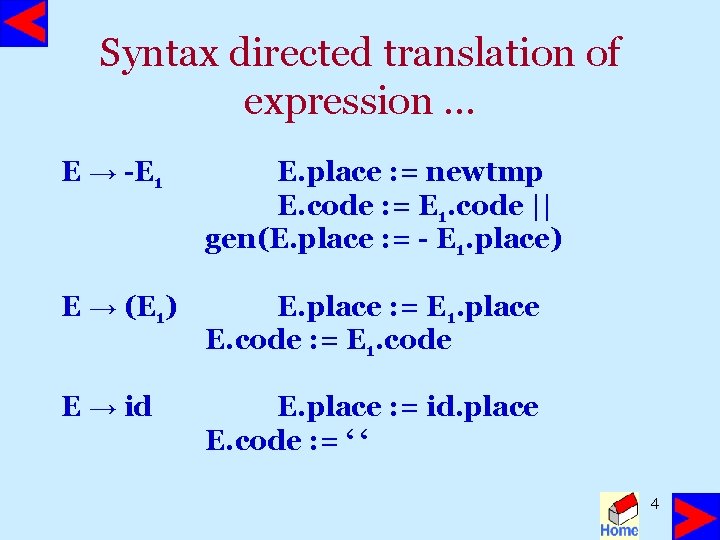
Syntax directed translation of expression … E → -E 1 E. place : = newtmp E. code : = E 1. code || gen(E. place : = - E 1. place) E → (E 1) E. place : = E 1. place E. code : = E 1. code E → id E. place : = id. place E. code : = ‘ ‘ 4
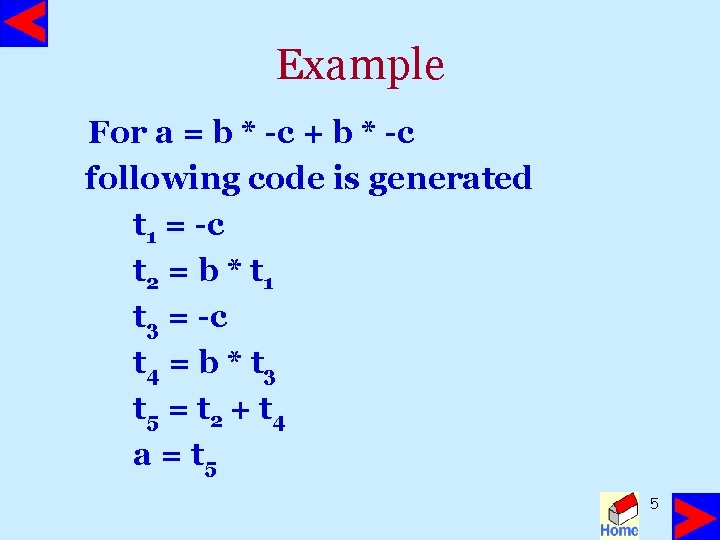
Example For a = b * -c + b * -c following code is generated t 1 = -c t 2 = b * t 1 t 3 = -c t 4 = b * t 3 t 5 = t 2 + t 4 a = t 5 5
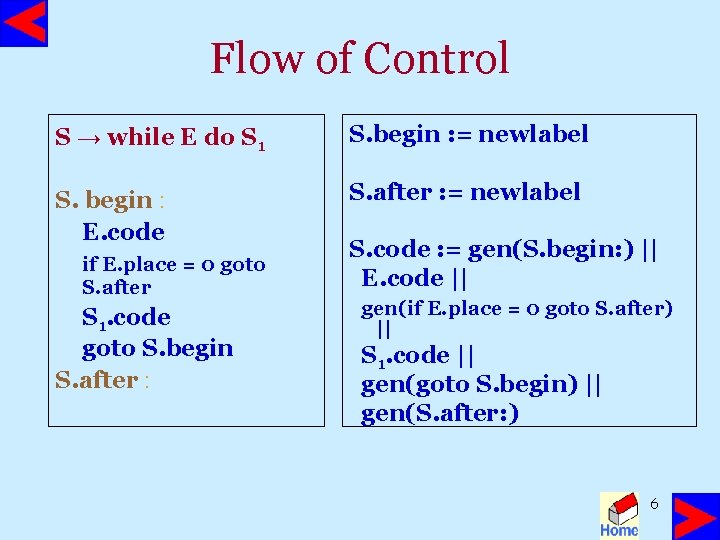
Flow of Control S → while E do S 1 S. begin : = newlabel S. begin : E. code S. after : = newlabel if E. place = 0 goto S. after S 1. code goto S. begin S. after : S. code : = gen(S. begin: ) || E. code || gen(if E. place = 0 goto S. after) || S 1. code || gen(goto S. begin) || gen(S. after: ) 6
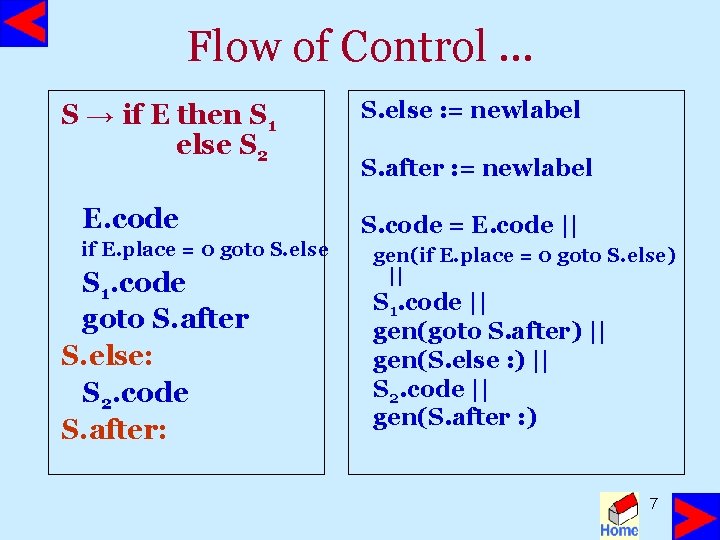
Flow of Control … S → if E then S 1 else S 2 E. code if E. place = 0 goto S. else S 1. code goto S. after S. else: S 2. code S. after: S. else : = newlabel S. after : = newlabel S. code = E. code || gen(if E. place = 0 goto S. else) || S 1. code || gen(goto S. after) || gen(S. else : ) || S 2. code || gen(S. after : ) 7
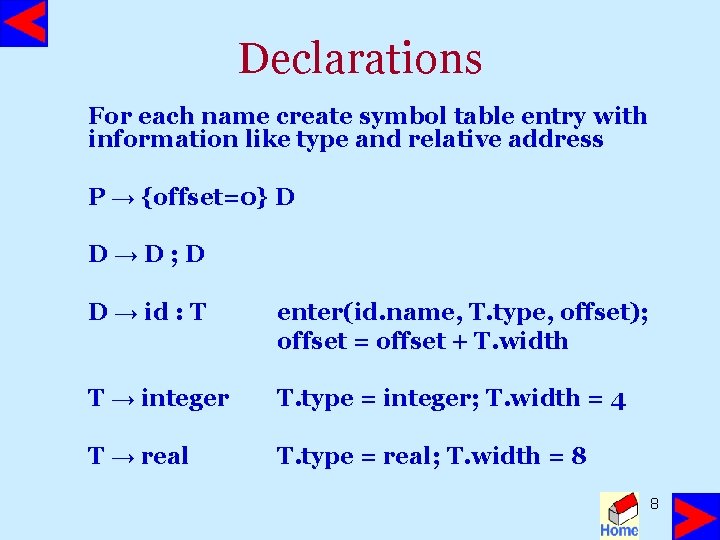
Declarations For each name create symbol table entry with information like type and relative address P → {offset=0} D D→D; D D → id : T enter(id. name, T. type, offset); offset = offset + T. width T → integer T. type = integer; T. width = 4 T → real T. type = real; T. width = 8 8
![Declarations … T → array [ num ] of T 1 T. type =](http://slidetodoc.com/presentation_image_h2/d6719eb8879e47a64614345ef105ada3/image-9.jpg "Declarations … T → array [ num ] of T 1 T. type =")
Declarations … T → array [ num ] of T 1 T. type = array(num. val, T 1. type) T. width = num. val x T 1. width T → ↑T 1 T. type = pointer(T 1. type) T. width = 4 9
Keeping track of local information • when a nested procedure is seen, processing of declaration in enclosing procedure is temporarily suspended • assume following language P→D D → D ; D | id : T | proc id ; D ; S • a new symbol table is created when procedure declaration D → proc id ; D 1 ; S is seen • entries for D 1 are created in the new symbol table • the name represented by id is local to the enclosing procedure 10
![Example program sort; var a : array[1. . n] of integer; x : integer;](http://slidetodoc.com/presentation_image_h2/d6719eb8879e47a64614345ef105ada3/image-11.jpg "Example program sort; var a : array[1. . n] of integer; x : integer;")
Example program sort; var a : array[1. . n] of integer; x : integer; procedure readarray; var i : integer; …… procedure exchange(i, j: integers); …… procedure quicksort(m, n : integer); var k, v : integer; function partition(x, y: integer): integer; var i, j: integer; …… …… begin{main} …… end. 11
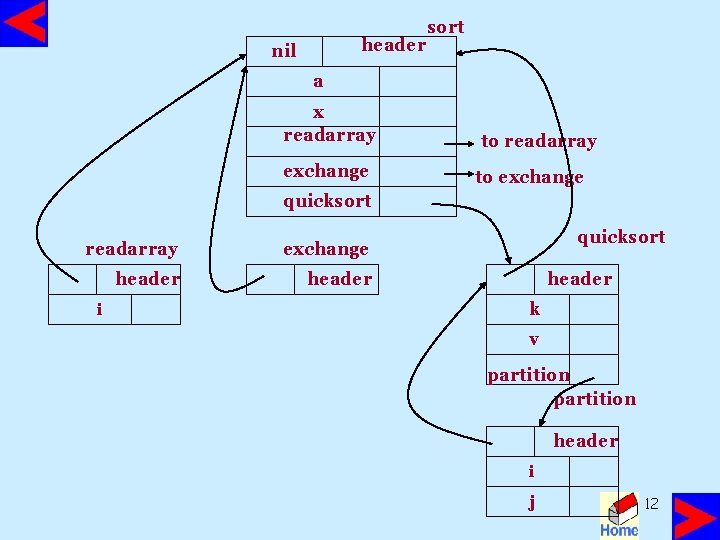
header nil sort a x readarray exchange to readarray to exchange quicksort readarray exchange header i quicksort header k v partition header i j 12
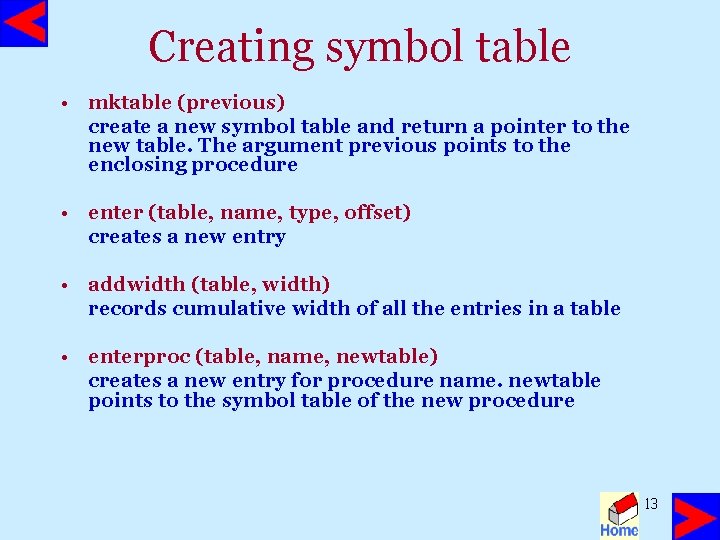
Creating symbol table • mktable (previous) create a new symbol table and return a pointer to the new table. The argument previous points to the enclosing procedure • enter (table, name, type, offset) creates a new entry • addwidth (table, width) records cumulative width of all the entries in a table • enterproc (table, name, newtable) creates a new entry for procedure name. newtable points to the symbol table of the new procedure 13
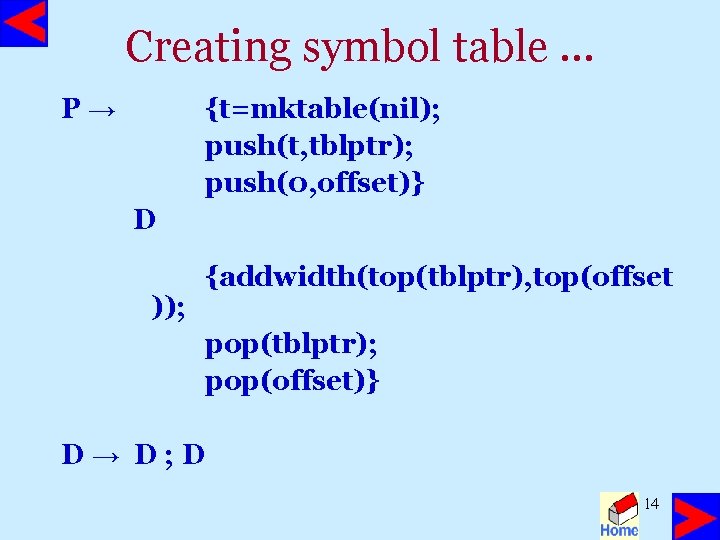
Creating symbol table … P→ {t=mktable(nil); push(t, tblptr); push(0, offset)} D )); {addwidth(top(tblptr), top(offset pop(tblptr); pop(offset)} D→ D; D 14
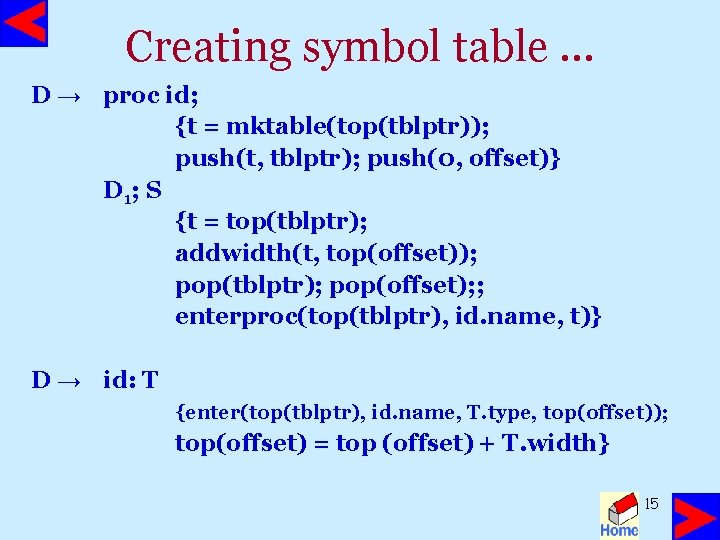
Creating symbol table … D → proc id; {t = mktable(top(tblptr)); push(t, tblptr); push(0, offset)} D 1; S {t = top(tblptr); addwidth(t, top(offset)); pop(tblptr); pop(offset); ; enterproc(top(tblptr), id. name, t)} D → id: T {enter(top(tblptr), id. name, T. type, top(offset)); top(offset) = top (offset) + T. width} 15
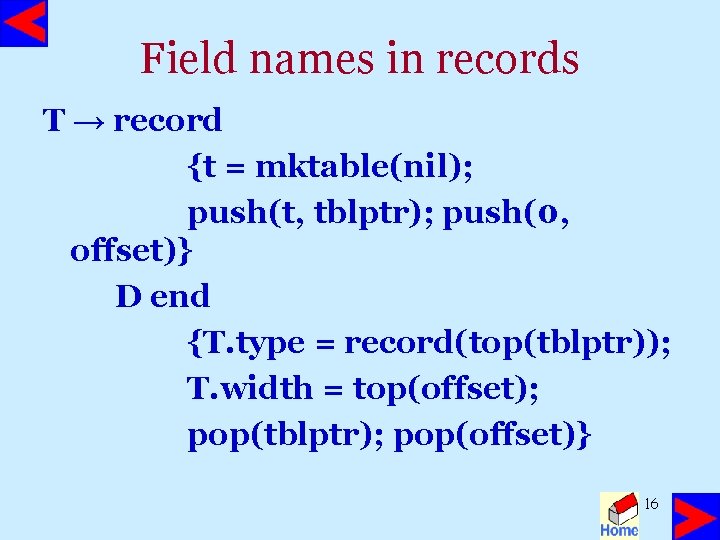
Field names in records T → record {t = mktable(nil); push(t, tblptr); push(0, offset)} D end {T. type = record(top(tblptr)); T. width = top(offset); pop(tblptr); pop(offset)} 16
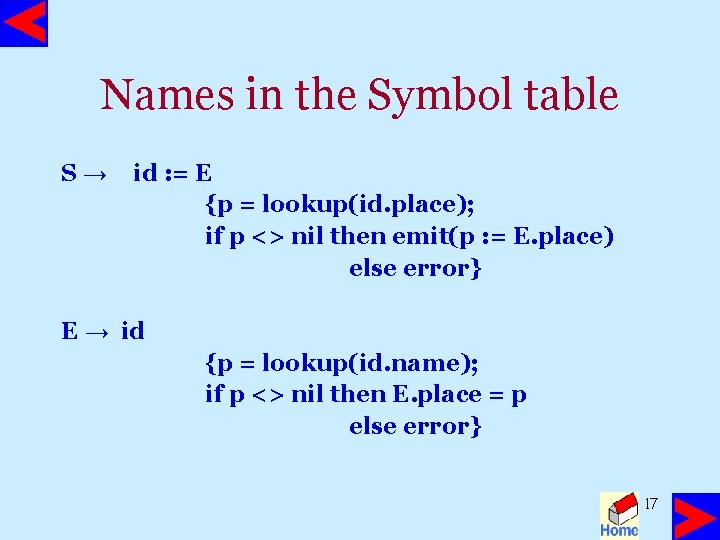
Names in the Symbol table S→ id : = E {p = lookup(id. place); if p <> nil then emit(p : = E. place) else error} E → id {p = lookup(id. name); if p <> nil then E. place = p else error} 17
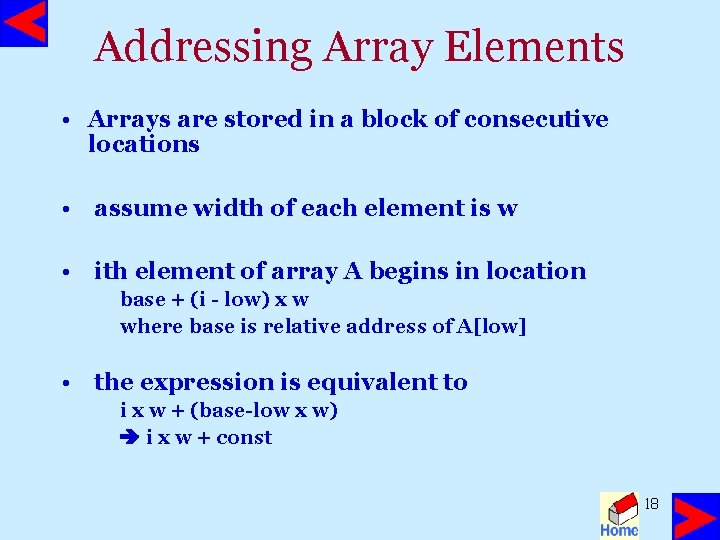
Addressing Array Elements • Arrays are stored in a block of consecutive locations • assume width of each element is w • ith element of array A begins in location base + (i - low) x w where base is relative address of A[low] • the expression is equivalent to i x w + (base-low x w) i x w + const 18
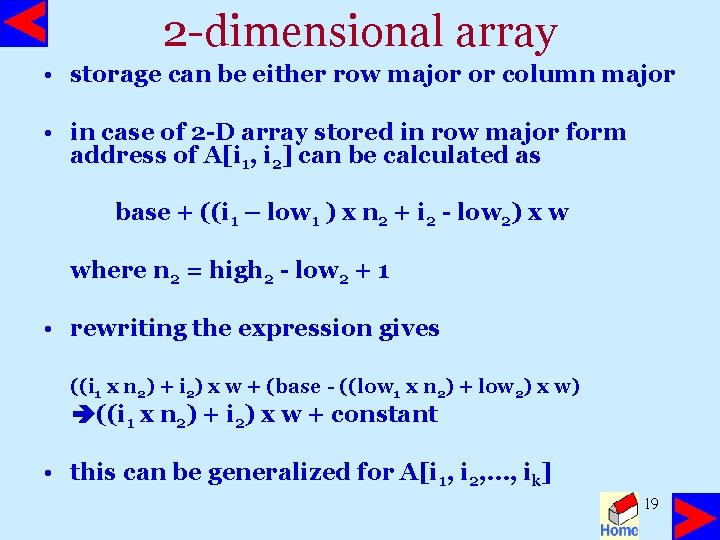
2 -dimensional array • storage can be either row major or column major • in case of 2 -D array stored in row major form address of A[i 1, i 2] can be calculated as base + ((i 1 – low 1 ) x n 2 + i 2 - low 2) x w where n 2 = high 2 - low 2 + 1 • rewriting the expression gives ((i 1 x n 2) + i 2) x w + (base - ((low 1 x n 2) + low 2) x w) ((i 1 x n 2) + i 2) x w + constant • this can be generalized for A[i 1, i 2, …, ik] 19
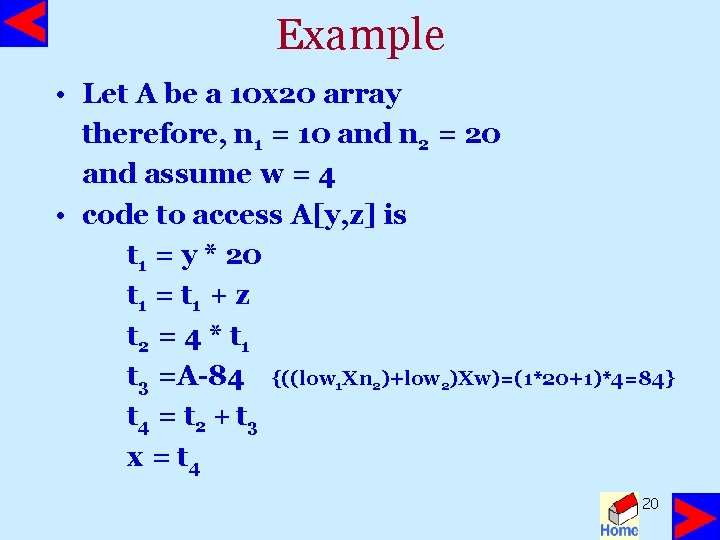
Example • Let A be a 10 x 20 array therefore, n 1 = 10 and n 2 = 20 and assume w = 4 • code to access A[y, z] is t 1 = y * 20 t 1 = t 1 + z t 2 = 4 * t 1 t 3 =A-84 {((low 1 Xn 2)+low 2)Xw)=(1*20+1)*4=84} t 4 = t 2 + t 3 x = t 4 20
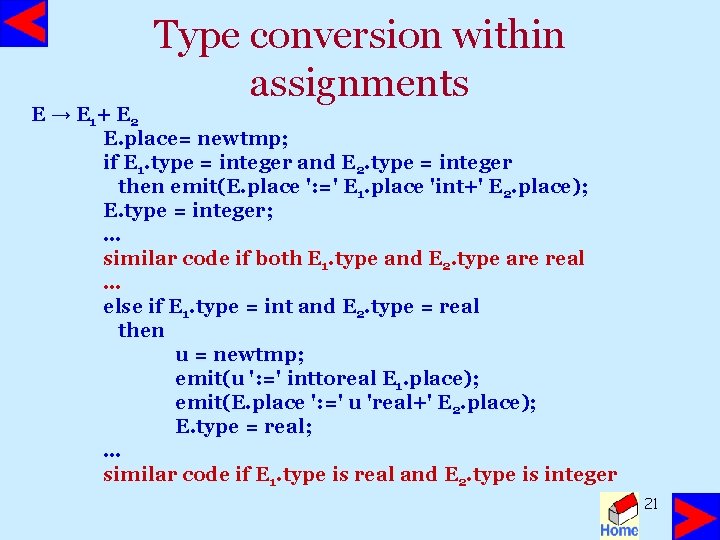
Type conversion within assignments E → E 1 + E 2 E. place= newtmp; if E 1. type = integer and E 2. type = integer then emit(E. place ': =' E 1. place 'int+' E 2. place); E. type = integer; … similar code if both E 1. type and E 2. type are real … else if E 1. type = int and E 2. type = real then u = newtmp; emit(u ': =' inttoreal E 1. place); emit(E. place ': =' u 'real+' E 2. place); E. type = real; … similar code if E 1. type is real and E 2. type is integer 21
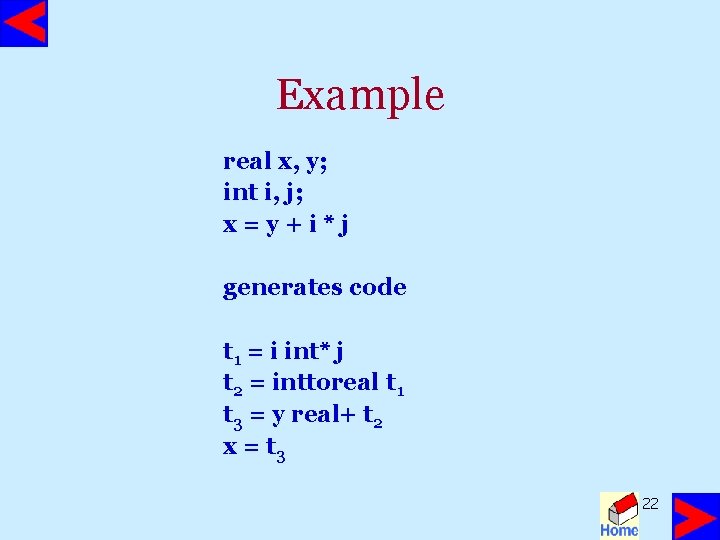
Example real x, y; int i, j; x=y+i*j generates code t 1 = i int* j t 2 = inttoreal t 1 t 3 = y real+ t 2 x = t 3 22
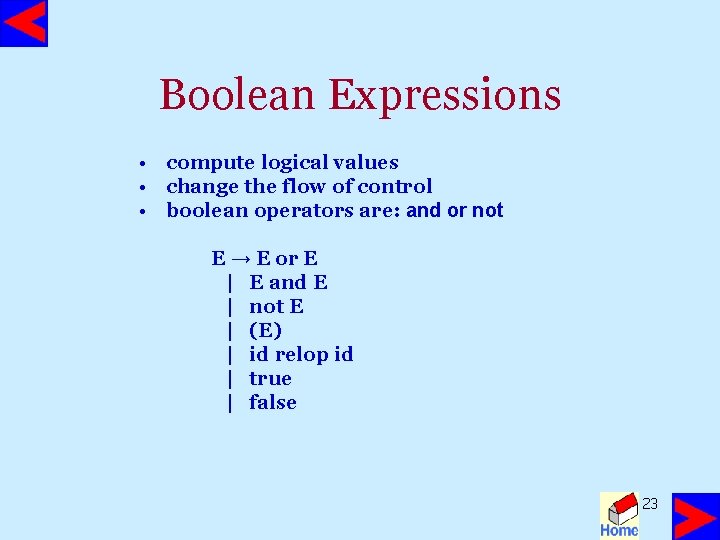
Boolean Expressions • compute logical values • change the flow of control • boolean operators are: and or not E → E or E | E and E | not E | (E) | id relop id | true | false 23
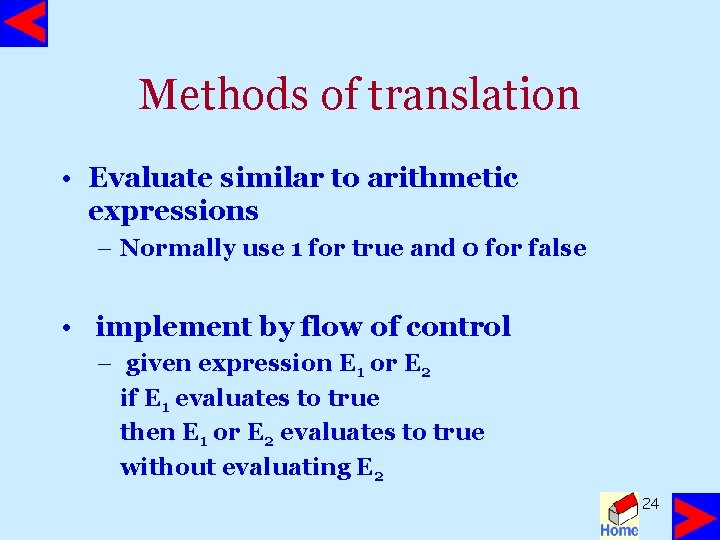
Methods of translation • Evaluate similar to arithmetic expressions – Normally use 1 for true and 0 for false • implement by flow of control – given expression E 1 or E 2 if E 1 evaluates to true then E 1 or E 2 evaluates to true without evaluating E 2 24
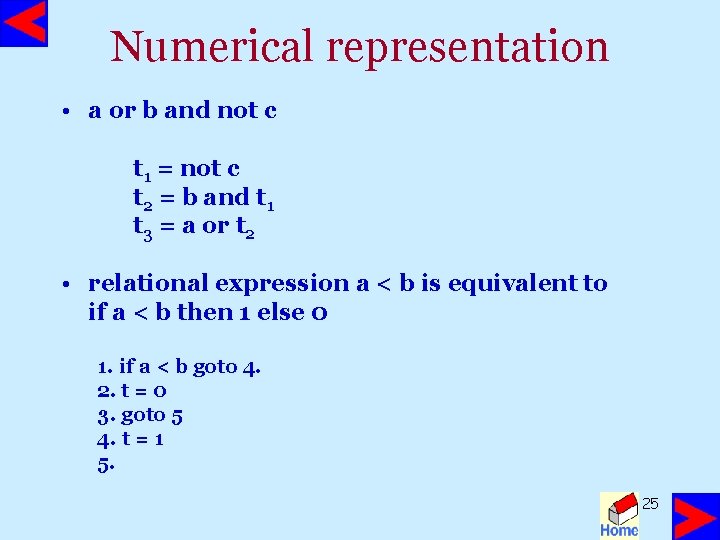
Numerical representation • a or b and not c t 1 = not c t 2 = b and t 1 t 3 = a or t 2 • relational expression a < b is equivalent to if a < b then 1 else 0 1. if a < b goto 4. 2. t = 0 3. goto 5 4. t = 1 5. 25
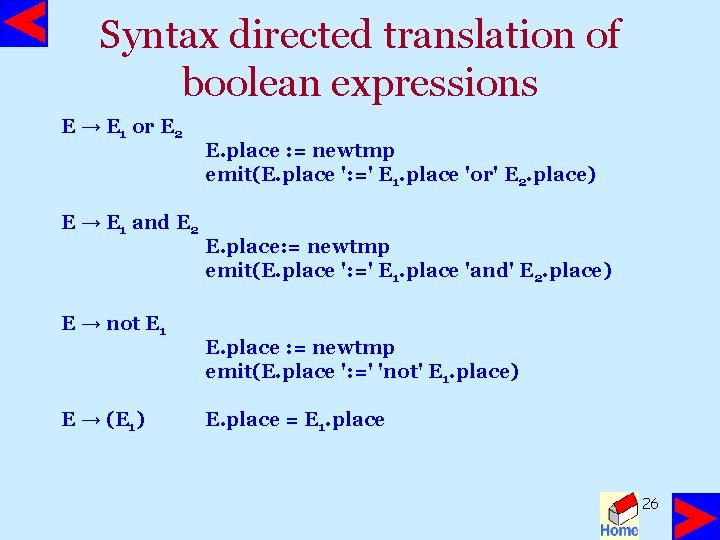
Syntax directed translation of boolean expressions E → E 1 or E 2 E → E 1 and E 2 E → not E 1 E → (E 1) E. place : = newtmp emit(E. place ': =' E 1. place 'or' E 2. place) E. place: = newtmp emit(E. place ': =' E 1. place 'and' E 2. place) E. place : = newtmp emit(E. place ': =' 'not' E 1. place) E. place = E 1. place 26
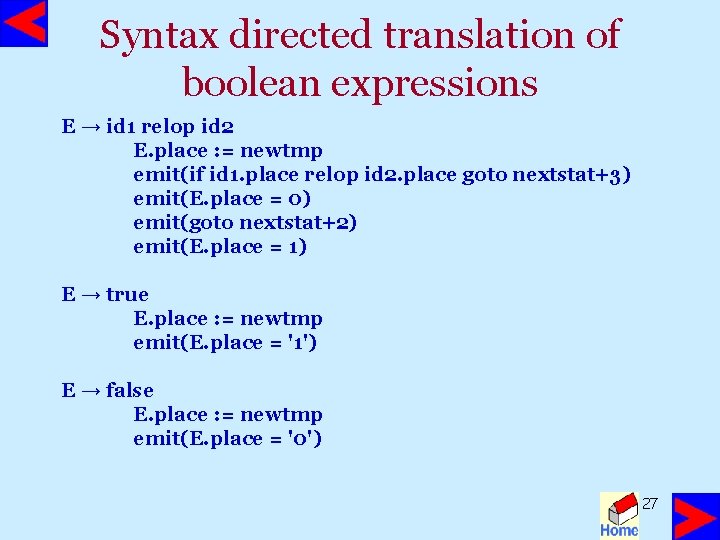
Syntax directed translation of boolean expressions E → id 1 relop id 2 E. place : = newtmp emit(if id 1. place relop id 2. place goto nextstat+3) emit(E. place = 0) emit(goto nextstat+2) emit(E. place = 1) E → true E. place : = newtmp emit(E. place = '1') E → false E. place : = newtmp emit(E. place = '0') 27
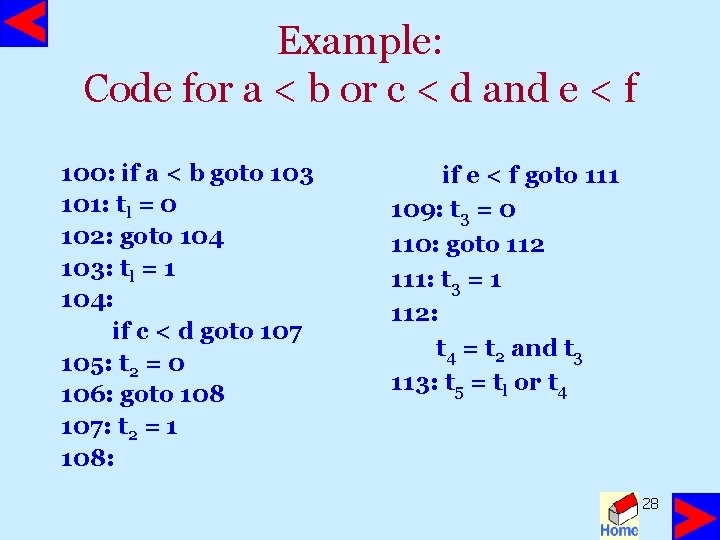
Example: Code for a < b or c < d and e < f 100: if a < b goto 103 101: tl = 0 102: goto 104 103: tl = 1 104: if c < d goto 107 105: t 2 = 0 106: goto 108 107: t 2 = 1 108: if e < f goto 111 109: t 3 = 0 110: goto 112 111: t 3 = 1 112: t 4 = t 2 and t 3 113: t 5 = tl or t 4 28
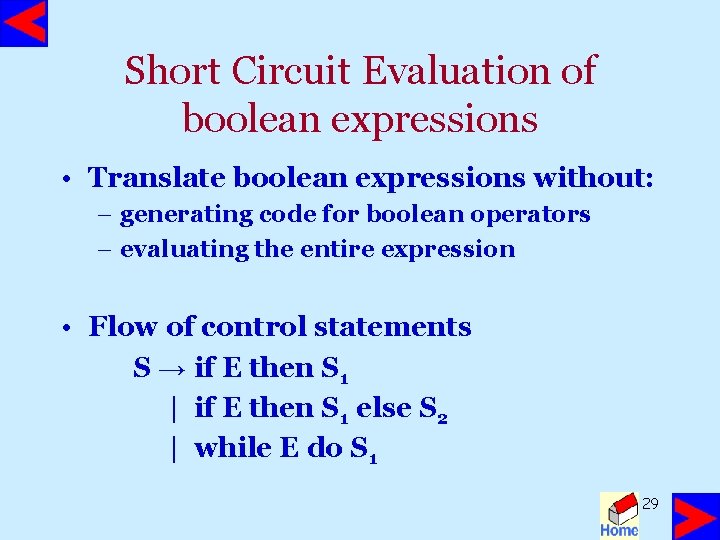
Short Circuit Evaluation of boolean expressions • Translate boolean expressions without: – generating code for boolean operators – evaluating the entire expression • Flow of control statements S → if E then S 1 | if E then S 1 else S 2 | while E do S 1 29
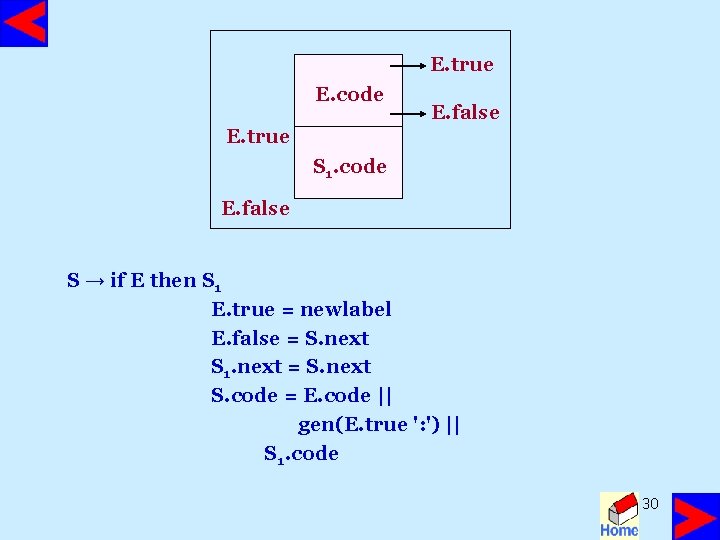
E. true E. code E. false E. true S 1. code E. false S → if E then S 1 E. true = newlabel E. false = S. next S 1. next = S. next S. code = E. code || gen(E. true ': ') || S 1. code 30
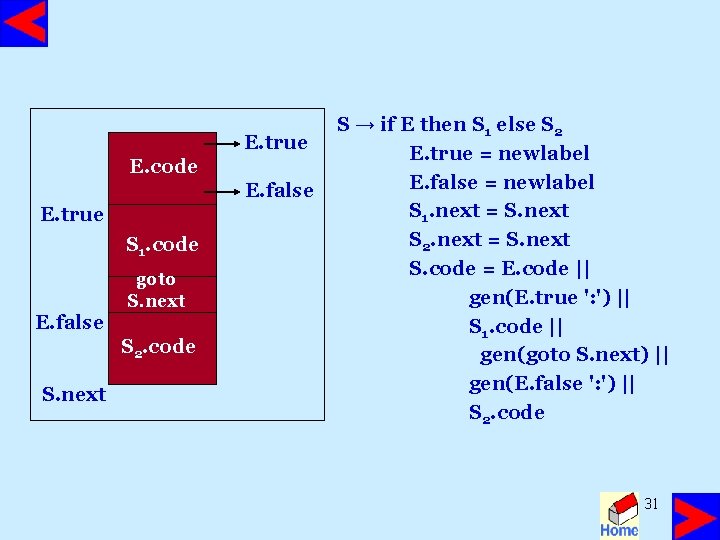
E. true E. code E. false E. true S 1. code E. false goto S. next S 2. code S. next S → if E then S 1 else S 2 E. true = newlabel E. false = newlabel S 1. next = S. next S 2. next = S. next S. code = E. code || gen(E. true ': ') || S 1. code || gen(goto S. next) || gen(E. false ': ') || S 2. code 31
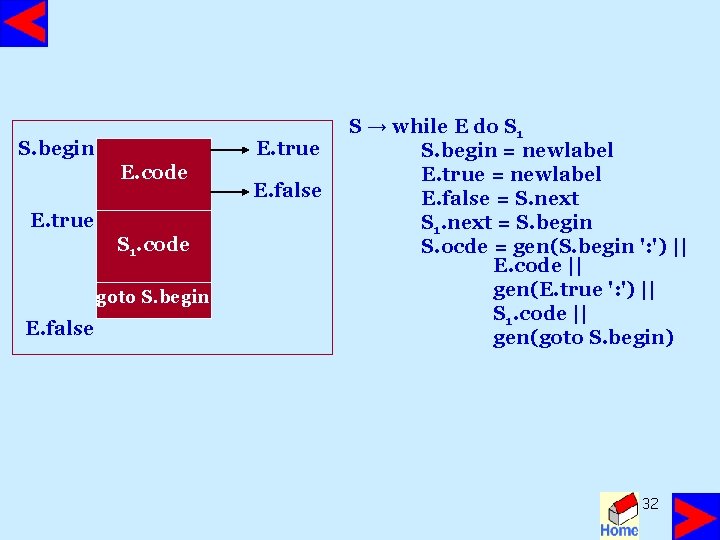
S. begin E. true E. code E. true S 1. code goto S. begin E. false S → while E do S 1 S. begin = newlabel E. true = newlabel E. false = S. next S 1. next = S. begin S. ocde = gen(S. begin ': ') || E. code || gen(E. true ': ') || S 1. code || gen(goto S. begin) 32
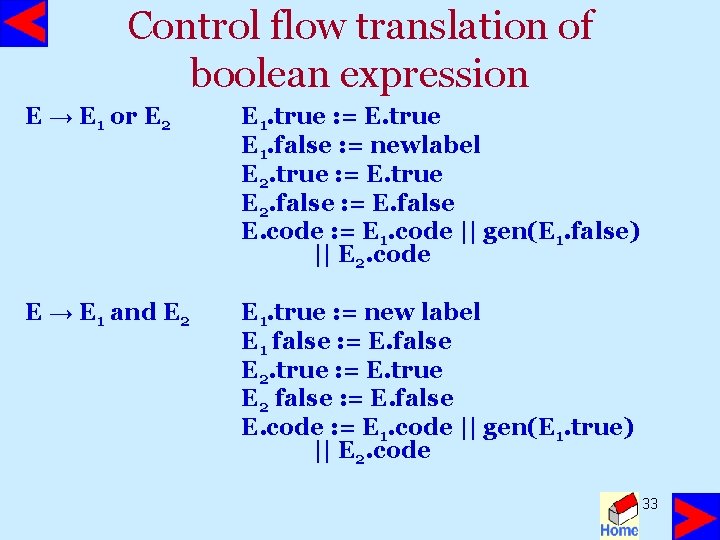
Control flow translation of boolean expression E → E 1 or E 2 E 1. true : = E. true E 1. false : = newlabel E 2. true : = E. true E 2. false : = E. false E. code : = E 1. code || gen(E 1. false) || E 2. code E → E 1 and E 2 E 1. true : = new label E 1 false : = E. false E 2. true : = E. true E 2 false : = E. false E. code : = E 1. code || gen(E 1. true) || E 2. code 33
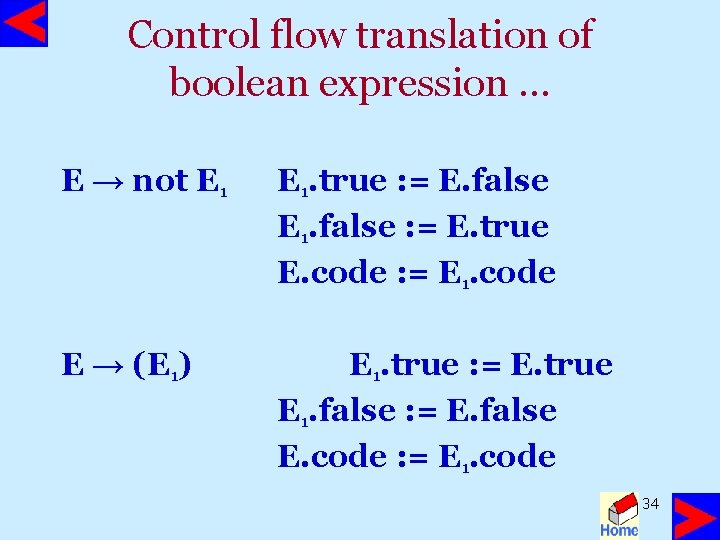
Control flow translation of boolean expression … E → not E 1. true : = E. false E 1. false : = E. true E. code : = E 1. code E → (E 1) E 1. true : = E. true E 1. false : = E. false E. code : = E 1. code 34
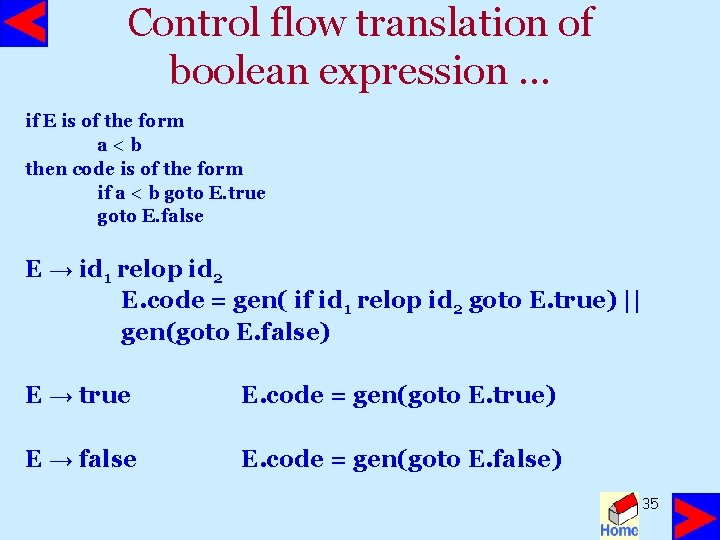
Control flow translation of boolean expression … if E is of the form a<b then code is of the form if a < b goto E. true goto E. false E → id 1 relop id 2 E. code = gen( if id 1 relop id 2 goto E. true) || gen(goto E. false) E → true E. code = gen(goto E. true) E → false E. code = gen(goto E. false) 35
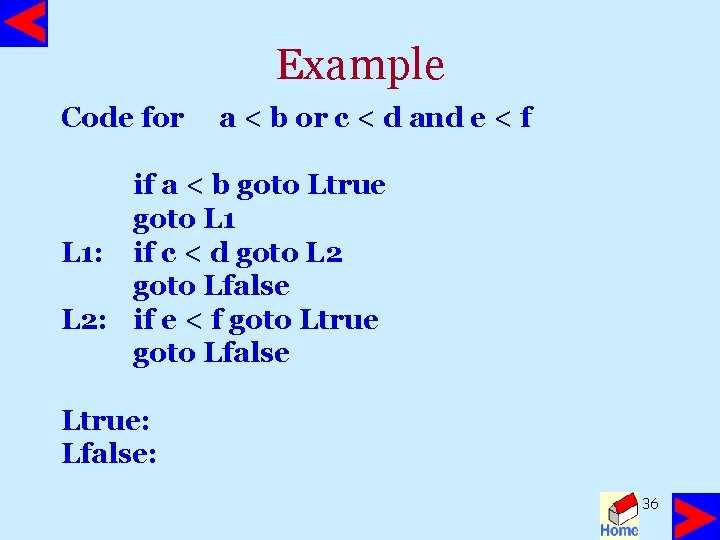
Example Code for a < b or c < d and e < f if a < b goto Ltrue goto L 1: if c < d goto L 2 goto Lfalse L 2: if e < f goto Ltrue goto Lfalse Ltrue: Lfalse: 36
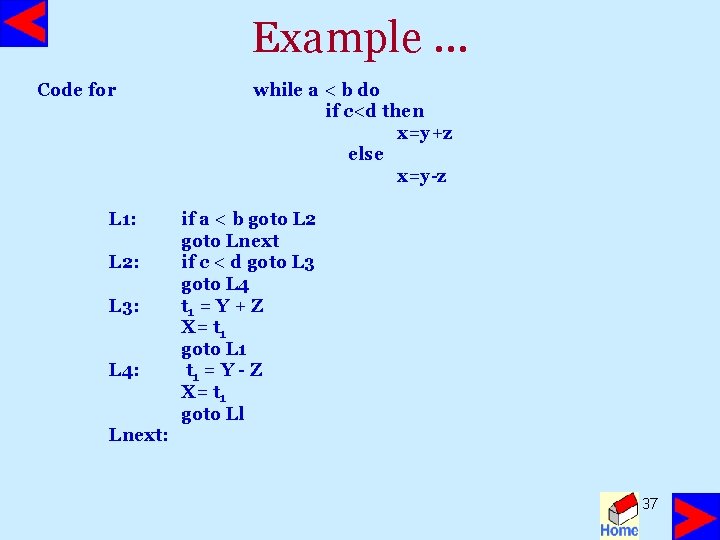
Example … Code for L 1: L 2: L 3: L 4: while a < b do if c<d then x=y+z else x=y-z if a < b goto L 2 goto Lnext if c < d goto L 3 goto L 4 t 1 = Y + Z X= t 1 goto L 1 t 1 = Y - Z X= t 1 goto Ll Lnext: 37
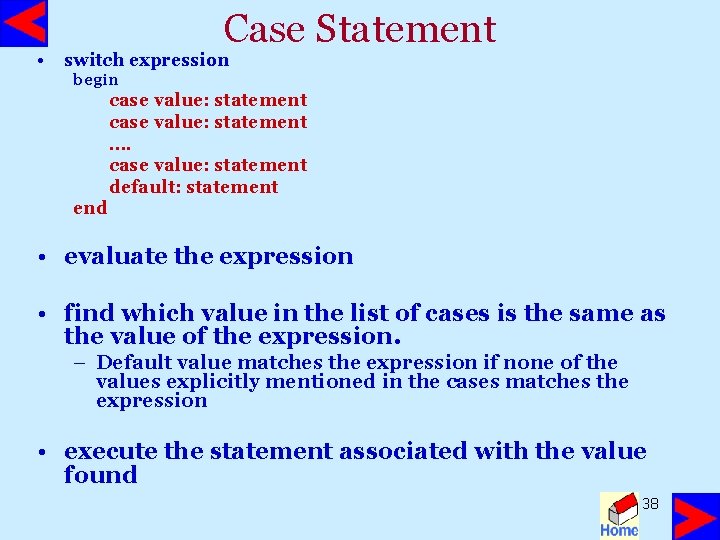
• Case Statement switch expression begin case value: statement …. case value: statement default: statement end • evaluate the expression • find which value in the list of cases is the same as the value of the expression. – Default value matches the expression if none of the values explicitly mentioned in the cases matches the expression • execute the statement associated with the value found 38
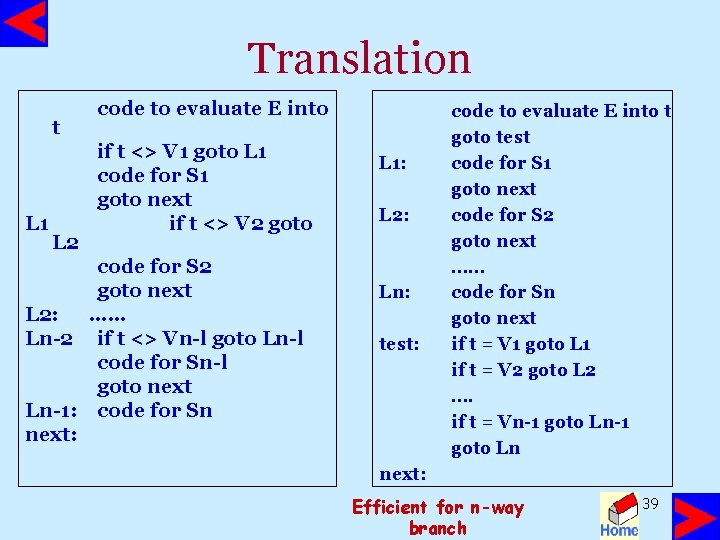
Translation t L 1 L 2 code to evaluate E into if t <> V 1 goto L 1 code for S 1 goto next if t <> V 2 goto code for S 2 goto next L 2: …… Ln-2 if t <> Vn-l goto Ln-l code for Sn-l goto next Ln-1: code for Sn next: L 1: L 2: Ln: test: code to evaluate E into t goto test code for S 1 goto next code for S 2 goto next …… code for Sn goto next if t = V 1 goto L 1 if t = V 2 goto L 2 …. if t = Vn-1 goto Ln next: Efficient for n-way branch 39
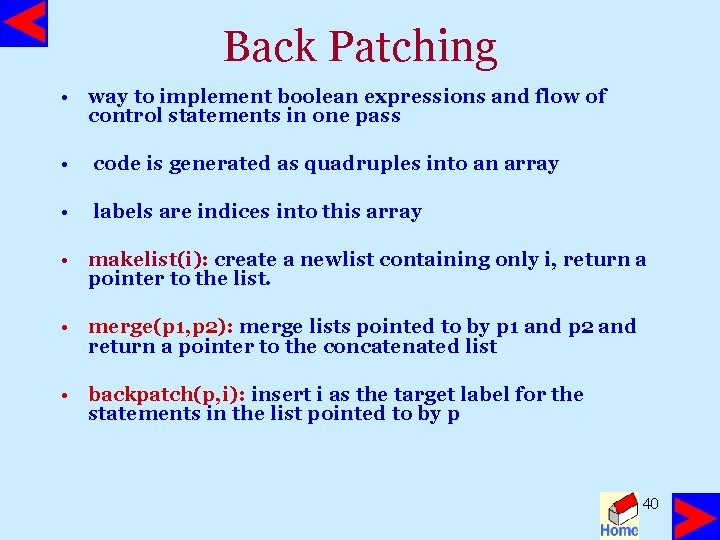
Back Patching • way to implement boolean expressions and flow of control statements in one pass • code is generated as quadruples into an array • labels are indices into this array • makelist(i): create a newlist containing only i, return a pointer to the list. • merge(p 1, p 2): merge lists pointed to by p 1 and p 2 and return a pointer to the concatenated list • backpatch(p, i): insert i as the target label for the statements in the list pointed to by p 40
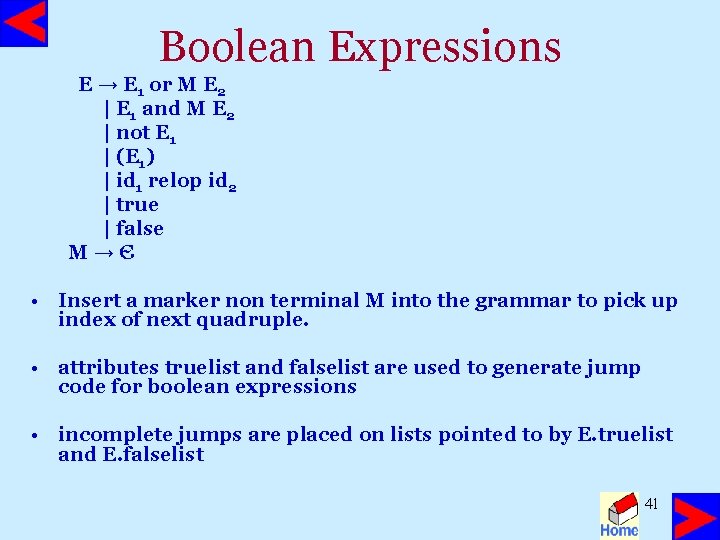
Boolean Expressions E → E 1 or M E 2 | E 1 and M E 2 | not E 1 | (E 1) | id 1 relop id 2 | true | false M→Є • Insert a marker non terminal M into the grammar to pick up index of next quadruple. • attributes truelist and falselist are used to generate jump code for boolean expressions • incomplete jumps are placed on lists pointed to by E. truelist and E. falselist 41
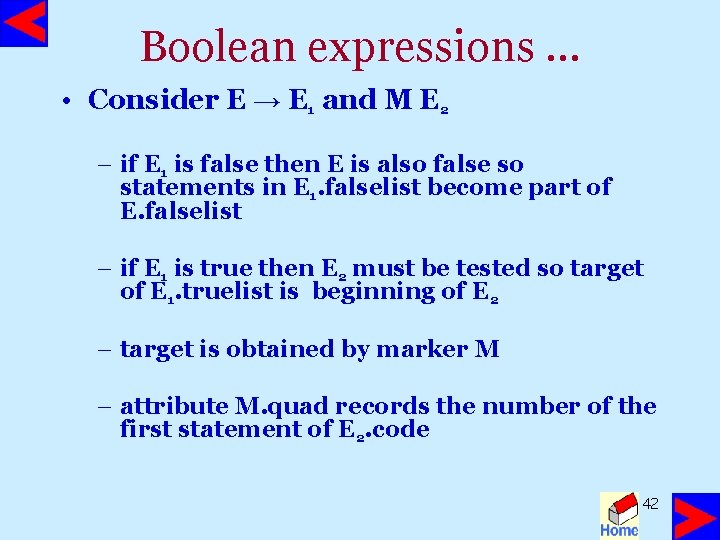
Boolean expressions … • Consider E → E 1 and M E 2 – if E 1 is false then E is also false so statements in E 1. falselist become part of E. falselist – if E 1 is true then E 2 must be tested so target of E 1. truelist is beginning of E 2 – target is obtained by marker M – attribute M. quad records the number of the first statement of E 2. code 42
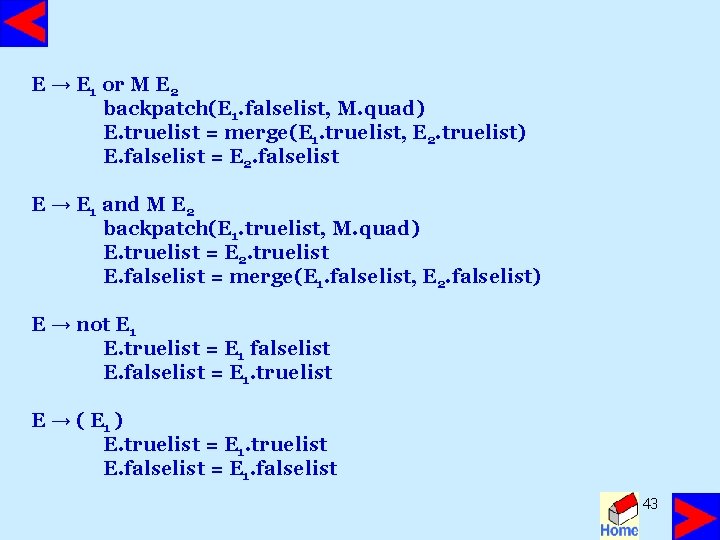
E → E 1 or M E 2 backpatch(E 1. falselist, M. quad) E. truelist = merge(E 1. truelist, E 2. truelist) E. falselist = E 2. falselist E → E 1 and M E 2 backpatch(E 1. truelist, M. quad) E. truelist = E 2. truelist E. falselist = merge(E 1. falselist, E 2. falselist) E → not E 1 E. truelist = E 1 falselist E. falselist = E 1. truelist E → ( E 1 ) E. truelist = E 1. truelist E. falselist = E 1. falselist 43
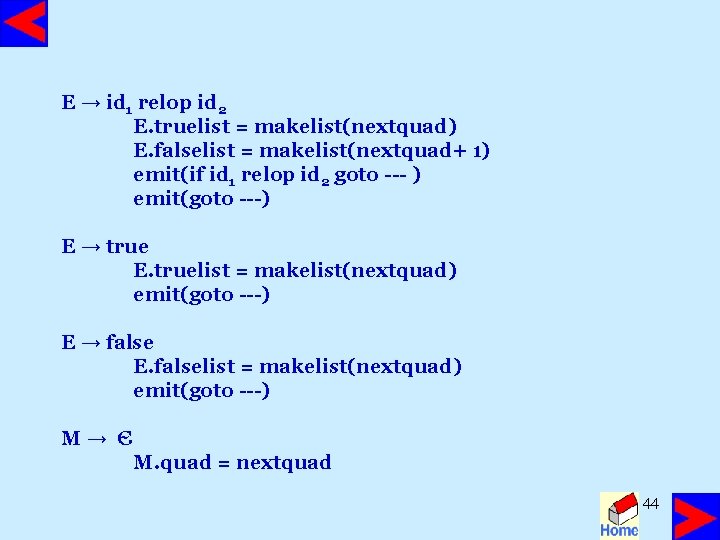
E → id 1 relop id 2 E. truelist = makelist(nextquad) E. falselist = makelist(nextquad+ 1) emit(if id 1 relop id 2 goto --- ) emit(goto ---) E → true E. truelist = makelist(nextquad) emit(goto ---) E → false E. falselist = makelist(nextquad) emit(goto ---) M→ Є M. quad = nextquad 44
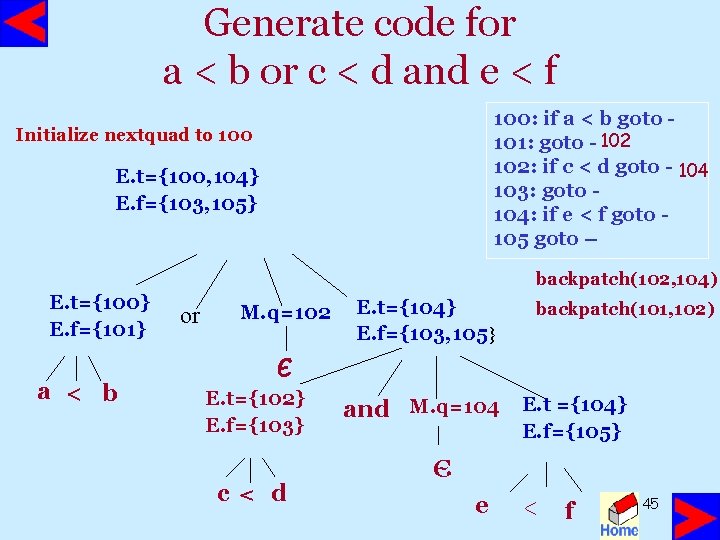
Generate code for a < b or c < d and e < f 100: if a < b goto 101: goto - 102: if c < d goto - 104 103: goto 104: if e < f goto 105 goto – Initialize nextquad to 100 E. t={100, 104} E. f={103, 105} backpatch(102, 104) E. t={100} E. f={101} a < b or M. q=102 E. t={104} E. f={103, 105} backpatch(101, 102) Є E. t={102} E. f={103} c < d and M. q=104 E. t ={104} E. f={105} Є e < f 45
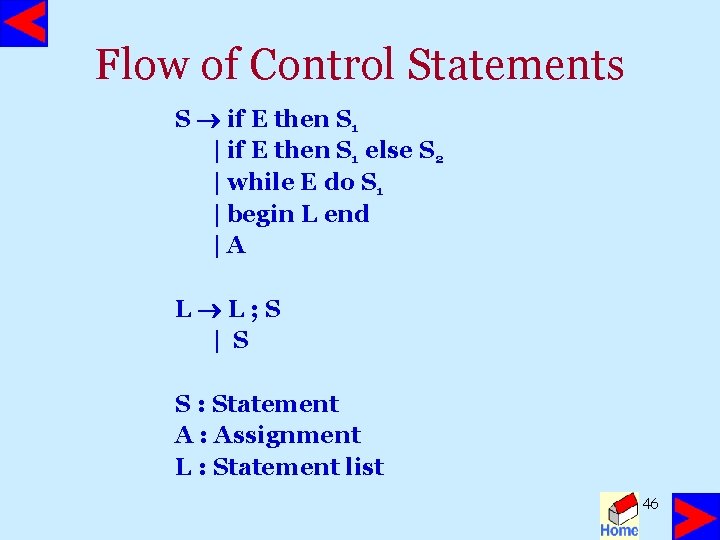
Flow of Control Statements S if E then S 1 | if E then S 1 else S 2 | while E do S 1 | begin L end |A L L; S | S S : Statement A : Assignment L : Statement list 46
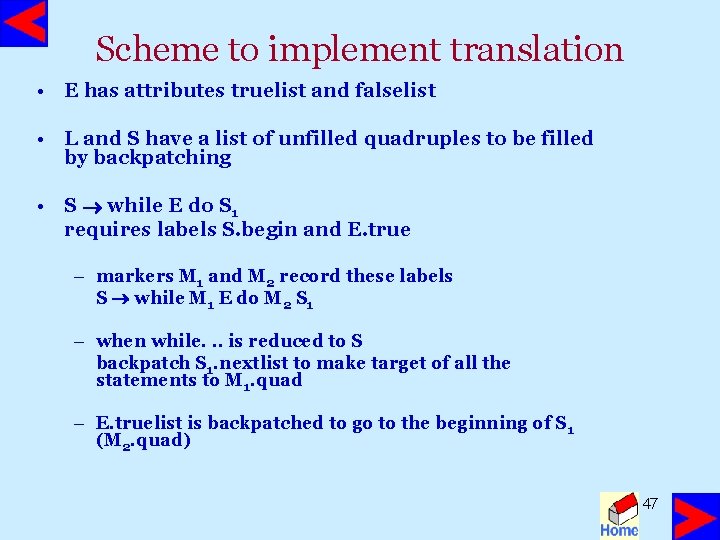
Scheme to implement translation • E has attributes truelist and falselist • L and S have a list of unfilled quadruples to be filled by backpatching • S while E do S 1 requires labels S. begin and E. true – markers M 1 and M 2 record these labels S while M 1 E do M 2 S 1 – when while. . . is reduced to S backpatch S 1. nextlist to make target of all the statements to M 1. quad – E. truelist is backpatched to go to the beginning of S 1 (M 2. quad) 47
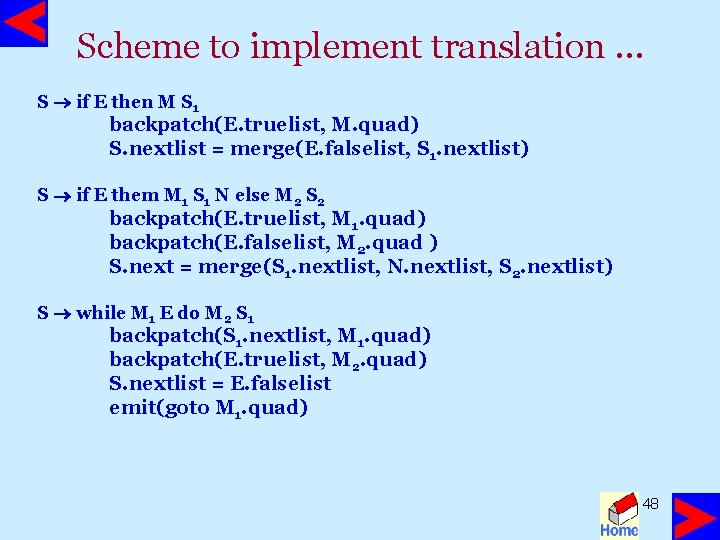
Scheme to implement translation … S if E then M S 1 backpatch(E. truelist, M. quad) S. nextlist = merge(E. falselist, S 1. nextlist) S if E them M 1 S 1 N else M 2 S 2 backpatch(E. truelist, M 1. quad) backpatch(E. falselist, M 2. quad ) S. next = merge(S 1. nextlist, N. nextlist, S 2. nextlist) S while M 1 E do M 2 S 1 backpatch(S 1. nextlist, M 1. quad) backpatch(E. truelist, M 2. quad) S. nextlist = E. falselist emit(goto M 1. quad) 48
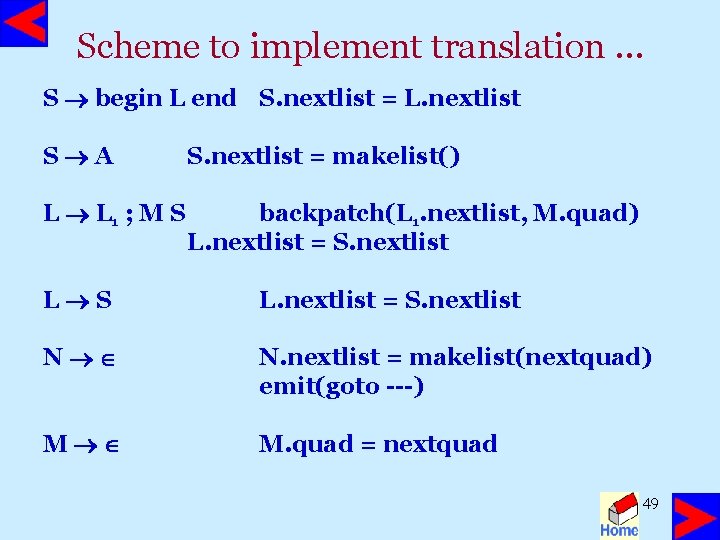
Scheme to implement translation … S begin L end S. nextlist = L. nextlist S A S. nextlist = makelist() L L 1 ; M S backpatch(L 1. nextlist, M. quad) L. nextlist = S. nextlist L S L. nextlist = S. nextlist N N. nextlist = makelist(nextquad) emit(goto ---) M M. quad = nextquad 49
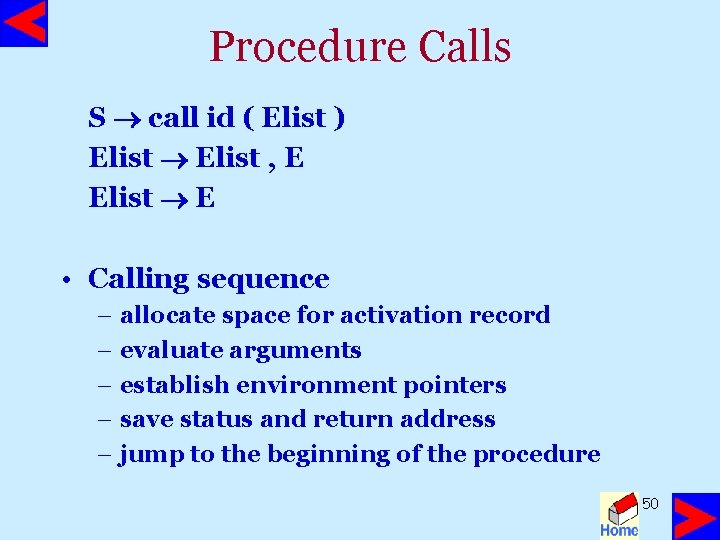
Procedure Calls S call id ( Elist ) Elist , E Elist E • Calling sequence – allocate space for activation record – evaluate arguments – establish environment pointers – save status and return address – jump to the beginning of the procedure 50
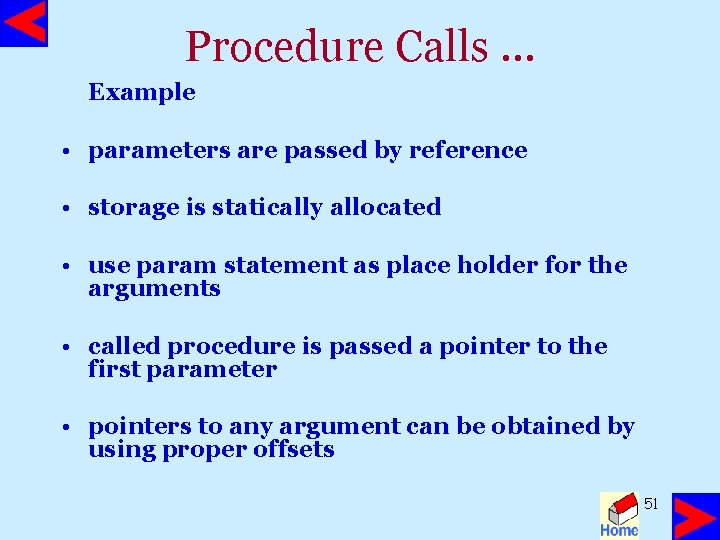
Procedure Calls … Example • parameters are passed by reference • storage is statically allocated • use param statement as place holder for the arguments • called procedure is passed a pointer to the first parameter • pointers to any argument can be obtained by using proper offsets 51
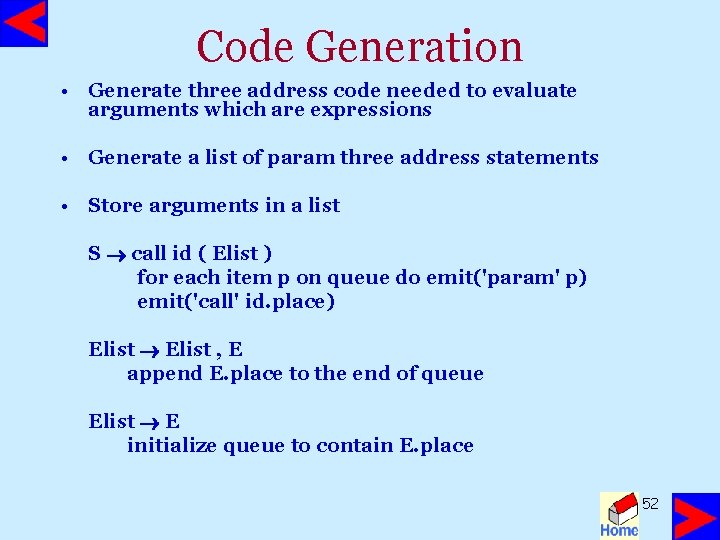
Code Generation • Generate three address code needed to evaluate arguments which are expressions • Generate a list of param three address statements • Store arguments in a list S call id ( Elist ) for each item p on queue do emit('param' p) emit('call' id. place) Elist , E append E. place to the end of queue Elist E initialize queue to contain E. place 52
- Slides: 52