
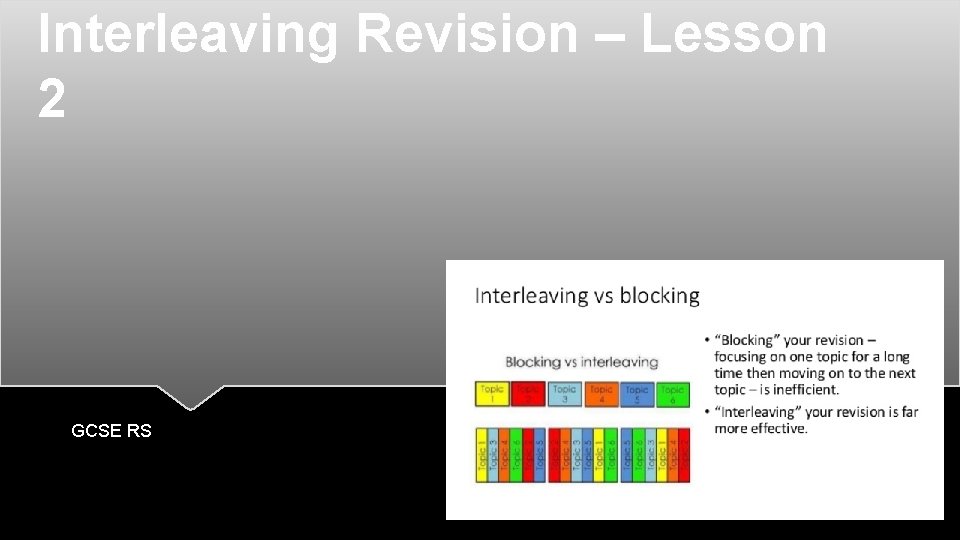
Interleaving Revision Lesson 2 GCSE RS Interleaving revision
- Slides: 12
Interleaving Revision – Lesson 2 GCSE RS
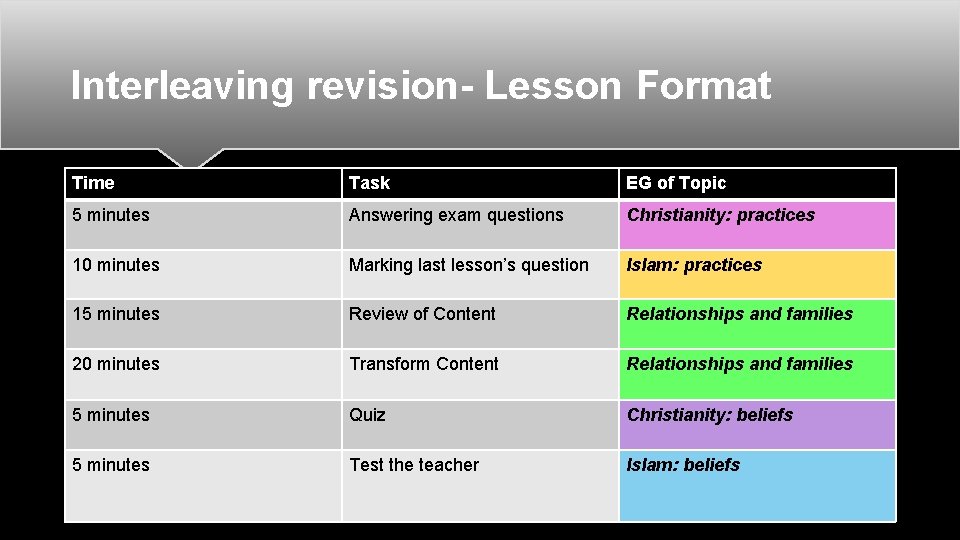
Interleaving revision- Lesson Format Time Task EG of Topic 5 minutes Answering exam questions Christianity: practices 10 minutes Marking last lesson’s question Islam: practices 15 minutes Review of Content Relationships and families 20 minutes Transform Content Relationships and families 5 minutes Quiz Christianity: beliefs 5 minutes Test the teacher Islam: beliefs
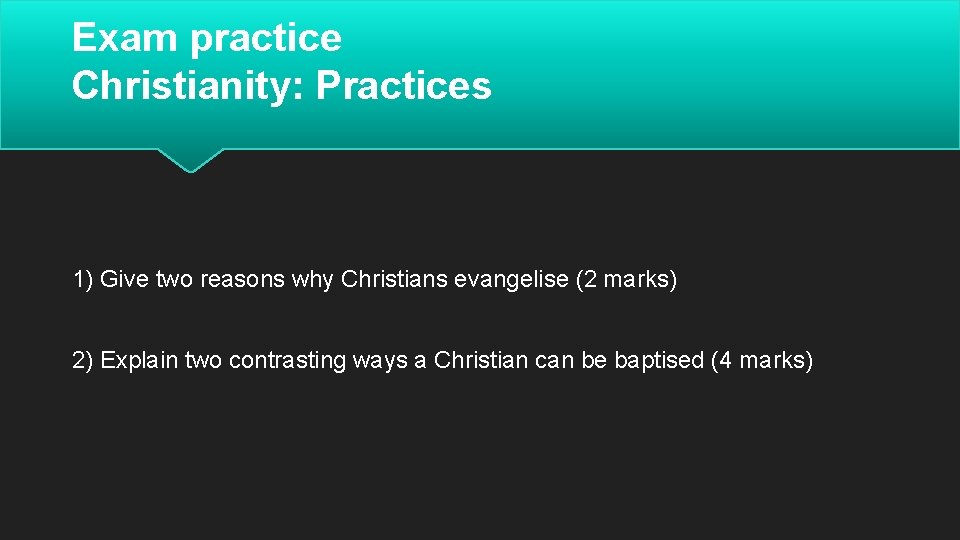
Exam practice Christianity: Practices 1) Give two reasons why Christians evangelise (2 marks) 2) Explain two contrasting ways a Christian can be baptised (4 marks)
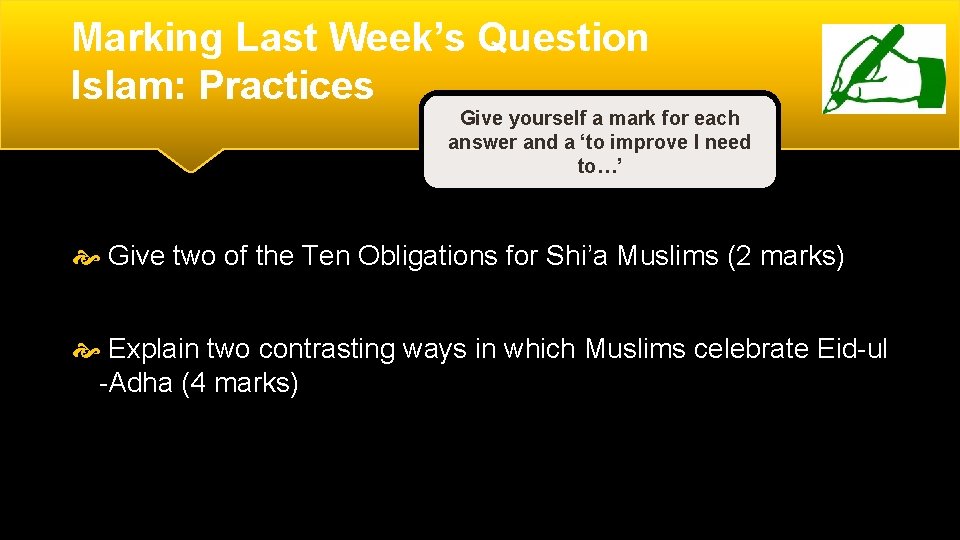
Marking Last Week’s Question Islam: Practices Give yourself a mark for each answer and a ‘to improve I need to…’ Give two of the Ten Obligations for Shi’a Muslims (2 marks) Explain two contrasting ways in which Muslims celebrate Eid-ul -Adha (4 marks)
Review Relationships and families
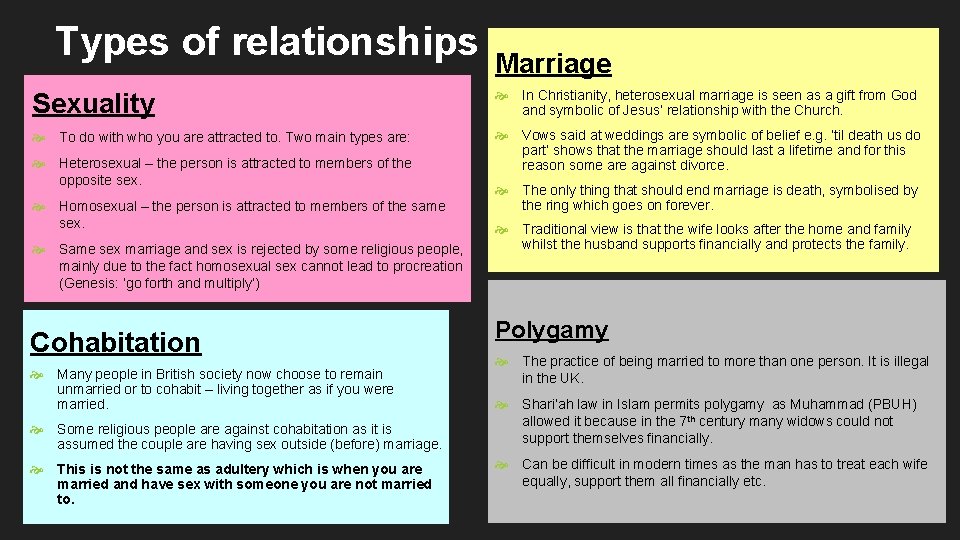
Types of relationships Marriage Sexuality In Christianity, heterosexual marriage is seen as a gift from God and symbolic of Jesus’ relationship with the Church. To do with who you are attracted to. Two main types are: Vows said at weddings are symbolic of belief e. g. ‘til death us do part’ shows that the marriage should last a lifetime and for this reason some are against divorce. Heterosexual – the person is attracted to members of the opposite sex. Homosexual – the person is attracted to members of the same sex. Same sex marriage and sex is rejected by some religious people, mainly due to the fact homosexual sex cannot lead to procreation (Genesis: ‘go forth and multiply’) Cohabitation Many people in British society now choose to remain unmarried or to cohabit – living together as if you were married. Some religious people are against cohabitation as it is assumed the couple are having sex outside (before) marriage. This is not the same as adultery which is when you are married and have sex with someone you are not married to. The only thing that should end marriage is death, symbolised by the ring which goes on forever. Traditional view is that the wife looks after the home and family whilst the husband supports financially and protects the family. Polygamy The practice of being married to more than one person. It is illegal in the UK. Shari’ah law in Islam permits polygamy as Muhammad (PBUH) allowed it because in the 7 th century many widows could not support themselves financially. Can be difficult in modern times as the man has to treat each wife equally, support them all financially etc.
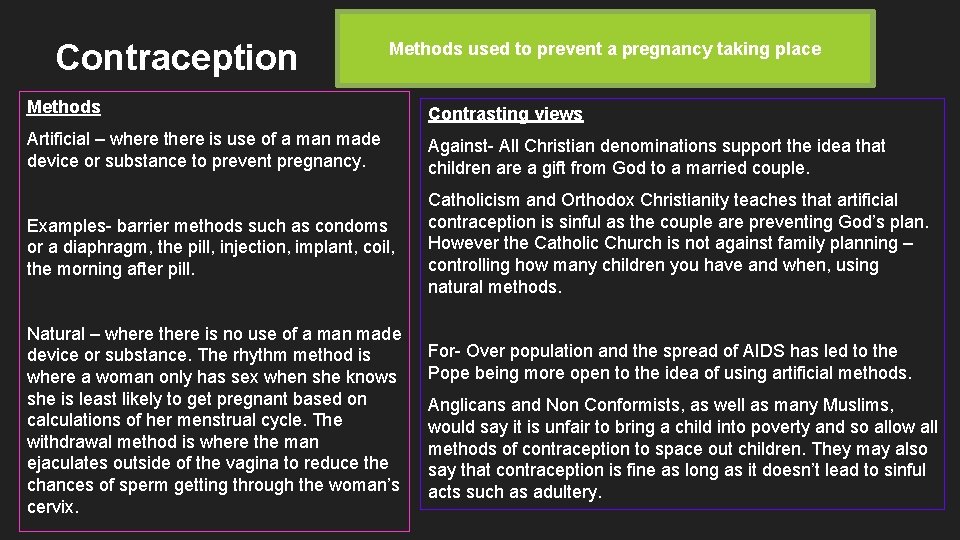
Contraception Methods used to prevent a pregnancy taking place Methods Contrasting views Artificial – where there is use of a man made device or substance to prevent pregnancy. Against- All Christian denominations support the idea that children are a gift from God to a married couple. Examples- barrier methods such as condoms or a diaphragm, the pill, injection, implant, coil, the morning after pill. Catholicism and Orthodox Christianity teaches that artificial contraception is sinful as the couple are preventing God’s plan. However the Catholic Church is not against family planning – controlling how many children you have and when, using natural methods. Natural – where there is no use of a man made device or substance. The rhythm method is where a woman only has sex when she knows she is least likely to get pregnant based on calculations of her menstrual cycle. The withdrawal method is where the man ejaculates outside of the vagina to reduce the chances of sperm getting through the woman’s cervix. For- Over population and the spread of AIDS has led to the Pope being more open to the idea of using artificial methods. Anglicans and Non Conformists, as well as many Muslims, would say it is unfair to bring a child into poverty and so allow all methods of contraception to space out children. They may also say that contraception is fine as long as it doesn’t lead to sinful acts such as adultery.
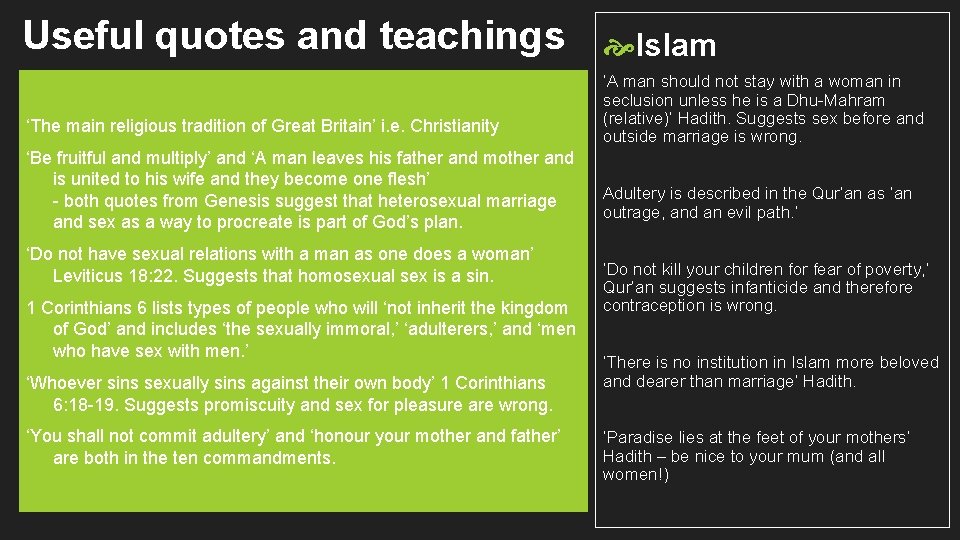
Useful quotes and teachings Islam ‘The main religious tradition of Great Britain’ i. e. Christianity ‘Be fruitful and multiply’ and ‘A man leaves his father and mother and is united to his wife and they become one flesh’ - both quotes from Genesis suggest that heterosexual marriage and sex as a way to procreate is part of God’s plan. ‘Do not have sexual relations with a man as one does a woman’ Leviticus 18: 22. Suggests that homosexual sex is a sin. 1 Corinthians 6 lists types of people who will ‘not inherit the kingdom of God’ and includes ‘the sexually immoral, ’ ‘adulterers, ’ and ‘men who have sex with men. ’ ‘Whoever sins sexually sins against their own body’ 1 Corinthians 6: 18 -19. Suggests promiscuity and sex for pleasure are wrong. ‘You shall not commit adultery’ and ‘honour your mother and father’ are both in the ten commandments. ‘A man should not stay with a woman in seclusion unless he is a Dhu-Mahram (relative)’ Hadith. Suggests sex before and outside marriage is wrong. Adultery is described in the Qur’an as ‘an outrage, and an evil path. ’ ‘Do not kill your children for fear of poverty, ’ Qur’an suggests infanticide and therefore contraception is wrong. ‘There is no institution in Islam more beloved and dearer than marriage’ Hadith. ‘Paradise lies at the feet of your mothers’ Hadith – be nice to your mum (and all women!)
Transform Relationships and families You now have 20 minutes to transform this information into some revision materials. ONLY USE YOUR NOTES IF YOU ABSOLUTELY HAVE TO!!! LISTS MIND MAPS FLASH CARDS QUIZZES
Quiz Christianity: Beliefs 1. According to Genesis, what did God make on the 6 th day of creation? 2. What does incarnation mean? 3. What happened to Jesus at the Ascension? 4. Name the 3 means to salvation in Christian belief 5. What does atonement mean? 6. Which parable is about salvation through obeying God’s laws?
Test the Teacher Islam: beliefs As a table, come up with either a 4, 5 or 12 mark question you would like me to answer about Beliefs and Teachings in Islam. I will type up and create a bank of answers. You can use an existing question or make one up.
Half term homework reminder Create your own revision resource* about the types of worship and types of prayer in Christianity. Use your books/folders/revision guides/our revision website (gcsereligiousstudies. weebly. com/revision) *Mind map, poster, flash cards, illustrated notes, quizzes… whatever works for you.