
Interim Progress Report Review of Narrative and Budget
Interim Progress Report Review of Narrative and Budget Summary Presentation to San Francisco HIV Prevention Planning Council (HPPC) August 14, 2008 San Francisco Department of Public Health Community Programs AIDS Office HIV Prevention Section
What is the Interim Progress Report (IPR)? • Each year the HIV Prevention Section (HPS) is required to submit a report to the Centers for Disease Control and Prevention (CDC) that outlines the programmatic action for the next fiscal year. • HPS is only required to report information for Perinatal and Heath Education and Risk Reduction from January 1, 2008 through June 30, 2008. • The report outlines programmatic actions for 2009 • The report includes a budget for the activities for 2009 2
What is the role of the HPPC? • Review the programmatic actions for 2009 • Review the 2009 budget • Develop a written response that describes whether the health department application does or does not, and to what degree, agree with the priorities set forth in the comprehensive HIV prevention plan. ” CDC Guidance, 2003 3
Options for written response of concurrence • Concurrence: “Concurrence” means that the HPPC agrees with application for January 1 through December 31, 2008. • Concurrence with reservations: “Concurrence with reservations” means that the HPPC basically agrees with the application, but has some concerns. The reservations/concerns should be identified in the letter. • Nonconcurrence: “Nonconcurrence” means that the HPPC does not agree with the application. A letter of nonconcurrence should describe the particular actions with which the HPPC disagrees. Instances of nonconcurrence are reviewed by CDC on a case-bycase basis. After consultation with the grantee and HPPC, CDC will determine an appropriate course of action. 4
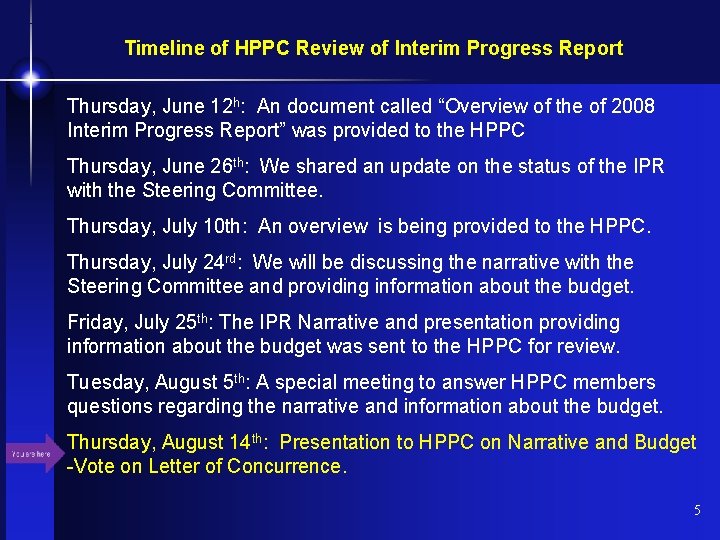
Timeline of HPPC Review of Interim Progress Report Thursday, June 12 h: An document called “Overview of the of 2008 Interim Progress Report” was provided to the HPPC Thursday, June 26 th: We shared an update on the status of the IPR with the Steering Committee. Thursday, July 10 th: An overview is being provided to the HPPC. Thursday, July 24 rd: We will be discussing the narrative with the Steering Committee and providing information about the budget. Friday, July 25 th: The IPR Narrative and presentation providing information about the budget was sent to the HPPC for review. Tuesday, August 5 th: A special meeting to answer HPPC members questions regarding the narrative and information about the budget. Thursday, August 14 th: Presentation to HPPC on Narrative and Budget -Vote on Letter of Concurrence. 5
Review of IPR Narrative Summary 6
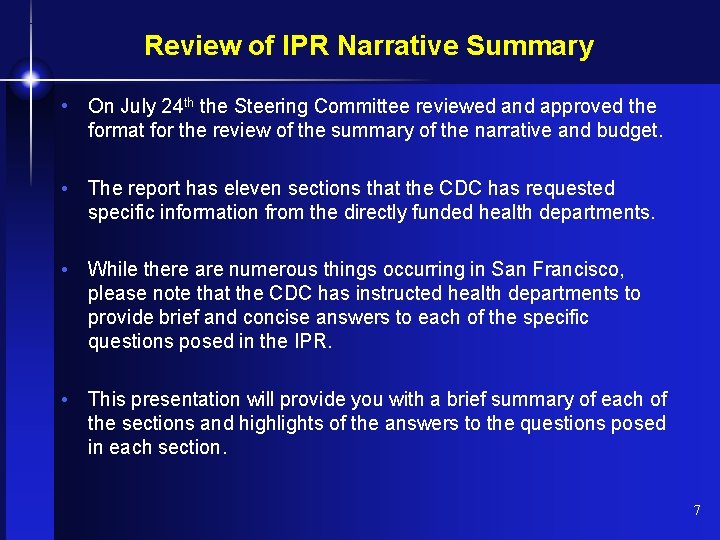
Review of IPR Narrative Summary • On July 24 th the Steering Committee reviewed and approved the format for the review of the summary of the narrative and budget. • The report has eleven sections that the CDC has requested specific information from the directly funded health departments. • While there are numerous things occurring in San Francisco, please note that the CDC has instructed health departments to provide brief and concise answers to each of the specific questions posed in the IPR. • This presentation will provide you with a brief summary of each of the sections and highlights of the answers to the questions posed in each section. 7
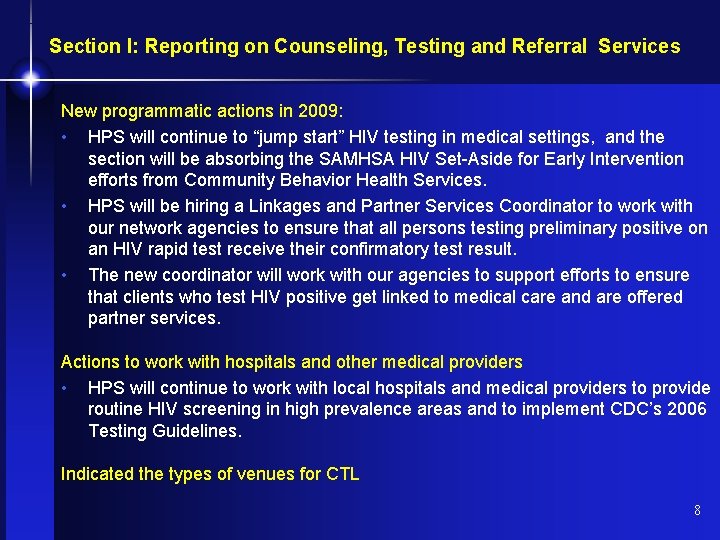
Section I: Reporting on Counseling, Testing and Referral Services New programmatic actions in 2009: • HPS will continue to “jump start” HIV testing in medical settings, and the section will be absorbing the SAMHSA HIV Set-Aside for Early Intervention efforts from Community Behavior Health Services. • HPS will be hiring a Linkages and Partner Services Coordinator to work with our network agencies to ensure that all persons testing preliminary positive on an HIV rapid test receive their confirmatory test result. • The new coordinator will work with our agencies to support efforts to ensure that clients who test HIV positive get linked to medical care and are offered partner services. Actions to work with hospitals and other medical providers • HPS will continue to work with local hospitals and medical providers to provide routine HIV screening in high prevalence areas and to implement CDC’s 2006 Testing Guidelines. Indicated the types of venues for CTL 8
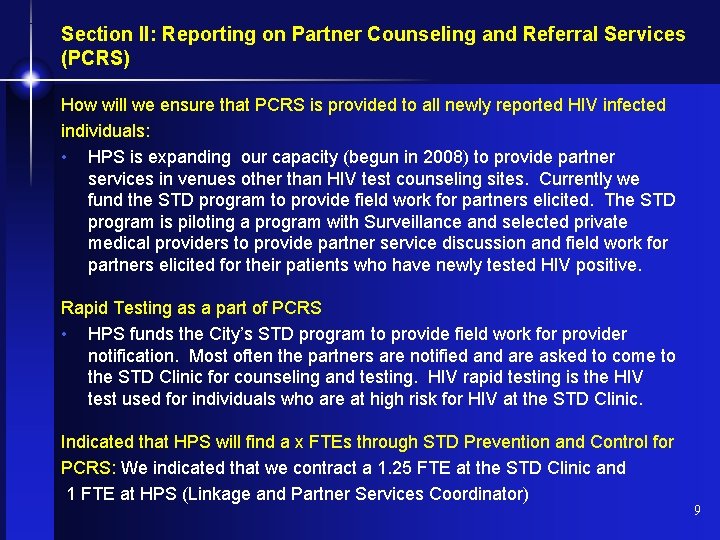
Section II: Reporting on Partner Counseling and Referral Services (PCRS) How will we ensure that PCRS is provided to all newly reported HIV infected individuals: • HPS is expanding our capacity (begun in 2008) to provide partner services in venues other than HIV test counseling sites. Currently we fund the STD program to provide field work for partners elicited. The STD program is piloting a program with Surveillance and selected private medical providers to provide partner service discussion and field work for partners elicited for their patients who have newly tested HIV positive. Rapid Testing as a part of PCRS • HPS funds the City’s STD program to provide field work for provider notification. Most often the partners are notified and are asked to come to the STD Clinic for counseling and testing. HIV rapid testing is the HIV test used for individuals who are at high risk for HIV at the STD Clinic. Indicated that HPS will find a x FTEs through STD Prevention and Control for PCRS: We indicated that we contract a 1. 25 FTE at the STD Clinic and 1 FTE at HPS (Linkage and Partner Services Coordinator) 9
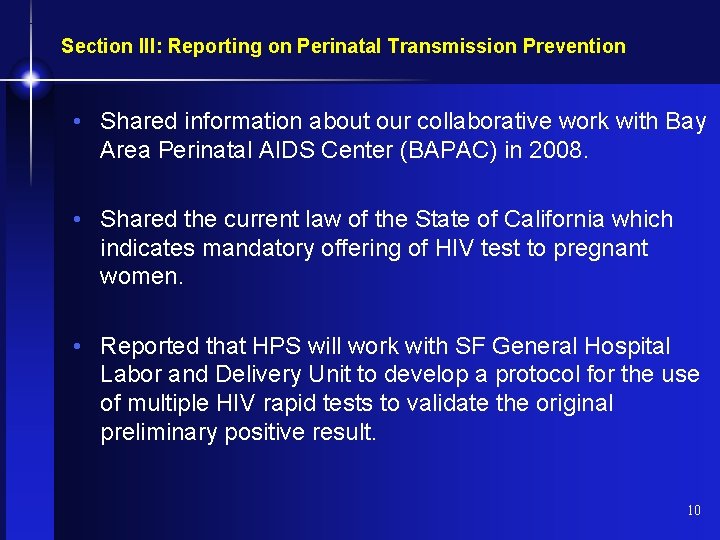
Section III: Reporting on Perinatal Transmission Prevention • Shared information about our collaborative work with Bay Area Perinatal AIDS Center (BAPAC) in 2008. • Shared the current law of the State of California which indicates mandatory offering of HIV test to pregnant women. • Reported that HPS will work with SF General Hospital Labor and Delivery Unit to develop a protocol for the use of multiple HIV rapid tests to validate the original preliminary positive result. 10
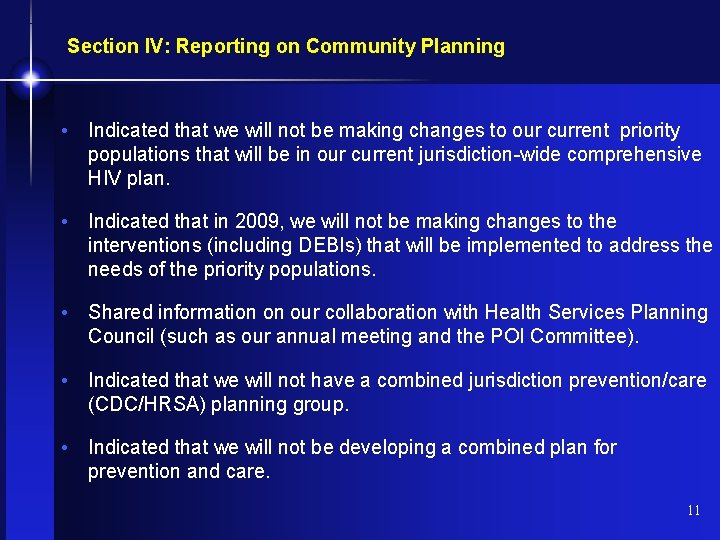
Section IV: Reporting on Community Planning • Indicated that we will not be making changes to our current priority populations that will be in our current jurisdiction-wide comprehensive HIV plan. • Indicated that in 2009, we will not be making changes to the interventions (including DEBIs) that will be implemented to address the needs of the priority populations. • Shared information on our collaboration with Health Services Planning Council (such as our annual meeting and the POI Committee). • Indicated that we will not have a combined jurisdiction prevention/care (CDC/HRSA) planning group. • Indicated that we will not be developing a combined plan for prevention and care. 11
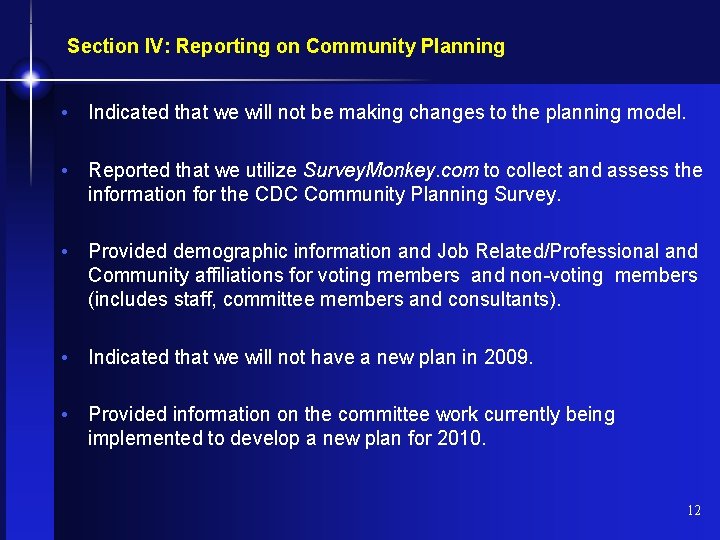
Section IV: Reporting on Community Planning • Indicated that we will not be making changes to the planning model. • Reported that we utilize Survey. Monkey. com to collect and assess the information for the CDC Community Planning Survey. • Provided demographic information and Job Related/Professional and Community affiliations for voting members and non-voting members (includes staff, committee members and consultants). • Indicated that we will not have a new plan in 2009. • Provided information on the committee work currently being implemented to develop a new plan for 2010. 12
Section V: Monitoring and Evaluation Reporting • Provided an overview of the health department contract monitoring process. • Provided an overview of the health department evaluation process. Section VI: Capacity Building • Provides information of the San Francisco Department of Health efforts to ensure cultural competency for all employees. • Provides an overview on focus areas where we will be providing capacity building and training to providers in 2009. 13
Section VII: Reporting on Health Education and Risk Reduction (HERR) Programmatic Activities • We provided a table with the name of program model, intervention (s), and target population(s) supported by CDC through January 1 st. June 30 th 2008 • No information was required for 2009 Section VIII: Reporting on Prevention for Infected Persons Programmatic Activities • Provided a brief explanation of Prevention with Positive (Pw. P) efforts. • Shared information about our work with University of California San Francisco, Positive Health Program to provide Pw. P in medical settings, and brief information of the prevention with positives efforts supported in collaboration with the Centers of Excellence. 14
Section IX: Reporting for Pubic Information Programs We reported that in 2009, HPS is considering developing two public information campaigns to address the following issues: • Increase testing among African American MSM • Increase repeat testing among all MSM Section X: Quality Assurance • Meet with grantees to discuss how core variables and other data can inform program improvement. • The HPS, in collaboration with the HPPC Strategies and Interventions Committee, will prioritize appropriate interventions for priority populations to be included in the 2010 San Francisco HIV Prevention Plan. • The HPS Program Managers will review and give feedback on Cultural Competency Reports from grantees. 15
Section XI: Collaboration and Coordination Provided information on all the agencies, institutions, health department units that we plan to collaborate and coordinate with during 2009: • • STD Prevention CDC directly funded CBOs HIV/AIDS Care Programs Juvenile and adult criminal justice Hepatitis prevention TB clinics and programs Family planning and women’s health • • • Family planning and women’s health, State and local education agencies, Community Behavioral Health Services (CBHS) Primary Care and Community Health Center Other community groups, businesses, and faith based organizations. 16
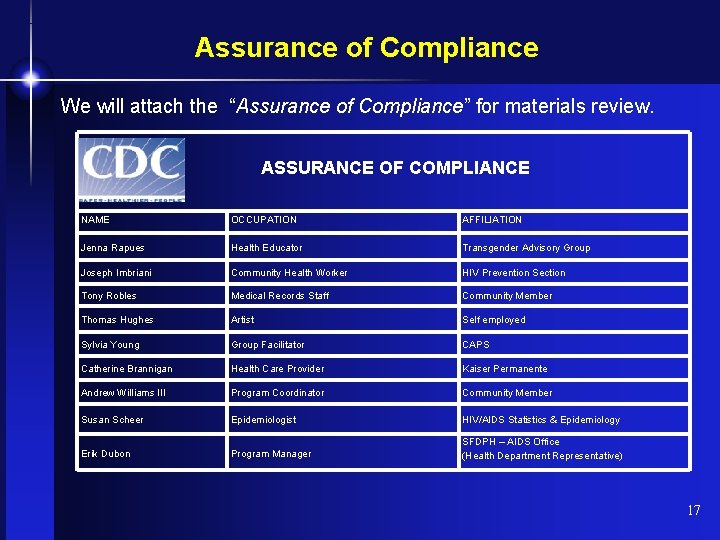
Assurance of Compliance We will attach the “Assurance of Compliance” for materials review. ASSURANCE OF COMPLIANCE NAME OCCUPATION AFFILIATION Jenna Rapues Health Educator Transgender Advisory Group Joseph Imbriani Community Health Worker HIV Prevention Section Tony Robles Medical Records Staff Community Member Thomas Hughes Artist Self employed Sylvia Young Group Facilitator CAPS Catherine Brannigan Health Care Provider Kaiser Permanente Andrew Williams III Program Coordinator Community Member Susan Scheer Epidemiologist HIV/AIDS Statistics & Epidemiology Erik Dubon Program Manager SFDPH – AIDS Office (Health Department Representative) 17
Review of IPR Budget Summary 18
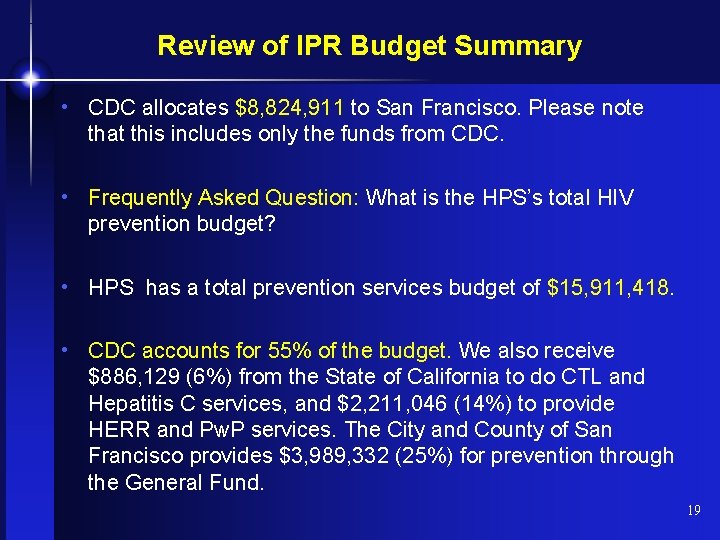
Review of IPR Budget Summary • CDC allocates $8, 824, 911 to San Francisco. Please note that this includes only the funds from CDC. • Frequently Asked Question: What is the HPS’s total HIV prevention budget? • HPS has a total prevention services budget of $15, 911, 418. • CDC accounts for 55% of the budget. We also receive $886, 129 (6%) from the State of California to do CTL and Hepatitis C services, and $2, 211, 046 (14%) to provide HERR and Pw. P services. The City and County of San Francisco provides $3, 989, 332 (25%) for prevention through the General Fund. 19
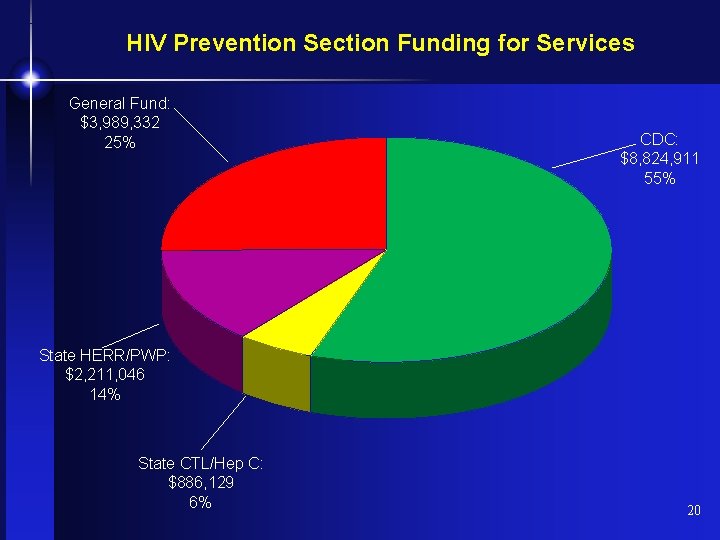
HIV Prevention Section Funding for Services General Fund: $3, 989, 332 25% CDC: $8, 824, 911 55% State HERR/PWP: $2, 211, 046 14% State CTL/Hep C: $886, 129 6% 20
Review of IPR Budget Summary • The first CDC budget category is Contractual: This represents contracts with community-based prevention providers and Memoranda of Understanding with other Department of Public Health programs. • The total amount of the CDC award that is contractual is $5, 920, 593. This represents 67% of the CDC budget. • Frequently Asked Question: Does this mean that only $5, 920, 593. goes to prevention services? • Please remember that these are not the only funds for prevention services. All of the SF General Funds and 60% of the State Funds are contractual, in other words, directly funded agencies that provide prevention programs. 21
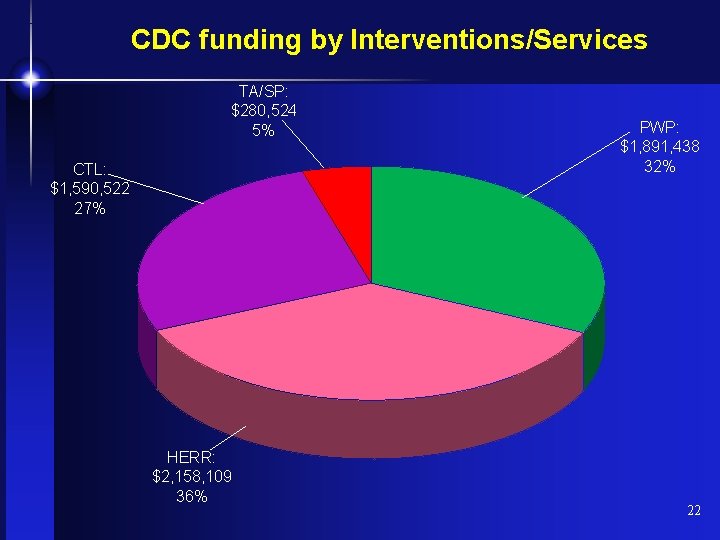
CDC funding by Interventions/Services TA/SP: $280, 524 5% CTL: $1, 590, 522 27% HERR: $2, 158, 109 36% PWP: $1, 891, 438 32% 22
Review of IPR Budget Summary The second CDC budget category is Administrative: The total amount of the CDC award that is administrative is $2, 904, 318. This represents 33% of the CDC budget. Frequently Asked Question: Why does such a large portion of the money go to administrative cost? • First it is important to note that the proportion for administrative vs. contractual costs has remained approximately the same for the last five years. Also, please note that CDC dollars are the primary resource used for administrative costs. • The overall administrative cost for HPS is 24%. A portion of the cost is also supported by State resources and none of the City General Funds are used for administrative cost. 23
Review of IPR Budget Summary The second CDC budget category is Administrative (cont. ): Breakdown of Administrative: Salary Cost: Total Salary is $2, 348, 689: This includes HPS staff (community planning, health education, program managers, counseling and testing, evaluation, and data management) as well as AIDS Office staff (contract management, IS Support) and other DPH staff such as payroll, accounting, invoice support, and other fiscal support. • Please note that this also includes the mandatory fringe benefits for employees. 24
Review of IPR Budget Summary Administrative (cont. ): • Travel: $33, 600 for staff and HPPC members (USCA, HPLS, UCHAPS, CDC meetings). • Materials and supplies: $27, 530 • Other Cost: $78, 180 , This includes rent for office space, rental of facilities for meetings, telephone, printing, stipends/honorariums, and staff trainings. • Indirect Cost: $425, 399, this includes items such as the cost of the building management of 25 Van Ness, insurance, legal costs, etc… 25
Motion to approve a Letter of Concurrence • On July 24 th The Steering Committee voted to approve the narrative and budget summary for the IPR and make the following motion: • “The HPPC agrees with the actions planned for 2009 and supports providing a letter of concurrence. ” 26
Questions and Answers 27
Motion to approve a Letter of Concurrence • “The HPPC agrees with the actions planned for 2009 and supports providing a letter of concurrence. ” 28
- Slides: 28