
Intergroup Relations Beyond Assimilation Review Bias is created
Intergroup Relations Beyond Assimilation
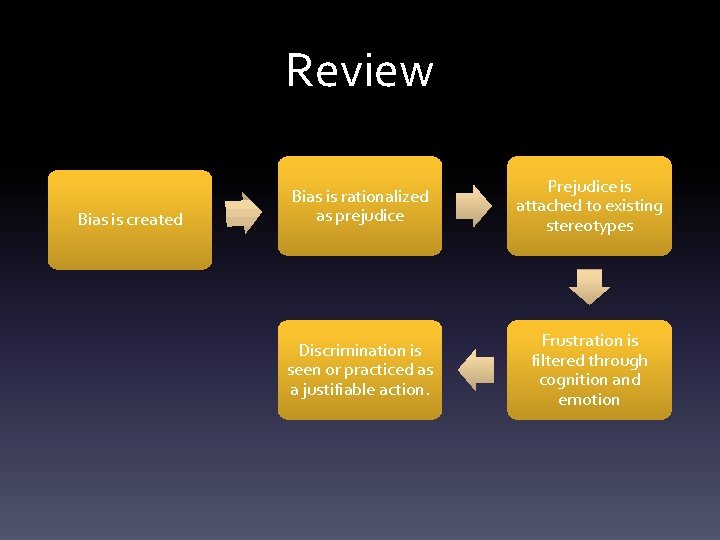
Review Bias is created Bias is rationalized as prejudice Prejudice is attached to existing stereotypes Discrimination is seen or practiced as a justifiable action. Frustration is filtered through cognition and emotion
Objectives • Understand how intergroup relations is framed by White supremacy • Describe how notions of superiority/inferiority are internalized • Understand intergroup relations as a product of past discriminatory practices.
Ethnic and Racial Group Identity • Any group unable to participate fully in the societal mainstream typically develops its own group identity. – Group identity can serve as a basis for positive encounters, comfort, strength or entry into the mainstream. – Identity can also be a foundation for prejudice and discrimination, negative self-image, a barrier to social acceptance, or a source of conflict.
Ethnic Group identity • The emphasis of cultural or national ties as the basis for primary social interactions and a sense of self. – Immigrants as strangers in a strange land become more self-conscious of their group identity once ethnic identity is established. – Socialization into one’s ethnic group promotes group identity.
How is the strange made familiar? • Avoidance – A way of dealing with discriminatory practices. • Migration • Ethnic-Enclaves • Religious and other practices as a refuge
What is the purpose of enclaves? • Create a miniature version of the familiar within the strange through an establishment of a safe place.
How is deviance associated with otherness? • When a group continually experiences rejection and discrimination, some members of its members are unable to identify with the dominant society or accept its norms. • Groups at the bottom of the socio-economic hierarchy may reject structural, cultural, and ideological assimilation, inhibiting economic integration and thereby respond to the pressures of everyday life in ways they consider reasonable but that others perceive as deviant.
How is otherness criminalized • When social norms are defended by the law, marginalized groups tend to be further oppressed by the imposition of legal standards: these standards are typically asymmetrically applied.
How does Law Enforcement perpetuate unequal treatment • Tendency of police to arrest suspects from minority groups at substantially higher rates than those from the majority group in situations in which discretionary judgment is possible. • Difficulty the poor encounter in affording bail • Poor quality of free legal defense • Disparities in sentencing for members of dominant and underprivileged groups
How do Perceptions and Stereotyping contribute to racial profiling? • When racialized group members commit offenses such as crime, drunkenness, or some public nuisance problem, it is assumed to be definitive of the group. – Deviance typically occurs not because of racial identity, but by poverty, lack of opportunity and other forms of disparate treatment. • A lack of opportunities encourages delinquency among lower-class males. – This fact explains a number of events that are assumed to be explained through cultural determinism.
How is opportunities linked to delinquency? • Aspirations for success are apparent throughout all levels of society – This is in conflict with available opportunities – Attitudes about education and routs to success are related to delinquency rates. – The greater commitment to education and other indicators of success, is inversely related to delinquency
How do people deal with racial discrimination? • Many people accept their situation within the socioeconomic tapestry of America. – Some conform to stereotypical perceptions, subordinate positions, and assimilationist expectations. – This is going to be through a conditioning of reprisals and rewards that administers punitive assessments against anything that defies the White normative and rewards anything that reifies it.
What are the consequences of being in an underprivileged group? • Negative self-image – Labeling Theory—identified with stereotypes and thereby internalize and identify others as having those same characteristics. – In a real life situation, it is being associated with deviance continuously and finding more benefits than costs in aligning with that. • In the case of defeating the perceived norm, there may be more reprisals than benefits.
How does Education operating as a historically White institution apply the labeling theory? • Teachers assume Black and Latino students are less intellectually capable • Teachers are less likely to meet those students’ educational needs – Teachers are also less likely to be able to attend to students’ cultural needs • Students are not paid attention to, and are marginalized through the hidden curriculum.
How is Uncle Tom Created? • Consider uncle Tom as someone who accepts White dominance and thereby polices White normatives in an effort to minimize reprisals against the reproduction and maintainance thereof. – This will be expressed through a degree of self-hatred whereby Black deviance is condemned through the acceptance of deterministic features. – Normalizing stereotypes and assuming that they are normal-through that normalization accepts the White normative to thereby police ethnic identification perceived as deviant.
Bill Cosby in a Speech to the NAACP commemorating Bv. B. • Ladies and gentlemen, listen to these people. They are showing you what’s wrong. People putting their clothes on backwards. Isn’t that a sign of something going on wrong? Are you not paying attention? People with their hat on backwards, pants down around the crack. Isn’t that a sign of something or are you waiting for Jesus to pull his pants up? Isn’t it a sign of something when she’s got her dress all the way up to the crack -- and got all kinds of needles and things going through her body. What part of Africa did this come from? We are not Africans. Those people are not Africans; they don’t know a damned thing about Africa. With names like Shaniqua, Shaligua, Mohammed and all that crap and all of them are in jail. (When we give these kinds names to our children, we give them the strength and inspiration in the meaning of those names. What’s the point of giving them strong names if there is not parenting and values backing it up).
How is Uncle Ruckus Created? • Uncle Ruckus is a more extreme version of Uncle Tom that has accepted stereotypes of the group whom (s)he identifies with while exercising a form of self-hatred. – This person “hates his/her own skin” and “skinfolk”
What are understood identities beyond Tom? • Apples • Bananas • Coconuts • Oreos
How is this explained by Myrtle’s Cumulative causation? • Discriminatory actions create reactions that are then abstracted as the reason for the existence of disparities. – Uncle Toms, along with those who benefit from the oppression of others do not see their benefit, however see the reaction of the oppressed as without basis. – In this regard, those whom benefit from oppression (consciously or unconsciously) may see themselves as having more in common with oppressors than the oppressed.

Marginality • The Uncle Tom syndrome is also explained though marginality – A member of an underprivileged gropu internalizes the dominant group’s cultural patterns without having gained full access themselves. – Those people will then regard others that are less socially, culturally, and/or economically as backward
Middleman/Model Minorities • This is the use of groups to triangulate domination – In a sense, it is bringing in or giving privileges to one group over another to maintain dominance. – These groups, although tokenized, experience discrimination—mostly structural and not as direct as for Blacks and Latinos.
Hate Crimes and Groups • “Hate” in and of itself oversimplifies the conditions by which these events tend to occur. • Typically are a response to racialized triggers – In terms of legality, crimes are not considered hate crimes unless they are racially motivated and can be proved to be such. – Many instances that could be motivated by racial considerations are not considered.
2012 FBI Hate Crime Statistics • 48. 3 percent of the 5, 790 single-bias incidents were racially motivated, while 19. 6 percent resulted from sexual orientation bias and 19 percent from religious bias. • Of the 7, 164 hate crime victims, 55. 4 percent were victims of crimes against persons and 41. 8 percent were victims of crimes against property. The remaining 2. 8 percent were victims of crimes against society (like drug offenses, gambling, and prostitution). • 39. 6 percent of the victims of crimes against persons suffered simple assaults, while 37. 5 percent were intimidated and 21. 5 percent were victims of aggravated assault. (Law enforcement also reported 10 murders and 15 rapes as hate crimes. ) • An overwhelming majority— 75. 6 percent—of the victims of crimes against property were victimized by acts of destruction, damage, and/or vandalism. • Of the 5, 331 known offenders, 54. 6 percent were white and 23. 3 percent were black
How is exploitation linked to a split labor market? • Primary labor market—hard work is rewarded • Secondary labor market—unregulated lowpaying jobs. – Mostly refers to an underground economy where workers are paid “under the table” – These jobs are offered and are readily available to “at risk” populations that are expendable
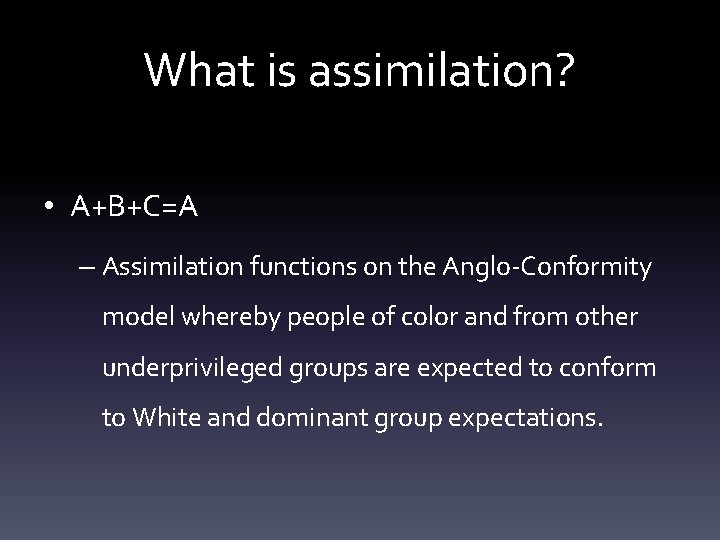
What is assimilation? • A+B+C=A – Assimilation functions on the Anglo-Conformity model whereby people of color and from other underprivileged groups are expected to conform to White and dominant group expectations.
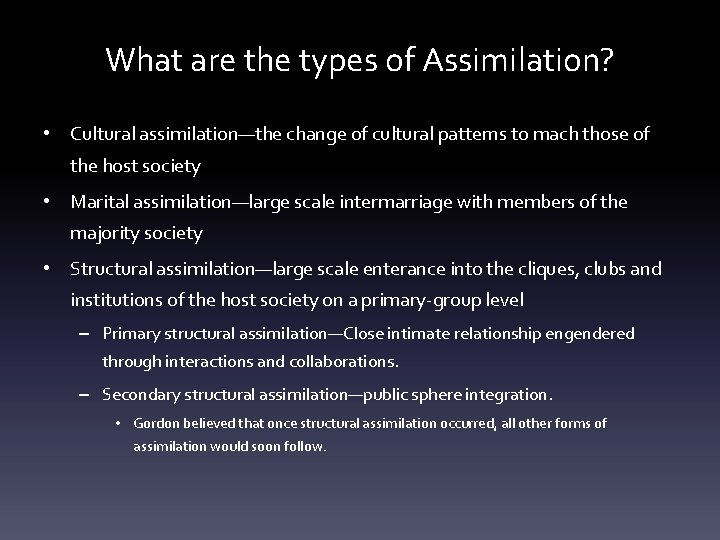
What are the types of Assimilation? • Cultural assimilation—the change of cultural patterns to mach those of the host society • Marital assimilation—large scale intermarriage with members of the majority society • Structural assimilation—large scale enterance into the cliques, clubs and institutions of the host society on a primary-group level – Primary structural assimilation—Close intimate relationship engendered through interactions and collaborations. – Secondary structural assimilation—public sphere integration. • Gordon believed that once structural assimilation occurred, all other forms of assimilation would soon follow.
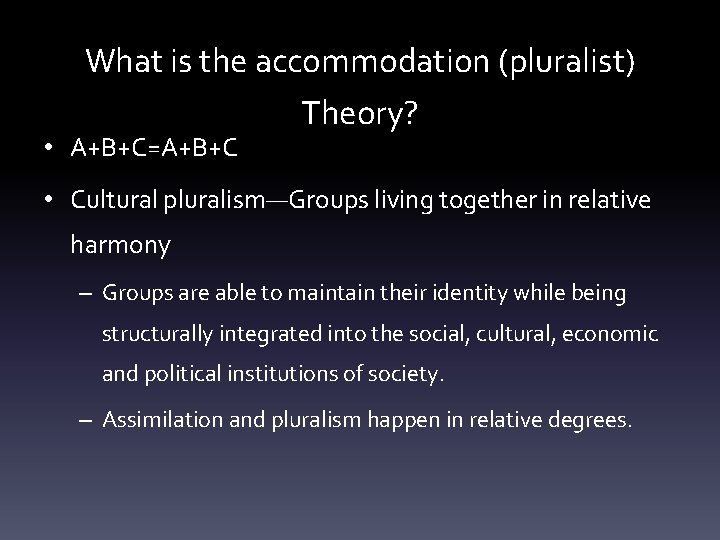
What is the accommodation (pluralist) Theory? • A+B+C=A+B+C • Cultural pluralism—Groups living together in relative harmony – Groups are able to maintain their identity while being structurally integrated into the social, cultural, economic and political institutions of society. – Assimilation and pluralism happen in relative degrees.
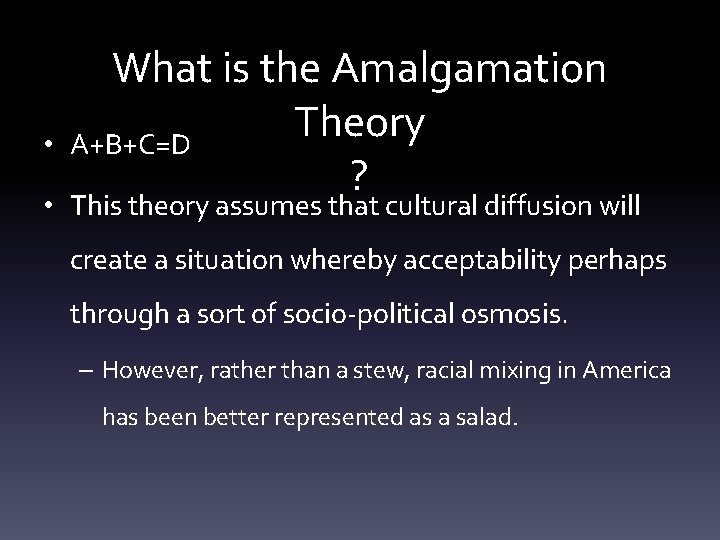
• What is the Amalgamation Theory A+B+C=D ? • This theory assumes that cultural diffusion will create a situation whereby acceptability perhaps through a sort of socio-political osmosis. – However, rather than a stew, racial mixing in America has been better represented as a salad.
- Slides: 29