
Interferometer in Space for Detecting Gravity Wave Radiation
- Slides: 24
Interferometer in Space for Detecting Gravity Wave Radiation using Lasers (In. Sp. RL) Dec-21 -2011 Workshop on Gravity Wave Detection Presenter: Babak. N. Saif
In. Sp. RL Team Gravitational-Wave Mission RFI Submitted by: Dr. Babak N. Saif, Instrument PI, GSFC Optics Branch, Babak. n. saif@nasa. gov, 301 -286 -5433 Study Team: Marcel Bluth, ATK Boom Engineer, Marcel. Bluth@atk. com Lee D. Feinberg, GSFC Chief Large Optics Systems Engineer, Lee. D. Feinberg@nasa. gov Dr. Peter Graham, Professor of Physics, Stanford University, PWGraham@stanford. edu Dr. Jason Hogan, Department of Physics, Stanford University, Hogan@stanford. edu Dr. Leo Hollberg, Prof. Physics, Stanford and Chief Technology Officer (Consulting) AOSense, Inc. , leoh@stanford. edu Dr. Mark Kasevich, Prof. Physics and Applied Physics, Stanford University, kasevich@stanford. edu Dr. Ritva Keski-Kuha, GSFC Optical Engineer, Ritva. a. keski-kuha@nasa. gov Dr. John Mather, GSFC Senior Astrophysicist, John. C. Mather@nasa. gov M. Bruce Milam, GSFC Aerospace Manager, Bruce. Milam@nasa. gov Dr. Surjeet Rajendran, Physicist, Stanford, Rajendran@stanford. edu Charles Perrygo, Genesis, Senior Mechanical Systems Engineer, charles. m. perrygo@nasa. gov Bernard D. Seery, GSFC Assistant Director for Advanced Concepts, bernie. seery@nasa. gov Dr. David Spergel, Senior Astrophysicist, Princeton University, dns@astro. princeton. edu
Outline of the talk • Why Atom Interferometry to detect Gravity Waves? • Basics Of Atom Interferometer. • Atom Gradiometer as a sensor for detection of Gravity Wave. • Amplification of Gravity Wave Phase: 1) Large Momentum Transfer (LMT) 2) Resonance(Heterodyne) detection • Laser Phase Noise Mitigation • Proposed Configurations. • Phase calculation. • Existing Technologies and Technology Maturation
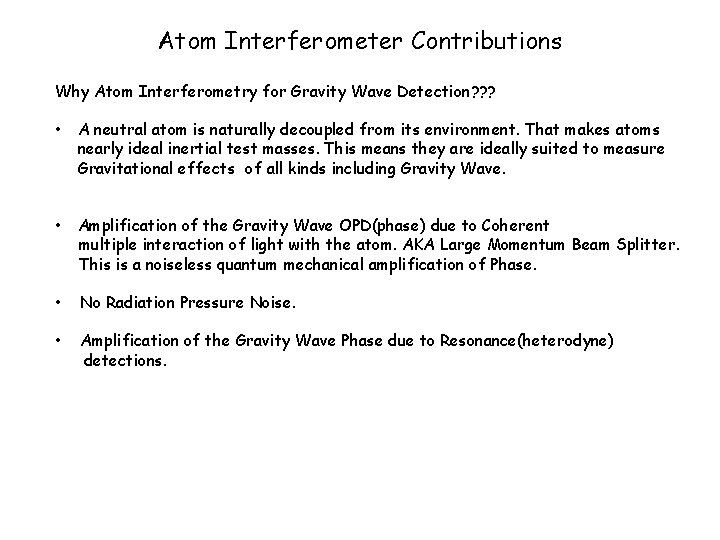
Atom Interferometer Contributions Why Atom Interferometry for Gravity Wave Detection? ? ? • A neutral atom is naturally decoupled from its environment. That makes atoms nearly ideal inertial test masses. This means they are ideally suited to measure Gravitational effects of all kinds including Gravity Wave. • Amplification of the Gravity Wave OPD(phase) due to Coherent multiple interaction of light with the atom. AKA Large Momentum Beam Splitter. This is a noiseless quantum mechanical amplification of Phase. • No Radiation Pressure Noise. • Amplification of the Gravity Wave Phase due to Resonance(heterodyne) detections.
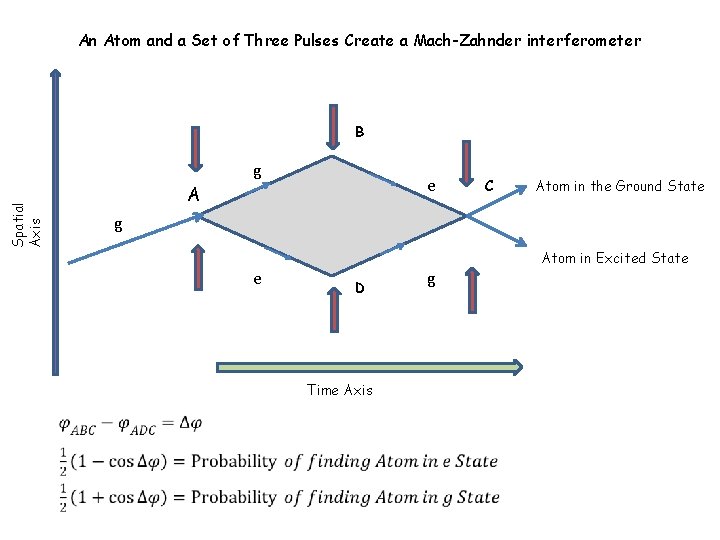
An Atom and a Set of Three Pulses Create a Mach-Zahnder interferometer Spatial Axis B A g e C Atom in the Ground State g e D Time Axis g Atom in Excited State
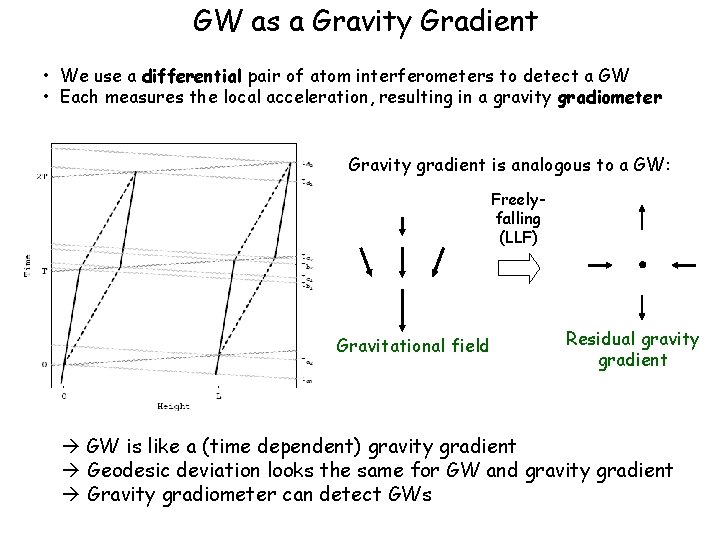
GW as a Gravity Gradient • We use a differential pair of atom interferometers to detect a GW • Each measures the local acceleration, resulting in a gravity gradiometer Gravity gradient is analogous to a GW: Freelyfalling (LLF) Gravitational field Residual gravity gradient GW is like a (time dependent) gravity gradient Geodesic deviation looks the same for GW and gravity gradient Gravity gradiometer can detect GWs
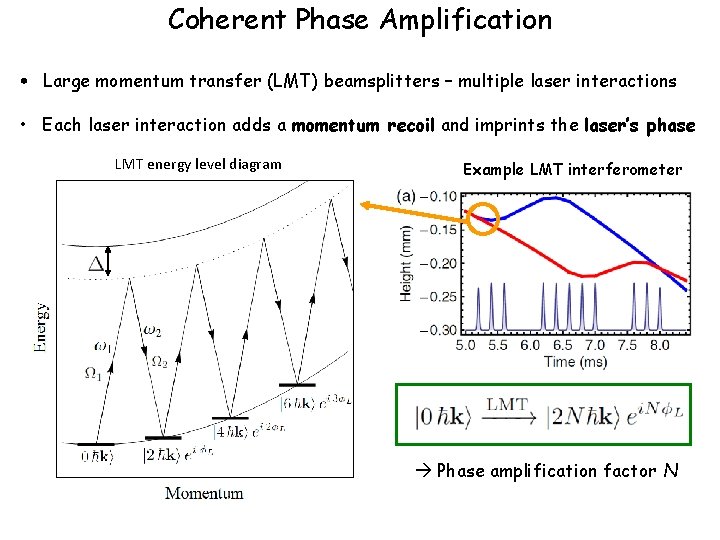
Coherent Phase Amplification • Large momentum transfer (LMT) beamsplitters – multiple laser interactions • Each laser interaction adds a momentum recoil and imprints the laser’s phase LMT energy level diagram Example LMT interferometer Phase amplification factor N
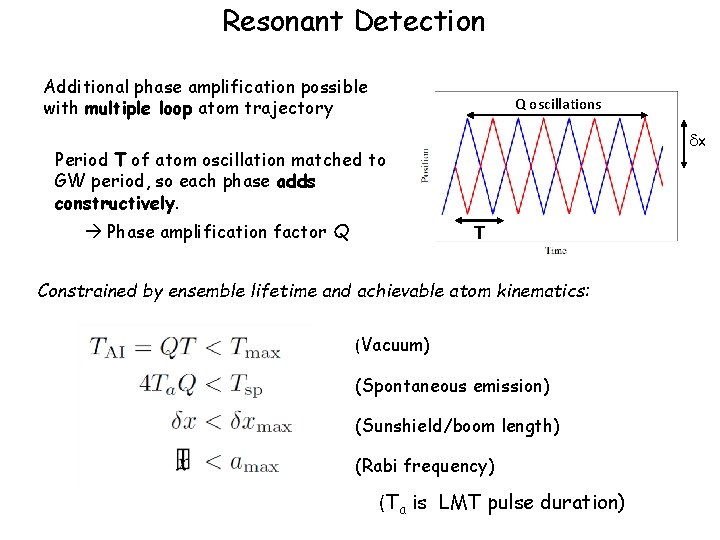
Resonant Detection Additional phase amplification possible with multiple loop atom trajectory Q oscillations dx Period T of atom oscillation matched to GW period, so each phase adds constructively. Phase amplification factor Q T Constrained by ensemble lifetime and achievable atom kinematics: (Vacuum) (Spontaneous emission) (Sunshield/boom length) (Rabi frequency) (Ta is LMT pulse duration)
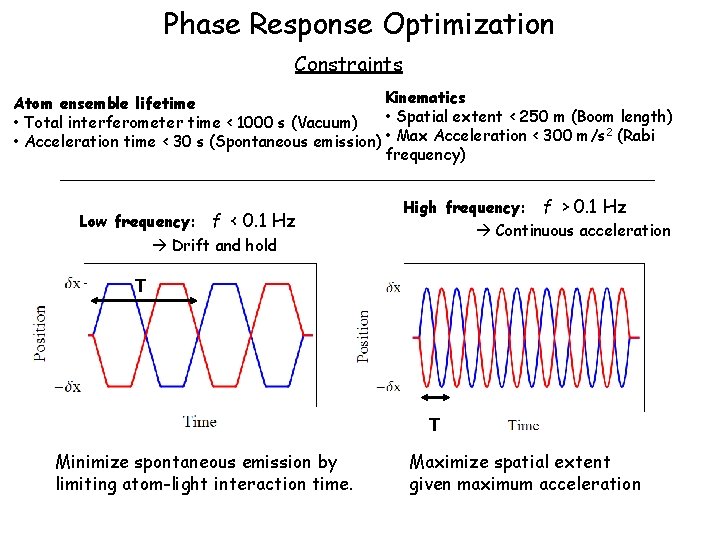
Phase Response Optimization Constraints Kinematics Atom ensemble lifetime • Spatial extent < 250 m (Boom length) • Total interferometer time < 1000 s (Vacuum) 2 • Acceleration time < 30 s (Spontaneous emission) • Max Acceleration < 300 m/s (Rabi frequency) Low frequency: f < 0. 1 Hz Drift and hold High frequency: f > 0. 1 Hz Continuous acceleration T T Minimize spontaneous emission by limiting atom-light interaction time. Maximize spatial extent given maximum acceleration
Laser Phase Noise Mitigation We have had discussions with members of CST and core team on laser phase noise mitigation for our single arm geometries. Our original RFI proposed method would require a stable laser oscillator. While single arm configuration would be game changing, the above method needs further study and makes the comparison of our RFI response to others difficult. Here we present two modified configurations to enable a direct comparison.
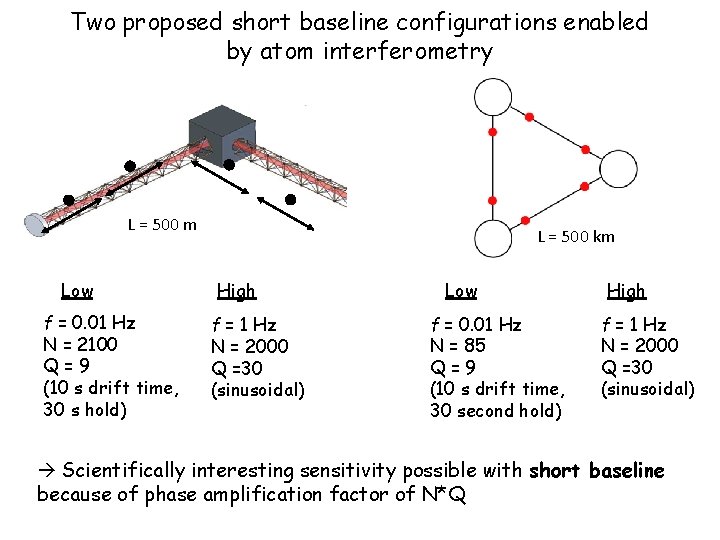
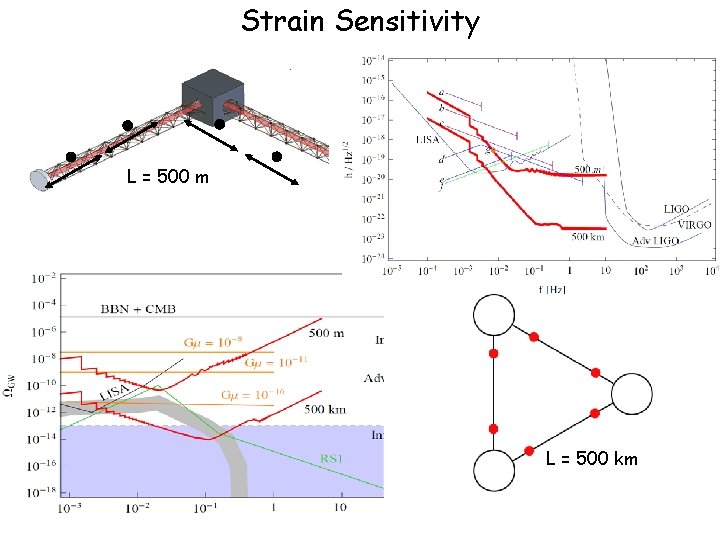
Two proposed short baseline configurations enabled by atom interferometry L = 500 m Low f = 0. 01 Hz N = 2100 Q=9 (10 s drift time, 30 s hold) L = 500 km High f = 1 Hz N = 2000 Q =30 (sinusoidal) Low f = 0. 01 Hz N = 85 Q=9 (10 s drift time, 30 second hold) High f = 1 Hz N = 2000 Q =30 (sinusoidal) Scientifically interesting sensitivity possible with short baseline because of phase amplification factor of N*Q
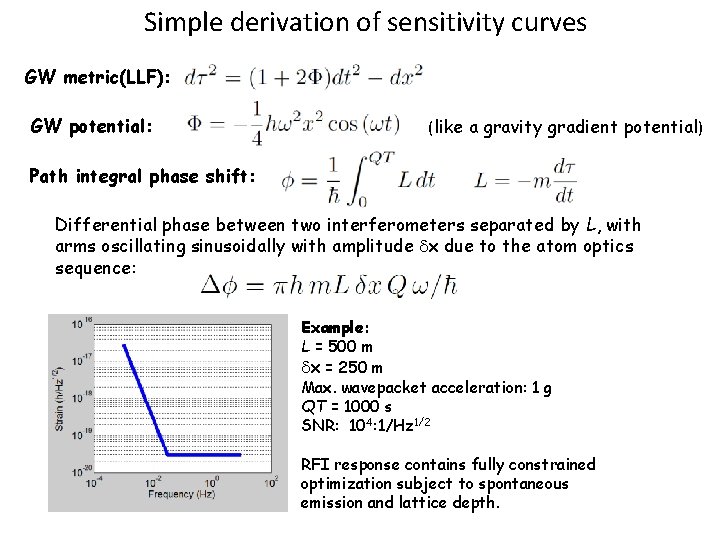
Simple derivation of sensitivity curves GW metric(LLF): GW potential: (like a gravity gradient potential) Path integral phase shift: Differential phase between two interferometers separated by L, with arms oscillating sinusoidally with amplitude dx due to the atom optics sequence: Example: L = 500 m dx = 250 m Max. wavepacket acceleration: 1 g QT = 1000 s SNR: 104: 1/Hz 1/2 RFI response contains fully constrained optimization subject to spontaneous emission and lattice depth.
Strain Sensitivity L = 500 m L = 500 km
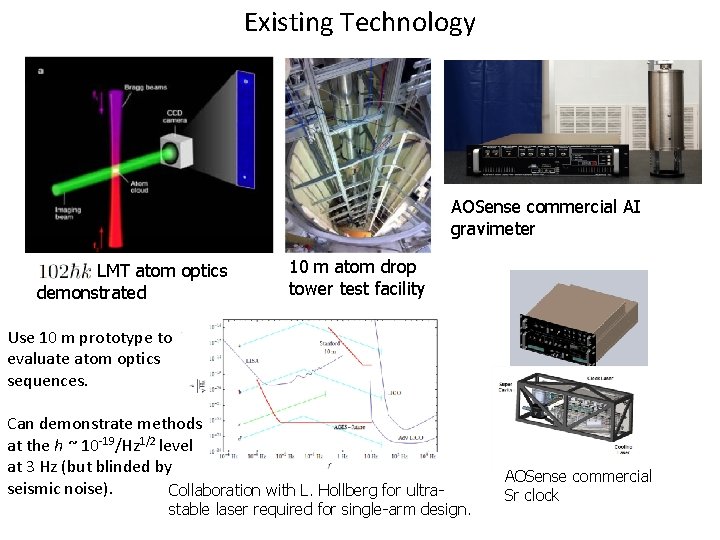
Existing Technology AOSense commercial AI gravimeter 102 hk LMT atom optics demonstrated 10 m atom drop tower test facility Use 10 m prototype to evaluate atom optics sequences. Can demonstrate methods at the h ~ 10 -19/Hz 1/2 level at 3 Hz (but blinded by seismic noise). Collaboration with L. Hollberg for ultra- stable laser required for single-arm design. AOSense commercial Sr clock
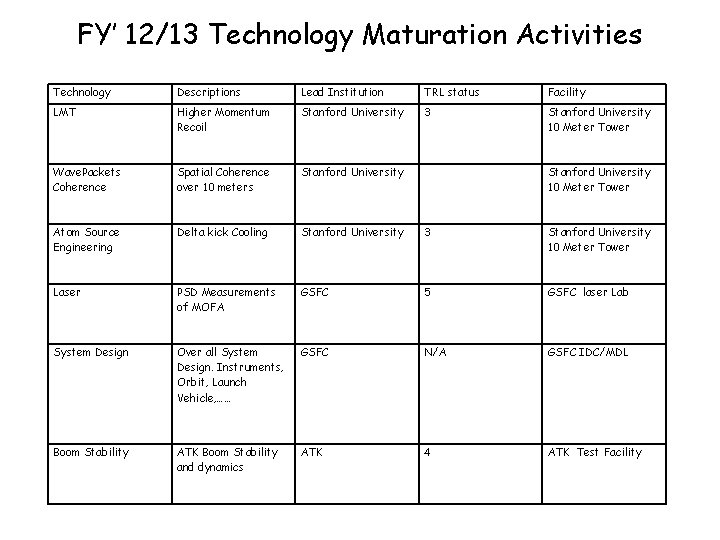
FY’ 12/13 Technology Maturation Activities Technology Descriptions Lead Institution TRL status Facility LMT Higher Momentum Recoil Stanford University 3 Stanford University 10 Meter Tower Wave. Packets Coherence Spatial Coherence over 10 meters Stanford University Atom Source Engineering Delta kick Cooling Stanford University 3 Stanford University 10 Meter Tower Laser PSD Measurements of MOFA GSFC 5 GSFC laser Lab System Design Over all System Design. Instruments, Orbit, Launch Vehicle, …… GSFC N/A GSFC IDC/MDL Boom Stability ATK Boom Stability and dynamics ATK 4 ATK Test Facility Stanford University 10 Meter Tower
Backup Slides
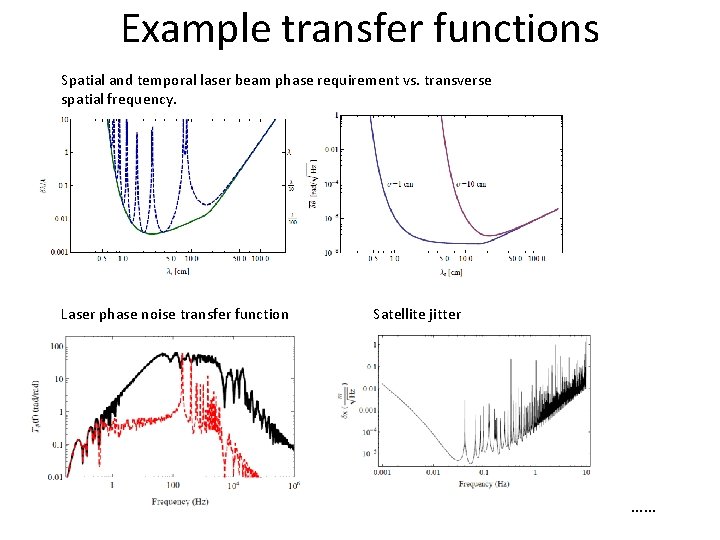
Example transfer functions Spatial and temporal laser beam phase requirement vs. transverse spatial frequency. Laser phase noise transfer function Satellite jitter ……
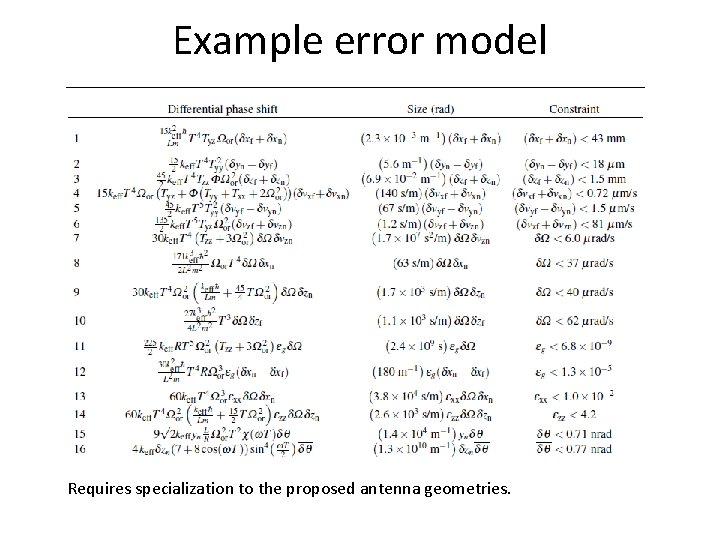
Example error model Requires specialization to the proposed antenna geometries.
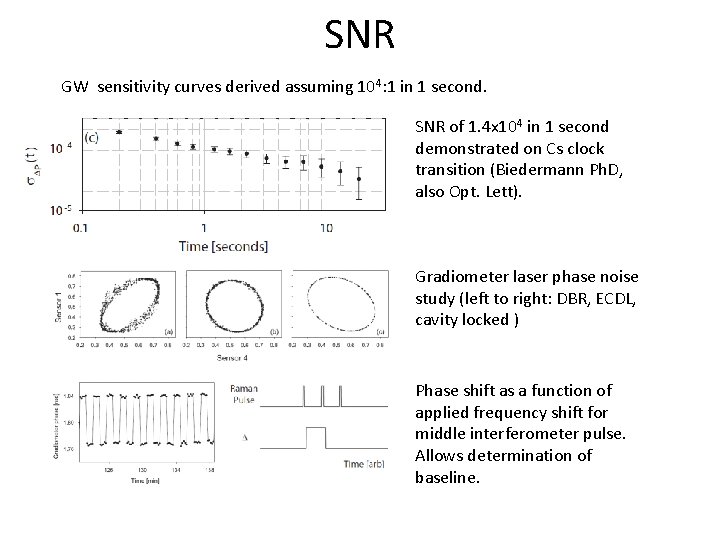
SNR GW sensitivity curves derived assuming 104: 1 in 1 second. SNR of 1. 4 x 10⁴ in 1 second demonstrated on Cs clock transition (Biedermann Ph. D, also Opt. Lett). Gradiometer laser phase noise study (left to right: DBR, ECDL, cavity locked ) Phase shift as a function of applied frequency shift for middle interferometer pulse. Allows determination of baseline.
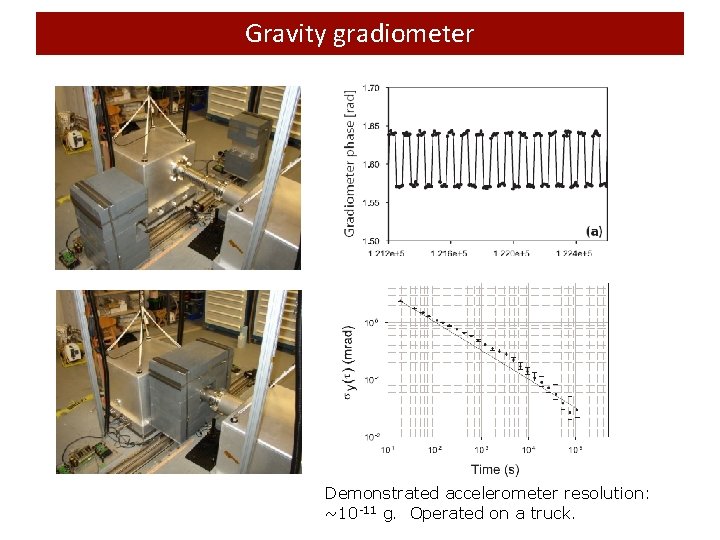
Gravity gradiometer Demonstrated accelerometer resolution: ~10 -11 g. Operated on a truck.
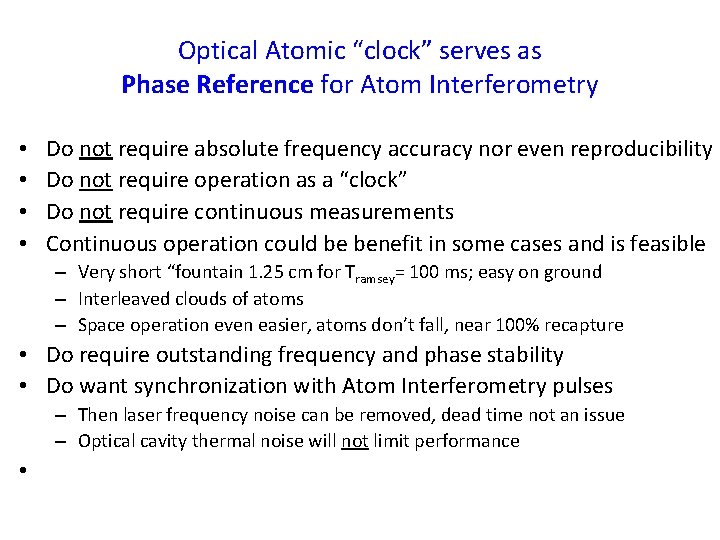
Optical Atomic “clock” serves as Phase Reference for Atom Interferometry • • Do not require absolute frequency accuracy nor even reproducibility Do not require operation as a “clock” Do not require continuous measurements Continuous operation could be benefit in some cases and is feasible – Very short “fountain 1. 25 cm for Tramsey= 100 ms; easy on ground – Interleaved clouds of atoms – Space operation even easier, atoms don’t fall, near 100% recapture • Do require outstanding frequency and phase stability • Do want synchronization with Atom Interferometry pulses – Then laser frequency noise can be removed, dead time not an issue – Optical cavity thermal noise will not limit performance •
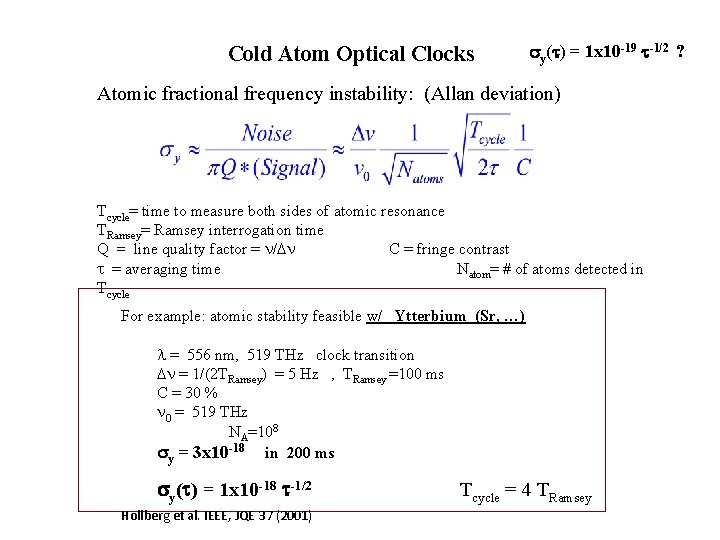
Cold Atom Optical Clocks y( ) = 1 x 10 -19 -1/2 ? Atomic fractional frequency instability: (Allan deviation) Tcycle= time to measure both sides of atomic resonance TRamsey= Ramsey interrogation time Q = line quality factor = / C = fringe contrast = averaging time Natom= # of atoms detected in Tcycle For example: atomic stability feasible w/ Ytterbium (Sr, …) = 556 nm, 519 THz clock transition = 1/(2 TRamsey) = 5 Hz , TRamsey =100 ms C = 30 % 0 = 519 THz NA=108 y = 3 x 10 -18 in 200 ms y( ) = 1 x 10 -18 -1/2 Hollberg et al. IEEE, JQE 37 (2001) Tcycle = 4 TRamsey
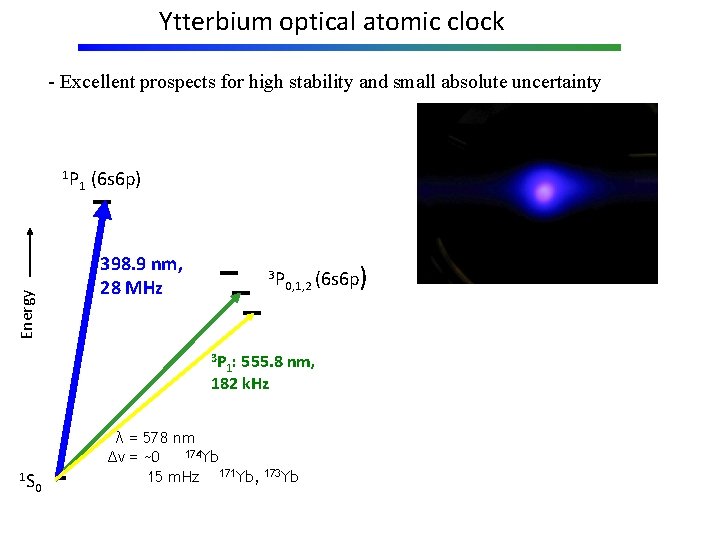
Ytterbium optical atomic clock - Excellent prospects for high stability and small absolute uncertainty Energy 1 P 1 (6 s 6 p) 398. 9 nm, 28 MHz 3 P 3 P 0, 1, 2 (6 s 6 p 555. 8 nm, 182 k. Hz 1 S 0 1: λ = 578 nm 174 Yb Δν = ~0 15 m. Hz 171 Yb, 173 Yb )
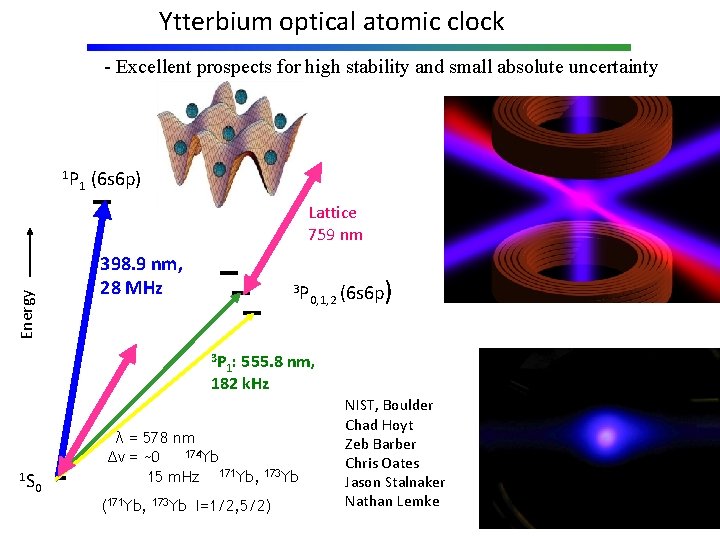
Ytterbium optical atomic clock - Excellent prospects for high stability and small absolute uncertainty 1 P 1 (6 s 6 p) Energy Lattice 759 nm 398. 9 nm, 28 MHz 3 P 3 P 0, 1, 2 (6 s 6 p ) 555. 8 nm, 182 k. Hz 1 S 0 1: λ = 578 nm 174 Yb Δν = ~0 15 m. Hz 171 Yb, (171 Yb, 173 Yb I=1/2, 5/2) NIST, Boulder Chad Hoyt Zeb Barber Chris Oates Jason Stalnaker Nathan Lemke