
Interference Geolocation Techniques Introduction and Basic Requirements ITU
Interference Geolocation Techniques Introduction and Basic Requirements ITU Workshop Limassol, Cyprus 14 -16 April 2014 G. Baraglia
Presentation Agenda Types of Interferences Detection Two Satellites Geolocation Single Satellite Geolocation Basic Requirements www. sat. com | 2
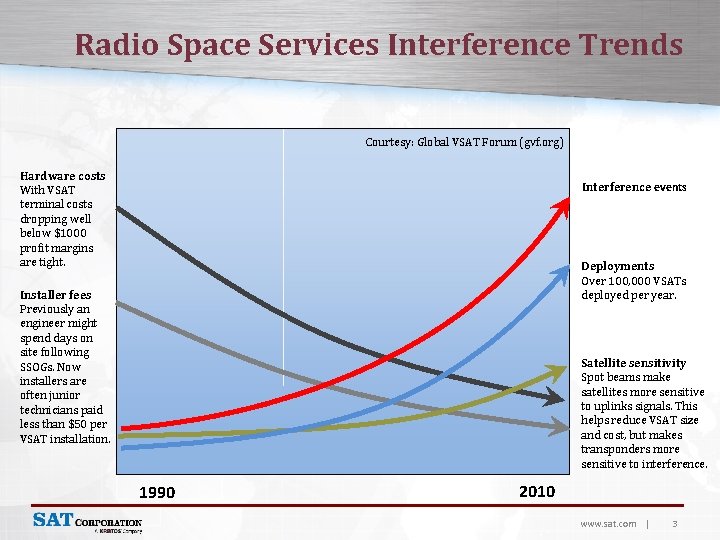
Radio Space Services Interference Trends Courtesy: Global VSAT Forum (gvf. org) Hardware costs With VSAT terminal costs dropping well below $1000 profit margins are tight. Interference events Deployments Over 100, 000 VSATs deployed per year. Installer fees Previously an engineer might spend days on site following SSOGs. Now installers are often junior technicians paid less than $50 per VSAT installation. Satellite sensitivity Spot beams make satellites more sensitive to uplinks signals. This helps reduce VSAT size and cost, but makes transponders more sensitive to interference. 1990 2010 www. sat. com | 3
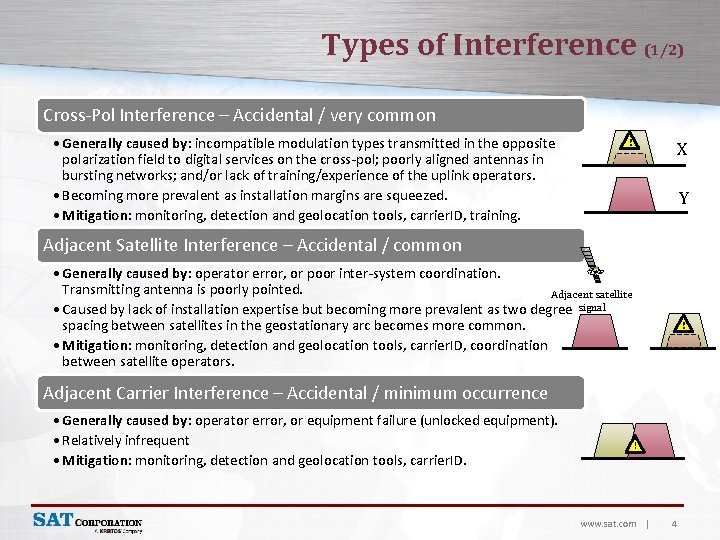
Types of Interference (1/2) Cross-Pol Interference – Accidental / very common • Generally caused by: incompatible modulation types transmitted in the opposite polarization field to digital services on the cross-pol; poorly aligned antennas in bursting networks; and/or lack of training/experience of the uplink operators. • Becoming more prevalent as installation margins are squeezed. • Mitigation: monitoring, detection and geolocation tools, carrier. ID, training. ! X Y Adjacent Satellite Interference – Accidental / common • Generally caused by: operator error, or poor inter-system coordination. Transmitting antenna is poorly pointed. Adjacent satellite • Caused by lack of installation expertise but becoming more prevalent as two degree signal spacing between satellites in the geostationary arc becomes more common. • Mitigation: monitoring, detection and geolocation tools, carrier. ID, coordination between satellite operators. ! Adjacent Carrier Interference – Accidental / minimum occurrence • Generally caused by: operator error, or equipment failure (unlocked equipment). • Relatively infrequent • Mitigation: monitoring, detection and geolocation tools, carrier. ID. ! www. sat. com | 4
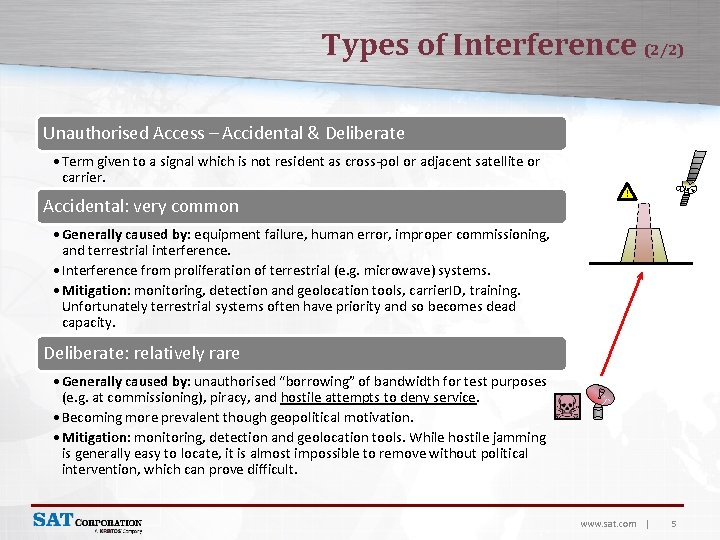
Types of Interference (2/2) Unauthorised Access – Accidental & Deliberate • Term given to a signal which is not resident as cross-pol or adjacent satellite or carrier. Accidental: very common ! • Generally caused by: equipment failure, human error, improper commissioning, and terrestrial interference. • Interference from proliferation of terrestrial (e. g. microwave) systems. • Mitigation: monitoring, detection and geolocation tools, carrier. ID, training. Unfortunately terrestrial systems often have priority and so becomes dead capacity. Deliberate: relatively rare • Generally caused by: unauthorised “borrowing” of bandwidth for test purposes (e. g. at commissioning), piracy, and hostile attempts to deny service. • Becoming more prevalent though geopolitical motivation. • Mitigation: monitoring, detection and geolocation tools. While hostile jamming is generally easy to locate, it is almost impossible to remove without political intervention, which can prove difficult. www. sat. com | 5
Ways to Detect Interference Passive • Wait for end customer complaints or local authority report • Compare spectrum plot of the transponder with the nominal frequency plan • Check for unauthorized carriers, spurious Active • Continually scan signals and transponders of interest, generate alarms for out -of-tolerance conditions • Analog Spectrum Analyzer • Digital Spectrum Analyzer • Pro-active; problem can be cleared before it is noticed by the customer www. sat. com | 6
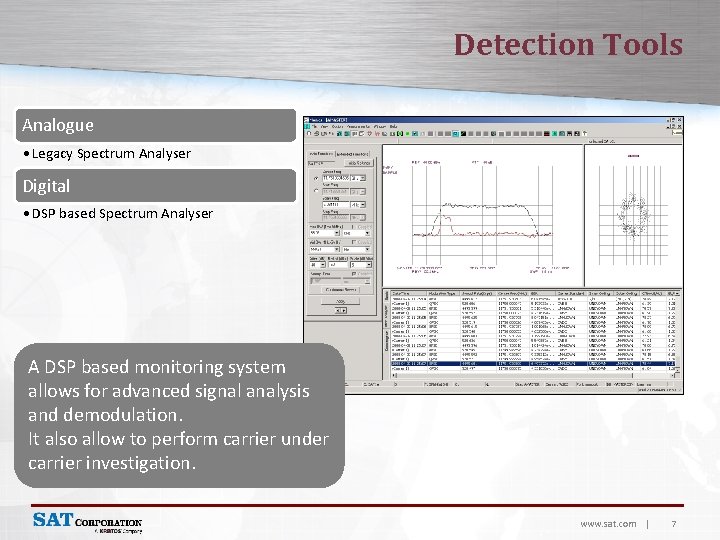
Detection Tools Analogue • Legacy Spectrum Analyser Digital • DSP based Spectrum Analyser A DSP based monitoring system allows for advanced signal analysis and demodulation. It also allow to perform carrier under carrier investigation. www. sat. com | 7

Two Satellites Geolocation (1/9) A Transmitting Station sends a signal to a satellite. This signal is received by the Receiving Station. sat. ID Receiving Station Interference Source www. sat. com | 8

Two Satellites Geolocation (2/9) Secondary Satellite Primary Satellite Transmitting Station antenna characteristics usually result in a lower power copy of signal being received by a nearby satellite. Solid lines: Majority of signal energy Dashed lines: Some signal energy sat. ID Receiving Station Interference Source www. sat. com | 9
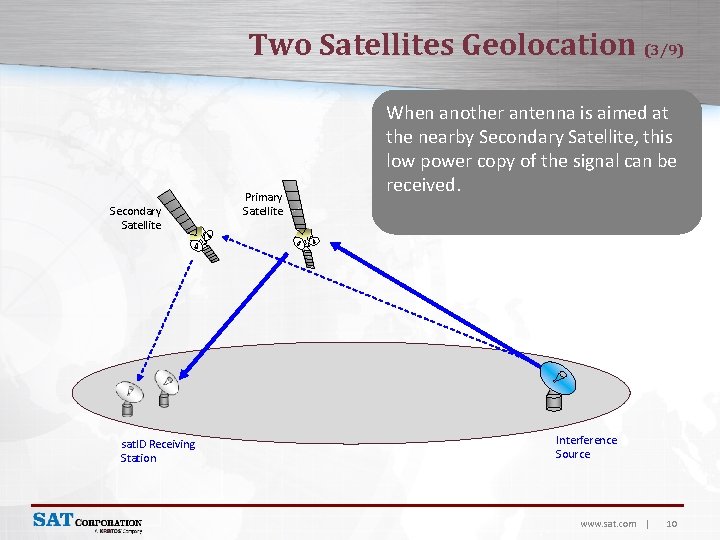
Two Satellites Geolocation (3/9) Secondary Satellite sat. ID Receiving Station Primary Satellite When another antenna is aimed at the nearby Secondary Satellite, this low power copy of the signal can be received. Interference Source www. sat. com | 10
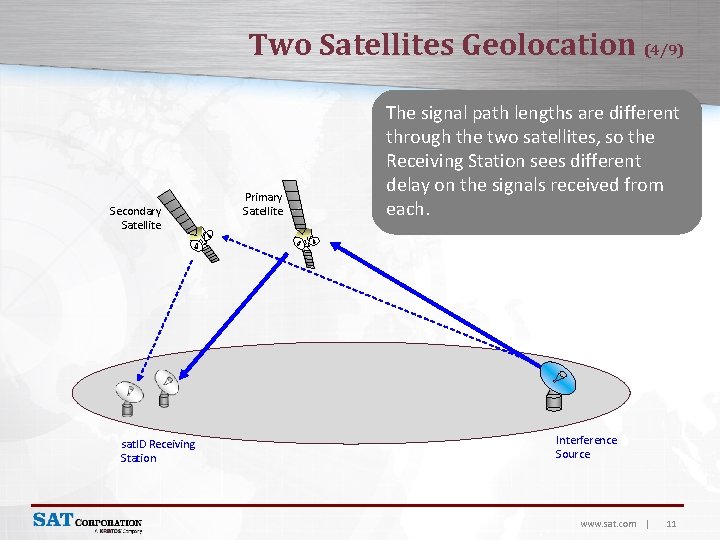
Two Satellites Geolocation (4/9) Secondary Satellite sat. ID Receiving Station Primary Satellite The signal path lengths are different through the two satellites, so the Receiving Station sees different delay on the signals received from each. Interference Source www. sat. com | 11
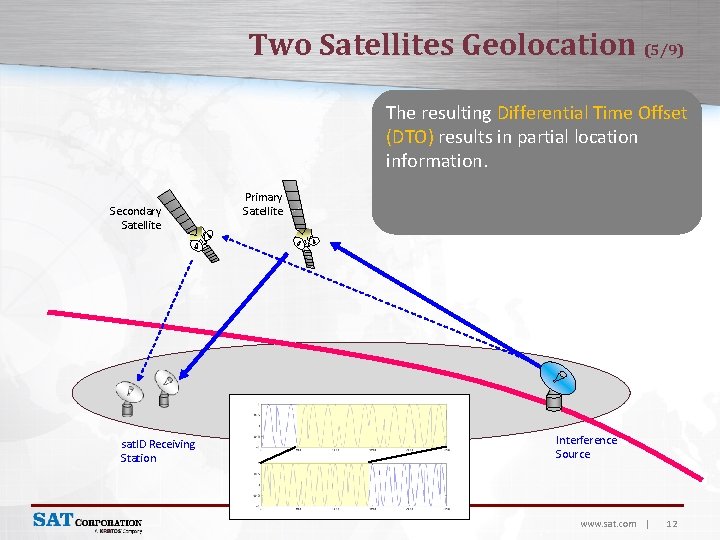
Two Satellites Geolocation (5/9) The resulting Differential Time Offset (DTO) results in partial location information. Secondary Satellite sat. ID Receiving Station Primary Satellite Interference Source www. sat. com | 12
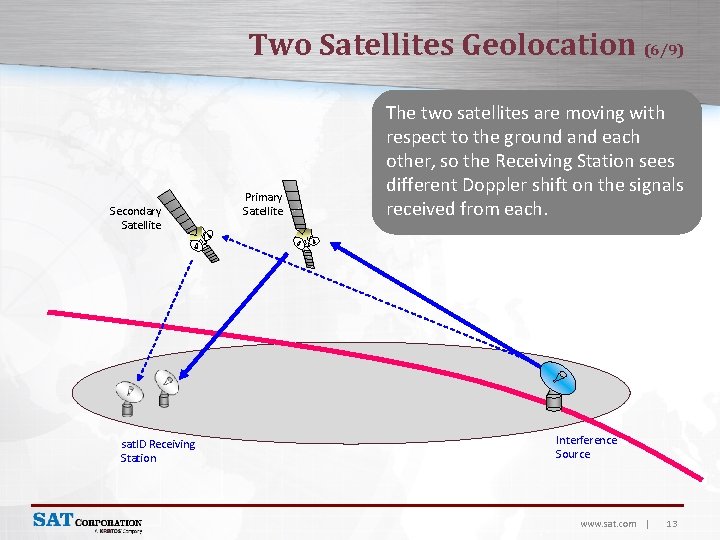
Two Satellites Geolocation (6/9) Secondary Satellite sat. ID Receiving Station Primary Satellite The two satellites are moving with respect to the ground and each other, so the Receiving Station sees different Doppler shift on the signals received from each. Interference Source www. sat. com | 13
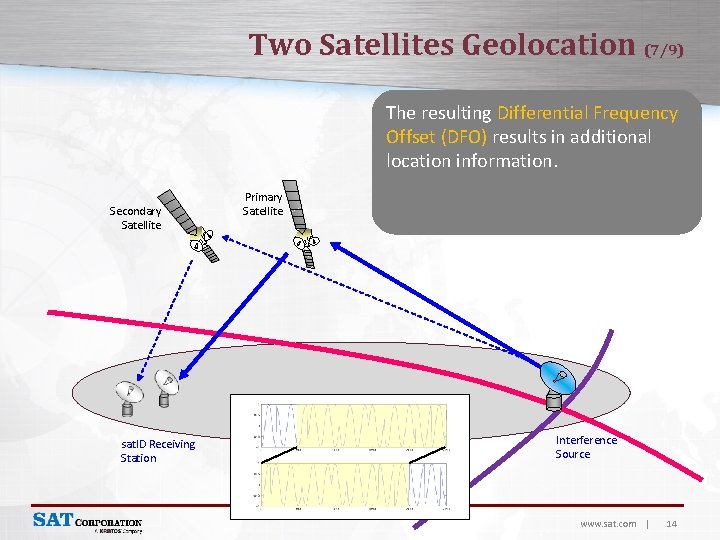
Two Satellites Geolocation (7/9) The resulting Differential Frequency Offset (DFO) results in additional location information. Secondary Satellite sat. ID Receiving Station Primary Satellite Interference Source www. sat. com | 14
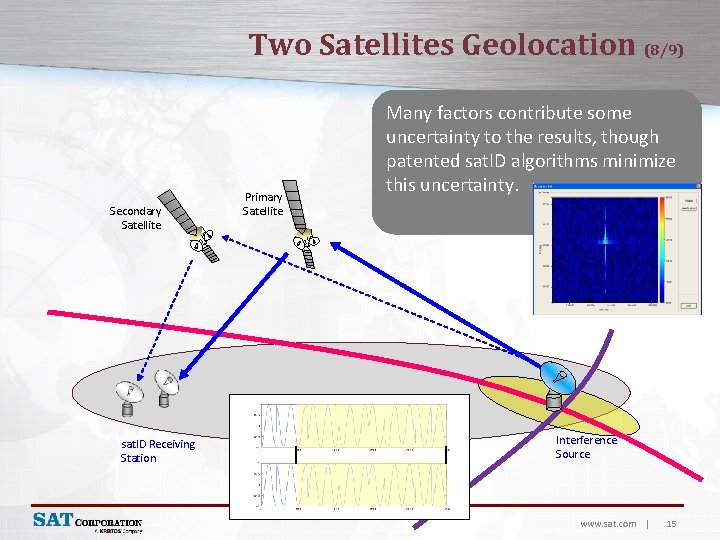
Two Satellites Geolocation (8/9) Secondary Satellite sat. ID Receiving Station Primary Satellite Many factors contribute some uncertainty to the results, though patented sat. ID algorithms minimize this uncertainty. Interference Source www. sat. com | 15
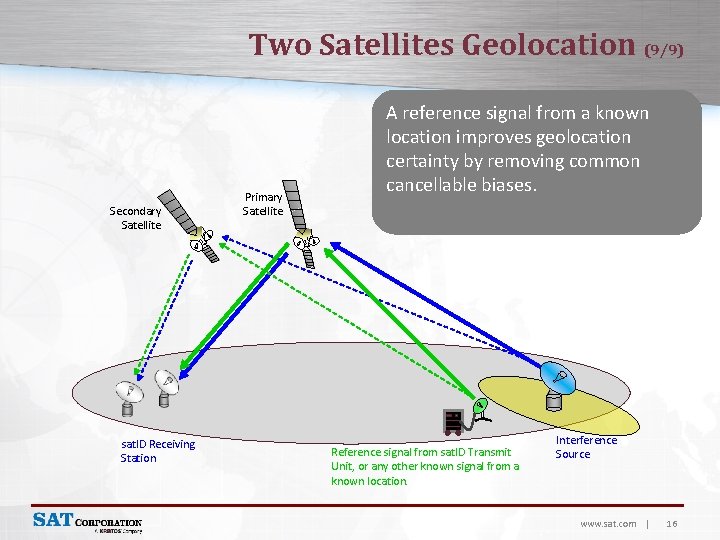
Two Satellites Geolocation (9/9) Secondary Satellite sat. ID Receiving Station Primary Satellite A reference signal from a known location improves geolocation certainty by removing common cancellable biases. Reference signal from sat. ID Transmit Unit, or any other known signal from a known location. Interference Source www. sat. com | 16
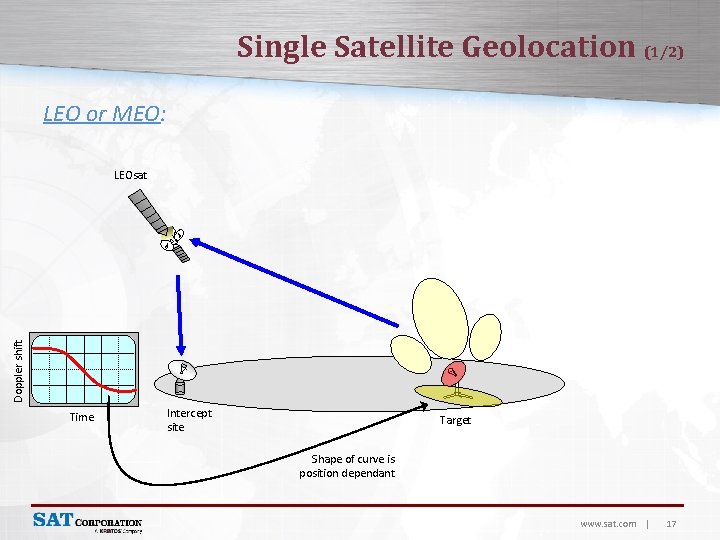
Single Satellite Geolocation (1/2) LEO or MEO: Doppler shift LEOsat Time Intercept site Target Shape of curve is position dependant www. sat. com | 17
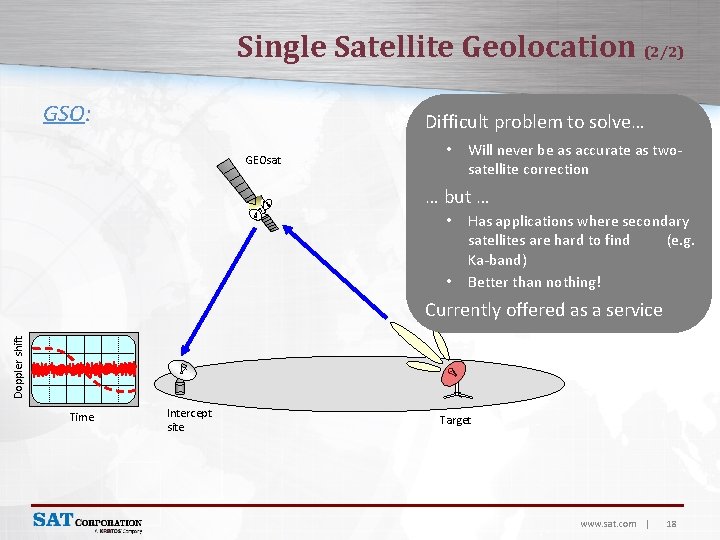
Single Satellite Geolocation (2/2) GSO: Difficult problem to solve… GEOsat • Will never be as accurate as twosatellite correction … but … • Has applications where secondary satellites are hard to find (e. g. Ka-band) • Better than nothing! Doppler shift Currently offered as a service Time Intercept site Target www. sat. com | 18
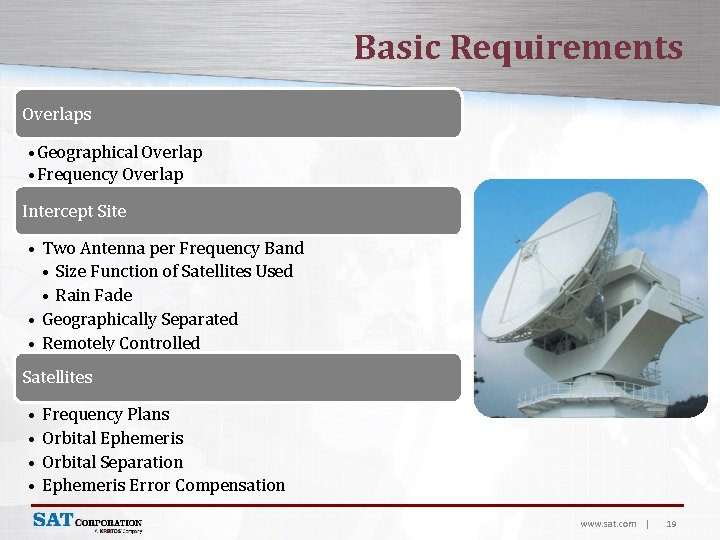
Basic Requirements Overlaps • Geographical Overlap • Frequency Overlap Intercept Site • Two Antenna per Frequency Band • Size Function of Satellites Used • Rain Fade • Geographically Separated • Remotely Controlled Satellites • Frequency Plans • Orbital Ephemeris • Orbital Separation • Ephemeris Error Compensation www. sat. com | 19
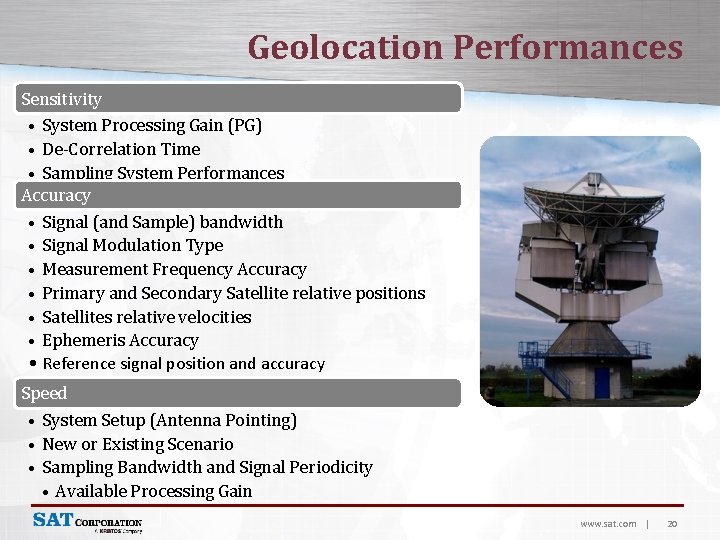
Geolocation Performances Sensitivity • System Processing Gain (PG) • De-Correlation Time • Sampling System Performances Accuracy • Signal (and Sample) bandwidth • Signal Modulation Type • Measurement Frequency Accuracy • Primary and Secondary Satellite relative positions • Satellites relative velocities • Ephemeris Accuracy • Reference signal position and accuracy Speed • System Setup (Antenna Pointing) • New or Existing Scenario • Sampling Bandwidth and Signal Periodicity • Available Processing Gain www. sat. com | 20
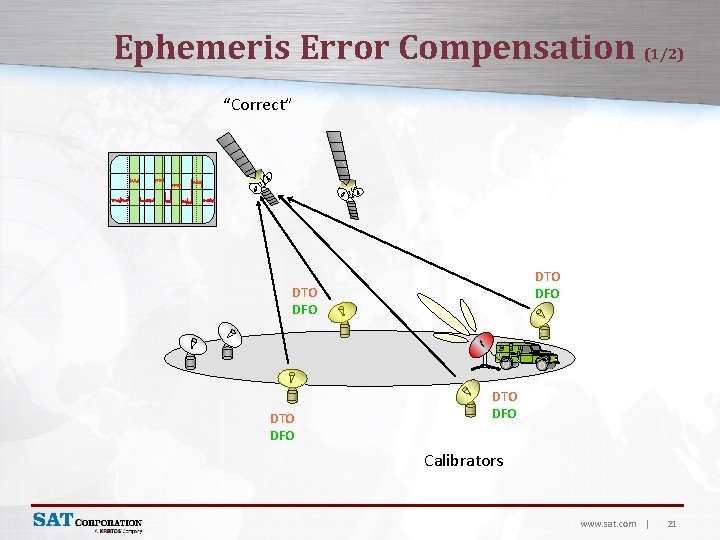
Ephemeris Error Compensation (1/2) “Correct” DTO DFO Calibrators www. sat. com | 21
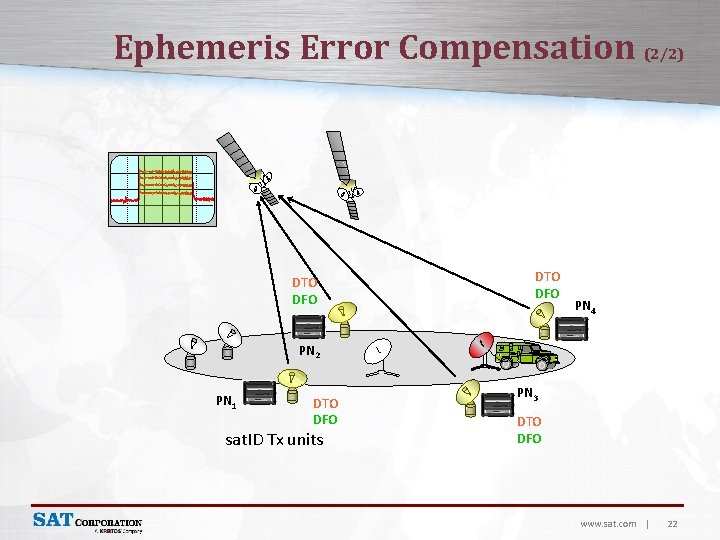
Ephemeris Error Compensation (2/2) DTO DFO PN 4 PN 2 PN 1 DTO DFO sat. ID Tx units PN 3 DTO DFO www. sat. com | 22
SAT Corporation (SAT) has prepared this document for use by its personnel, licensees, and potential licensees. SAT reserves the right to change any products described in this document as well as information included herein without prior notice. The information contained herein is presented for educational purposes only and the right to copy and use this document is limited to that necessary to fulfill this function. The recipient agrees that they will not, nor will they cause others to, copy or reproduce this information, either in whole or in part, or manufacture, produce, sell or lease any product copied from or essentially based upon the information contained herein without prior written approval of SAT. Registered trademarks of SAT Corporation include, but are not limited to, Monics, SAT-DSA, sat. ID and Sig. Mon. Copyright© 2014 SAT Corporation. All rights reserved. Contact Guido Baraglia gbaraglia@sat. com RT Logic Proprietary 23 www. sat. com | 23
- Slides: 23