
INTERFACING TO INDIGO Technical Operational considerations interfacing to
- Slides: 20
INTERFACING TO INDIGO Technical & Operational considerations interfacing to a submarine open line system Tim Rayner, - AARNet - June 2019
AGENDA AARNet, Australia’s NREN • • • National Optical Network – background to Indigo Traditional Submarine Networks Spectrum Sharing Submarine Networks – How Indigo is different Network Design Equipment used Wavelength Configurations, performance & capacity © AARNet Pty Ltd | 2
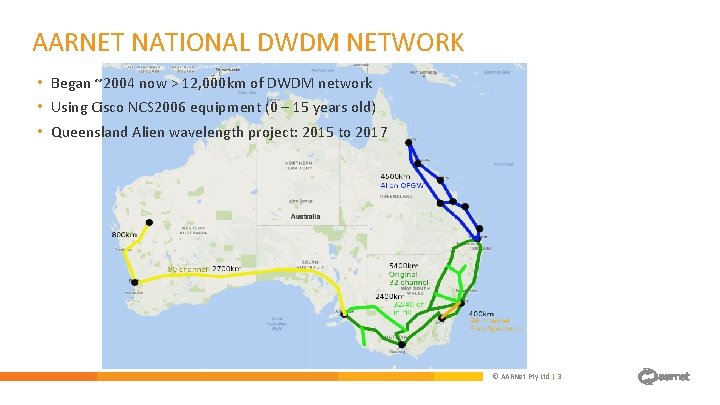
AARNET NATIONAL DWDM NETWORK • Began ~2004 now > 12, 000 km of DWDM network • Using Cisco NCS 2006 equipment (0 – 15 years old) • Queensland Alien wavelength project: 2015 to 2017 © AARNet Pty Ltd | 3
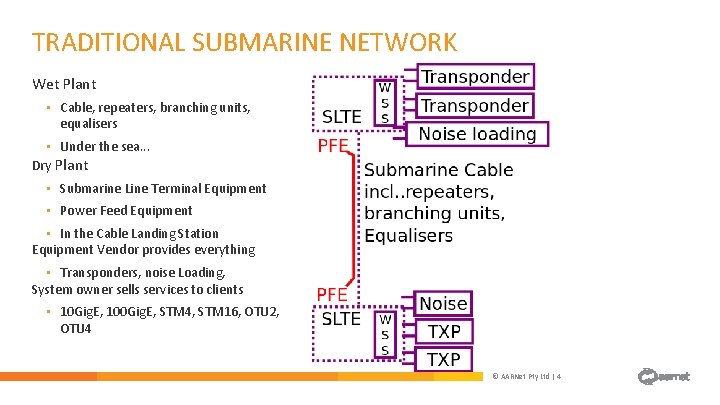
TRADITIONAL SUBMARINE NETWORK Wet Plant • Cable, repeaters, branching units, equalisers • Under the sea. . . Dry Plant • Submarine Line Terminal Equipment • Power Feed Equipment • In the Cable Landing Station Equipment Vendor provides everything • Transponders, noise Loading, System owner sells services to clients • 10 Gig. E, 100 Gig. E, STM 4, STM 16, OTU 2, OTU 4 © AARNet Pty Ltd | 4
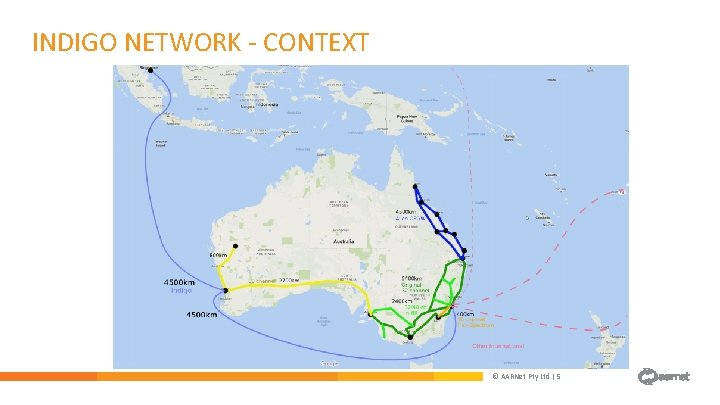
INDIGO NETWORK - CONTEXT © AARNet Pty Ltd | 5
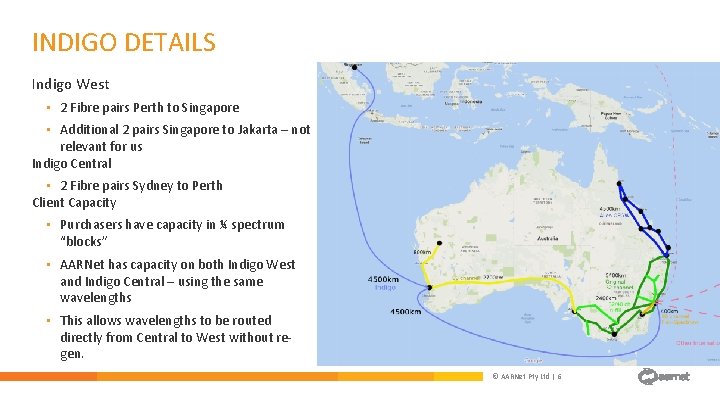
INDIGO DETAILS Indigo West • 2 Fibre pairs Perth to Singapore • Additional 2 pairs Singapore to Jakarta – not relevant for us Indigo Central • 2 Fibre pairs Sydney to Perth Client Capacity • Purchasers have capacity in ¼ spectrum “blocks” • AARNet has capacity on both Indigo West and Indigo Central – using the same wavelengths • This allows wavelengths to be routed directly from Central to West without regen. © AARNet Pty Ltd | 6
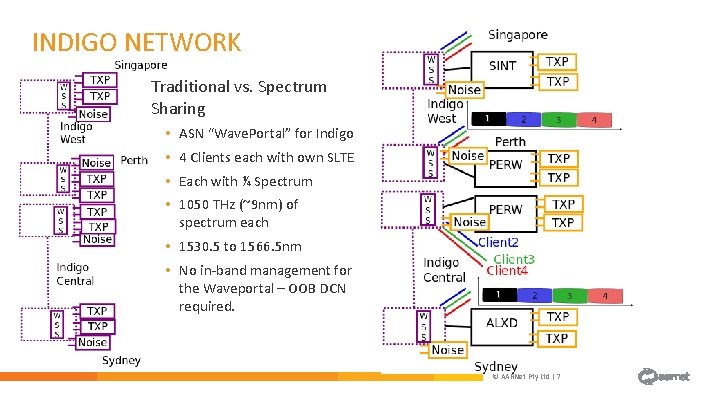
INDIGO NETWORK Traditional vs. Spectrum Sharing • ASN “Wave. Portal” for Indigo • 4 Clients each with own SLTE • Each with ¼ Spectrum • 1050 THz (~9 nm) of spectrum each • 1530. 5 to 1566. 5 nm • No in-band management for the Waveportal – OOB DCN required. © AARNet Pty Ltd | 7
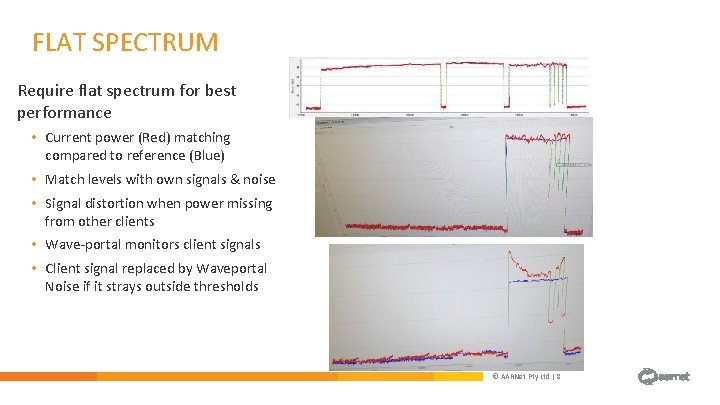
FLAT SPECTRUM Require flat spectrum for best performance • Current power (Red) matching compared to reference (Blue) • Match levels with own signals & noise • Signal distortion when power missing from other clients • Wave-portal monitors client signals • Client signal replaced by Waveportal Noise if it strays outside thresholds © AARNet Pty Ltd | 8
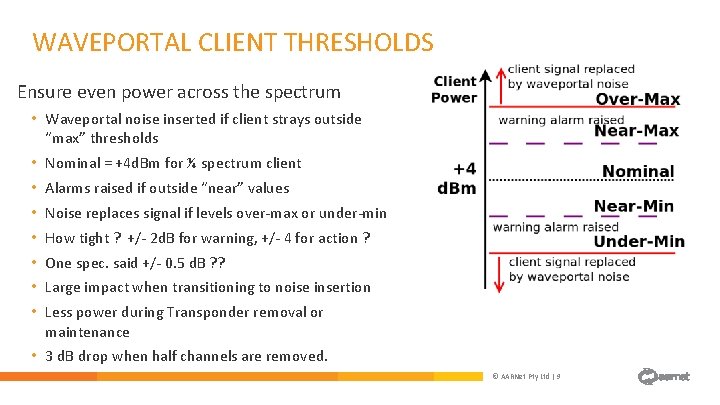
WAVEPORTAL CLIENT THRESHOLDS Ensure even power across the spectrum • Waveportal noise inserted if client strays outside “max” thresholds • Nominal = +4 d. Bm for ¼ spectrum client • Alarms raised if outside “near” values • Noise replaces signal if levels over-max or under-min • How tight ? +/- 2 d. B for warning, +/- 4 for action ? • One spec. said +/- 0. 5 d. B ? ? • Large impact when transitioning to noise insertion • Less power during Transponder removal or maintenance • 3 d. B drop when half channels are removed. © AARNet Pty Ltd | 9
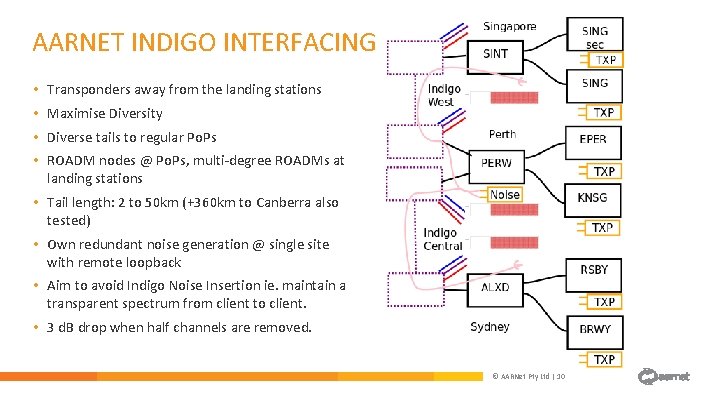
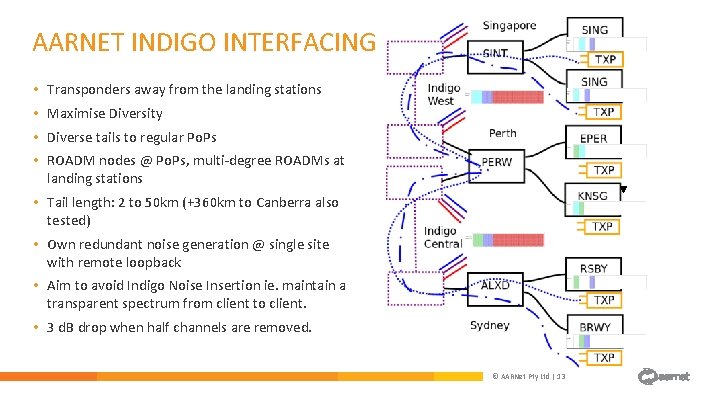
AARNET INDIGO INTERFACING • Transponders away from the landing stations • Maximise Diversity • Diverse tails to regular Po. Ps • ROADM nodes @ Po. Ps, multi-degree ROADMs at landing stations • Tail length: 2 to 50 km (+360 km to Canberra also tested) • Own redundant noise generation @ single site with remote loopback • Aim to avoid Indigo Noise Insertion ie. maintain a transparent spectrum from client to client. • 3 d. B drop when half channels are removed. © AARNet Pty Ltd | 10
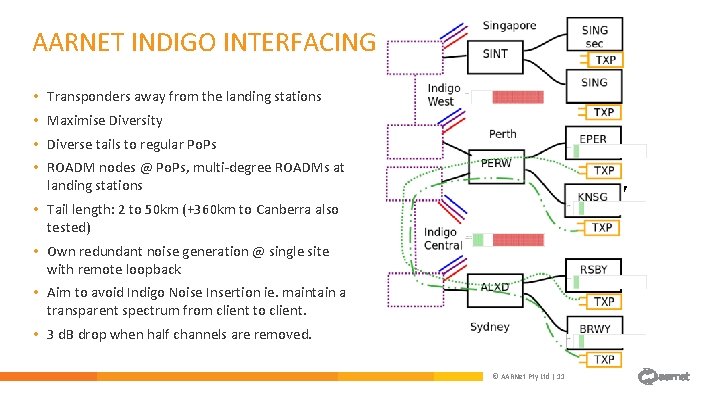
AARNET INDIGO INTERFACING • Transponders away from the landing stations • Maximise Diversity • Diverse tails to regular Po. Ps • ROADM nodes @ Po. Ps, multi-degree ROADMs at landing stations • Tail length: 2 to 50 km (+360 km to Canberra also tested) • Own redundant noise generation @ single site with remote loopback • Aim to avoid Indigo Noise Insertion ie. maintain a transparent spectrum from client to client. • 3 d. B drop when half channels are removed. © AARNet Pty Ltd | 11
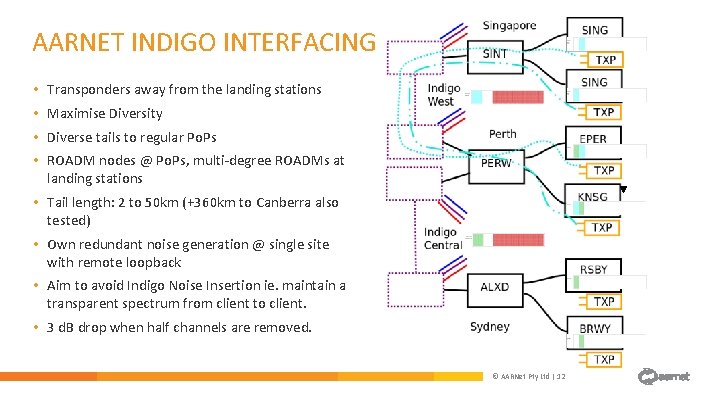
AARNET INDIGO INTERFACING • Transponders away from the landing stations • Maximise Diversity • Diverse tails to regular Po. Ps • ROADM nodes @ Po. Ps, multi-degree ROADMs at landing stations • Tail length: 2 to 50 km (+360 km to Canberra also tested) • Own redundant noise generation @ single site with remote loopback • Aim to avoid Indigo Noise Insertion ie. maintain a transparent spectrum from client to client. • 3 d. B drop when half channels are removed. © AARNet Pty Ltd | 12
AARNET INDIGO INTERFACING • Transponders away from the landing stations • Maximise Diversity • Diverse tails to regular Po. Ps • ROADM nodes @ Po. Ps, multi-degree ROADMs at landing stations • Tail length: 2 to 50 km (+360 km to Canberra also tested) • Own redundant noise generation @ single site with remote loopback • Aim to avoid Indigo Noise Insertion ie. maintain a transparent spectrum from client to client. • 3 d. B drop when half channels are removed. © AARNet Pty Ltd | 13
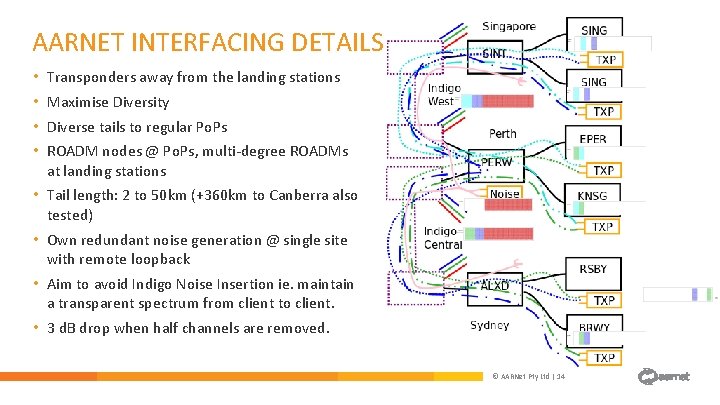
AARNET INTERFACING DETAILS • Transponders away from the landing stations • Maximise Diversity • Diverse tails to regular Po. Ps • ROADM nodes @ Po. Ps, multi-degree ROADMs at landing stations • Tail length: 2 to 50 km (+360 km to Canberra also tested) • Own redundant noise generation @ single site with remote loopback • Aim to avoid Indigo Noise Insertion ie. maintain a transparent spectrum from client to client. • 3 d. B drop when half channels are removed. © AARNet Pty Ltd | 14
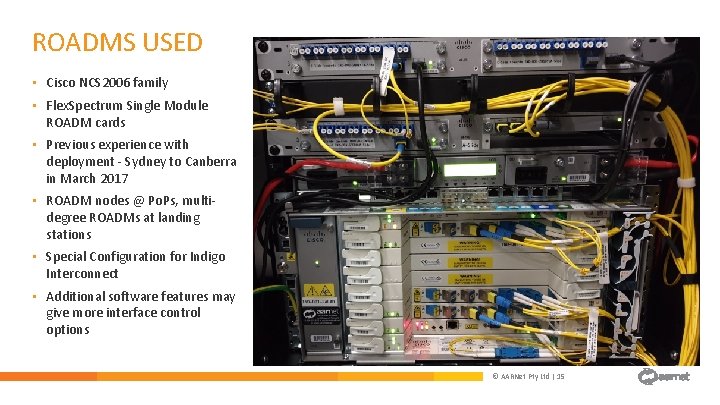
ROADMS USED • Cisco NCS 2006 family • Flex. Spectrum Single Module ROADM cards • Previous experience with deployment - Sydney to Canberra in March 2017 • ROADM nodes @ Po. Ps, multidegree ROADMs at landing stations • Special Configuration for Indigo Interconnect • Additional software features may give more interface control options © AARNet Pty Ltd | 15
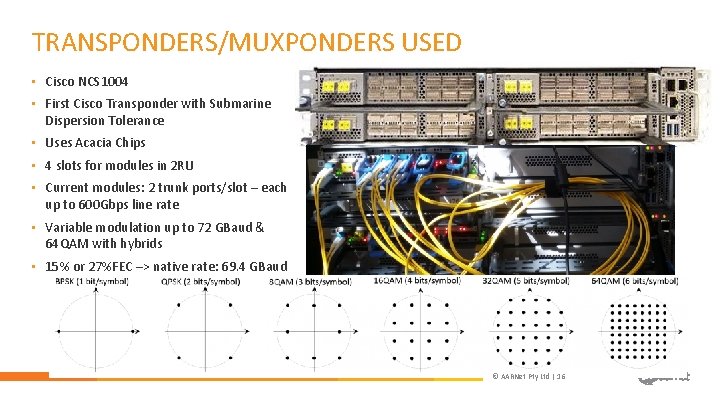
TRANSPONDERS/MUXPONDERS USED • Cisco NCS 1004 • First Cisco Transponder with Submarine Dispersion Tolerance • Uses Acacia Chips • 4 slots for modules in 2 RU • Current modules: 2 trunk ports/slot – each up to 600 Gbps line rate • Variable modulation up to 72 GBaud & 64 QAM with hybrids • 15% or 27%FEC –> native rate: 69. 4 GBaud © AARNet Pty Ltd | 16
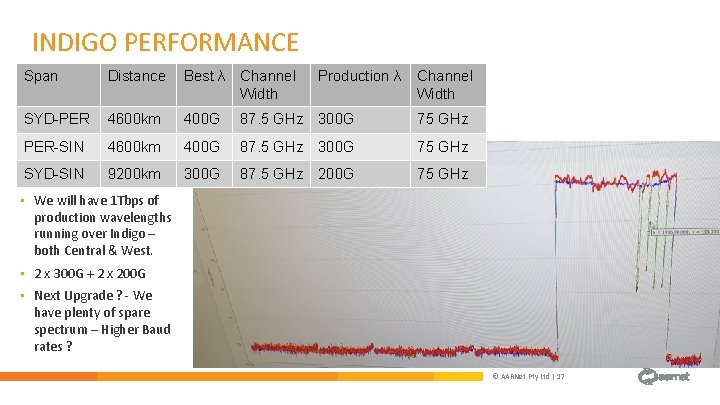
INDIGO PERFORMANCE Span Distance Best λ Channel Width Production λ Channel Width SYD-PER 4600 km 400 G 87. 5 GHz 300 G 75 GHz PER-SIN 4600 km 400 G 87. 5 GHz 300 G 75 GHz SYD-SIN 9200 km 300 G 87. 5 GHz 200 G 75 GHz • We will have 1 Tbps of production wavelengths running over Indigo – both Central & West. • 2 x 300 G + 2 x 200 G • Next Upgrade ? - We have plenty of spare spectrum – Higher Baud rates ? © AARNet Pty Ltd | 17
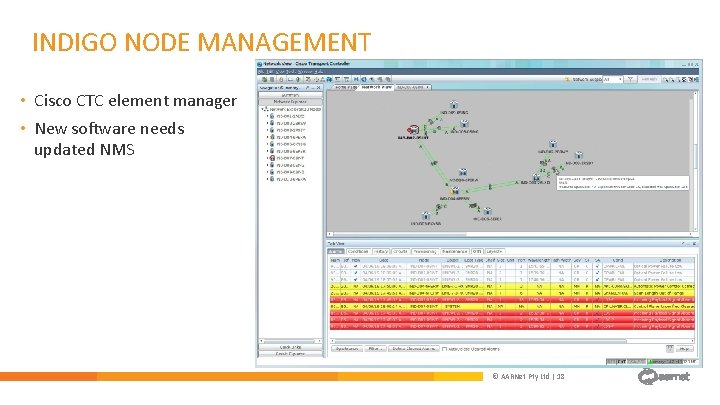
INDIGO NODE MANAGEMENT • Cisco CTC element manager • New software needs updated NMS © AARNet Pty Ltd | 18
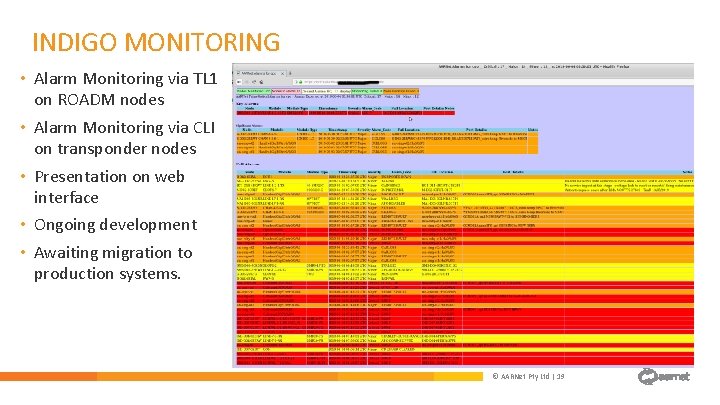
INDIGO MONITORING • Alarm Monitoring via TL 1 on ROADM nodes • Alarm Monitoring via CLI on transponder nodes • Presentation on web interface • Ongoing development • Awaiting migration to production systems. © AARNet Pty Ltd | 19
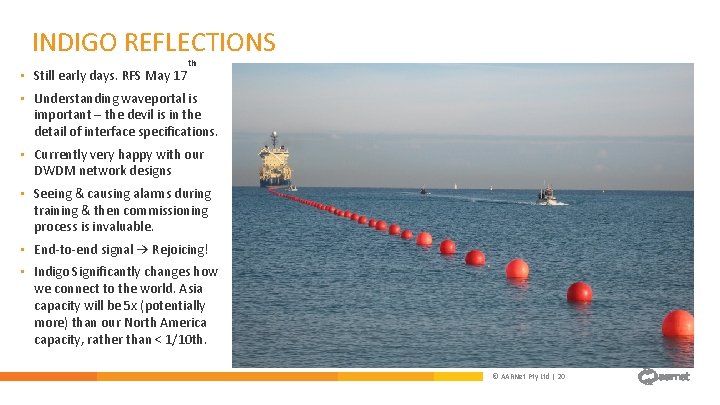
INDIGO REFLECTIONS • Still early days. RFS May 17 th • Understanding waveportal is important – the devil is in the detail of interface specifications. • Currently very happy with our DWDM network designs • Seeing & causing alarms during training & then commissioning process is invaluable. • End-to-end signal → Rejoicing! • Indigo Significantly changes how we connect to the world. Asia capacity will be 5 x (potentially more) than our North America capacity, rather than < 1/10 th. © AARNet Pty Ltd | 20