
Interfacing quantum optical and solid state qubits Cambridge
Interfacing quantum optical and solid state qubits Cambridge, Sept 2004 Lin Tian Universität Innsbruck People : R. Blatt (experiment) P. Rabl L. Tian I. Wilson-Rae Peter Zoller • Motivation: ion trap quantum computing; future roads for exploring • Interfacing with solid-state devices: protocols -- hybrid qubit & quantum trap; realization -- superconducting qubit • Other approaches -- … In collaboration with : A. Imamoglu (ETH) I. Martin (LANL) A. Shnirman (Karlsruhe) References: Tian, Rabl, Blatt & Zoller, PRL (’ 04)
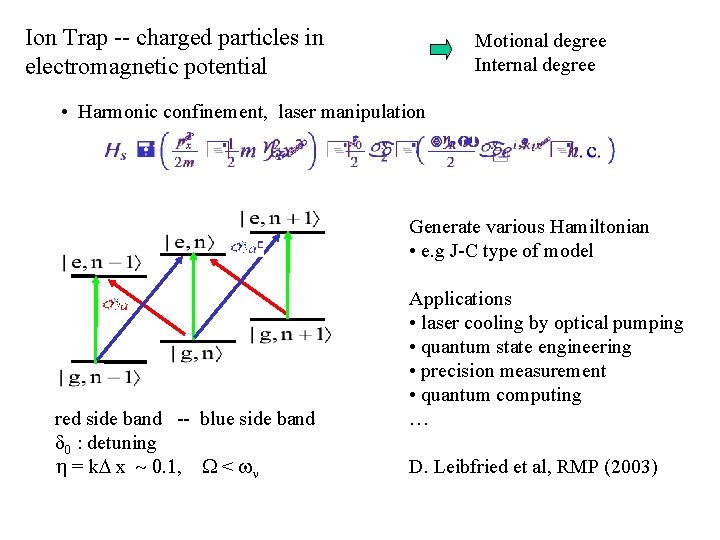
Ion Trap -- charged particles in electromagnetic potential Motional degree Internal degree • Harmonic confinement, laser manipulation Generate various Hamiltonian • e. g J-C type of model red side band -- blue side band d 0 : detuning h = k. D x ~ 0. 1, W < wn Applications • laser cooling by optical pumping • quantum state engineering • precision measurement • quantum computing … D. Leibfried et al, RMP (2003)
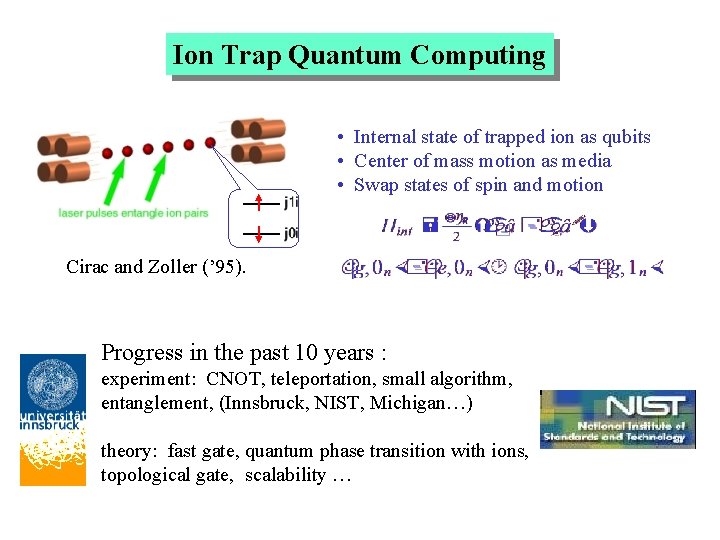
Ion Trap Quantum Computing • Internal state of trapped ion as qubits • Center of mass motion as media • Swap states of spin and motion Cirac and Zoller (’ 95). Progress in the past 10 years : experiment: CNOT, teleportation, small algorithm, entanglement, (Innsbruck, NIST, Michigan…) theory: fast gate, quantum phase transition with ions, topological gate, scalability …
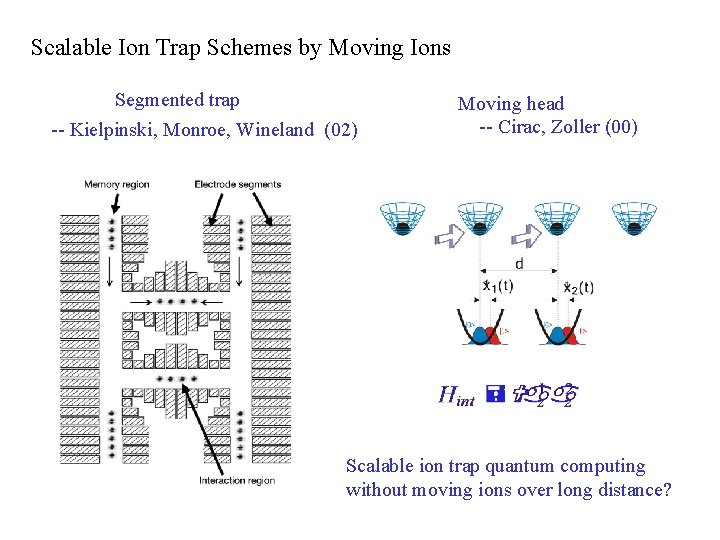
Scalable Ion Trap Schemes by Moving Ions Segmented trap -- Kielpinski, Monroe, Wineland (02) Moving head -- Cirac, Zoller (00) Scalable ion trap quantum computing without moving ions over long distance?
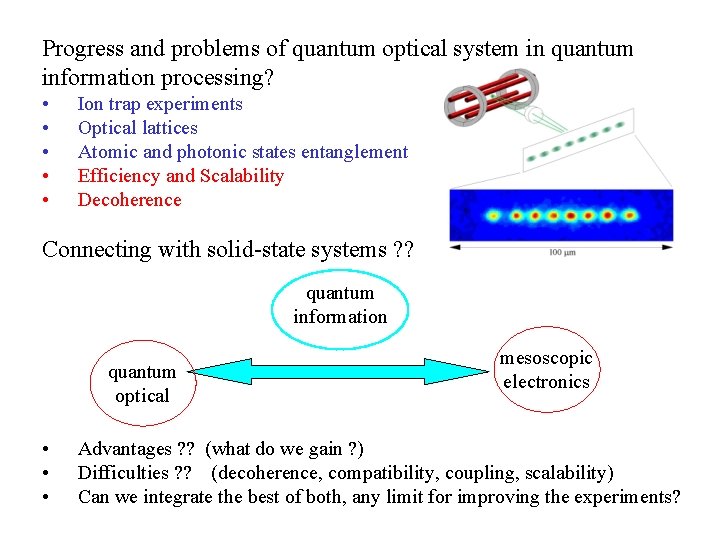
Progress and problems of quantum optical system in quantum information processing? • • • Ion trap experiments Optical lattices Atomic and photonic states entanglement Efficiency and Scalability Decoherence Connecting with solid-state systems ? ? quantum information quantum optical • • • mesoscopic electronics Advantages ? ? (what do we gain ? ) Difficulties ? ? (decoherence, compatibility, coupling, scalability) Can we integrate the best of both, any limit for improving the experiments?
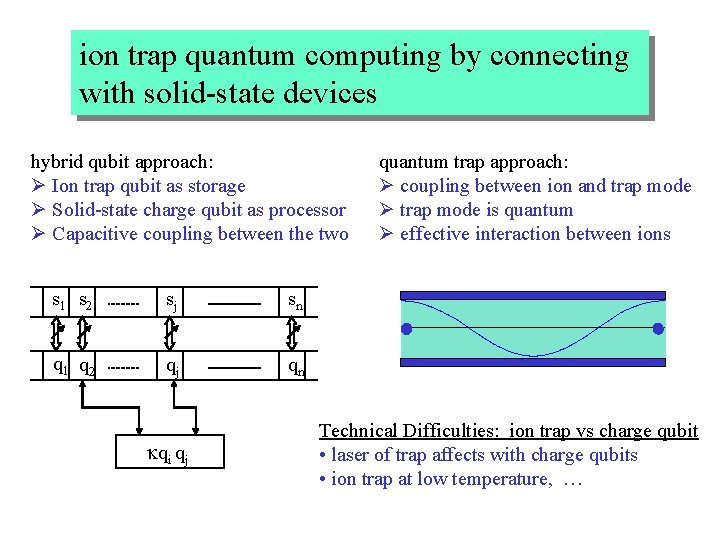
ion trap quantum computing by connecting with solid-state devices hybrid qubit approach: Ø Ion trap qubit as storage Ø Solid-state charge qubit as processor Ø Capacitive coupling between the two s 1 s 2 sj sn q 1 q 2 qj qn kqi qj quantum trap approach: Ø coupling between ion and trap mode Ø trap mode is quantum Ø effective interaction between ions Technical Difficulties: ion trap vs charge qubit • laser of trap affects with charge qubits • ion trap at low temperature, …
Realization -- with superconducting devices • • • Coupling with the motion of trapped ions Hybrid qubit – superconducting charge qubit, double dot qubit Quantum trap – EM modes in superconducting cavity • • • Exchange information between ion qubit and charge qubit Decoherence Scalability
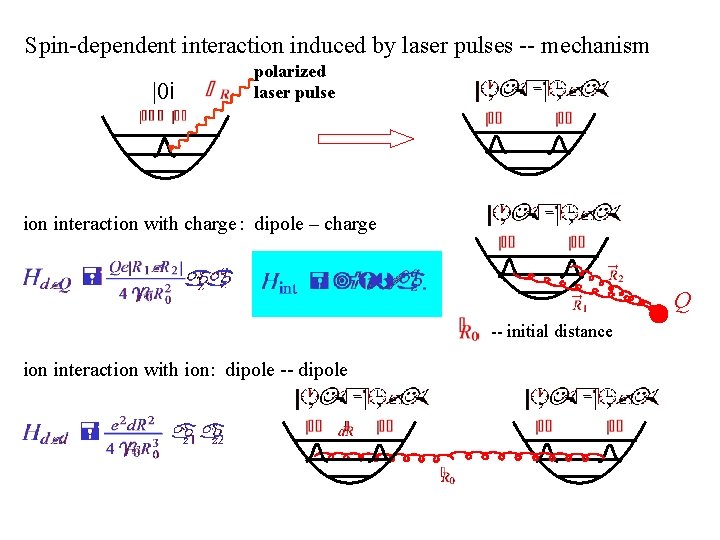
Spin-dependent interaction induced by laser pulses -- mechanism |0 i polarized laser pulse ion interaction with charge: dipole – charge Q -- initial distance ion interaction with ion: dipole -- dipole
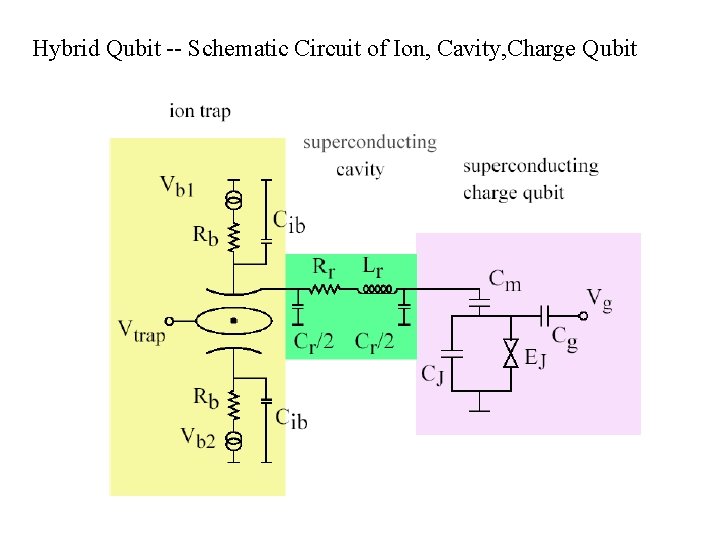
Hybrid Qubit -- Schematic Circuit of Ion, Cavity, Charge Qubit
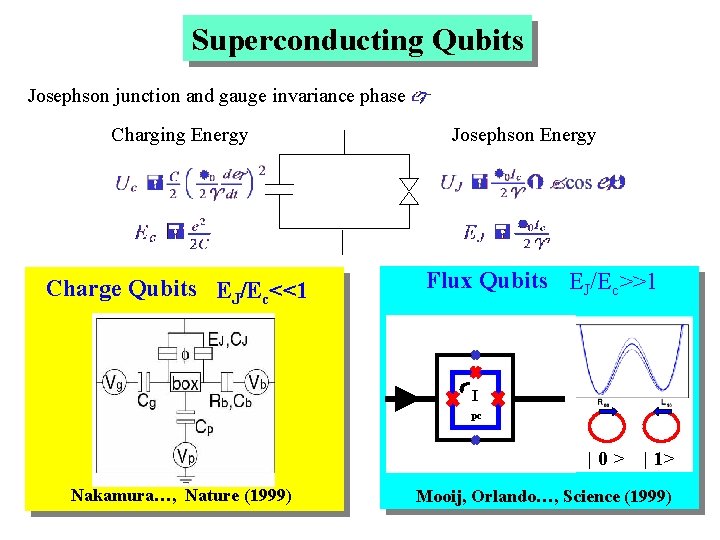
Superconducting Qubits Josephson junction and gauge invariance phase Charging Energy Charge Qubits EJ/Ec<<1 Josephson Energy Flux Qubits EJ/Ec>>1 I pc | 0 > | 1> Nakamura…, Nature (1999) Mooij, Orlando…, Science (1999)
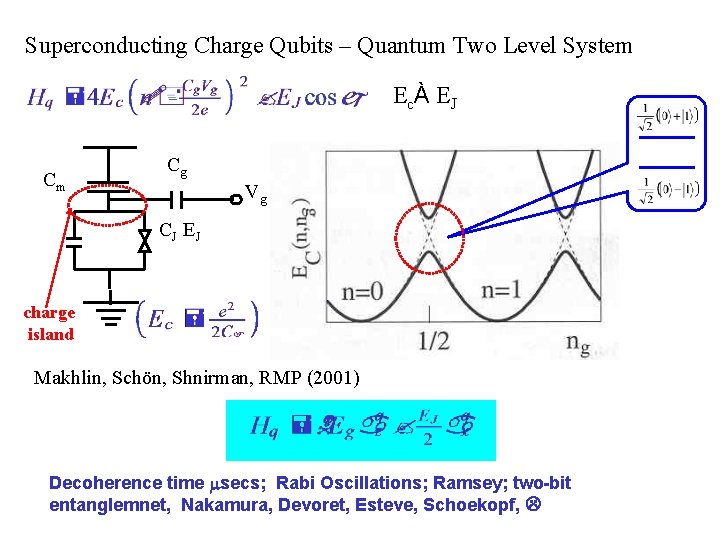
Superconducting Charge Qubits – Quantum Two Level System E cÀ E J Cm Cg Vg CJ EJ charge island Makhlin, Schön, Shnirman, RMP (2001) Decoherence time msecs; Rabi Oscillations; Ramsey; two-bit entanglemnet, Nakamura, Devoret, Esteve, Schoekopf, L
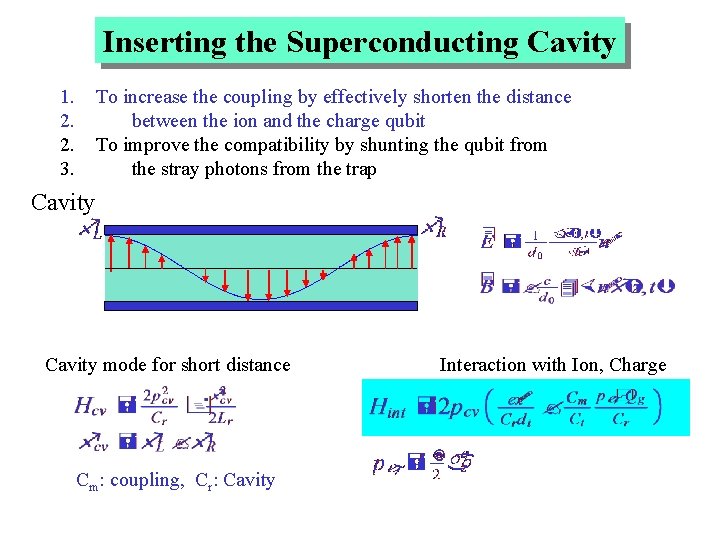
Inserting the Superconducting Cavity 1. 2. 2. 3. To increase the coupling by effectively shorten the distance between the ion and the charge qubit To improve the compatibility by shunting the qubit from the stray photons from the trap Cavity mode for short distance Cm: coupling, Cr: Cavity Interaction with Ion, Charge
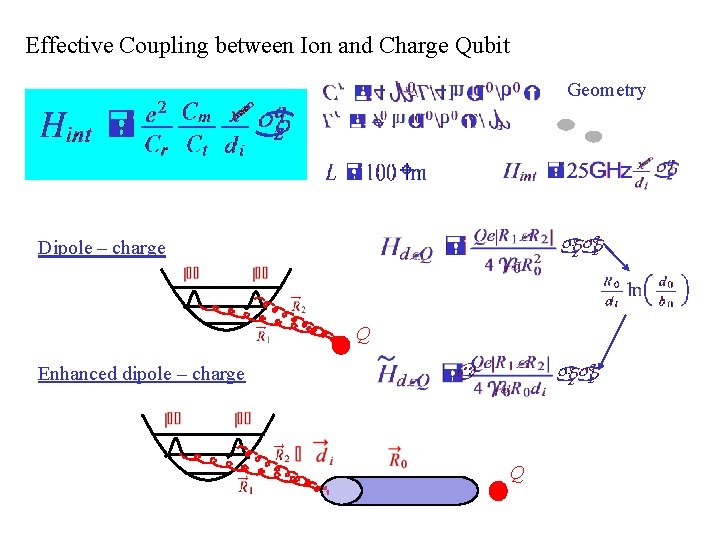
Effective Coupling between Ion and Charge Qubit Geometry Dipole – charge Q Enhanced dipole – charge Q
Realization -- with superconducting devices • • • Coupling with the motion of trapped ions Hybrid qubit – superconducting charge qubit, double dot qubit Quantum trap – EM modes in superconducting cavity • • • Exchange information between ion qubit and charge qubit Decoherence Scalability
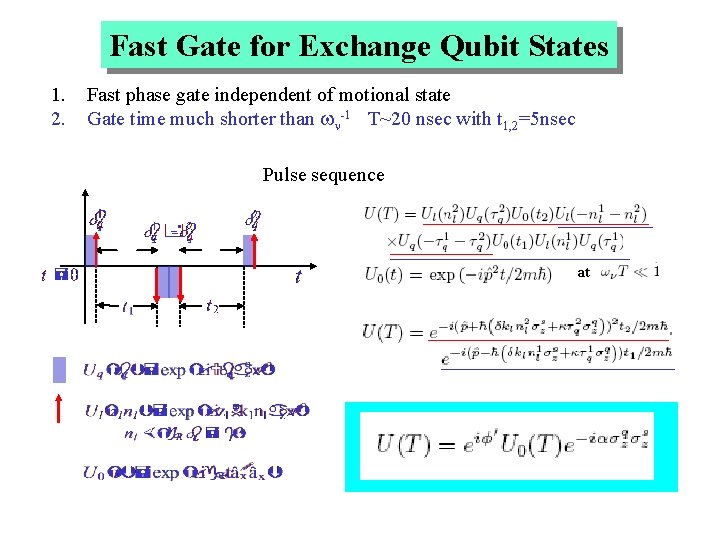
Fast Gate for Exchange Qubit States 1. 2. Fast phase gate independent of motional state Gate time much shorter than wn-1 T~20 nsec with t 1, 2=5 nsec Pulse sequence at
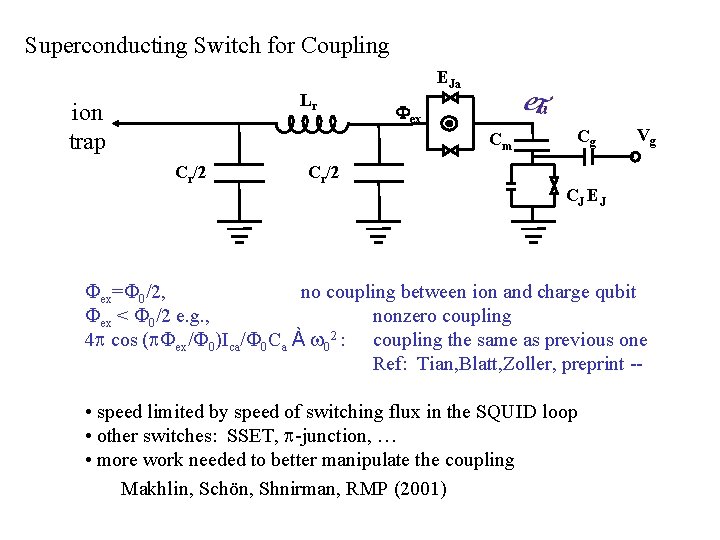
Superconducting Switch for Coupling Lr ion trap EJa Fex Cm Cr/2 Cg Vg Cr/2 CJ E J Fex=F 0/2, no coupling between ion and charge qubit Fex < F 0/2 e. g. , nonzero coupling 4 p cos (p. Fex/F 0)Ica/F 0 Ca À w 02 : coupling the same as previous one Ref: Tian, Blatt, Zoller, preprint -- • speed limited by speed of switching flux in the SQUID loop • other switches: SSET, p-junction, … • more work needed to better manipulate the coupling Makhlin, Schön, Shnirman, RMP (2001)
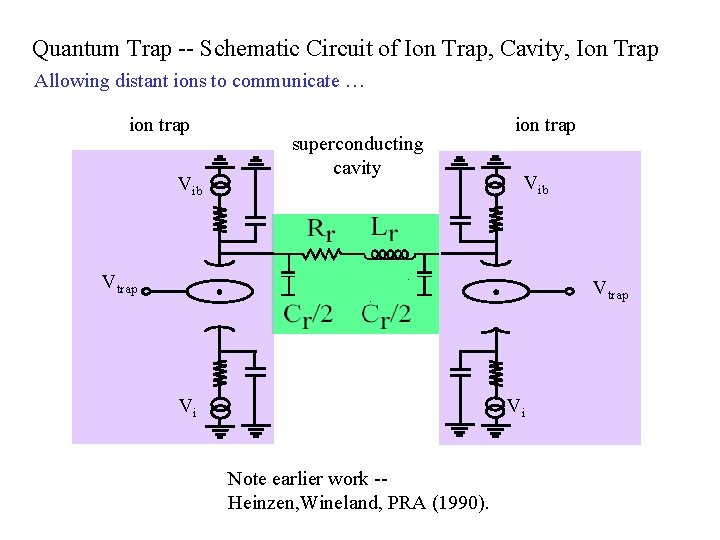
Quantum Trap -- Schematic Circuit of Ion Trap, Cavity, Ion Trap Allowing distant ions to communicate … ion trap Vib superconducting cavity ion trap Vib Vtrap Vi Vi Note earlier work -Heinzen, Wineland, PRA (1990).
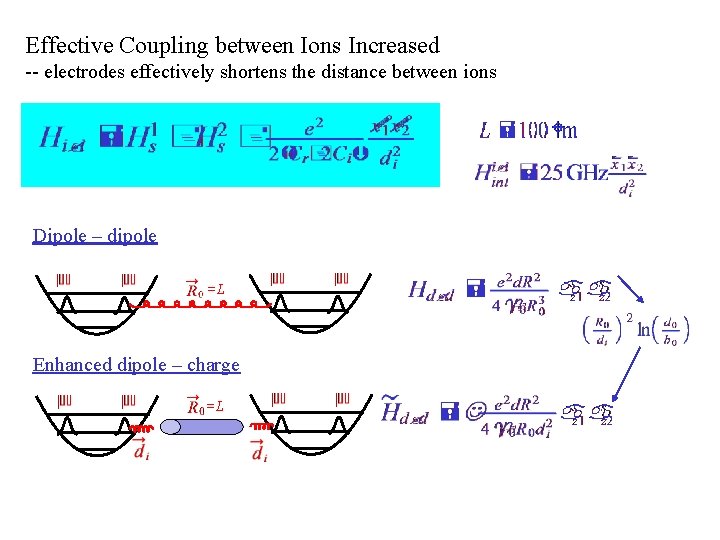
Effective Coupling between Ions Increased -- electrodes effectively shortens the distance between ions Dipole – dipole =L Enhanced dipole – charge =L
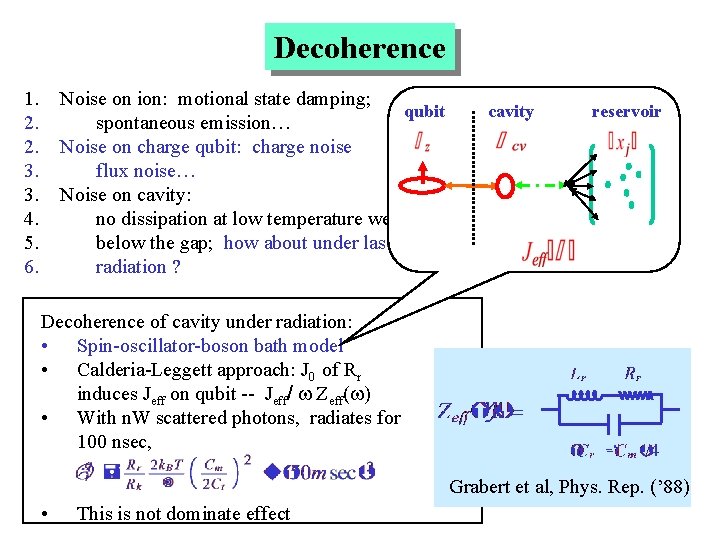
Decoherence 1. 2. 2. 3. 3. 4. 5. 6. Noise on ion: motional state damping; qubit spontaneous emission… Noise on charge qubit: charge noise flux noise… Noise on cavity: no dissipation at low temperature well below the gap; how about under laser radiation ? Decoherence of cavity under radiation: • Spin-oscillator-boson bath model • Calderia-Leggett approach: J 0 of Rr induces Jeff on qubit -- Jeff/ w Zeff(w) • With n. W scattered photons, radiates for 100 nsec, cavity reservoir = Grabert et al, Phys. Rep. (’ 88) • This is not dominate effect
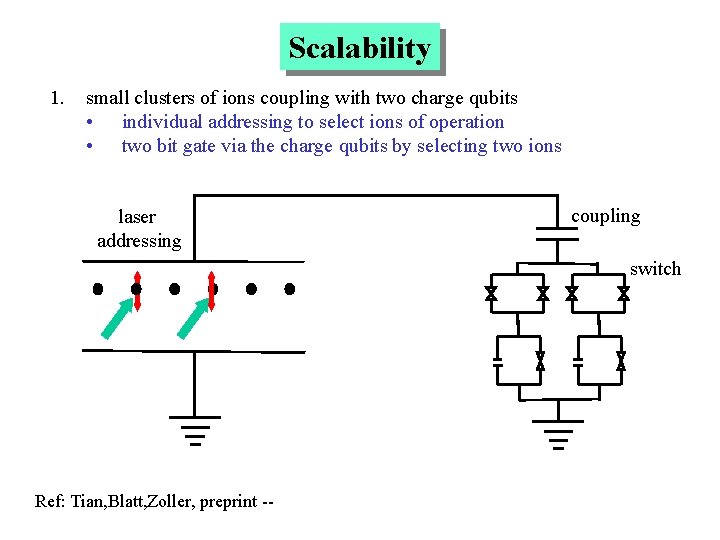
Scalability 1. small clusters of ions coupling with two charge qubits • individual addressing to select ions of operation • two bit gate via the charge qubits by selecting two ions laser addressing coupling switch Ref: Tian, Blatt, Zoller, preprint --
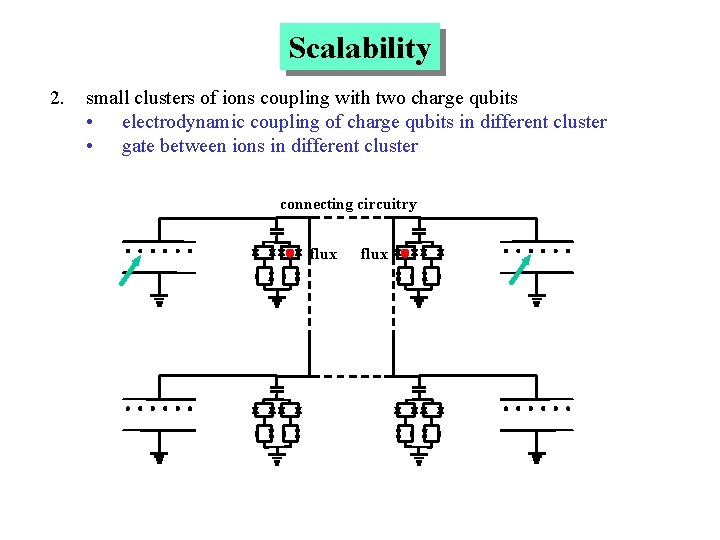
Scalability 2. small clusters of ions coupling with two charge qubits • electrodynamic coupling of charge qubits in different cluster • gate between ions in different cluster connecting circuitry flux
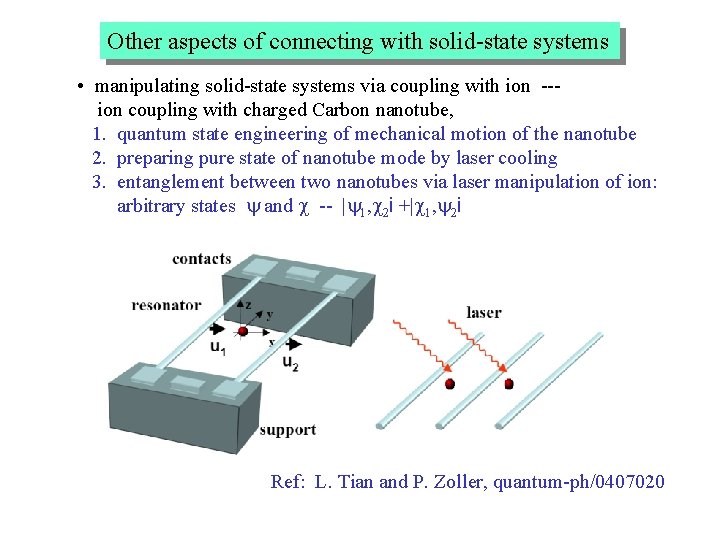
Other aspects of connecting with solid-state systems • manipulating solid-state systems via coupling with ion --ion coupling with charged Carbon nanotube, 1. quantum state engineering of mechanical motion of the nanotube 2. preparing pure state of nanotube mode by laser cooling 3. entanglement between two nanotubes via laser manipulation of ion: arbitrary states y and c -- |y 1, c 2 i +|c 1, y 2 i Ref: L. Tian and P. Zoller, quantum-ph/0407020
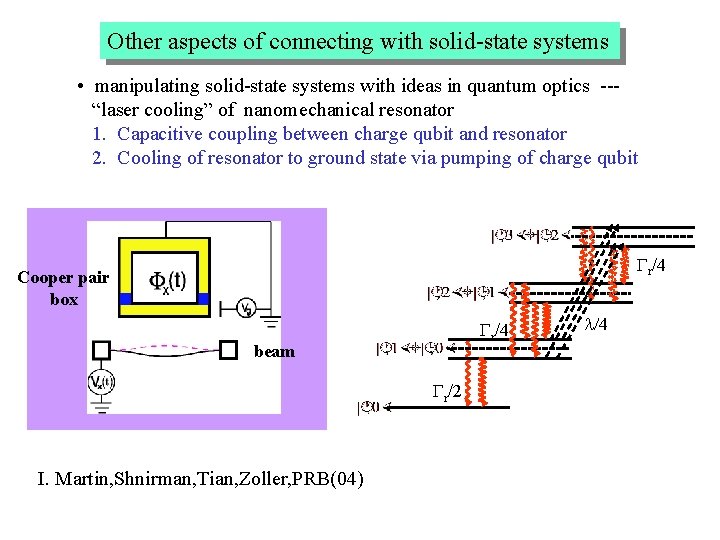
Other aspects of connecting with solid-state systems • manipulating solid-state systems with ideas in quantum optics --“laser cooling” of nanomechanical resonator 1. Capacitive coupling between charge qubit and resonator 2. Cooling of resonator to ground state via pumping of charge qubit Gr/4 Cooper pair box Gr/4 beam Gr/2 I. Martin, Shnirman, Tian, Zoller, PRB(04) l/4
Summary We studied the interfacing of the ion trap qubit with solid-state systems: 1. a hybrid qubit can be made of a trapped ion coupling with charge qubit via electrostatic interaction; 2. distant ions can couple via the quantum modes of the electrode; 3. decoherence and scalability are studied; 4. interfacing can provide manipulation of solid-state systems: mechanical modes of nanotubes, resonators

- Slides: 25