
Interfaces and Abstract Classes CS 240 Advanced Programming
Interfaces and Abstract Classes CS 240 – Advanced Programming Concepts
Polymorphism • • Poly = “many” Morph = “change” Polymorphism = “many forms” (we don’t say many changes) Objects can take on many forms in an object-oriented program • The form of the class in which they are declared • The form of any parent class in the class’ inheritance hierarchy • ‘Object’ is a parent class whether declared or not (always at the top of the inheritance hierarchy) • The form is represented by the type of the reference that refers to the object • Reference and object types may differ (but must be compatible according to inheritance—’is a’) • Simple definition: A reference of one type referring to an object of a different type 2
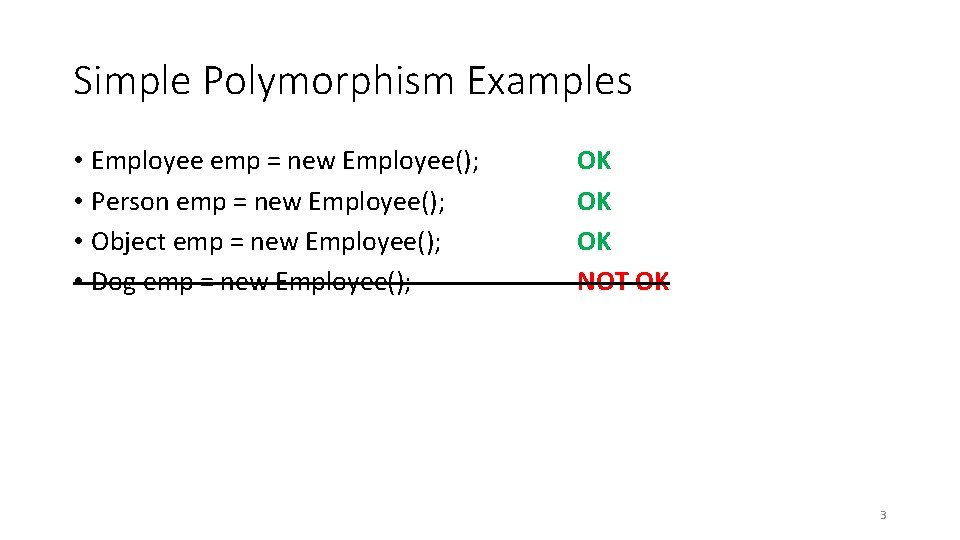
Simple Polymorphism Examples • Employee emp = new Employee(); • Person emp = new Employee(); • Object emp = new Employee(); • Dog emp = new Employee(); OK OK OK NOT OK 3
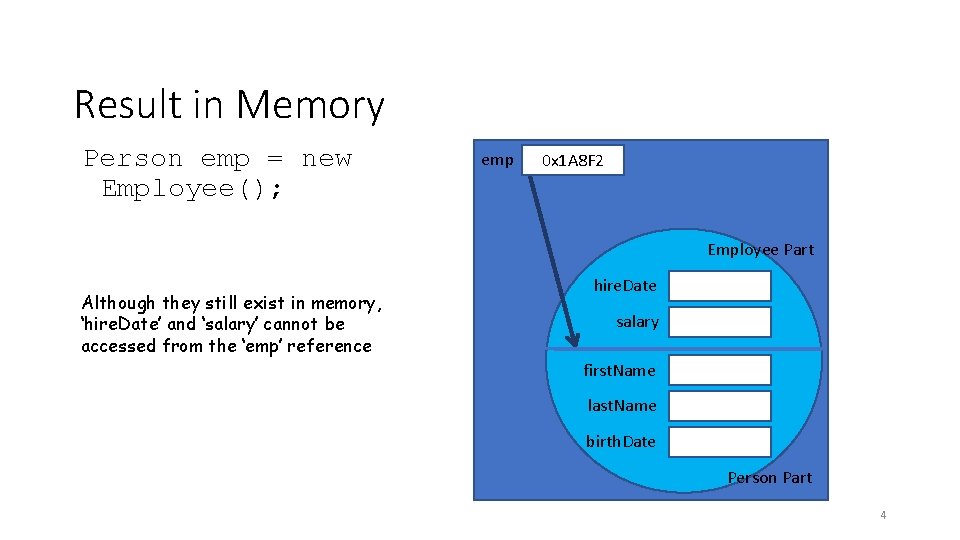
Result in Memory Person emp = new Employee(); emp 0 x 1 A 8 F 2 Employee Part Although they still exist in memory, ‘hire. Date’ and ‘salary’ cannot be accessed from the ‘emp’ reference hire. Date salary first. Name last. Name birth. Date Person Part 4
Reasons for Polymorphism • Would probably never create the simple version of polymorphism • Person emp = new Employee(); • Get the same result (reference of one type referring to an object of another type) when you use either of the following: • Heterogeneous Collections • Collections (such as arrays or Array. Lists) of a parent type that contain children of different types • Polymorphic parameters • Parameters in a method call that expect a parent reference or object but receive a child of the expected type 5
City Simulation Example • Create a simulation of a city, using an inheritance hierarchy of vehicles • Will have different kinds of vehicles in the city that can all ‘go’ • Will start the simulation by placing vehicles in an array and calling a ‘go()’ method • What type of polymorphism is this? 6
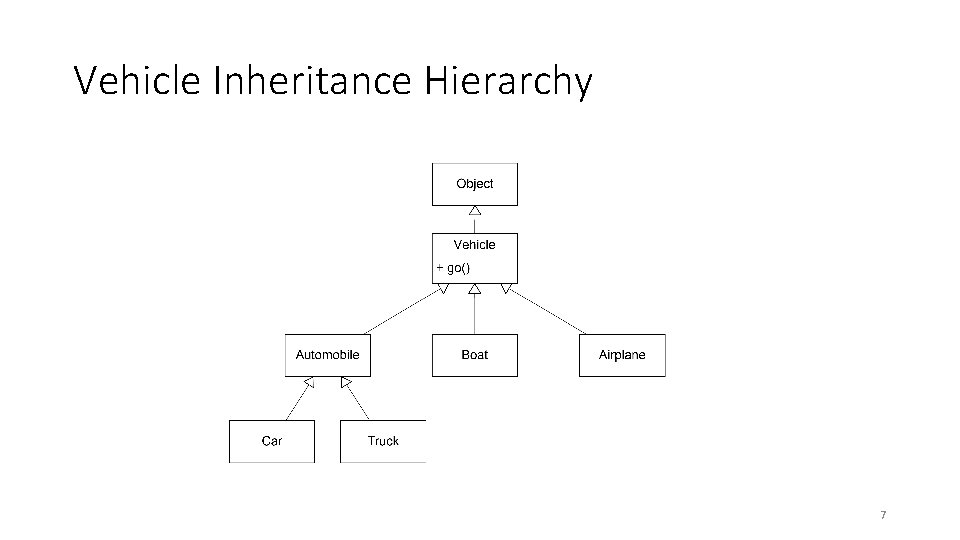
Vehicle Inheritance Hierarchy 7
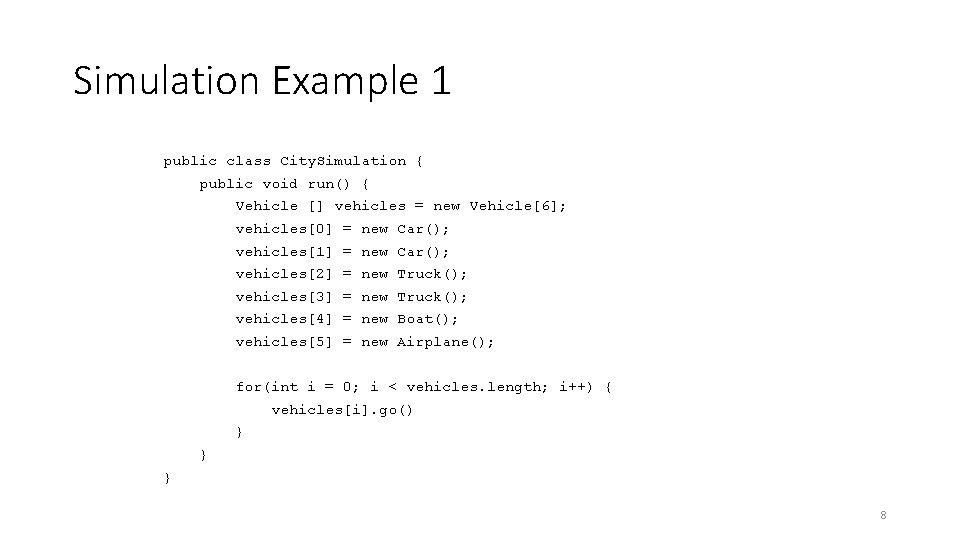
Simulation Example 1 public class City. Simulation { public void run() { Vehicle [] vehicles = new Vehicle[6]; vehicles[0] = new Car(); vehicles[1] = new Car(); vehicles[2] = new Truck(); vehicles[3] = new Truck(); vehicles[4] = new Boat(); vehicles[5] = new Airplane(); for(int i = 0; i < vehicles. length; i++) { vehicles[i]. go() } } } 8
Problems • No common code to inherit for ‘go()’ method (so what should we write? ) • Even if there were common code, how would creators of subclasses know they need to override the ‘go() method? • Solution: Abstract Method (which requires an Abstract Class) 9

Abstract Vehicle Class public abstract class Vehicle { public abstract void go(); } 10
Abstract Methods • Require containing class to be abstract • Must be overridden in child classes unless the child is abstract • A way to say a class has a behavior that will be defined in the subclasses • Allows polymorphic method invocations of methods declared but not defined by the reference type 11
Polymorphic Method Invocation • AKA: Polymorphic Operation Vehicle v = new Car(); v. go(); • Allowable because… • Every class that has one or more abstract methods must be abstract • You can’t create an instance of an abstract class So, • Vehicle references can only refer to vehicle’s non-abstract child classes, so anything a vehicle reference can refer to, will have a non-abstract go() method Vehicle v = new Vehicle(); Illegal! 12

Abstract Classes • Cannot be instantiated • Can be used as reference types (polymorphism) • May have non-abstract methods • Don’t have to have abstract methods • Provide a guarantee: • If you have a non-null reference of an abstract type, it refers to an object that is not abstract and therefore has non-abstract implementations for all methods 13
Simulation Example with Abstract Vehicle Class public class City. Simulation { public void run() { Vehicle [] vehicles = new Vehicle[6]; vehicles[0] = new Vehicle(); // Illegal if abstract vehicles[1] = new Car(); vehicles[2] = new Truck(); vehicles[3] = new Truck(); vehicles[4] = new Boat(); vehicles[5] = new Airplane(); for(int i = 0; i < vehicles. length; i++) { // Guaranteed to invoke a real (non-abstract) method vehicles[i]. go() } } } 14
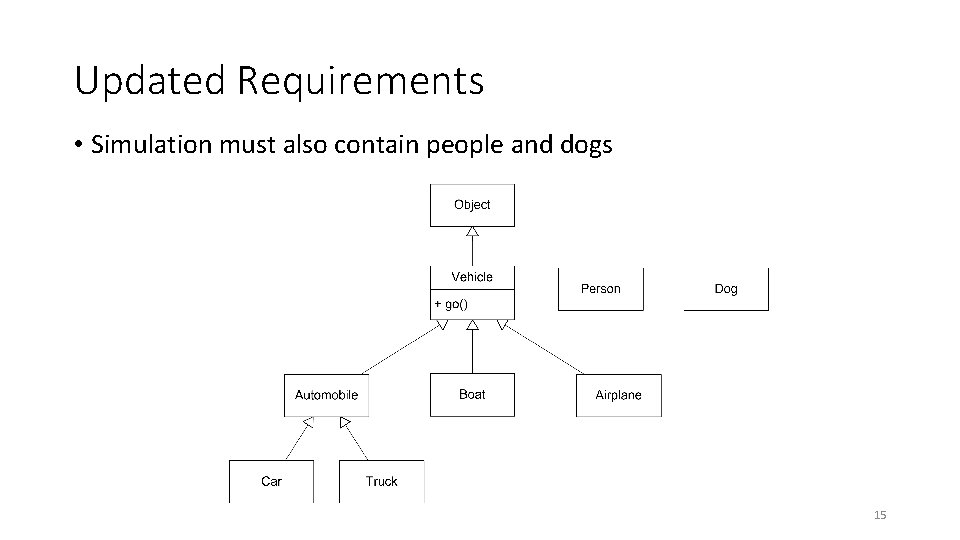
Updated Requirements • Simulation must also contain people and dogs 15
How Do We Start the Simulation Now? • Would like the people and dogs to start moving at the same time as the vehicles • Can we put ‘Person’ and ‘Dog’ objects in our Vehicle array? • Can we change the type of the array to ‘Object’ and then put them in? • Need polymorphism (heterogeneous collection) without inheritance 16
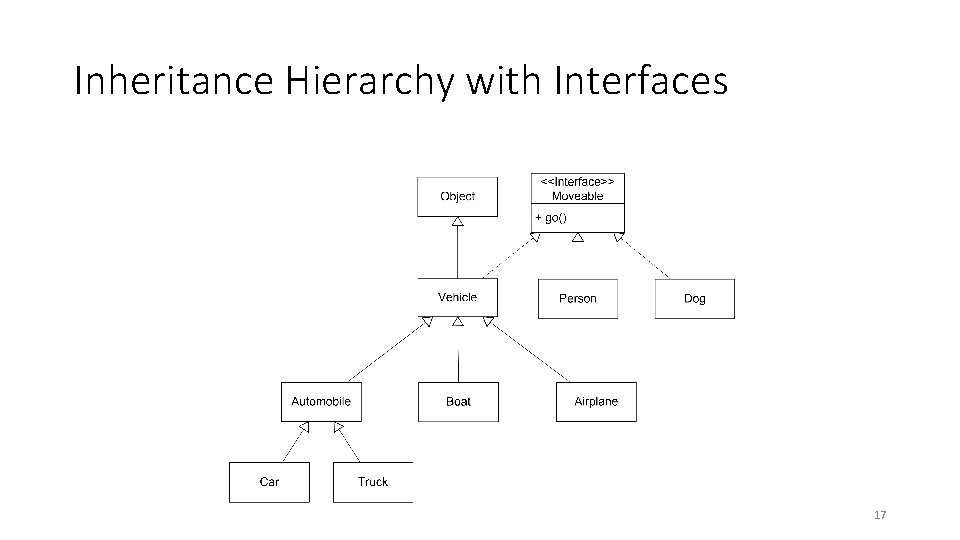
Inheritance Hierarchy with Interfaces 17
Interfaces • • Cannot be instantiated Can be used as reference types (polymorphism) Can be used as collection (array) types (polymorphism) May NOT have non-abstract methods • All methods are abstract (with three exceptions in Java version 8 and later) • All methods are public (whether you declare them as public or not) • With one exception in recent Java version 8 and later • Provide same guarantee as abstract classes: • If you have a non-null reference of an interface type, it refers to an object that implements the interface and is not abstract and therefore has non-abstract implementations for all behaviors (methods) 18
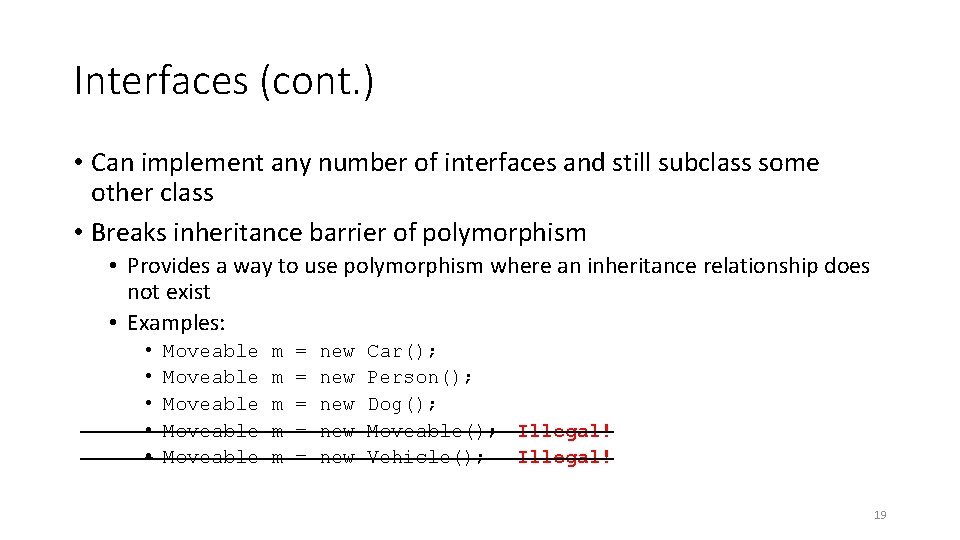
Interfaces (cont. ) • Can implement any number of interfaces and still subclass some other class • Breaks inheritance barrier of polymorphism • Provides a way to use polymorphism where an inheritance relationship does not exist • Examples: • • • Moveable Moveable m m m = = = new new new Car(); Person(); Dog(); Moveable(); Illegal! Vehicle(); Illegal! 19
Interfaces (cont. ) • Can have constant variables • All variables are public, static, and final • In Java 8 and Later: • Can have instance methods with bodies (must be declared as default) • default void my. Default. Method() {…} • Can have static methods (with bodies) • Can have private methods (not inherited so only useful as helper methods to default methods) 20
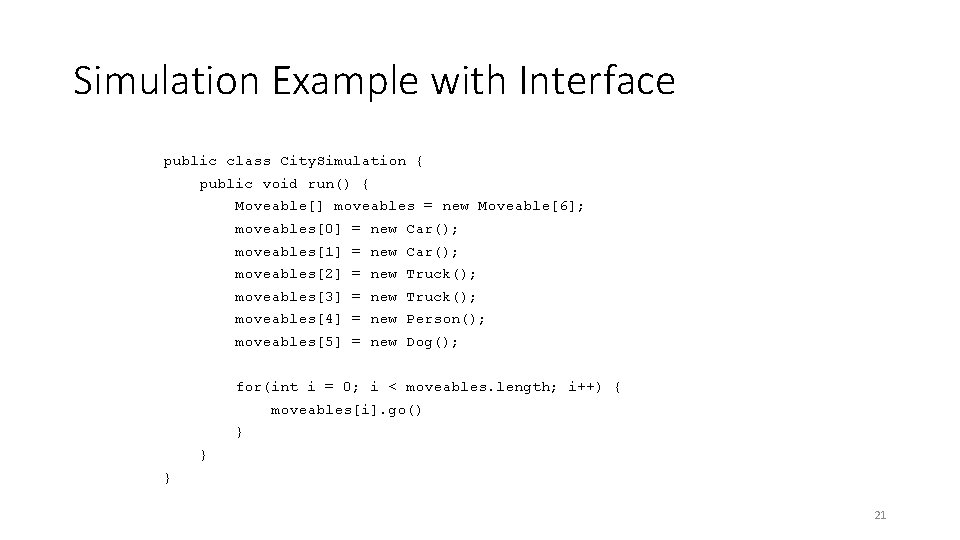
Simulation Example with Interface public class City. Simulation { public void run() { Moveable[] moveables = new Moveable[6]; moveables[0] = new Car(); moveables[1] = new Car(); moveables[2] = new Truck(); moveables[3] = new Truck(); moveables[4] = new Person(); moveables[5] = new Dog(); for(int i = 0; i < moveables. length; i++) { moveables[i]. go() } } } 21
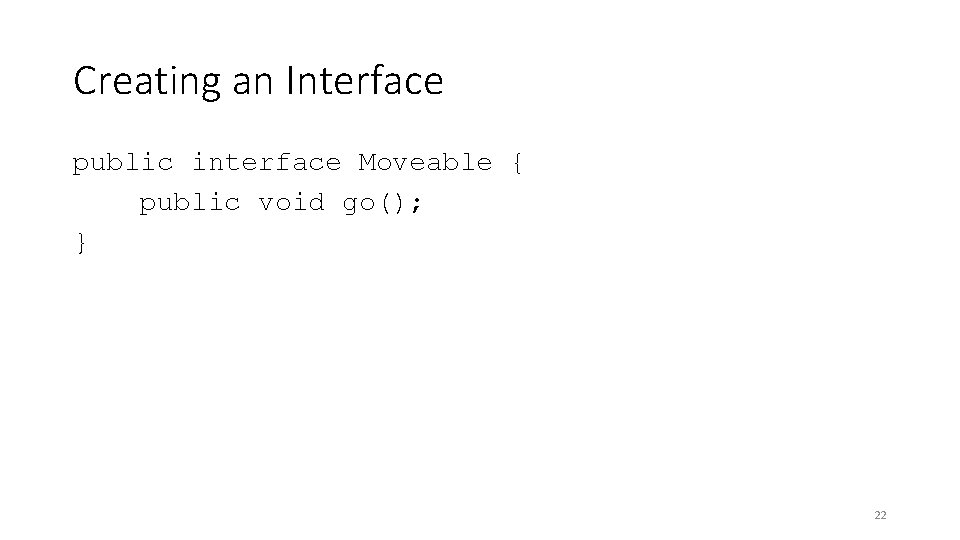
Creating an Interface public interface Moveable { public void go(); } 22
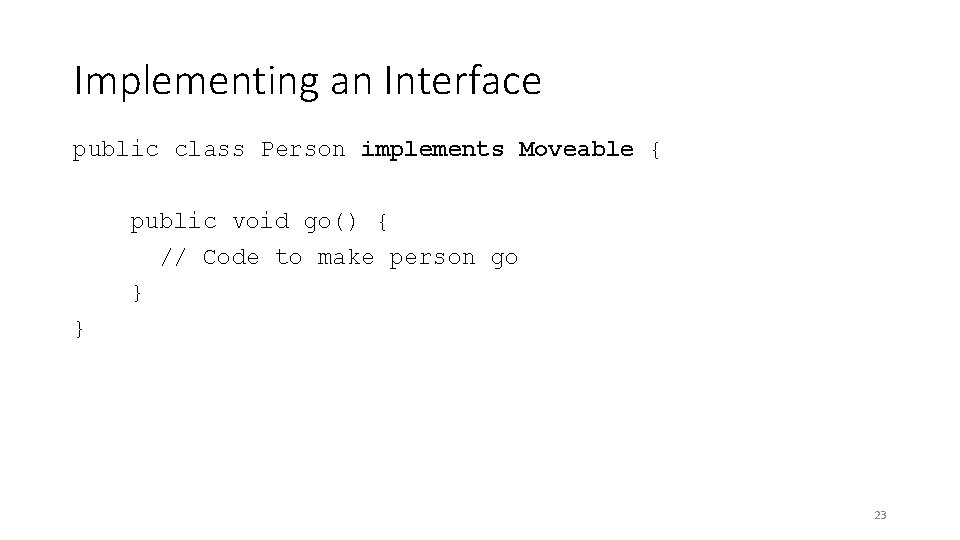
Implementing an Interface public class Person implements Moveable { public void go() { // Code to make person go } } 23
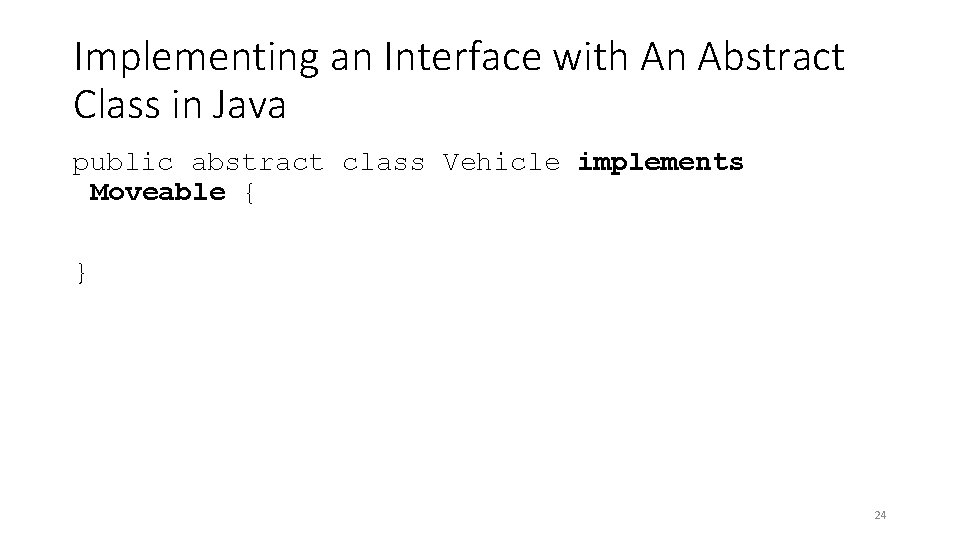
Implementing an Interface with An Abstract Class in Java public abstract class Vehicle implements Moveable { } 24
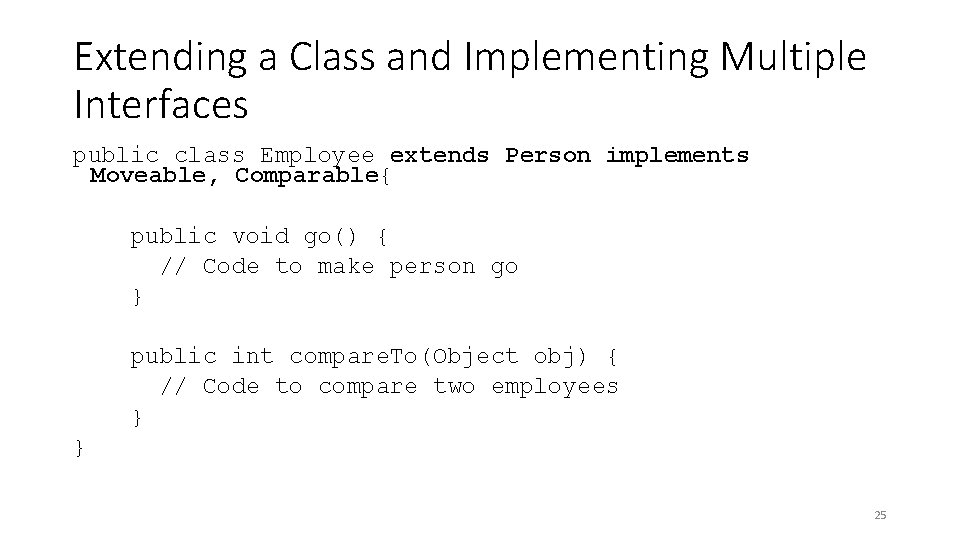
Extending a Class and Implementing Multiple Interfaces public class Employee extends Person implements Moveable, Comparable{ public void go() { // Code to make person go } public int compare. To(Object obj) { // Code to compare two employees } } 25
- Slides: 25