
Interest Rate Derivatives Models of the Short Rate
![Hull and White Model l l dr = [q(t ) – ar ]dt +](https://slidetodoc.com/presentation_image_h2/6153b519c2f1f317925ba6f8eff78946/image-11.jpg "Hull and White Model l l dr = [q(t ) – ar ]dt +")
- Slides: 15
Interest Rate Derivatives: Models of the Short Rate Chapter 28 Options, Futures, and Other Derivatives, 6 th Edition, Copyright © John C. Hull 2005 28. 1
Term Structure Models l l Black’s model is concerned with describing the probability distribution of a single variable at a single point in time A term structure model describes the evolution of the whole yield curve Options, Futures, and Other Derivatives, 6 th Edition, Copyright © John C. Hull 2005 2
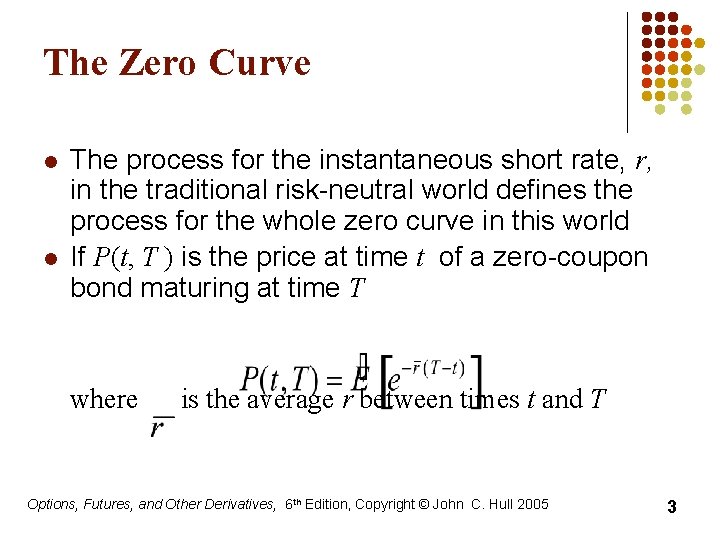
The Zero Curve l l The process for the instantaneous short rate, r, in the traditional risk-neutral world defines the process for the whole zero curve in this world If P(t, T ) is the price at time t of a zero-coupon bond maturing at time T where is the average r between times t and T Options, Futures, and Other Derivatives, 6 th Edition, Copyright © John C. Hull 2005 3
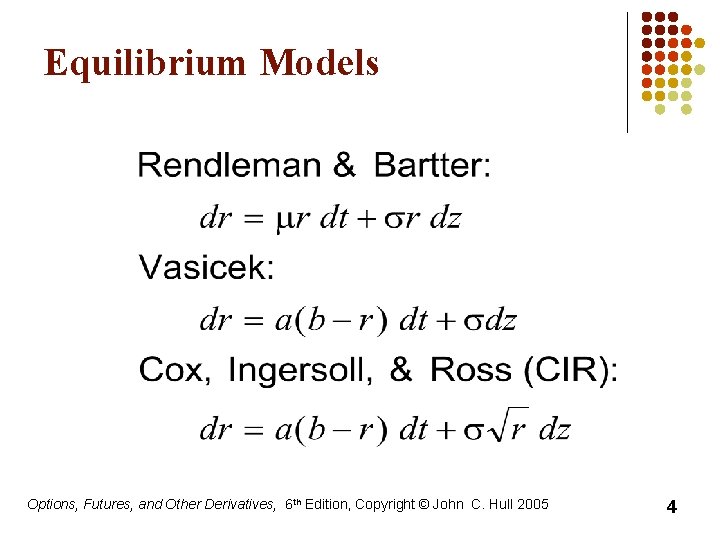
Equilibrium Models Options, Futures, and Other Derivatives, 6 th Edition, Copyright © John C. Hull 2005 4
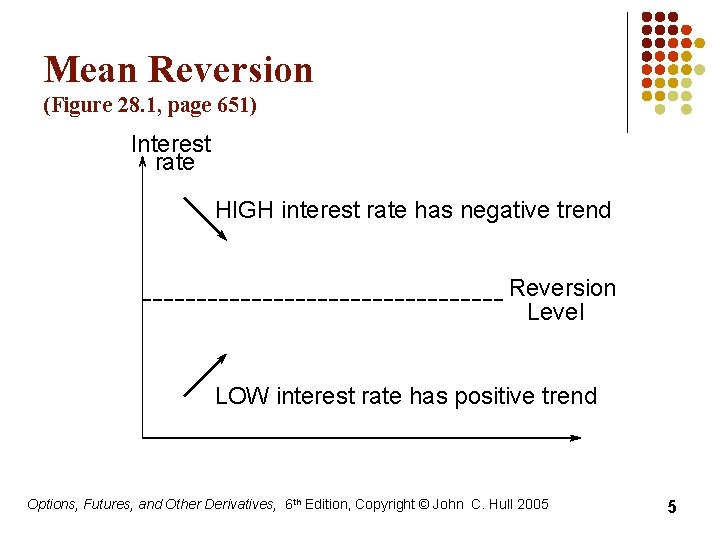
Mean Reversion (Figure 28. 1, page 651) Interest rate HIGH interest rate has negative trend Reversion Level LOW interest rate has positive trend Options, Futures, and Other Derivatives, 6 th Edition, Copyright © John C. Hull 2005 5
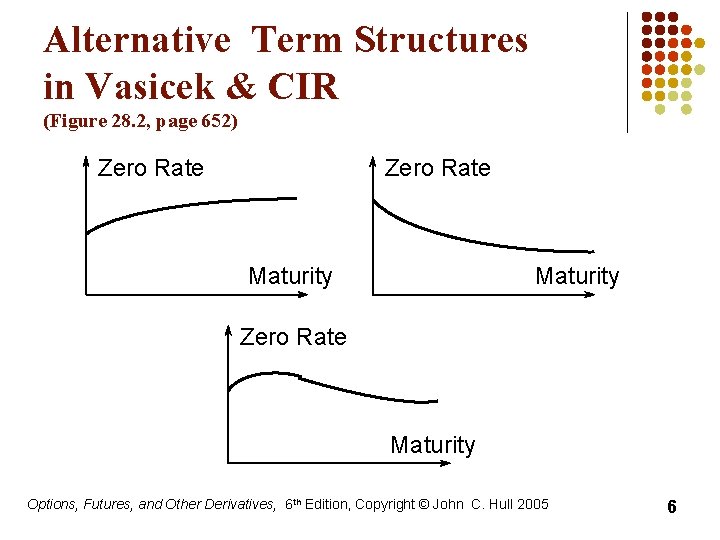
Alternative Term Structures in Vasicek & CIR (Figure 28. 2, page 652) Zero Rate Maturity Options, Futures, and Other Derivatives, 6 th Edition, Copyright © John C. Hull 2005 6
Equilibrium vs No-Arbitrage Models l l In an equilibrium model today’s term structure is an output In a no-arbitrage model today’s term structure is an input Options, Futures, and Other Derivatives, 6 th Edition, Copyright © John C. Hull 2005 7
Developing No-Arbitrage Model for r A model for r can be made to fit the initial term structure by including a function of time in the drift Options, Futures, and Other Derivatives, 6 th Edition, Copyright © John C. Hull 2005 8
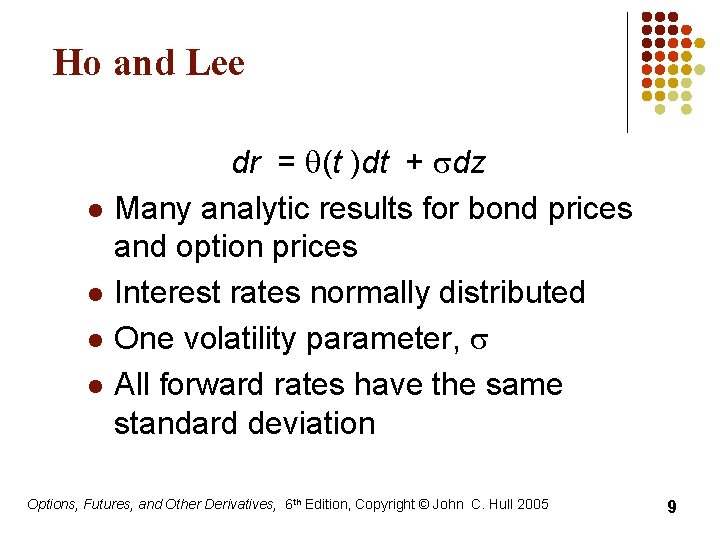
Ho and Lee l l dr = q(t )dt + sdz Many analytic results for bond prices and option prices Interest rates normally distributed One volatility parameter, s All forward rates have the same standard deviation Options, Futures, and Other Derivatives, 6 th Edition, Copyright © John C. Hull 2005 9
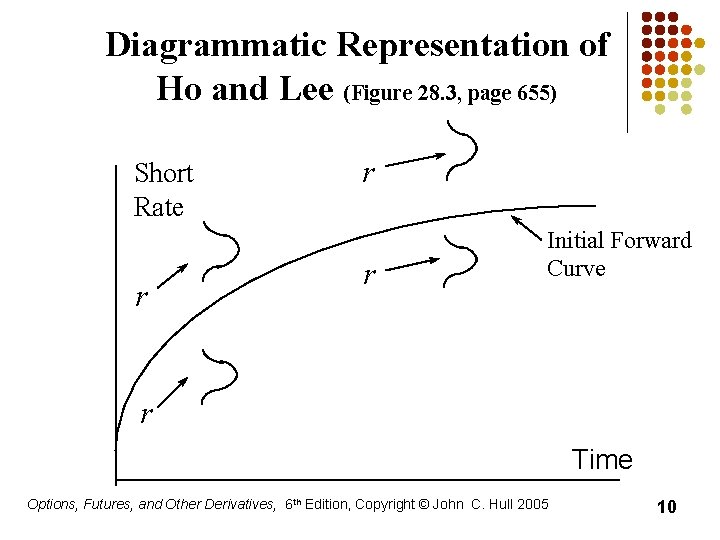
Diagrammatic Representation of Ho and Lee (Figure 28. 3, page 655) Short Rate r r r Initial Forward Curve r Time Options, Futures, and Other Derivatives, 6 th Edition, Copyright © John C. Hull 2005 10
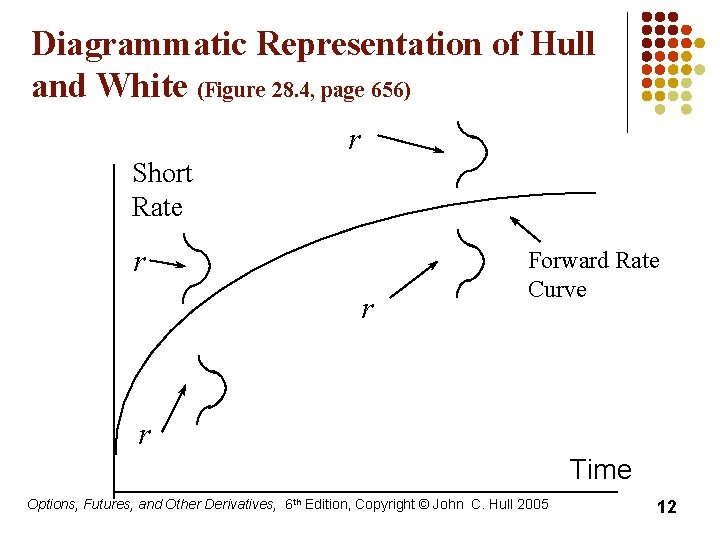
Hull and White Model l l dr = [q(t ) – ar ]dt + sdz Many analytic results for bond prices and option prices Two volatility parameters, a and s Interest rates normally distributed Standard deviation of a forward rate is a declining function of its maturity Options, Futures, and Other Derivatives, 6 th Edition, Copyright © John C. Hull 2005 11
Diagrammatic Representation of Hull and White (Figure 28. 4, page 656) r Short Rate r r Forward Rate Curve r Time Options, Futures, and Other Derivatives, 6 th Edition, Copyright © John C. Hull 2005 12
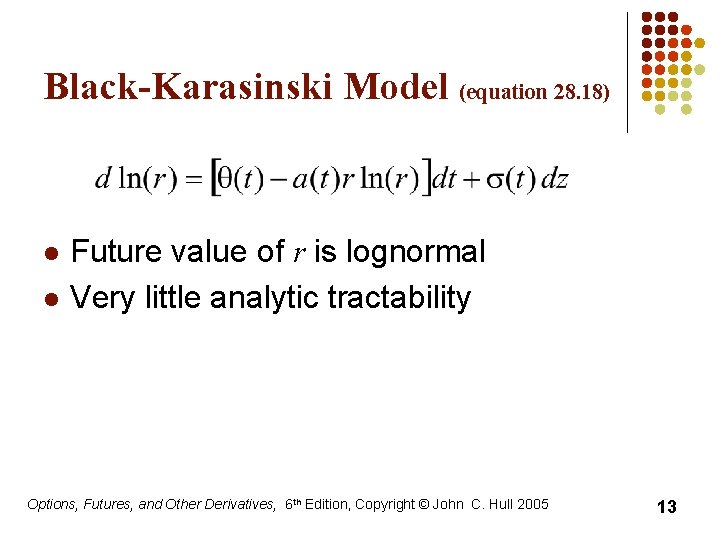
Black-Karasinski Model (equation 28. 18) l l Future value of r is lognormal Very little analytic tractability Options, Futures, and Other Derivatives, 6 th Edition, Copyright © John C. Hull 2005 13
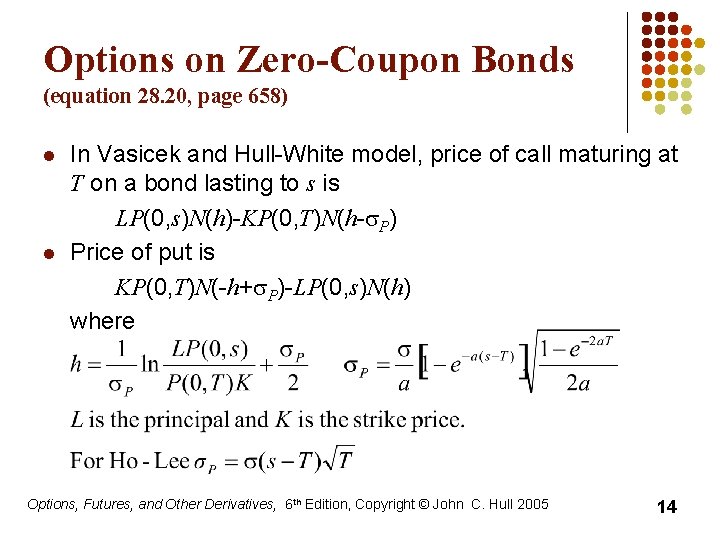
Options on Zero-Coupon Bonds (equation 28. 20, page 658) l l In Vasicek and Hull-White model, price of call maturing at T on a bond lasting to s is LP(0, s)N(h)-KP(0, T)N(h-s. P) Price of put is KP(0, T)N(-h+s. P)-LP(0, s)N(h) where Options, Futures, and Other Derivatives, 6 th Edition, Copyright © John C. Hull 2005 14
Options on Coupon Bearing Bonds l l l In a one-factor model a European option on a coupon-bearing bond can be expressed as a portfolio of options on zero-coupon bonds. We first calculate the critical interest rate at the option maturity for which the coupon-bearing bond price equals the strike price at maturity The strike price for each zero-coupon bond is set equal to its value when the interest rate equals this critical value Options, Futures, and Other Derivatives, 6 th Edition, Copyright © John C. Hull 2005 15