
Interest Grabber Section 8 1 Go to Section

Interest Grabber Section 8 -1 Go to Section:
Section Outline Section 8 -1 8– 1 Energy and Life A. Autotrophs and Heterotrophs B. Chemical Energy and ATP 1. Storing Energy 2. Releasing Energy C. Using Biochemical Energy Go to Section:
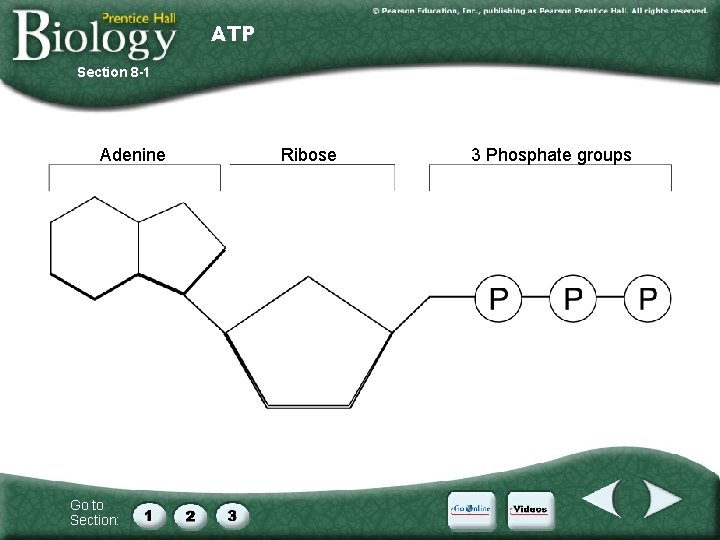
ATP Section 8 -1 Adenine Go to Section: Ribose 3 Phosphate groups
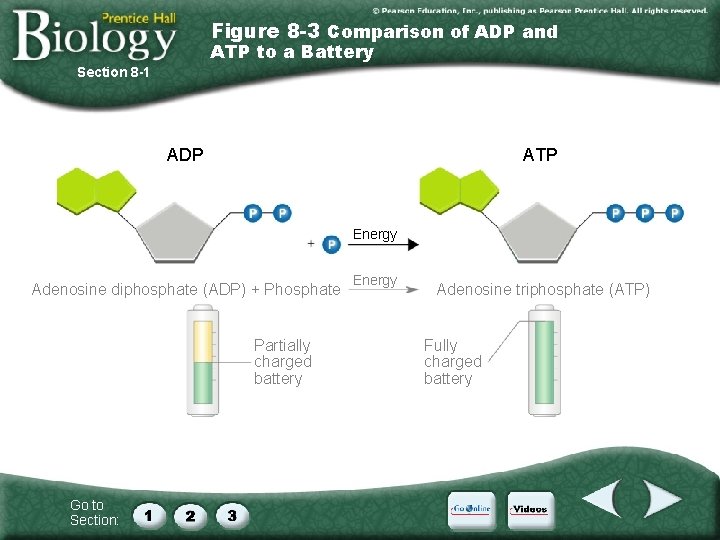
Figure 8 -3 Comparison of ADP and ATP to a Battery Section 8 -1 ADP ATP Energy Adenosine diphosphate (ADP) + Phosphate Partially charged battery Go to Section: Energy Adenosine triphosphate (ATP) Fully charged battery
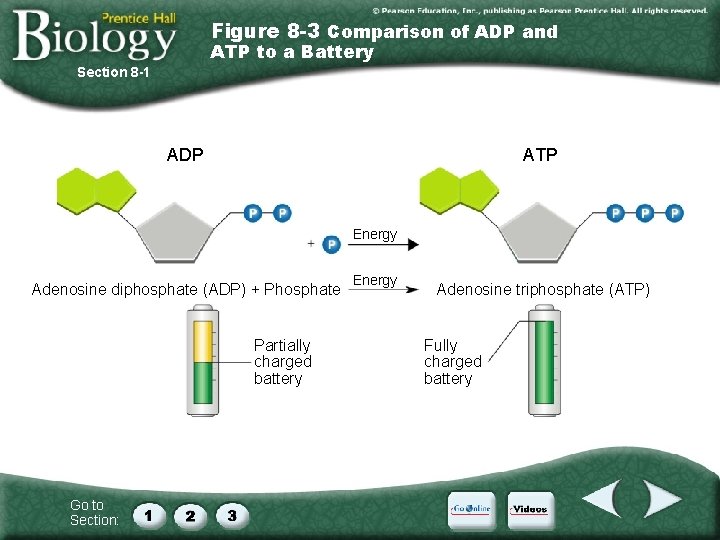
Figure 8 -3 Comparison of ADP and ATP to a Battery Section 8 -1 ADP ATP Energy Adenosine diphosphate (ADP) + Phosphate Partially charged battery Go to Section: Energy Adenosine triphosphate (ATP) Fully charged battery
Interest Grabber Section 8 -2 Trapping Energy Have you ever used a solar-powered calculator? No matter where you go, as long as you have a light source, the calculator works. You never have to put batteries in it. Go to Section:
Interest Grabber continued Section 8 -2 1. A solar-powered calculator uses solar cells that are found in rows along the top of the calculator. Into what kind of energy is the light energy converted so that the calculator works? 2. Recall that plants use light energy from the sun to make food. Into what kind of energy is the light energy converted by plants? 3. Most plants, no matter what size or shape they are, have some parts that are green. Which parts of a plant are usually green? 4. What does the green color have to do with the plant’s ability to convert light energy into the energy found in the food it makes? Go to Section:
Section Outline Section 8 -2 8– 2 Photosynthesis: An Overview A. Investigating Photosynthesis 1. Van Helmont’s Experiment 2. Priestley’s Experiment 3. Jan Ingenhousz B. The Photosynthesis Equation C. Light and Pigments Go to Section:
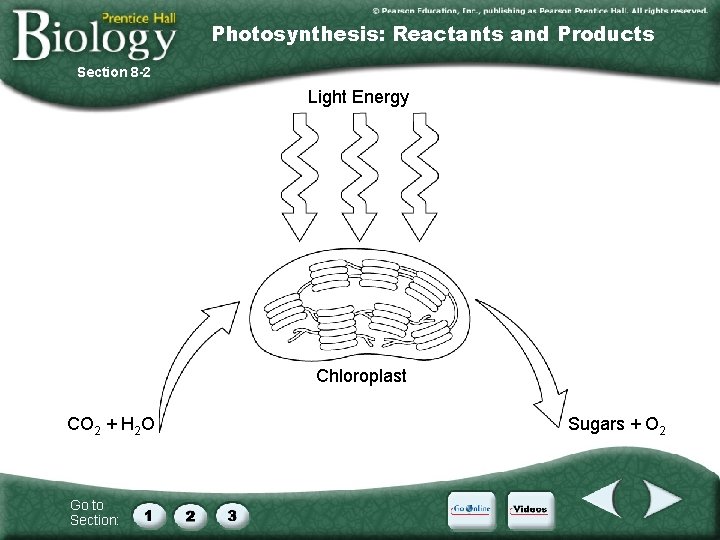
Photosynthesis: Reactants and Products Section 8 -2 Light Energy Chloroplast CO 2 + H 2 O Go to Section: Sugars + O 2
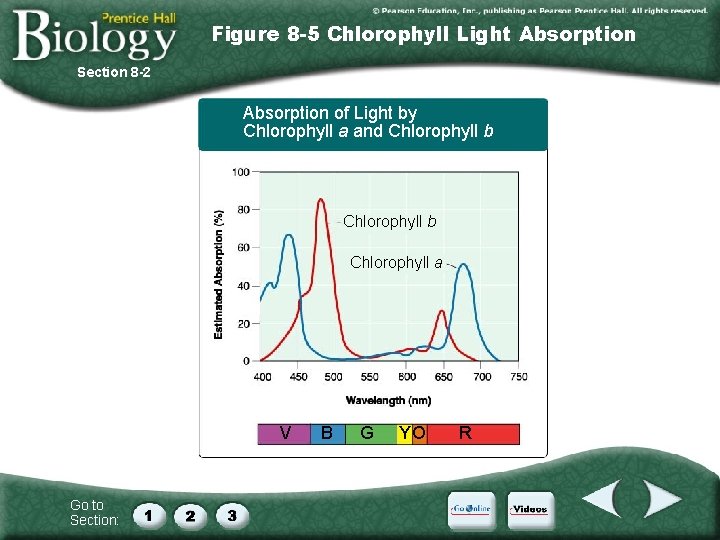
Figure 8 -5 Chlorophyll Light Absorption Section 8 -2 Absorption of Light by Chlorophyll a and Chlorophyll b Chlorophyll a V Go to Section: B G YO R
Interest Grabber Section 8 -3 A Look Into the Future It is 100 years in the future and you are a research scientist. An enormous volcanic eruption has recently sent huge quantities of dust and ash into the atmosphere. Working with a partner, make a list of how this event will affect each of the following: Go to Section: 1. photosynthesis 2. plant life 3. animal life 4. human societies
Section Outline Section 8 -3 8– 3 The Reactions of Photosynthesis A. B. C. D. E. Go to Section: Inside a Chloroplast Electron Carriers Light-Dependent Reactions The Calvin Cycle Factors Affecting Photosynthesis
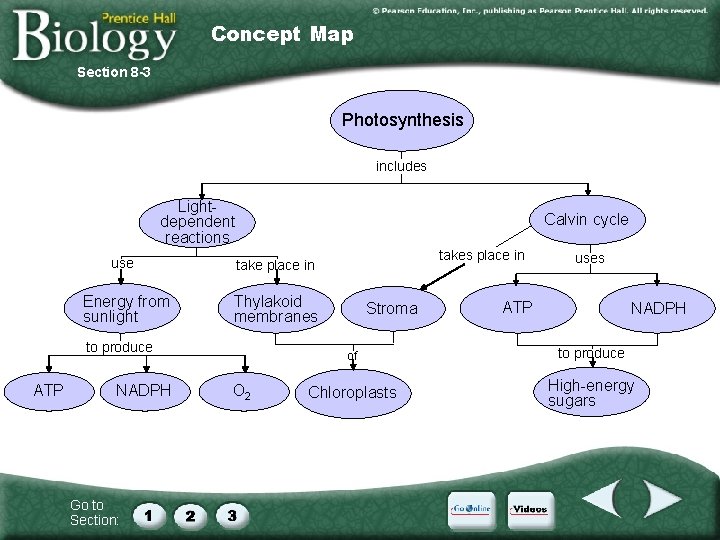
Concept Map Section 8 -3 Photosynthesis includes Lightdependent reactions Calvin cycle use take place in Energy from sunlight Thylakoid membranes to produce ATP NADPH Go to Section: O 2 takes place in Stroma uses ATP NADPH of to produce Chloroplasts High-energy sugars
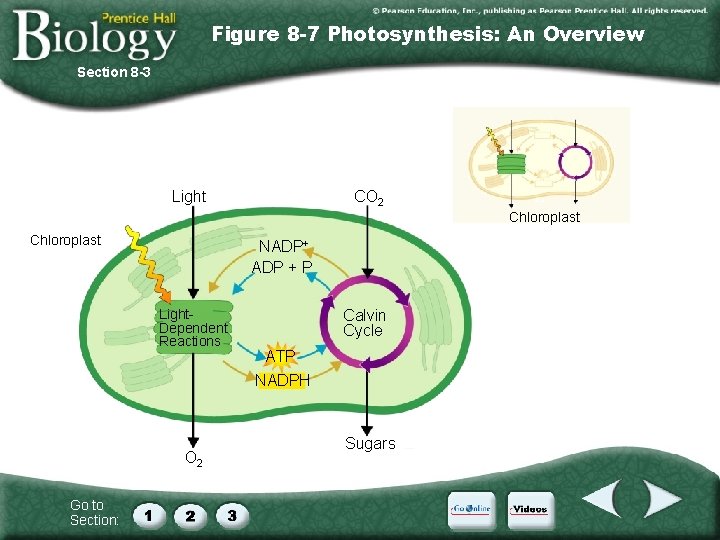
Figure 8 -7 Photosynthesis: An Overview Section 8 -3 Light CO 2 Chloroplast NADP+ ADP + P Light. Dependent Reactions O 2 Go to Section: Calvin Cycle ATP NADPH Sugars
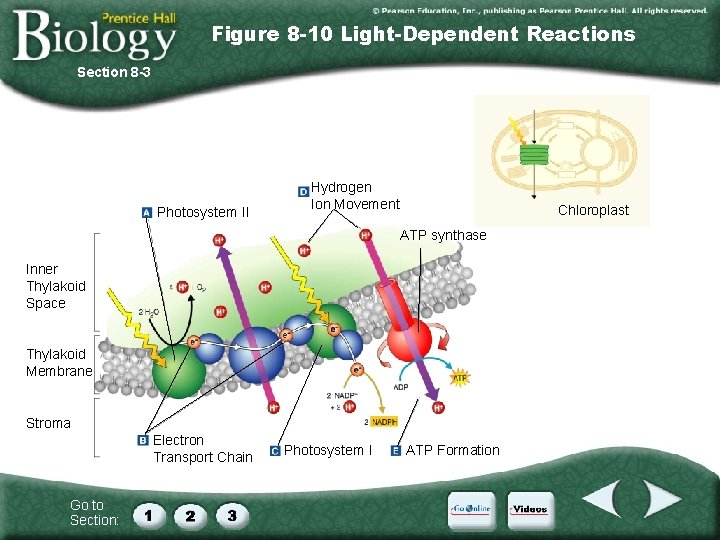
Figure 8 -10 Light-Dependent Reactions Section 8 -3 Photosystem II Hydrogen Ion Movement Chloroplast ATP synthase Inner Thylakoid Space Thylakoid Membrane Stroma Electron Transport Chain Go to Section: Photosystem I ATP Formation
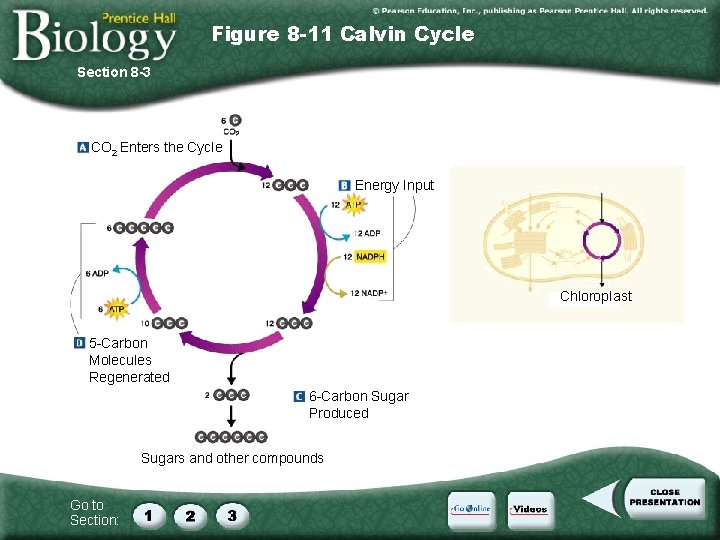
Figure 8 -11 Calvin Cycle Section 8 -3 CO 2 Enters the Cycle Energy Input Chlorop. Iast 5 -Carbon Molecules Regenerated 6 -Carbon Sugar Produced Sugars and other compounds Go to Section:
Videos Click a hyperlink to choose a video. ATP Formation Photosynthesis Light-Dependent Reactions, Part 1 Light-Dependent Reactions, Part 2 Calvin Cycle
Video 1 ATP Formation Click the image to play the video segment.
Video 2 Photosynthesis Click the image to play the video segment.
Video 3 Light-Dependent Reactions, Part 1 Click the image to play the video segment.
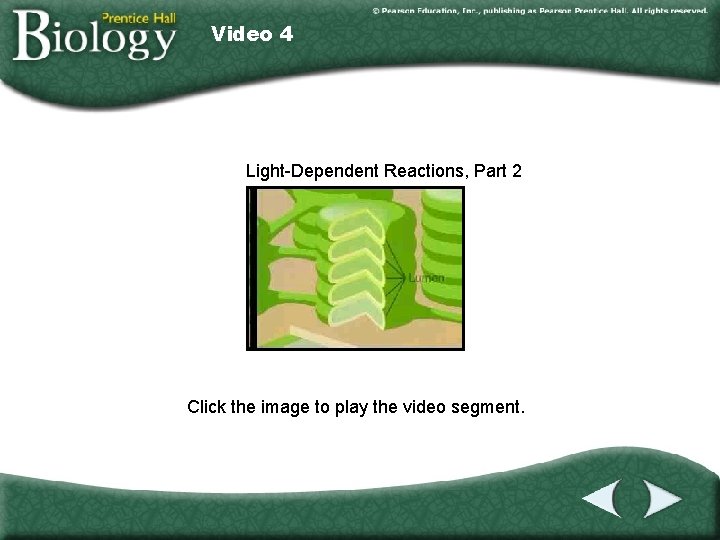
Video 4 Light-Dependent Reactions, Part 2 Click the image to play the video segment.
Video 5 Calvin Cycle Click the image to play the video segment.
Go Online ATP activity Interactive test For links on Calvin cycle, go to www. Sci. Links. org and enter the Web Code as follows: cbn-3082. For links on photosynthesis, go to www. Sci. Links. org and enter the Web Code as follows: cbn-3083.
Interest Grabber Answers 1. 2. 3. 4. What are the benefits of having a bank account? To save money and earn interest. What do you have to do if you need some of this money? Go to the bank and take out the money you need. What might your body do when it has more energy than it needs to carry out its activities? Students will likely say that the body stores the energy. What does your body do when it needs energy? Student answers may include that energy is gotten from food.
Interest Grabber Answers 1. A solar-powered calculator uses solar cells that are found in rows along the top of the calculator. Into what kind of energy is the light energy converted so that the calculator works? They convert light energy into electrical energy. 2. Recall that plants use light energy from the sun to make food. Into what kind of energy is the light energy converted by plants? Plants convert light energy into chemical energy. 3. Most plants, no matter what size or shape they are, have some parts that are green. Which parts of a plant are usually green? Leaves are green, as are some stems. 4. What does the green color have to do with the plant’s ability to convert light energy into the energy found in the food it makes? The green color is the pigment chlorophyll, which absorbs light energy from the sun and converts it to chemical energy in the process of photosynthesis.
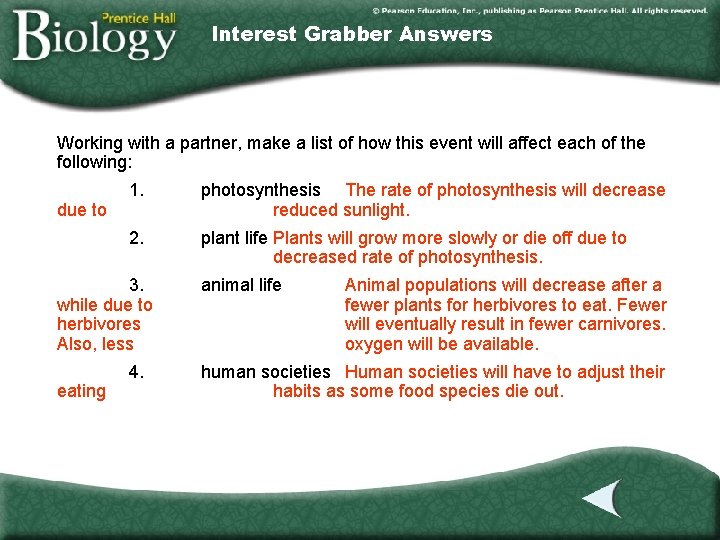
Interest Grabber Answers Working with a partner, make a list of how this event will affect each of the following: due to 1. photosynthesis The rate of photosynthesis will decrease reduced sunlight. 2. plant life Plants will grow more slowly or die off due to decreased rate of photosynthesis. 3. while due to herbivores Also, less eating 4. animal life Animal populations will decrease after a fewer plants for herbivores to eat. Fewer will eventually result in fewer carnivores. oxygen will be available. human societies Human societies will have to adjust their habits as some food species die out.

This slide is intentionally blank.
- Slides: 27