
Interdisciplinary Research Two War Stories Shashi Shekhar Mc
- Slides: 20
Interdisciplinary Research: Two War Stories Shashi Shekhar Mc. Knight Distinguished University Professor Department of Computer Science and Eng. , University of Minnesota www. cs. umn. edu/~shekhar
Collaborations With Geographers • All I know about GIS, I learned from Geographers! – And I used that to discover limitations of Computer Science – It helped advance Computer Sc. While helping application domains • University of Minnesota – – R. Mc. Master: co-taught seminar (1994), co-advised students T. Burk: UMN Map Server (1995 -2005) scale up searches F. Harvey: co-PI on U-Spatial (2012 -15), MN Future Workshop (2009) S. Ruggles, Minnesota Population Center, NSF Datanet Terrapop • USA – – – M. Goodchild (UCSB), D. Mark (Buffalo), M. Egenhofer (U Maine) ESRI: Jack Dangermond, … UCGIS: Board of Director (2003), Congressional breakfast (2004), … Intl. Conf. on Geographic Info. Science (2012 Co-chair, 2004 keynote) American Association of Geographers (AAG) workshops with NIH, … • International – Canada (GEOIDE), Ireland (Geo-computation Center, NUI), India (GIS Center @ IIT-Mumbai, UNDP Project), China (Wuhan U, Beijing U), … – Keynote @ Geo-Computation conference (2011, UCL, UK), ISPRS Spatial Data Mining (2006, Turkey), … 2
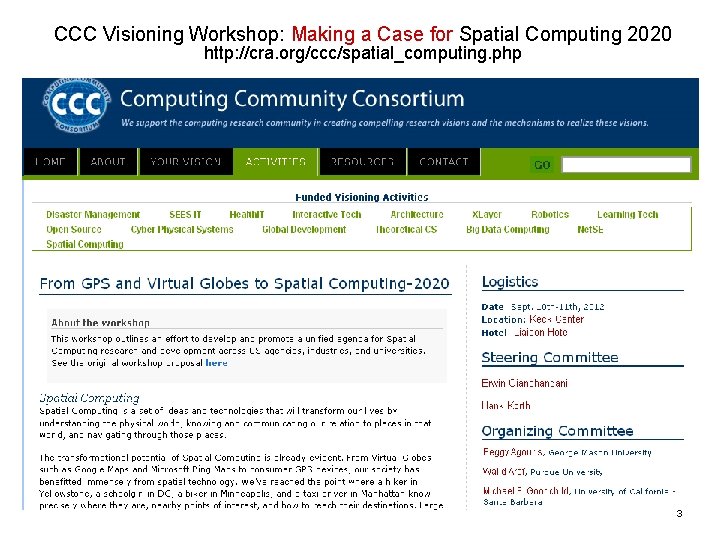
CCC Visioning Workshop: Making a Case for Spatial Computing 2020 http: //cra. org/ccc/spatial_computing. php 3 3
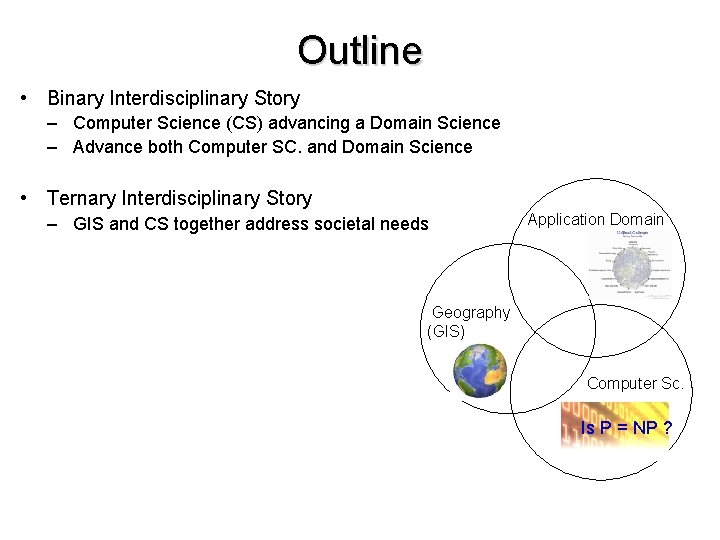
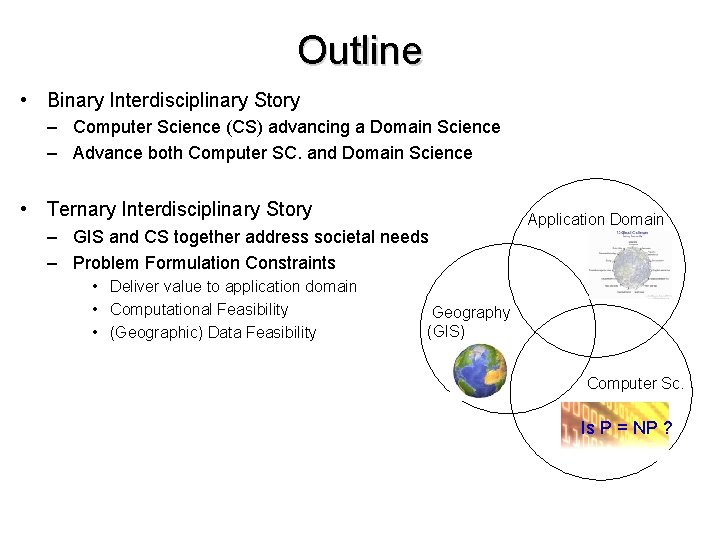
Outline • Binary Interdisciplinary Story – Computer Science (CS) advancing a Domain Science – Advance both Computer SC. and Domain Science • Ternary Interdisciplinary Story – GIS and CS together address societal needs Application Domain Geography (GIS) Computer Sc. Is P = NP ?
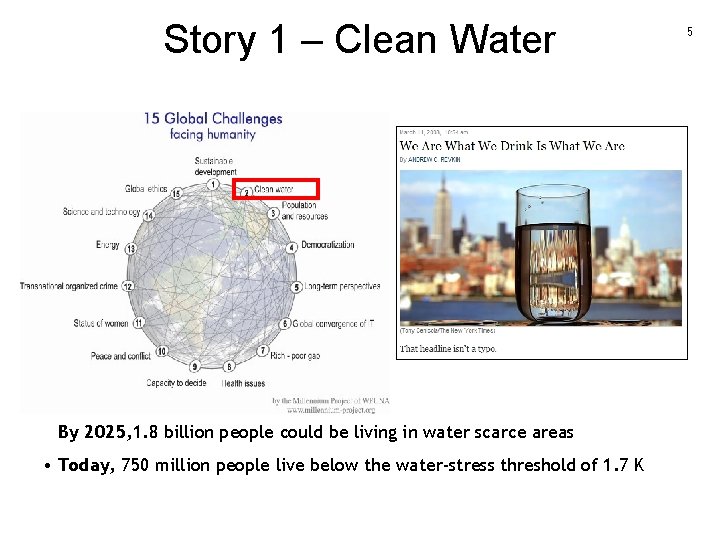
Story 1 – Clean Water Source: New York Times (March 11, 2008) (http: //dotearth. blogs. nytimes. com/2008/03/11/w e-are-what-we-drink-is-what-we-are/? hp) • By 2025, 1. 8 billion people could be living in water scarce areas • Today, 750 million people live below the water-stress threshold of 1. 7 K cubic meters person Souce: WFUNA, 15 Global Challenges 5
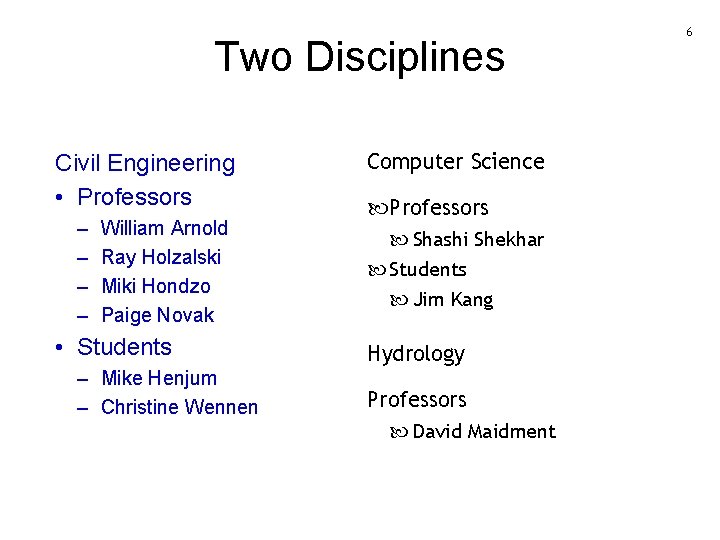
Two Disciplines Civil Engineering • Professors – – William Arnold Ray Holzalski Miki Hondzo Paige Novak • Students – Mike Henjum – Christine Wennen Computer Science Professors Shashi Shekhar Students Jim Kang Hydrology Professors David Maidment 6
What is Interdisciplinary Research? • Is it multiple Disciplines working on a single project? • Is it one discipline helping another? • My Thoughts: – Ideal: Perform research that enhances all disciplines involved. • Not just a subset! – Very Hard To Do!!! – A lot of asking questions back and forth 7
8 Challenge: Communication, Finding Win-Win • Each Discipline has its own language! – We need to learn language of other discipline – Almost like learning a foreign language – Ex. : meaing of “infrastructure” and “network” • Disciplines have different values, cultures and goals • Mis-understanding of what each discipline really is – e. g. , “I thought Civil Engineering was all about building bridges!” – e. g. , “I thought Computer Science was all about programming!” • Break down barriers – Keep talking to each other and have an open mind when discussing each others interest
Brainstorming: In the Beginning… Civil Engineering Questions • How is Computer Science involved in this work? • CS Ans: – I don’t know! – Need to understand the domain questions and the dataset first Computer Science Questions Do you plan on having more than 5 sensors? Like 1000 or 10, 000 or more? CE Ans: No Way! The cost of each sensor ranges from 10 to 100 k 9
Brainstorming: A little later… Civil Eng. Questions • Can you remove errors from the dataset? • CS Ans: – Yes, – But, not really CS work – Existing techniques already exist • e. g. , Triggers Computer Science Questions Do you want to know how fast the river is flowing? CE Ans: Not really, We can already determine that by the discharge, water depth, and physical characteristics of the river 10
Brainstorming: Light at the end of the tunnel Civil Engineering Questions • Can you find when and where interesting contaminants may enter the river? • CS Ans: – Yes! – Flow Anomaly Computer Science Questions Are you interested in finding point sources in both space and time? CE Ans: Yes! Its too hard to find this manually e. g. , hours to sift through the data 50 k data points per measured variable 11
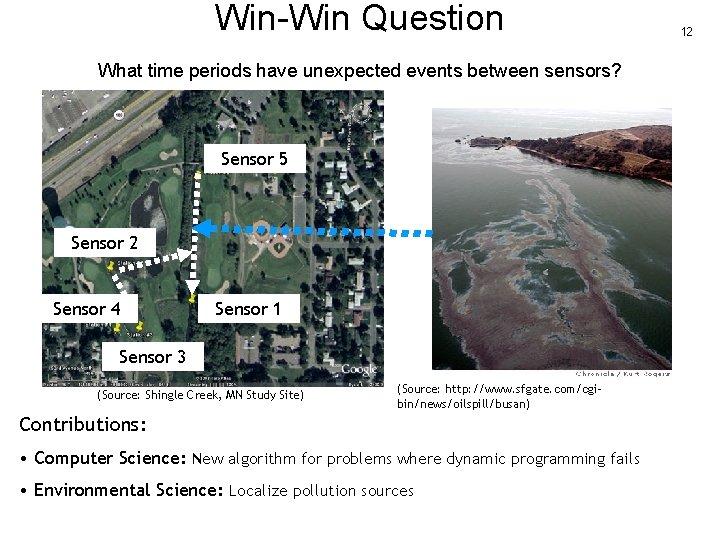
Win-Win Question What time periods have unexpected events between sensors? Ex. An Oil Spill Sensor 5 Sensor 2 Sensor 4 Sensor 1 Sensor 3 (Source: Shingle Creek, MN Study Site) (Source: http: //www. sfgate. com/cgibin/news/oilspill/busan) Contributions: • Computer Science: New algorithm for problems where dynamic programming fails • Environmental Science: Localize pollution sources 12
Outline • Binary Interdisciplinary Story – Computer Science (CS) advancing a Domain Science – Advance both Computer SC. and Domain Science • Ternary Interdisciplinary Story – GIS and CS together address societal needs – Problem Formulation Constraints • Deliver value to application domain • Computational Feasibility • (Geographic) Data Feasibility Application Domain Geography (GIS) Computer Sc. Is P = NP ?
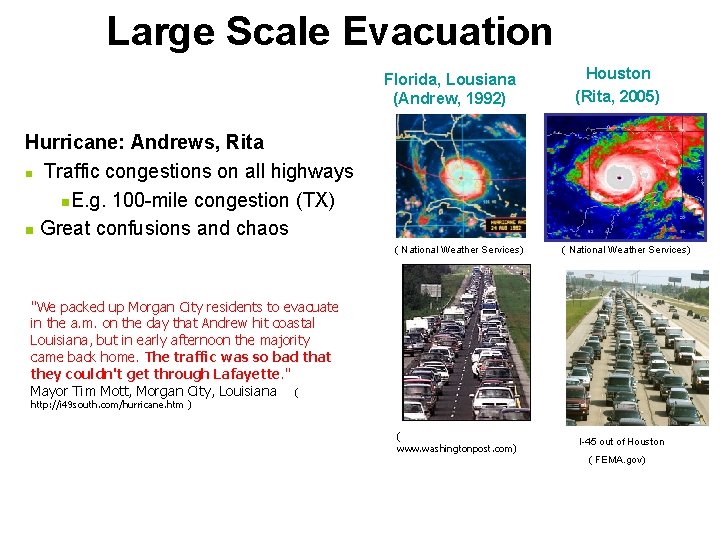
Large Scale Evacuation Florida, Lousiana (Andrew, 1992) Houston (Rita, 2005) Hurricane: Andrews, Rita n Traffic congestions on all highways n. E. g. 100 -mile congestion (TX) n Great confusions and chaos ( National Weather Services) "We packed up Morgan City residents to evacuate in the a. m. on the day that Andrew hit coastal Louisiana, but in early afternoon the majority came back home. The traffic was so bad that they couldn't get through Lafayette. " Mayor Tim Mott, Morgan City, Louisiana ( http: //i 49 south. com/hurricane. htm ) ( www. washingtonpost. com) I-45 out of Houston ( FEMA. gov)
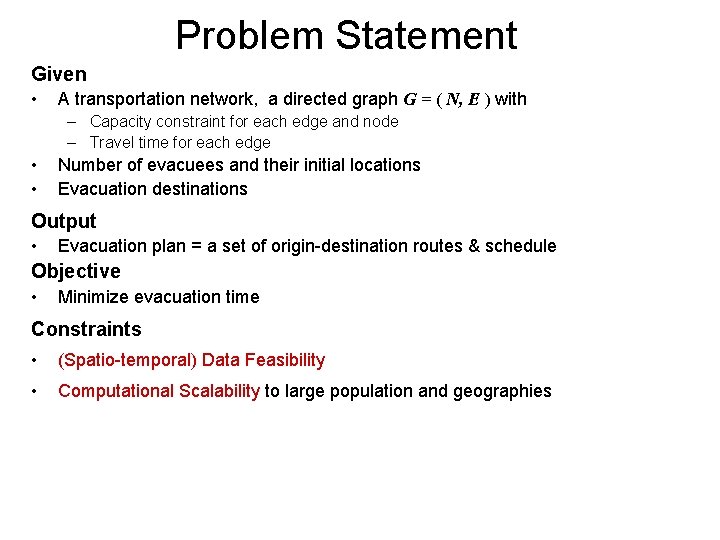
Problem Statement Given • A transportation network, a directed graph G = ( N, E ) with – Capacity constraint for each edge and node – Travel time for each edge • • Number of evacuees and their initial locations Evacuation destinations Output • Evacuation plan = a set of origin-destination routes & schedule Objective • Minimize evacuation time Constraints • (Spatio-temporal) Data Feasibility • Computational Scalability to large population and geographies
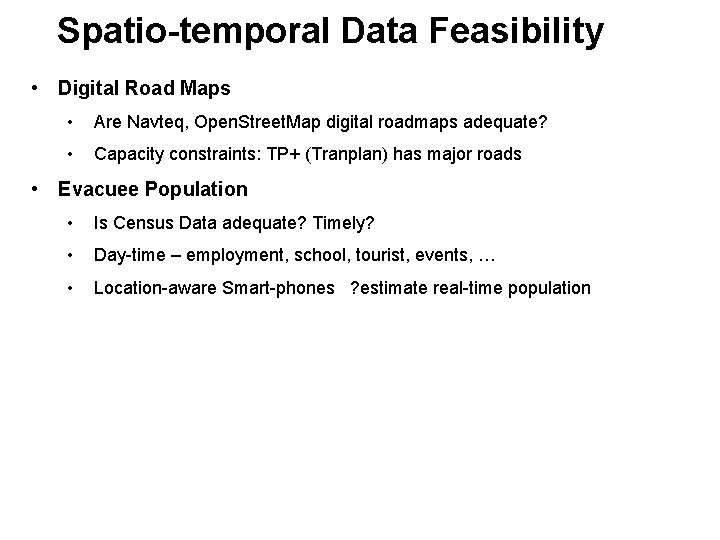
Spatio-temporal Data Feasibility • Digital Road Maps • Are Navteq, Open. Street. Map digital roadmaps adequate? • Capacity constraints: TP+ (Tranplan) has major roads • Evacuee Population • Is Census Data adequate? Timely? • Day-time – employment, school, tourist, events, … • Location-aware Smart-phones ? estimate real-time population
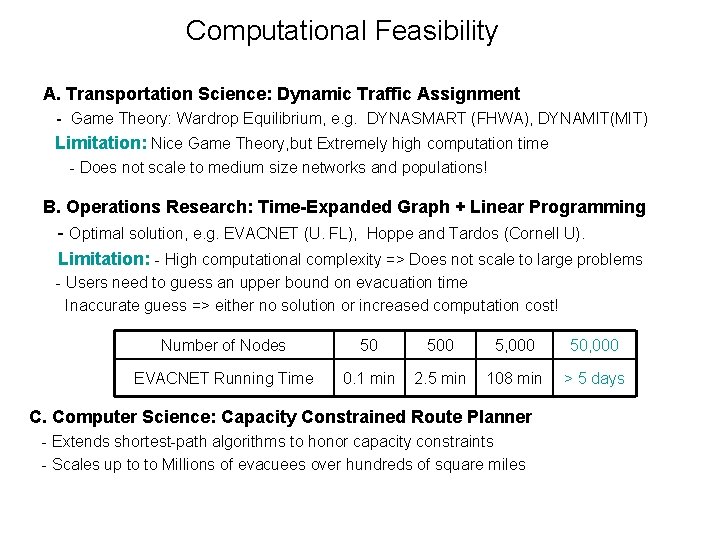
Computational Feasibility A. Transportation Science: Dynamic Traffic Assignment - Game Theory: Wardrop Equilibrium, e. g. DYNASMART (FHWA), DYNAMIT(MIT) Limitation: Nice Game Theory, but Extremely high computation time - Does not scale to medium size networks and populations! B. Operations Research: Time-Expanded Graph + Linear Programming - Optimal solution, e. g. EVACNET (U. FL), Hoppe and Tardos (Cornell U). Limitation: - High computational complexity => Does not scale to large problems - Users need to guess an upper bound on evacuation time Inaccurate guess => either no solution or increased computation cost! Number of Nodes 50 500 5, 000 50, 000 EVACNET Running Time 0. 1 min 2. 5 min 108 min > 5 days C. Computer Science: Capacity Constrained Route Planner - Extends shortest-path algorithms to honor capacity constraints - Scales up to to Millions of evacuees over hundreds of square miles
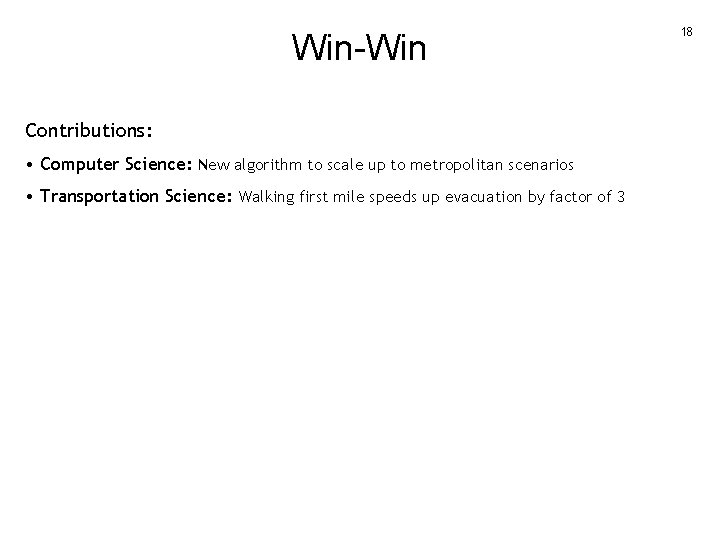
18 Win-Win Contributions: Ex. An Oil Spill • Computer Science: New algorithm to scale up to metropolitan scenarios • Transportation Science: Walking first mile speeds up evacuation by factor of 3
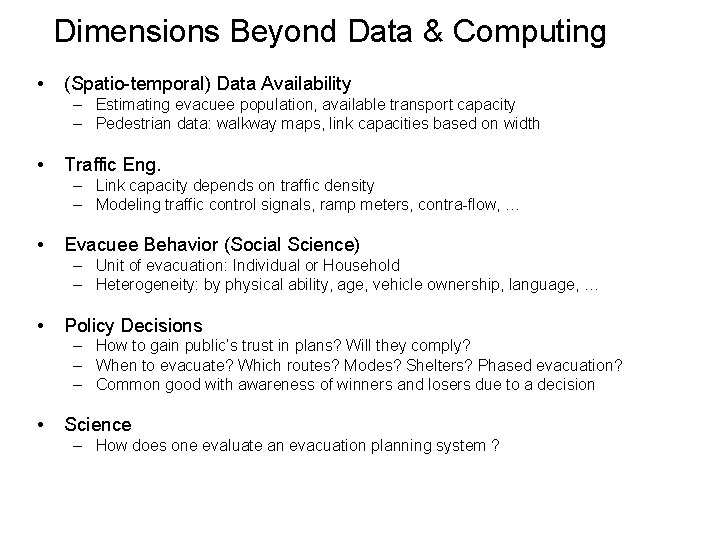
Dimensions Beyond Data & Computing • (Spatio-temporal) Data Availability – Estimating evacuee population, available transport capacity – Pedestrian data: walkway maps, link capacities based on width • Traffic Eng. – Link capacity depends on traffic density – Modeling traffic control signals, ramp meters, contra-flow, … • Evacuee Behavior (Social Science) – Unit of evacuation: Individual or Household – Heterogeneity: by physical ability, age, vehicle ownership, language, … • Policy Decisions – How to gain public’s trust in plans? Will they comply? – When to evacuate? Which routes? Modes? Shelters? Phased evacuation? – Common good with awareness of winners and losers due to a decision • Science – How does one evaluate an evacuation planning system ?
Lessons Learned • Interdisciplinary Research is HARD • Hardest part is trying to understand the other domain • Crucial that both sides understand each other before research can begin • A lot of trial and error between both sides • Once an “Ah-ha” moment occurs – The number of opportunities can be unlimited! 22