
Interdisciplinary interactions between humanities and sciences in music
Interdisciplinary interactions between humanities and sciences in music research Richard Parncutt Centre for Systematic Musicology University of Graz, Austria Sys. Mus Graz Audio Communication Day 27 June 2014, TU Berlin
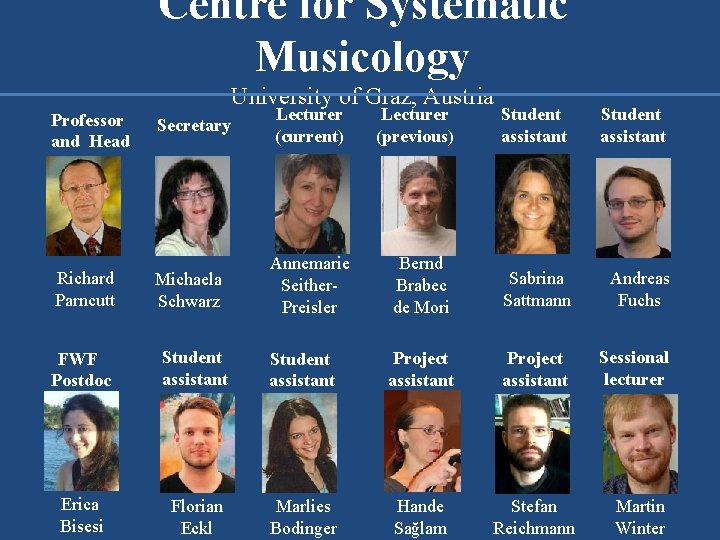
Centre for Systematic Musicology Professor and Head Richard Parncutt University of Graz, Austria Secretary Lecturer (current) Lecturer (previous) Student assistant Michaela Schwarz Annemarie Seither. Preisler Bernd Brabec de Mori Sabrina Sattmann Andreas Fuchs Sessional lecturer FWF Postdoc Student assistant Project assistant Erica Bisesi Florian Eckl Marlies Bodinger Hande Sağlam Stefan Reichmann Martin Winter
Do we need disciplinary categories? Schwarz oder weiß Text & Musik: Oliver Gies (2009? ) Schwarz oder weiß Hörst du Beatles oder die Stones? Ja oder nein Guckst Du Tagesschau oder Indiana Jones? Grautöne sind mir viel zu Warst du Zivi oder beim Bund? Bist du schüchtern oder drängst dich in den Vordergrund? allgemein Bitte kein “Äh” Bist du träge oder agil? Bitte kein “Jein” Depressiv oder mental eher stabil? In eine meiner Schubladen, Trinkst du Wein oder lieber Bier? Hast Du’n Reihenhaus m. Garten od. lebst du v. Hartz IV? da krieg ich dich schon rein Hähnchendöner oder lieber Lamm? Trennst Du Müll oder schmeißt du alles zusamm’n? Fährst du Taxi oder mit dem Bus? Sagst du Super-Dickmann oder sagst du Negerkuss? Guckst du Arte oder Sat 1? Nennst du deinen Sohn Jean-Luc oder Karl-Heinz? Gibst du nach oder bist du stur? Liest Du regelmäßig “Bild” oder hast du das Abitur?
Disciplinary categories are necessary! Experts and specialization are the basis of academic quality Each discipline has its own epistemologies • • Ways of thinking Ways of doing research Ways of training future scholars Ways of evaluating quality Epistemology • What is knowledge? • Which knowledge exists? • How is knowledge acquired?
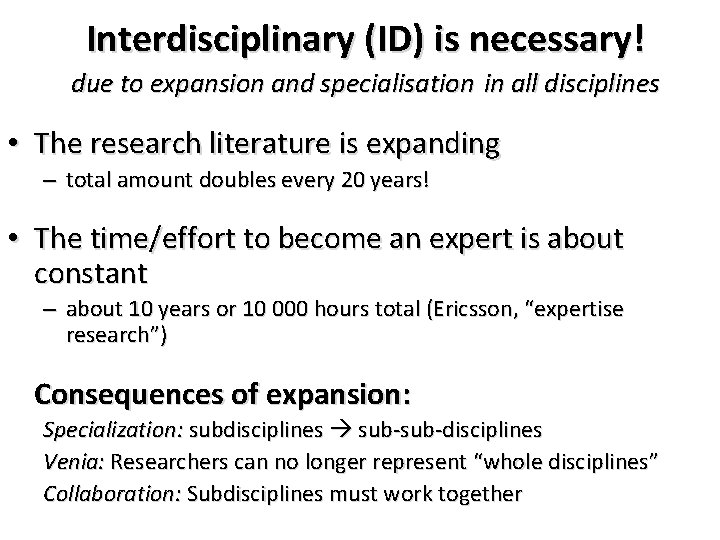
Interdisciplinary (ID) is necessary! due to expansion and specialisation in all disciplines • The research literature is expanding – total amount doubles every 20 years! • The time/effort to become an expert is about constant – about 10 years or 10 000 hours total (Ericsson, “expertise research”) Consequences of expansion: Specialization: subdisciplines sub-disciplines Venia: Researchers can no longer represent “whole disciplines” Collaboration: Subdisciplines must work together
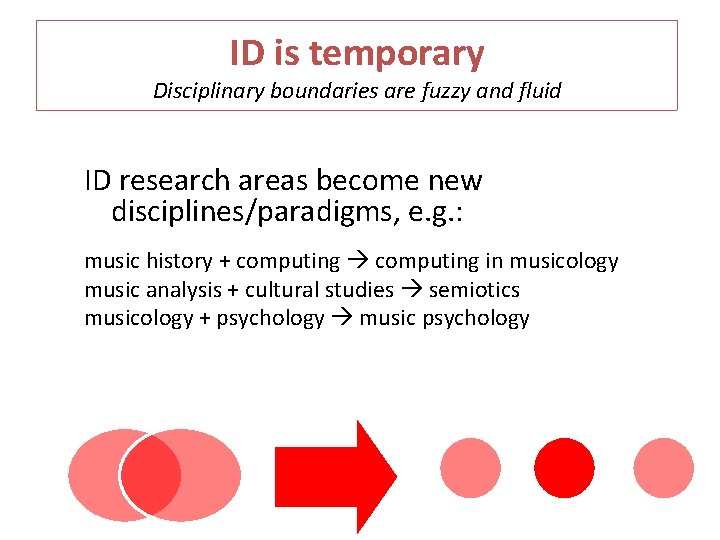
ID is temporary Disciplinary boundaries are fuzzy and fluid ID research areas become new disciplines/paradigms, e. g. : music history + computing in musicology music analysis + cultural studies semiotics musicology + psychology music psychology
ID is unusual It costs extra time and energy 1. Communication problems Different ways of talking, researching misunderstandings 2. Structural problems Clear hierarchies: easy to organise, but impede ID 3. Quality control problems Different quality mechanisms “Own” discipline superior?
The rest of this talk… Humanities and Sciences (H&S) (a) in general (b) in musicology Combining H&S in music research (a) in general (b) in my research and teaching
Separation of H & S Relationships between disciplines in Austrian research projects funded by FWF 1992 -2006 FAS. research (2008). Netzwerke der Wissensproduktion. Wien.
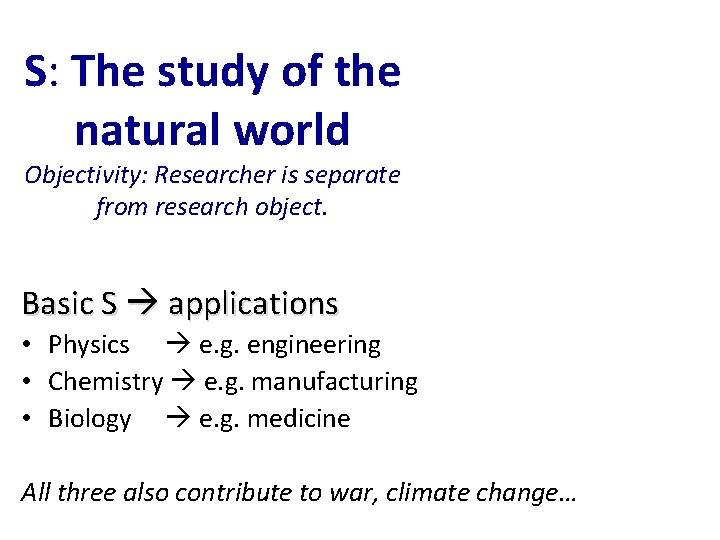
S: The study of the natural world Objectivity: Researcher is separate from research object. Basic S applications • Physics e. g. engineering • Chemistry e. g. manufacturing • Biology e. g. medicine All three also contribute to war, climate change…
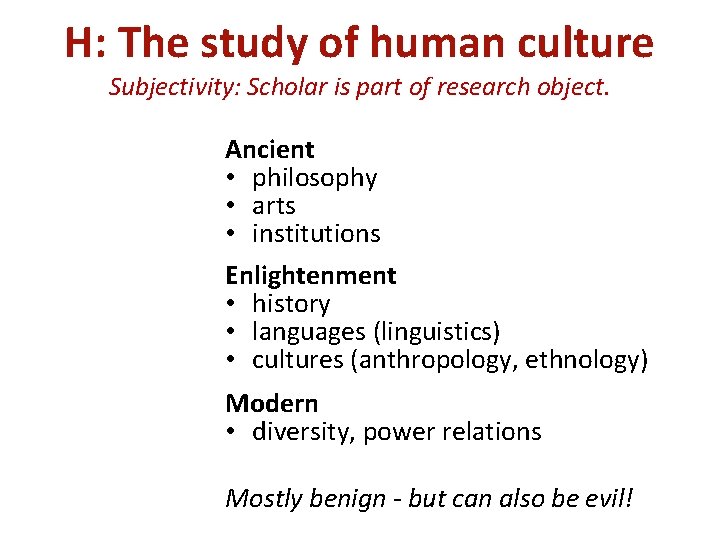
H: The study of human culture Subjectivity: Scholar is part of research object. Ancient • philosophy • arts • institutions Enlightenment • history • languages (linguistics) • cultures (anthropology, ethnology) Modern • diversity, power relations Mostly benign - but can also be evil!
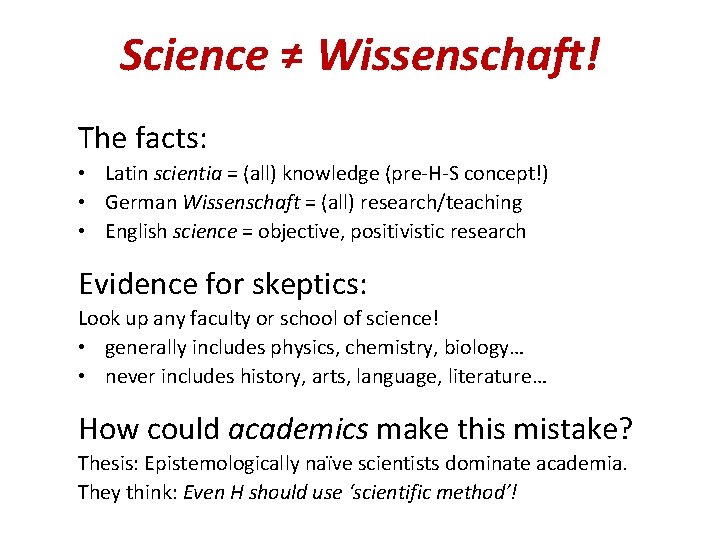
Science ≠ Wissenschaft! The facts: • Latin scientia = (all) knowledge (pre-H-S concept!) • German Wissenschaft = (all) research/teaching • English science = objective, positivistic research Evidence for skeptics: Look up any faculty or school of science! • generally includes physics, chemistry, biology… • never includes history, arts, language, literature… How could academics make this mistake? Thesis: Epistemologically naïve scientists dominate academia. They think: Even H should use ‘scientific method’!
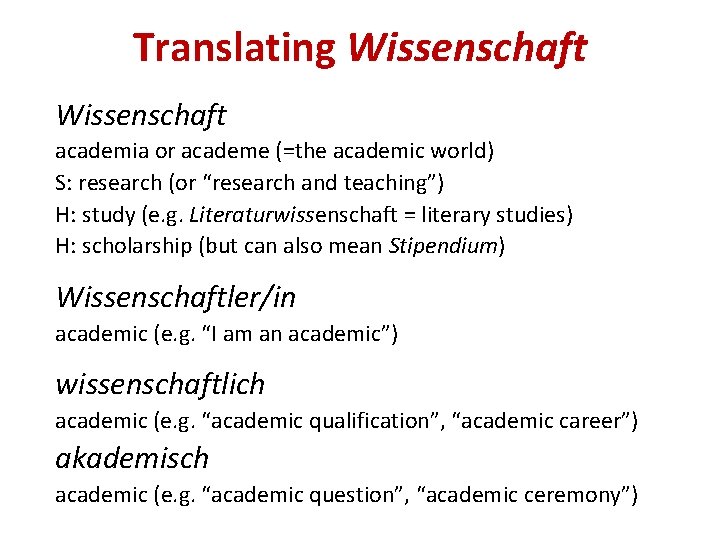
Translating Wissenschaft academia or academe (=the academic world) S: research (or “research and teaching”) H: study (e. g. Literaturwissenschaft = literary studies) H: scholarship (but can also mean Stipendium) Wissenschaftler/in academic (e. g. “I am an academic”) wissenschaftlich academic (e. g. “academic qualification”, “academic career”) akademisch academic (e. g. “academic question”, “academic ceremony”)
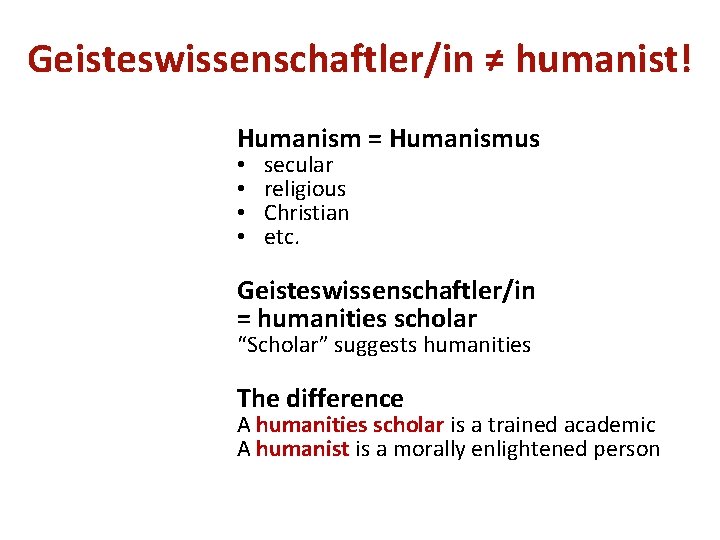
Geisteswissenschaftler/in ≠ humanist! Humanism = Humanismus • • secular religious Christian etc. Geisteswissenschaftler/in = humanities scholar “Scholar” suggests humanities The difference A humanities scholar is a trained academic A humanist is a morally enlightened person
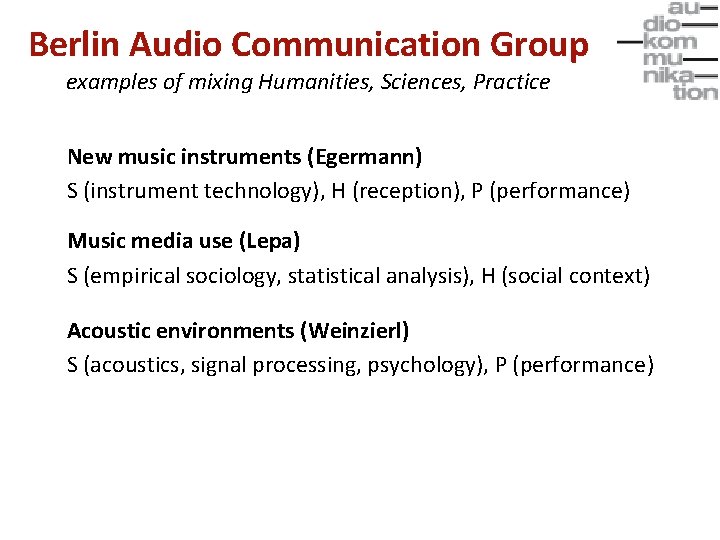
Berlin Audio Communication Group examples of mixing Humanities, Sciences, Practice New music instruments (Egermann) S (instrument technology), H (reception), P (performance) Music media use (Lepa) S (empirical sociology, statistical analysis), H (social context) Acoustic environments (Weinzierl) S (acoustics, signal processing, psychology), P (performance)
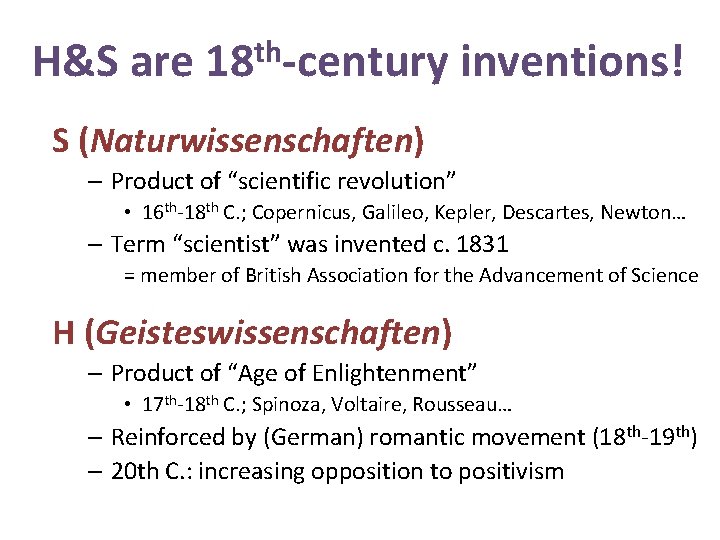
H&S are 18 th-century inventions! S (Naturwissenschaften) – Product of “scientific revolution” • 16 th-18 th C. ; Copernicus, Galileo, Kepler, Descartes, Newton… – Term “scientist” was invented c. 1831 = member of British Association for the Advancement of Science H (Geisteswissenschaften) – Product of “Age of Enlightenment” • 17 th-18 th C. ; Spinoza, Voltaire, Rousseau… – Reinforced by (German) romantic movement (18 th-19 th) – 20 th C. : increasing opposition to positivism
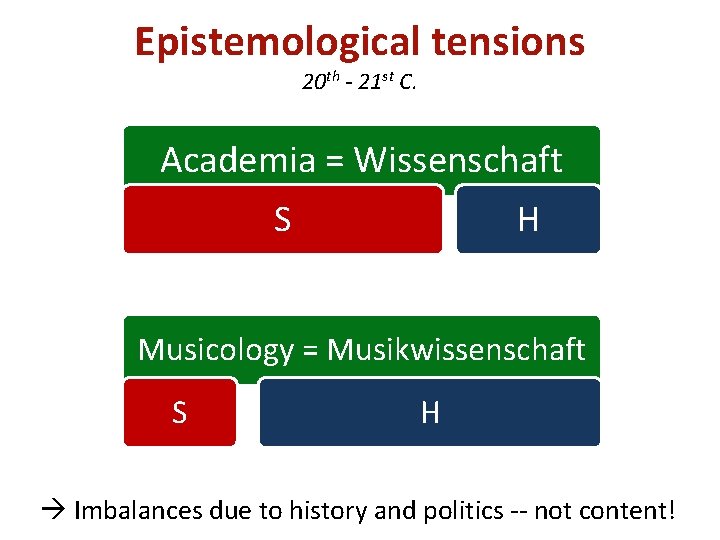
Epistemological tensions 20 th - 21 st C. Academia = Wissenschaft S H Musicology = Musikwissenschaft S H Imbalances due to history and politics -- not content!
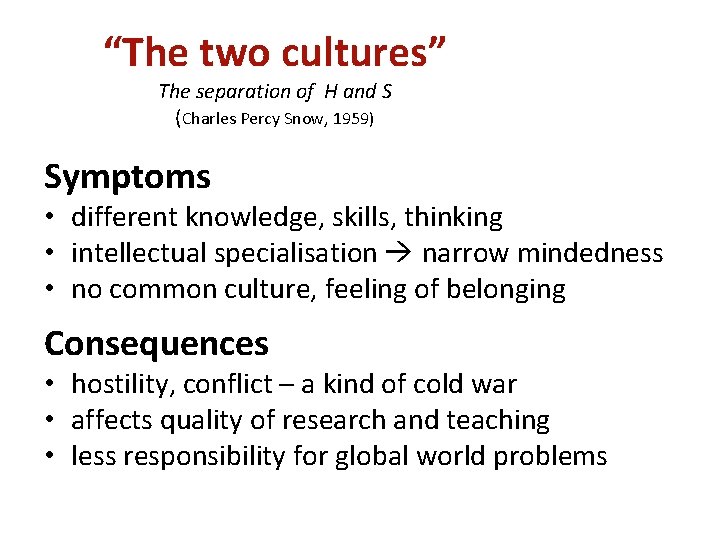
“The two cultures” The separation of H and S (Charles Percy Snow, 1959) Symptoms • different knowledge, skills, thinking • intellectual specialisation narrow mindedness • no common culture, feeling of belonging Consequences • hostility, conflict – a kind of cold war • affects quality of research and teaching • less responsibility for global world problems
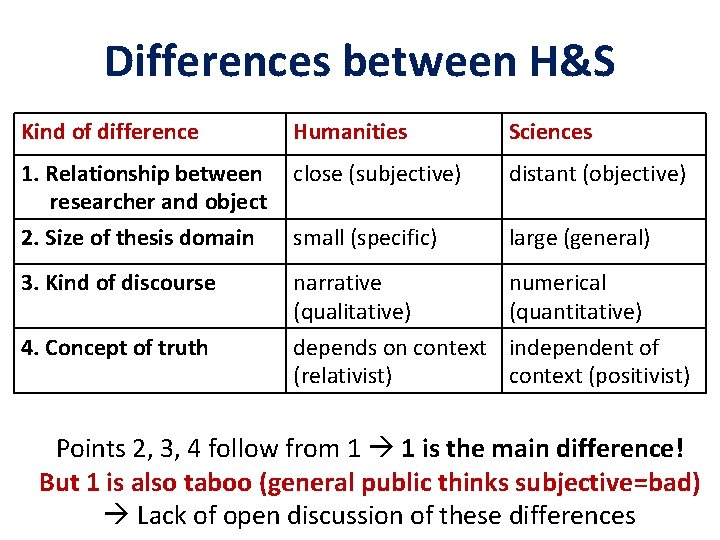
Differences between H&S Kind of difference Humanities Sciences 1. Relationship between researcher and object close (subjective) distant (objective) 2. Size of thesis domain small (specific) large (general) 3. Kind of discourse narrative (qualitative) depends on context (relativist) numerical (quantitative) independent of context (positivist) 4. Concept of truth Points 2, 3, 4 follow from 1 1 is the main difference! But 1 is also taboo (general public thinks subjective=bad) Lack of open discussion of these differences
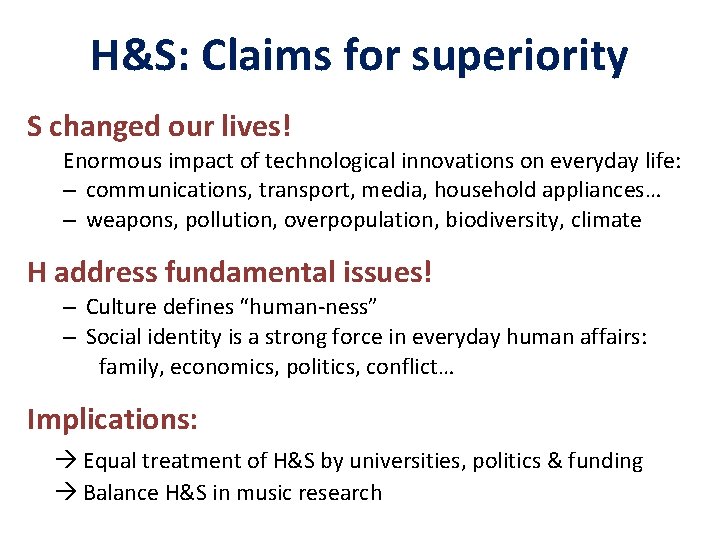
H&S: Claims for superiority S changed our lives! Enormous impact of technological innovations on everyday life: – communications, transport, media, household appliances… – weapons, pollution, overpopulation, biodiversity, climate H address fundamental issues! – Culture defines “human-ness” – Social identity is a strong force in everyday human affairs: family, economics, politics, conflict… Implications: Equal treatment of H&S by universities, politics & funding Balance H&S in music research
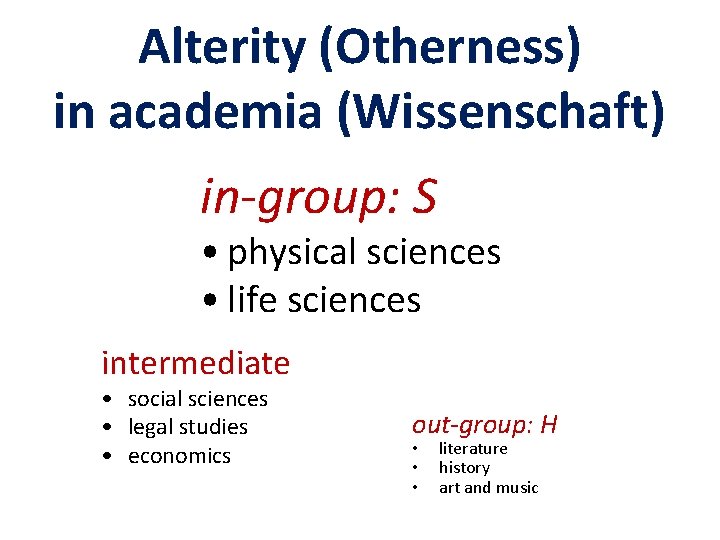
Alterity (Otherness) in academia (Wissenschaft) in-group: S • physical sciences • life sciences intermediate • social sciences • legal studies • economics out-group: H • • • literature history art and music
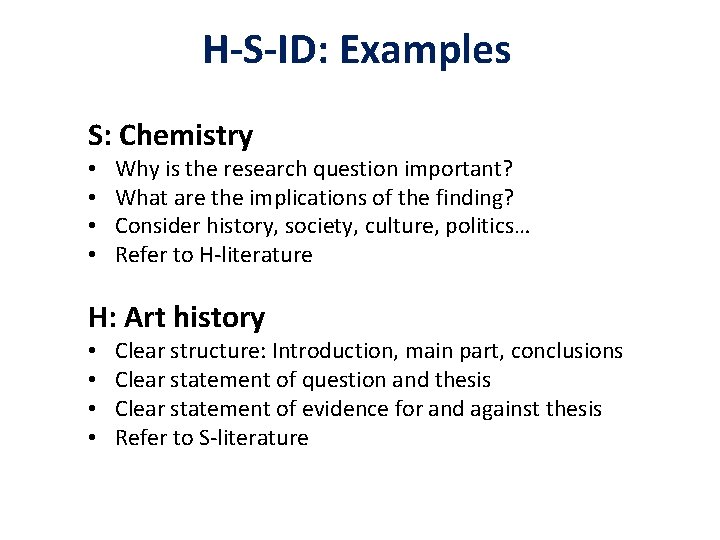
H-S-ID: Examples S: Chemistry • • Why is the research question important? What are the implications of the finding? Consider history, society, culture, politics… Refer to H-literature H: Art history • • Clear structure: Introduction, main part, conclusions Clear statement of question and thesis Clear statement of evidence for and against thesis Refer to S-literature
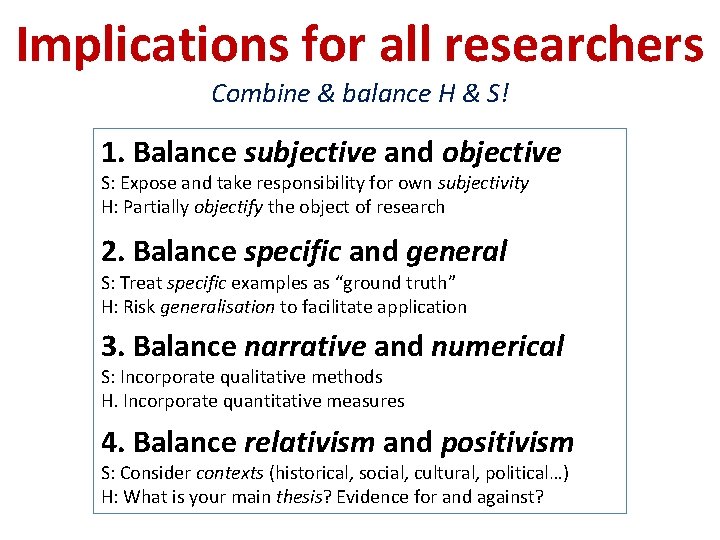
Implications for all researchers Combine & balance H & S! 1. Balance subjective and objective S: Expose and take responsibility for own subjectivity H: Partially objectify the object of research 2. Balance specific and general S: Treat specific examples as “ground truth” H: Risk generalisation to facilitate application 3. Balance narrative and numerical S: Incorporate qualitative methods H. Incorporate quantitative measures 4. Balance relativism and positivism S: Consider contexts (historical, social, cultural, political…) H: What is your main thesis? Evidence for and against?
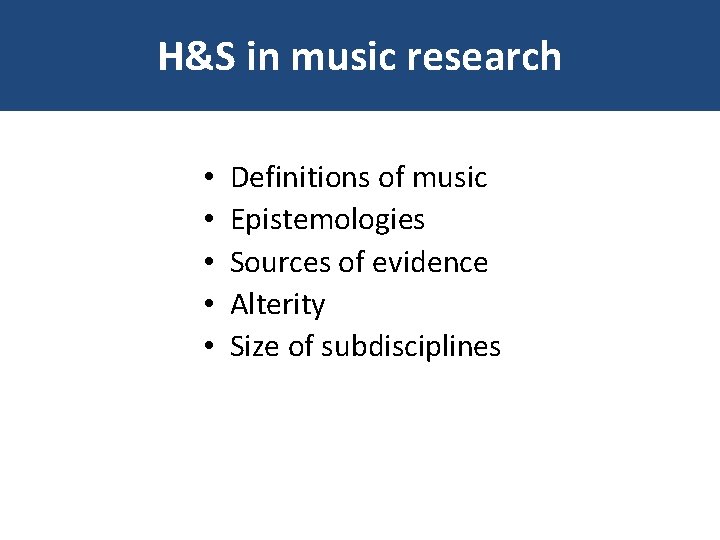
H&S in music research • • • Definitions of music Epistemologies Sources of evidence Alterity Size of subdisciplines
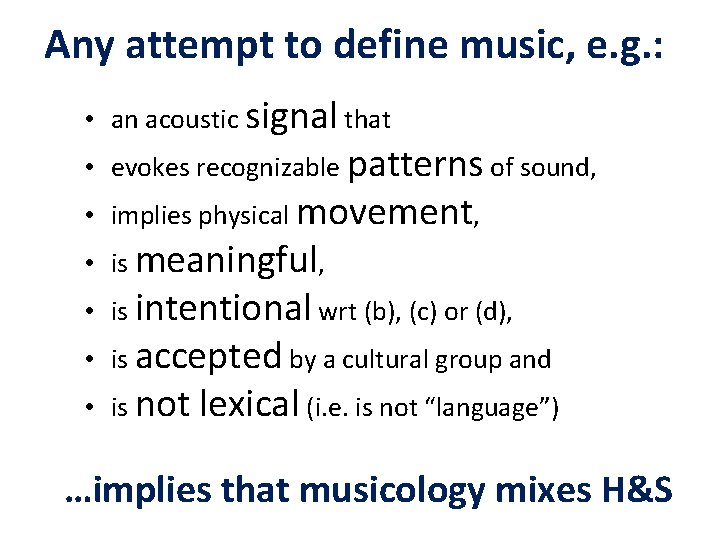
Any attempt to define music, e. g. : • an acoustic signal that • evokes recognizable patterns of sound, • implies physical movement, • is meaningful, • is intentional wrt (b), (c) or (d), • is accepted by a cultural group and • is not lexical (i. e. is not “language”) …implies that musicology mixes H&S
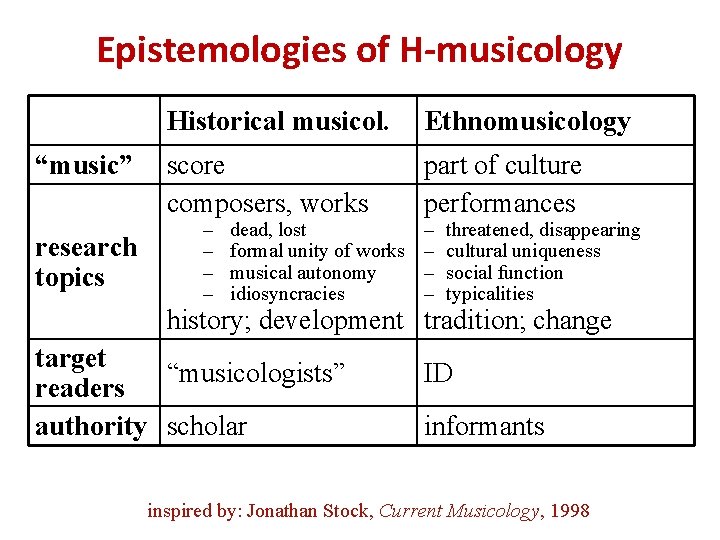
Epistemologies of H-musicology “music” research topics Historical musicol. Ethnomusicology score composers, works part of culture performances – – dead, lost formal unity of works musical autonomy idiosyncracies – – threatened, disappearing cultural uniqueness social function typicalities history; development tradition; change target “musicologists” readers authority scholar ID informants inspired by: Jonathan Stock, Current Musicology, 1998
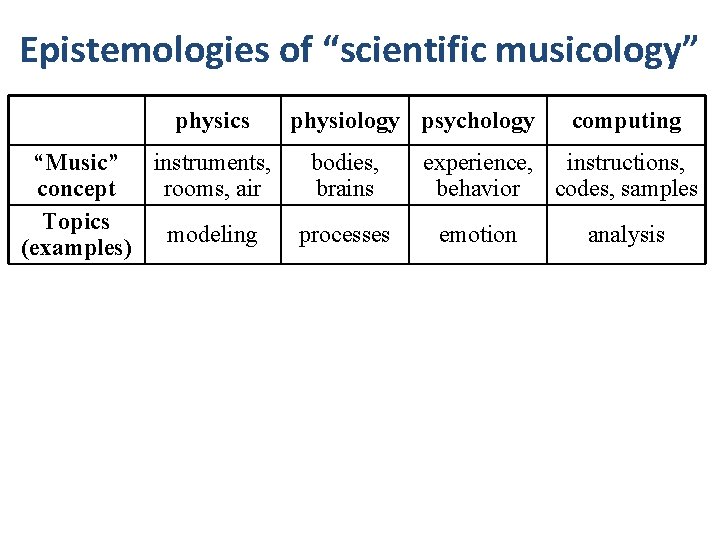
Epistemologies of “scientific musicology” physics “Music” instruments, concept rooms, air Topics modeling (examples) physiology psychology bodies, brains processes computing experience, instructions, behavior codes, samples emotion analysis
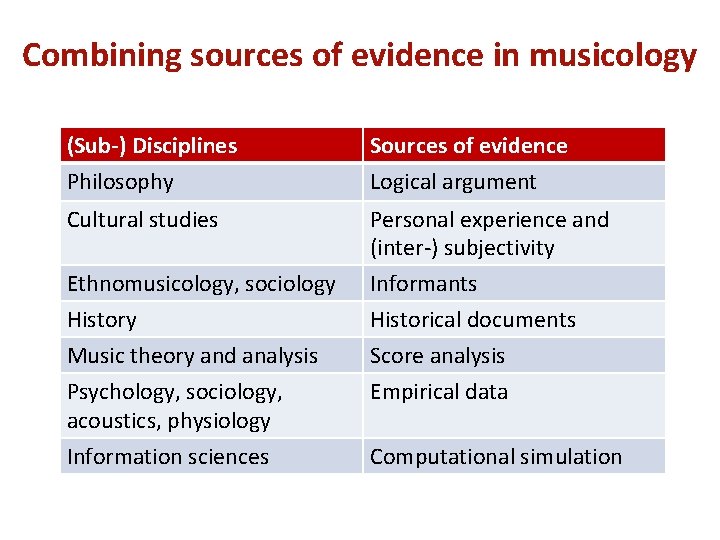
Combining sources of evidence in musicology (Sub-) Disciplines Sources of evidence Philosophy Logical argument Cultural studies Personal experience and (inter-) subjectivity Ethnomusicology, sociology Informants History Historical documents Music theory and analysis Score analysis Psychology, sociology, acoustics, physiology Empirical data Information sciences Computational simulation
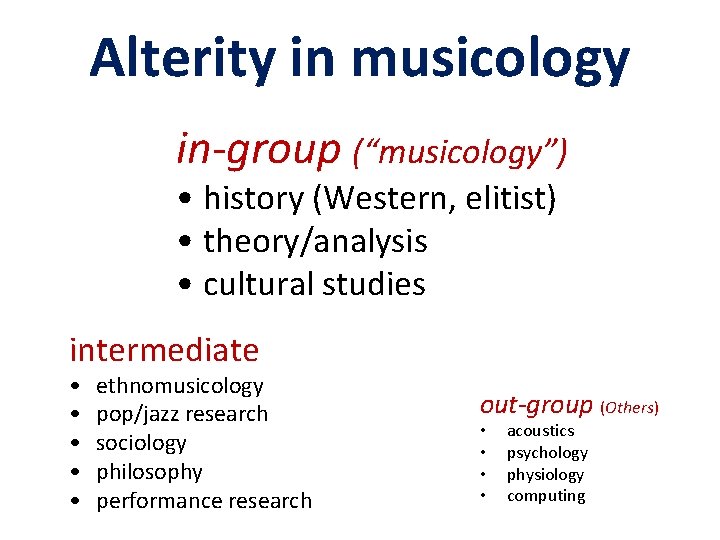
Alterity in musicology in-group (“musicology”) • history (Western, elitist) • theory/analysis • cultural studies intermediate • • • ethnomusicology pop/jazz research sociology philosophy performance research out-group (Others) • • acoustics psychology physiology computing
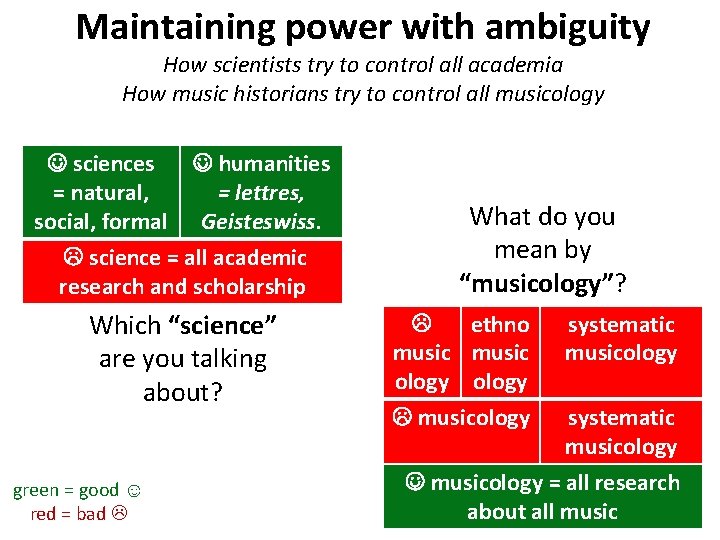
Maintaining power with ambiguity How scientists try to control all academia How music historians try to control all musicology sciences humanities = natural, = lettres, social, formal Geisteswiss. science = all academic research and scholarship Which “science” are you talking about? green = good ☺ red = bad What do you mean by “musicology”? ethno music ology systematic musicology = all research about all music
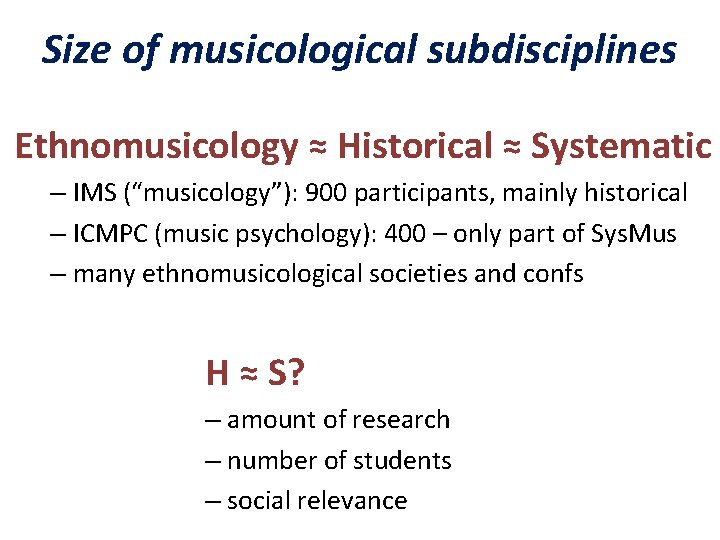
Size of musicological subdisciplines Ethnomusicology ≈ Historical ≈ Systematic – IMS (“musicology”): 900 participants, mainly historical – ICMPC (music psychology): 400 – only part of Sys. Mus – many ethnomusicological societies and confs H ≈ S? – amount of research – number of students – social relevance
Projects to promote ID in musicology Research • Specific projects • New infrastructures Teaching • Undergraduate • Graduate
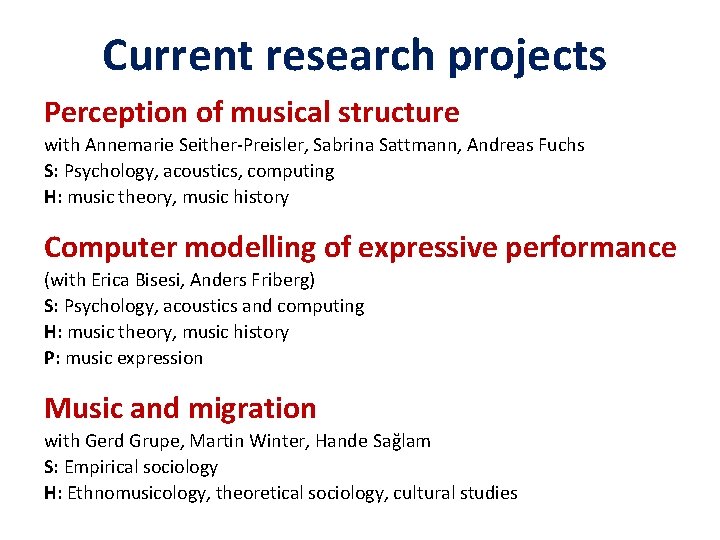
Current research projects Perception of musical structure with Annemarie Seither-Preisler, Sabrina Sattmann, Andreas Fuchs S: Psychology, acoustics, computing H: music theory, music history Computer modelling of expressive performance (with Erica Bisesi, Anders Friberg) S: Psychology, acoustics and computing H: music theory, music history P: music expression Music and migration with Gerd Grupe, Martin Winter, Hande Sağlam S: Empirical sociology H: Ethnomusicology, theoretical sociology, cultural studies
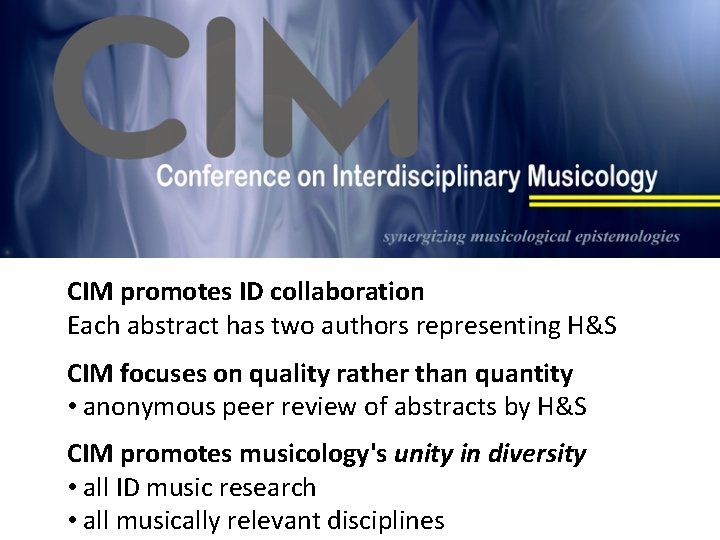
CIM promotes ID collaboration Each abstract has two authors representing H&S CIM focuses on quality rather than quantity • anonymous peer review of abstracts by H&S CIM promotes musicology's unity in diversity • all ID music research • all musically relevant disciplines
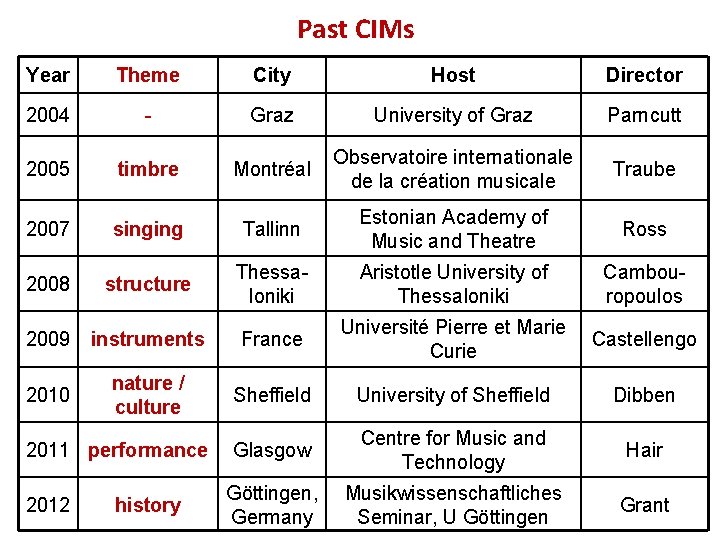
Past CIMs Year Theme City Host Director 2004 - Graz University of Graz Parncutt 2005 timbre Montréal Observatoire internationale de la création musicale Traube 2007 singing Tallinn Estonian Academy of Music and Theatre Ross 2008 structure Thessaloniki Aristotle University of Thessaloniki Cambouropoulos 2009 instruments France Université Pierre et Marie Curie Castellengo 2010 nature / culture Sheffield University of Sheffield Dibben Glasgow Centre for Music and Technology Hair Göttingen, Germany Musikwissenschaftliches Seminar, U Göttingen Grant 2011 performance 2012 history
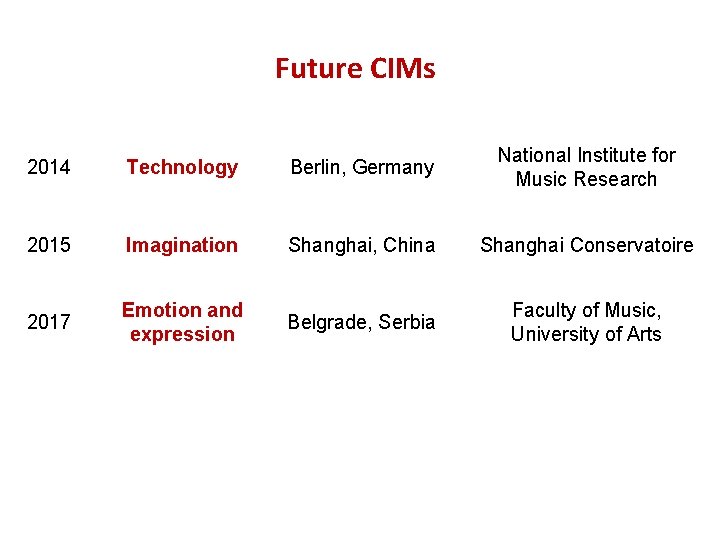
Future CIMs 2014 Technology Berlin, Germany National Institute for Music Research 2015 Imagination Shanghai, China Shanghai Conservatoire 2017 Emotion and expression Belgrade, Serbia Faculty of Music, University of Arts
Integrated H-S cooperation 1. All contributors have at least two authors If 1 st author is H, 2 nd must be S (and vice-versa) 2. All submissions are reviewed by H & S
ESF EXPLORATORY WORKSHOP “Cognition of Early Polyphony” Graz, Austria, 12 -14 April 2012 9 humanities scholars meet 9 scientists • Research projects • Discussion across H-S boundary • Future projects/grants
LECTURE SERIES “Introduction to Systematic Musicology” In 1 st semester of Graz Bachelors Program in Musicology Parent disciplines (subdisciplines) • S: acoustics, neurosciences, psychology, computing • H: theoretical sociology, philosophy/aesthetics How to work with them • Contrasting epistemologies • Multidisciplinary and ID approaches
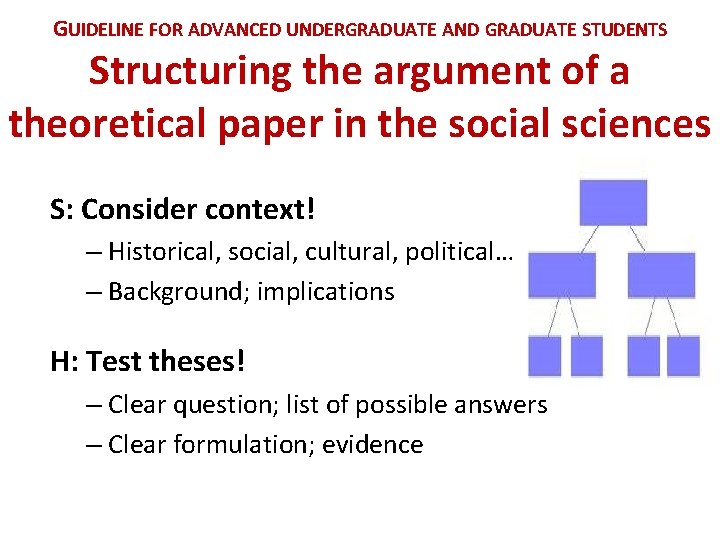
GUIDELINE FOR ADVANCED UNDERGRADUATE AND GRADUATE STUDENTS Structuring the argument of a theoretical paper in the social sciences S: Consider context! – Historical, social, cultural, political… – Background; implications H: Test theses! – Clear question; list of possible answers – Clear formulation; evidence
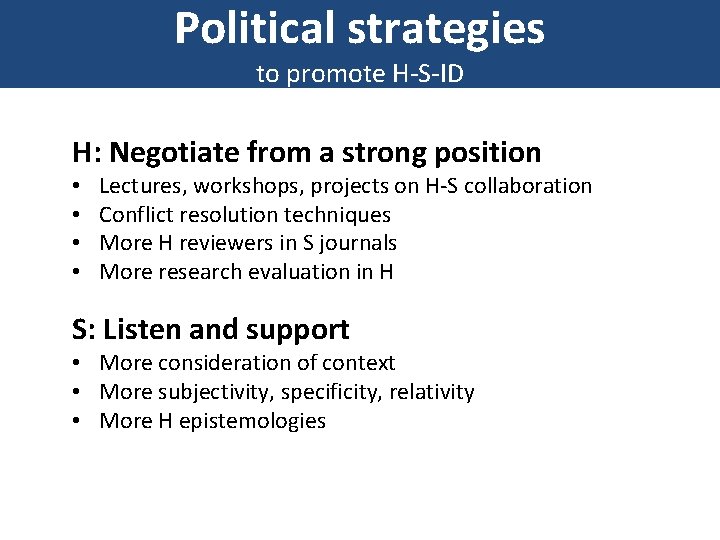
Political strategies to promote H-S-ID H: Negotiate from a strong position • • Lectures, workshops, projects on H-S collaboration Conflict resolution techniques More H reviewers in S journals More research evaluation in H S: Listen and support • More consideration of context • More subjectivity, specificity, relativity • More H epistemologies
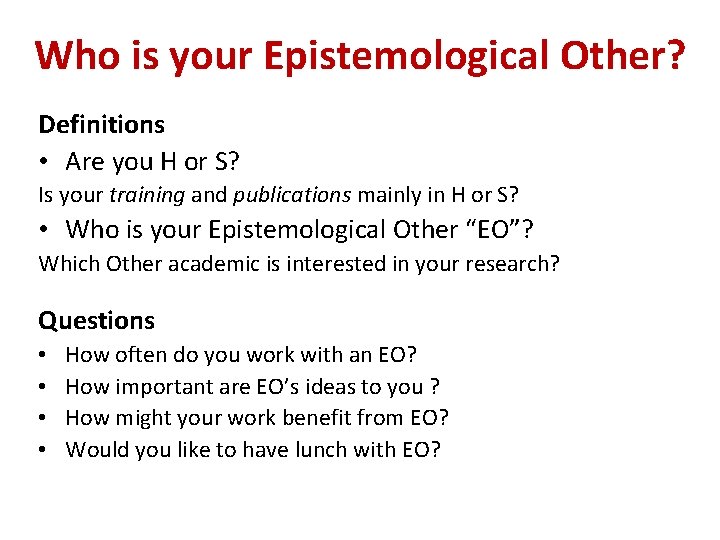
Who is your Epistemological Other? Definitions • Are you H or S? Is your training and publications mainly in H or S? • Who is your Epistemological Other “EO”? Which Other academic is interested in your research? Questions • • How often do you work with an EO? How important are EO’s ideas to you ? How might your work benefit from EO? Would you like to have lunch with EO?
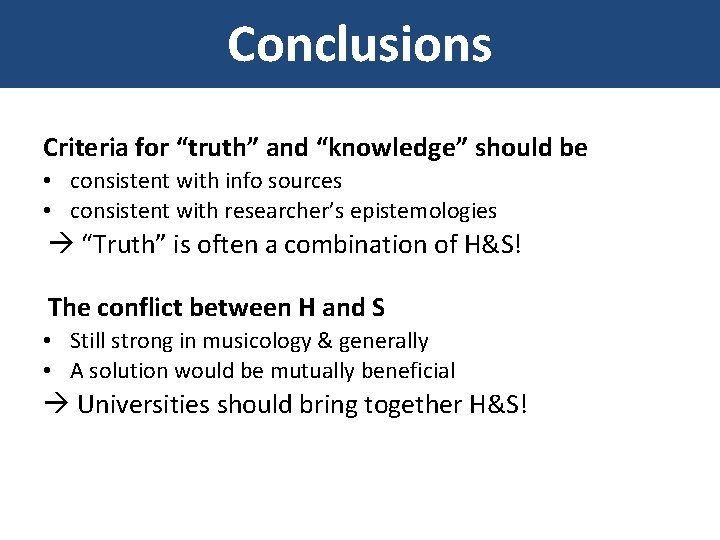
Conclusions Criteria for “truth” and “knowledge” should be • consistent with info sources • consistent with researcher’s epistemologies “Truth” is often a combination of H&S! The conflict between H and S • Still strong in musicology & generally • A solution would be mutually beneficial Universities should bring together H&S!
- Slides: 43