
Intercultural vocabulary Terms to help you describe different
Intercultural vocabulary Terms to help you describe different aspects of culture
Importance of work Masculine business culture Career overshadows family Competition encouraged Gender differentiation tolerated Feminine business culture Solidarity & cooperation important Weak taken care of Gender equality expected

The basis of status Ascription-based culture Status ascribed (given) to certain groups Older males Members of important families People with the right background Achievement-based cultures Status has to be won/earned/achieved Young people often high positions People evaluated on results (their track record)
Doing business with others Deal-focused cultures Direct approach to customer possible Producer with the best product gets the order Contract protects the two parties Relationship-focused cultures Introduction by third party essential Time must be invested in developing the relationship Mutual trust is the basis of the deal
Being a boss Individual leadership style Directive management style Top-down communication Competence, authority & decisiveness expected High power distance common Group leadership style Consultative management style Two-way communication Team-building, openness, empathy expected Low power distance common

Getting work done Systematic working environment Importance of rules & regulations Detailed plans, deadlines, action plans important Precision & thoroughness prioritised Monochronic culture Organic working environment Focuses on people Creativity & flexibility encouraged Polychronic culture
Interacting with others Formal communication style Use of titles (academic or professional) Politeness & protocol important Common in ascriptive cultures Informal communication style Little use of titles or polite forms Speaking plainly is encouraged Common in achievement-based cultures
Speaking your mind Indirect communication style Vagueness common (implicit style) Tact & diplomacy prioritised – high context Important to read between the lines Direct communication style Directness common (explicit style) Clarity & honesty appreciated – low context Things can be taken on face value
Showing your feelings Emotional cultures Enthusiasm, pleasure, anger & disappointment shown openly Extensive use of gestures & facial expressions Neutral cultures Calmness is appreciated Emotions kept under control (disguised) Little use of gestures or facial expression Straight-faced communicators
Conversation etiquette Overlapping Interruptions common – sign of interest Often than one person speaking at a time Common in emotional cultures Turn-taking Interruption uncommon – sign of rudeness Wait your turn to speak Common in neutral cultures

The meaning of silence Silence indicates different things in different cultures & contexts The person is thinking The listener has understood The listener has not understood Lack of interest – even annoyance Tolerance of silence is either high or low
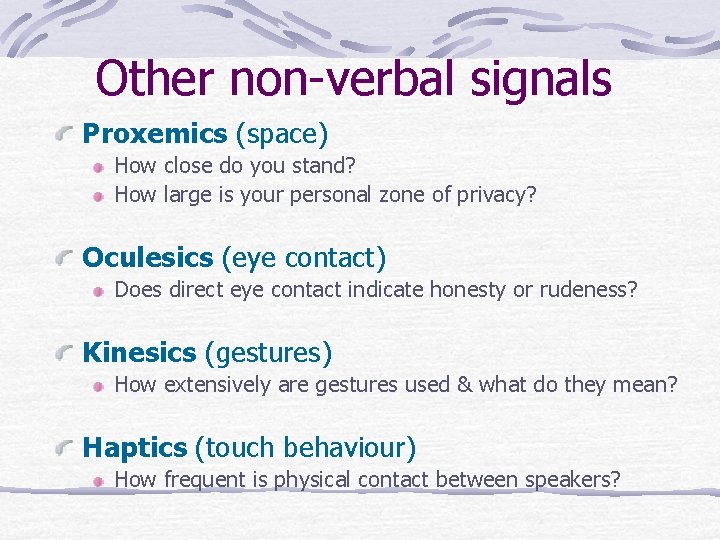
Other non-verbal signals Proxemics (space) How close do you stand? How large is your personal zone of privacy? Oculesics (eye contact) Does direct eye contact indicate honesty or rudeness? Kinesics (gestures) How extensively are gestures used & what do they mean? Haptics (touch behaviour) How frequent is physical contact between speakers?
- Slides: 12