
Intercultural Communication Chapter 3 How Can We Learn




- Slides: 13
Intercultural Communication Chapter 3: How Can We Learn about Our Own and Others’ Cultures? © 2016 Taylor & Francis
The Learning Process � Need What is your motivation for learning? How can you learn in ways that are effective and appropriate? �Precedent What has gone before you (i. e. , direct and indirect experiences) that can provide a model for your learning and for what to expect or do in the future? How do/will need and precedence influence what and how you learn about culture? © 2016 Taylor & Francis
How can we access culture? SPEAKING (Hymes, 1974) �An etic framework for extracting an emic framework �Communicative competence: Hymes, 1972, p. 277 �Knowing when to speak and when not to speak, what to talk about and with whom, and when, where, and in what manner to interact © 2016 Taylor & Francis
Etic/Emic �Etic: Things that are meaningful across cultures or are universal �Emic: Things that are meaningful within a particular community The human need for respect may be universal, but how it is expressed across societies may be very different. © 2016 Taylor & Francis
How do we look for culture? � �SPEAKING �Scene and setting �Physical situation �Psychological situation �Participants �Who was there? Who was not there? What are the relationships among those present? �End �Purpose for the interaction �Why are people there? What are the goals of the interaction? © 2016 Taylor & Francis
�Act topic: Content of the interaction What is being talked about? What is said? �Act Sequence: Order of the interaction Who speaks first? Who follows? �Key What is the tone or mood of the interaction? �Instrumentalities What are the channels for communicating? Face-to-face? Facebook? Twitter? Cell phone? What accents are used? © 2016 Taylor & Francis
�Norms of interaction and norms of interpretation �Rules for accepted and acceptable behavior that are meaningful (intelligible) to participants �Genre: Type or form of talk �Prayers, gossip, jokes, shop talk, baby talk, radio talk, sports talk, TED talks… © 2016 Taylor & Francis
Where can we look for culture? In any given community, we can observe and listen for silences, terms of address, metaphors, narratives, rituals, social dramas, and key terms. People shape and are shaped by culture fundamentally via the things they say and don’t say. © 2016 Taylor & Francis
Narratives: Teaching Functions �The way the world works �Our place in the world �How to act in the world �How to evaluate what goes on in the world As you were growing up, what narratives or stories were you told to teach you life lessons? © 2016 Taylor & Francis
Rituals: (Mis)impressions About the Nature of Rituals �Just the same thing over and over again �Outdated, hypocritical, and meaningless �Reserved for specialized settings �Engaged in by those less sophisticated than I What family rituals—daily and/or special event—are/were practiced in your family? © 2016 Taylor & Francis
Social Dramas �“A process through which potential violations of community-accepted social norms are publicly recognized and managed. ” What do you think about the concept of “social drama”? Does the public stage idea work for you? © 2016 Taylor & Francis
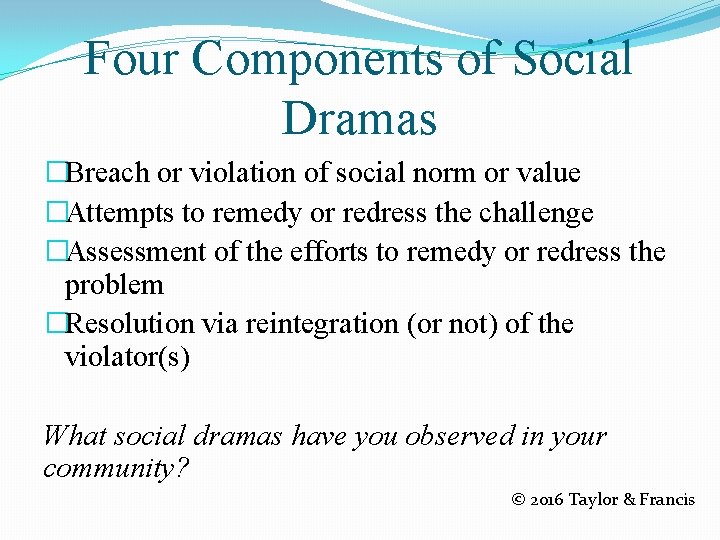
Four Components of Social Dramas �Breach or violation of social norm or value �Attempts to remedy or redress the challenge �Assessment of the efforts to remedy or redress the problem �Resolution via reintegration (or not) of the violator(s) What social dramas have you observed in your community? © 2016 Taylor & Francis
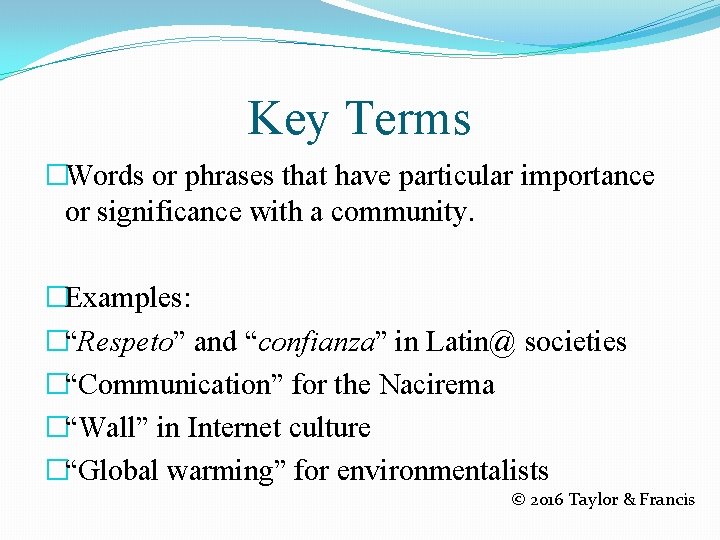
Key Terms �Words or phrases that have particular importance or significance with a community. �Examples: �“Respeto” and “confianza” in Latin@ societies �“Communication” for the Nacirema �“Wall” in Internet culture �“Global warming” for environmentalists © 2016 Taylor & Francis