
Intercompany Transactions Merchandise Plant Assets and Notes FISCHER


- Slides: 22
Intercompany Transactions: Merchandise, Plant Assets, and Notes FISCHER | TAYLOR | CHENG
Learning Objectives (1 of 2) 1. 2. 3. Explain why transactions between members of a consolidated firm should not be reflected in the consolidated financial statements. Defer intercompany profits on merchandise sales when appropriate and eliminate the double counting of sales between affiliates. Defer profits on intercompany sales of long-term assets and realize the profits over the period of use and/or at the time of sale to a firm outside the consolidated group. COPYRIGHT © 2012 South-Western/Cengage Learning 2
Learning Objectives (2 of 2) 4. 5. 6. 7. Demonstrate an understanding of the profit deferral issues for intercompany sales of assets under long-term construction contracts. Eliminate intercompany loans and notes. Discuss the complications intercompany profits create for the use of the sophisticated equity method. (Appendix) Apply intercompany profit eliminations on a vertical worksheet. COPYRIGHT © 2012 South-Western/Cengage Learning 3
Typical Intercompany Transactions • • • Merchandise for resale Land Fixed assets Long-term construction contracts Notes receivable/payable COPYRIGHT © 2012 South-Western/Cengage Learning 4
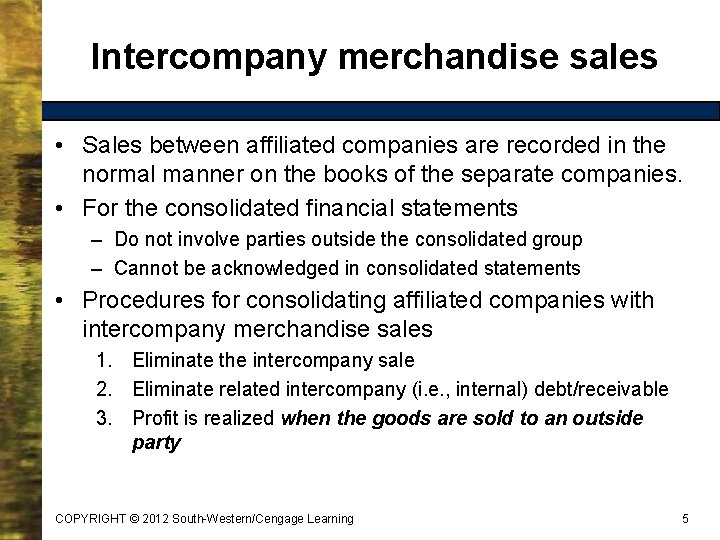
Intercompany merchandise sales • Sales between affiliated companies are recorded in the normal manner on the books of the separate companies. • For the consolidated financial statements – Do not involve parties outside the consolidated group – Cannot be acknowledged in consolidated statements • Procedures for consolidating affiliated companies with intercompany merchandise sales 1. Eliminate the intercompany sale 2. Eliminate related intercompany (i. e. , internal) debt/receivable 3. Profit is realized when the goods are sold to an outside party COPYRIGHT © 2012 South-Western/Cengage Learning 5
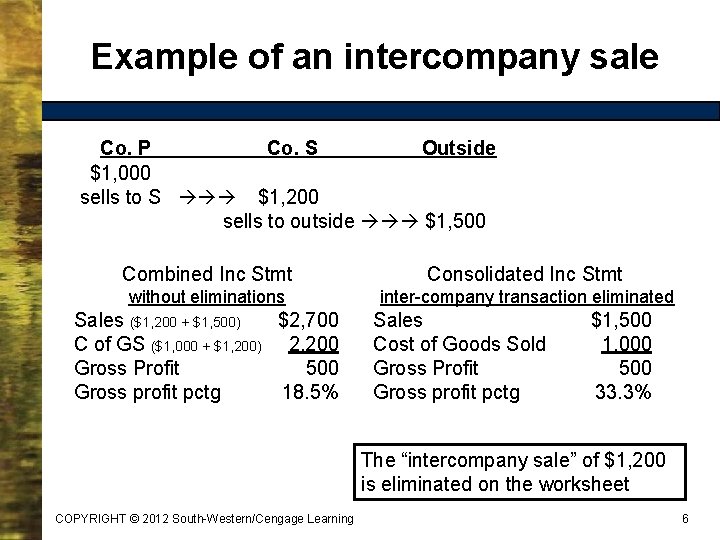
Example of an intercompany sale Co. P Co. S Outside $1, 000 sells to S $1, 200 sells to outside $1, 500 Combined Inc Stmt Consolidated Inc Stmt without eliminations inter-company transaction eliminated Sales ($1, 200 + $1, 500) $2, 700 C of GS ($1, 000 + $1, 200) 2, 200 Gross Profit 500 Gross profit pctg 18. 5% Sales Cost of Goods Sold Gross Profit Gross profit pctg $1, 500 1, 000 500 33. 3% The “intercompany sale” of $1, 200 is eliminated on the worksheet COPYRIGHT © 2012 South-Western/Cengage Learning 6
Intercompany Price Does the intercompany price matter? Yes, if there is an NCI • the reported net income of the subsidiary reflects the intercompany sales price • the subsidiary's separate income statement becomes the base from which the noncontrolling share of income is calculated. • if Company S is an 80%-owned subsidiary, the NCI will receive 20% of the $300 ($1, 500 - $1, 200) profit made on the final sale by Company S, or $60. COPYRIGHT © 2012 South-Western/Cengage Learning 7
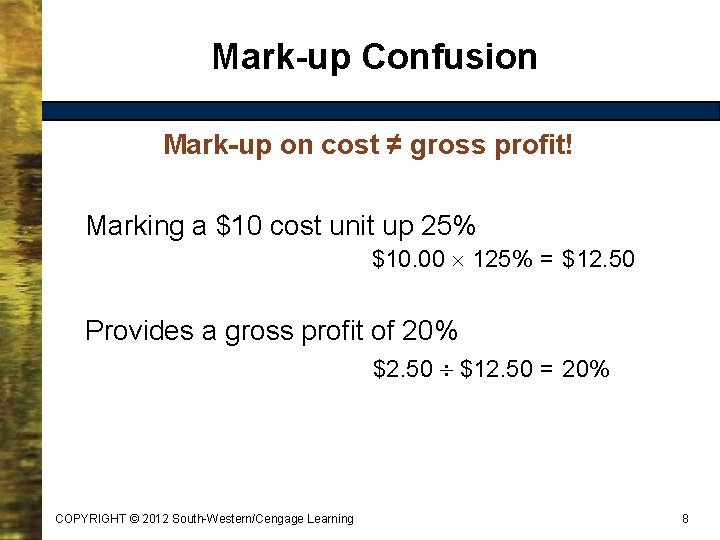
Mark-up Confusion Mark-up on cost ≠ gross profit! Marking a $10 cost unit up 25% $10. 00 125% = $12. 50 Provides a gross profit of 20% $2. 50 $12. 50 = 20% COPYRIGHT © 2012 South-Western/Cengage Learning 8
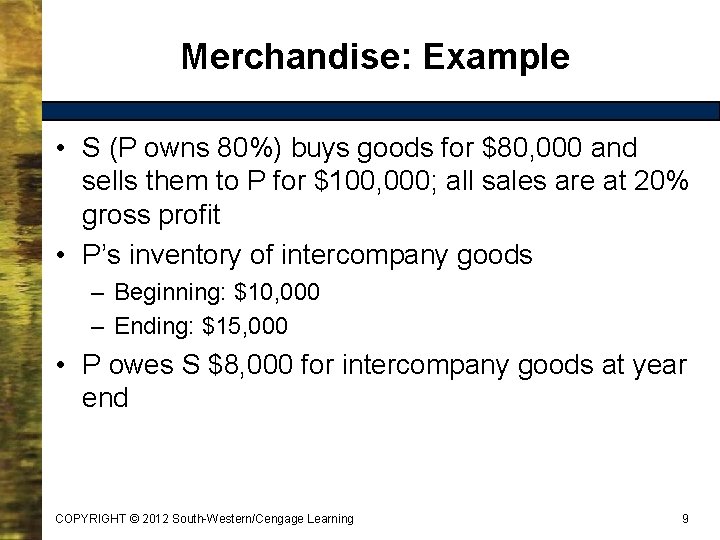
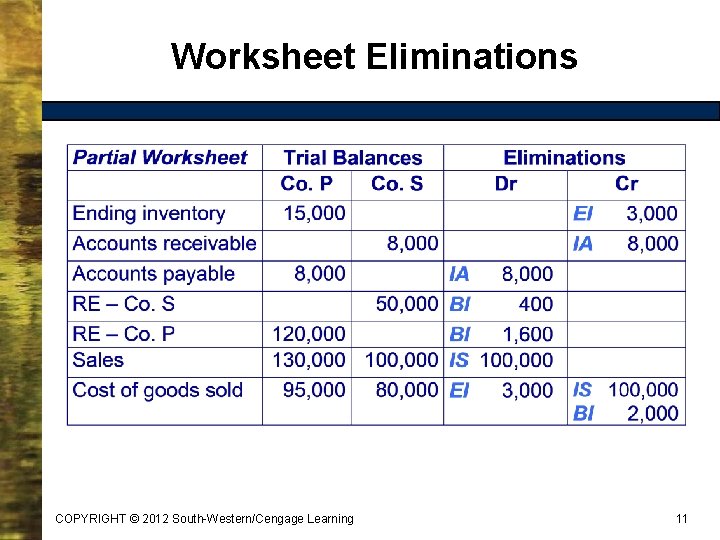
Merchandise: Example • S (P owns 80%) buys goods for $80, 000 and sells them to P for $100, 000; all sales are at 20% gross profit • P’s inventory of intercompany goods – Beginning: $10, 000 – Ending: $15, 000 • P owes S $8, 000 for intercompany goods at year end COPYRIGHT © 2012 South-Western/Cengage Learning 9
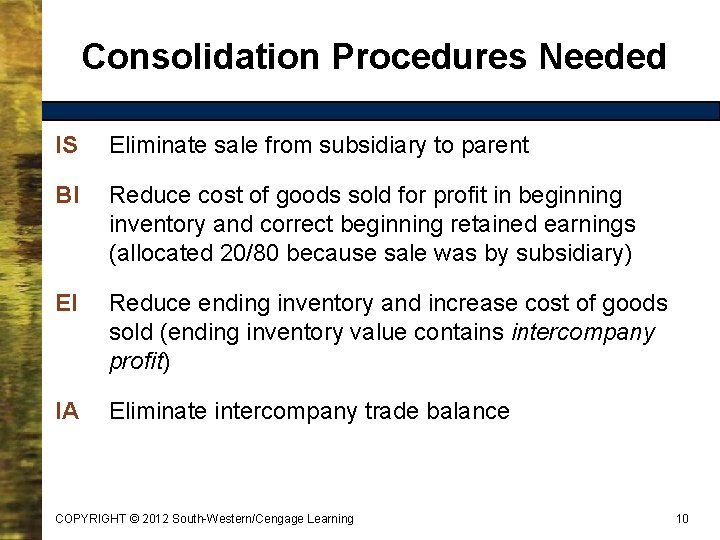
Consolidation Procedures Needed IS Eliminate sale from subsidiary to parent BI Reduce cost of goods sold for profit in beginning inventory and correct beginning retained earnings (allocated 20/80 because sale was by subsidiary) EI Reduce ending inventory and increase cost of goods sold (ending inventory value contains intercompany profit) IA Eliminate intercompany trade balance COPYRIGHT © 2012 South-Western/Cengage Learning 10
Worksheet Eliminations COPYRIGHT © 2012 South-Western/Cengage Learning 11
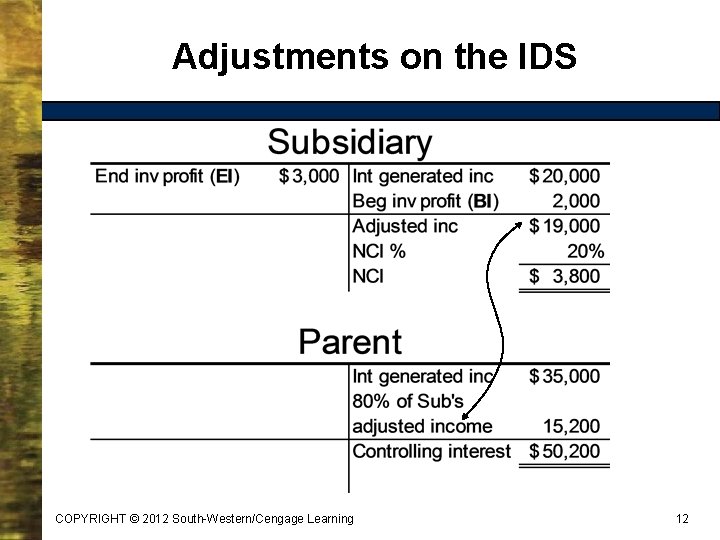
Adjustments on the IDS COPYRIGHT © 2012 South-Western/Cengage Learning 12
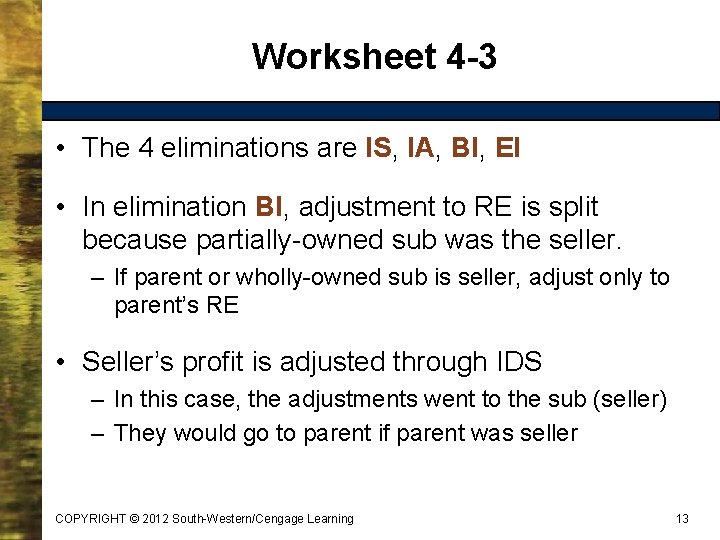
Worksheet 4 -3 • The 4 eliminations are IS, IA, BI, EI • In elimination BI, adjustment to RE is split because partially-owned sub was the seller. – If parent or wholly-owned sub is seller, adjust only to parent’s RE • Seller’s profit is adjusted through IDS – In this case, the adjustments went to the sub (seller) – They would go to parent if parent was seller COPYRIGHT © 2012 South-Western/Cengage Learning 13
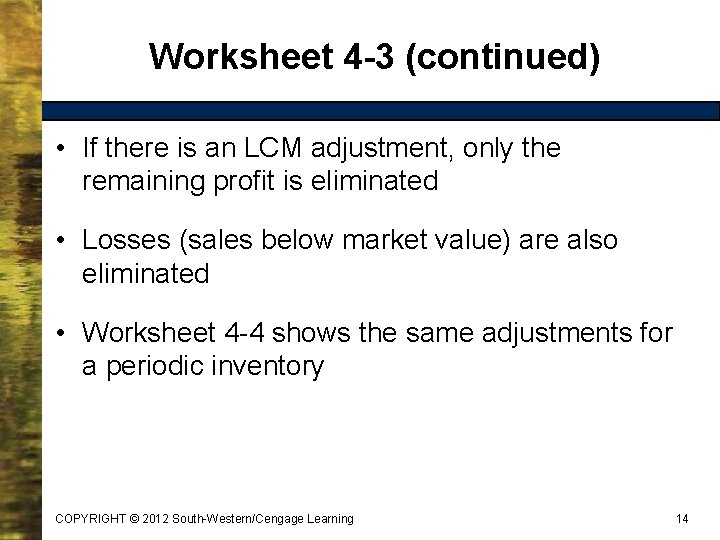
Worksheet 4 -3 (continued) • If there is an LCM adjustment, only the remaining profit is eliminated • Losses (sales below market value) are also eliminated • Worksheet 4 -4 shows the same adjustments for a periodic inventory COPYRIGHT © 2012 South-Western/Cengage Learning 14
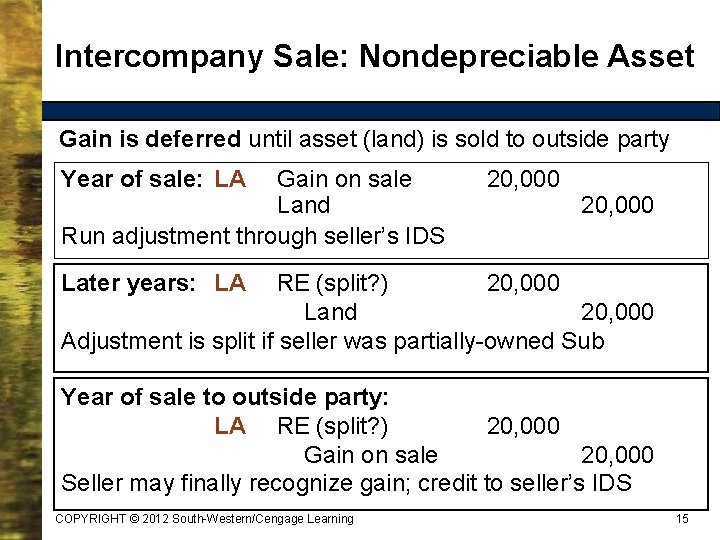
Intercompany Sale: Nondepreciable Asset Gain is deferred until asset (land) is sold to outside party Year of sale: LA Gain on sale Land Run adjustment through seller’s IDS 20, 000 Later years: LA RE (split? ) 20, 000 Land 20, 000 Adjustment is split if seller was partially-owned Sub Year of sale to outside party: LA RE (split? ) 20, 000 Gain on sale 20, 000 Seller may finally recognize gain; credit to seller’s IDS COPYRIGHT © 2012 South-Western/Cengage Learning 15
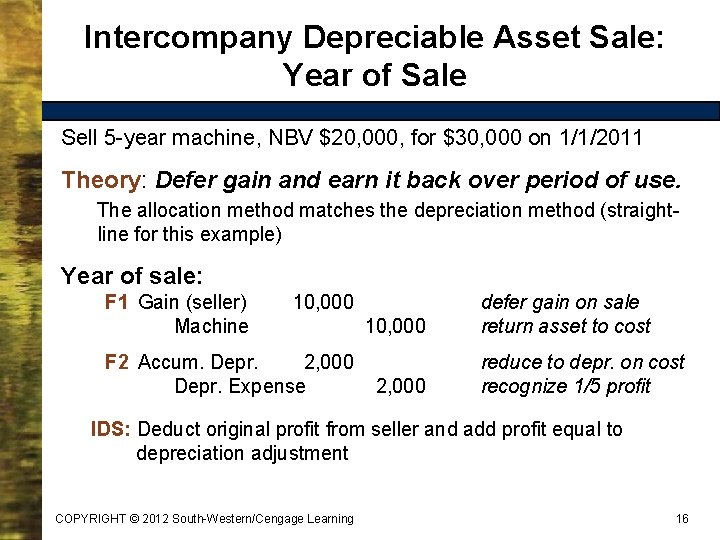
Intercompany Depreciable Asset Sale: Year of Sale Sell 5 -year machine, NBV $20, 000, for $30, 000 on 1/1/2011 Theory: Defer gain and earn it back over period of use. The allocation method matches the depreciation method (straightline for this example) Year of sale: F 1 Gain (seller) Machine 10, 000 F 2 Accum. Depr. 2, 000 Depr. Expense 10, 000 2, 000 defer gain on sale return asset to cost reduce to depr. on cost recognize 1/5 profit IDS: Deduct original profit from seller and add profit equal to depreciation adjustment COPYRIGHT © 2012 South-Western/Cengage Learning 16
Intercompany Depreciable Asset Sale: Year Subsequent to Intercompany Sale End of second year: Adjust asset at start of year F 1 RE (split? ) 8, 000 deferred gain on 1/1/12 Accum. Depr. 2, 000 adjust prior year’s depr. Machine 10, 000 return asset to cost RE adjustment is split when partially-owned sub is seller Adjust current year depreciation F 2 Accum. Depr. 2, 000 Depr. Expense 2, 000 reduce to depr on cost recognize 1/5 profit IDS: Seller gets profit equal to depreciation adjustment COPYRIGHT © 2012 South-Western/Cengage Learning 17
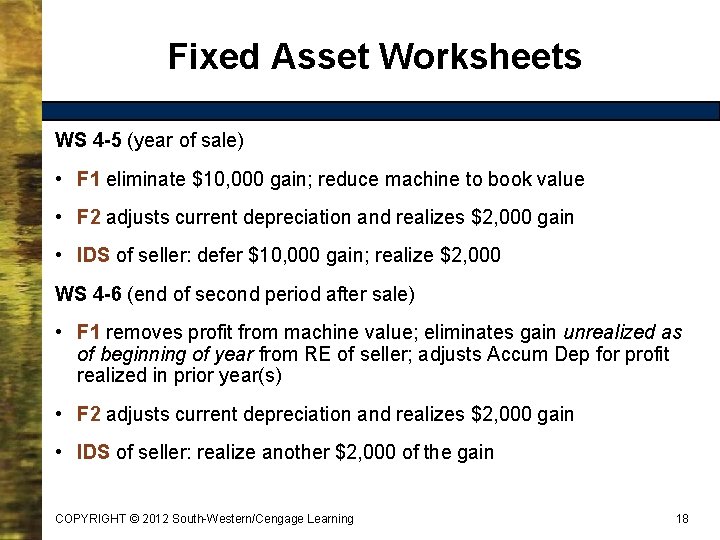
Fixed Asset Worksheets WS 4 -5 (year of sale) • F 1 eliminate $10, 000 gain; reduce machine to book value • F 2 adjusts current depreciation and realizes $2, 000 gain • IDS of seller: defer $10, 000 gain; realize $2, 000 WS 4 -6 (end of second period after sale) • F 1 removes profit from machine value; eliminates gain unrealized as of beginning of year from RE of seller; adjusts Accum Dep for profit realized in prior year(s) • F 2 adjusts current depreciation and realizes $2, 000 gain • IDS of seller: realize another $2, 000 of the gain COPYRIGHT © 2012 South-Western/Cengage Learning 18
Fixed Asset Worksheets (continued) WS 4 -7 (Asset sold to outside party at end of second year) • Machinery and accumulated depreciation are not there to adjust • The $6, 000 remaining gain at the start of the year is now earned (sale to outside occurred) • F 3 Combining the $6, 000 deferred gain ($10, 000 original less $4, 000 recognized - $2, 000 in 2011 and 2012) and the recorded $4, 000 loss on sale to outside party creates a gain on the consolidated statement of $2, 000 COPYRIGHT © 2012 South-Western/Cengage Learning 19
Long-Term Construction Contracts Completed – Like any other fixed asset sale Not Complete using Completed Contract Method: – Eliminate seller’s Billings and Cost of Construction in Progress; adjust buyer’s Asset Under Construction for unbilled costs incurred by seller – Eliminate intercompany debt balance Not Complete using Percentage of Completion: – Key is to defer profit recorded by builder and restore asset under construction to cost – Eliminate intercompany debt balance COPYRIGHT © 2012 South-Western/Cengage Learning 20
Intercompany Debt • Typically Parent lends to Sub • Eliminations – LN 1 Intercompany payables and receivables – LN 2 Interest expense and revenue • Income distribution schedule – Sub’s internally generated net income is not adjusted for incurred intercompany interest expense COPYRIGHT © 2012 South-Western/Cengage Learning 21
Sophisticated Equity Method: Intercompany Transactions • Sophisticated equity method records subsidiary income net of all intercompany profits • Parent prepares an IDS-Subsidiary to determine and record its share of subsidiary income • Unrealized profits of prior periods – Parent’s beginning RE does not include – Sub’s beginning RE does include – Adj replaces BI to remove intercompany profit from Sub’s beginning RE and Parents’s beginning inv COPYRIGHT © 2012 South-Western/Cengage Learning 22