
Interatomic Spin Coupling in Manganese Clusters on Graphene





- Slides: 24
Inter-atomic Spin Coupling in Manganese Clusters on Graphene Haiming Guo Email: hmguo@iphy. ac. cn Institute of Physics, Chinese Academy of Sciences 2018. 08. 14 Nanoscale Physics & Devices Laboratory, Institute of Physics, CAS
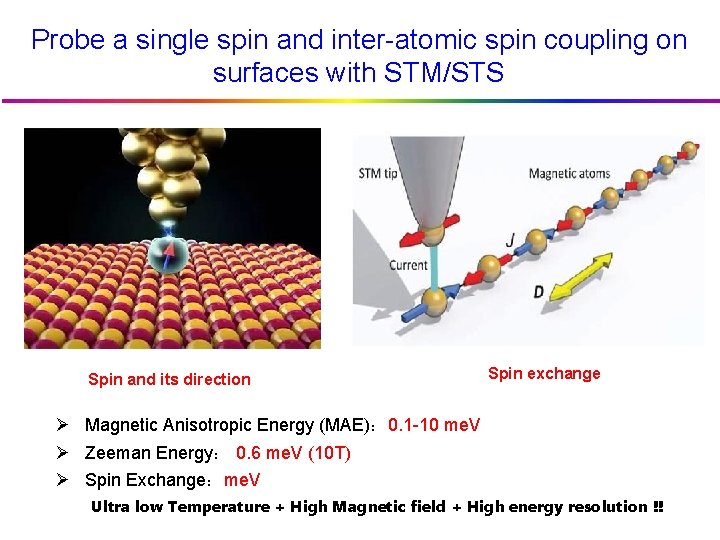
Probe a single spin and inter-atomic spin coupling on surfaces with STM/STS Spin and its direction Spin exchange Ø Magnetic Anisotropic Energy (MAE): 0. 1 -10 me. V Ø Zeeman Energy: 0. 6 me. V (10 T) Ø Spin Exchange:me. V Ultra low Temperature + High Magnetic field + High energy resolution !!
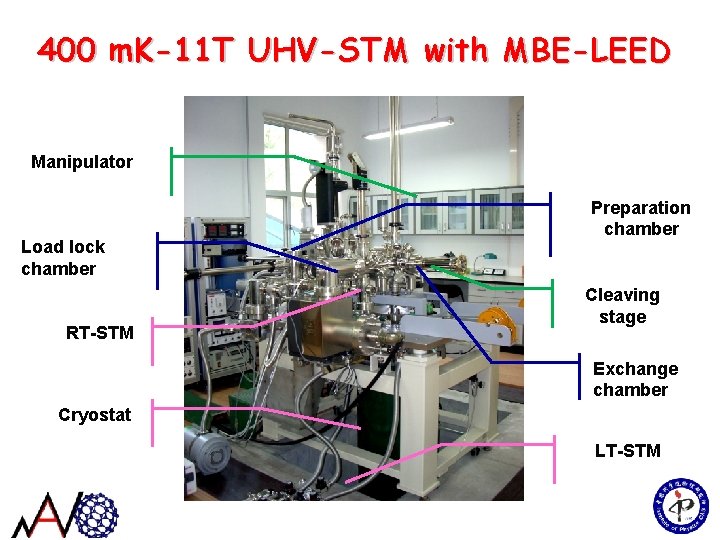
400 m. K-11 T UHV-STM with MBE-LEED Manipulator Load lock chamber RT-STM Preparation chamber Cleaving stage Exchange chamber Cryostat LT-STM
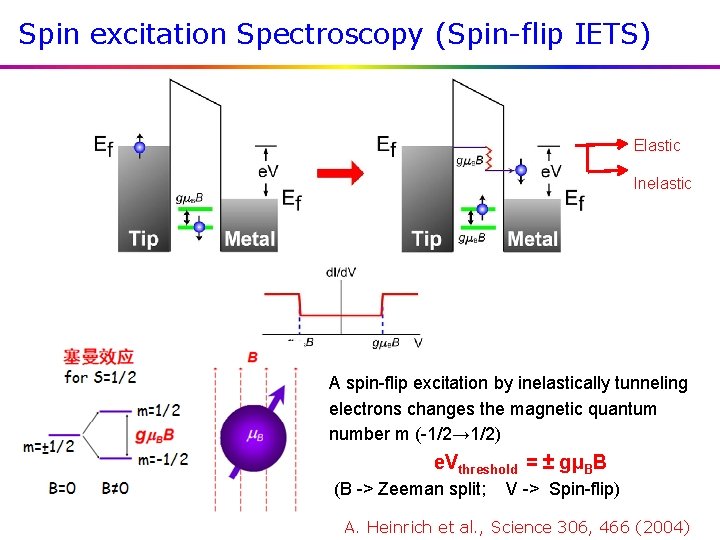
Spin excitation Spectroscopy (Spin-flip IETS) Elastic Inelastic A spin-flip excitation by inelastically tunneling electrons changes the magnetic quantum number m (-1/2→ 1/2) e. Vthreshold = ± gμBB (B -> Zeeman split; V -> Spin-flip) A. Heinrich et al. , Science 306, 466 (2004)
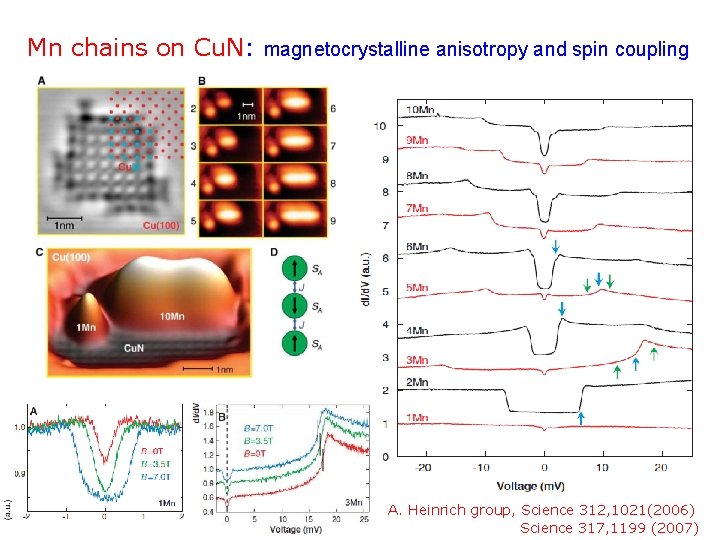
Mn chains on Cu. N: magnetocrystalline anisotropy and spin coupling A. Heinrich group, Science 312, 1021(2006) Science 317, 1199 (2007)
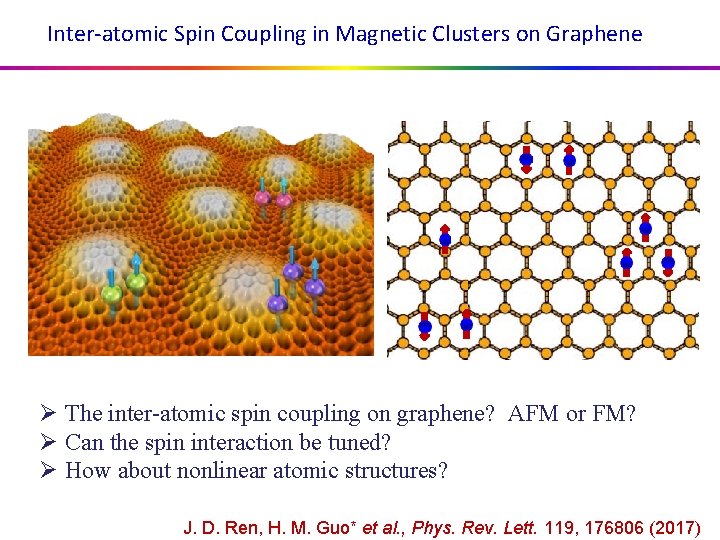
Inter-atomic Spin Coupling in Magnetic Clusters on Graphene Ø The inter-atomic spin coupling on graphene? AFM or FM? Ø Can the spin interaction be tuned? Ø How about nonlinear atomic structures? J. D. Ren, H. M. Guo* et al. , Phys. Rev. Lett. 119, 176806 (2017)
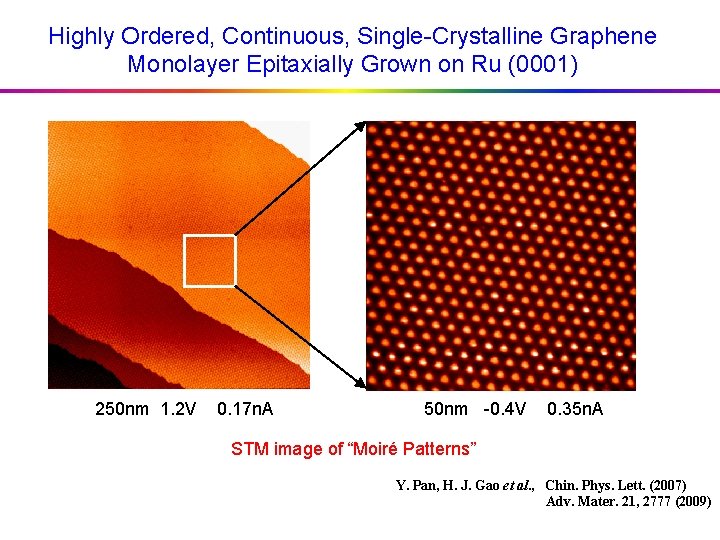
Highly Ordered, Continuous, Single-Crystalline Graphene Monolayer Epitaxially Grown on Ru (0001) 250 nm 1. 2 V 0. 17 n. A 50 nm -0. 4 V 0. 35 n. A STM image of “Moiré Patterns” Y. Pan, H. J. Gao et al. , Chin. Phys. Lett. (2007) Adv. Mater. 21, 2777 (2009)
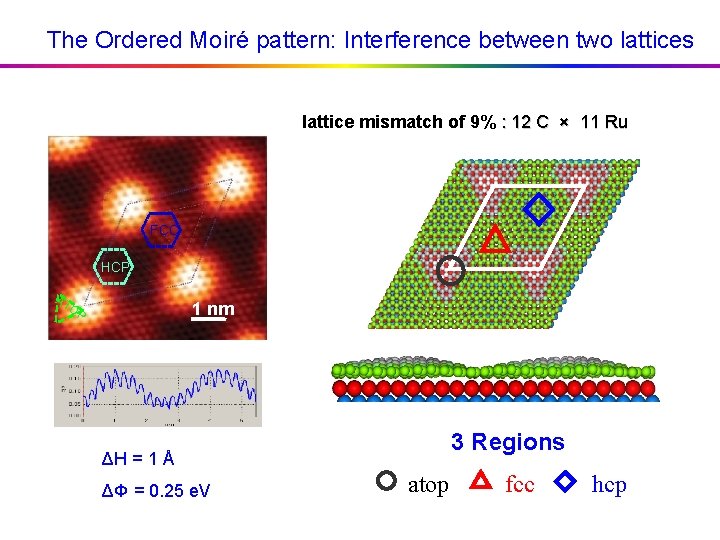
The Ordered Moiré pattern: Interference between two lattices lattice mismatch of 9% : 12 C × 11 Ru FCC HCP AT 1 nm OP 3 Regions ΔH = 1 Å ΔΦ = 0. 25 e. V atop fcc hcp
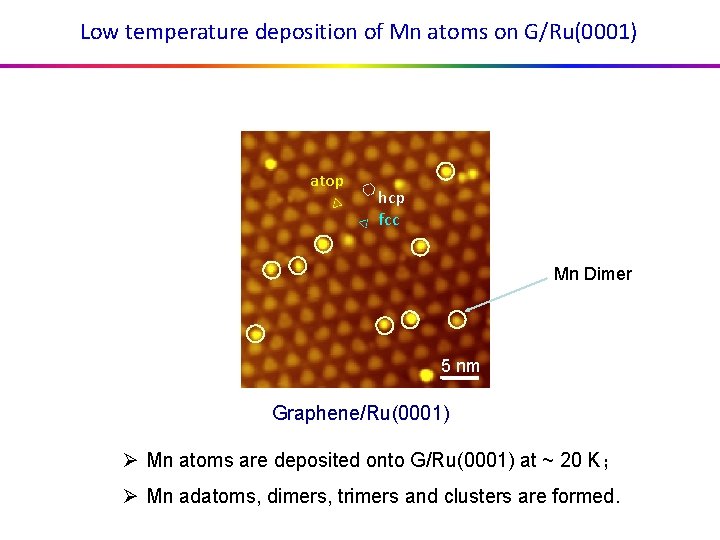
Low temperature deposition of Mn atoms on G/Ru(0001) atop hcp fcc Mn Dimer 5 nm Graphene/Ru(0001) Ø Mn atoms are deposited onto G/Ru(0001) at ~ 20 K; Ø Mn adatoms, dimers, trimers and clusters are formed.
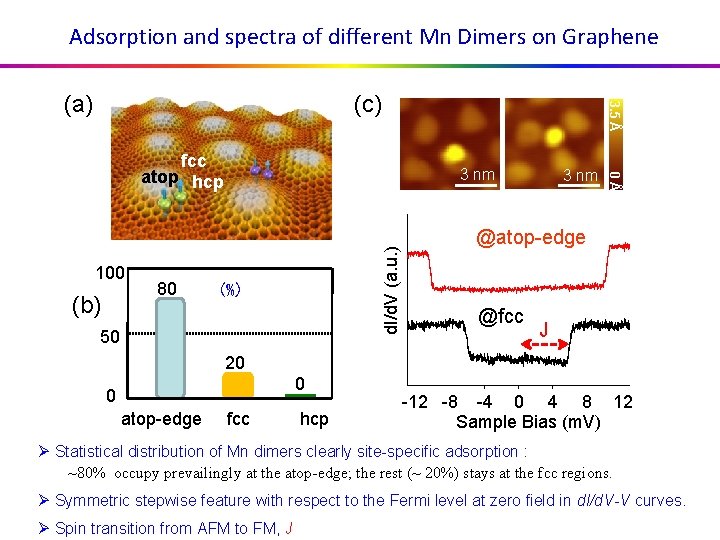
Adsorption and spectra of different Mn Dimers on Graphene (c) (b) 80 d. I/d. V (a. u. ) 100 3 nm (%) 50 20 0 0 atop-edge fcc hcp 3 nm 0 Å fcc atop hcp 3. 5 Å (a) @atop-edge @fcc J -12 -8 -4 0 4 8 12 Sample Bias (m. V) Ø Statistical distribution of Mn dimers clearly site-specific adsorption : ~80% occupy prevailingly at the atop-edge; the rest (~ 20%) stays at the fcc regions. Ø Symmetric stepwise feature with respect to the Fermi level at zero field in d. I/d. V-V curves. Ø Spin transition from AFM to FM, J
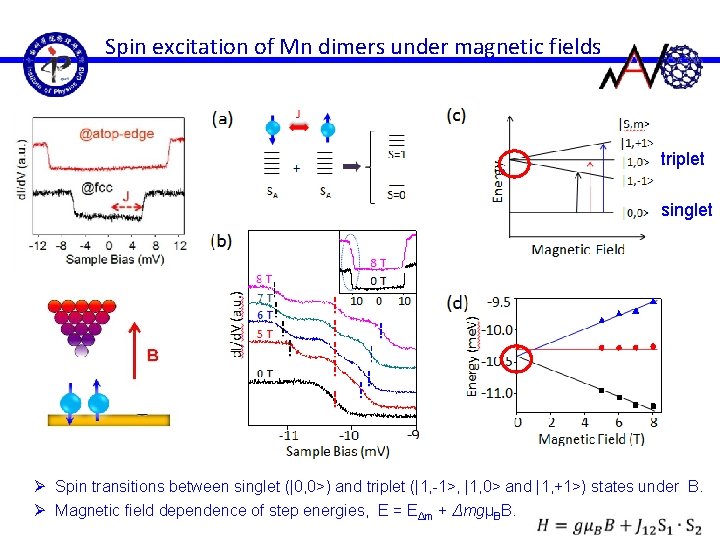
Spin excitation of Mn dimers under magnetic fields triplet singlet Ø Spin transitions between singlet (|0, 0>) and triplet (|1, -1>, |1, 0> and |1, +1>) states under B. Ø Magnetic field dependence of step energies, E = EΔm + ΔmgμBB.
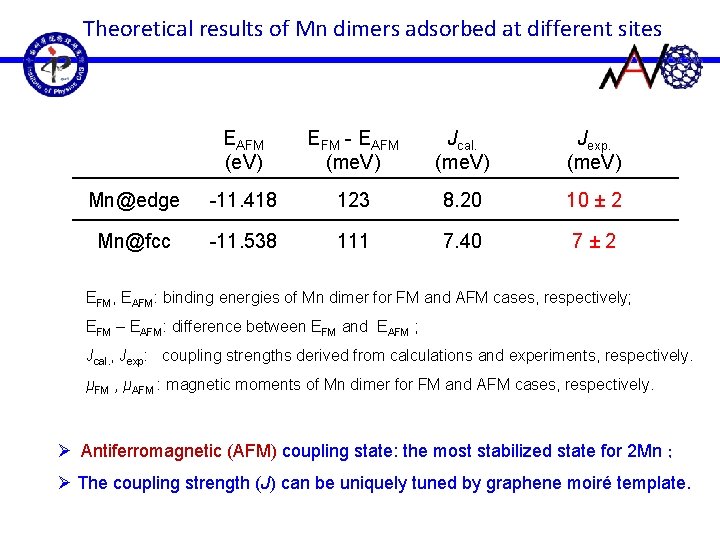
Theoretical results of Mn dimers adsorbed at different sites EAFM (e. V) EFM - EAFM (me. V) Jcal. (me. V) Jexp. (me. V) Mn@edge -11. 418 123 8. 20 10 ± 2 Mn@fcc -11. 538 111 7. 40 7 ± 2 EFM, EAFM: binding energies of Mn dimer for FM and AFM cases, respectively; EFM – EAFM: difference between EFM and EAFM ; Jcal. , Jexp: coupling strengths derived from calculations and experiments, respectively. μFM , μAFM : magnetic moments of Mn dimer for FM and AFM cases, respectively. Ø Antiferromagnetic (AFM) coupling state: the most stabilized state for 2 Mn; Ø The coupling strength (J) can be uniquely tuned by graphene moiré template.
Theoretical results of Mn dimers with increasing distances AFM FM 8. 2 me. V -0. 2 me. V Ø Transition of AFM to FM interaction with increasing inter-atomic distance between two Mn atoms (for example, from 2. 6 Å to ~ 6. 1 Å)
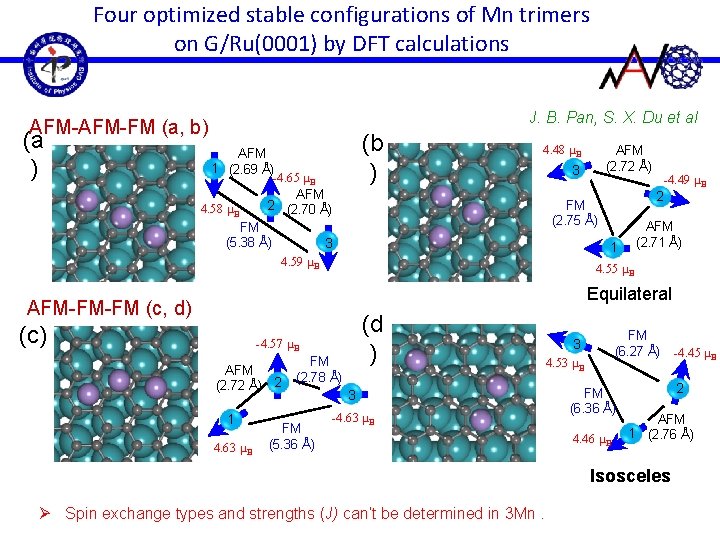
Four optimized stable configurations of Mn trimers on G/Ru(0001) by DFT calculations J. B. Pan, S. X. Du et al AFM-FM (a, b) (a ) (b ) AFM 1 (2. 69 Å) -4. 65 μB AFM 2 4. 58 μB (2. 70 Å) FM (5. 38 Å) 3 4. 59 μB 4. 48 μB AFM (2. 72 Å) 3 -4. 49 μB 2 FM (2. 75 Å) AFM (2. 71 Å) 1 4. 55 μB Equilateral AFM-FM-FM (c, d) (c) (d ) -4. 57 μB AFM (2. 72 Å) 2 1 4. 63 μB FM (2. 78 Å) FM (5. 36 Å) 3 -4. 63 μB FM (6. 27 Å) 3 4. 53 μB FM (6. 36 Å) 4. 46 μB -4. 45 μB 2 AFM 1 (2. 76 Å) Isosceles Ø Spin exchange types and strengths (J) can’t be determined in 3 Mn.
Spin excitation of a Mn trimer under magnetic fields B Ø Three symmetric stepwise features appear near EF. Ø Each manifests a different dependence on B field. The 1 st and 3 rd steps blueshift to higher energy, while the 2 nd step redshifts to lower energy 8 T 4 T 0 T -12 -8 -4 0 4 8 12 Sample Bias (m. V) Energy (me. V) d. I/d. V (a. u. ) a b 12 9 6 3 0 2 4 6 Magnetic field (T) 8
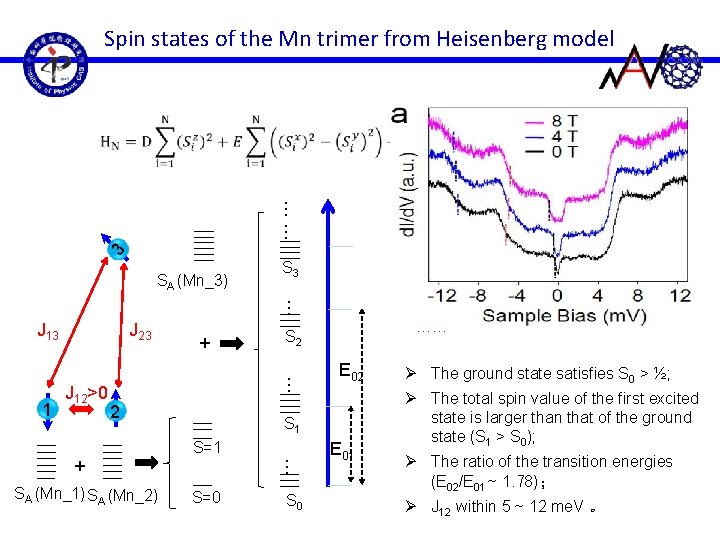
Spin states of the Mn trimer from Heisenberg model …… By changing J 12. J 13 and J 23 , S 3 1 st excitation state? 3 ground state? SA (Mn_3) … 2 nd excitation state? J 23 J 13 … 1 J 12>0 + 2 SA (Mn_1) SA (Mn_2) E 02 S 1 S=1 … + …… S 2 S=0 S 0 E 01 Ø The ground state satisfies S 0 > ½; Ø The total spin value of the first excited state is larger than that of the ground state (S 1 > S 0); Ø The ratio of the transition energies (E 02/E 01 ~ 1. 78); Ø J 12 within 5 ~ 12 me. V 。
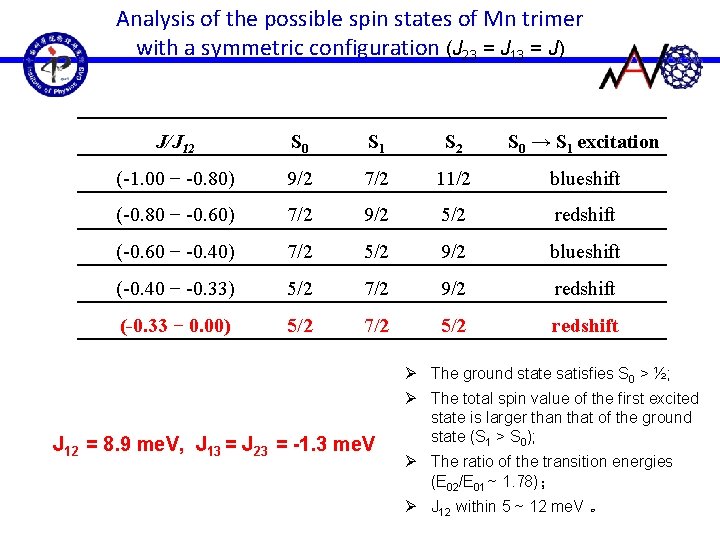
Analysis of the possible spin states of Mn trimer with a symmetric configuration (J 23 = J 13 = J) J/J 12 S 0 S 1 S 2 S 0 → S 1 excitation (-1. 00 − -0. 80) 9/2 7/2 11/2 blueshift (-0. 80 − -0. 60) 7/2 9/2 5/2 redshift (-0. 60 − -0. 40) 7/2 5/2 9/2 blueshift (-0. 40 − -0. 33) 5/2 7/2 9/2 redshift (-0. 33 − 0. 00) 5/2 7/2 5/2 redshift Ø The ground state satisfies S 0 > ½; J 12 = 8. 9 me. V, J 13 = J 23 = -1. 3 me. V Ø The total spin value of the first excited state is larger than that of the ground state (S 1 > S 0); Ø The ratio of the transition energies (E 02/E 01 ~ 1. 78); Ø J 12 within 5 ~ 12 me. V 。
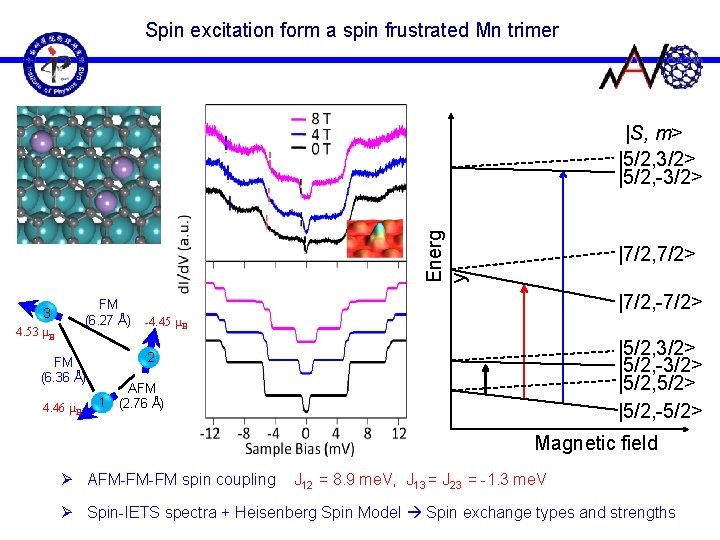
Spin excitation form a spin frustrated Mn trimer Energ y |S, m> |5/2, 3/2> |5/2, -3/2> FM (6. 27 Å) 3 4. 53 μB FM (6. 36 Å) 4. 46 μB |7/2, 7/2> |7/2, -7/2> -4. 45 μB |5/2, 3/2> |5/2, -3/2> |5/2, 5/2> |5/2, -5/2> 2 AFM 1 (2. 76 Å) Magnetic field Ø AFM-FM-FM spin coupling J 12 = 8. 9 me. V, J 13 = J 23 = -1. 3 me. V Ø Spin-IETS spectra + Heisenberg Spin Model Spin exchange types and strengths
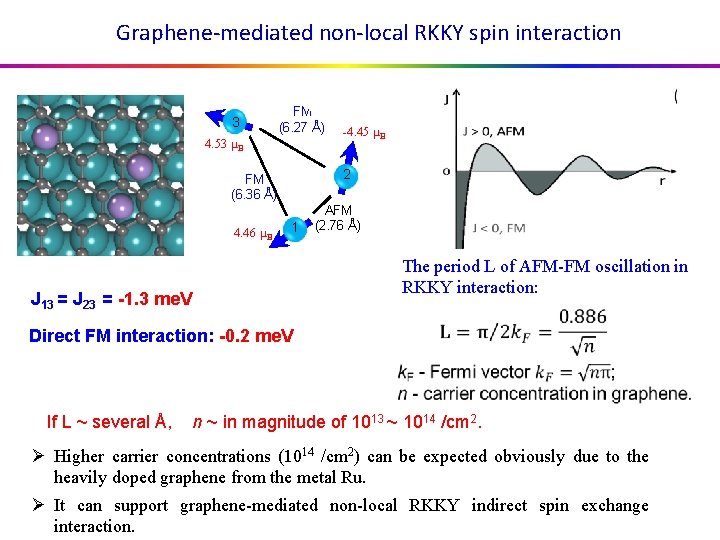
Graphene-mediated non-local RKKY spin interaction 3 FM (6. 27 Å) 4. 53 μB 2 FM (6. 36 Å) 4. 46 μB -4. 45 μB 1 J 13 = J 23 = -1. 3 me. V AFM (2. 76 Å) The period L of AFM-FM oscillation in RKKY interaction: Direct FM interaction: -0. 2 me. V If L ~ several Å, n ~ in magnitude of 1013 ~ 1014 /cm 2. Ø Higher carrier concentrations (1014 /cm 2) can be expected obviously due to the heavily doped graphene from the metal Ru. Ø It can support graphene-mediated non-local RKKY indirect spin exchange interaction.
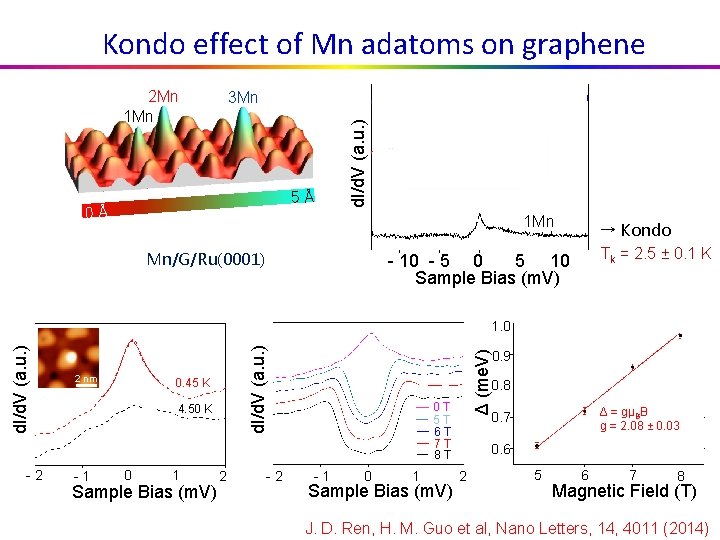
Kondo effect of Mn adatoms on graphene 2 Mn 1 Mn 3 Mn → spin 3 Mn 0 Å d. I/d. V (a. u. ) 5 Å excitation → Singlettriplet 2 Mn 1 Mn Mn/G/Ru(0001) → Kondo Tk = 2. 5 ± 0. 1 K - 10 - 5 0 5 10 Sample Bias (m. V) - 2 0. 45 K 4. 50 K - 1 0 1 Sample Bias (m. V) 2 - 2 0. 9 Δ (me. V) 2 nm d. I/d. V (a. u. ) 1. 0 0. 8 0 T 5 T 6 T 7 T 8 T - 1 0 1 Sample Bias (m. V) Δ = gμBB g = 2. 08 ± 0. 03 0. 7 0. 6 2 5 6 7 8 Magnetic Field (T) J. D. Ren, H. M. Guo et al, Nano Letters, 14, 4011 (2014)
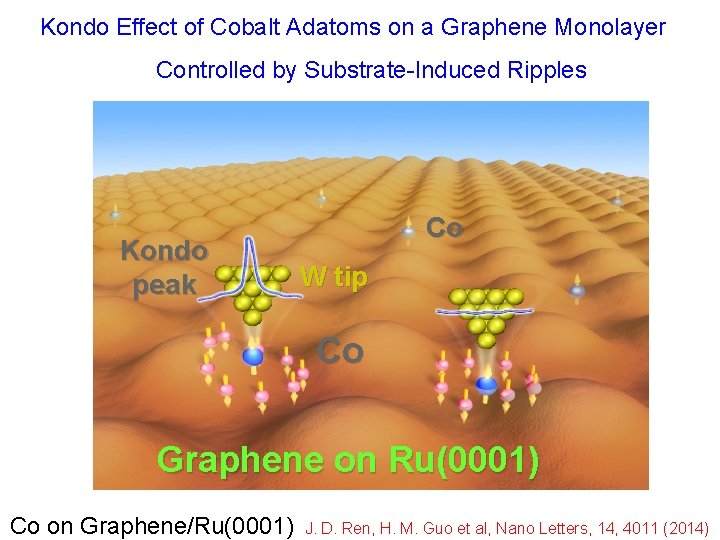
Kondo Effect of Cobalt Adatoms on a Graphene Monolayer Controlled by Substrate-Induced Ripples Kondo peak Co W tip Co Graphene on Ru(0001) Co on Graphene/Ru(0001) J. D. Ren, H. M. Guo et al, Nano Letters, 14, 4011 (2014)
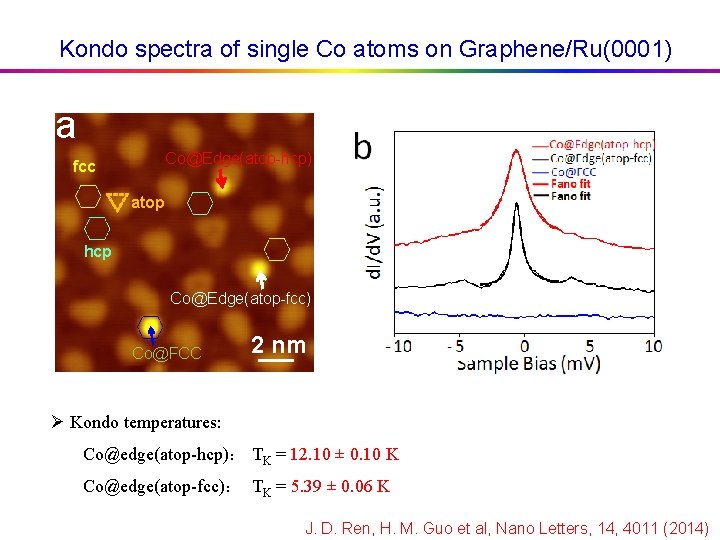
Kondo spectra of single Co atoms on Graphene/Ru(0001) a Co@Edge(atop-hcp) fcc atop hcp Co@Edge(atop-fcc) Co@FCC 2 nm Ø Kondo temperatures: Co@edge(atop-hcp): TK = 12. 10 ± 0. 10 K Co@edge(atop-fcc): TK = 5. 39 ± 0. 06 K J. D. Ren, H. M. Guo et al, Nano Letters, 14, 4011 (2014)
Acknowledgements Ø Institute of Physics, CAS Prof. Hongjun Gao Prof. Shixuan Du Prof. Yeliang Wang Dr. Wende Xiao L. W. Liu, K. Yang, J. D. Ren, X. Wu, L. Z. Zhang, J. B. Pan. . . Ø Lanzhou University: Prof. H. G. Luo; Ø University of Maryland: Prof. M. Ouyang; Ø University of Liverpool: Prof. W. A. Hofer; Ø National University of Singapore: Prof: A. H. Castro Neto Ø Oak Ridge National Laboratory: Dr. Y. Y. Zhang and Prof. S. T. Pantelides
VASSCAA-10 Shanghai 2020 The 10 th Vacuum and Surface Science Conference of Asia and Australia Shanghai, China October, 2020 Chinese Vacuum Society (CVS)