
Interactive Street Sensing as basic deployment of city
Interactive Street Sensing as basic deployment of city monitoring system Authors: B. Sc. Stanislava Stanković, School of Electrical Engineering, University of Belgrade B. Sc. Marko Stanković, School of Electrical Engineering, University of Belgrade Pro. Sense special section, TELFOR 2008.
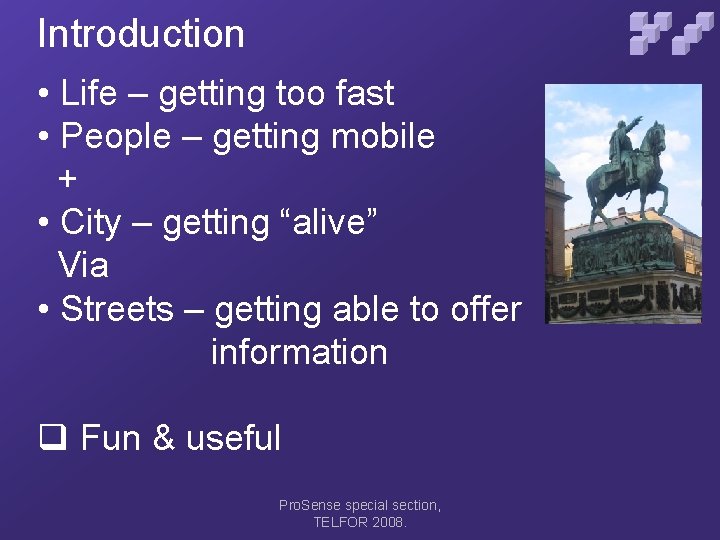
Introduction • Life – getting too fast • People – getting mobile + • City – getting “alive” Via • Streets – getting able to offer information q Fun & useful Pro. Sense special section, TELFOR 2008.
Introduction - New approach to city monitoring - “Alive street” concept - People take part in the new system taking from the environment as much data as they can get + People, by using cell phones, provide the environment with information (spontaneous service payment) Pro. Sense special section, TELFOR 2008.
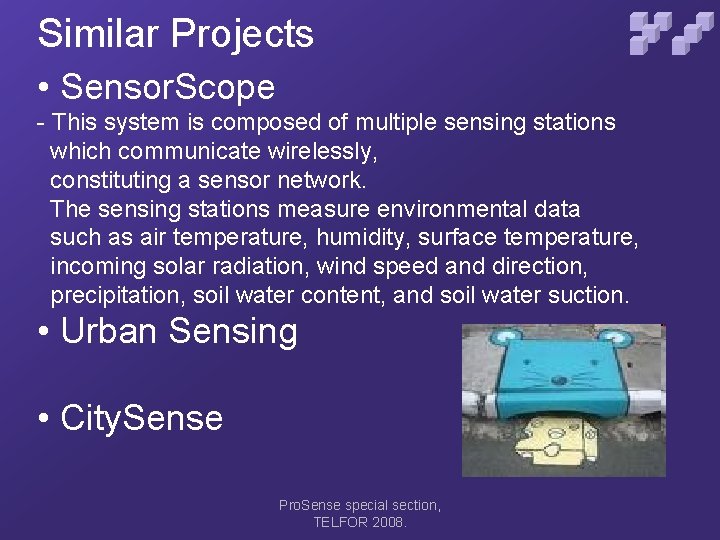
Similar Projects • Sensor. Scope - This system is composed of multiple sensing stations which communicate wirelessly, constituting a sensor network. The sensing stations measure environmental data such as air temperature, humidity, surface temperature, incoming solar radiation, wind speed and direction, precipitation, soil water content, and soil water suction. • Urban Sensing • City. Sense Pro. Sense special section, TELFOR 2008.
ISS Solution • Previous projects develop large-scale distributed environmental measurement systems centered on WSNs • ISS app proposes small-scale system installed in the street Main approach: “Problem solving should firstly start at your own yard!” Io. T In the future (Internet of Things), street concept moving towards the whole city Pro. Sense special section, TELFOR 2008.

ISS Solution - Street monitoring - Microcontrollers & Sensors - Video tracking (not precisely) - Different parameters: • temperature • humidity • noise • CO 2 • CO (“Silent Killer”) Pro. Sense special section, TELFOR 2008.
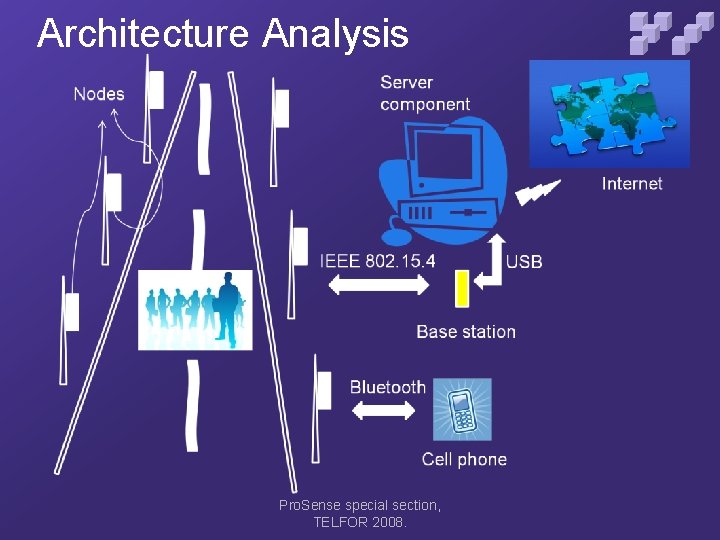
Architecture Analysis Pro. Sense special section, TELFOR 2008.
Architecture Analysis Present architecture: • Street (covered with leaves ) + • People, walking and carrying cell phones Improved architecture: • Microcontrollers equipped with sensors + • Microcontrollers - Bluetooth enabled Pro. Sense special section, TELFOR 2008.
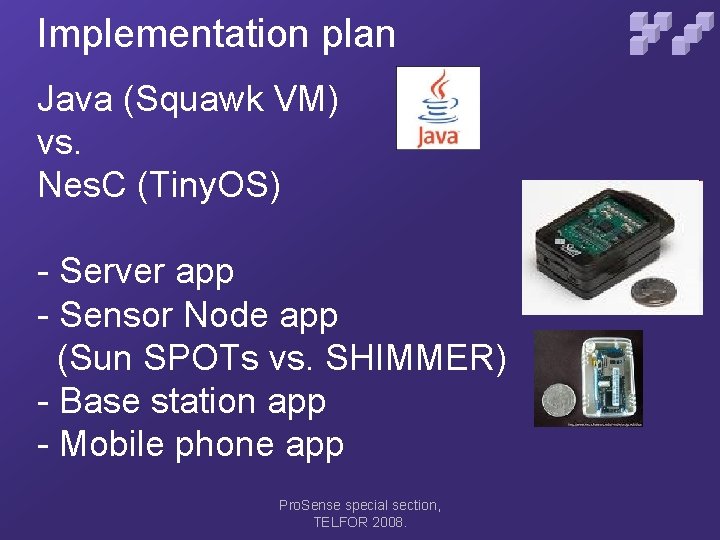
Implementation plan Java (Squawk VM) vs. Nes. C (Tiny. OS) - Server app - Sensor Node app (Sun SPOTs vs. SHIMMER) - Base station app - Mobile phone app Pro. Sense special section, TELFOR 2008.
Future Concern More effort is necessary in order to resolve problems in system implementation Present problems and solutions (in case of Sun SPOTs): - Node power supplying (limited battery life) For now, we have in mind to put SPOTs on fixed power supply, by using AC-USB adapters, for solving the limited battery problem. Different solution is possible in the future. - Number of sensors on a single node may be increased in the future. These issues are money dependent. Pro. Sense special section, TELFOR 2008.
Future Concern Presence - Equipment purchasing phase - Delivery issues - Time issues HW implies the necessary SW (Java vs. Nes. C) Pro. Sense special section, TELFOR 2008.
Conclusion - ISS system as basic infrastructure - Small scale WSN - Good enhancement capabilities (on the city level) - Good adaptation capabilities for indoor monitoring (houses, hotels, workplaces) Pro. Sense special section, TELFOR 2008.

Thank you for your attention mailto: saska 58@gmail. com Pro. Sense special section, TELFOR 2008.
- Slides: 13