
Interactive Storytelling for Video Games Chapter 6 Defining
- Slides: 11
Interactive Storytelling for Video Games Chapter 6: Defining Interactive and Player-Driven Storytelling Josiah Lebowitz Chris Klug
What makes a story interactive? § There’s a lot of disagreement about what exactly makes an interactive story. Some definitions include nearly everything, others nothing short of Star Trek’s holo-deck. § A truly interactive story allows the player to, in some way, interact with the world and/or characters. § By this definition, pop-up books, backwards text, digital novels, and other overly broad definitions of interactive storytelling don’t apply.
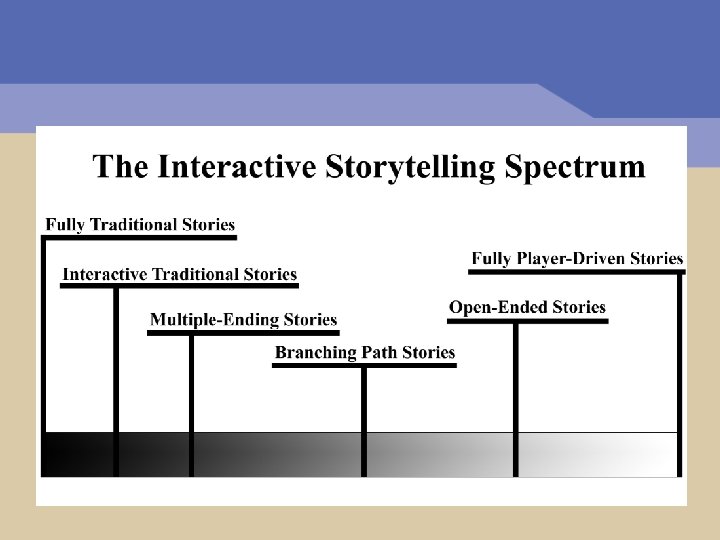
What makes a story playerdriven? § In a player-driven story, the player’s interactions can affect and change the progression and outcome of the story. § All player-driven stories are interactive. § All interactive stories are not player-driven. § There any many different types of interactive and playerdriven stories used in video games. § These storytelling types can best be defined as points on a spectrum.
Fully Traditional Stories § The most traditional and classic form of storytelling. § Remains exactly the same no matter how many times it’s watched, read, or played. § Not well suited for video games due to its complete lack of interactivity. § Examples: Harry Potter books, Star Wars movies, the visual novel Higurashi When They Cry
Interactive Traditional Stories § Interactive but not player-driven. § The player can interact with the story but cannot significantly change the main plot in any way. § Very popular in video games. § Example Games: FINAL FANTASY XIII, Metal Gear Solid 3, Lunar Silver Star Harmony
Multiple-Ending Stories § The simplest type of player-driven story. § Very similar to interactive traditional stories. § The player is allowed to chose between two or more endings. § This choice may be a conscious decision or be made automatically based on the player’s actions during the game. § Example Games: CHRONO TRIGGER, Castlevania: Dawn of Sorrow, Bioshock
Branching Path Stories § Allow the player to make a series of choices throughout the course of the game. § While some choices only change the story slightly, others can have an enormous impact. § The style was popularized in the Choose Your Own Adventure books. § Example Games: Heavy Rain, Fate/Stay Night, Front Mission 3
Open-Ended Stories § Sort of like highly complex branching path stories. § The story’s progression is often determined more by the player’s actions than his response to specific prompts. § The main plot is usually short and simple and the primary focus is on creating an interesting world for the player to explore. § Example Games: Fable II, Fallout 3, The Elder Scrolls III: Morrowind
Fully Player-Driven Stories § Gives the player total or near total control of his actions. § There is little if any main plot, though there might be various optional sub-plots. § The “story” is comprised primarily of the player’s actions in the game world. § Example Games: The Sims, Animal Crossing, World of Warcraft
Things to Consider § Other than video games, what are some things that you consider to be interactive stories? § List one game you’ve played for every major type of storytelling on the spectrum. (It’s ok if you can’t think of any games with a fully traditional story. ) § Why do you think some types of storytelling are used much more often than others? § List several games you’ve played that don’t have any stories. Do you think the addition of stories would significantly improve them? Why or why not?