
Interactive Multimedia Narrative and Linear Narrative Week 11
- Slides: 19
Interactive Multimedia Narrative and Linear Narrative Week 11 & 12 By Miss Amreet Kaur A/P Jageer Singh
Narrative & Interactive Narrative A narrative – a “story” It’s a series of events that are linked together in a number of ways , including cause and effect , time and place. Something that happens in the first event causes the action in the second event, and so on, usually moving forward in time.
Narrative & Interactive Narrative interactive multimedia involves telling a story using many media and interactivity. Often the player is one of the characters in the story and sees action from the character’s point of view. Used for pure entertainment or to present information in an experiential way.
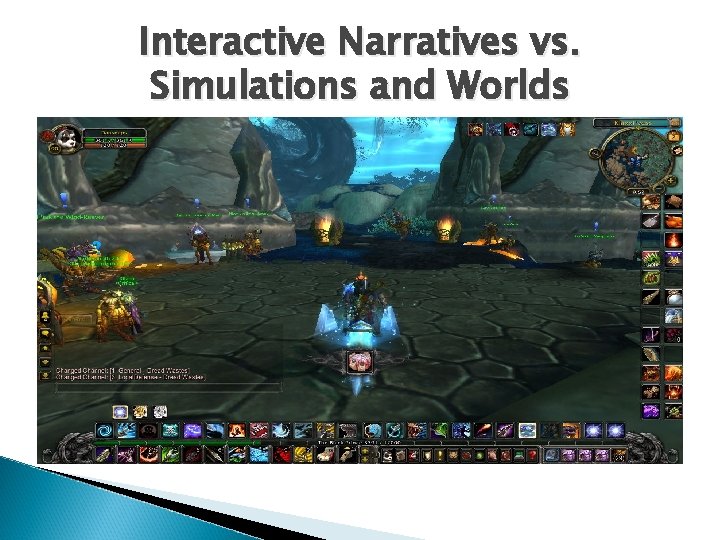
Interactive Narratives vs. Simulations and Worlds In a virtual world program, the player explores an environment, e. g. World of Warcraft. It’s a physical space, such as a mysterious island or an entire war-ravaged mythical world, where the player has the freedom to move about and interact with various elements, opening doors, examining objects, talking to other characters)
Interactive Narratives vs. Simulations and Worlds
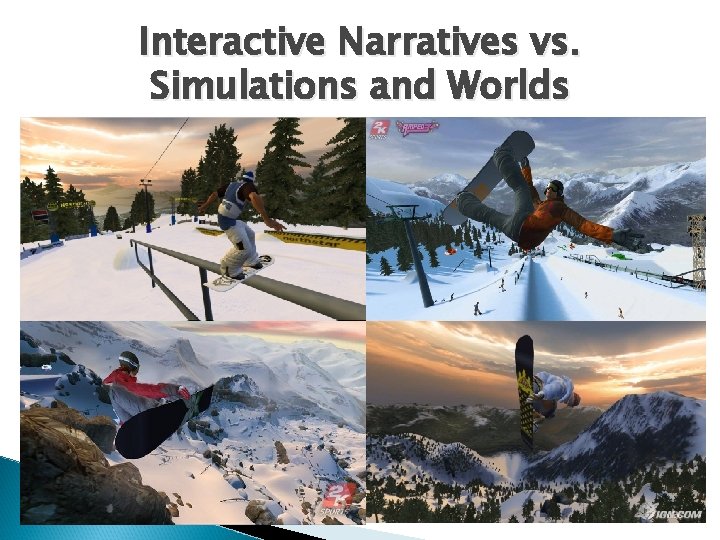
Interactive Narratives vs. Simulations and Worlds programs are not narratives, even though some of the characters and locations may have background information presented about them. In a simulation, a player explores all the different possibilities in an activity, such as building a ship or going snowboarding. Simulations are not narratives.
Interactive Narratives vs. Simulations and Worlds
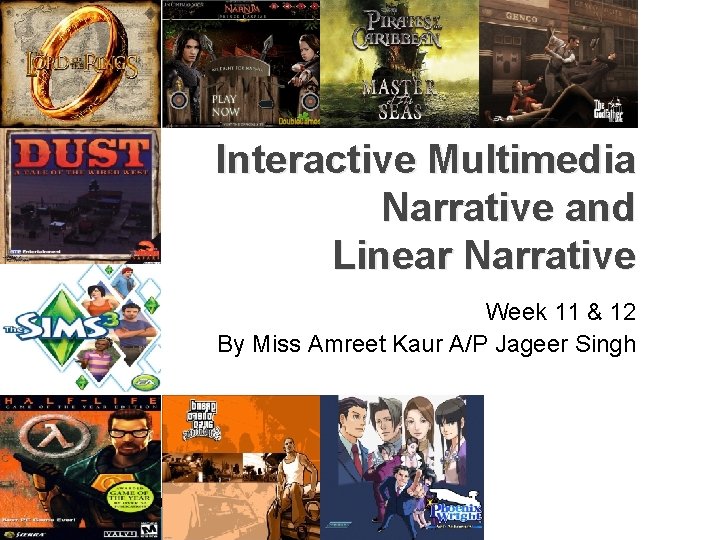
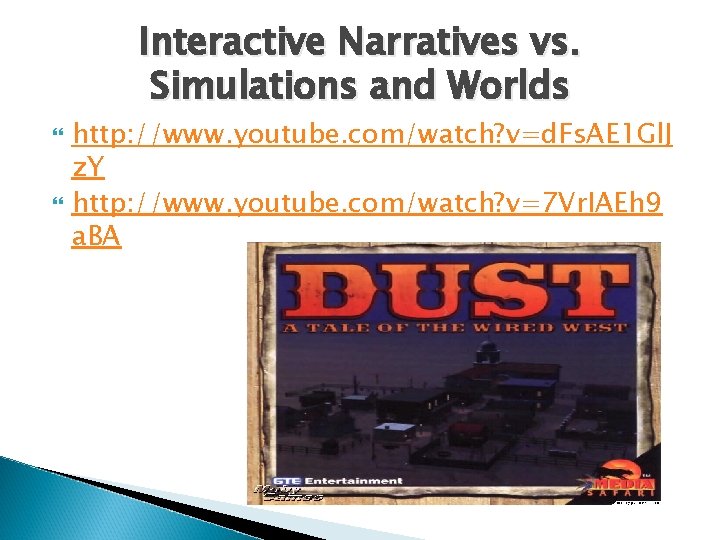
Interactive Narratives vs. Simulations and Worlds In an interactive narrative, a player explores a story. Interactive narratives have beginnings, middles, and ends, even though each user may experience these elements differently. E. g. The Nancy Drew mystery games A combination of simulations, worlds and narratives- the most common way they are currently presented. E. g. Dust: A Tale of the Wired West
Interactive Narratives vs. Simulations and Worlds http: //www. youtube. com/watch? v=d. Fs. AE 1 Gl. J z. Y http: //www. youtube. com/watch? v=7 Vr. IAEh 9 a. BA
Computer Games and Video Games: Defining Terms Computer game- Any game played with a computer involved. It includes all consoles (Play. Station, Xbox, etc). , PC computers, mobile devices, interactive TV, and arcade games. Video game- Any kind of game using a video display. Electronic games-applies to all types of video and computer games
Classical Linear Narrative Elements Defined Character Structure Scenes and Sequences Jeopardy Point of View Pace
Character Most successful film and video today clearly define their characters early in the piece. Who are the characters? Where are they from? What do they want or need, and why do they want it? What the character wants usually provides the action story of the film or video)
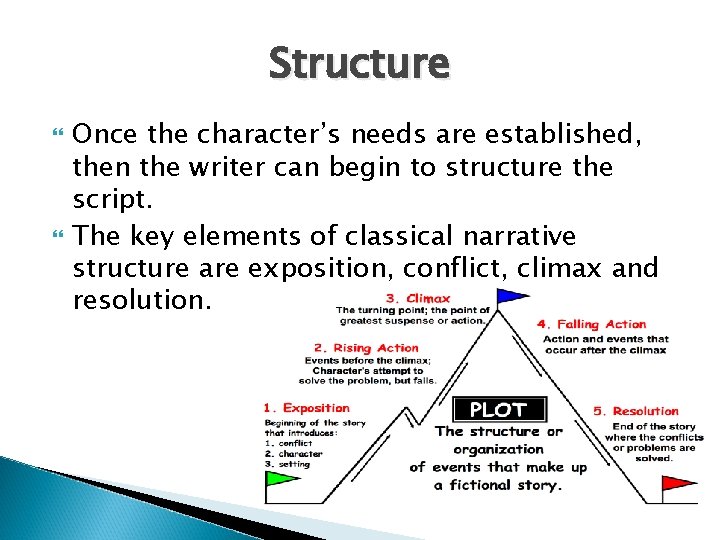
Structure Once the character’s needs are established, then the writer can begin to structure the script. The key elements of classical narrative structure are exposition, conflict, climax and resolution.
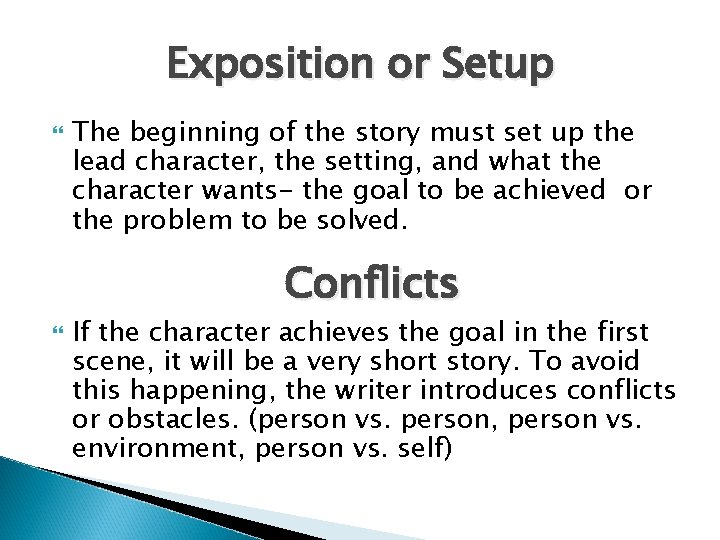
Exposition or Setup The beginning of the story must set up the lead character, the setting, and what the character wants- the goal to be achieved or the problem to be solved. Conflicts If the character achieves the goal in the first scene, it will be a very short story. To avoid this happening, the writer introduces conflicts or obstacles. (person vs. person, person vs. environment, person vs. self)
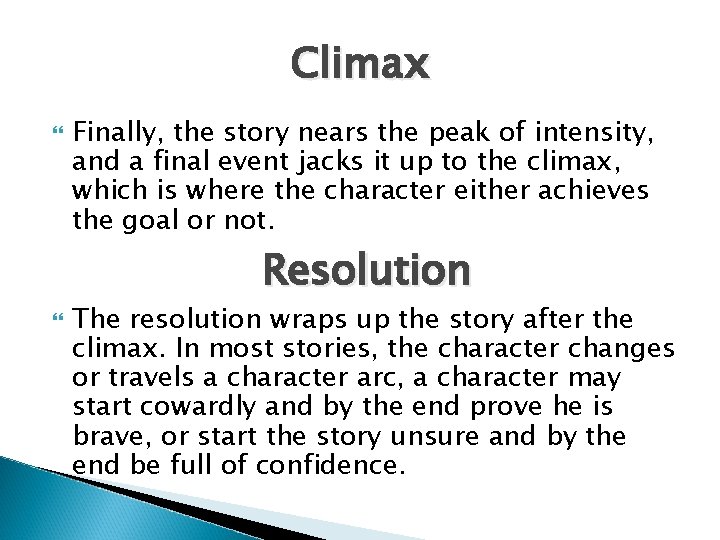
Climax Finally, the story nears the peak of intensity, and a final event jacks it up to the climax, which is where the character either achieves the goal or not. Resolution The resolution wraps up the story after the climax. In most stories, the character changes or travels a character arc, a character may start cowardly and by the end prove he is brave, or start the story unsure and by the end be full of confidence.
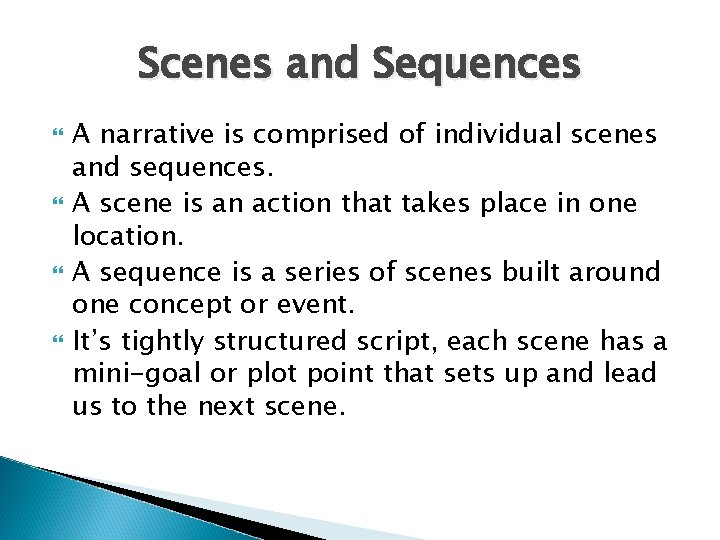
Scenes and Sequences A narrative is comprised of individual scenes and sequences. A scene is an action that takes place in one location. A sequence is a series of scenes built around one concept or event. It’s tightly structured script, each scene has a mini-goal or plot point that sets up and lead us to the next scene.
Jeopardy The characters’ success or failure in achieving their goals has to have serious consequence for them. It’s easy for the writer to set up jeopardy if it is a life-and-death situation, such as being butchered by orcs in The Lord of the Rings.
Point of View Point of view defines from whose perspective the story is told. The most common point of view (or POV) is third person or omniscient (all knowing). The other major type of point of view is first person or subjective point of view. In this case, the entire story is told from one character’s perspective. The audience sees everything through his or her eyes.
Pace and Time Pace is the audience’s experience of how quickly the events of the narrative seem to move. Many short sequences, scenes and bots of dialogue tend to make the pace move quickly, longer elements slow it down. Writers tend to accelerate pace near a climax and slow it down for expositional and romantic scenes.