
Interactive Exploration and Visualization of OLAP Cubes Carlos

Interactive Exploration and Visualization of OLAP Cubes Carlos Ordonez Zhibo Chen University of Houston Javier García-García UNAM/IPN
Outline Problem Our solution Example Means comparison parametric test Program exectution Conclusions and future work
The problem In OLAP a large data set is analyzed with multiple aggregations to find interesting results. Such aggregations, computed based on multiple dimension combinations, resemble a multidimensional cube whose mathematical structure is represented by a lattice. In general, cube computations return simple descriptive statistics such as sums, row counts and averages. However, the analysis is done without statistical reliability.
Our Proposal We propose to use parametric statistical tests to help analyze the cube in order to get high statistical reliability. On the other hand, we study how to visualize interesting results discovered from the cube.
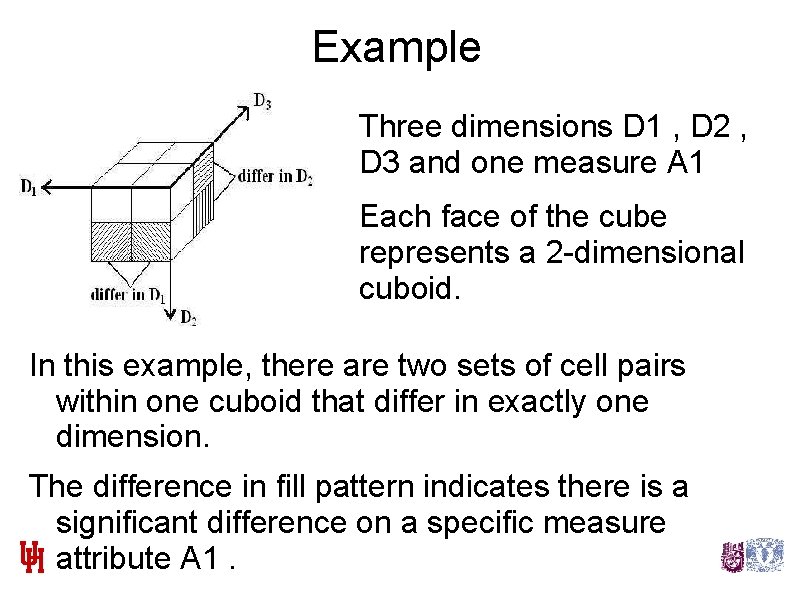
Example Three dimensions D 1 , D 2 , D 3 and one measure A 1 Each face of the cube represents a 2 -dimensional cuboid. In this example, there are two sets of cell pairs within one cuboid that differ in exactly one dimension. The difference in fill pattern indicates there is a significant difference on a specific measure attribute A 1.
We use a parametric statistical test to compare the population means of pairs of groups. Two large groups of any size can be compared including groups with very different number of elements (e. g. a large and a small group). The means comparison test takes into account data variance, which measures overlap between the corresponding pair of populations. In the case of OLAP, dimensions can be used to focus on highly similar groups, differing in a few dimensions
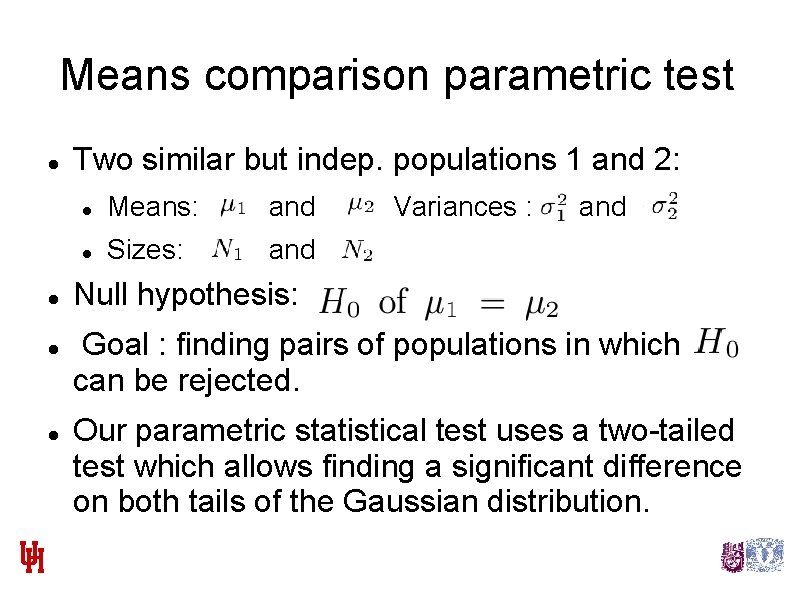
Means comparison parametric test Two similar but indep. populations 1 and 2: Means: and Sizes: and Variances : and Null hypothesis: Goal : finding pairs of populations in which can be rejected. Our parametric statistical test uses a two-tailed test which allows finding a significant difference on both tails of the Gaussian distribution.
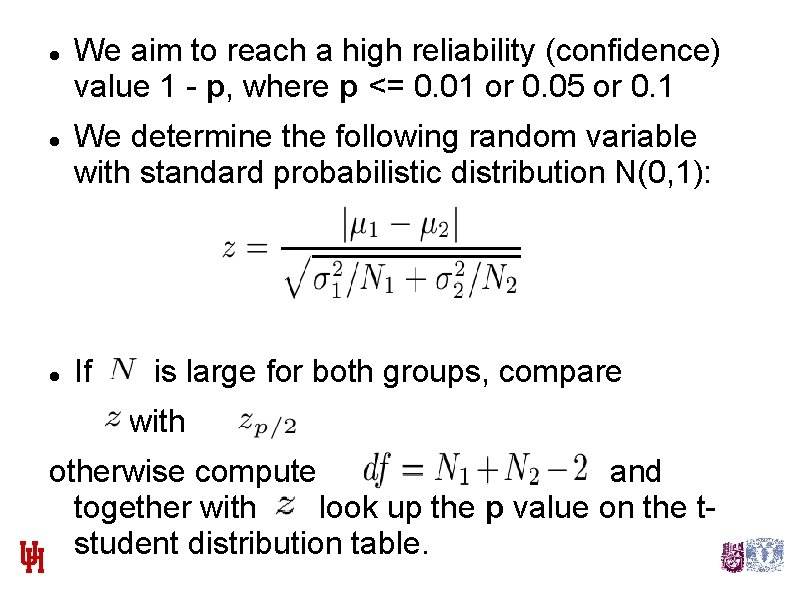
We aim to reach a high reliability (confidence) value 1 - p, where p <= 0. 01 or 0. 05 or 0. 1 We determine the following random variable with standard probabilistic distribution N(0, 1): If is large for both groups, compare with otherwise compute and together with look up the p value on the tstudent distribution table.
Main objectives Discovering significant differences between two groups in a cuboid on at least one measure. A significant difference can only be supported by a small pvalue When there exists a significant difference we isolate those groups that differ in one dimension, which can explain a cause-effect relationship. The algorithm aims to discover significant differences in highly similar cube cells because that helps point out which specific dimension “triggers” a significant change on the cuboid measure.

Program execution

Conclusions We presented an innovative system that combines the exploratory power of OLAP cubes with the statistical reliability of statistical tests. Pairs of similar groups are isolated and compared with a statistical test to discover specific pairs that cause a significant difference in some measure value. The OLAP cube is depicted using a two-tier design that allows the user to quickly switch between cuboids. We presented an application in the medical domain to improve heart disease diagnosis.
Future work A 2 D cube representation is easier to manipulate than a 3 D display, but we would like to compare its strengths and weaknesses with a 3 D visualization. We need to study mathematical relationships between the dimensions lattice and cube visual representations. The visualization of cubes requires further study when confronted with a cube having a large number of dimensions. Finally, we want to integrate other statistical tests or statistical models with OLAP cubes.

Thanks. Questions?
- Slides: 13