
Interactive and Engaging Teaching Approaches Jeffrey Rakofsky MD
- Slides: 20
Interactive and Engaging Teaching Approaches Jeffrey Rakofsky, MD
GETTING AND MAINTAINING ATTENTION Catch Crisp Tell them with a catchy title learning objectives a story Power-pointers: “Entertain, don’t overwhelm. ”
MOVING BEYOND THE POWERPOINT Vocal dynamics/vocal underlining Full body movements Use metaphors Use the white board Practice/practice/edit
PROMOTING DISCUSSION AS A TEACHER Start Use with broad or provocative questions problem-sets/vignettes Assign reading Point out similar and contrasting themes in students’ responses Ignore your transference
Interactive and Engaging Teaching Approaches Gene Farber, Ph. D, ABPP
GETTING AND MAINTAINING ATTENTION Create anticipation – what value will be gained? Use narrative frame to tell a scholarly story Offer a tangible takeaway message with immediate relevance or application
MOVING BEYOND THE POWERPOINT Use of case material for group discussion Role Use play clinical scenarios of audio or visual media
PROMOTING DISCUSSION AS A TEACHER Facilitate group norms that encourage mutual participation and dialogue Promote idea of student as expert Establish treatment team concept for case discussion
Interactive and Engaging Teaching Approaches Gene Farber, Ph. D, ABPP
GETTING AND MAINTAINING ATTENTION Create anticipation – what value will be gained? Use narrative frame to tell a scholarly story Offer a tangible takeaway message with immediate relevance or application
MOVING BEYOND THE POWERPOINT Use of case material for group discussion Role Use play clinical scenarios of audio or visual media
PROMOTING DISCUSSION AS A TEACHER Facilitate group norms that encourage mutual participation and dialogue Promote idea of student as expert Establish treatment team concept for case discussion
Interactive and Engaging Teaching Approaches Martha Ward, MD
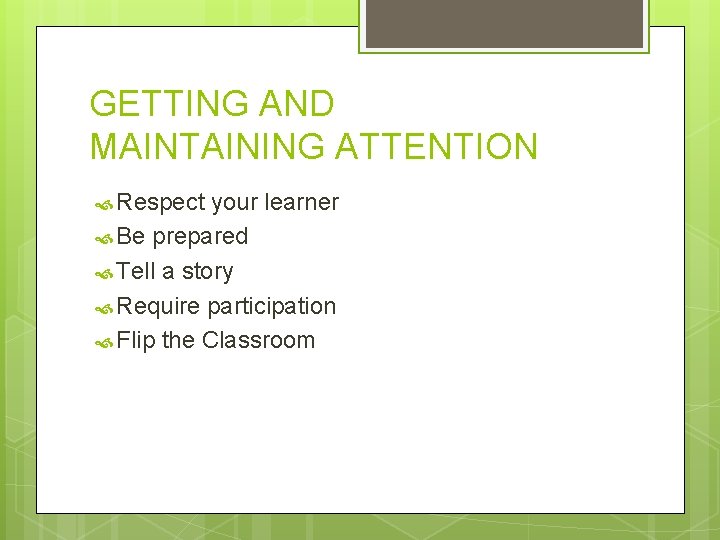
GETTING AND MAINTAINING ATTENTION Respect your learner Be prepared Tell a story Require participation Flip the Classroom
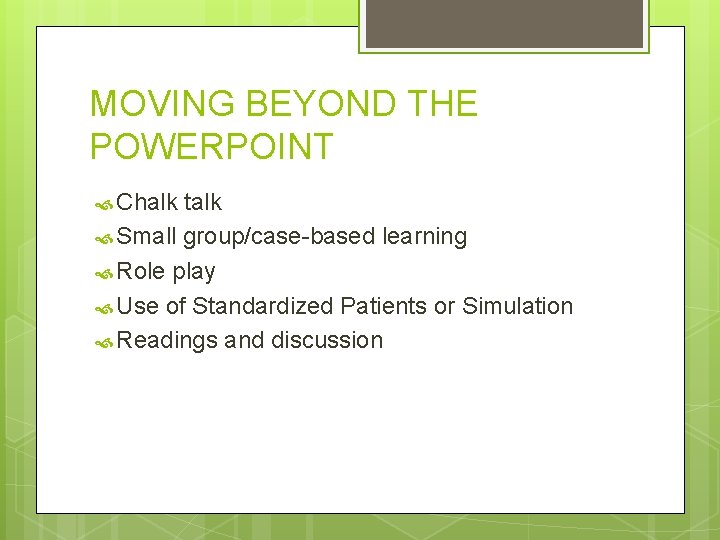
MOVING BEYOND THE POWERPOINT Chalk talk Small group/case-based learning Role play Use of Standardized Patients or Simulation Readings and discussion
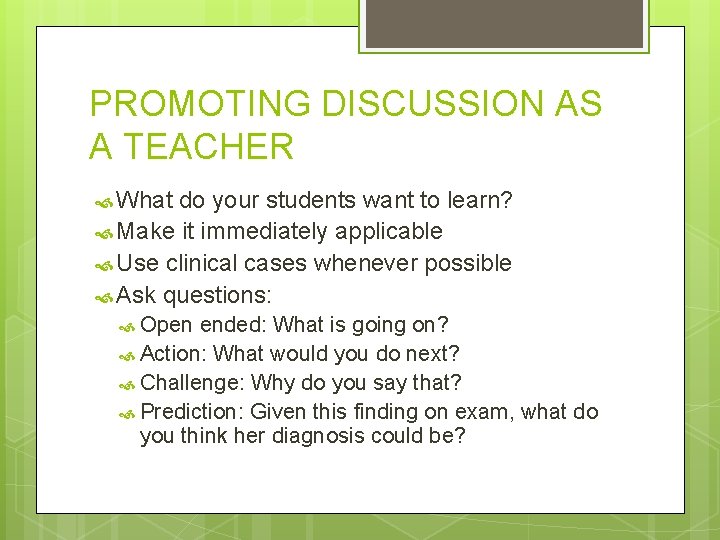
PROMOTING DISCUSSION AS A TEACHER What do your students want to learn? Make it immediately applicable Use clinical cases whenever possible Ask questions: Open ended: What is going on? Action: What would you do next? Challenge: Why do you say that? Prediction: Given this finding on exam, what do you think her diagnosis could be?
Interactive and Engaging Teaching Approaches Boadie Dunlop, MD
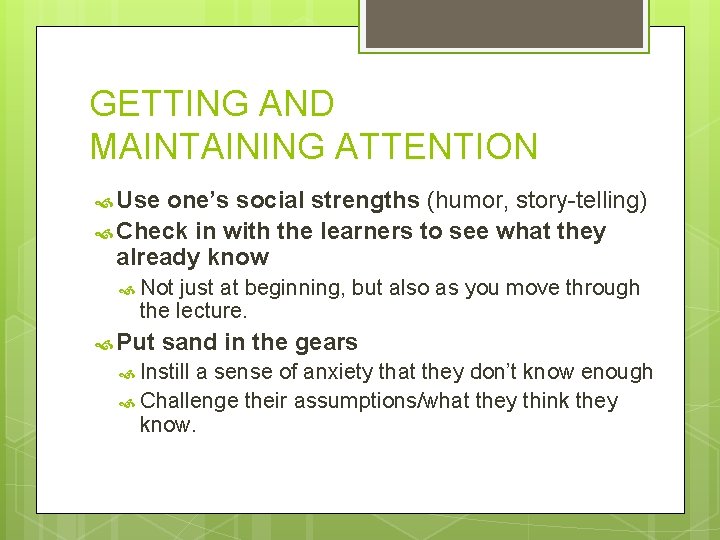
GETTING AND MAINTAINING ATTENTION Use one’s social strengths (humor, story-telling) Check in with the learners to see what they already know Not just at beginning, but also as you move through the lecture. Put sand in the gears Instill a sense of anxiety that they don’t know enough Challenge their assumptions/what they think they know.
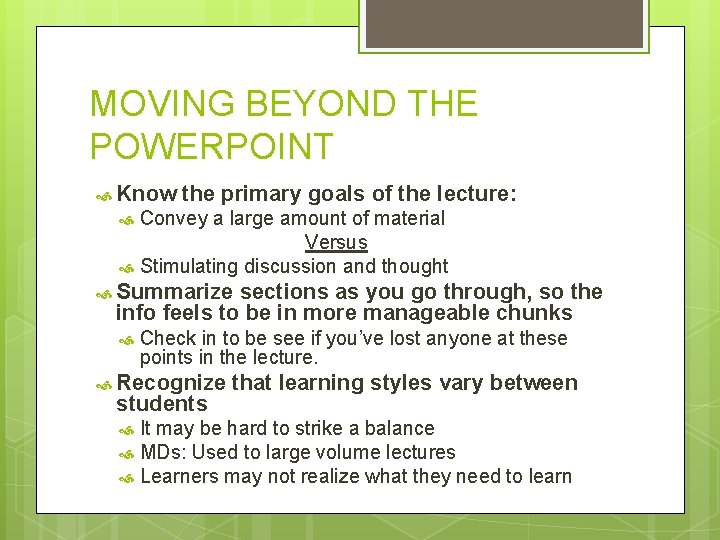
MOVING BEYOND THE POWERPOINT Know the primary goals of the lecture: Convey a large amount of material Versus Stimulating discussion and thought Summarize sections as you go through, so the info feels to be in more manageable chunks Check in to be see if you’ve lost anyone at these points in the lecture. Recognize students that learning styles vary between It may be hard to strike a balance MDs: Used to large volume lectures Learners may not realize what they need to learn
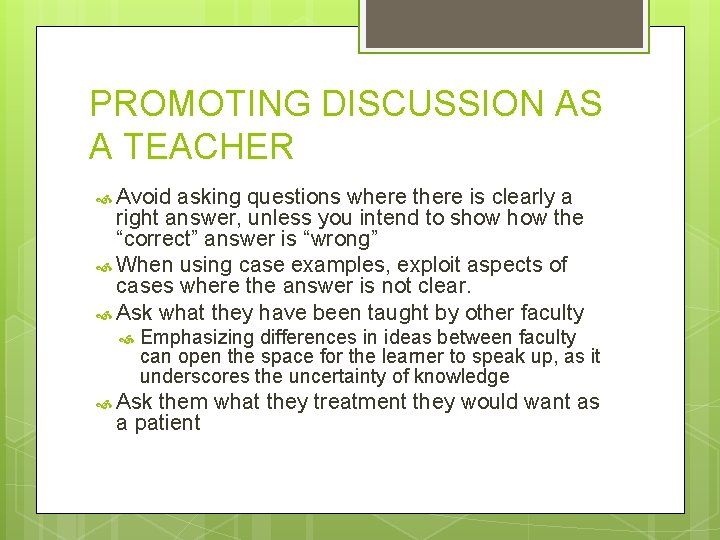
PROMOTING DISCUSSION AS A TEACHER Avoid asking questions where there is clearly a right answer, unless you intend to show the “correct” answer is “wrong” When using case examples, exploit aspects of cases where the answer is not clear. Ask what they have been taught by other faculty Emphasizing differences in ideas between faculty can open the space for the learner to speak up, as it underscores the uncertainty of knowledge Ask them what they treatment they would want as a patient