
Interactions of high energy photons with matter Cross

- Slides: 13
Interactions of high energy photons with matter • • Cross section/attenution length/optical depth Photoelectric absorption Compton scattering Electron-positron pair production
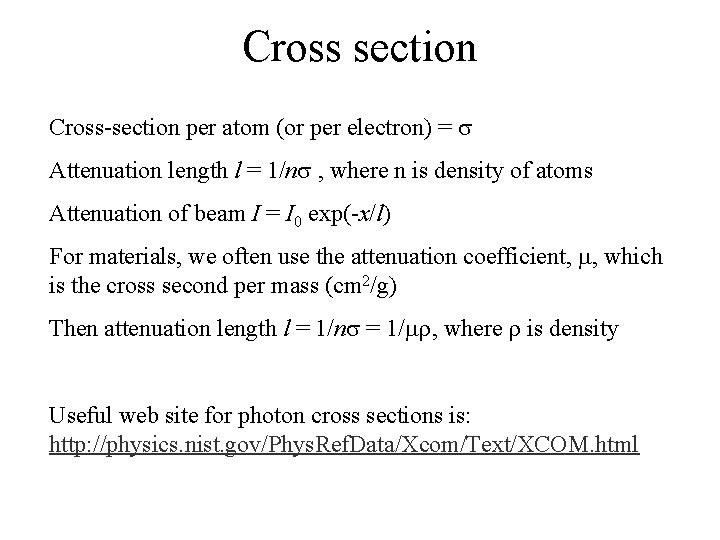
Cross section Cross-section per atom (or per electron) = Attenuation length l = 1/n , where n is density of atoms Attenuation of beam I = I 0 exp(-x/l) For materials, we often use the attenuation coefficient, , which is the cross second per mass (cm 2/g) Then attenuation length l = 1/n = 1/ , where is density Useful web site for photon cross sections is: http: //physics. nist. gov/Phys. Ref. Data/Xcom/Text/XCOM. html
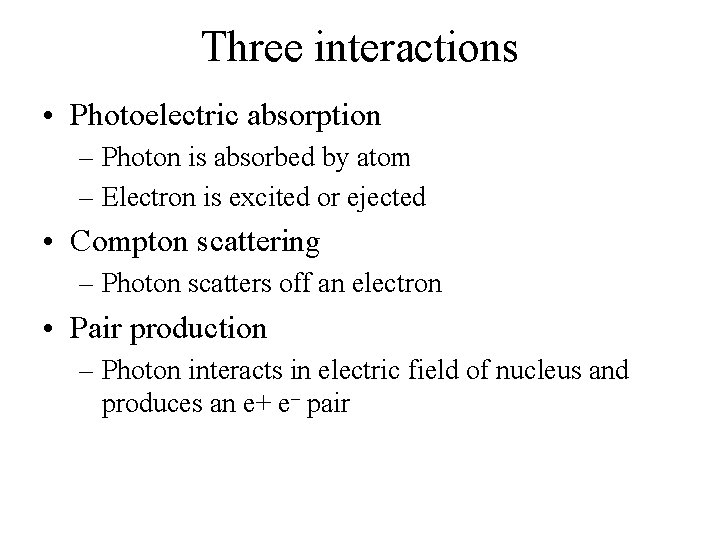
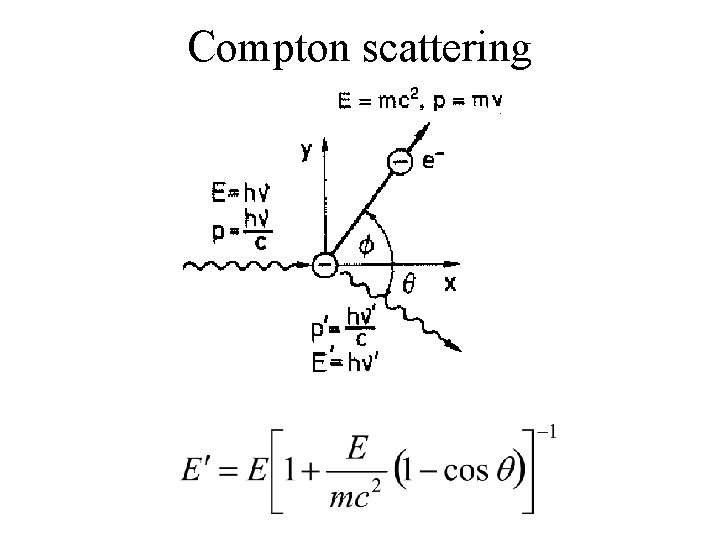
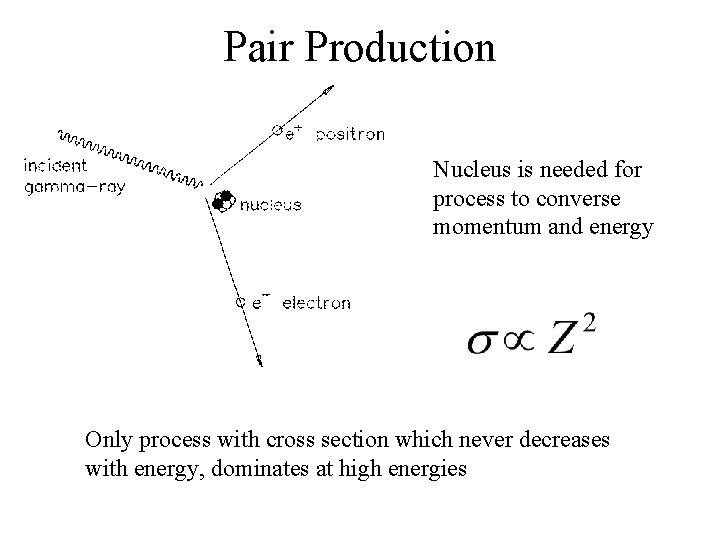
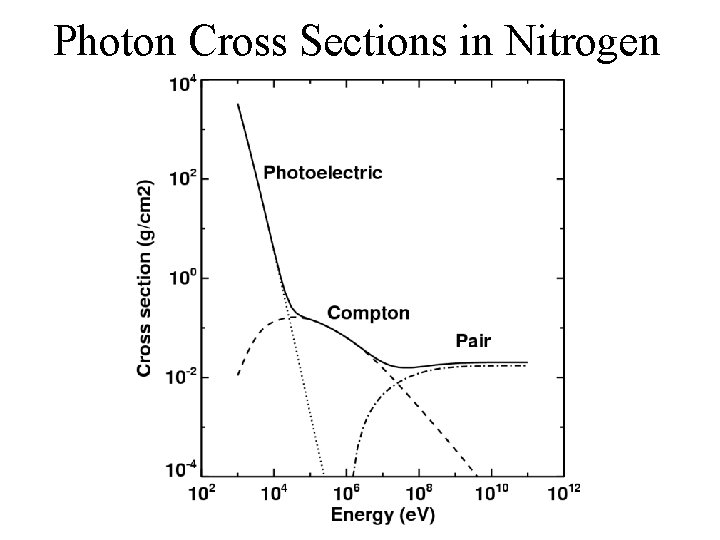
Three interactions • Photoelectric absorption – Photon is absorbed by atom – Electron is excited or ejected • Compton scattering – Photon scatters off an electron • Pair production – Photon interacts in electric field of nucleus and produces an e+ e– pair
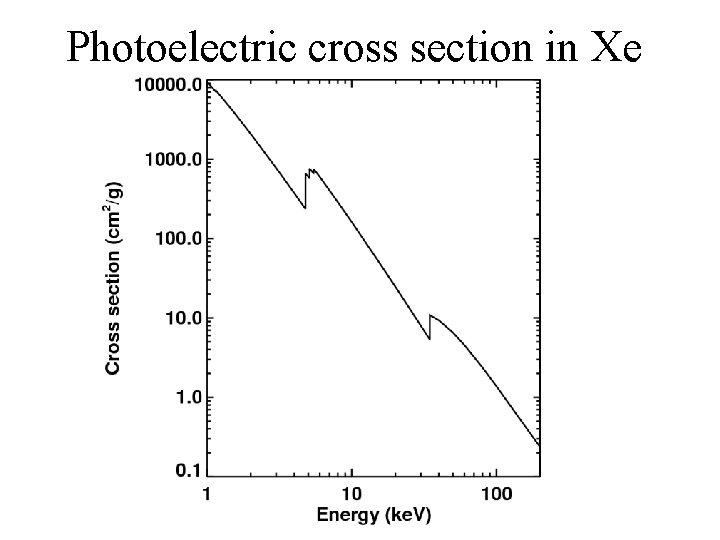
Photoelectric cross section in Xe
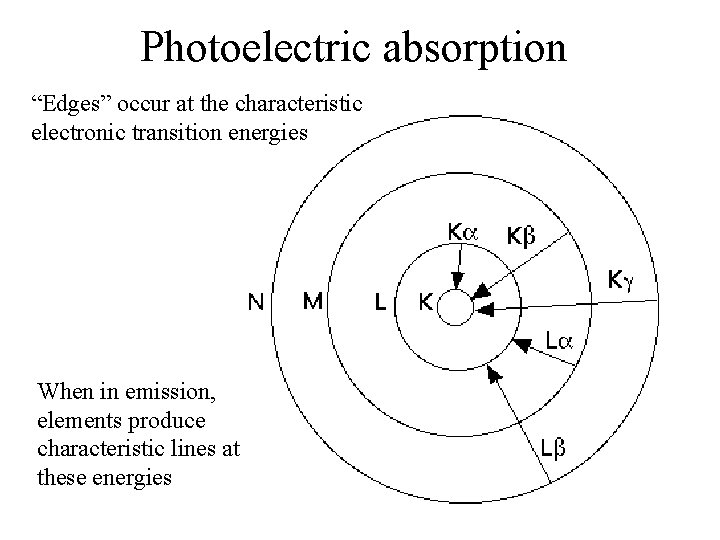
Photoelectric absorption “Edges” occur at the characteristic electronic transition energies When in emission, elements produce characteristic lines at these energies
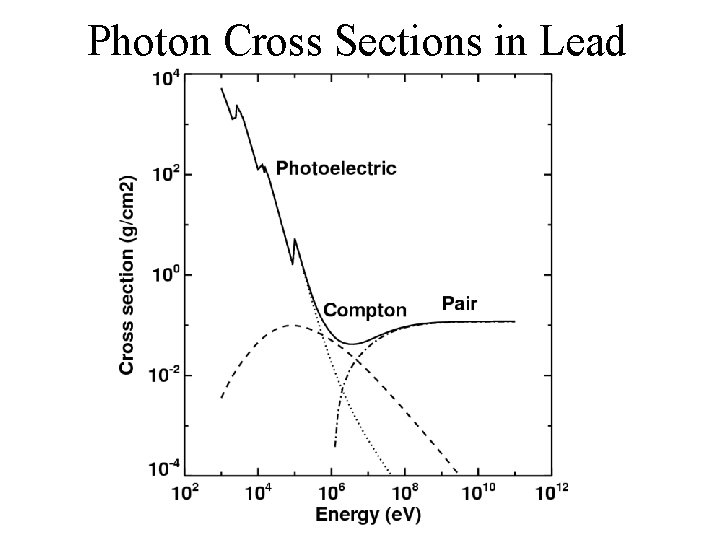
Photoelectric absorption The photon electric cross-section scales with Z 5 This means that high-Z detectors are more efficient at high energies. Above the highest edge, the cross-section scales roughly as (energy)-3. This means that photo-absorption detectors rapidly become inefficient at high energies.
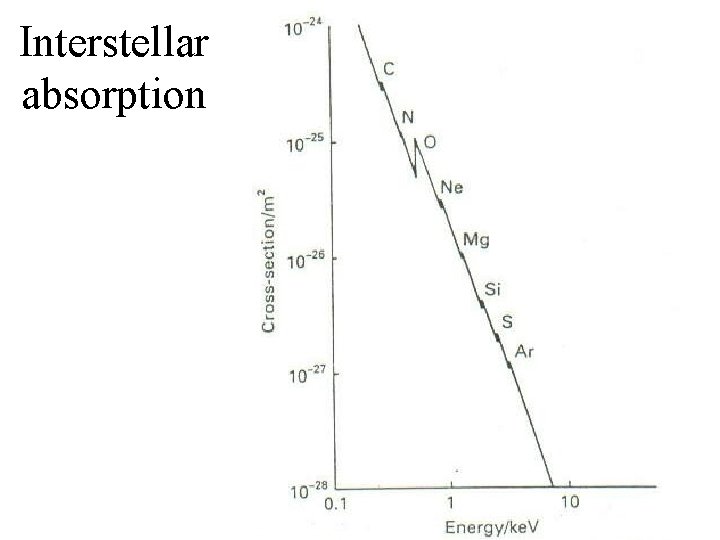
Interstellar absorption
Compton scattering
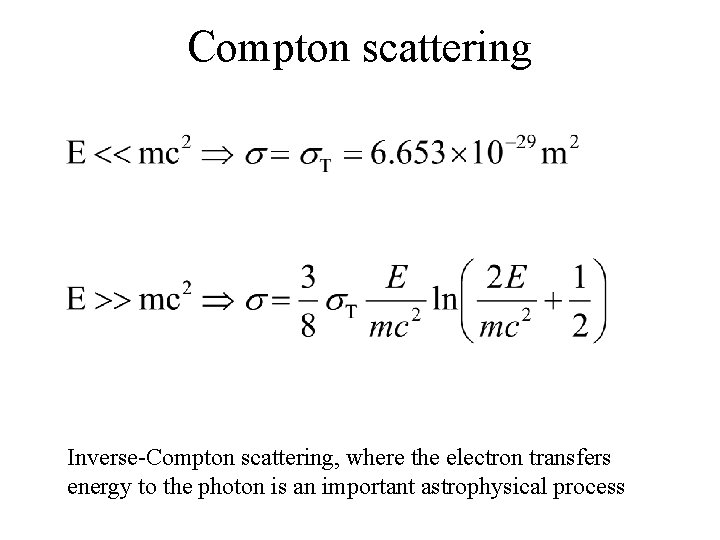
Compton scattering Inverse-Compton scattering, where the electron transfers energy to the photon is an important astrophysical process
Pair Production Nucleus is needed for process to converse momentum and energy Only process with cross section which never decreases with energy, dominates at high energies
Photon Cross Sections in Nitrogen
Photon Cross Sections in Lead
Reading Longair: 4. 1, 4. 2, 4. 3 (skip 4. 3. 3, 4. 3. 4), 4. 4