
Interactions between Europeans and Indigenous Peoples Early Exploration
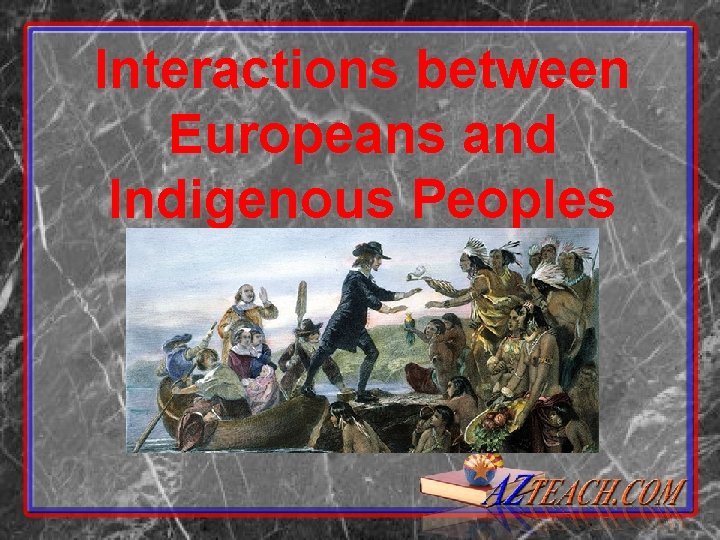
Interactions between Europeans and Indigenous Peoples

Early Exploration • Exploration of the Americas boomed during the 15 th to 17 th centuries • The following are just a few of the North American explorers. They were usually sent by a European country to explore and conquer:

Early Exploration Christopher Columbus Jacques Marquette Henry Hudson Marco Polo Vasco de Gama Bartolomeu Dias Leif Eriksson Prince Henry the Navigator Juan Ponce de León Hernán Cortés Francisco Vásquez de Coronado Ferdinand Magellan Blast from the Past! These Names should Look familiar!

Early Exploration Explorers Lets Refresh our Memories! And also look at a couple of more names and faces!
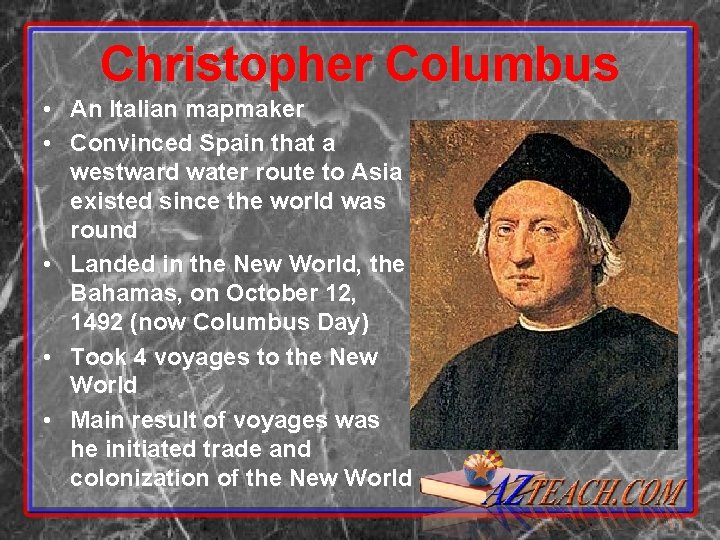
Christopher Columbus • An Italian mapmaker • Convinced Spain that a westward water route to Asia existed since the world was round • Landed in the New World, the Bahamas, on October 12, 1492 (now Columbus Day) • Took 4 voyages to the New World • Main result of voyages was he initiated trade and colonization of the New World
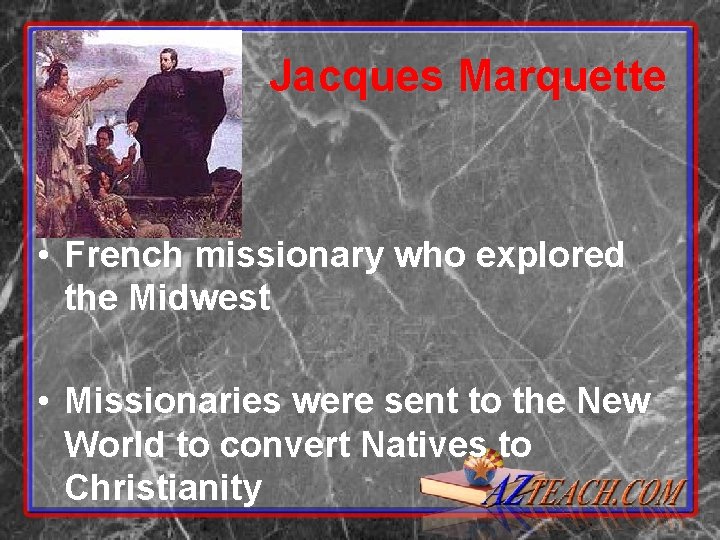
Jacques Marquette • French missionary who explored the Midwest • Missionaries were sent to the New World to convert Natives to Christianity

Henry Hudson • English explorer who was searching for a Northwest Passage to the Pacific Ocean to get to the Orient • Found the Hudson River and the Hudson Strait

Reciprocal Impact What does “Reciprocal Impact” Mean?
Reciprocal Impact • the exchange of goods, ideas, agricultural products and even disease between Europeans and the indigenous populations of the Americas

Europeans changed lives of the First Americans • At first, Indians were not hostile • Indians desired peaceful trade • Cooperative encounters became less frequent over time
Transfer of Food as Reciprocal Impact • Plants and animals from the Old to the New World • American crops to Europe and Africa

From Europe to the Americas • Sugar and bananas transformed economies of Latin America • Pigs, sheep, and cattle multiplied more rapidly than they had in Europe • The horse was reintroduce and was adapted for hunting

From the Americas to Europe and Africa • Maize, beans, squash, sweet potatoes, peppers, tomatoes, potato • Tobacco • Rich new sources of nutrition helped increase the European population
Transfer of Food as Reciprocal Impact The Columbian Exchange! What was another name for this?
Reciprocal Impact Not everything! Was all trade good?
Transfer of Disease • From the Americas to Europe – Syphilis – Appeared in Europe within a year of Columbus’s return – spread to China by 1505

Transfer of Disease • From Europe to Americas – Natives had little natural immunity to common African and European diseases – Influenza, typhus, measles, small pox – Millions died
The “Great Dying” • “Historical demographers now estimate that some tribes suffered a 90% to 95% loss within the first century of European contact. ” – Divine, et al. America, Past and Present. 1991, New York City.

Ideas also Exchanged • Reciprocal impact also referred to the exchange of ideas and cultural concepts, not just physical items like food or animals • Indian way of life altered • Europeans influenced by Indian culture
The Three G’s!!! Why did the Spanish come to the New World

Spanish Exploration • The Spanish came to North America for three reasons – God, gold & glory • Spanish built missions and were sent by the Roman Catholic church – in the missions, natives were taught Christianity and European farming, herding, and crafts

Spanish Exploration • Spaniards brought horses which allowed the Native American empire to expand

Exploration • Europeans used North America’s land to extract gold, tobacco, food, and spices to send back to Europe
Money, Money! Why did the French come to the New World
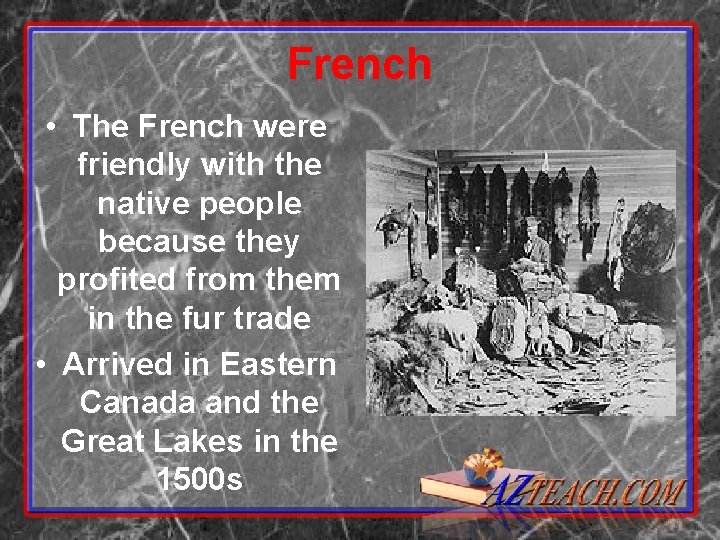
French • The French were friendly with the native people because they profited from them in the fur trade • Arrived in Eastern Canada and the Great Lakes in the 1500 s
Iroquois Confederacy/League of Five Nations
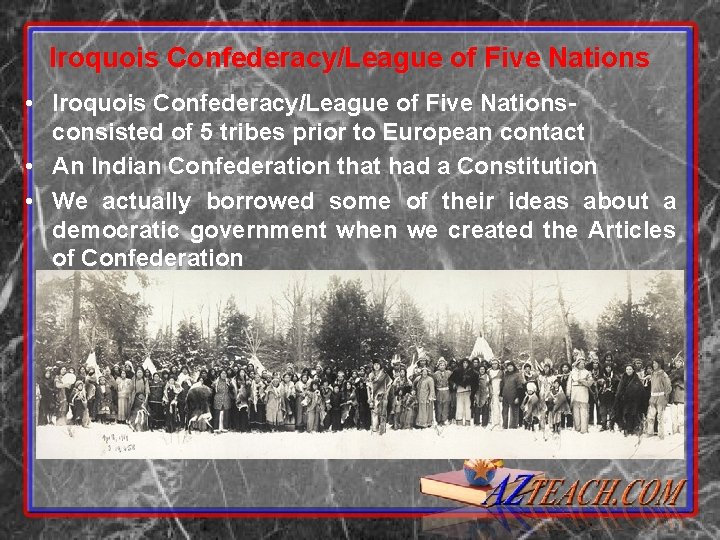
Iroquois Confederacy/League of Five Nations • Iroquois Confederacy/League of Five Nationsconsisted of 5 tribes prior to European contact • An Indian Confederation that had a Constitution • We actually borrowed some of their ideas about a democratic government when we created the Articles of Confederation

Iroquois Confederacy/League of Five Nations • Europeans were surprised by some Native cultural differences • Many native populations used matriarchal leadership (women ruled the society as elders, the husband joins the wife’s family, women and mothers are highly respected)

Iroquois Confederacy/League of Five Nations • New European settlements continued to spring up and push the natives out of their sacred homelands
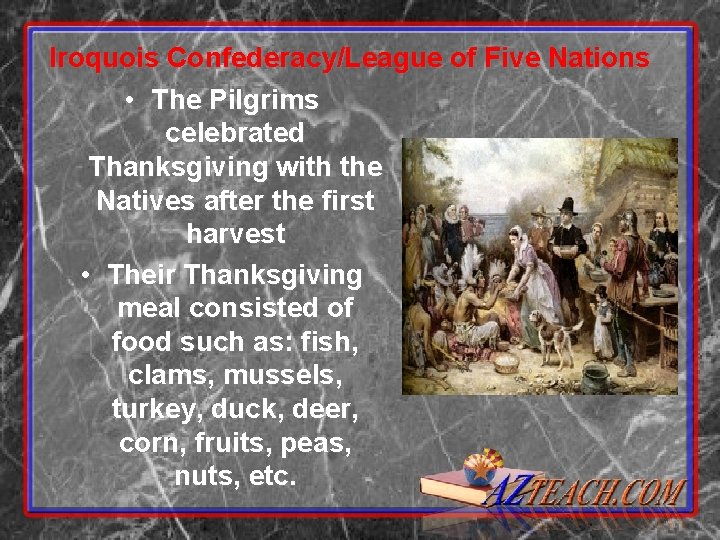
Iroquois Confederacy/League of Five Nations • The Pilgrims celebrated Thanksgiving with the Natives after the first harvest • Their Thanksgiving meal consisted of food such as: fish, clams, mussels, turkey, duck, deer, corn, fruits, peas, nuts, etc.
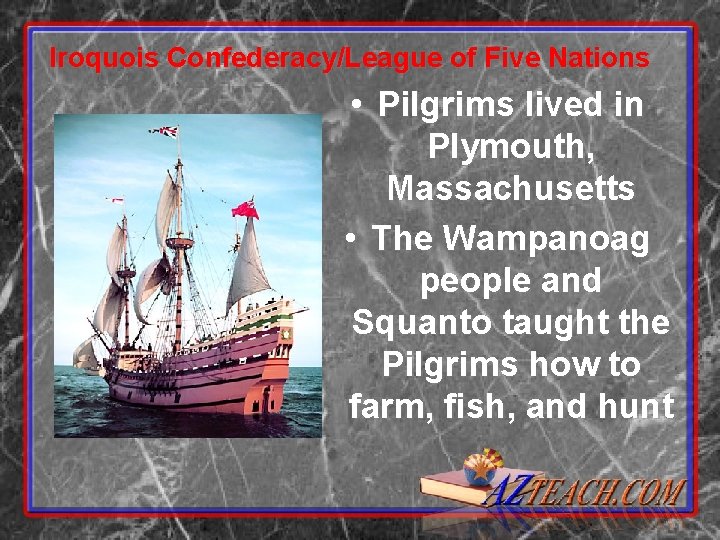
Iroquois Confederacy/League of Five Nations • Pilgrims lived in Plymouth, Massachusetts • The Wampanoag people and Squanto taught the Pilgrims how to farm, fish, and hunt

Let’s take a look! What tribes made up the “Confederacy? ”
Iroquois Confederacy • 5 Iroquois Nations – Mohawk – Oneida – Onondaga – Cayuga – Seneca

Iroquois Confederacy • lasted for hundreds of years • united to stand together against invasion – common council composed of clan and village chiefs – decision must be unanimous • served as model for founders of US government
Matriarchal Leadership • In many tribes, leadership is passed through women • Stories and names are also handed down through women • Directly contrasted to male-dominated European cultures
In summary… The Reciprocal Impact was… Let’s wrap it up!

Reciprocal Impact • All of the following were a result of the reciprocal impact of European contact with the indigenous (native) people: – Europeans attempted to convert Natives to Christianity – Death of Natives by disease due to lack of immunity – Addition of new foods into the European diet

Reciprocal Impact • After the French and Indian War (17541763), the natives were pushed west of the Appalachian mountains • But then we decided to move West and we forced them on to reservations
Dependency • Influence of Europeans caused Indians to become dependent • European system of land use reduced supply of animals Indians hunted • Forests were cleared and land fenced • Trade with Europeans caused Indians to go into debt and encouraged overhunting

QUESTIONS?
- Slides: 40