
Interactions Among Living Things Copy what is highlighted
- Slides: 37
Interactions Among Living Things Copy what is highlighted!
PART 1 1. Adapting to the Environment • Natural Selection – a characteristic that makes an individual better suited to its environment may eventually become common in that species. • Natural selection results in adaptations or behaviors and physical characteristics that allow organisms to live successfully in their environments. • (you will hear more about this during Evolution)
2. CHANGES IN POPULATION SIZES • BIRTHS VS DEATHS • Birth rate> death rate= increase in population Death rate > birth rate= decrease in population IMMIGRATION VS EMIGRATION immigration- moving into a population emigration- leaving a population POPULATION DENSITY- the number of individuals in an area of a specific size. Population Density= Number of individuals Unit Area
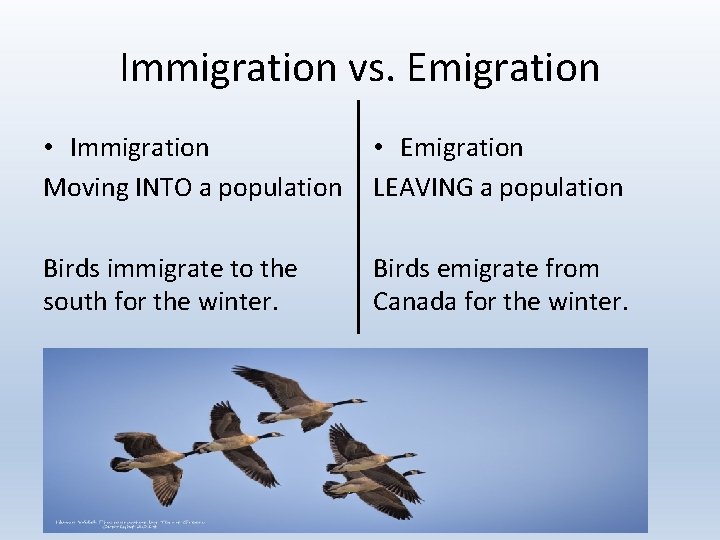
Immigration vs. Emigration • Immigration Moving INTO a population • Emigration LEAVING a population Birds immigrate to the south for the winter. Birds emigrate from Canada for the winter.
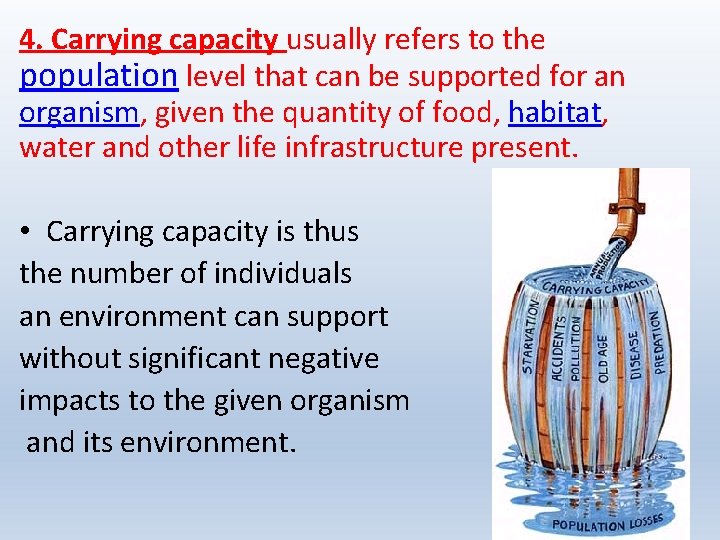
4. Carrying capacity usually refers to the population level that can be supported for an organism, given the quantity of food, habitat, water and other life infrastructure present. • Carrying capacity is thus the number of individuals an environment can support without significant negative impacts to the given organism and its environment.
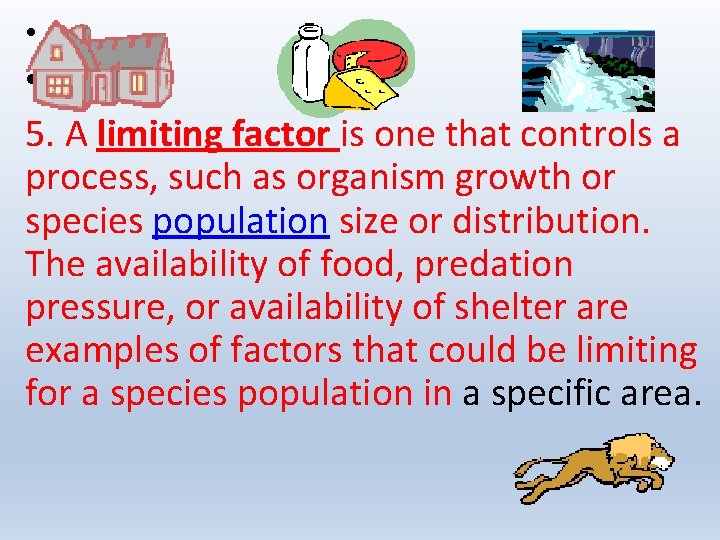
• • 5. A limiting factor is one that controls a process, such as organism growth or species population size or distribution. The availability of food, predation pressure, or availability of shelter are examples of factors that could be limiting for a species population in a specific area.
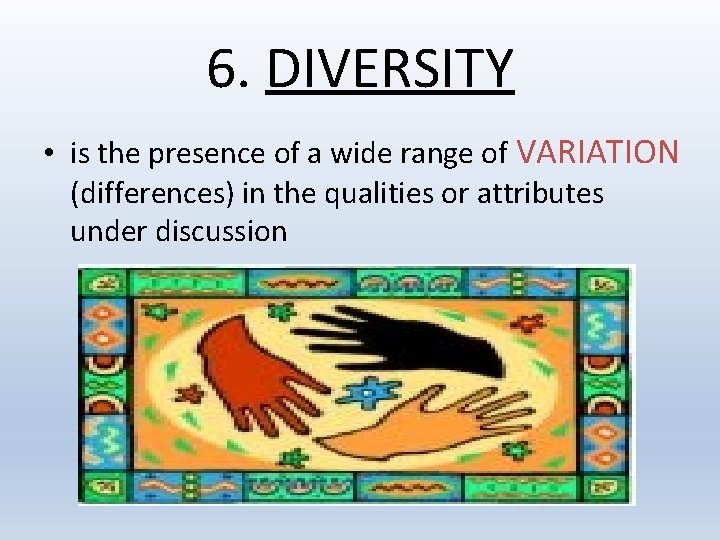
6. DIVERSITY • is the presence of a wide range of VARIATION (differences) in the qualities or attributes under discussion
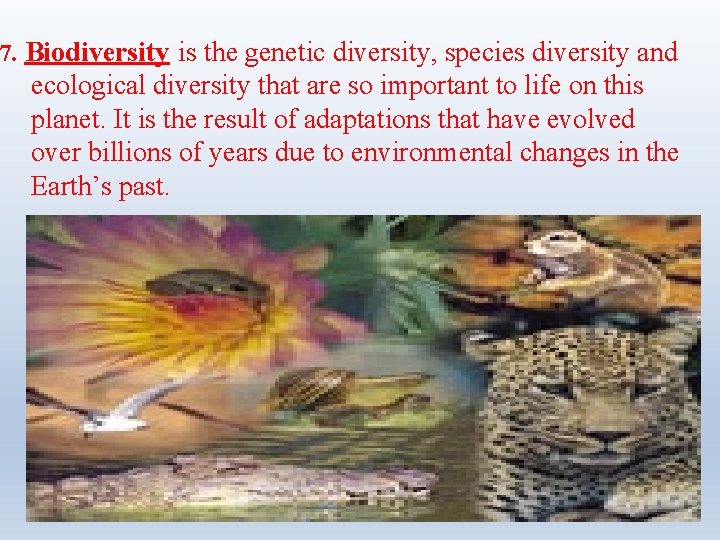
7. Biodiversity is the genetic diversity, species diversity and ecological diversity that are so important to life on this planet. It is the result of adaptations that have evolved over billions of years due to environmental changes in the Earth’s past.
8. Interactions Among Living Things Organisms have adaptations that help them survive in their environment All organisms have their own Niche is the role of an organism in its environment or how it makes its living. NICHE INCLUDES: • type of food the organisms eats • how it obtains this food • which other organisms use this organism as food • when and how it reproduces • physical conditions it requires to survive What is YOUR niche? _____& _____
• Agenda • Warm up- vocabulary sheet #23 -31 (if you have completed those review them and work ahead) • Work session: notes PART 1
10/20/16 Science • Agenda • Warm up- 10 minutes: work on any remaining vocabulary All 3 sheets will be due on your NBI day next week. (3 rd Tu, 4 th Wed, 5 th Th, 6 th Fri) Classwork- notes part 2
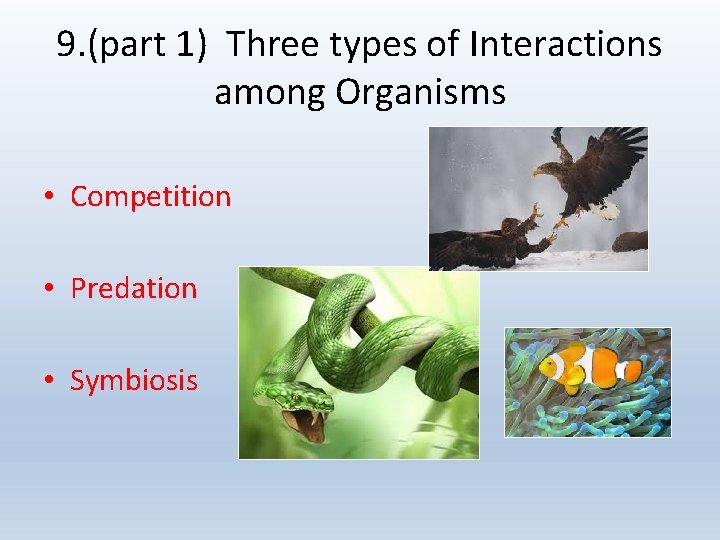
9. (part 1) Three types of Interactions among Organisms • Competition • Predation • Symbiosis
9 (part 2) & 10. Competition • It is the struggle between organisms as they attempt to use the same limited resource • Occurs when two species occupy the same niche • Why can’t two species occupy the same niche? – If two species occupy the same niche, they will compete directly against each other and one species will eventually die off
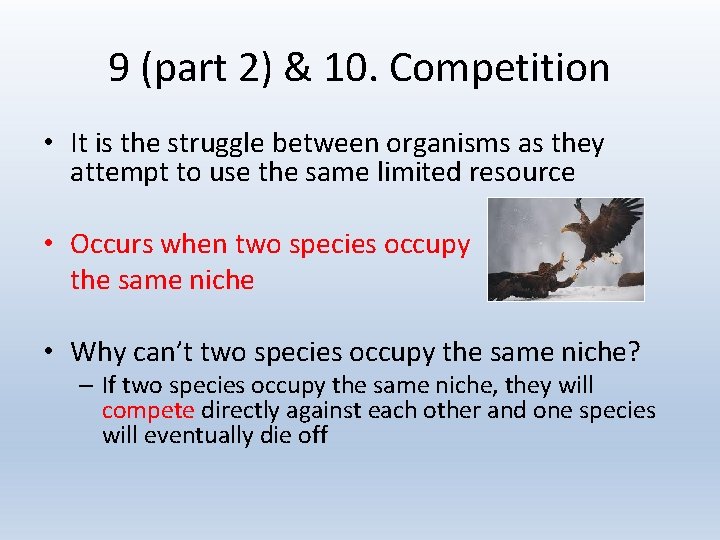
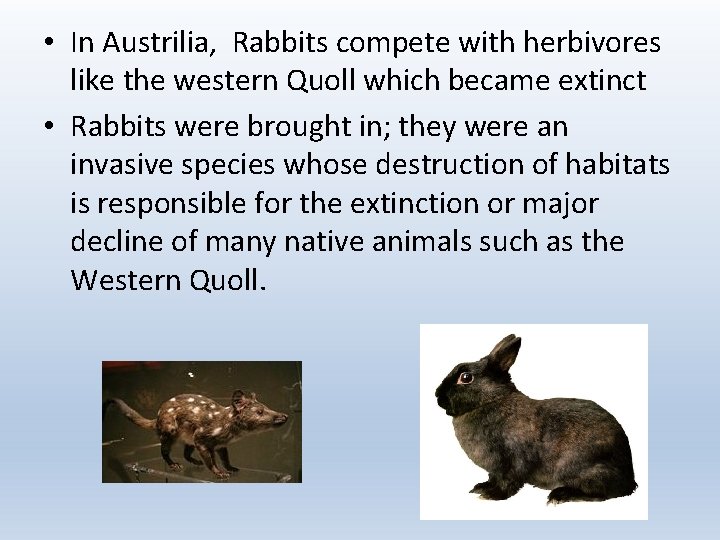
• In Austrilia, Rabbits compete with herbivores like the western Quoll which became extinct • Rabbits were brought in; they were an invasive species whose destruction of habitats is responsible for the extinction or major decline of many native animals such as the Western Quoll.
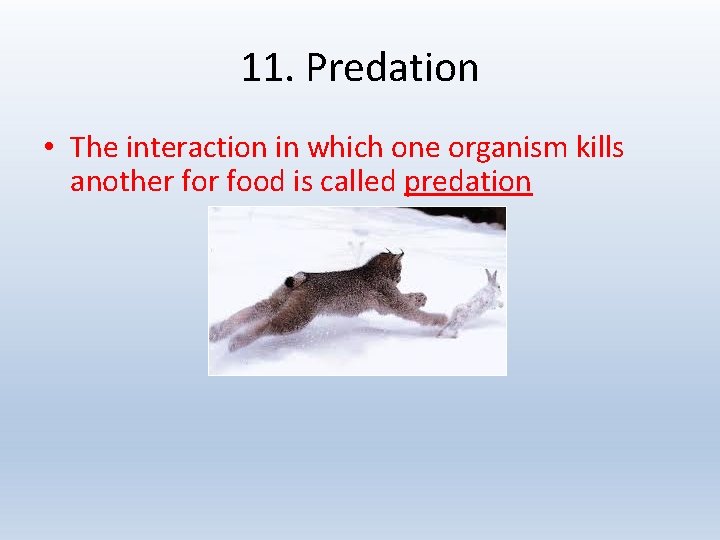
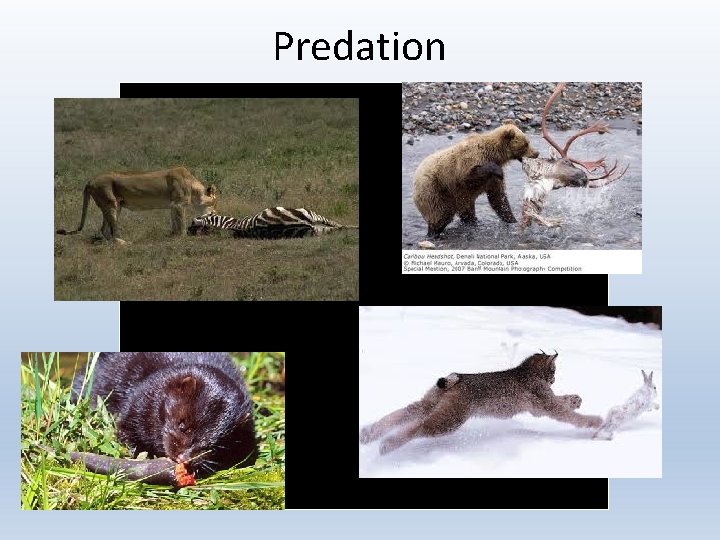
11. Predation • The interaction in which one organism kills another food is called predation
Predation
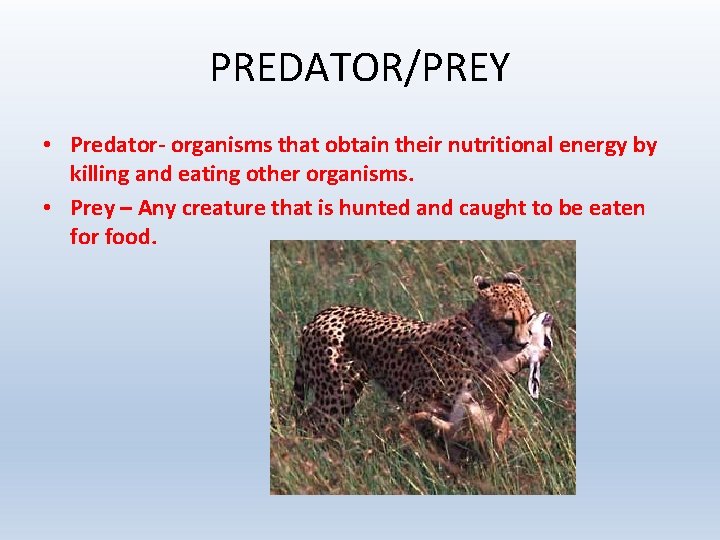
PREDATOR/PREY • Predator- organisms that obtain their nutritional energy by killing and eating other organisms. • Prey – Any creature that is hunted and caught to be eaten for food.
12. Adaptations • Predator adaptations – Help them catch and kill prey • Cheetah can run very fast for a short time • Jellyfish’s tentacles contain a poisonous substance that paralyze tiny water animals • Prey adaptations – Help them avoid becoming prey • Alertness and speed of an antelope help protect it from its predators • Smelly spray of a skunk
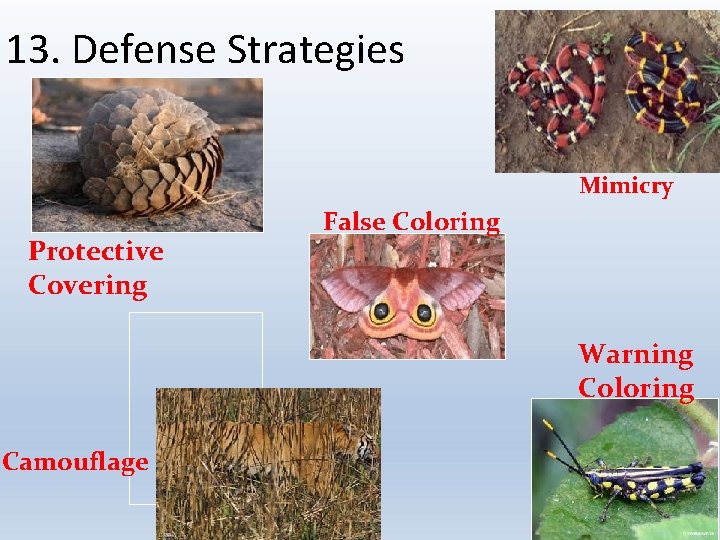
13. Defense Strategies Mimicry Protective Covering False Coloring Warning Coloring Camouflage
14. COMPETITION • The simultaneous demand by two or more organisms for limited environmental resources, such as nutrients, living space, or light. • Example
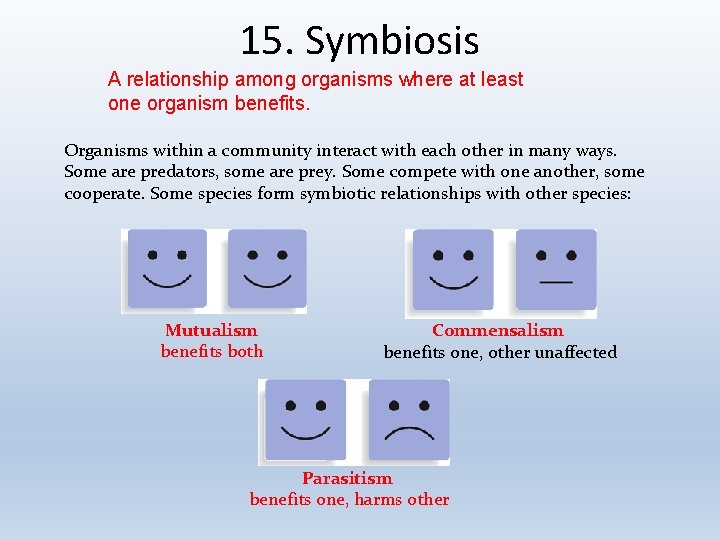
15. Symbiosis A relationship among organisms where at least one organism benefits. Organisms within a community interact with each other in many ways. Some are predators, some are prey. Some compete with one another, some cooperate. Some species form symbiotic relationships with other species: Mutualism benefits both Commensalism benefits one, other unaffected Parasitism benefits one, harms other
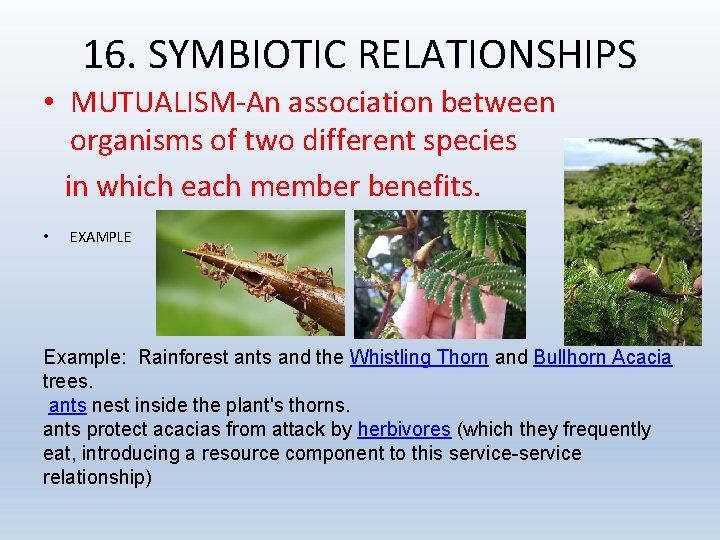
16. SYMBIOTIC RELATIONSHIPS • MUTUALISM-An association between organisms of two different species in which each member benefits. • EXAMPLE Example: Rainforest ants and the Whistling Thorn and Bullhorn Acacia trees. ants nest inside the plant's thorns. ants protect acacias from attack by herbivores (which they frequently eat, introducing a resource component to this service-service relationship)
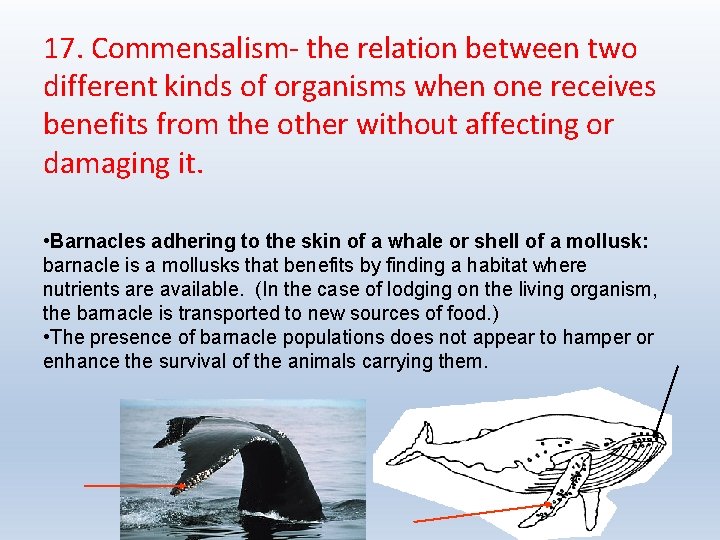
17. Commensalism- the relation between two different kinds of organisms when one receives benefits from the other without affecting or damaging it. • Barnacles adhering to the skin of a whale or shell of a mollusk: barnacle is a mollusks that benefits by finding a habitat where nutrients are available. (In the case of lodging on the living organism, the barnacle is transported to new sources of food. ) • The presence of barnacle populations does not appear to hamper or enhance the survival of the animals carrying them.
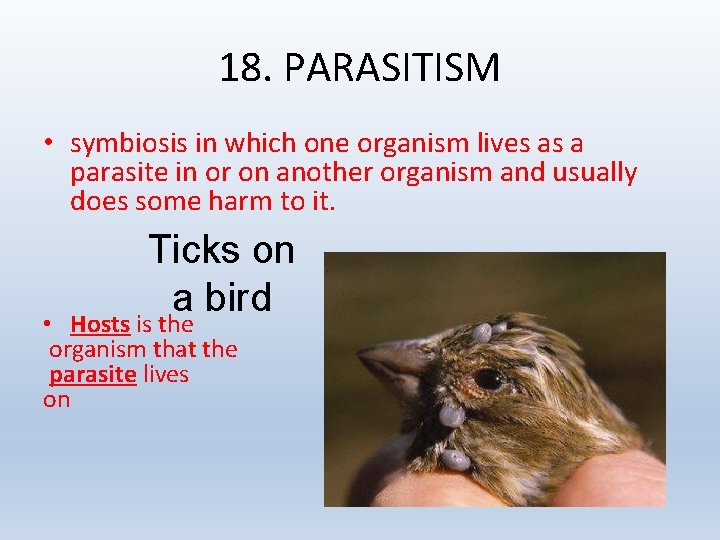
18. PARASITISM • symbiosis in which one organism lives as a parasite in or on another organism and usually does some harm to it. Ticks on a bird • Hosts is the organism that the parasite lives on
On a ½ sheet of paper • Make a 3 flap foldable – On the flap label: 1. competition 2. predation 3. symbiosis -under the flap: re-word the definition -sketch an example or draw: emojis to help you remember what the word means This is your ticket-out-the-door
10/21/16 Science • Agenda: • Warm up- wrap up “Interactions of Org” notes from yesterday • Work session – video with handout
PART 2 19. Changes in Communities Ecological Succesion is the process of change in the species structure of an ecological community over time. The time scale can be decades (for example, after a wildfire), or even millions of years after a mass extinction.
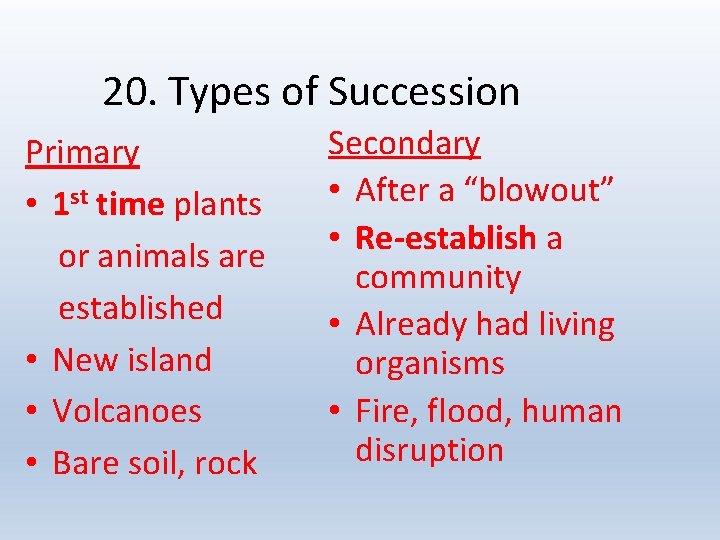
20. Types of Succession Primary • 1 st time plants or animals are established • New island • Volcanoes • Bare soil, rock Secondary • After a “blowout” • Re-establish a community • Already had living organisms • Fire, flood, human disruption
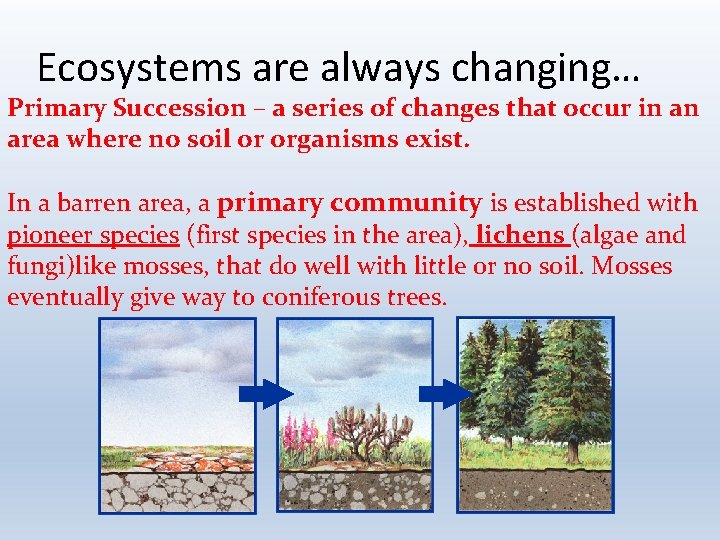
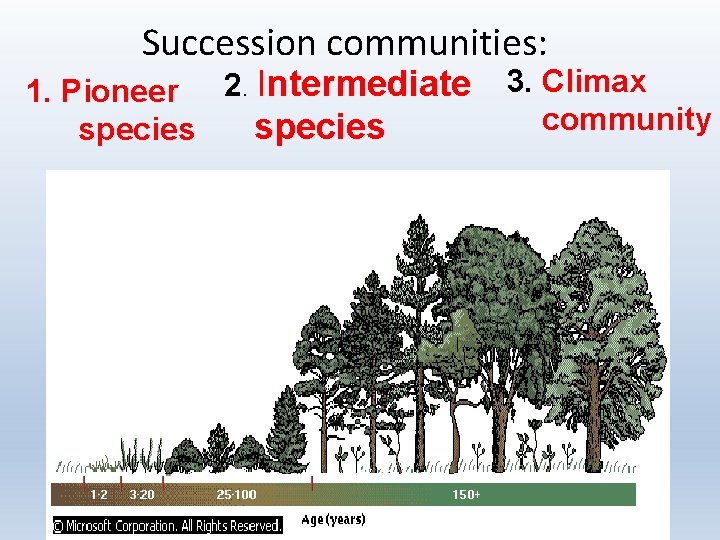
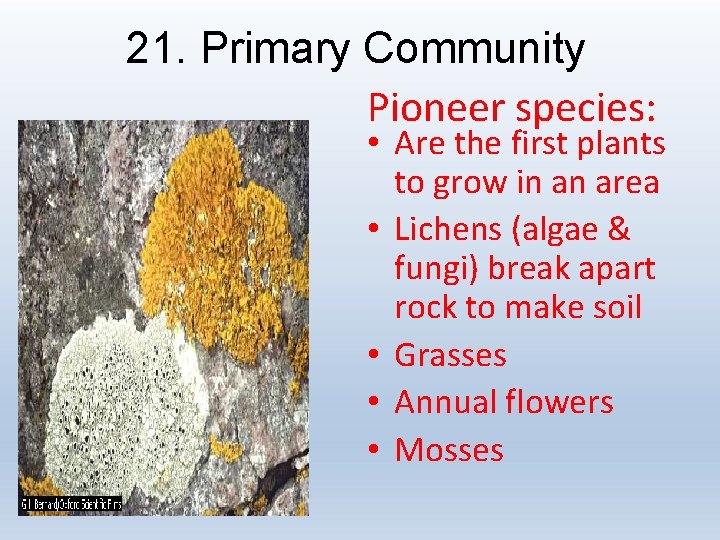
Ecosystems are always changing… Primary Succession – a series of changes that occur in an area where no soil or organisms exist. In a barren area, a primary community is established with pioneer species (first species in the area), lichens (algae and fungi)like mosses, that do well with little or no soil. Mosses eventually give way to coniferous trees.
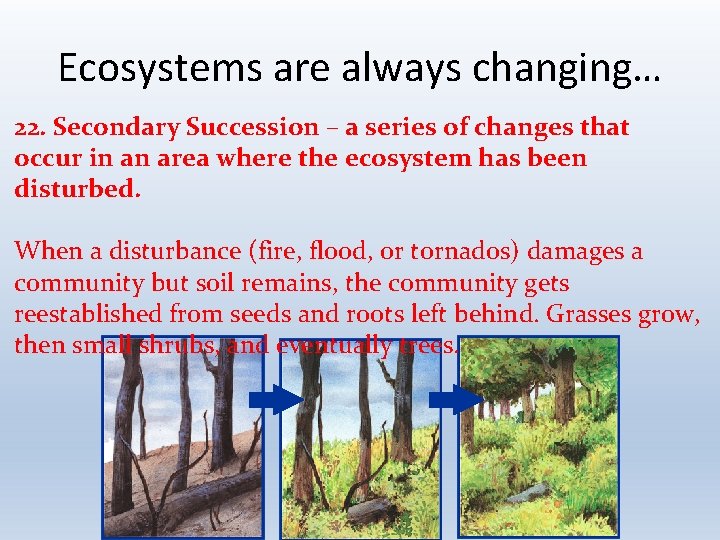
Ecosystems are always changing… 22. Secondary Succession – a series of changes that occur in an area where the ecosystem has been disturbed. When a disturbance (fire, flood, or tornados) damages a community but soil remains, the community gets reestablished from seeds and roots left behind. Grasses grow, then small shrubs, and eventually trees.
Succession communities: 1. Pioneer 2. Intermediate species 3. Climax community
21. Primary Community Pioneer species: • Are the first plants to grow in an area • Lichens (algae & fungi) break apart rock to make soil • Grasses • Annual flowers • Mosses
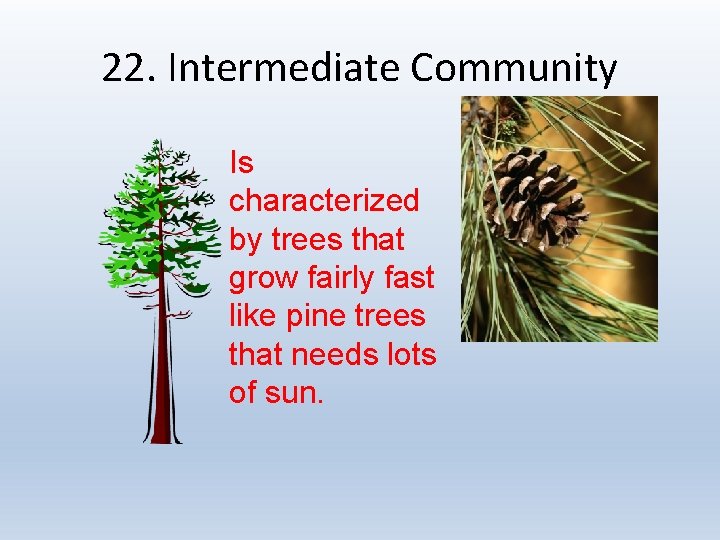
22. Intermediate Community Is characterized by trees that grow fairly fast like pine trees that needs lots of sun.
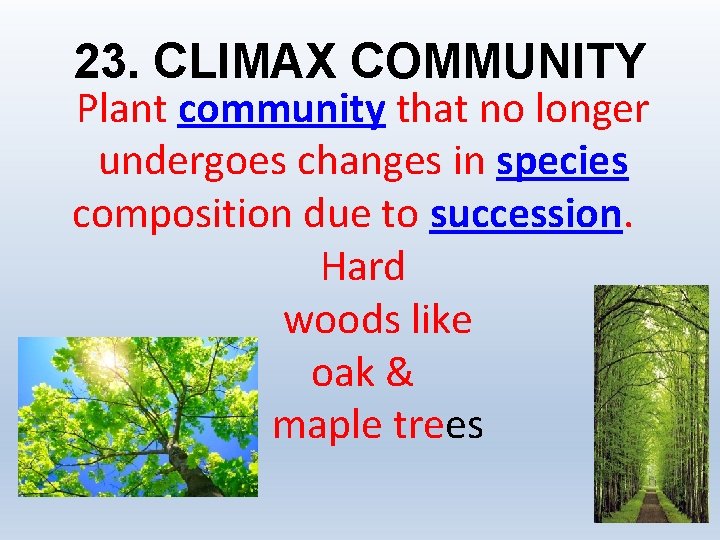
23. CLIMAX COMMUNITY Plant community that no longer undergoes changes in species composition due to succession. Hard woods like oak & maple trees
World Population video • https: //www. youtube. com/watch? v=kh. Fjdmp 9 s. Zk