
INTERACTION PARADIGMS Why study paradigms Concerns How can
- Slides: 22
INTERACTION PARADIGMS
Why study paradigms Concerns How can an interactive system be developed to ensure its usability? How can the usability of an interactive system be demonstrated or measured? History of interactive system design provides paradigms for usable designs
First principle of HCI (Usability) useful Accomplish what is required (functional, does things) usable Do it easily and naturally without error (does the right things) used Make people want to use it (be attractive, acceptable to organization)
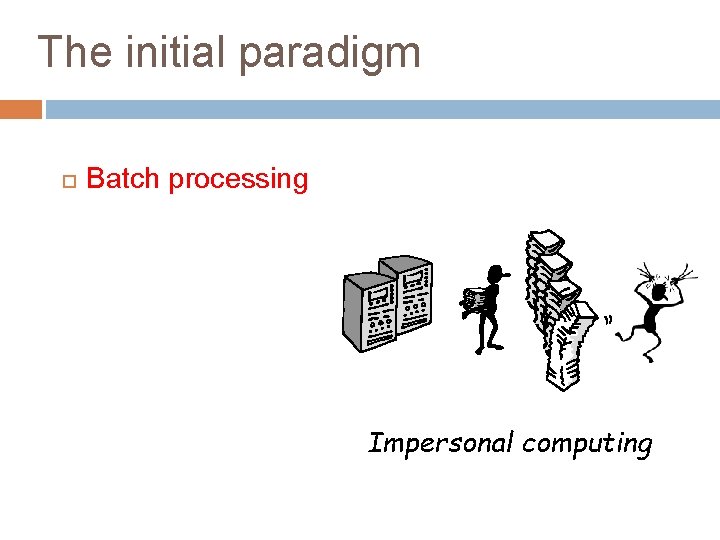
The initial paradigm Batch processing Impersonal computing
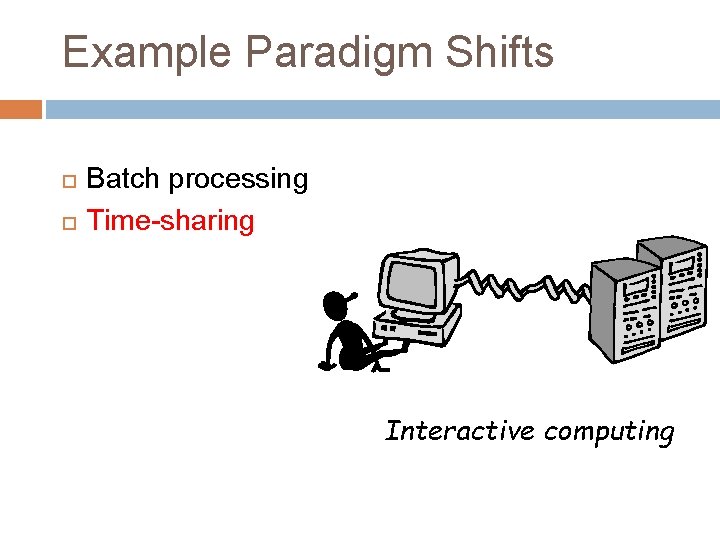
Example Paradigm Shifts Batch processing Time-sharing Interactive computing
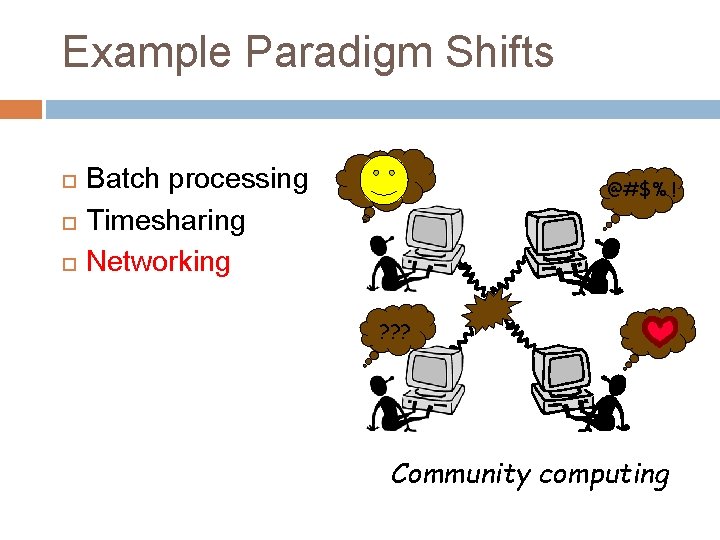
Example Paradigm Shifts Batch processing Timesharing Networking @#$% ! ? ? ? Community computing
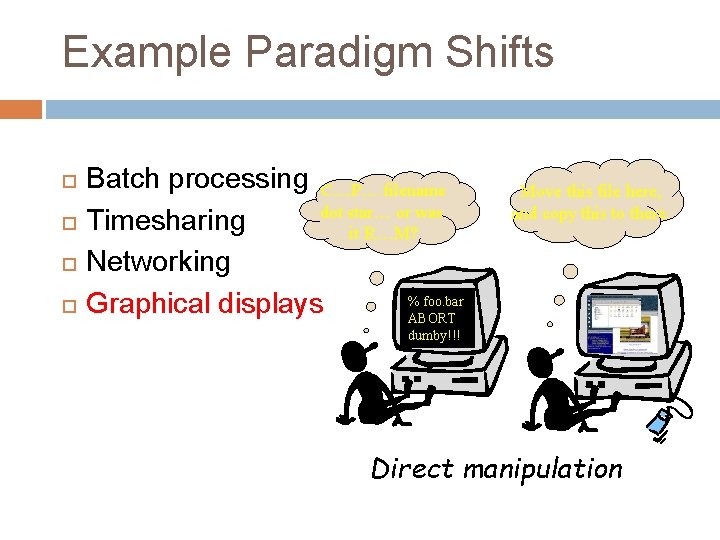
Example Paradigm Shifts Batch processing C…P… filename dot star… or was Timesharing it R…M? Networking % foo. bar Graphical displays ABORT Move this file here, and copy this to there. dumby!!! Direct manipulation
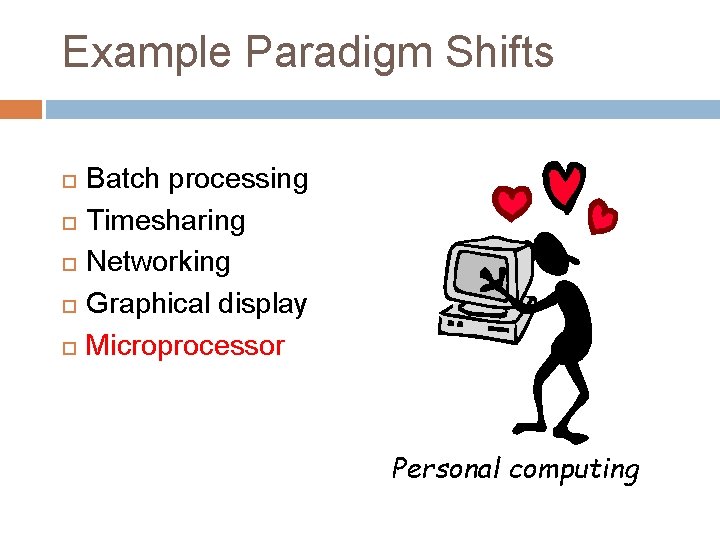
Example Paradigm Shifts Batch processing Timesharing Networking Graphical display Microprocessor Personal computing
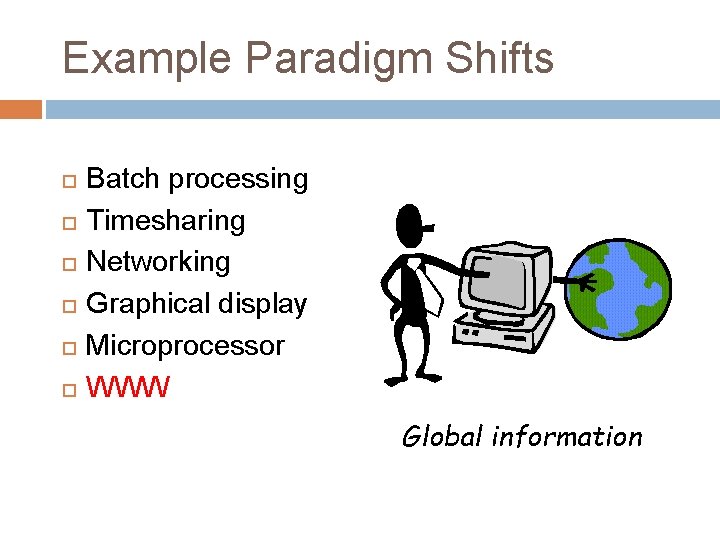
Example Paradigm Shifts Batch processing Timesharing Networking Graphical display Microprocessor WWW Global information
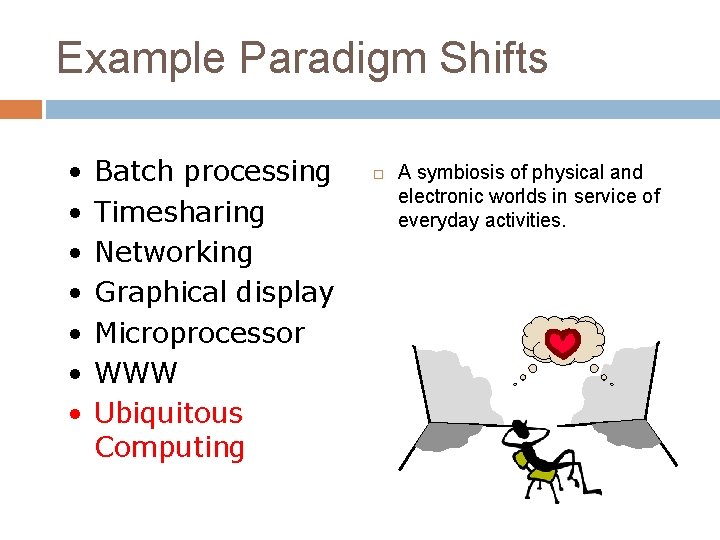
Example Paradigm Shifts • • Batch processing Timesharing Networking Graphical display Microprocessor WWW Ubiquitous Computing A symbiosis of physical and electronic worlds in service of everyday activities.
Time-sharing 1940 s and 1950 s – explosive technological growth 1960 s – need to channel the power J. C. R. Licklider at ARPA Single computer supporting multiple users
Video Display Units More suitable medium than paper 1962 – Sutherland's Sketchpad Computers for visualizing and manipulating data One person's contribution could drastically change the history of computing
Programming toolkits Engelbart at Stanford Research Institute 1963 – augmenting man's intellect 1968 NLS/Augment system demonstration The right programming toolkit provides building blocks to producing complex interactive systems
Personal computing 1970 s – Papert's LOGO language for simple graphics programming by children A system is more powerful as it becomes easier to user Future of computing in small, powerful machines dedicated to the individual Kay at Xerox PARC – the Dynabook as the ultimate personal computer
Window systems and the WIMP Interface Humans can pursue more than one task at a time Windows used for dialogue partitioning, to “change the topic” 1981 – Xerox Star first commercial windowing system Windows, Icons, Menus and Pointers now familiar interaction mechanisms
Metaphor Relating computing to other real-world activity is effective teaching technique LOGO's turtle dragging its tail file management on an office desktop word processing as typing financial analysis on spreadsheets virtual reality – user inside the metaphor Problems some tasks do not fit into a given metaphor cultural bias
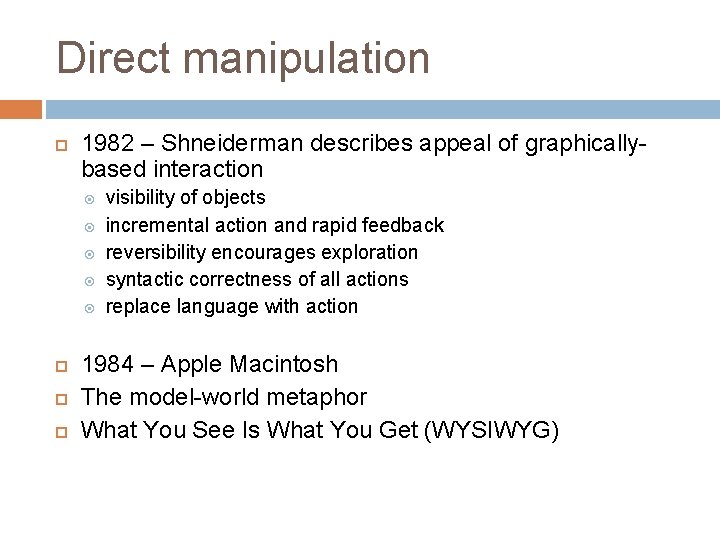
Direct manipulation 1982 – Shneiderman describes appeal of graphicallybased interaction visibility of objects incremental action and rapid feedback reversibility encourages exploration syntactic correctness of all actions replace language with action 1984 – Apple Macintosh The model-world metaphor What You See Is What You Get (WYSIWYG)
Language versus Action actions do not always speak louder than words! DM – interface replaces underlying system language paradigm interface as mediator interface acts as intelligent agent programming by example is both action and language
Hypertext 1945 – Vannevar Bush and the memex key to success in managing explosion of information mid 1960 s – Nelson describes hypertext as non-linear browsing structure hypermedia and multimedia Nelson's Xanadu project still a dream today
Multimodality A mode is a human communication channel Emphasis on simultaneous use of multiple channels for input and output
Computer Supported Cooperative Work (CSCW) CSCW removes bias of single user / single computer system Can no longer neglect the social aspects Electronic mail is most prominent success
The World Wide Web Hypertext, as originally realized, was a closed system Simple, universal protocols (e. g. HTTP) and mark-up languages (e. g. HTML) made publishing and accessing easy Critical mass of users lead to a complete transformation of our information economy.