
Interaction of Radiation with Matter Lecture 3 For

- Slides: 56
Interaction of Radiation with Matter - Lecture 3 For sp. Rs sitting FRCR Part I Examinations Amanda Barry, Ph. D
Interaction of Charge Particles with Matter TO RECAP: 1. Scattered Radiation & Secondary electrons - sources of scatter and effects 2. Charged particles are surrounded by an electrostatic field 3. Charged particle undergoes many interactions 4. Energy loss due to interaction of Coulomb fields of incoming charged particle and that of atomic electron/nuclei 1. Collisional Losses – Ionisation/Excitation via Hard & Soft X ns 2. Radiative Losses – Bremsstrahlung via interaction with nuclear field 5. Stopping Power and Restricted Stopping Power 1. Absorbed Dose 2. Particle Range
Interaction of Sub-atomic Particles with Matter 3. Interaction of sub atomic particles with matter. 1. Ionisation and excitation due to charged particles 2. Electrons 1. collision loss 2. radiative loss 3. stopping power due to each and total stopping power, 4. Particle range 5. Bragg peak Bremsstrahlung Neutrons - elastic and inelastic collisions. Protons, ionisation profile Elementary knowledge of pions and heavy ions. 3. 4. 5. 6.
Introduction to Hadrons What are Hadrons? • Hadrons are subatomic particles which experience the strong nuclear force e. g. neutrons and protons • They are composed of fundamental particles called quarks, antiquarks and gluons • Generally, cannot see free (anti-)quarks or gluons • Hadrons are either Baryons (spin-1/2) or Mesons (spin-0) • Examples of Baryons are Neutrons and Protons • Examples of Mesons are Pions Where are Hadrons useful?
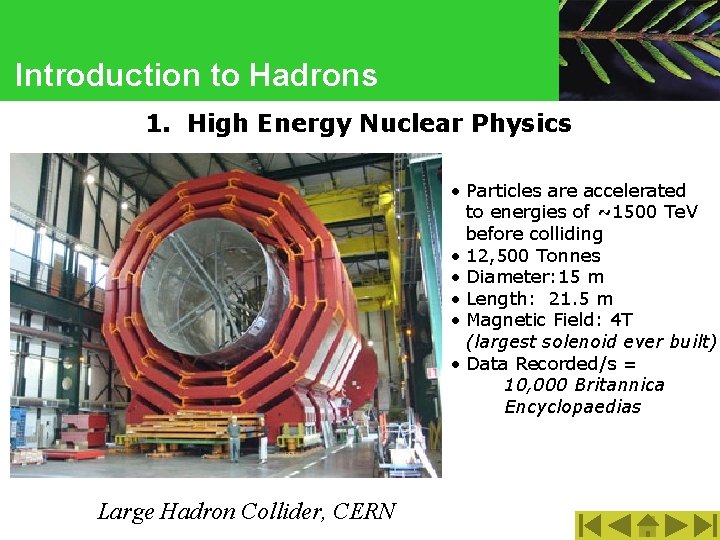
Introduction to Hadrons 1. High Energy Nuclear Physics • Particles are accelerated to energies of ~1500 Te. V before colliding • 12, 500 Tonnes • Diameter: 15 m • Length: 21. 5 m • Magnetic Field: 4 T (largest solenoid ever built) • Data Recorded/s = 10, 000 Britannica Encyclopaedias Large Hadron Collider, CERN
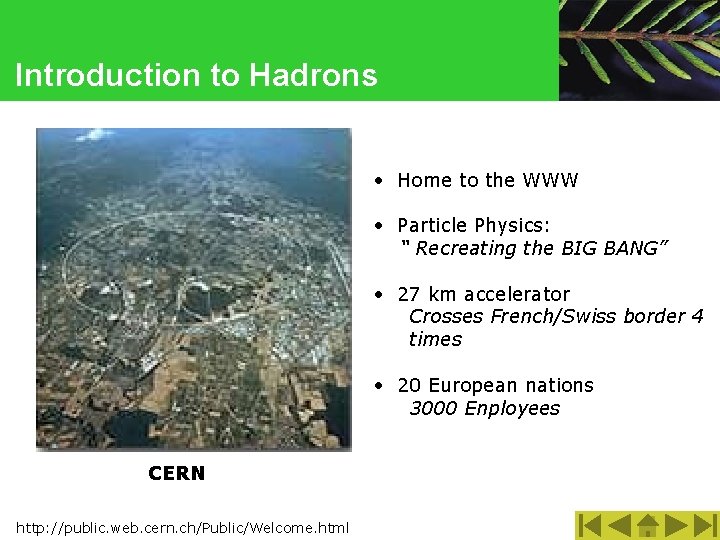
Introduction to Hadrons • Home to the WWW • Particle Physics: “ Recreating the BIG BANG” • 27 km accelerator Crosses French/Swiss border 4 times • 20 European nations 3000 Enployees CERN http: //public. web. cern. ch/Public/Welcome. html
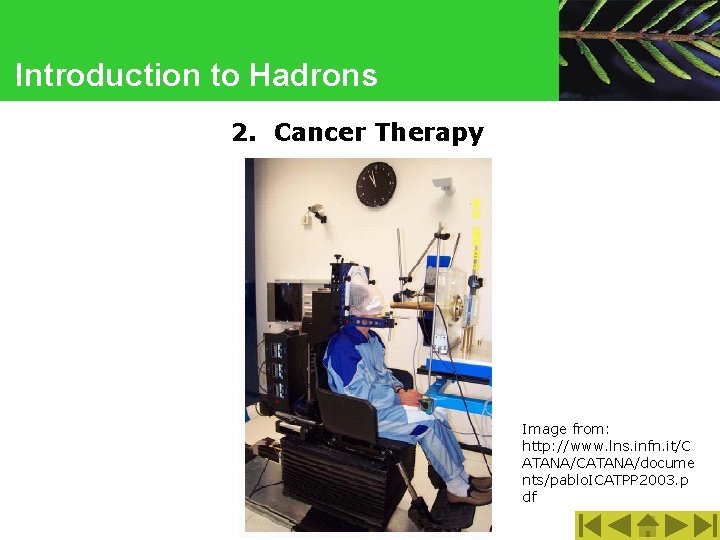
Introduction to Hadrons 2. Cancer Therapy Image from: http: //www. lns. infn. it/C ATANA/CATANA/docume nts/pablo. ICATPP 2003. p df
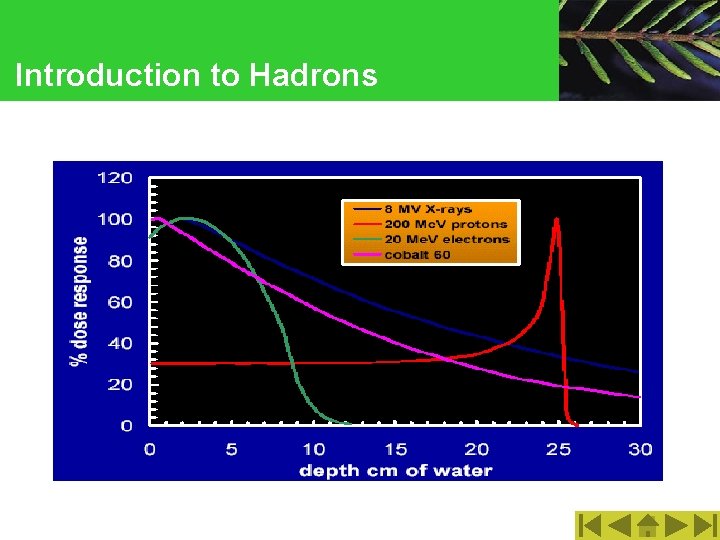
Introduction to Hadrons Why are Hadrons useful in Cancer Therapy? In many cases: • penetration depth can be well-defined and adjustable • most energy deposited at end-of-range • no dose beyond target • dose to normal tissue minimised • good tumour kill If most HADRON energy deposited at a depth that depends precisely on the energy of the particles Þ tumours can be targeted more accurately, allowing a larger radiation dose to be delivered Þ speeding up the treatment programme. HADRONS ENABLE DELIVERY OF HIGH DOSE TO THE TUMOUR SPARING THE SURRONDING TISSUES
Introduction to Hadrons
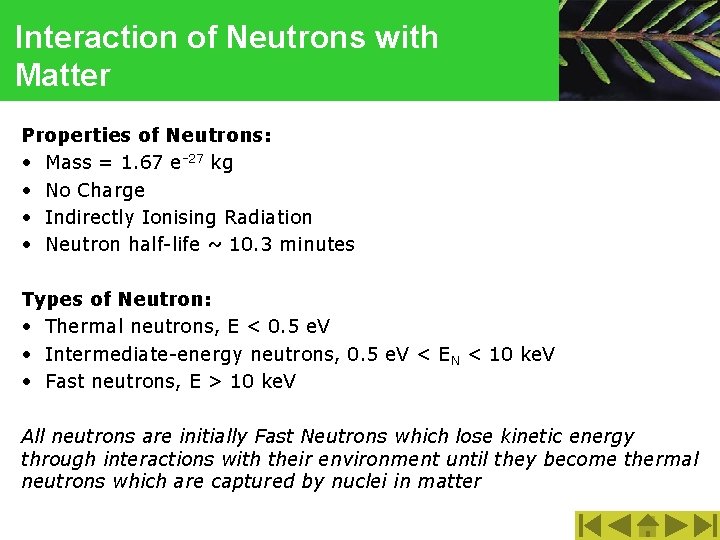
Interaction of Neutrons with Matter Properties of Neutrons: • Mass = 1. 67 e-27 kg • No Charge • Indirectly Ionising Radiation • Neutron half-life ~ 10. 3 minutes Types of Neutron: • Thermal neutrons, E < 0. 5 e. V • Intermediate-energy neutrons, 0. 5 e. V < EN < 10 ke. V • Fast neutrons, E > 10 ke. V All neutrons are initially Fast Neutrons which lose kinetic energy through interactions with their environment until they become thermal neutrons which are captured by nuclei in matter
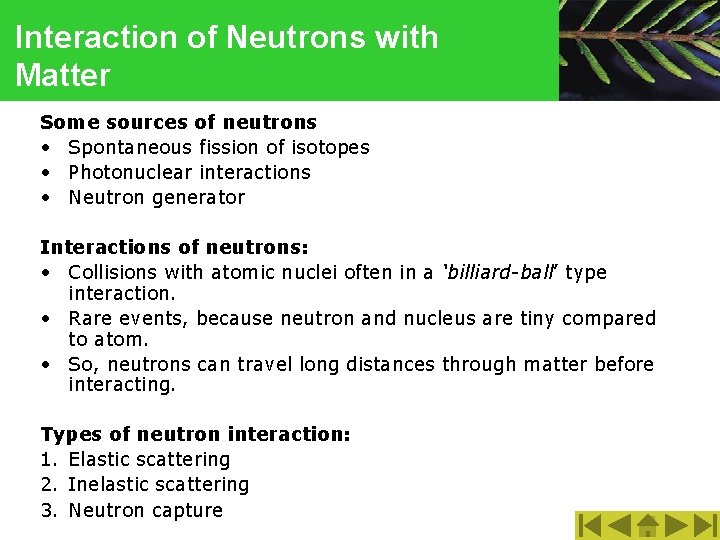
Interaction of Neutrons with Matter Some sources of neutrons • Spontaneous fission of isotopes • Photonuclear interactions • Neutron generator Interactions of neutrons: • Collisions with atomic nuclei often in a ‘billiard-ball’ type interaction. • Rare events, because neutron and nucleus are tiny compared to atom. • So, neutrons can travel long distances through matter before interacting. Types of neutron interaction: 1. Elastic scattering 2. Inelastic scattering 3. Neutron capture
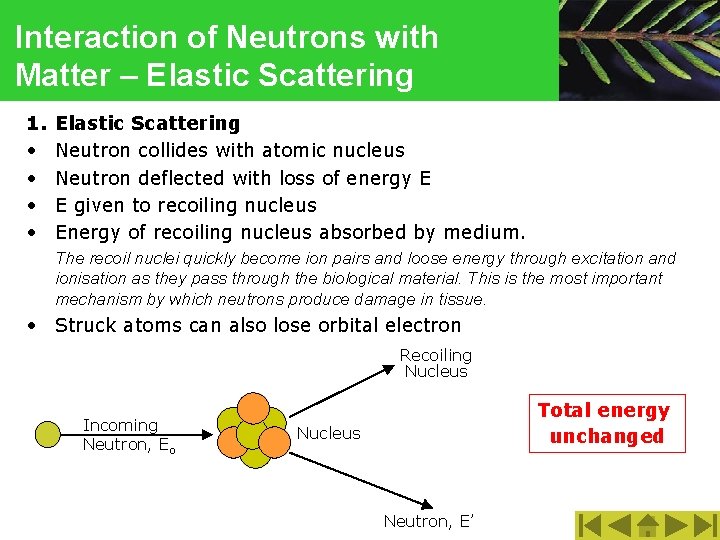
Interaction of Neutrons with Matter – Elastic Scattering 1. • • Elastic Scattering Neutron collides with atomic nucleus Neutron deflected with loss of energy E E given to recoiling nucleus Energy of recoiling nucleus absorbed by medium. The recoil nuclei quickly become ion pairs and loose energy through excitation and ionisation as they pass through the biological material. This is the most important mechanism by which neutrons produce damage in tissue. • Struck atoms can also lose orbital electron Recoiling Nucleus Incoming Neutron, Eo Total energy unchanged Nucleus Neutron, E’
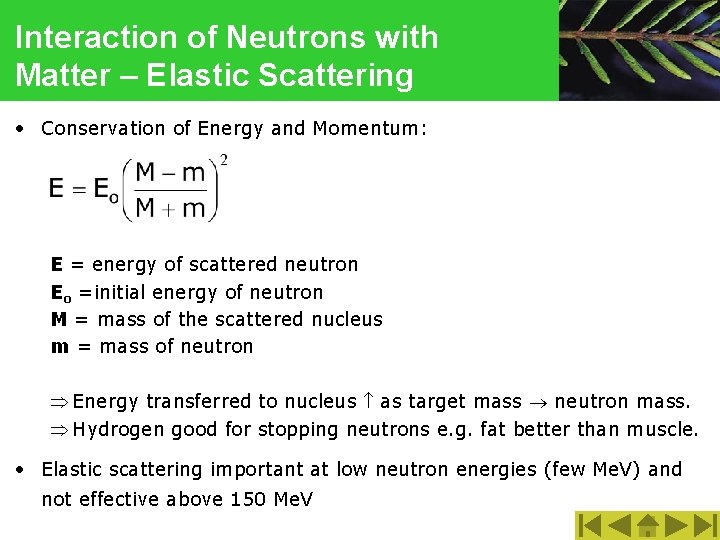
Interaction of Neutrons with Matter – Elastic Scattering • Conservation of Energy and Momentum: E = energy of scattered neutron Eo =initial energy of neutron M = mass of the scattered nucleus m = mass of neutron Þ Energy transferred to nucleus as target mass neutron mass. Þ Hydrogen good for stopping neutrons e. g. fat better than muscle. • Elastic scattering important at low neutron energies (few Me. V) and not effective above 150 Me. V
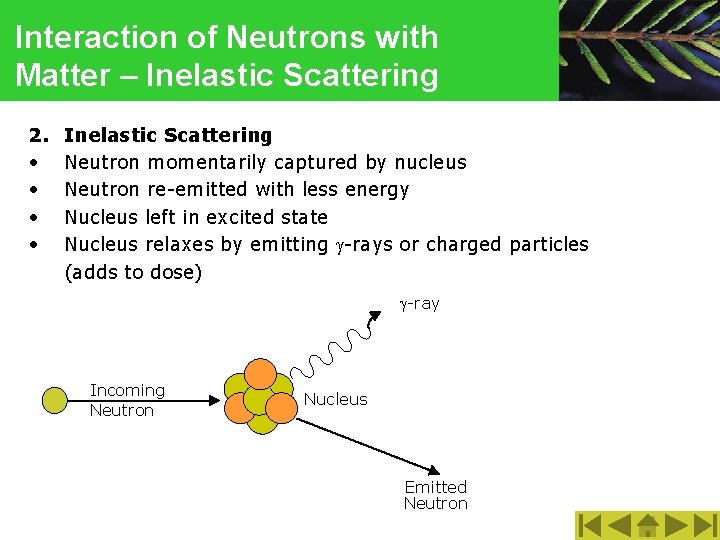
Interaction of Neutrons with Matter – Inelastic Scattering 2. • • Inelastic Scattering Neutron momentarily captured by nucleus Neutron re-emitted with less energy Nucleus left in excited state Nucleus relaxes by emitting g-rays or charged particles (adds to dose) g-ray Incoming Neutron Nucleus Emitted Neutron
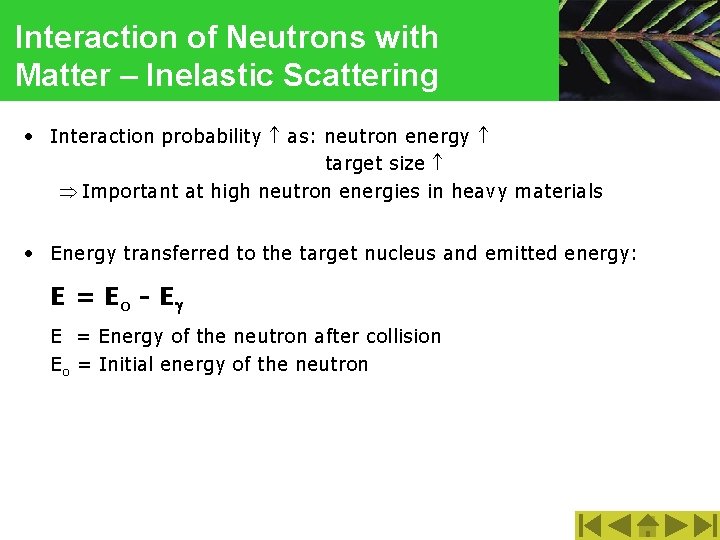
Interaction of Neutrons with Matter – Inelastic Scattering • Interaction probability as: neutron energy target size Þ Important at high neutron energies in heavy materials • Energy transferred to the target nucleus and emitted energy: E = Eo - E g E = Energy of the neutron after collision Eo = Initial energy of the neutron
Interaction of Neutrons with Matter- Neutron Capture 3. Neutron Capture • Neutron captured by nucleus of absorbing material • Only g-ray emitted. • Probability of capture is inversely proportional to the energy of the neutron. Þ Low energy (=thermal neutrons) have the highest probability for capture. g-ray Slow Neutron Nucleus Na 23 Na 24
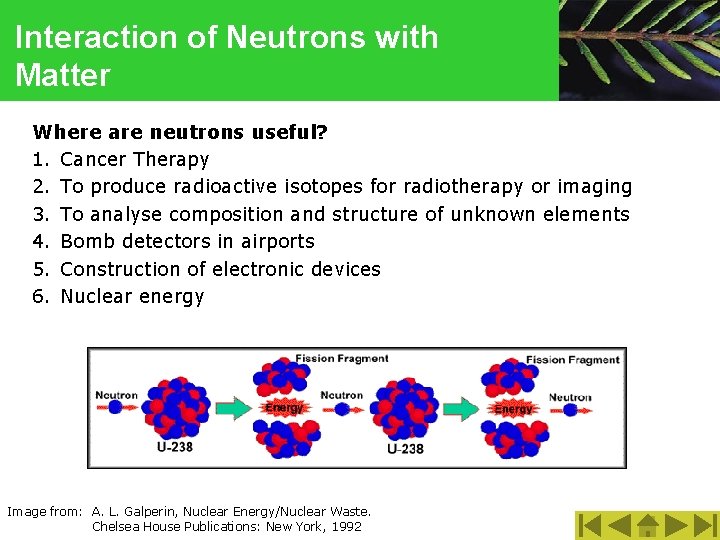
Interaction of Neutrons with Matter Where are neutrons useful? 1. Cancer Therapy 2. To produce radioactive isotopes for radiotherapy or imaging 3. To analyse composition and structure of unknown elements 4. Bomb detectors in airports 5. Construction of electronic devices 6. Nuclear energy Image from: A. L. Galperin, Nuclear Energy/Nuclear Waste. Chelsea House Publications: New York, 1992
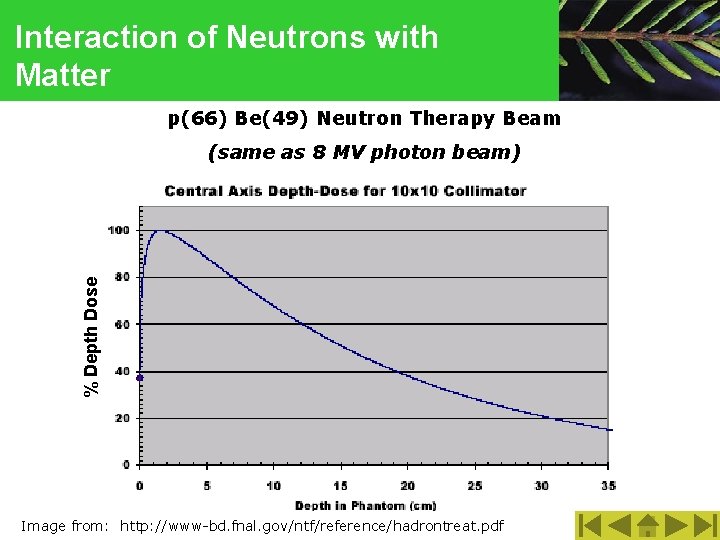
Interaction of Neutrons with Matter p(66) Be(49) Neutron Therapy Beam % Depth Dose (same as 8 MV photon beam) Image from: http: //www-bd. fnal. gov/ntf/reference/hadrontreat. pdf
Interaction of Neutrons with Matter Neutrons for Radiotherapy • Neutrons have good tumour killing capabilities • Tissue damage is primarily by nuclear interactions • Neutrons are high LET radiation + have high B. E. Þ Lower chance of tumour repair Þ Often lower dose required Þ Good for radioresistant tumours
Protons Properties of Protons: • Mass = 1. 67 e-27 kg • Positive Charge • Directly Ionising Radiation • Proton half-life ~ 1035 years Types of Proton Interaction: • Electronic - Ionisation and Excitation of atomic electrons • Nuclear – Coulomb Scattering – Elastic Collision – Non-elastic nuclear collision (20%)
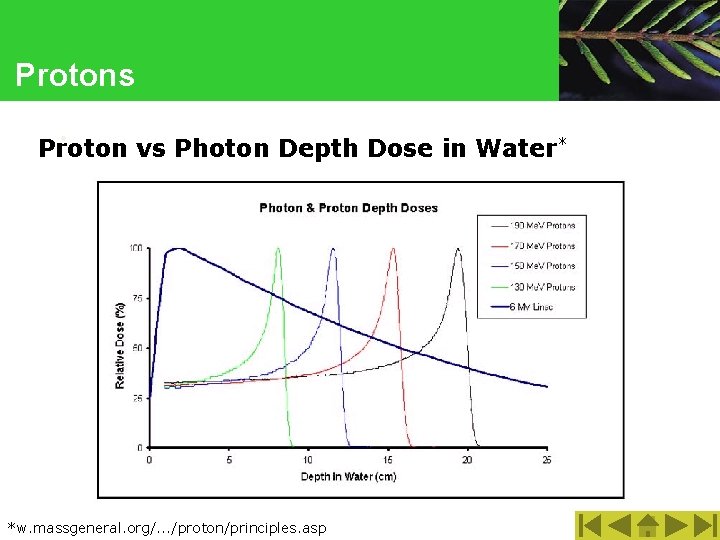
Protons • Proton vs Photon Depth Dose in Water* *w. massgeneral. org/. . . /proton/principles. asp
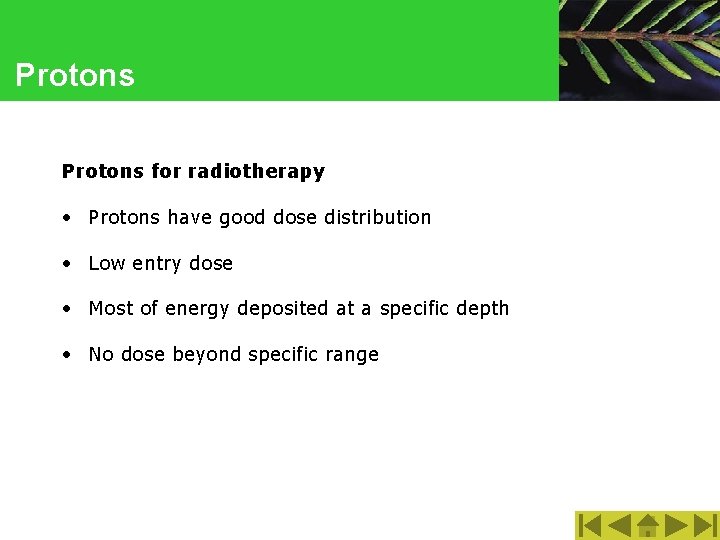
Protons for radiotherapy • Protons have good dose distribution • Low entry dose • Most of energy deposited at a specific depth • No dose beyond specific range
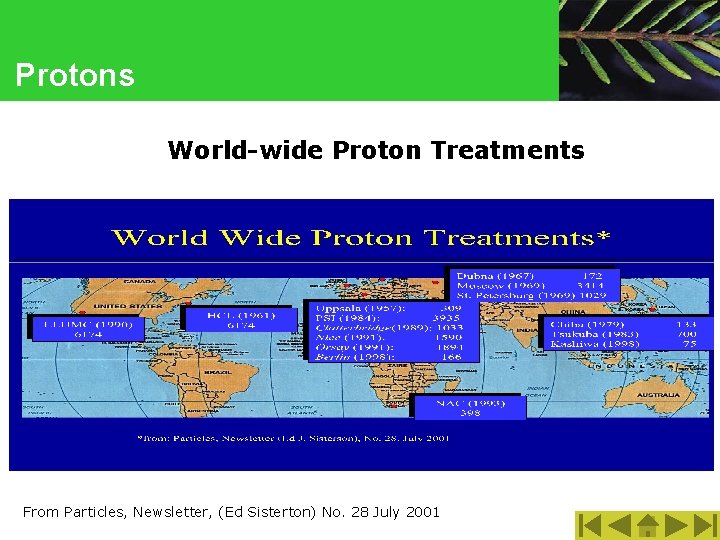
Protons World-wide Proton Treatments From Particles, Newsletter, (Ed Sisterton) No. 28 July 2001
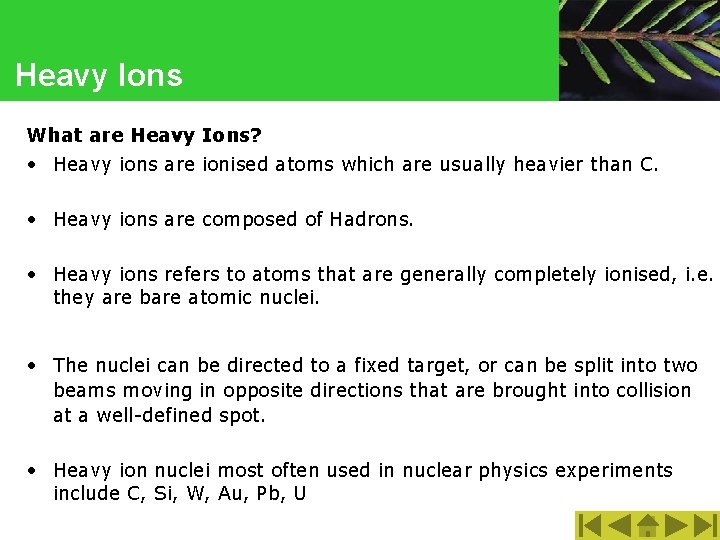
Heavy Ions What are Heavy Ions? • Heavy ions are ionised atoms which are usually heavier than C. • Heavy ions are composed of Hadrons. • Heavy ions refers to atoms that are generally completely ionised, i. e. they are bare atomic nuclei. • The nuclei can be directed to a fixed target, or can be split into two beams moving in opposite directions that are brought into collision at a well-defined spot. • Heavy ion nuclei most often used in nuclear physics experiments include C, Si, W, Au, Pb, U
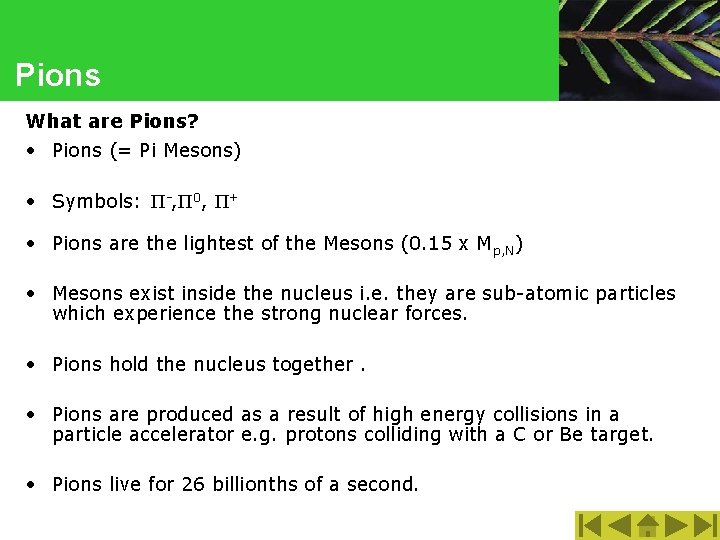
Pions What are Pions? • Pions (= Pi Mesons) • Symbols: P-, P 0, P+ • Pions are the lightest of the Mesons (0. 15 x Mp, N) • Mesons exist inside the nucleus i. e. they are sub-atomic particles which experience the strong nuclear forces. • Pions hold the nucleus together. • Pions are produced as a result of high energy collisions in a particle accelerator e. g. protons colliding with a C or Be target. • Pions live for 26 billionths of a second.
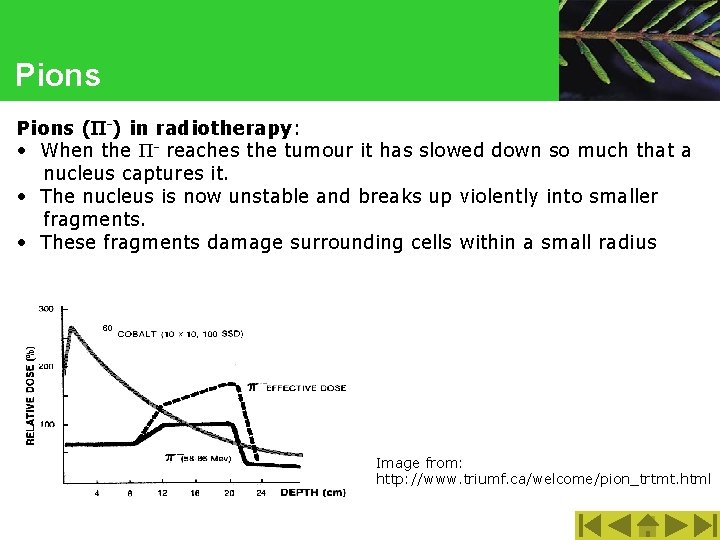
Pions (P-) in radiotherapy: • When the P- reaches the tumour it has slowed down so much that a nucleus captures it. • The nucleus is now unstable and breaks up violently into smaller fragments. • These fragments damage surrounding cells within a small radius Image from: http: //www. triumf. ca/welcome/pion_trtmt. html
Hadron Comparison • Low LET = Protons & Photons Þ Similar RBE but protons have sharp dose fall off at a specific depth determined by proton energy • High LET = Neutrons, Heavy Ions & Pions Þ Have high RBE, good tumour kill, poor cell repair
End of Lecture 3
QUIZ
Heavy ions are ions that are heavier than which element? A: Carbon
What type of interaction is most common for photons in the radiotherapy energy range? A: Compton Effect
What do you call a sub-atomic particle that experiences the strong nuclear force? A: Hadron
How does the photoelectric effect depend on energy? A: 1/E 3
Which Hadron is used for detecting bombs in airports? A: Neutron
What is another name for an energetic secondary electron? A: Delta ray
What is produced as a result of Pair Production? A: positron/electron pair
What is the mass of a proton? A: 1. 67 e-27 kg
When many electrons are produced as a result of the Auger Effect, we have an …? A: Auger Shower
Approximately, what is the LET of a 5 Me. V neutron? A: ~ 50 ke. V/mm
How many interactions does a 1 Me. V electron typically undergo before coming to a stop? A: 100, 000
What type of particle follows a tortuous path when passing through matter? A: Electron
Neutrons belong to which group of Hadrons? A: Baryons
How does the Compton effect depend on Z? A: It is independent of Z
What type of radiation is produced when electrons come close to the atomic nucleus ? A: Bremsstrahlung
Of these two sub-atomic particles, which has the largest LET? Photon? Neutron? A: Neutron
What type of collision results in no net loss of energy? A: Elastic
Hadrons are made from what type of fundamental particles? A: Quarks
What is the rest mass energy of an electron in Me. V? A: 0. 511 Me. V
Which of these is a form of DIRECTLY ionising radiation? Electron? Neutron? A: Electron
What type of particle collision is short-handed by b >> a? A: Soft Collision
What is produced when an electron and a positron annihilate? A: Two g-rays
What is the probability of photon interaction called? A: Linear Attenuation Coefficient
In which material do electrons of the same energy have the longest range? Bone? Fat? A: Fat
Radiation that is easily stopped in matter, has a HIGH or LOW LET? A: High
What is the probability that a charged particle will pass through a medium without interaction? A: Zero
How much energy is required to form an ion pair in dry air? A: ~ 34 e. V