
Interaction of heavy charged particles and ions with
- Slides: 3
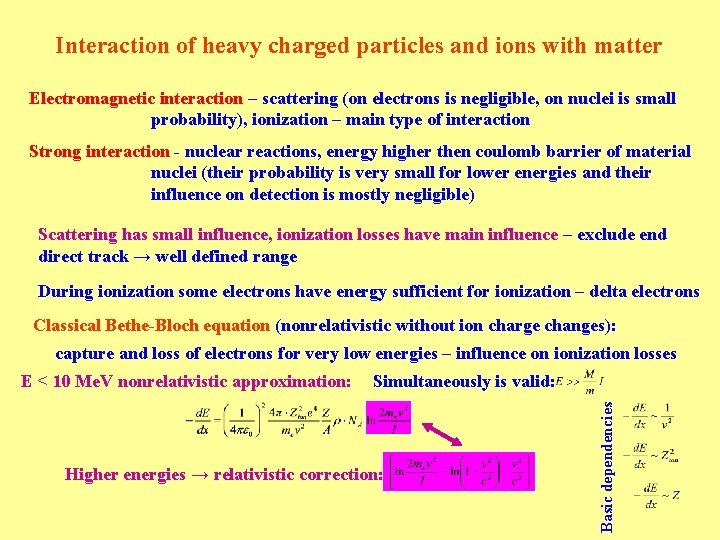
Interaction of heavy charged particles and ions with matter Electromagnetic interaction – scattering (on electrons is negligible, on nuclei is small probability), ionization – main type of interaction Strong interaction - nuclear reactions, energy higher then coulomb barrier of material nuclei (their probability is very small for lower energies and their influence on detection is mostly negligible) Scattering has small influence, ionization losses have main influence – exclude end direct track → well defined range During ionization some electrons have energy sufficient for ionization – delta electrons Classical Bethe-Bloch equation (nonrelativistic without ion charge changes): capture and loss of electrons for very low energies – influence on ionization losses Simultaneously is valid: Higher energies → relativistic correction: Basic dependencies E < 10 Me. V nonrelativistic approximation:
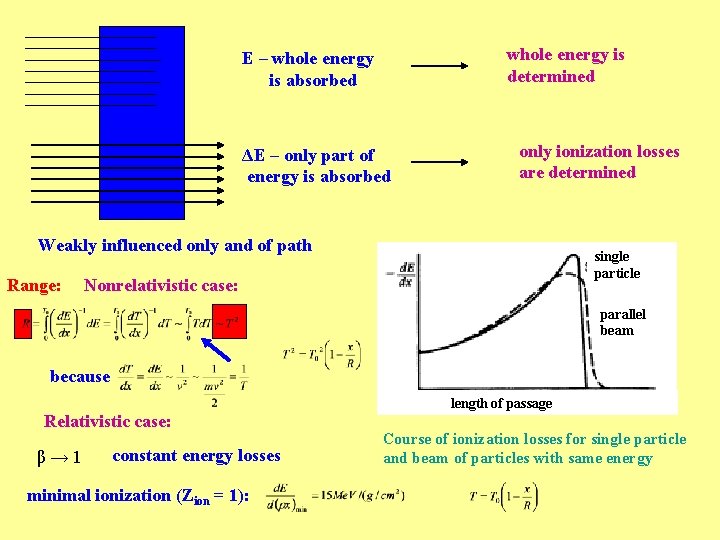
whole energy is determined E – whole energy is absorbed ΔE – only part of energy is absorbed only ionization losses are determined Weakly influenced only and of path Range: single particle Nonrelativistic case: parallel beam because length of passage Relativistic case: β→ 1 constant energy losses minimal ionization (Zion = 1): Course of ionization losses for single particle and beam of particles with same energy
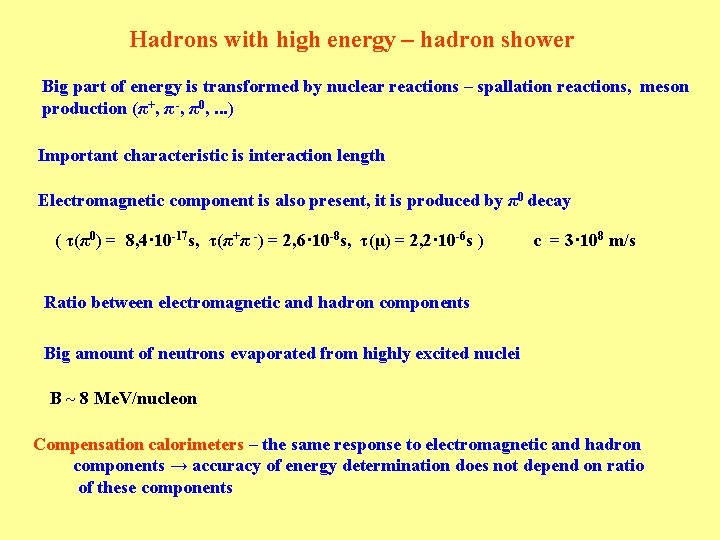
Hadrons with high energy – hadron shower Big part of energy is transformed by nuclear reactions – spallation reactions, meson production (π+, π -, π0, . . . ) Important characteristic is interaction length Electromagnetic component is also present, it is produced by π0 decay ( τ(π0) = 8, 4·10 -17 s, τ(π+π -) = 2, 6·10 -8 s, τ(μ) = 2, 2·10 -6 s ) c = 3·108 m/s Ratio between electromagnetic and hadron components Big amount of neutrons evaporated from highly excited nuclei B ~ 8 Me. V/nucleon Compensation calorimeters – the same response to electromagnetic and hadron components → accuracy of energy determination does not depend on ratio of these components