
Interaction of gamma rays with matter Aluminum total
![Interaction of gamma rays with matter Aluminum total absorption coefficient: μ/ρ [cm 2/g] i=1](https://slidetodoc.com/presentation_image_h2/e8f6cf5dad826c591b95718b657c8809/image-1.jpg "Interaction of gamma rays with matter Aluminum total absorption coefficient: μ/ρ [cm 2/g] i=1")
- Slides: 18
Interaction of gamma rays with matter Aluminum total absorption coefficient: μ/ρ [cm 2/g] i=1 photoelectric effect i=2 Compton scattering i=3 pair production Hans-Jürgen Wollersheim - 2020 Lead
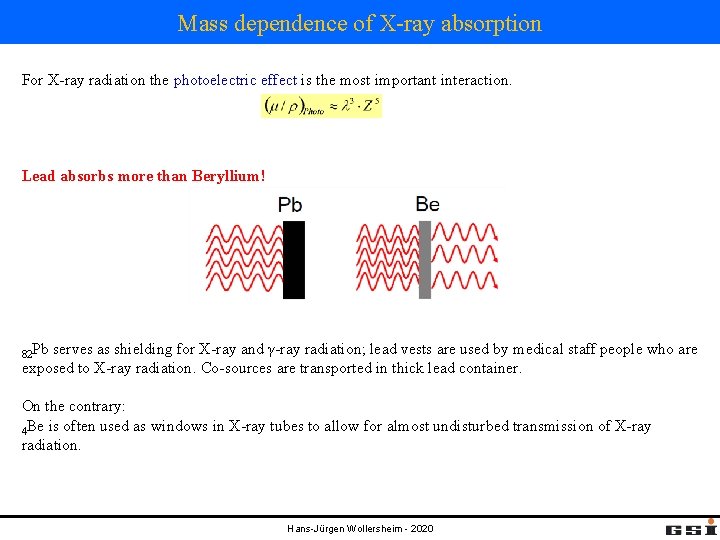
Mass dependence of X-ray absorption For X-ray radiation the photoelectric effect is the most important interaction. Lead absorbs more than Beryllium! 82 Pb serves as shielding for X-ray and γ-ray radiation; lead vests are used by medical staff people who are exposed to X-ray radiation. Co-sources are transported in thick lead container. On the contrary: 4 Be is often used as windows in X-ray tubes to allow for almost undisturbed transmission of X-ray radiation. Hans-Jürgen Wollersheim - 2020
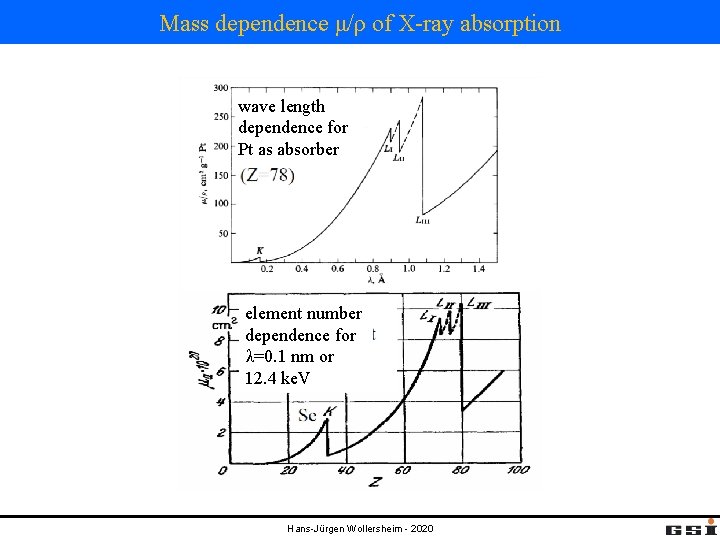
Mass dependence μ/ρ of X-ray absorption wave length dependence for Pt as absorber element number dependence for λ=0. 1 nm or 12. 4 ke. V Hans-Jürgen Wollersheim - 2020
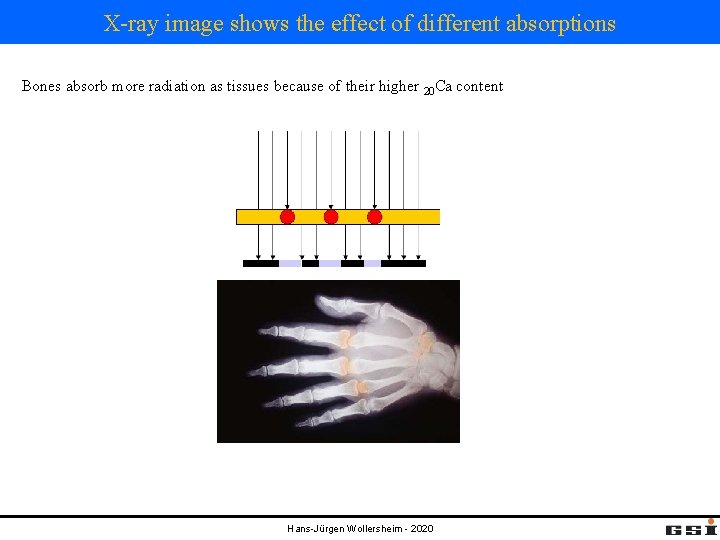
X-ray image shows the effect of different absorptions Bones absorb more radiation as tissues because of their higher 20 Ca content Hans-Jürgen Wollersheim - 2020
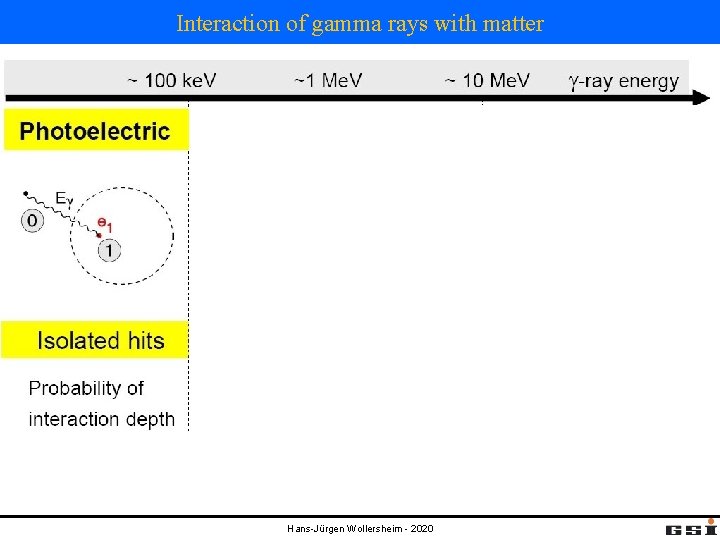
Interaction of gamma rays with matter Hans-Jürgen Wollersheim - 2020
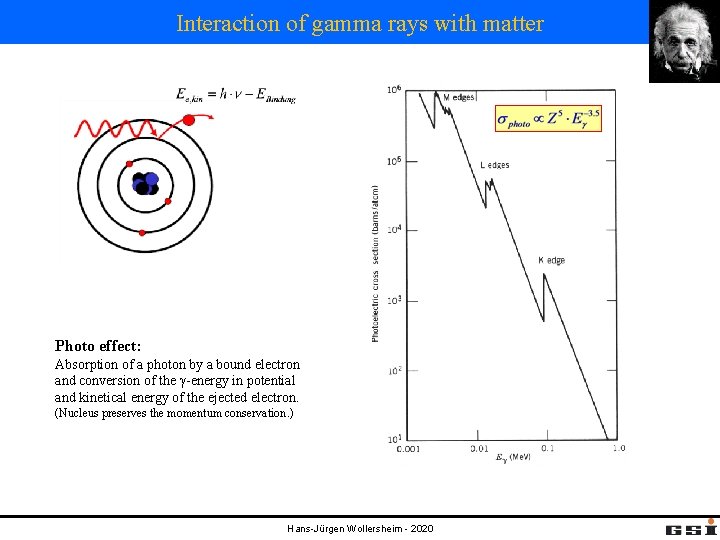
Interaction of gamma rays with matter Photo effect: Absorption of a photon by a bound electron and conversion of the γ-energy in potential and kinetical energy of the ejected electron. (Nucleus preserves the momentum conservation. ) Hans-Jürgen Wollersheim - 2020
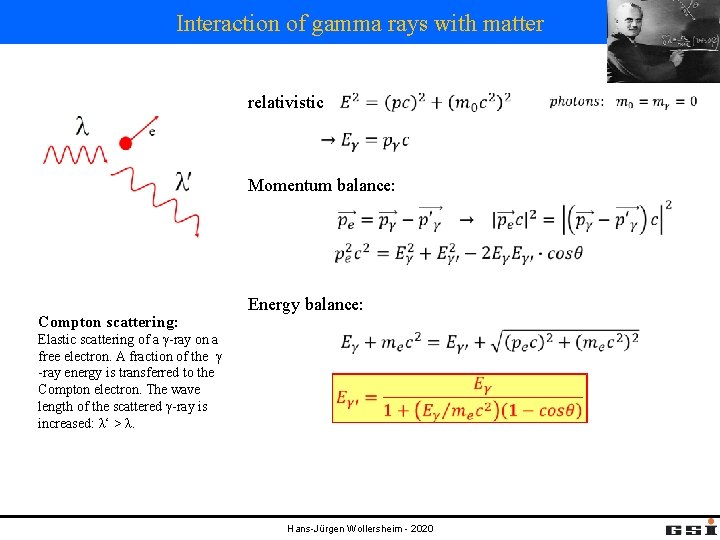
Interaction of gamma rays with matter relativistic Momentum balance: Compton scattering: Energy balance: Elastic scattering of a γ-ray on a free electron. A fraction of the γ -ray energy is transferred to the Compton electron. The wave length of the scattered γ-ray is increased: λ‘ > λ. Hans-Jürgen Wollersheim - 2020
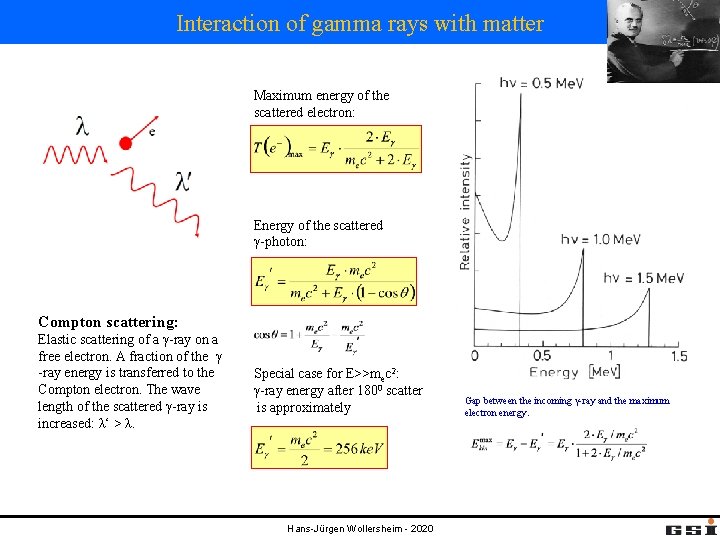
Interaction of gamma rays with matter Maximum energy of the scattered electron: Energy of the scattered γ-photon: Compton scattering: Elastic scattering of a γ-ray on a free electron. A fraction of the γ -ray energy is transferred to the Compton electron. The wave length of the scattered γ-ray is increased: λ‘ > λ. Special case for E>>mec 2: γ-ray energy after 1800 scatter is approximately Hans-Jürgen Wollersheim - 2020 Gap between the incoming γ-ray and the maximum electron energy.
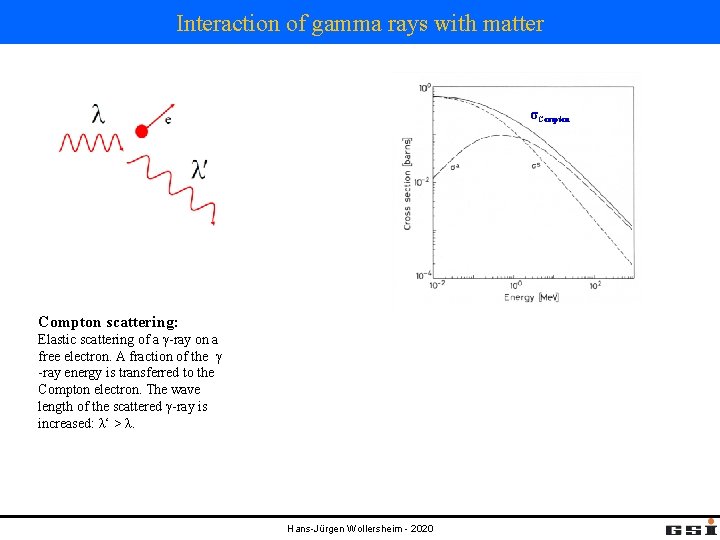
Interaction of gamma rays with matter σCompton scattering: Elastic scattering of a γ-ray on a free electron. A fraction of the γ -ray energy is transferred to the Compton electron. The wave length of the scattered γ-ray is increased: λ‘ > λ. Hans-Jürgen Wollersheim - 2020
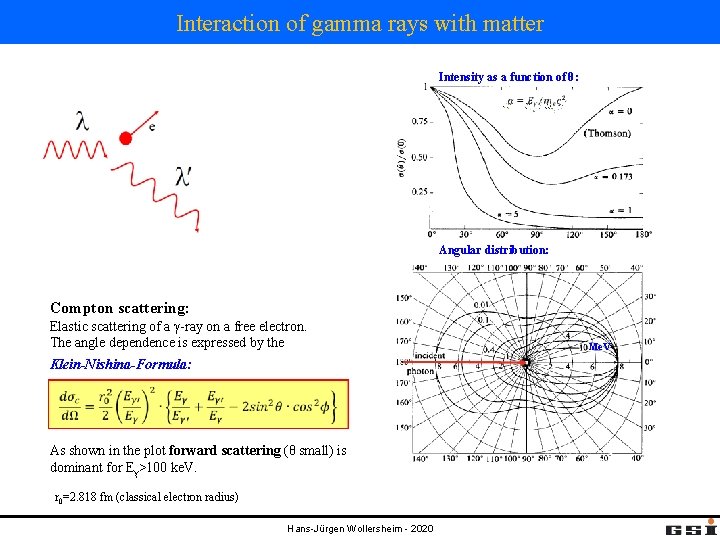
Interaction of gamma rays with matter Intensity as a function of θ: Angular distribution: Compton scattering: Elastic scattering of a γ-ray on a free electron. The angle dependence is expressed by the Klein-Nishina-Formula: As shown in the plot forward scattering (θ small) is dominant for Eγ>100 ke. V. r 0=2. 818 fm (classical electron radius) Hans-Jürgen Wollersheim - 2020 Me. V
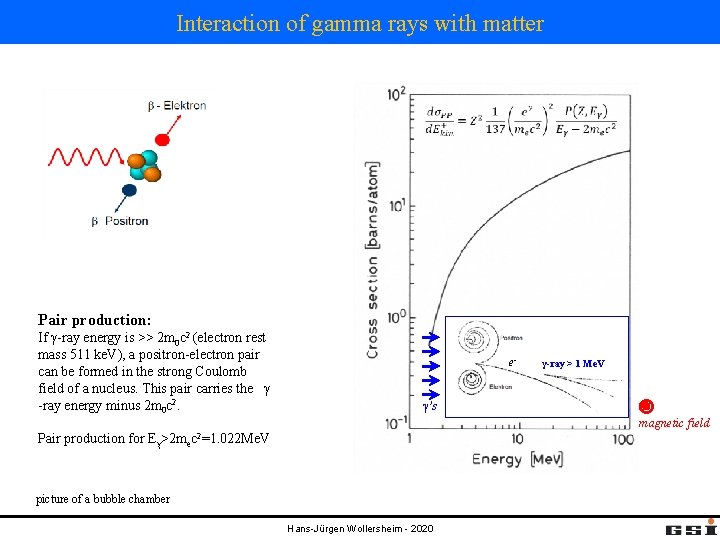
Interaction of gamma rays with matter Pair production: If γ-ray energy is >> 2 m 0 c 2 (electron rest mass 511 ke. V), a positron-electron pair can be formed in the strong Coulomb field of a nucleus. This pair carries the γ -ray energy minus 2 m 0 c 2. e- γ-ray > 1 Me. V γ’s magnetic field Pair production for Eγ>2 me c 2=1. 022 Me. V picture of a bubble chamber Hans-Jürgen Wollersheim - 2020
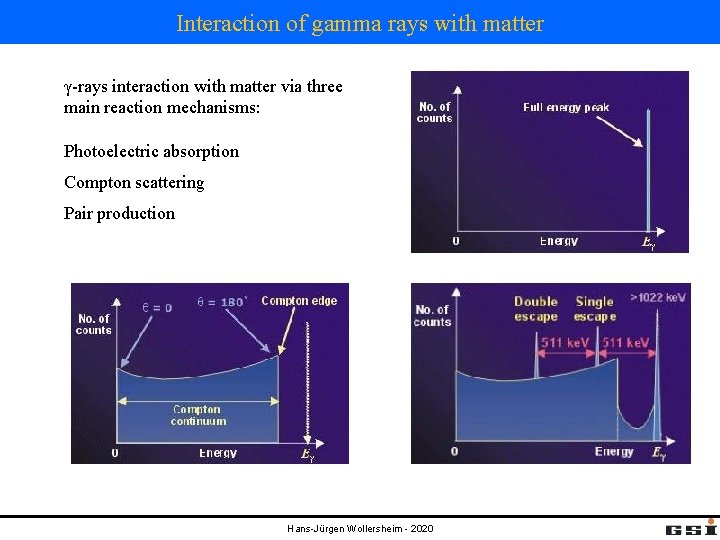
Interaction of gamma rays with matter γ-rays interaction with matter via three main reaction mechanisms: Photoelectric absorption Compton scattering Pair production Hans-Jürgen Wollersheim - 2020
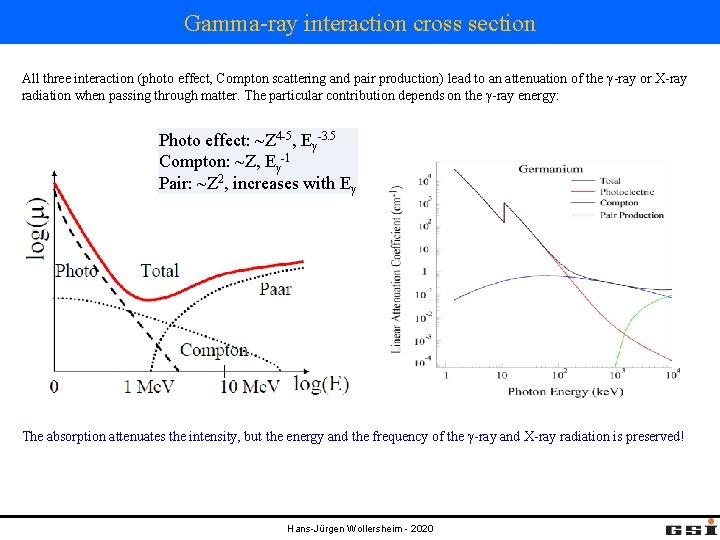
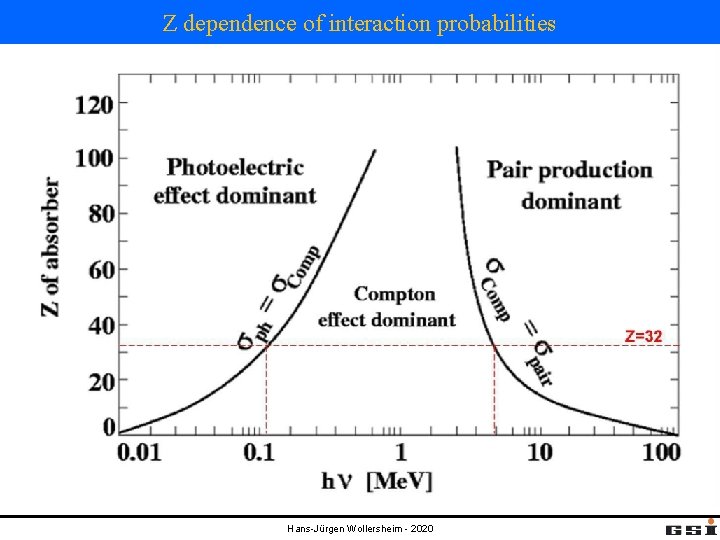
Gamma-ray interaction cross section All three interaction (photo effect, Compton scattering and pair production) lead to an attenuation of the γ-ray or X-ray radiation when passing through matter. The particular contribution depends on the γ-ray energy: Photo effect: ~Z 4 -5, Eγ-3. 5 Compton: ~Z, Eγ-1 Pair: ~Z 2, increases with Eγ The absorption attenuates the intensity, but the energy and the frequency of the γ-ray and X-ray radiation is preserved! Hans-Jürgen Wollersheim - 2020
Z dependence of interaction probabilities Hans-Jürgen Wollersheim - 2020
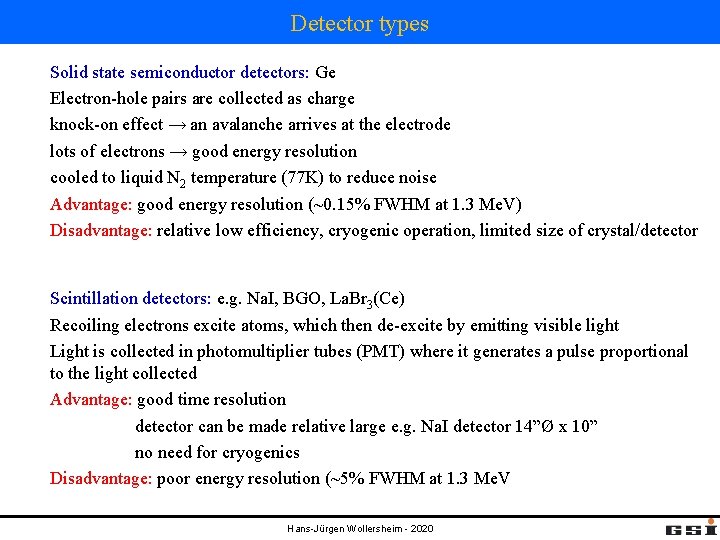
Detector types Solid state semiconductor detectors: Ge Electron-hole pairs are collected as charge knock-on effect → an avalanche arrives at the electrode lots of electrons → good energy resolution cooled to liquid N 2 temperature (77 K) to reduce noise Advantage: good energy resolution (~0. 15% FWHM at 1. 3 Me. V) Disadvantage: relative low efficiency, cryogenic operation, limited size of crystal/detector Scintillation detectors: e. g. Na. I, BGO, La. Br 3(Ce) Recoiling electrons excite atoms, which then de-excite by emitting visible light Light is collected in photomultiplier tubes (PMT) where it generates a pulse proportional to the light collected Advantage: good time resolution detector can be made relative large e. g. Na. I detector 14”Ø x 10” no need for cryogenics Disadvantage: poor energy resolution (~5% FWHM at 1. 3 Me. V Hans-Jürgen Wollersheim - 2020
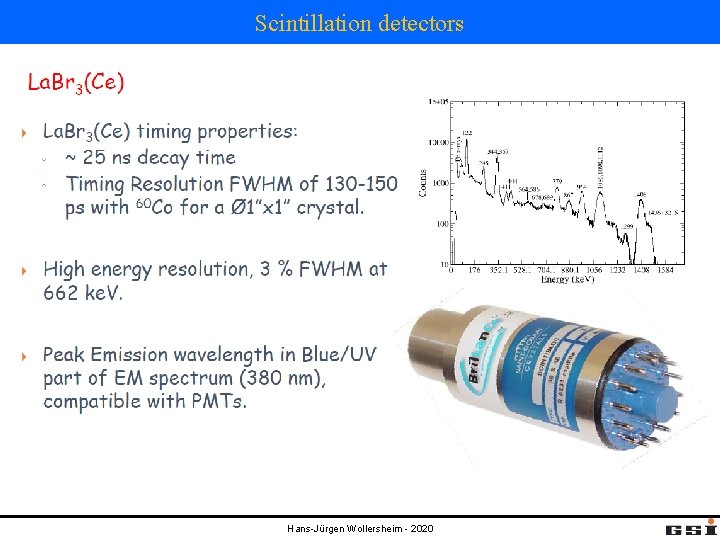
Scintillation detectors Hans-Jürgen Wollersheim - 2020
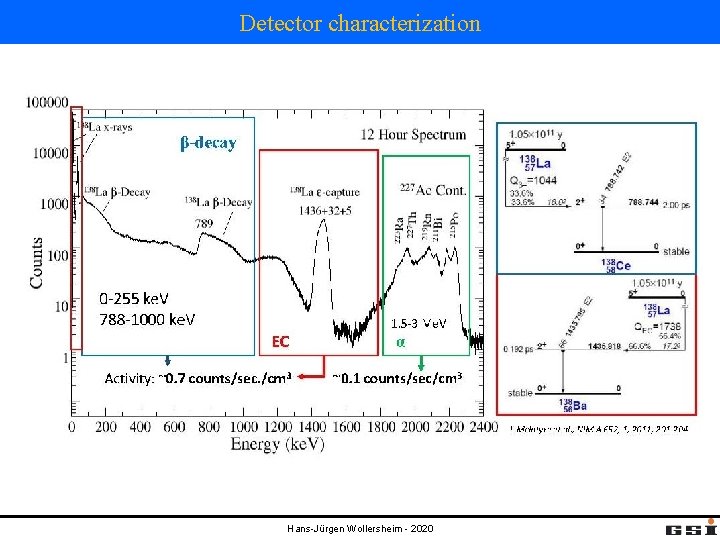
Detector characterization Hans-Jürgen Wollersheim - 2020
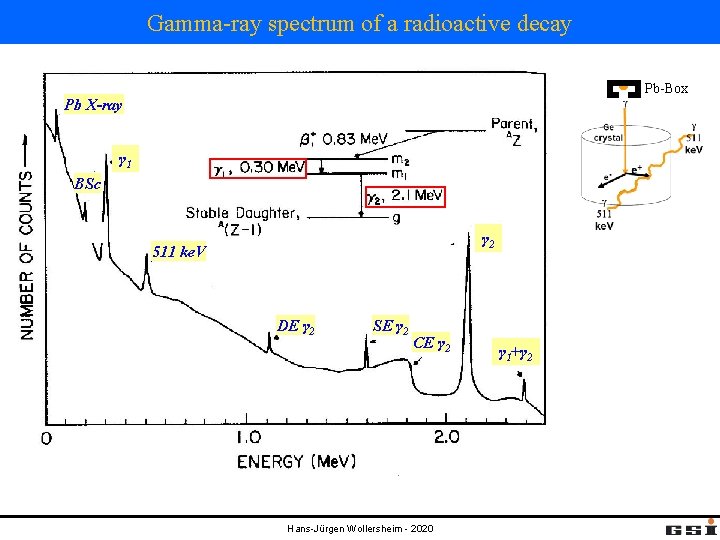
Gamma-ray spectrum of a radioactive decay Pb-Box Pb X-ray γ 1 BSc γ 2 511 ke. V DE γ 2 SE γ 2 CE γ 2 Hans-Jürgen Wollersheim - 2020 γ 1+γ 2