
Interaction of charged particles in matter BetheBloch formula
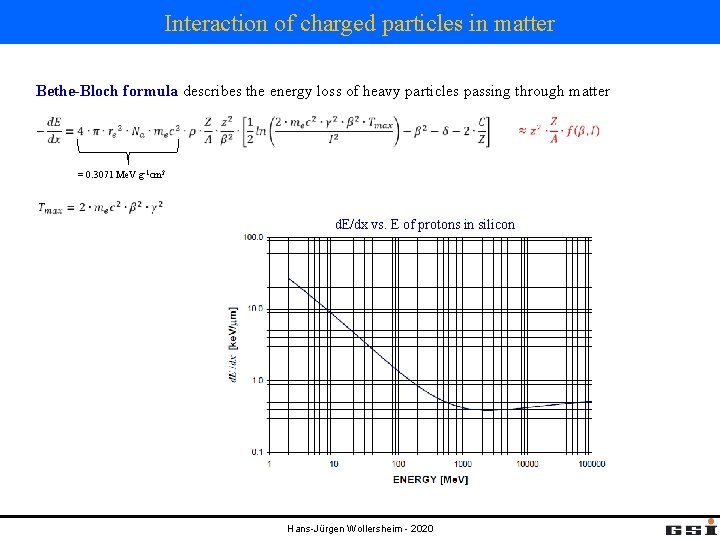
Interaction of charged particles in matter Bethe-Bloch formula describes the energy loss of heavy particles passing through matter = 0. 3071 Me. V g-1 cm 2 d. E/dx vs. E of protons in silicon Hans-Jürgen Wollersheim - 2020
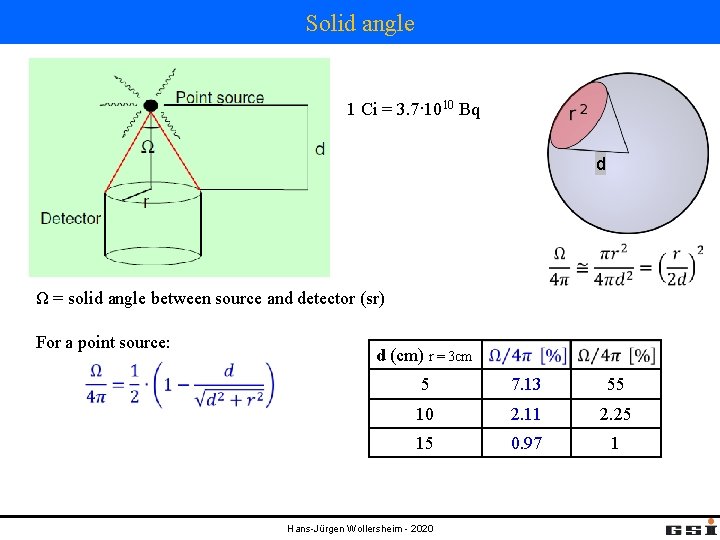
Solid angle 1 Ci = 3. 7·1010 Bq d Ω = solid angle between source and detector (sr) For a point source: d (cm) r = 3 cm 5 7. 13 55 10 2. 11 2. 25 15 0. 97 1 Hans-Jürgen Wollersheim - 2020
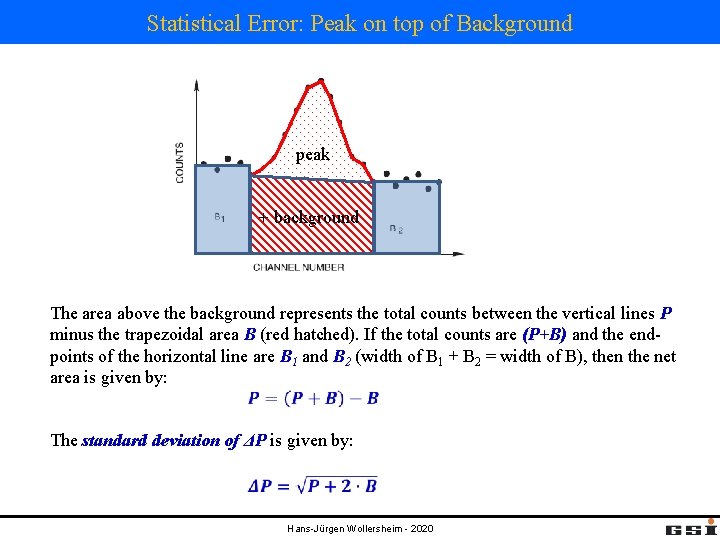
Statistical Error: Peak on top of Background peak + background The area above the background represents the total counts between the vertical lines P minus the trapezoidal area B (red hatched). If the total counts are (P+B) and the endpoints of the horizontal line are B 1 and B 2 (width of B 1 + B 2 = width of B), then the net area is given by: The standard deviation of ΔP is given by: Hans-Jürgen Wollersheim - 2020
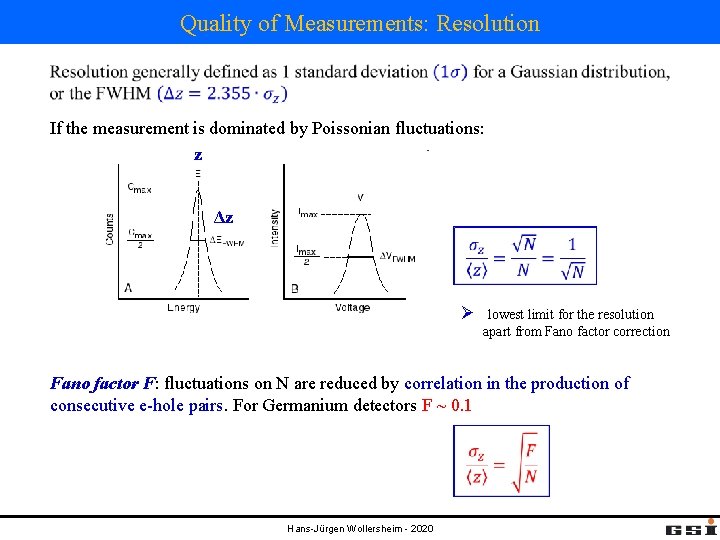
Quality of Measurements: Resolution If the measurement is dominated by Poissonian fluctuations: z Δz Ø lowest limit for the resolution apart from Fano factor correction Fano factor F: fluctuations on N are reduced by correlation in the production of consecutive e-hole pairs. For Germanium detectors F ~ 0. 1 Hans-Jürgen Wollersheim - 2020
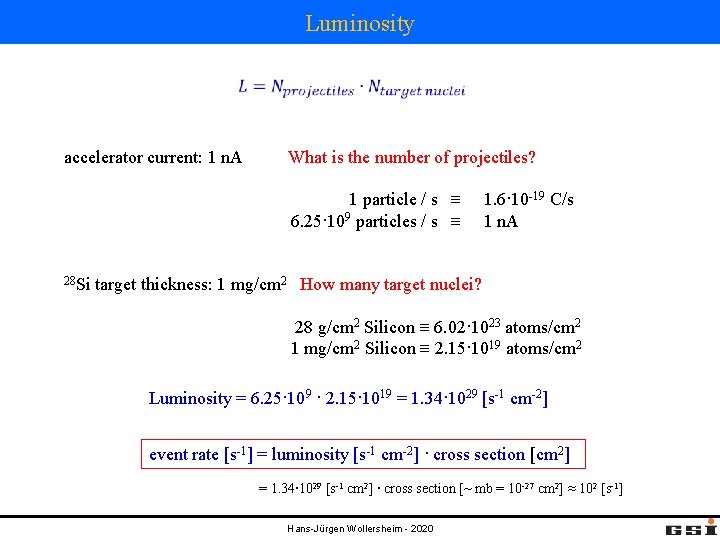
Luminosity accelerator current: 1 n. A What is the number of projectiles? 1 particle / s ≡ 6. 25·109 particles / s ≡ 28 Si 1. 6·10 -19 C/s 1 n. A target thickness: 1 mg/cm 2 How many target nuclei? 28 g/cm 2 Silicon ≡ 6. 02·1023 atoms/cm 2 1 mg/cm 2 Silicon ≡ 2. 15·1019 atoms/cm 2 Luminosity = 6. 25·109 · 2. 15·1019 = 1. 34·1029 [s-1 cm-2] event rate [s-1] = luminosity [s-1 cm-2] · cross section [cm 2] = 1. 34∙ 1029 [s-1 cm 2] ∙ cross section [~ mb = 10 -27 cm 2] ≈ 102 [s-1] Hans-Jürgen Wollersheim - 2020
- Slides: 5