
Interaction of Beta and Charged Particles with Matter
Interaction of Beta and Charged Particles with Matter ● betas, protons, alphas and other heavy charged particles as 16 O, gamma and x-rays, and neutrons ● to understand the physical basis for radiation dosimetry/radiation shielding, one must be able to comprehend the mechanisms by which radiations interact with matter including biological material
Interaction of Beta and Charged Particles with Matter ● in any type of matter, radiation may interact with the nuclei or the electrons, in excitation or ionization of the absorber atoms ● finally, the energy transferred either to tissue or to irradiation shield is dissipated as heat ● Consider: What is the difference between excitation and ionization?
Heavy Charged Particles (HCP) 1. Energy Loss Mechanisms ● protons, alphas, 12 C, 16 O, 14 N; not electrons or positrons (β-, β+) ● HCP traversing matter loses energy primarily through the ionization and excitation of atoms ● except at low velocities, a HCP loses a negligible amount of energy in nuclear collisions
Heavy Charged Particles (HCP) ● HCP exerts electromagnetic forces on atomic electrons and imparts energy to them ● energy transferred can be sufficient to knock an electron out of an atom and ionize it ● or it may leave the atom in an excited non-ionized state ● since a HCP loses only a small fraction of its energy in a simple collision and almost in a straight path, it loses energy continuously in small amounts through multiple collisions leaving ionized and excited atoms
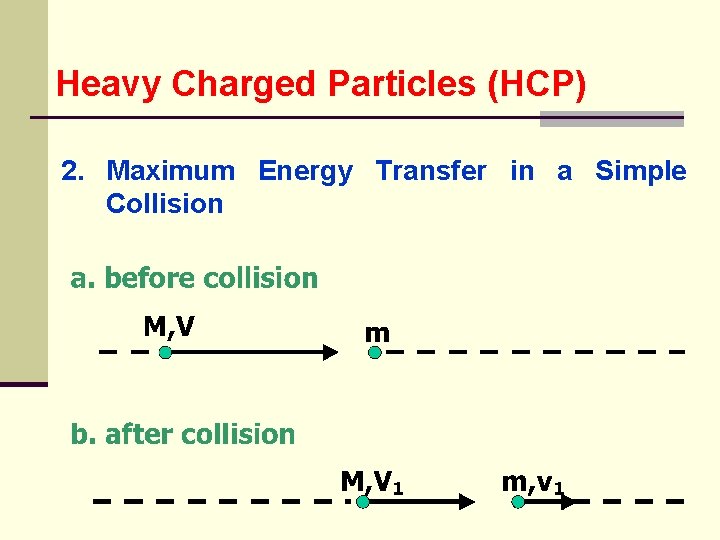
Heavy Charged Particles (HCP) 2. Maximum Energy Transfer in a Simple Collision
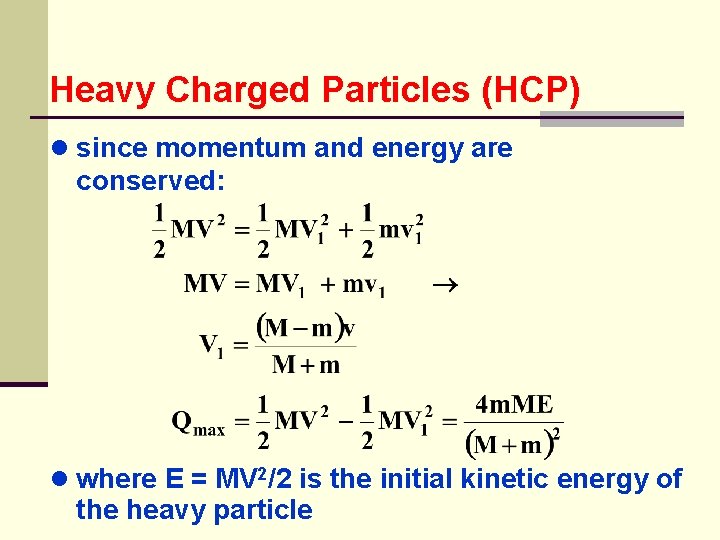
Heavy Charged Particles (HCP) ● since momentum and energy are conserved: ● where E = MV 2/2 is the initial kinetic energy of the heavy particle
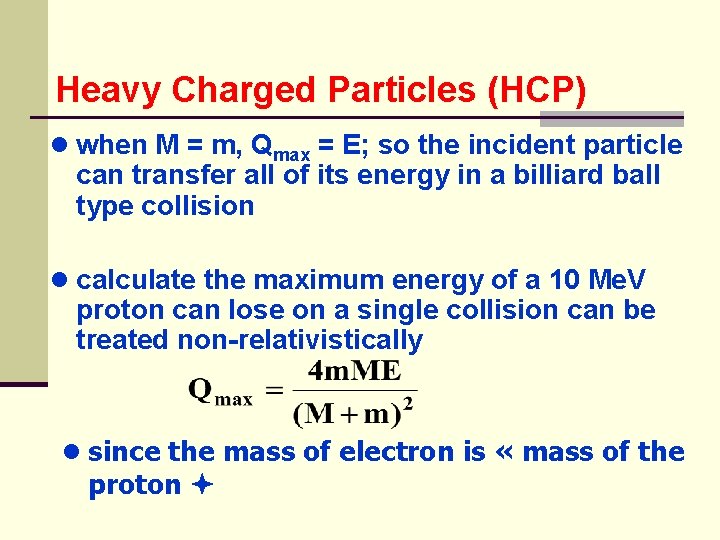
Heavy Charged Particles (HCP) ● when M = m, Qmax = E; so the incident particle can transfer all of its energy in a billiard ball type collision ● calculate the maximum energy of a 10 Me. V proton can lose on a single collision can be treated non-relativistically ● since the mass of electron is « mass of the proton
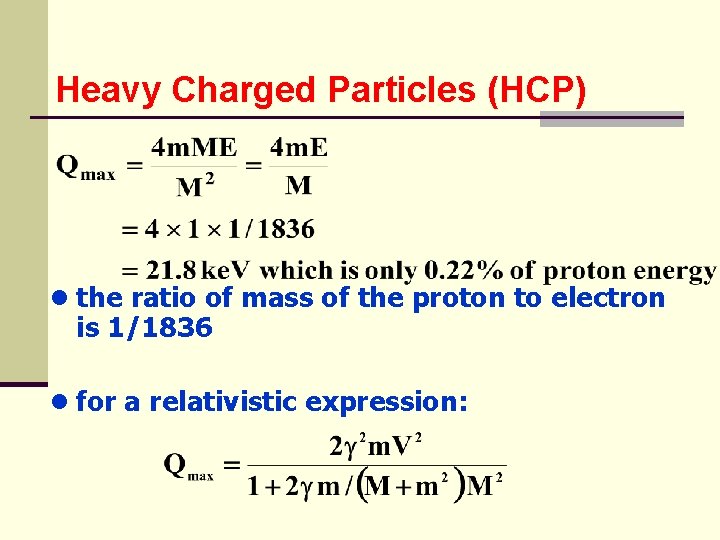
Heavy Charged Particles (HCP) ● the ratio of mass of the proton to electron is 1/1836 ● for a relativistic expression:
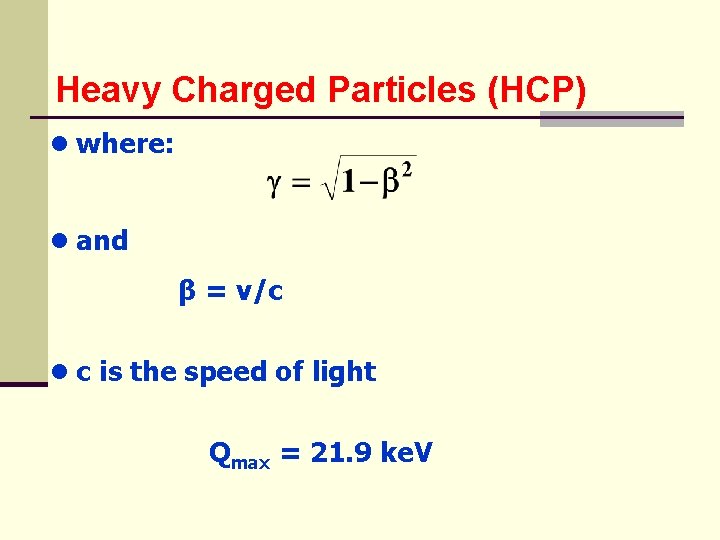
Heavy Charged Particles (HCP) ● where: ● and β = v/c ● c is the speed of light Qmax = 21. 9 ke. V
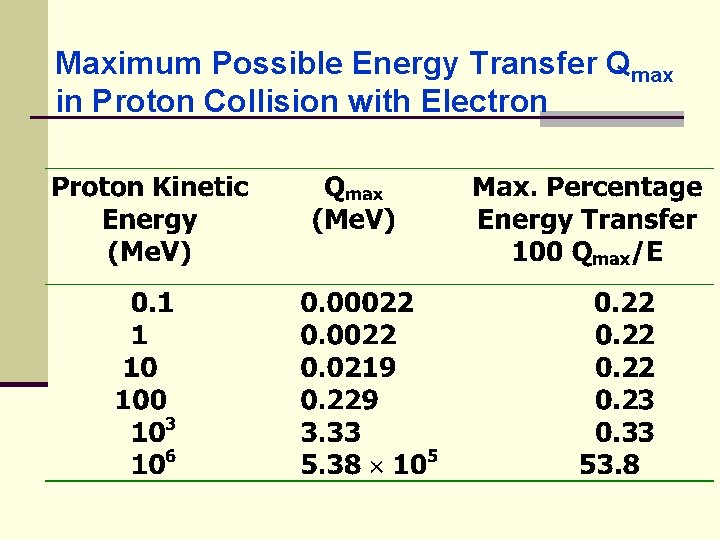
Maximum Possible Energy Transfer Qmax in Proton Collision with Electron
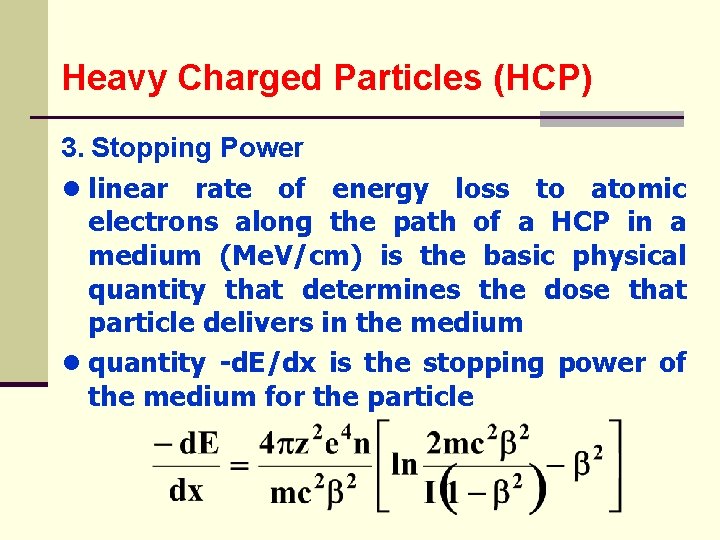
Heavy Charged Particles (HCP) 3. Stopping Power ● linear rate of energy loss to atomic electrons along the path of a HCP in a medium (Me. V/cm) is the basic physical quantity that determines the dose that particle delivers in the medium ● quantity -d. E/dx is the stopping power of the medium for the particle
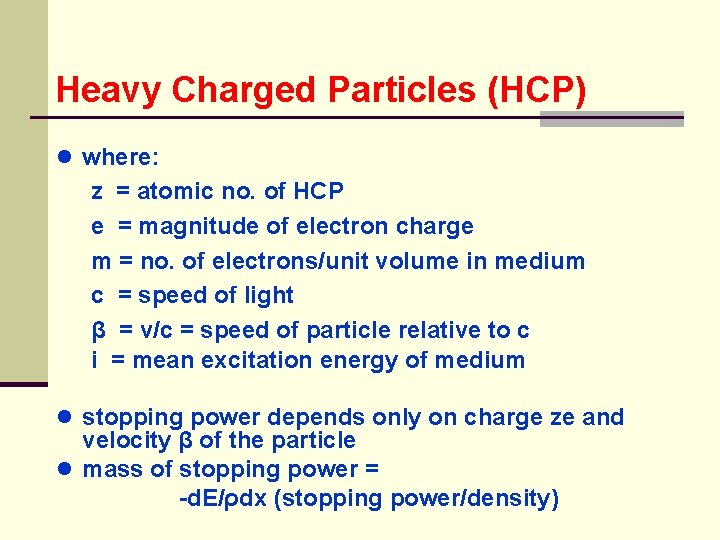
Heavy Charged Particles (HCP) ● where: z = atomic no. of HCP e = magnitude of electron charge m = no. of electrons/unit volume in medium c = speed of light β = v/c = speed of particle relative to c i = mean excitation energy of medium ● stopping power depends only on charge ze and ● velocity β of the particle mass of stopping power = -d. E/ρdx (stopping power/density)
Heavy Charged Particles (HCP) ● expresses the rate of energy loss of charged particle per g/cm 2 the ● mass stopping power does not differ greatly for materials with similar atomic composition eg ● for 10 Me. V protons: -d. E/ρdx for H 2 O is 45. 9 Me. V cm 2/g and for anthracine (C 14 H 10) it is ● 44. 2 Me. V cm 2/g
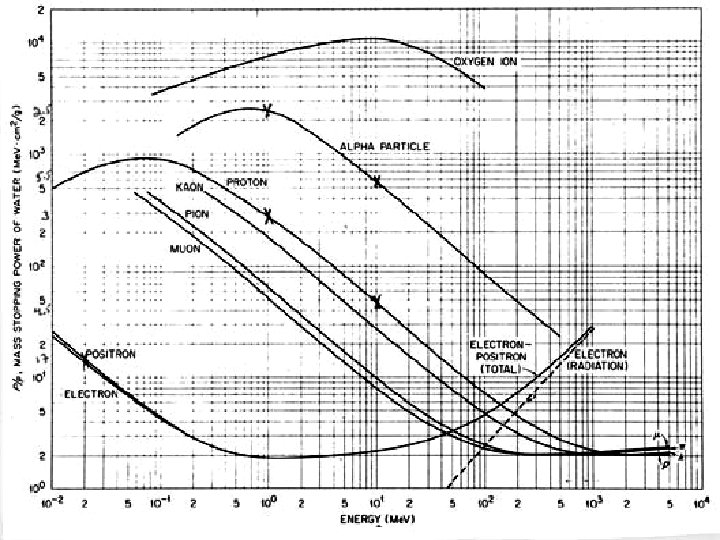
Heavy Charged Particles (HCP) ● for 10 Me. V protons and Pb (z = 82) -d. E/ρdx = 17. 5 Me. V cm 2/g ● in general heavy atoms are less efficient on a cm 2/g basis for slowing down HCP ● the reason being that many of their electrons are too tightly bound to the inner shells to absorb energy
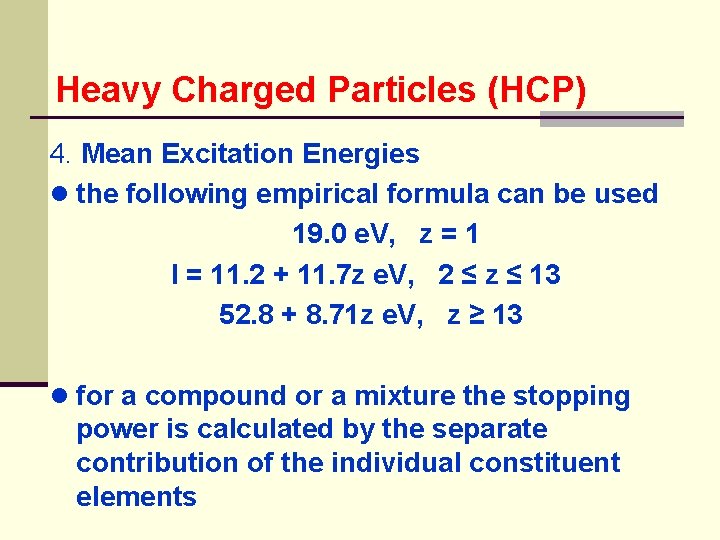
Heavy Charged Particles (HCP) 4. Mean Excitation Energies ● the following empirical formula can be used 19. 0 e. V, z = 1 I = 11. 2 + 11. 7 z e. V, 2 ≤ z ≤ 13 52. 8 + 8. 71 z e. V, z ≥ 13 ● for a compound or a mixture the stopping power is calculated by the separate contribution of the individual constituent elements
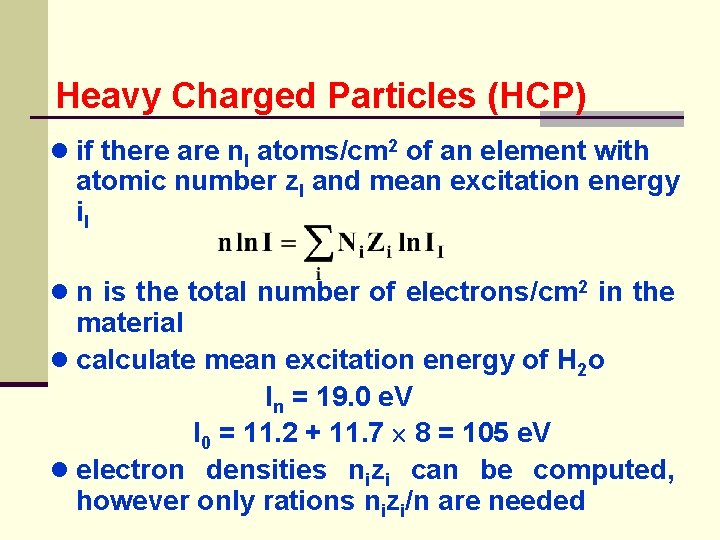
Heavy Charged Particles (HCP) ● if there are n. I atoms/cm 2 of an element with atomic number z. I and mean excitation energy i. I ● n is the total number of electrons/cm 2 in the material ● calculate mean excitation energy of H 2 o In = 19. 0 e. V I 0 = 11. 2 + 11. 7 8 = 105 e. V ● electron densities nizi can be computed, however only rations nizi/n are needed
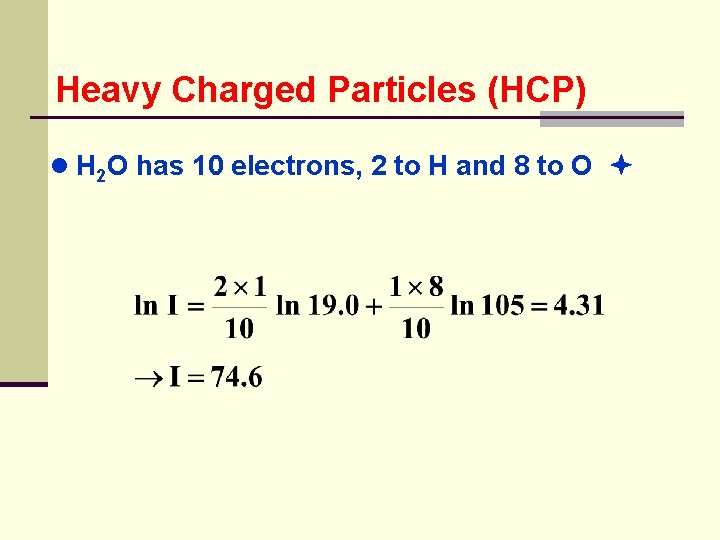
Heavy Charged Particles (HCP) ● H 2 O has 10 electrons, 2 to H and 8 to O
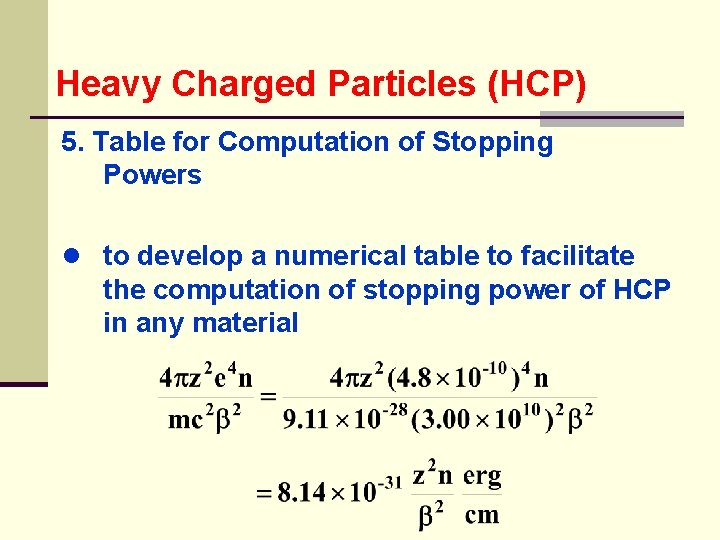
Heavy Charged Particles (HCP) 5. Table for Computation of Stopping Powers ● to develop a numerical table to facilitate the computation of stopping power of HCP in any material
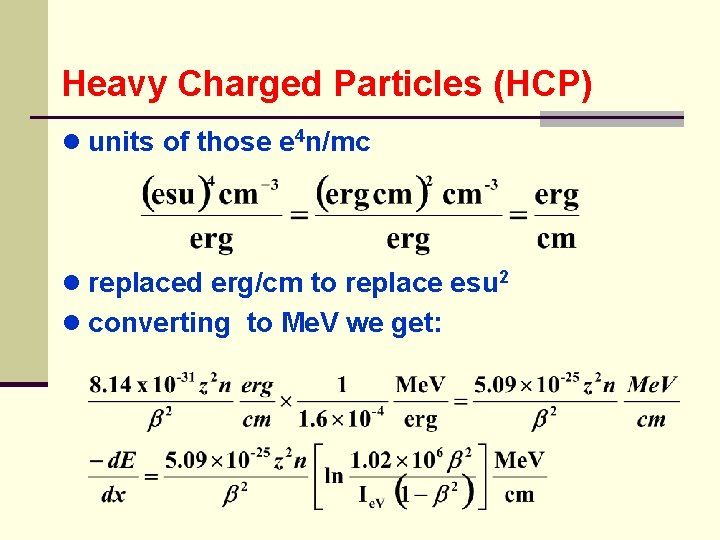
Heavy Charged Particles (HCP) ● units of those e 4 n/mc ● replaced erg/cm to replace esu 2 ● converting to Me. V we get:
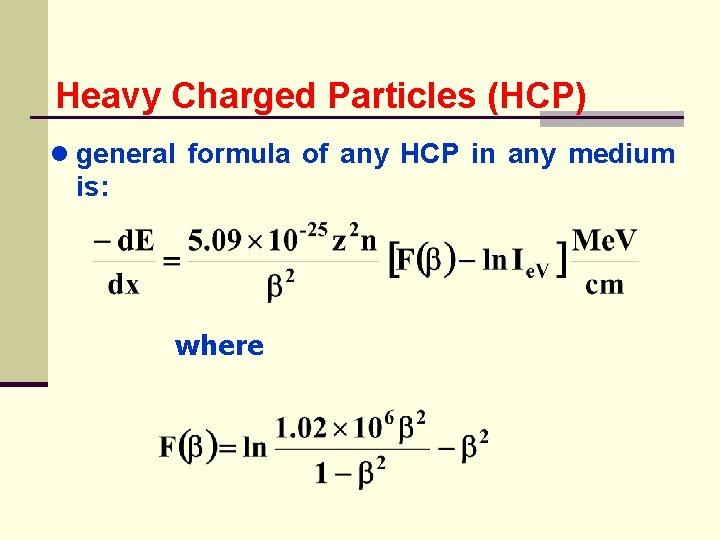
Heavy Charged Particles (HCP) ● general formula of any HCP in any medium is: where
Data for Computation of Stopping Power for Heavy Charged Particles
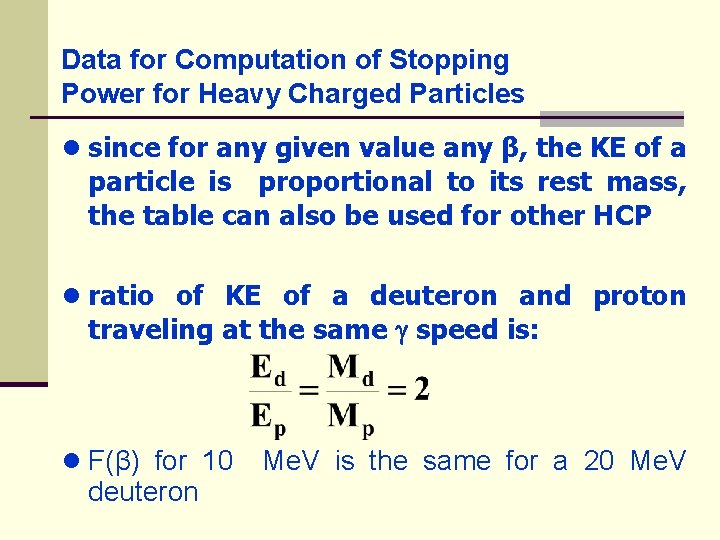
Data for Computation of Stopping Power for Heavy Charged Particles ● since for any given value any β, the KE of a particle is proportional to its rest mass, the table can also be used for other HCP ● ratio of KE of a deuteron and proton traveling at the same speed is: ● F(β) for 10 deuteron Me. V is the same for a 20 Me. V
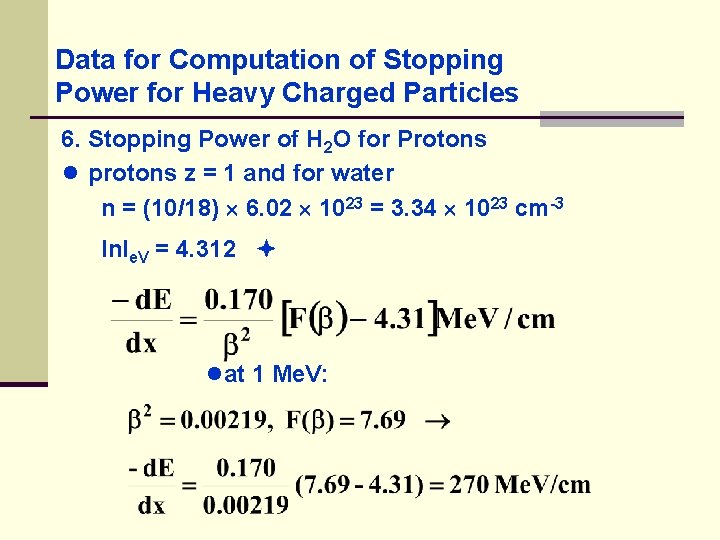
Data for Computation of Stopping Power for Heavy Charged Particles 6. Stopping Power of H 2 O for Protons ● protons z = 1 and for water n = (10/18) 6. 02 1023 = 3. 34 1023 cm-3 ln. Ie. V = 4. 312 ●at 1 Me. V:
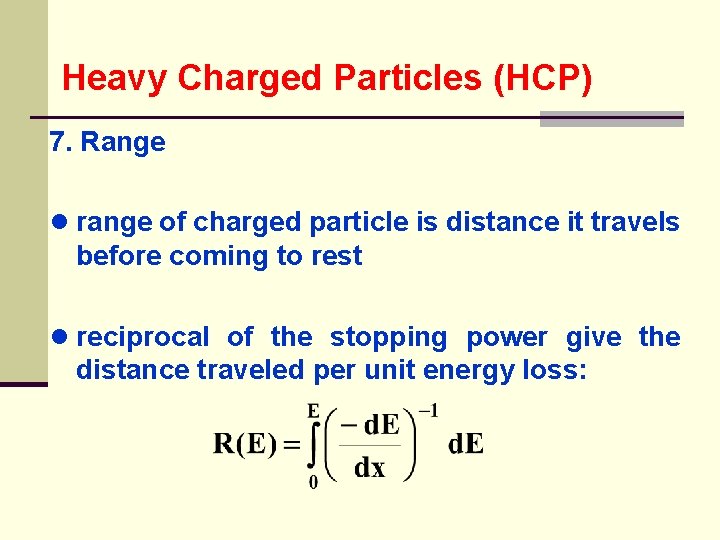
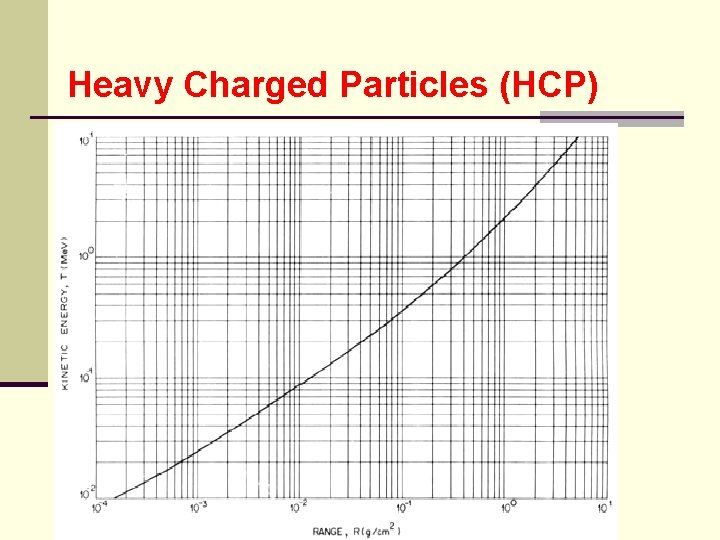
Heavy Charged Particles (HCP) 7. Range ● range of charged particle is distance it travels before coming to rest ● reciprocal of the stopping power give the distance traveled per unit energy loss:
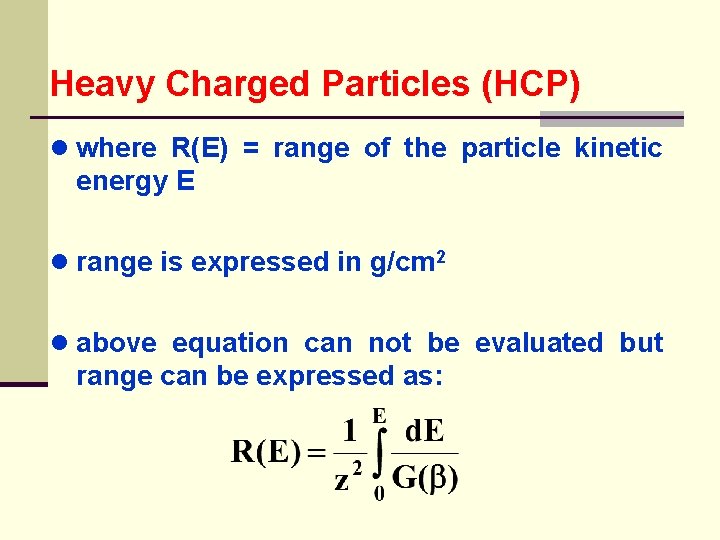
Heavy Charged Particles (HCP) ● where R(E) = range of the particle kinetic energy E ● range is expressed in g/cm 2 ● above equation can not be evaluated but range can be expressed as:
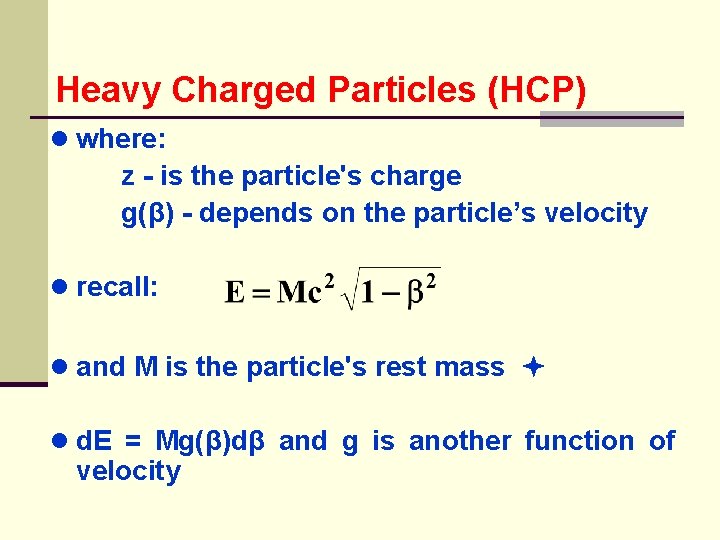
Heavy Charged Particles (HCP) ● where: z - is the particle's charge g(β) - depends on the particle’s velocity ● recall: ● and M is the particle's rest mass ● d. E = Mg(β)dβ and g is another function of velocity
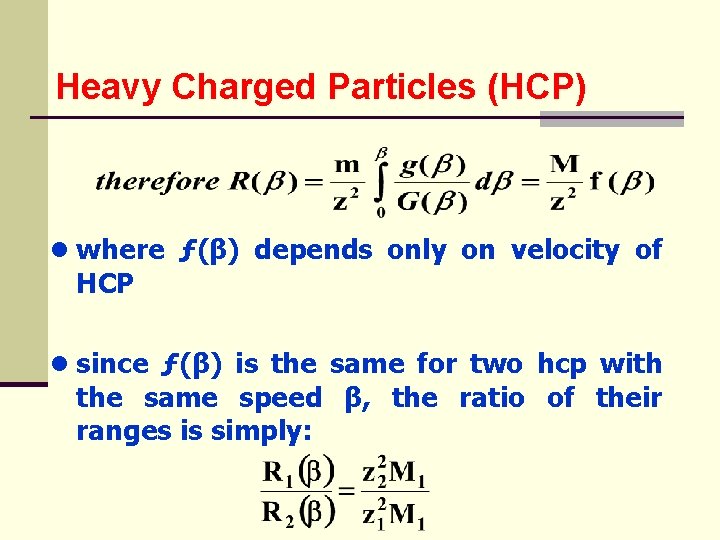
Heavy Charged Particles (HCP) ● where HCP ● since ƒ(β) depends only on velocity of ƒ(β) is the same for two hcp with the same speed β, the ratio of their ranges is simply:
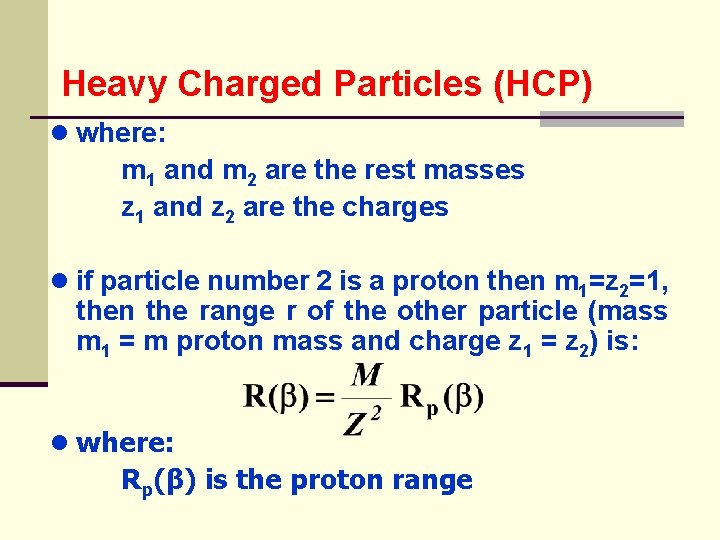
Heavy Charged Particles (HCP) ● where: m 1 and m 2 are the rest masses z 1 and z 2 are the charges ● if particle number 2 is a proton then m 1=z 2=1, then the range r of the other particle (mass m 1 = m proton mass and charge z 1 = z 2) is: ● where: Rp(β) is the proton range
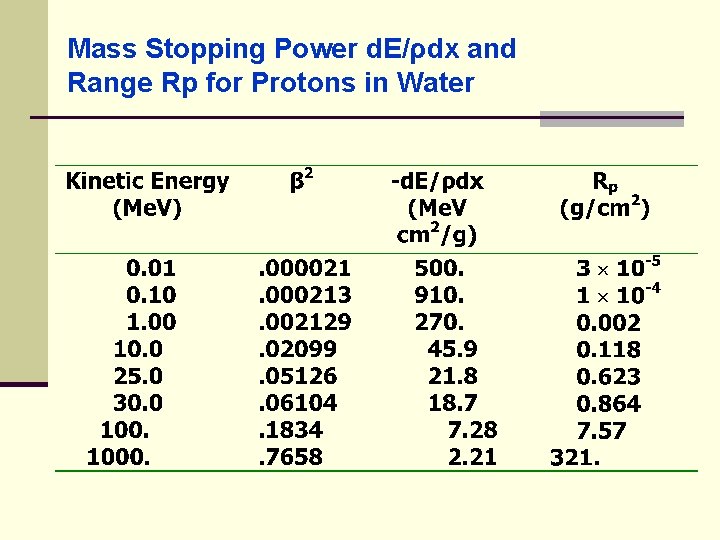
Mass Stopping Power d. E/ρdx and Range Rp for Protons in Water
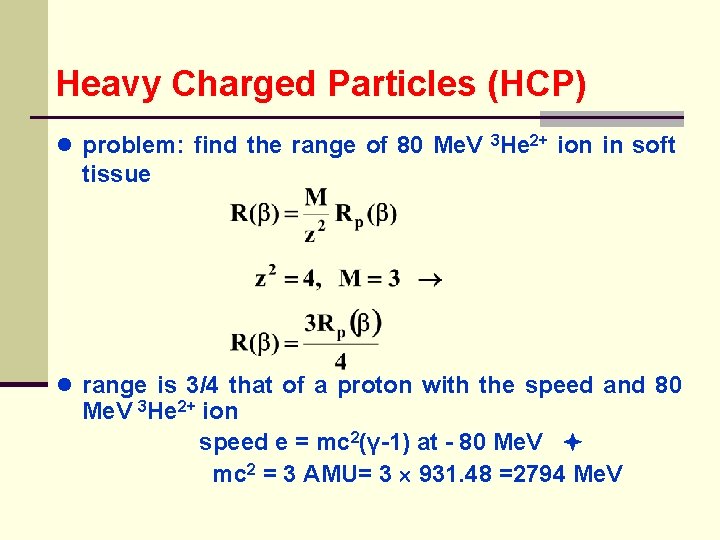
Heavy Charged Particles (HCP) ● problem: find the range of 80 Me. V 3 He 2+ ion in soft tissue ● range is 3/4 that of a proton with the speed and 80 Me. V 3 He 2+ ion speed e = mc 2(γ-1) at - 80 Me. V mc 2 = 3 AMU= 3 931. 48 =2794 Me. V
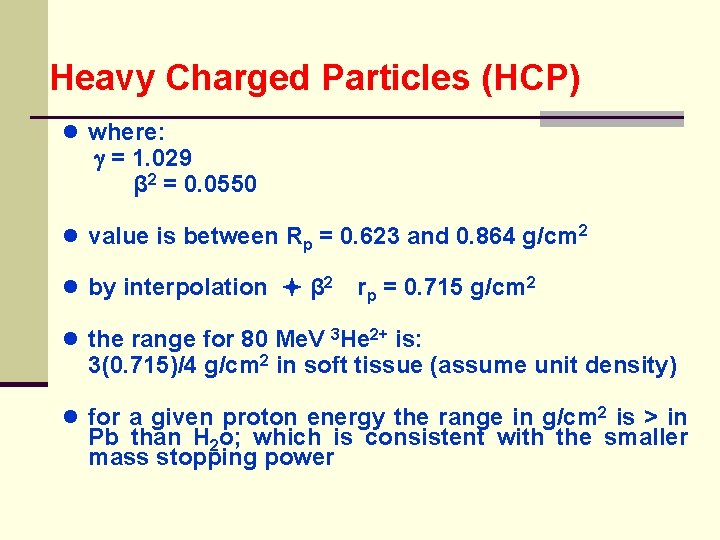
Heavy Charged Particles (HCP) ● where: = 1. 029 β 2 = 0. 0550 ● value is between Rp = 0. 623 and 0. 864 g/cm 2 ● by interpolation β 2 rp = 0. 715 g/cm 2 ● the range for 80 Me. V 3 He 2+ is: 3(0. 715)/4 g/cm 2 in soft tissue (assume unit density) ● for a given proton energy the range in g/cm 2 is > in Pb than H 2 o; which is consistent with the smaller mass stopping power
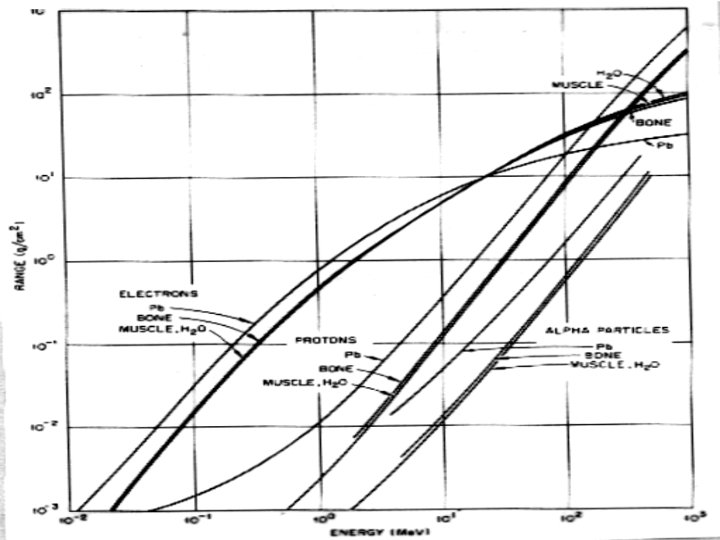
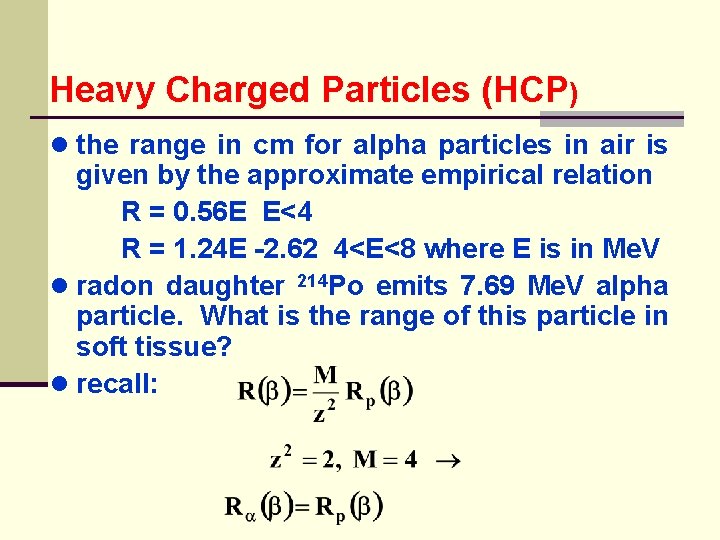
Heavy Charged Particles (HCP) ● the range in cm for alpha particles in air is given by the approximate empirical relation R = 0. 56 E E<4 R = 1. 24 E -2. 62 4<E<8 where E is in Me. V ● radon daughter 214 Po emits 7. 69 Me. V alpha particle. What is the range of this particle in soft tissue? ● recall:
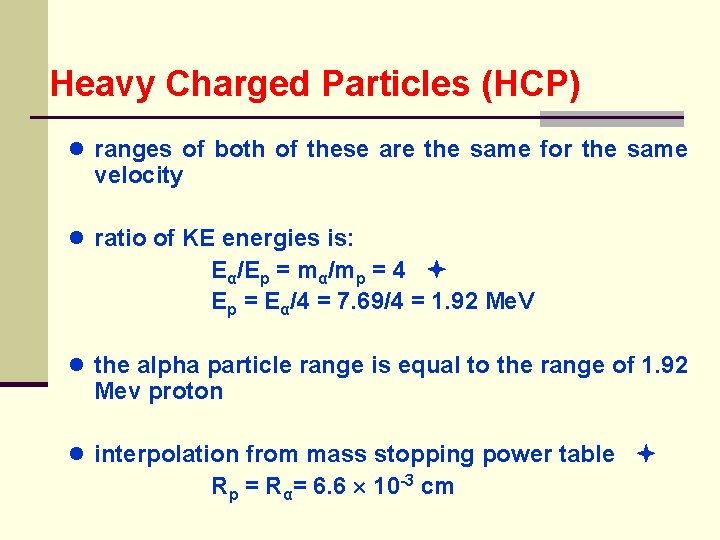
Heavy Charged Particles (HCP) ● ranges of both of these are the same for the same velocity ● ratio of KE energies is: Eα/Ep = mα/mp = 4 Ep = Eα/4 = 7. 69/4 = 1. 92 Me. V ● the alpha particle range is equal to the range of 1. 92 Mev proton ● interpolation from mass stopping power table Rp = Rα= 6. 6 10 -3 cm
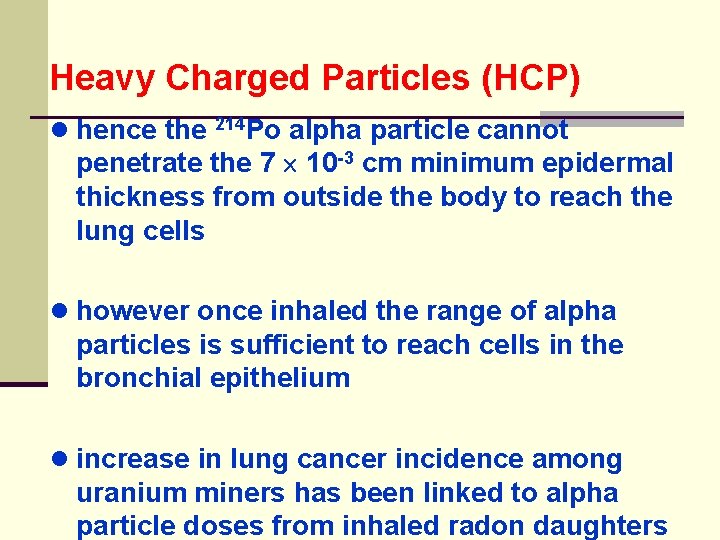
Heavy Charged Particles (HCP) ● hence the 214 Po alpha particle cannot penetrate the 7 10 -3 cm minimum epidermal thickness from outside the body to reach the lung cells ● however once inhaled the range of alpha particles is sufficient to reach cells in the bronchial epithelium ● increase in lung cancer incidence among uranium miners has been linked to alpha particle doses from inhaled radon daughters
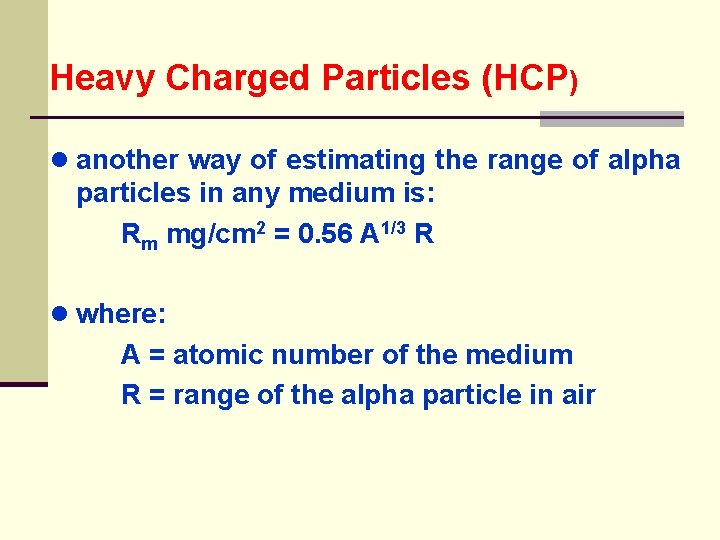
Heavy Charged Particles (HCP) ● another way of estimating the range of alpha particles in any medium is: Rm mg/cm 2 = 0. 56 A 1/3 R ● where: A = atomic number of the medium R = range of the alpha particle in air
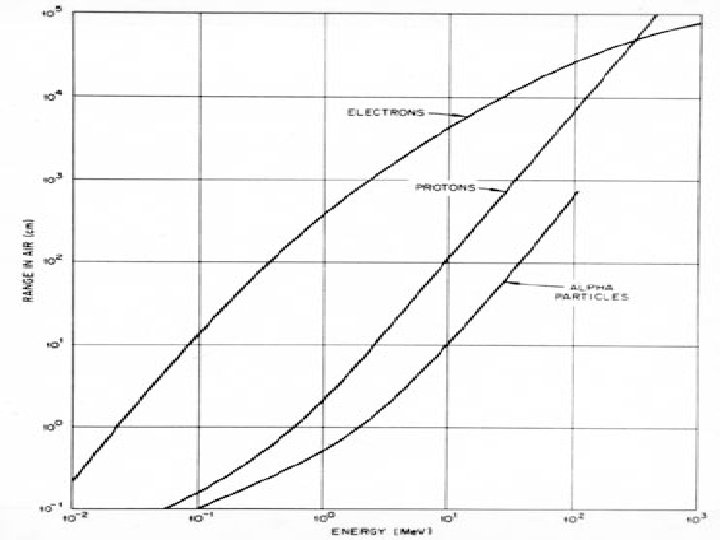
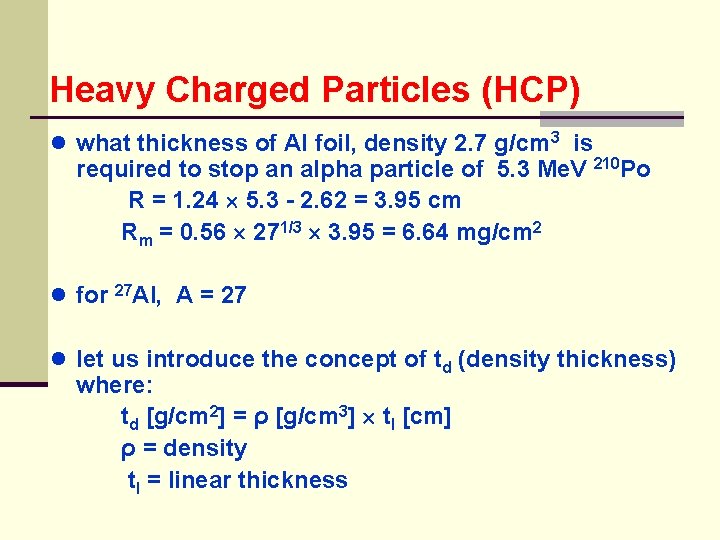
Heavy Charged Particles (HCP) ● what thickness of Al foil, density 2. 7 g/cm 3 is required to stop an alpha particle of 5. 3 Me. V 210 Po R = 1. 24 5. 3 - 2. 62 = 3. 95 cm Rm = 0. 56 271/3 3. 95 = 6. 64 mg/cm 2 ● for 27 Al, A = 27 ● let us introduce the concept of td (density thickness) where: td [g/cm 2] = ρ [g/cm 3] tl [cm] ρ = density tl = linear thickness
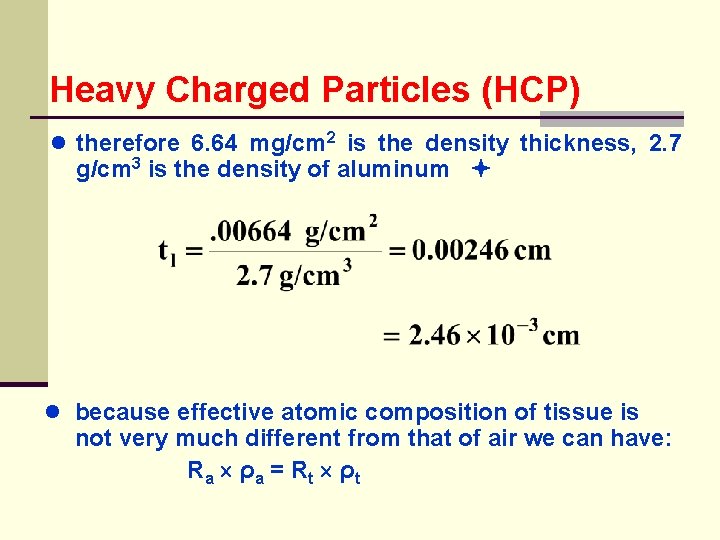
Heavy Charged Particles (HCP) ● therefore 6. 64 mg/cm 2 is the density thickness, 2. 7 g/cm 3 is the density of aluminum ● because effective atomic composition of tissue is not very much different from that of air we can have: Ra ρ a = Rt ρ t
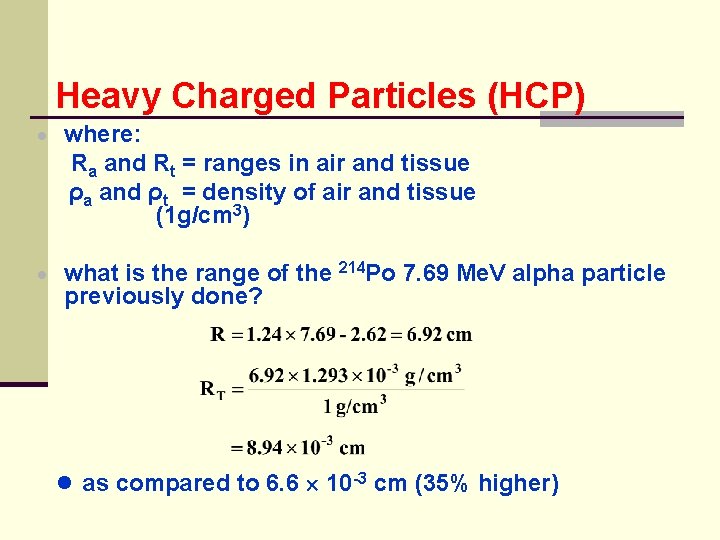
Heavy Charged Particles (HCP) · where: Ra and Rt = ranges in air and tissue ρa and ρt = density of air and tissue (1 g/cm 3) · what is the range of the previously done? 214 Po 7. 69 Me. V alpha particle ● as compared to 6. 6 10 -3 cm (35% higher)
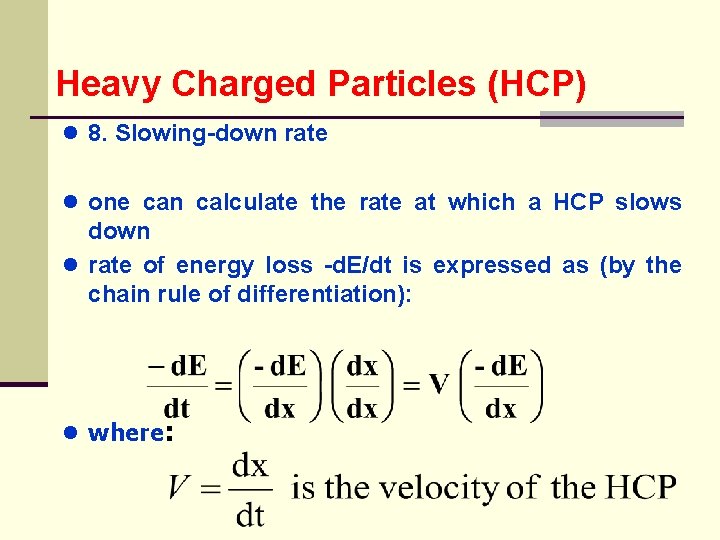
Heavy Charged Particles (HCP) ● 8. Slowing-down rate ● one ● can calculate the rate at which a HCP slows down rate of energy loss -d. E/dt is expressed as (by the chain rule of differentiation): ● where:
Heavy Charged Particles (HCP) ● calculate the slowing down rate and estimate stopping time , for 0. 5 Me. V protons in water
Heavy Charged Particles (HCP) ● stopping power ρ for protons in water ● recall:
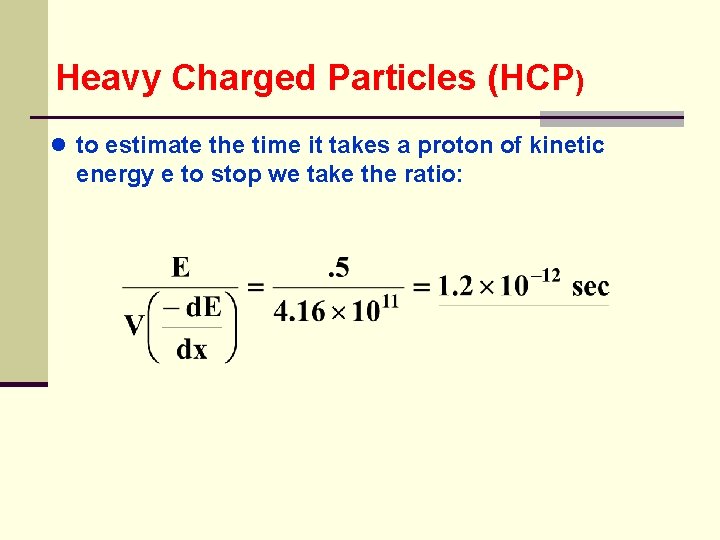
Heavy Charged Particles (HCP) ● to estimate the time it takes a proton of kinetic energy e to stop we take the ratio:
Calculated Slowing Down Rates -d. E/dt and Estimated Stopping Time for Protons in Water
BETA PARTICLES (β+, β-) 1. Energy-loss Mechanisms ● excitation and ionization- beta particles can also radiate energy by bremsstrahlung ● 2. Collision Stopping Power different than for heavy charged particles because the beta particle can lose a large fraction of its energy in the first collision ● also since β- is identical to the atomic electrons and β+ is the anti-particle certain symmetry conditions are required
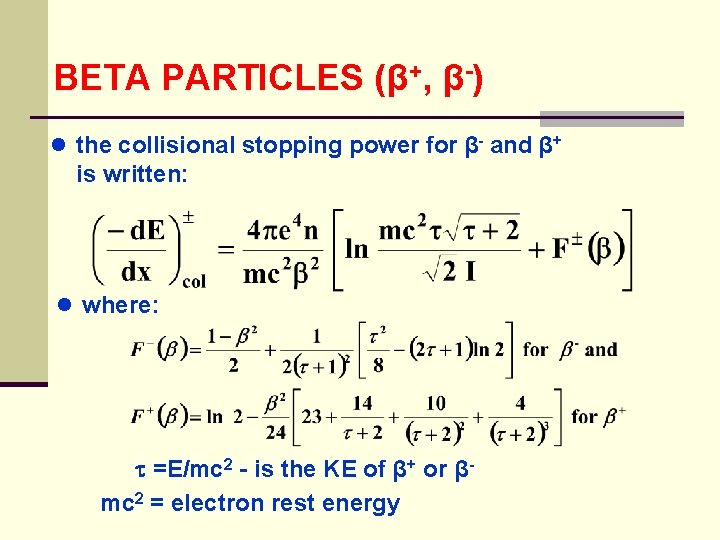
BETA PARTICLES (β+, β-) ● the collisional stopping power for β- and β+ is written: ● where: =E/mc 2 - is the KE of β+ or βmc 2 = electron rest energy
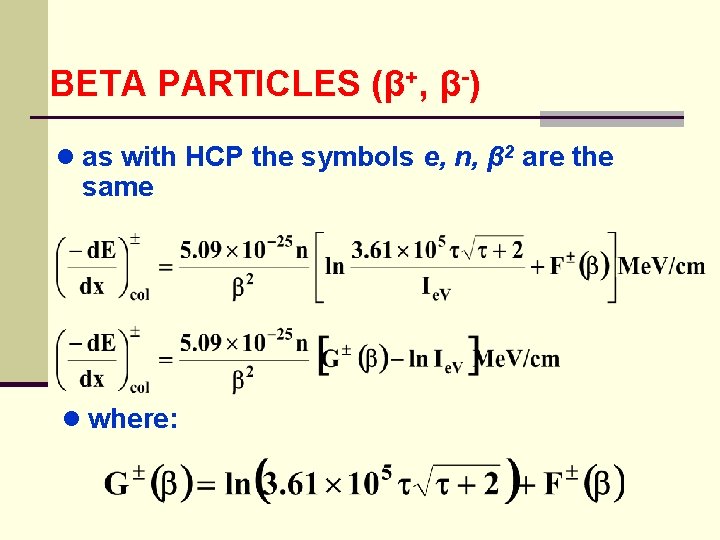
BETA PARTICLES (β+, β-) ● as with HCP the symbols e, n, β 2 are the same ● where:
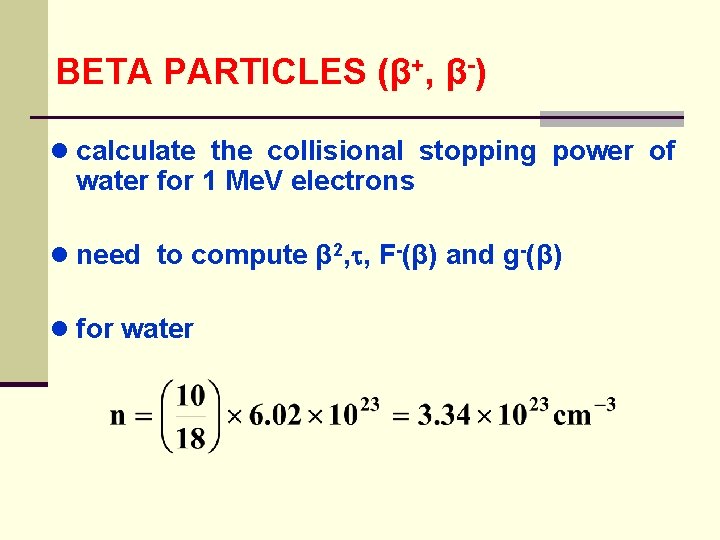
BETA PARTICLES (β+, β-) ● calculate the collisional stopping power of water for 1 Me. V electrons ● need to compute β 2, , F-(β) and g-(β) ● for water
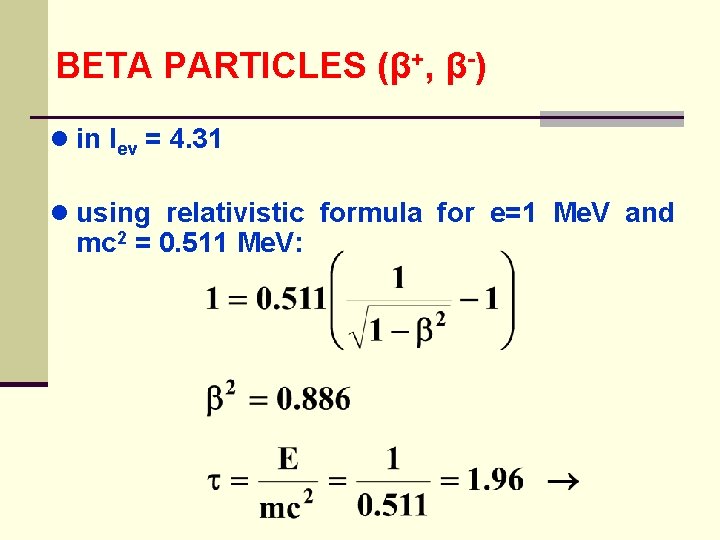
BETA PARTICLES (β+, β-) ● in Iev = 4. 31 ● using relativistic formula for e=1 Me. V and mc 2 = 0. 511 Me. V:
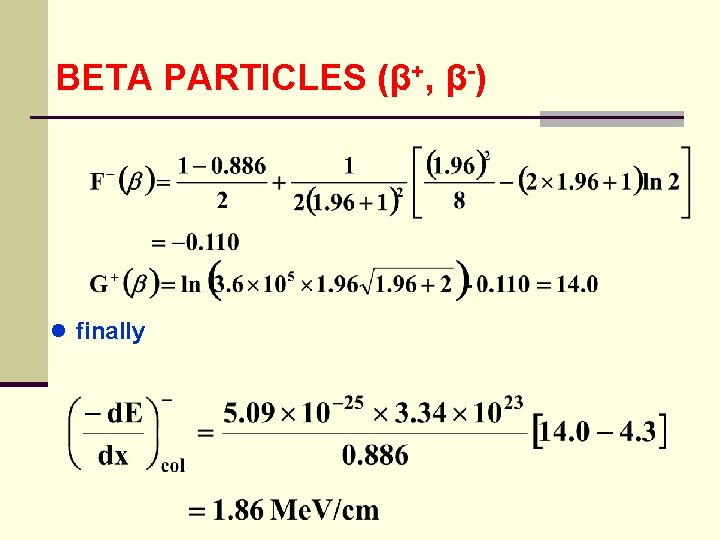
BETA PARTICLES (β+, β-) ● finally
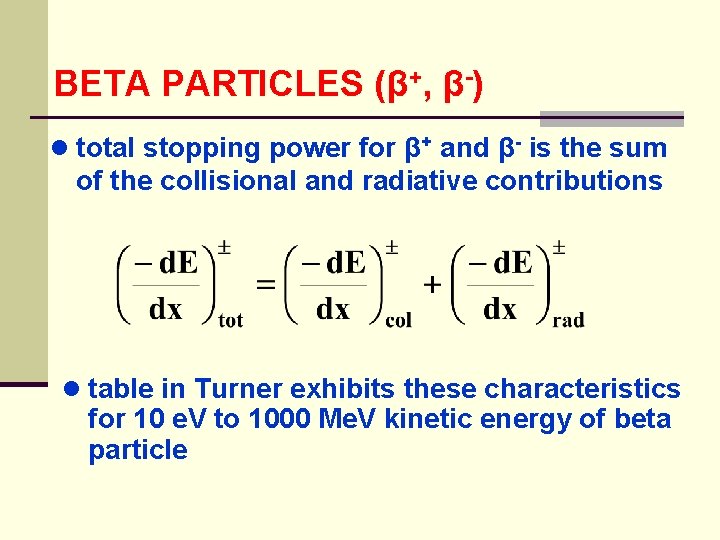
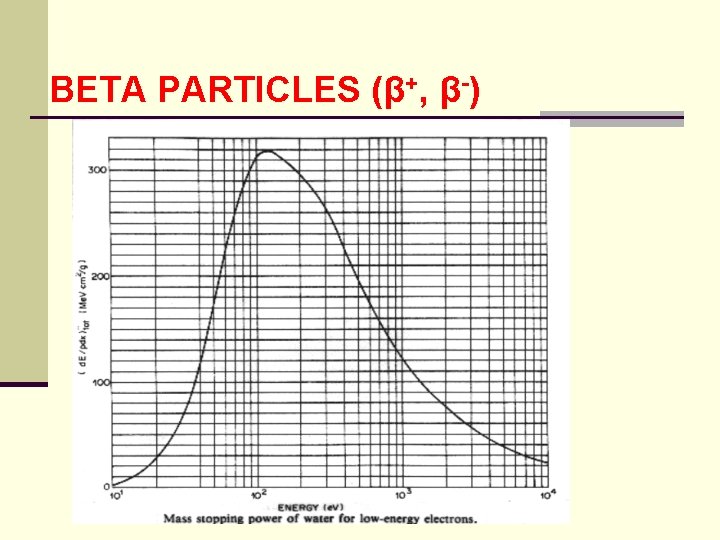
BETA PARTICLES (β+, β-) ● total stopping power for β+ and β- is the sum of the collisional and radiative contributions ● table in Turner exhibits these characteristics for 10 e. V to 1000 Me. V kinetic energy of beta particle
BETA PARTICLES (β+, β-)
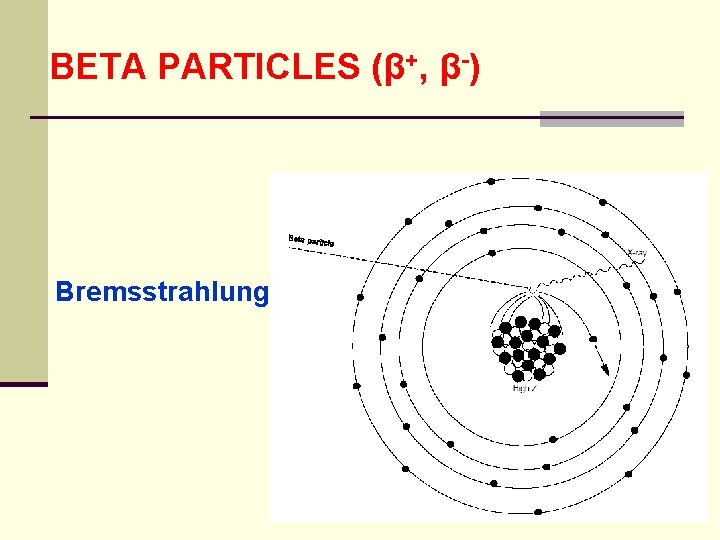
BETA PARTICLES (β+, β-) 3. Radiative Stopping Power ● beta particles, because of their small mass can be accelerated by electromagnetic forces within an atom and hence emit radiation called Bremsstrahlung ● Bremsstrahlung occurs where a beta particle is deflected in the electric field of a nucleus and to a lesser extent in the field of an atomic electron ● at high beta particle energies, the radiation is emitted mostly in the forward direction
BETA PARTICLES (β+, β-) ● efficiency of Bremsstrahlung in elements of different atomic number Z varies nearly as Z 2 ● for beta particles of a given energy bremsstrahlung losses are considerably greater in high-Z materials such as Pb than in low-Z materials such as water ● collision loss rate is proportional to n and hence Z ● radiative loss rate increases nearly linearly with beta particle energy where as collisional rate increases only logarithmically
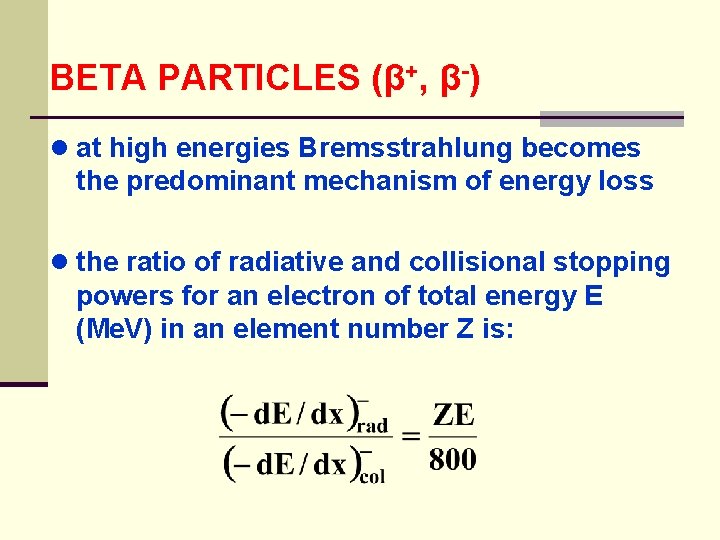
BETA PARTICLES (β+, β-) ● at high energies Bremsstrahlung becomes the predominant mechanism of energy loss ● the ratio of radiative and collisional stopping powers for an electron of total energy E (Me. V) in an element number Z is:
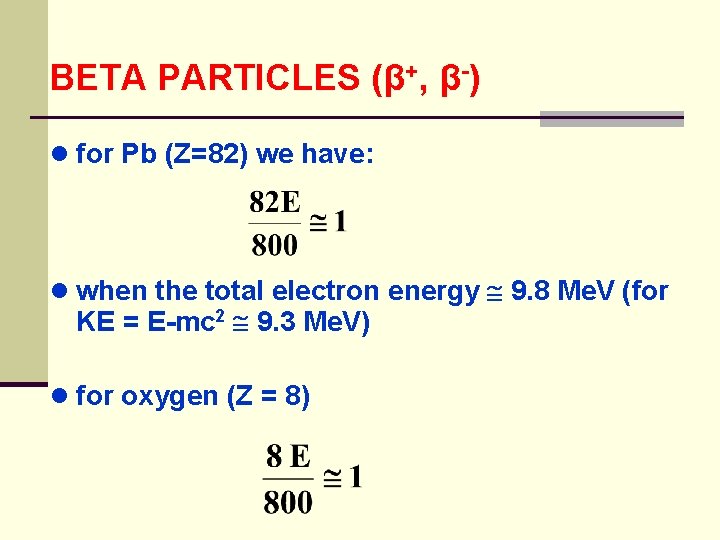
BETA PARTICLES (β+, β-) ● for Pb (Z=82) we have: ● when the total electron energy 9. 8 Me. V (for KE = E-mc 2 9. 3 Me. V) ● for oxygen (Z = 8)
BETA PARTICLES (β+, β-) ● when the total electron energy 100 Me. V KE have an order of magnitude difference to have the radiative and collisional stopping powers to be equal ● at very high energies the dominance of the radiative over collisional energy results in electron-photon cascades which in turn produces Compton electrons and electronpositron pairs and more Bremsstrahlung
BETA PARTICLES (β+, β-) 4. Radiation Yield ● an estimate of the radiation yield is very important in trying to deduce the potential Bremsstrahlung hazard of strong beta sources where: Y = radiation yield Z = atomic number of absorber E = critical KE energy of the beta particle
BETA PARTICLES (β+, β-) Bremsstrahlung
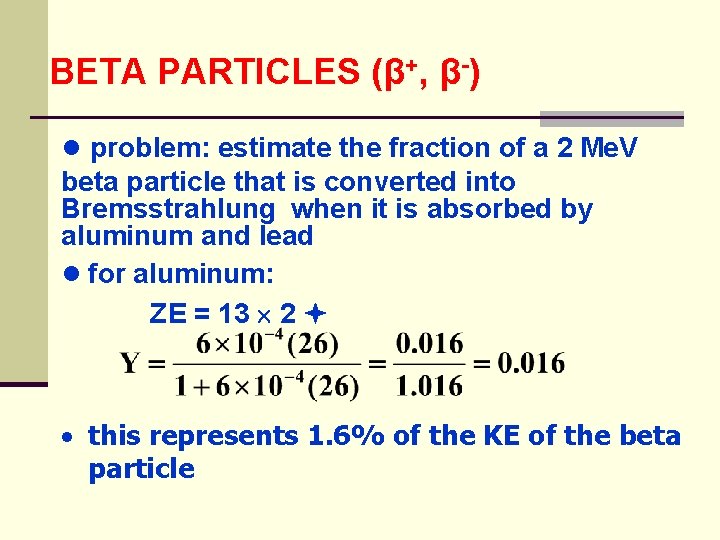
BETA PARTICLES (β+, β-) ● problem: estimate the fraction of a 2 Me. V beta particle that is converted into Bremsstrahlung when it is absorbed by aluminum and lead ● for aluminum: ZE = 13 2 · this represents 1. 6% of the KE of the beta particle
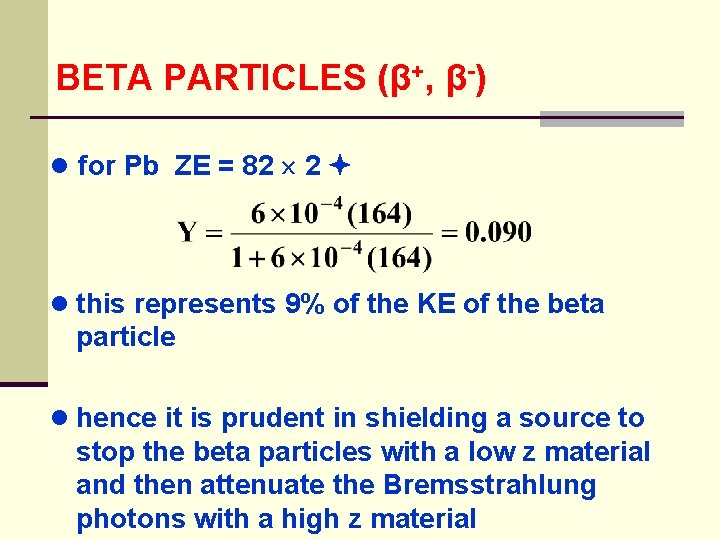
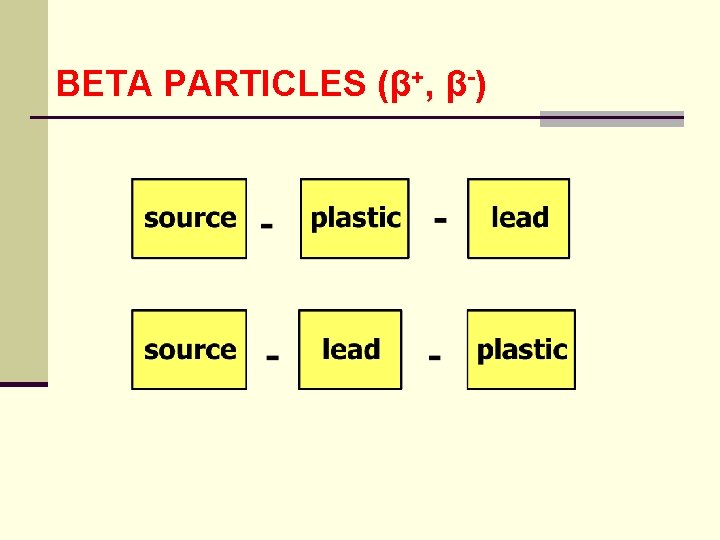
BETA PARTICLES (β+, β-) ● for Pb ZE = 82 2 ● this represents 9% of the KE of the beta particle ● hence it is prudent in shielding a source to stop the beta particles with a low z material and then attenuate the Bremsstrahlung photons with a high z material
BETA PARTICLES (β+, β-)
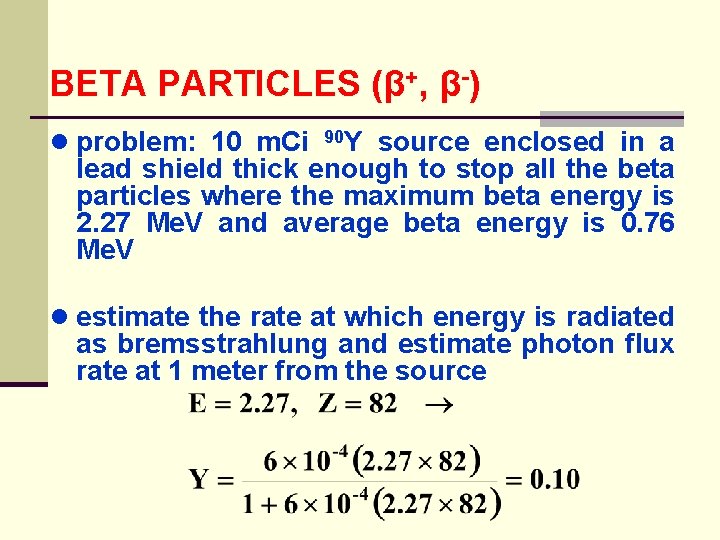
BETA PARTICLES (β+, β-) ● problem: 10 m. Ci 90 Y source enclosed in a lead shield thick enough to stop all the beta particles where the maximum beta energy is 2. 27 Me. V and average beta energy is 0. 76 Me. V ● estimate the rate at which energy is radiated as bremsstrahlung and estimate photon flux rate at 1 meter from the source
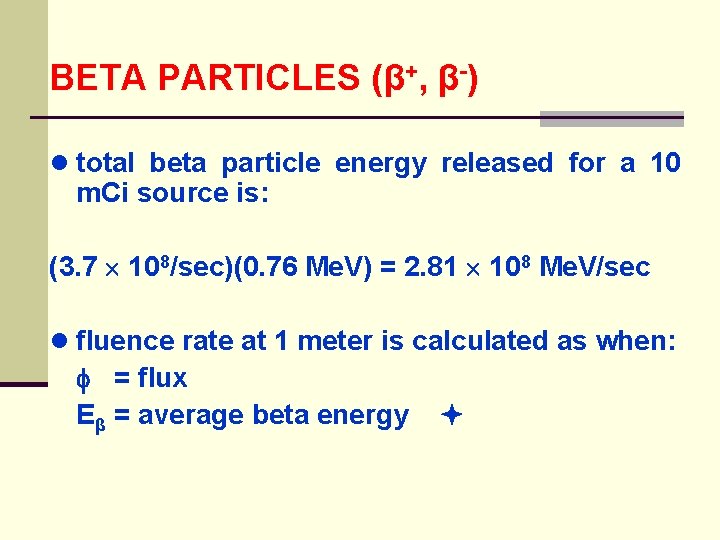
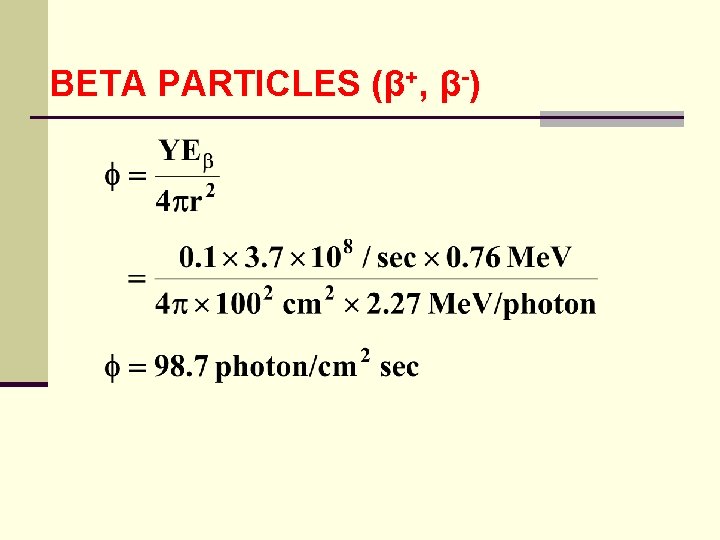
BETA PARTICLES (β+, β-) ● total beta particle energy released for a 10 m. Ci source is: (3. 7 108/sec)(0. 76 Me. V) = 2. 81 108 Me. V/sec ● fluence rate at 1 meter is calculated as when: = flux Eβ = average beta energy
BETA PARTICLES (β+, β-)
BETA PARTICLES (β+, β-) ● we divide by 2. 27 Me. V since it is assumed that all the beta particle energy is converted to 2. 27 Me. V photon ● this is a conservative approach in assessing radiation hazards ● another formula for estimating the yield is: Y = 3. 5 10 -4 ZE
BETA PARTICLES (β+, β-) 5. Range ● the collisional mass stopping power for beta particles is smaller in high Z materials, such as Pb, than in water ● the following empirical equation for electrons in low Z material relates the range R in g/cm 2 to the kinetic energy E in Me. V
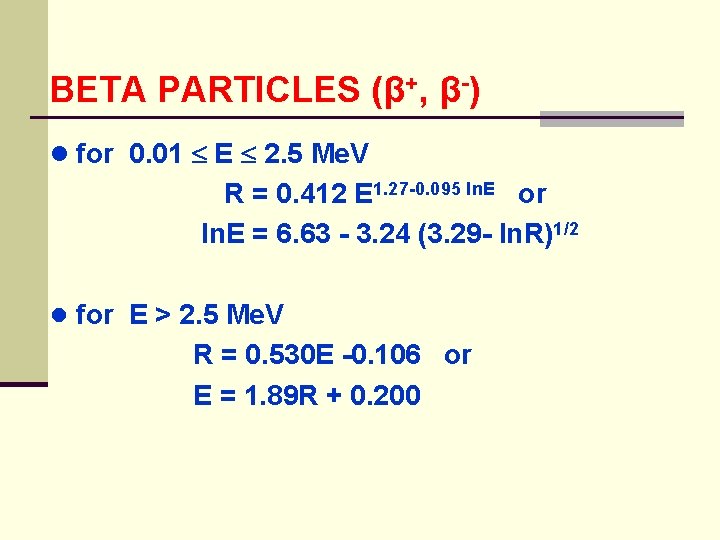
BETA PARTICLES (β+, β-) ● for 0. 01 E 2. 5 Me. V R = 0. 412 E 1. 27 -0. 095 ln. E or ln. E = 6. 63 - 3. 24 (3. 29 - ln. R)1/2 ● for E > 2. 5 Me. V R = 0. 530 E -0. 106 or E = 1. 89 R + 0. 200
Heavy Charged Particles (HCP)
Heavy Charged Particles (HCP)
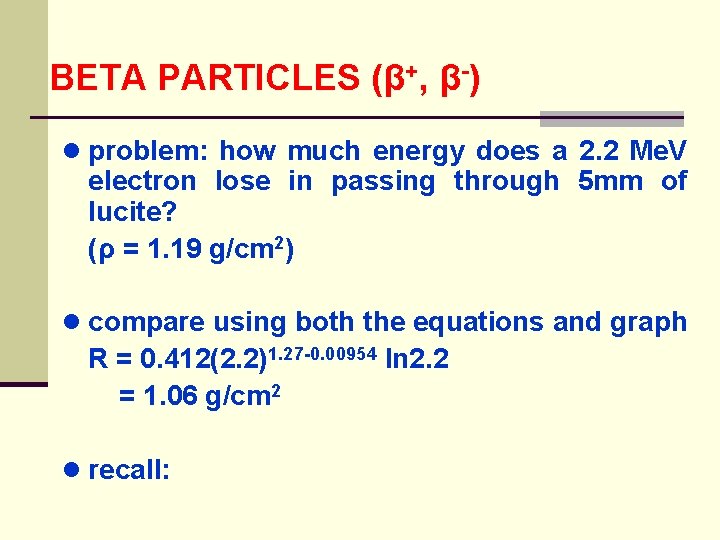
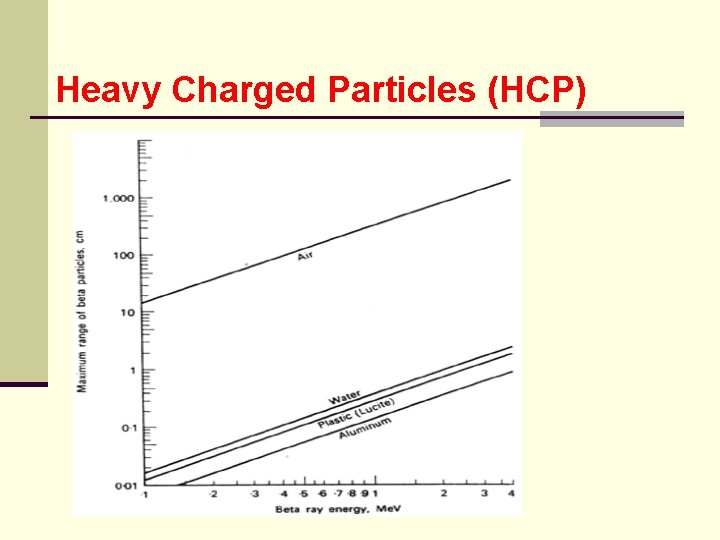
BETA PARTICLES (β+, β-) ● problem: how much energy does a 2. 2 Me. V electron lose in passing through 5 mm of lucite? (ρ = 1. 19 g/cm 2) ● compare using both the equations and graph R = 0. 412(2. 2)1. 27 -0. 00954 ln 2. 2 = 1. 06 g/cm 2 ● recall:
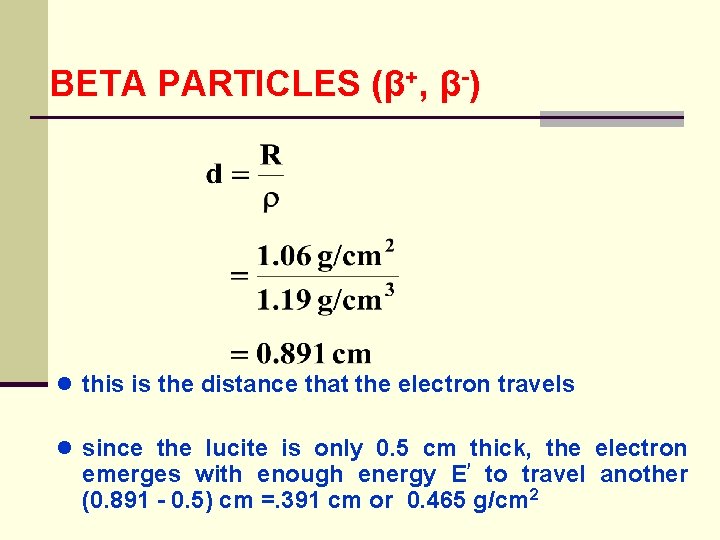
BETA PARTICLES (β+, β-) ● this is the distance that the electron travels ● since the lucite is only 0. 5 cm thick, the electron emerges with enough energy E to travel another (0. 891 - 0. 5) cm =. 391 cm or 0. 465 g/cm 2
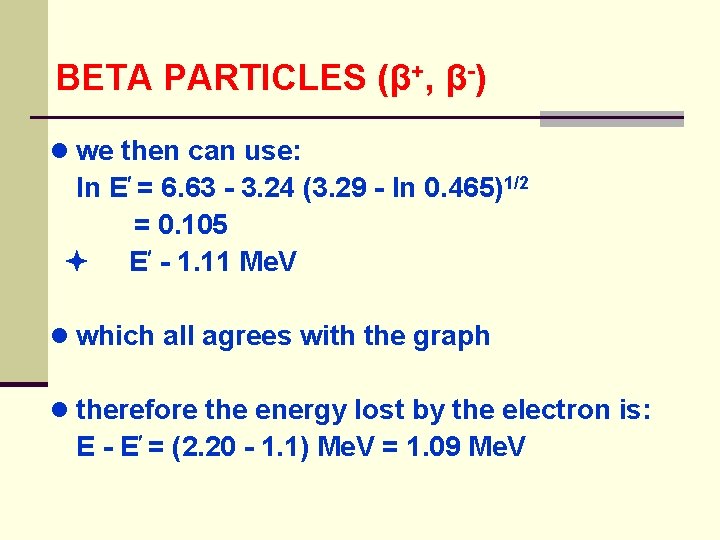
BETA PARTICLES (β+, β-) ● we then can use: ln E = 6. 63 - 3. 24 (3. 29 - ln 0. 465)1/2 = 0. 105 E - 1. 11 Me. V ● which all agrees with the graph ● therefore the energy lost by the electron is: E - E = (2. 20 - 1. 1) Me. V = 1. 09 Me. V
BETA PARTICLES (β+, β-) ● unlike alpha particles, beta particles have numerous radionuclides with ranges > the thickness of the epidermis ● even a 70 ke. V electron can penetrate the 7 mg/cm 2 of the epidermal layer ● beta particles can be potentially damaging to both the skin and eyes
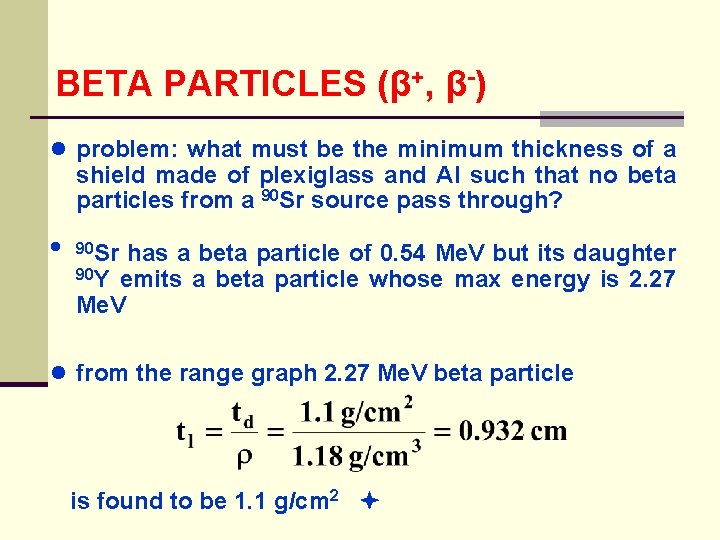
BETA PARTICLES (β+, β-) ● problem: what must be the minimum thickness of a shield made of plexiglass and Al such that no beta particles from a 90 Sr source pass through? ● 90 Sr has a beta particle of 0. 54 Me. V but its daughter 90 Y emits a beta particle whose max energy is 2. 27 Me. V ● from the range graph 2. 27 Me. V beta particle is found to be 1. 1 g/cm 2
BETA PARTICLES (β+, β-) ● since plexiglass may suffer radiation damage and crack if exposed to very intense radiation for a long time, aluminum is a better choice ● using the same calculation for Al the thickness is found to be 0. 41 cm 6. Slow Down Time ● read Turner - the calculations are similar to those done for heavy charged particle
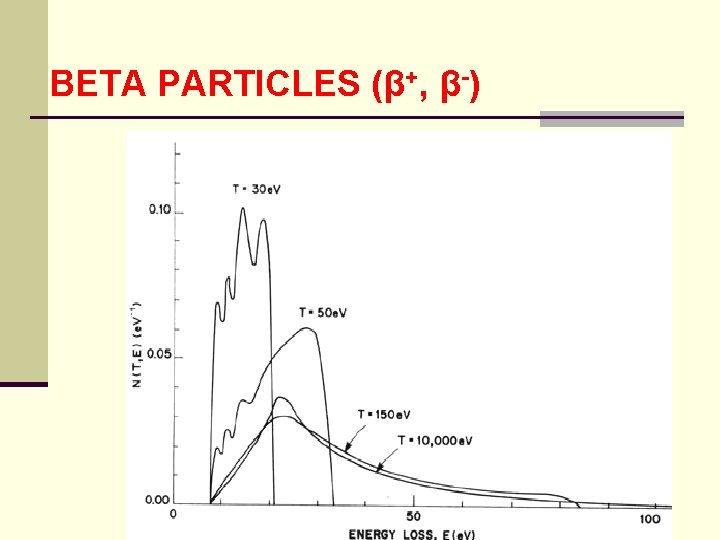
BETA PARTICLES (β+, β-) 7. Single Collision Spectra in Water ● interaction of low energy electrons with matter is fundamental to understanding the physical and biological effects of ionizing radiation ● low energy electrons are responsible for producing initial alterations that lead to chemical changes in tissue and tissue-like materials such as water ● interaction of an electron with kinetic energy e can be characterized by probability N(E, E )d. E that it loses an amount of energy between E and E + d. E
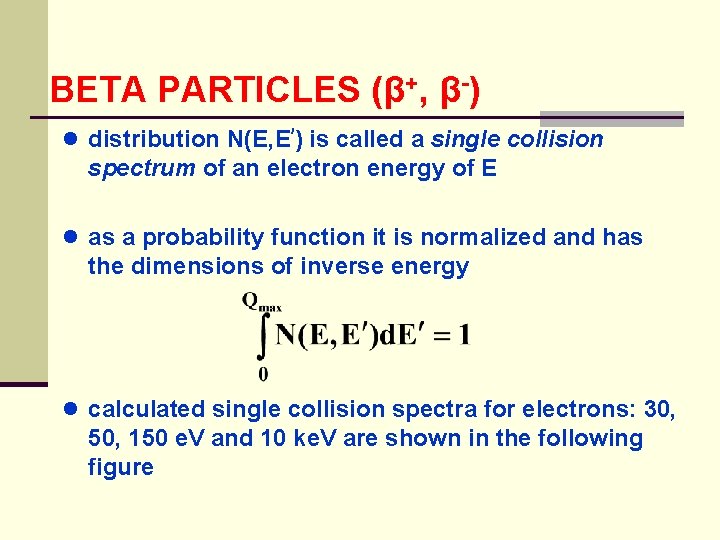
BETA PARTICLES (β+, β-) ● distribution N(E, E ) is called a single collision spectrum of an electron energy of E ● as a probability function it is normalized and has the dimensions of inverse energy ● calculated single collision spectra for electrons: 30, 50, 150 e. V and 10 ke. V are shown in the following figure
BETA PARTICLES (β+, β-)
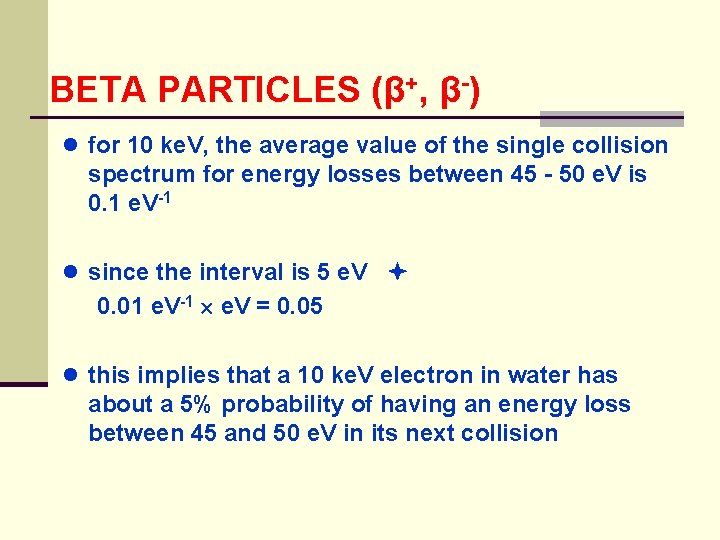
BETA PARTICLES (β+, β-) ● for 10 ke. V, the average value of the single collision spectrum for energy losses between 45 - 50 e. V is 0. 1 e. V-1 ● since the interval is 5 e. V 0. 01 e. V-1 e. V = 0. 05 ● this implies that a 10 ke. V electron in water has about a 5% probability of having an energy loss between 45 and 50 e. V in its next collision
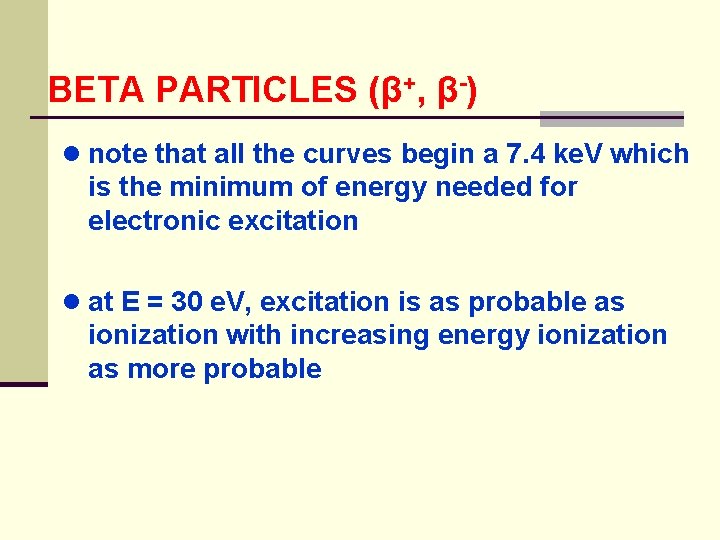
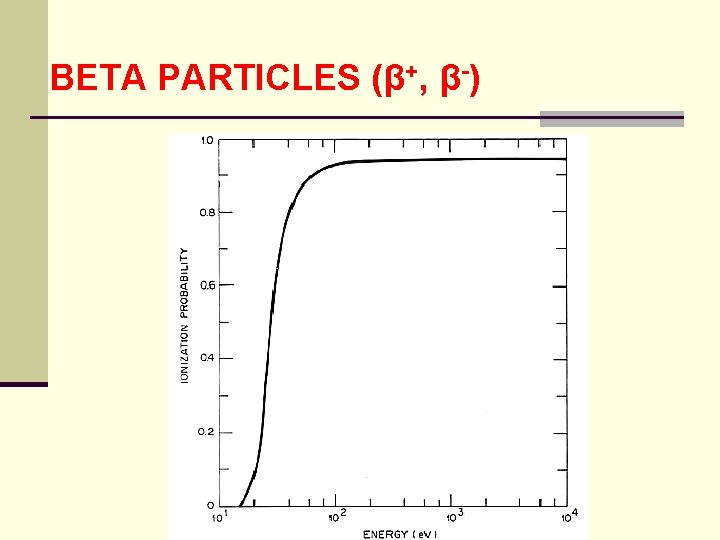
BETA PARTICLES (β+, β-) ● note that all the curves begin a 7. 4 ke. V which is the minimum of energy needed for electronic excitation ● at E = 30 e. V, excitation is as probable as ionization with increasing energy ionization as more probable
BETA PARTICLES (β+, β-)
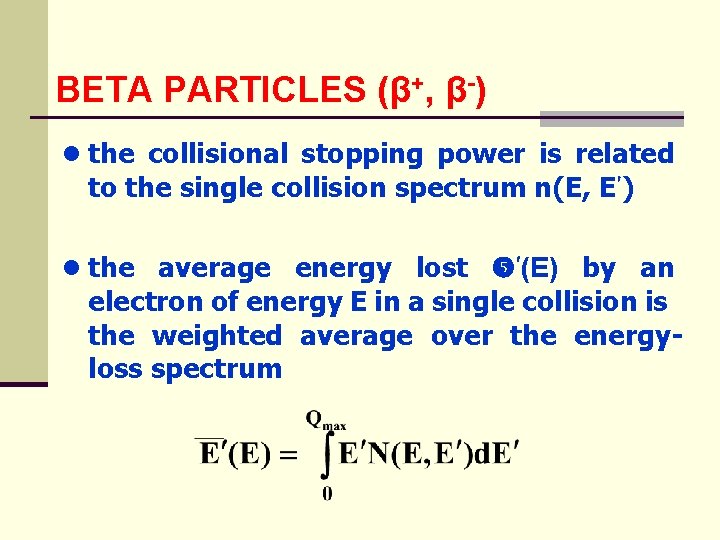
BETA PARTICLES (β+, β-) ● the collisional stopping power is related to the single collision spectrum n(E, E ) ● the average energy lost (E) by an electron of energy E in a single collision is the weighted average over the energyloss spectrum
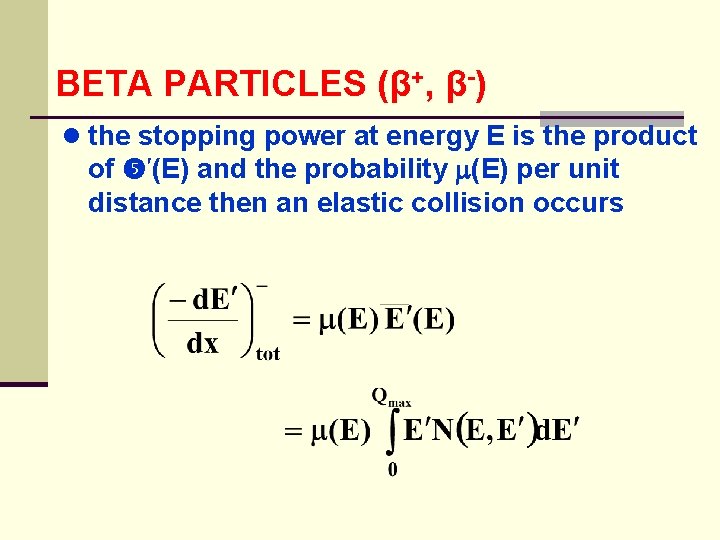
BETA PARTICLES (β+, β-) ● the stopping power at energy E is the product of (E) and the probability (E) per unit distance then an elastic collision occurs
BETA PARTICLES (β+, β-) 8. Electron Tracks in Water ● Monte Carlo computer codes are used to simulate electron transport in water ● each primary electron starts with 5 ke. V and each dot ● represents the location at 10 -11 sec of a chemical active species
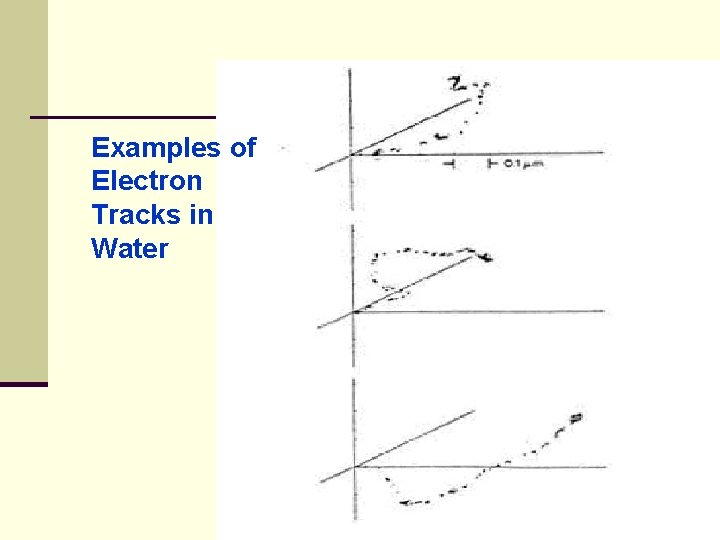
Examples of Electron Tracks in Water
BETA PARTICLES (β+, β-) ● the Monte Carlo code randomly selects events from specified distributions of flight, distance energy loss and angle of scatter in order to calculate the fate of individual electrons
Phenomena Associated with Charged Particle Tracks 1. Delta Rays ● HCP or electrons passing through matter sometimes produce a secondary electron with enough energy to leave and create its own path ● such an electron is called delta ray
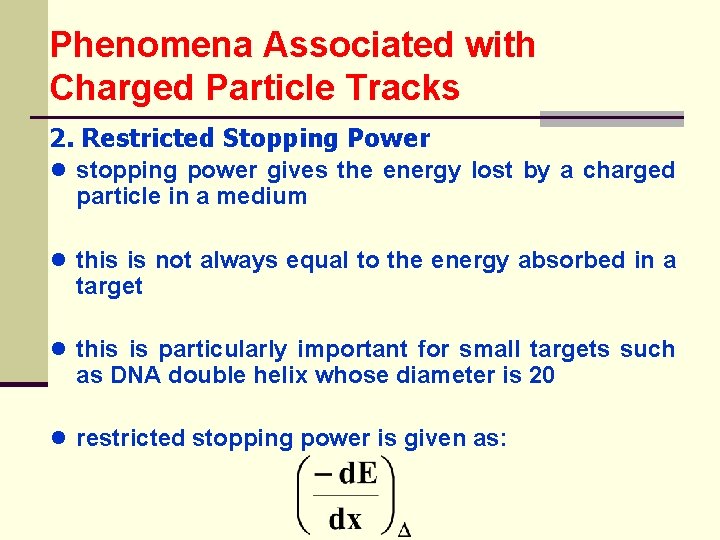
Phenomena Associated with Charged Particle Tracks 2. Restricted Stopping Power ● stopping power gives the energy lost by a charged particle in a medium ● this is not always equal to the energy absorbed in a target ● this is particularly important for small targets such as DNA double helix whose diameter is 20 ● restricted stopping power is given as:
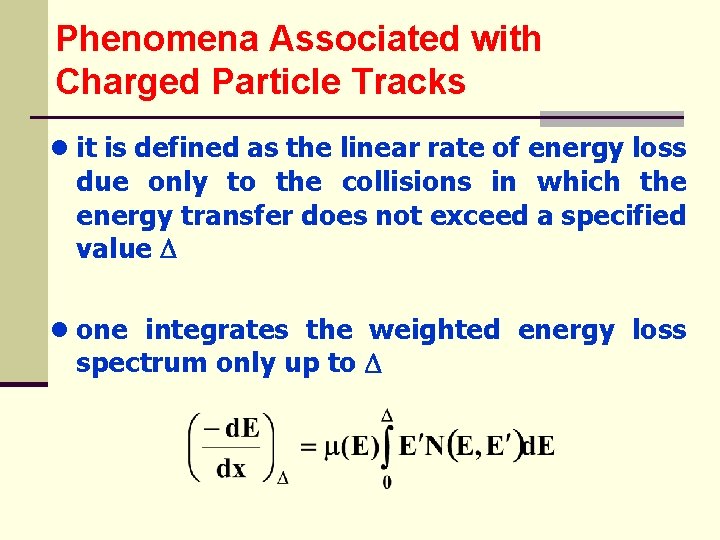
Phenomena Associated with Charged Particle Tracks ● it is defined as the linear rate of energy loss due only to the collisions in which the energy transfer does not exceed a specified value ● one integrates the weighted energy loss spectrum only up to
Phenomena Associated with Charged Particle Tracks ● tables in Turner show the restricted mass stopping power for protons and restricted collisional mass stopping mass power for electrons
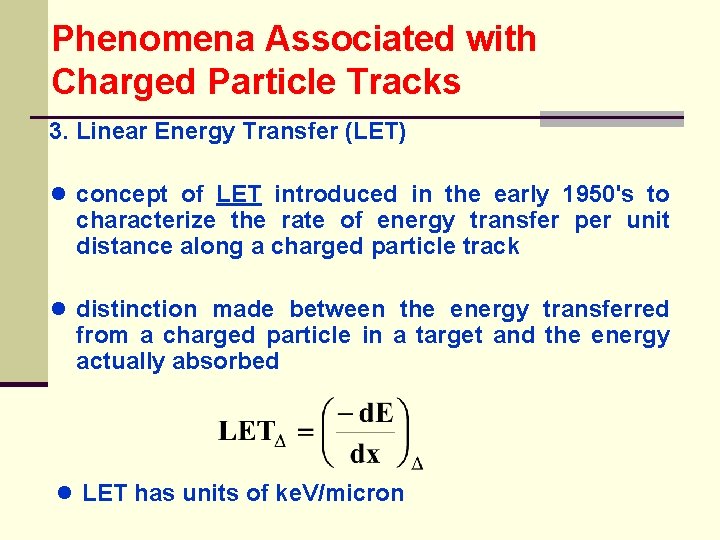
Phenomena Associated with Charged Particle Tracks 3. Linear Energy Transfer (LET) ● concept of LET introduced in the early 1950's to characterize the rate of energy transfer per unit distance along a charged particle track ● distinction made between the energy transferred from a charged particle in a target and the energy actually absorbed ● LET has units of ke. V/micron
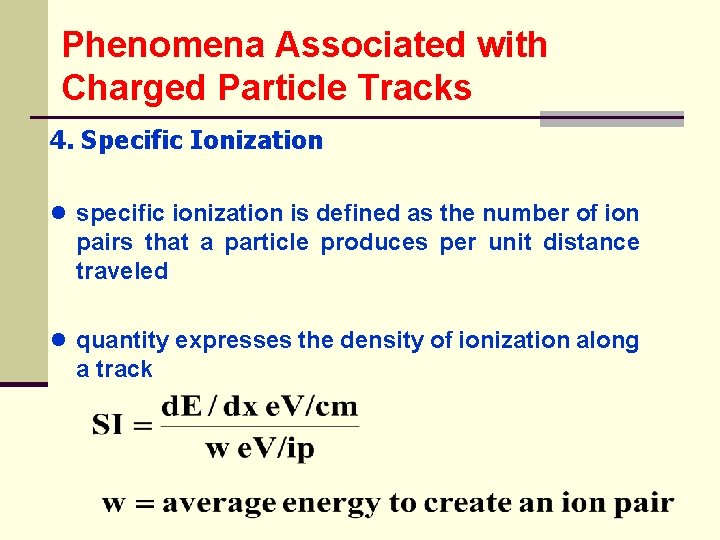
Phenomena Associated with Charged Particle Tracks 4. Specific Ionization ● specific ionization is defined as the number of ion pairs that a particle produces per unit distance traveled ● quantity expresses the density of ionization along a track
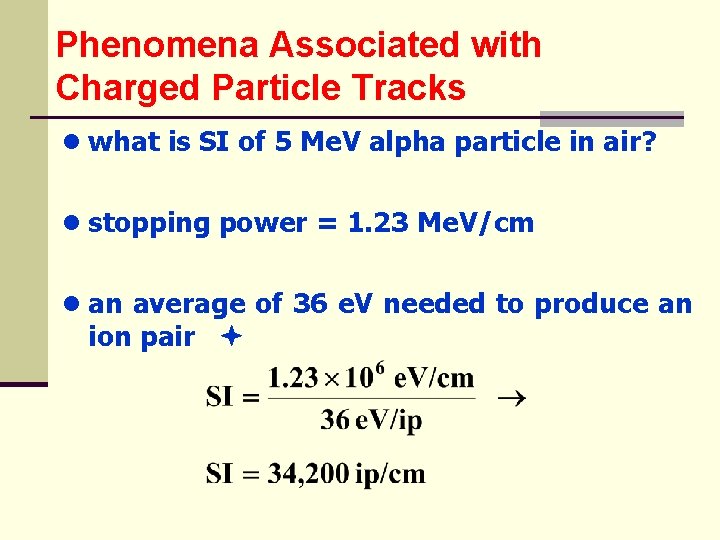
Phenomena Associated with Charged Particle Tracks ● what is SI of 5 Me. V alpha particle in air? ● stopping power = 1. 23 Me. V/cm ● an average of 36 e. V needed to produce an ion pair
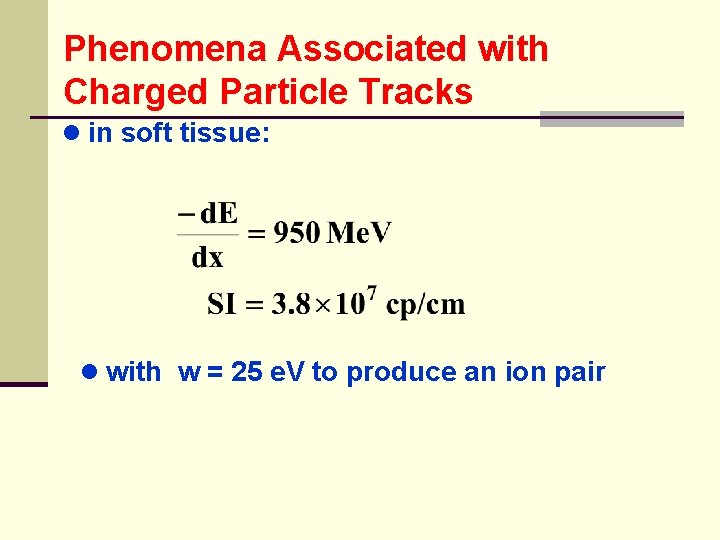
Phenomena Associated with Charged Particle Tracks ● in soft tissue: ● with w = 25 e. V to produce an ion pair
Phenomena Associated with Charged Particle Tracks ● 6. Energy Straggling read Turner ● 7. Range Straggling read Turner ● 8. Multiple Coulomb Scattering read Turner
- Slides: 98