
Interaction Modelling Topics to be discuss What is
Interaction Modelling
Topics to be discuss What is Interaction Modelling Use Case Models Actor Use cases Use Case Diagram Symbols Use case Diagram Use Case Realtionship Guidelines for Use case Models
Ø Ø Ø What is Interaction Modeling The Interaction model is the third leg of the modeling tripod and describe interactions with in a system. The class model describes the objects in a system and their relationship, the state model describes the life cycles of the objects and the interaction model describes how the objects interact. Interaction can be modeled at different levels of abstraction. At a high level, use cases describes how a system interacts with outside actors. Each use case represents a piece of functionality that a system provides to its users Sequence diagrams provide more detail and show the messages exchanged among a set of objects over time. And finally, activity diagrams provide more detail and show messages exchanged among a set of objects over time.
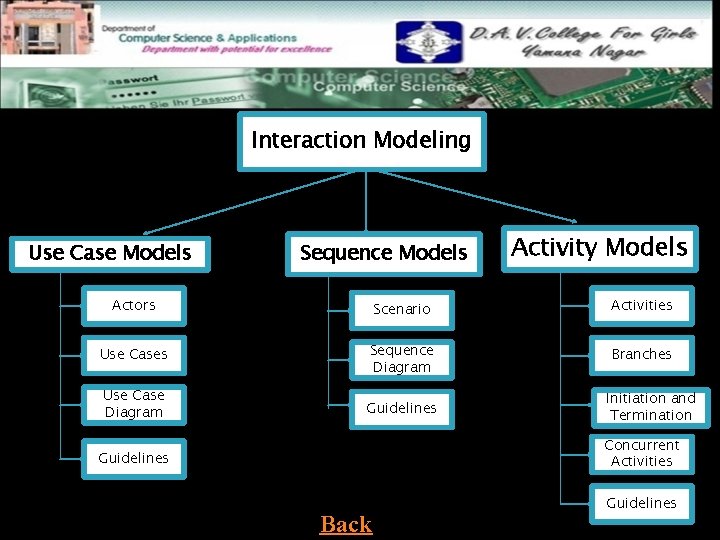
Interaction Modeling Use Case Models Sequence Models Activity Models Actors Scenario Activities Use Cases Sequence Diagram Branches Use Case Diagram Guidelines Initiation and Termination Concurrent Activities Guidelines Back Guidelines
Use case Model
Actor An actor is a direct external user of a system-an object or set of objects that communicates directly with the system but that is not part of the system. For example-customer and repair technician are different actors of a vending machine. Actors can be persons, devices and other systems-anything that interacts directly with the system. Back
Use cases ØA use case is a coherent piece of functionality that a system can provide by interacting with actors. ØFor example-a customer actor can buy a beverage from a vending machine. The customer inserts money into the machine, make a selection and ultimately receives a beverage. ØA use case involves a sequence of messages among the system and its actors. Buy a beverage: The vending machine delivers a beverage after a customer selects and pay for it Perform scheduled maintenance: A repair technician performs the periodic service on the vending machine necessary to keep it in good working condition. Make repairs: A repair technician performs the unexpected service on the vending machine necessary to repair a problem in its operation. Load items: A stock clerk adds items into the vending machine to replenish its stock of beverages. Figure-Use Case summaries for a vending machine Back
Use Case Diagram Symbols Use Case Actor Boundary Connection <<include>> Include relationship Extend relationship Back <<extend>>
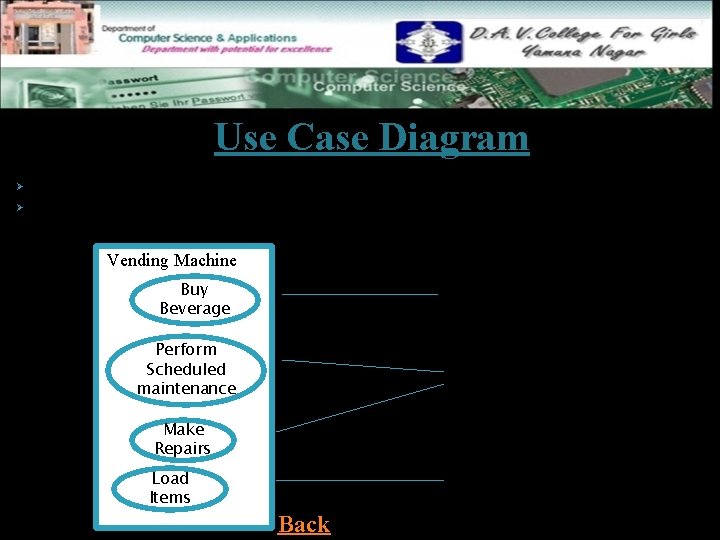
Use Case Diagram Ø Ø A system involves a set of use cases and a set of actors. The UML has a graphical notation for summarizing use cases and the below figure show an example. Vending Machine Buy Beverage Perform Scheduled maintenance Make Repairs Load Items Customer Repair Technician Stock Clerk Back. Figure-Use Case Diagram for a vending machine
Use Case Realtionship Include Relationship Extend Relationship
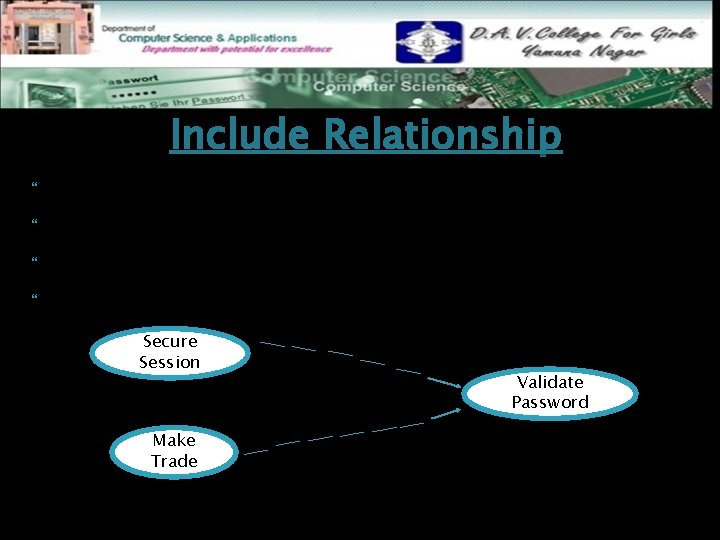
Include Relationship The include relationship incorporates one use case within the behavior sequence of another use case. An included use case is like a subroutine-it represents behavior that would otherwise have to be described repeatedly. The UML notation for an include relationship is a dashed arrow from the source(including) use case to the target(included) use case. The keyword <<include>> annotates the arrow. The following figure shows an example from an online stock brokerage system. Secure Session Make Trade <<include>> Validate Password <<include>> Fig-Use case inclusion
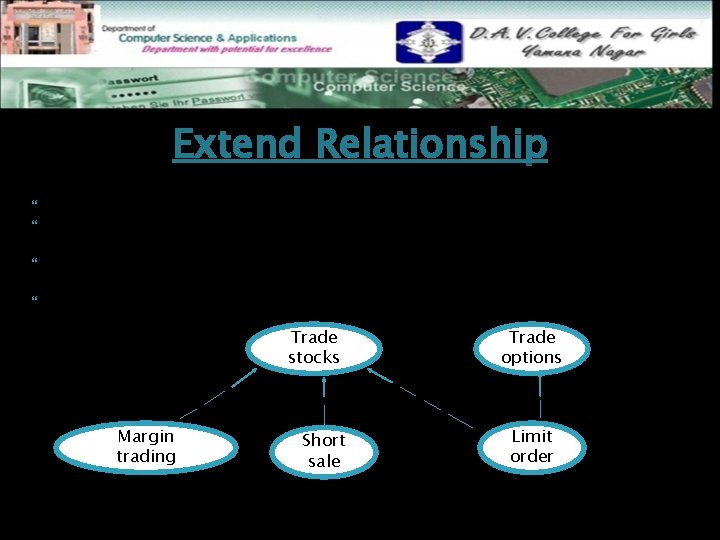
Extend Relationship The extend relationship adds incremental behavior to a use case. It represents the frequent situation in which some initial capability is defined and later features are added modularly. The UML notation for an extend relationship is a dashed arrow from the extension use case to the base use case. The keyword <<extend>> annotates the arrow. The following figure shows the base use case trade stocks for a stock brokerage system. Trade stocks <<extend>> Margin trading Trade options Short sale <<extend>> Limit order Fig-Use case extension
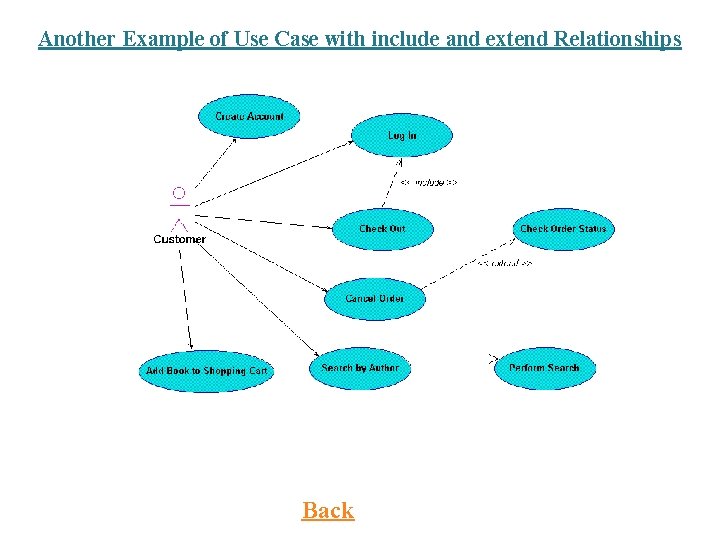
Another Example of Use Case with include and extend Relationships Back Prof. Rajender Nath
Guidelines for Use case Models Use cases identify the functionality of a system and organize it according to the perspective of users. The main purpose of a system is almost always found in the use cases, with requirements lists supplying additional implementation constraints. Here are some guidelines for constructing use case models. q q q First determine the system boundary Ensure that actors are focused Each use case must provide value to users Relate use cases and actors Remember that use cases are informal Use cases can be structured Back
THANKS Back
- Slides: 15