
Interaction in Urban Traffic Insights into an Observation
Interaction in Urban Traffic – Insights into an Observation of Pedestrian-Vehicle Encounters André Dietrich, Chair of Ergonomics, TUM andre. dietrich@tum. de Tuesday, December 14, are funded by CARTRE and SCOUT the European Union Horizon 2020 2021 Work Programme

Observation of Pedestrian-Vehicle Encounters Interaction in Urban Traffic – Insights into an Observation of Pedestrian-Vehicle Encounters Tuesday, December 14, 2021 /2
Key Objectives • Observe human-human interactions in current complex urban environments Interaction in Urban Traffic – Insights into an Observation of Pedestrian-Vehicle Encounters Tuesday, December 14, 2021 /3
Key Objectives • Observe human-human interactions in current complex urban environments • Model interaction using different approaches • Interaction vocabulary: How do TPs communicate and anticipate intent • Interaction sequences: What is the general interaction process in specific use cases, scenarios and scenes? • Quantitative models: How can interactions be mathematically formulated to allow model-in-theloop simulations? Interaction in Urban Traffic – Insights into an Observation of Pedestrian-Vehicle Encounters Tuesday, December 14, 2021 /4
Key Objectives • Observe human-human interactions in current complex urban environments • Model interaction using different approaches • Interaction vocabulary: How do TPs communicate and anticipate intent • Interaction sequences: What is the general interaction process in specific use cases, scenarios and scenes? • Quantitative models: How can interactions be mathematically formulated to allow model in the loop simulations? • Develop real-time situation and intention analysis algorithms based on the interaction models Interaction in Urban Traffic – Insights into an Observation of Pedestrian-Vehicle Encounters Tuesday, December 14, 2021 /5
Key Objectives • Observe human-human interactions in current complex urban environments • Model interaction using different approaches • Interaction vocabulary: How do TPs communicate and anticipate intent • Interaction sequences: What is the general interaction process in specific use cases, scenarios and scenes? • Quantitative models: How can interactions be mathematically formulated to allow model in the loop simulations? • Develop real-time situation and intention analysis algorithms based on the interaction models Observe, Model, Predict Interaction in Urban Traffic – Insights into an Observation of Pedestrian-Vehicle Encounters Tuesday, December 14, 2021 /6
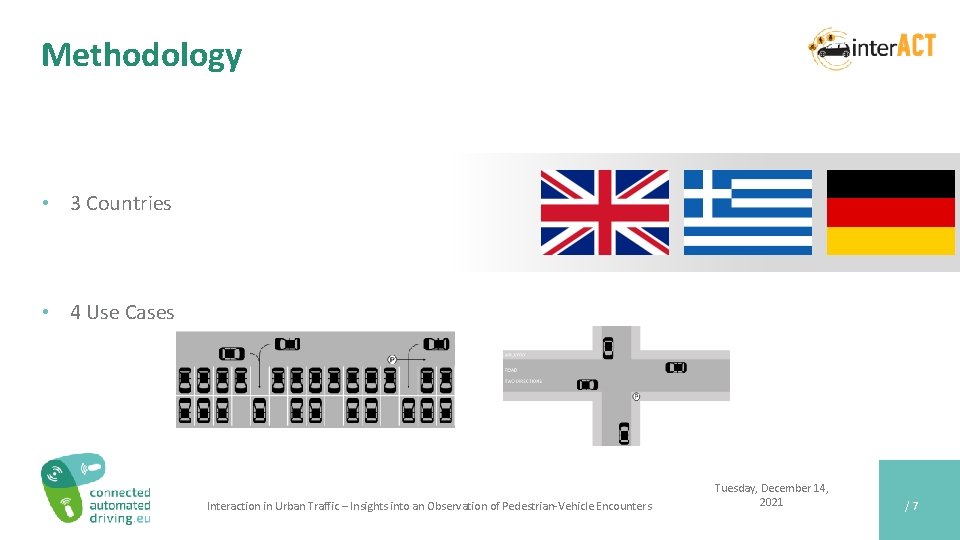
Methodology • 3 Countries • 4 Use Cases Interaction in Urban Traffic – Insights into an Observation of Pedestrian-Vehicle Encounters Tuesday, December 14, 2021 /7
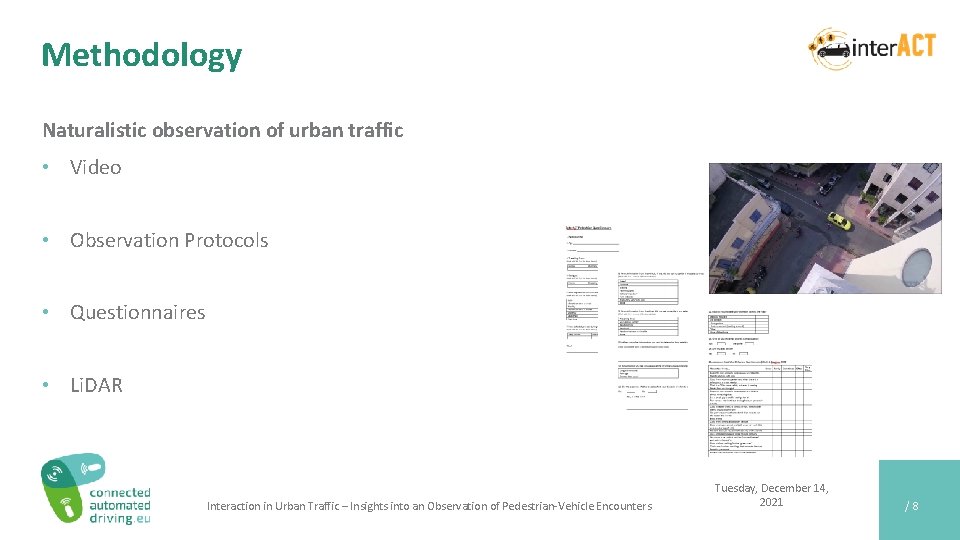
Methodology Naturalistic observation of urban traffic • Video • Observation Protocols • Questionnaires • Li. DAR Interaction in Urban Traffic – Insights into an Observation of Pedestrian-Vehicle Encounters Tuesday, December 14, 2021 /8
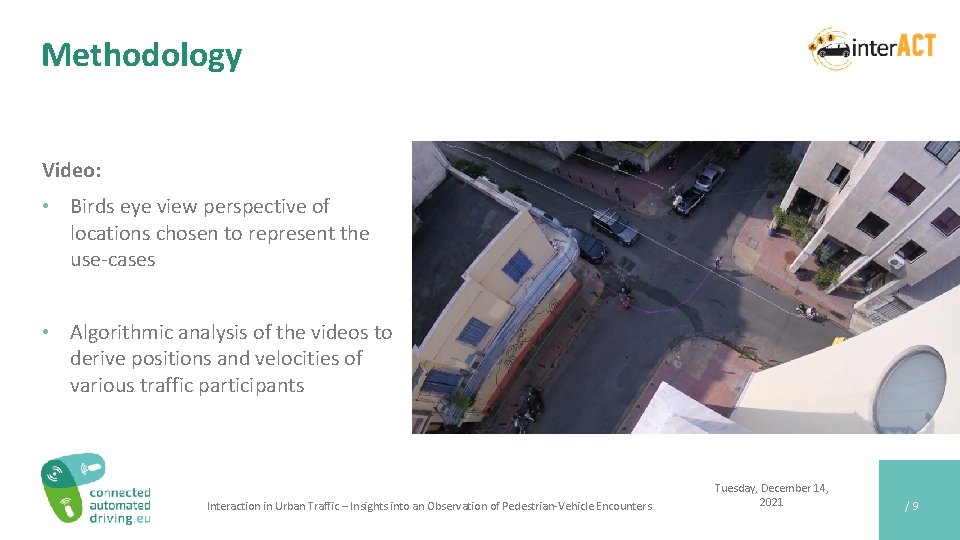
Methodology Video: • Birds eye view perspective of locations chosen to represent the use-cases • Algorithmic analysis of the videos to derive positions and velocities of various traffic participants Interaction in Urban Traffic – Insights into an Observation of Pedestrian-Vehicle Encounters Tuesday, December 14, 2021 /9
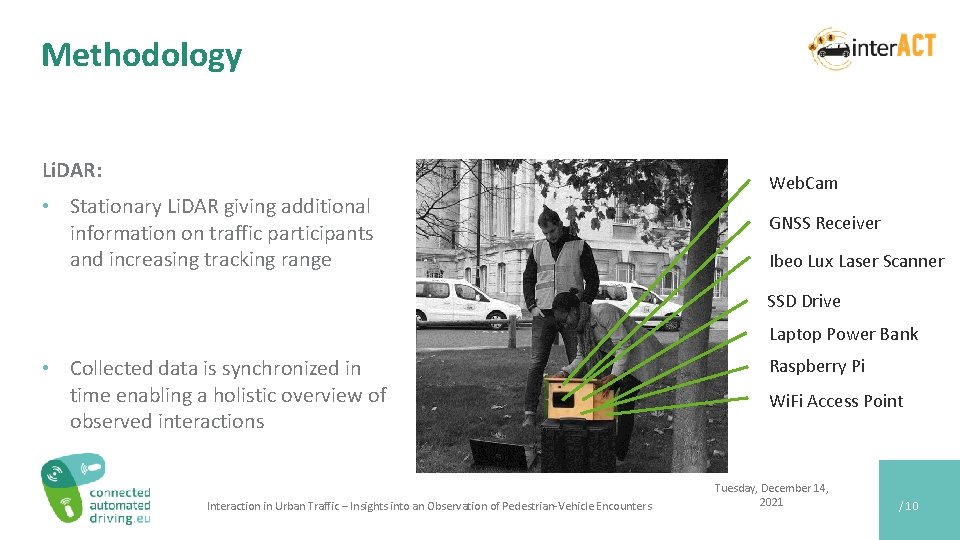
Methodology Li. DAR: • Stationary Li. DAR giving additional information on traffic participants and increasing tracking range Web. Cam GNSS Receiver Ibeo Lux Laser Scanner SSD Drive Laptop Power Bank • Collected data is synchronized in time enabling a holistic overview of observed interactions Interaction in Urban Traffic – Insights into an Observation of Pedestrian-Vehicle Encounters Raspberry Pi Wi. Fi Access Point Tuesday, December 14, 2021 / 10
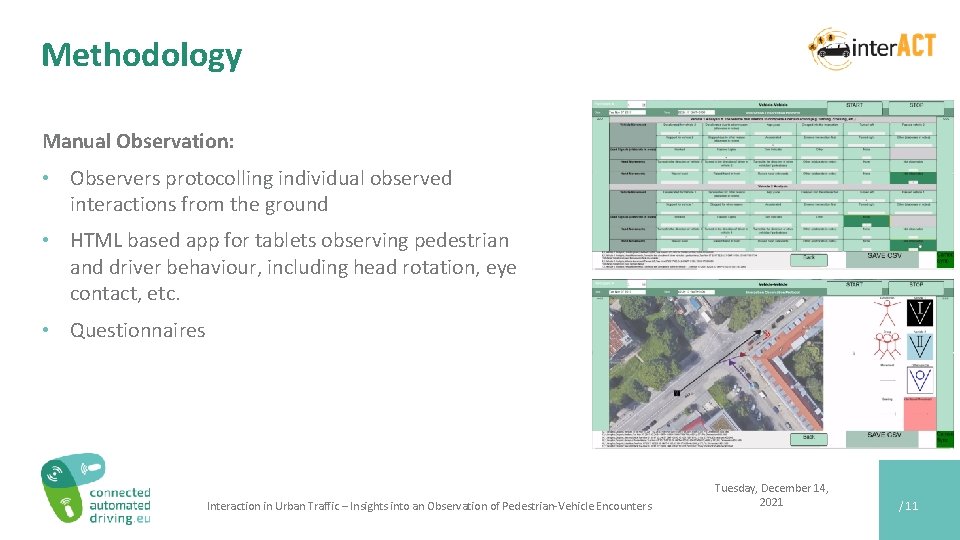
Methodology Manual Observation: • Observers protocolling individual observed interactions from the ground • HTML based app for tablets observing pedestrian and driver behaviour, including head rotation, eye contact, etc. • Questionnaires Interaction in Urban Traffic – Insights into an Observation of Pedestrian-Vehicle Encounters Tuesday, December 14, 2021 / 11
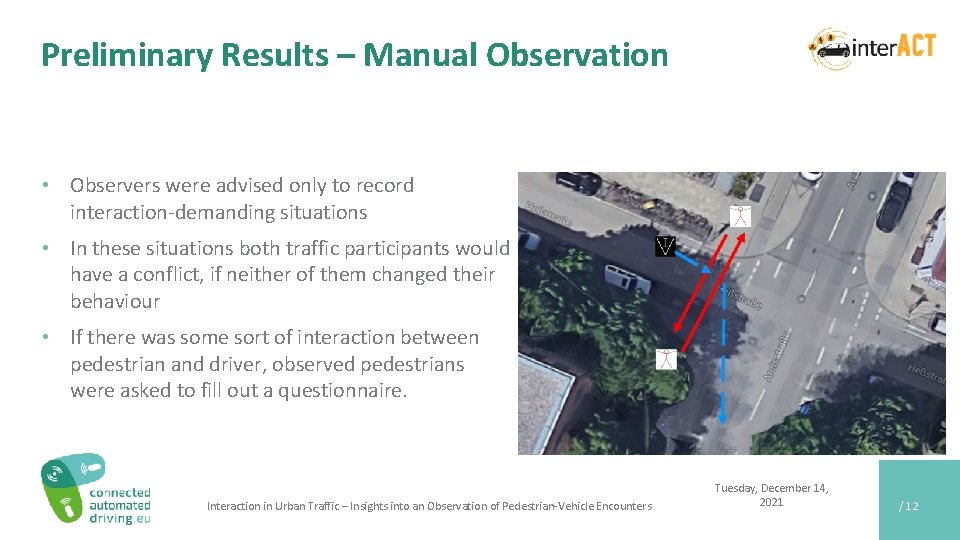
Preliminary Results – Manual Observation • Observers were advised only to record interaction-demanding situations • In these situations both traffic participants would have a conflict, if neither of them changed their behaviour • If there was some sort of interaction between pedestrian and driver, observed pedestrians were asked to fill out a questionnaire. Interaction in Urban Traffic – Insights into an Observation of Pedestrian-Vehicle Encounters Tuesday, December 14, 2021 / 12
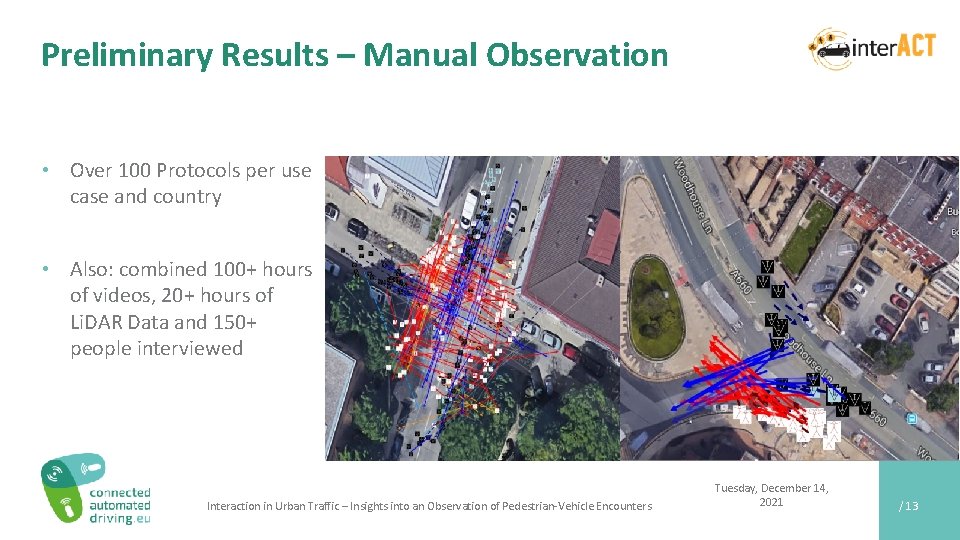
Preliminary Results – Manual Observation • Over 100 Protocols per use case and country • Also: combined 100+ hours of videos, 20+ hours of Li. DAR Data and 150+ people interviewed Interaction in Urban Traffic – Insights into an Observation of Pedestrian-Vehicle Encounters Tuesday, December 14, 2021 / 13
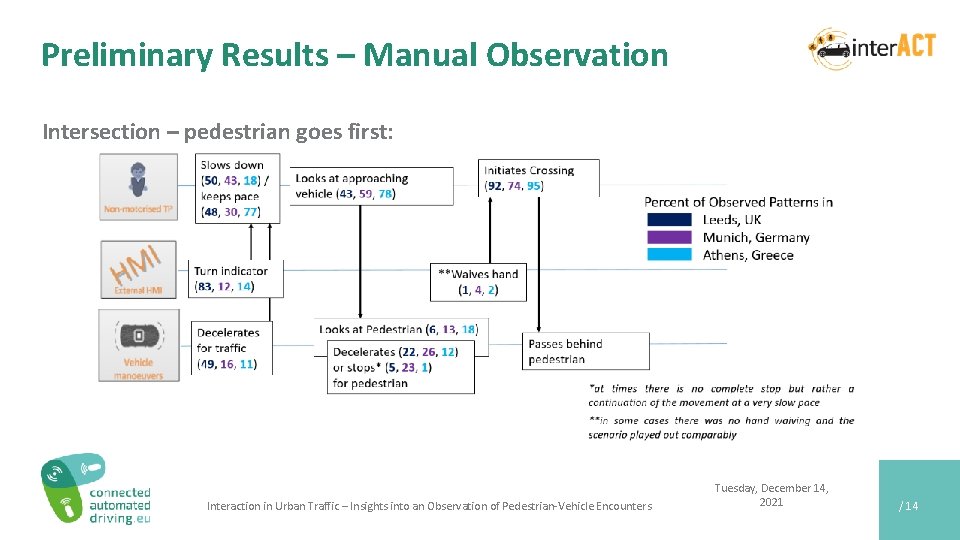
Preliminary Results – Manual Observation Intersection – pedestrian goes first: Interaction in Urban Traffic – Insights into an Observation of Pedestrian-Vehicle Encounters Tuesday, December 14, 2021 / 14
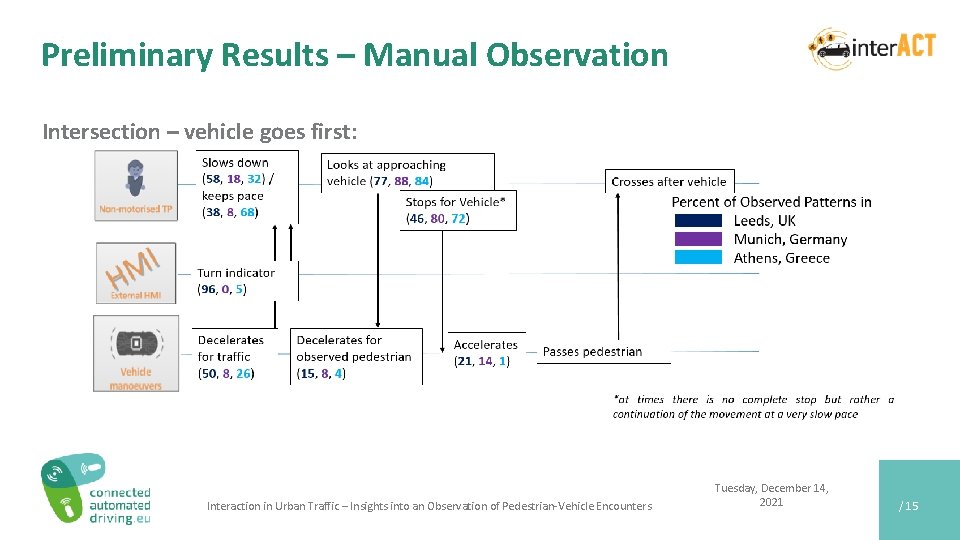
Preliminary Results – Manual Observation Intersection – vehicle goes first: Interaction in Urban Traffic – Insights into an Observation of Pedestrian-Vehicle Encounters Tuesday, December 14, 2021 / 15
Overall Findings • Occurrence and necessity of interactions highly depends on the situation and a variety of other influences, such as traffic density, time of day and specific traffic conditions • Explicit communication (e. g. gesturing, flashing lights etc. ) happens rarely - most potential interaction-demanding situations are resolved before they actually arise, mostly by adjusting kinematic motion • Cooperation, communication and thus interaction between human road users takes place at low speeds, usually below 20 km/h • At higher speeds conflict avoidance is predominant – pedestrians use large enough intervehicle gaps to cross without expecting the second vehicle to adapt • Self reports ≠ reality: About 50% of pedestrians reported to use some sort of visual information from the driver – even when the driver could not have been physically perceived Interaction in Urban Traffic – Insights into an Observation of Pedestrian-Vehicle Encounters Tuesday, December 14, 2021 / 16
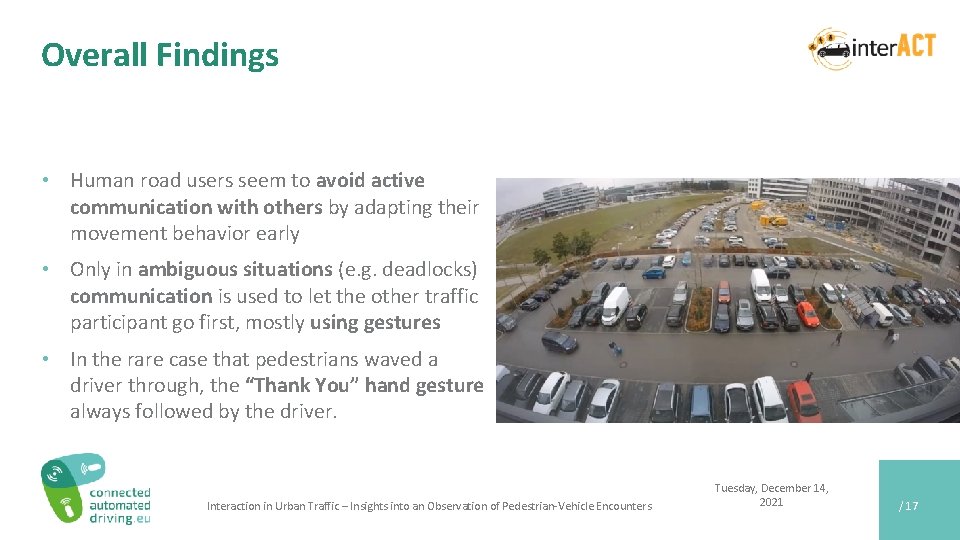
Overall Findings • Human road users seem to avoid active communication with others by adapting their movement behavior early • Only in ambiguous situations (e. g. deadlocks) communication is used to let the other traffic participant go first, mostly using gestures • In the rare case that pedestrians waved a driver through, the “Thank You” hand gesture always followed by the driver. Interaction in Urban Traffic – Insights into an Observation of Pedestrian-Vehicle Encounters Tuesday, December 14, 2021 / 17
(First) Conclusions • Automated Vehicles do not need to communicate much using external Human Machine Interfaces if the idea is to replace a human driver – only in ambiguous situations explicit communication is really necessary • BUT – Automated Vehicles could enhance the vehicle by communicating early in addition to adapting their movement possibly increasing Acceptance, Safety and Traffic Flow Interaction in Urban Traffic – Insights into an Observation of Pedestrian-Vehicle Encounters Tuesday, December 14, 2021 / 18
Thank you! Tuesday, December 14, are funded by CARTRE and SCOUT the European Union Horizon 2020 2021 Work Programme
- Slides: 19