
INTERACTION HYPOTHESIS M Long Introduction Based on Krashens
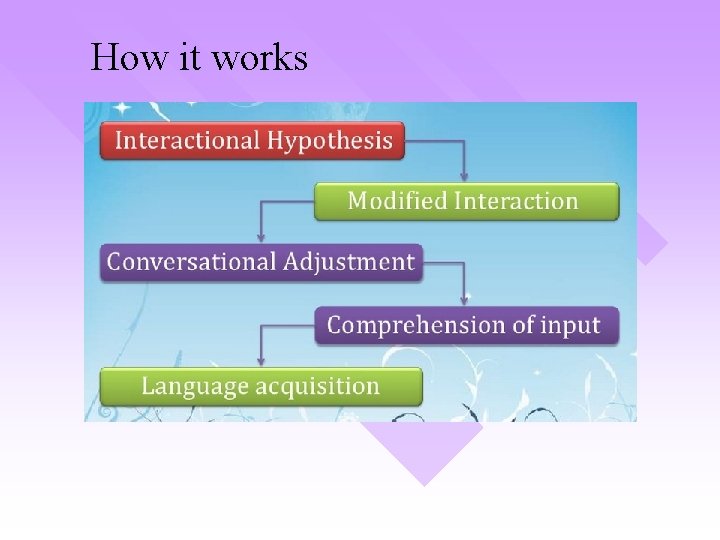
INTERACTION HYPOTHESIS – M. Long Introduction Based on Krashen’s Input Hypothesis: Second language input must be comprehensible - be one stage above the learner’s current level (i+1) in order to be acquired (Krashen, 1985). Long’s Interaction Hypothesis is concerned with how input is made comprehensible. Long focuses on types of intput and how this input leads to communication through modified, negotiated interaction and communicating ideas. The Interaction hypothesis emphasizes that when learners engage with their interlocutors in negotiations around meaning, the nature of the input might be qualitatively changed. (Long 1981, 1983 a, 1996)
ITERACTION & OUTPUT HYPOTHESES
How it works
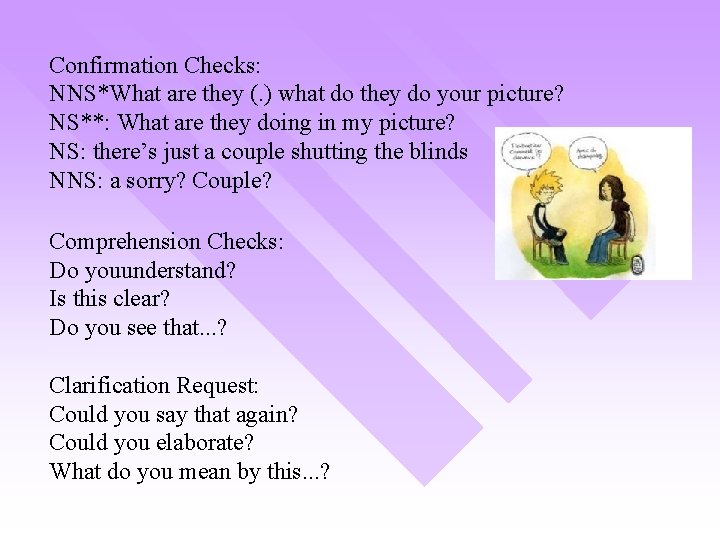
Confirmation Checks: NNS*What are they (. ) what do they do your picture? NS**: What are they doing in my picture? NS: there’s just a couple shutting the blinds NNS: a sorry? Couple? Comprehension Checks: Do youunderstand? Is this clear? Do you see that. . . ? Clarification Request: Could you say that again? Could you elaborate? What do you mean by this. . . ?
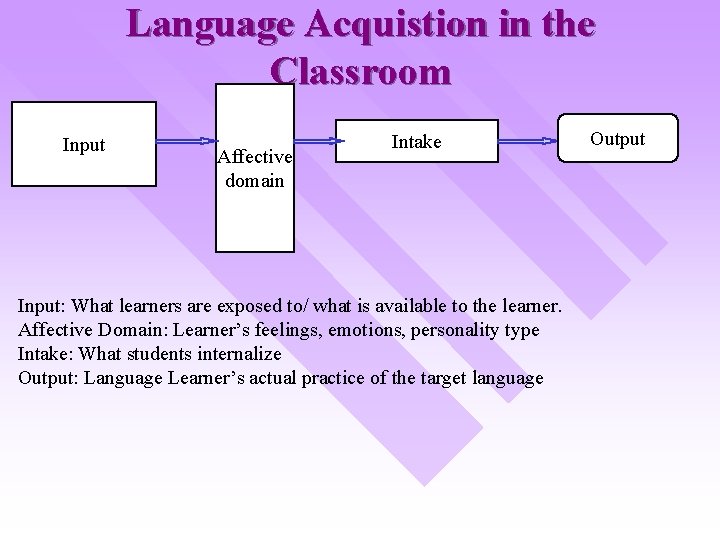
Language Acquistion in the Classroom Input Affective domain Intake Input: What learners are exposed to/ what is available to the learner. Affective Domain: Learner’s feelings, emotions, personality type Intake: What students internalize Output: Language Learner’s actual practice of the target language Output

Swain: Output Hypothesis Importance of comprehensible output—not enough to see and hear language in use, but learners need the chance to use the target language. Swain suggests that when learners are engaged in negotiation of meaning and talking about language (namely “comprehensible output”) they are, in those moments, engaged in learning language. For Swain, constant practice facilitates the learner to be conscious of her/his production. Output makes the learner move from semantic processing to complete grammatical processing for accurate production.
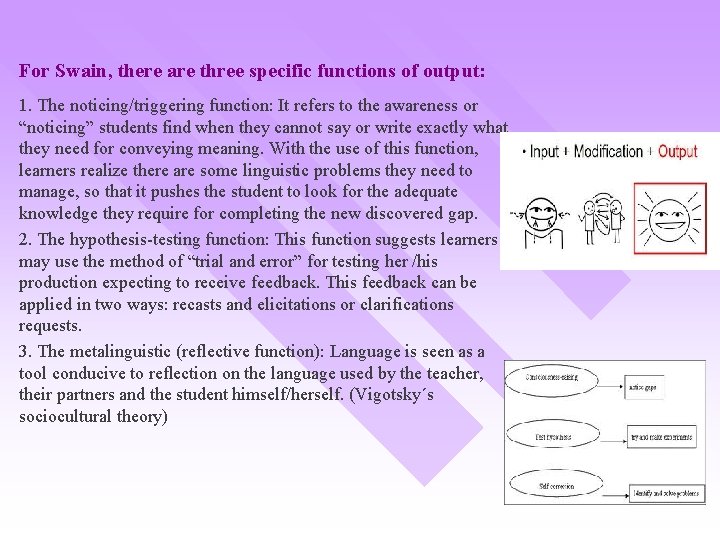
For Swain, there are three specific functions of output: 1. The noticing/triggering function: It refers to the awareness or “noticing” students find when they cannot say or write exactly what they need for conveying meaning. With the use of this function, learners realize there are some linguistic problems they need to manage, so that it pushes the student to look for the adequate knowledge they require for completing the new discovered gap. 2. The hypothesis-testing function: This function suggests learners may use the method of “trial and error” for testing her /his production expecting to receive feedback. This feedback can be applied in two ways: recasts and elicitations or clarifications requests. 3. The metalinguistic (reflective function): Language is seen as a tool conducive to reflection on the language used by the teacher, their partners and the student himself/herself. (Vigotsky´s sociocultural theory)
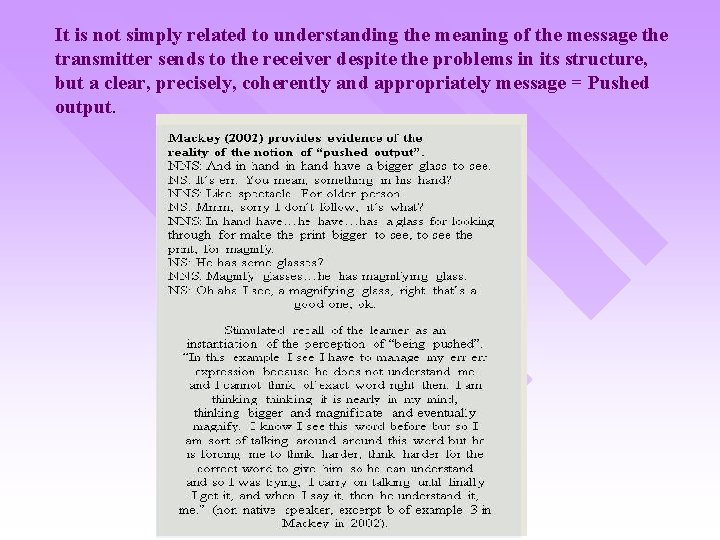
It is not simply related to understanding the meaning of the message the transmitter sends to the receiver despite the problems in its structure, but a clear, precisely, coherently and appropriately message = Pushed output.
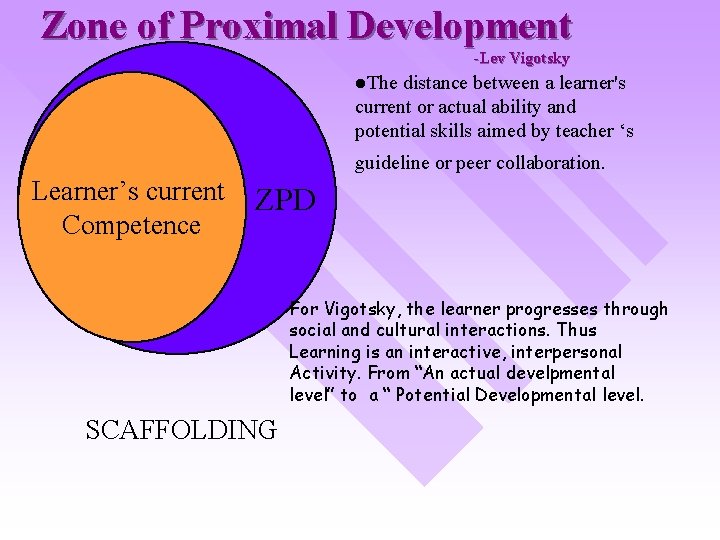
Zone of Proximal Development -Lev Vigotsky l. The distance between a learner's current or actual ability and potential skills aimed by teacher ‘s guideline or peer collaboration. Learner’s current Competence ZPD For Vigotsky, the learner progresses through social and cultural interactions. Thus Learning is an interactive, interpersonal Activity. From “An actual develpmental level” to a “ Potential Developmental level. SCAFFOLDING
Zone of proximal development The difference between the child's capacity to solve problems on his own, and his capacity to solve them with assistance. In other words, the actual developmental level refers to all the functions and activities that a child can perform on his own, independently without the help of anyone else. On the other hand, the zone of proximal development includes all the functions and activities that a child or a learner can perform only with the assistance of someone else. The person in this scaffolding process, providing non-intrusive intervention, could be an adult (parent, teacher, caretaker, language instructor) or another peer who has already mastered that particular function. Scaffolding: Teachers and other adults modify their language to match the language level of students. This type of modification is called “scaffolding. ” All students (including adults) learn better when the teacher scaffolds or adjusts his/her instruction to the level of the student.
- Slides: 10