
Interaction between different types of visual information Big

Interaction between different types of visual information • Big question: the ‘binding problem’ (how are separate neural representations re-combined? ) • Smaller question of this paper: where (not how or why) do motion and position information interact?
Motion aftereffect (‘static’ MAE) • Stare at moving stripes/dots for a while (adapt) • Inspect a stationary version of the adapting pattern • Old story: a sensation of motion without position shift • New story: a sensation of motion + apparent shift of position (in the direction of the MAE)

Site of interaction? • Previous suggestion: In V 1 or V 2, via connections from V 5/MT (Nishida and Johnston, 1999), because small RFs in V 1 would give good position sensitivity. • Authors suggest it all happens in V 5 (more parsimonious than backwards projections from V 5 to V 1)
Overview of experiment • Perceived misalignment of static test stimuli produced by prior adaptation to motion (via MAE) • Attempt to disrupt this misalignment by TMS during perception of the test field • TMS applied to V 1 or V 5 • Also compared with effects of TMS to V 5 after adapting to counter-phased gratings (don’t produce misalignment in test field) • If TMS disrupts perceived misalignment, that area is involved in integration of motion and position
Experimental design
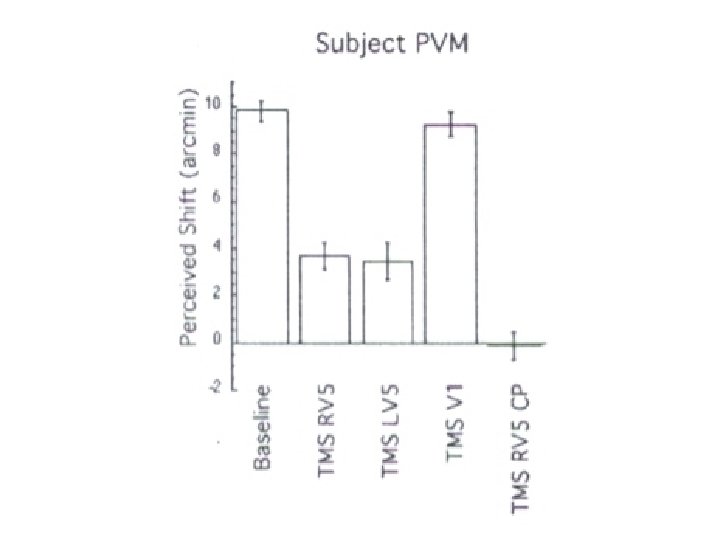
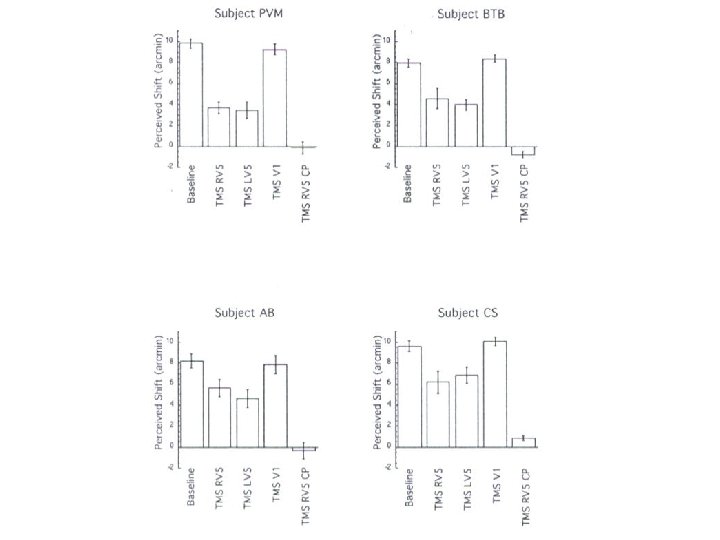
Author’s conclusion • TMS affects perceived misalignment when applied to V 5, but not to V 1 • Integration of motion and position information occurs in V 5, not V 1
Problem (1) • What is TMS doing? • Authors suppose it in affecting integration in V 5 • But it may be affecting motion signal in V 5 (which affects what goes back down to V 1) and adding a little noise to the integrated information in V 1 • We are not told how the measurements were made (‘via standard psychophysical procedures’)
Problem (2) • How can we be sure that TMS affected relevant processing in V 1? • Authors say: In two Ss, coil position was localised by structural MRI. So TMS was applied to V 1, but its effects uncertain In other 2 Ss, ‘use of stationary and moving phosphenes established locus of V 1 and V 5’ Web address for more details no longer exists
Problem (2 cont. ) • Missing condition? : • Apply TMS to V 1 and V 5 during adaptation • (would show whether relevant motionsensitive neurons in V 1 as well as V 5 are affected by TMS) • Does TMS have any effects in V 1? We need to know this in order to interpret the lack of effect in the alignment task
Problem (3) • How does TMS affect vision? • If you hit V 5, motion-sensitive neurons are presumably affected, but how? Temporary reduction in output? • How do the Gabor test patches appear with V 1 and V 5 TMS? Distorted? Normal? • Why is only motion apparently affected by TMS?
My conclusion • TMS affects V 5, but it’s not clear how • Nishida and Johnston’s idea still alive – if the TMS to V 5 disrupts motion signals down to V 1 • TMS to V 1 need not affect integrated signals • RAE panel should look hard at papers in Current Biology
- Slides: 14