
Interaction and Second Language Learning Two Adolescent French
- Slides: 13
Interaction and Second Language Learning: Two Adolescent French Immersion Students Working Together Swain & Lapkin (1998) Brenda & Ian
Learning objectives • Theoretical perspective • Related research • The study: two grade 8 French immersion students • Data analysis and results
Theoretical perspective “Language is simultaneously a means of communication and a tool for thinking” (p. 320) Process “cognitive processes arise from the interaction that occurs between individuals” (p. 321) Product
Literature Review (a) dialogue as an enactment of mental processes; (b) dialogue as occasions for L 2 learning. (c) classroom-based research
Dialogue as an Enactment of Mental Processes • Goss et al. (1994) demonstrate that the mental processes used to solve a linguistic problem are manifested in dialogue. The similar mental processes are at work in joint activity. Language mediated students’ judgments as revealed in their making use of translations and making explicit their metaknowledge.
Dialogue as Occasions for L 2 Learning • Donato (1994) & La. Pierre (1994) demonstrate that the coconstruction of linguistic knowledge in dialogue is language learning in progress. Learners added to their own L 2 knowledge and extended that of their peers. When students reflected consciously on the language that they were producing, then there was occasion for L 2 learning.
Discussion A debate on whether classroom-based or laboratory-type research is more efficient.
!THE STUDY! • • Grade 8 French immersion class Pre-Test Jigsaw Task in pairs Post-Test
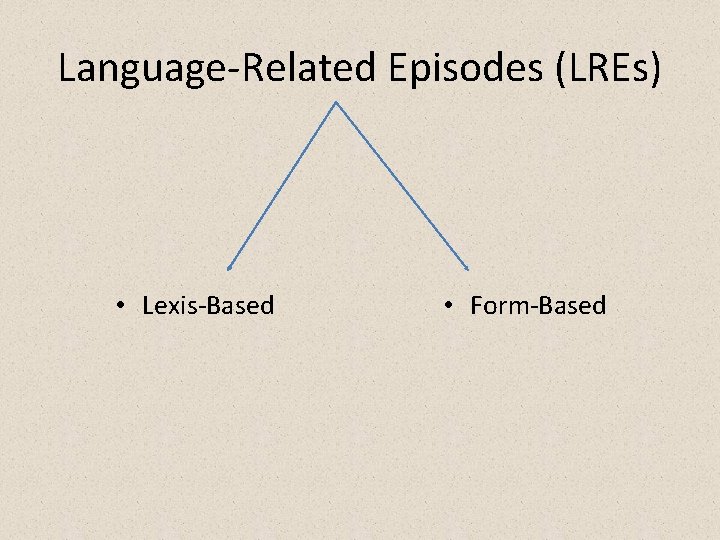
Language-Related Episodes (LREs) • Lexis-Based • Form-Based
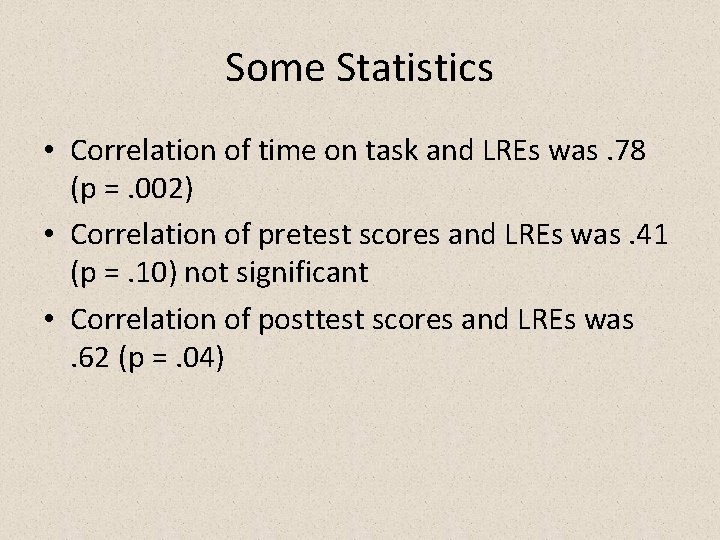
Some Statistics • Correlation of time on task and LREs was. 78 (p =. 002) • Correlation of pretest scores and LREs was. 41 (p =. 10) not significant • Correlation of posttest scores and LREs was. 62 (p =. 04)
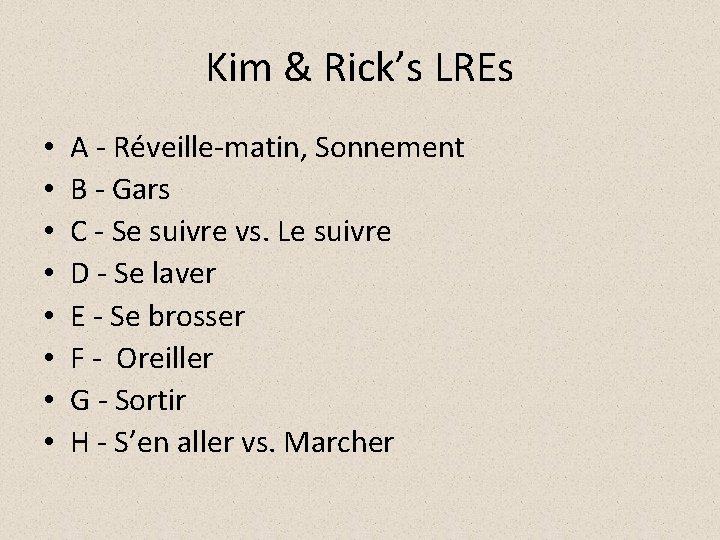
Kim & Rick’s LREs • • A - Réveille-matin, Sonnement B - Gars C - Se suivre vs. Le suivre D - Se laver E - Se brosser F - Oreiller G - Sortir H - S’en aller vs. Marcher
Discussion In your groups, discuss what kinds of tasks and strategies you would employ to elicit as many LREs as possible during collaborative activities.