
Interacting Ultra Cold Atoms a brief overview Fei
Interacting Ultra Cold Atoms a brief overview Fei Zhou PITP, University of British Columbia at Quantum Nanoscience conference, Noosa Blue, Australia, Jan 23, 2006 1. Collaborators: I. Affleck (UBC), E. Demler (Harvard), Z. C. Gu (Tsing. Hua), 2. M. Snoek (Utrecht), C. Wu (UCSB), H. Zhai (Tsing. Hua) $: Office of the Dean of Science, UBC NSERC, Canada Sloan foundation, New York
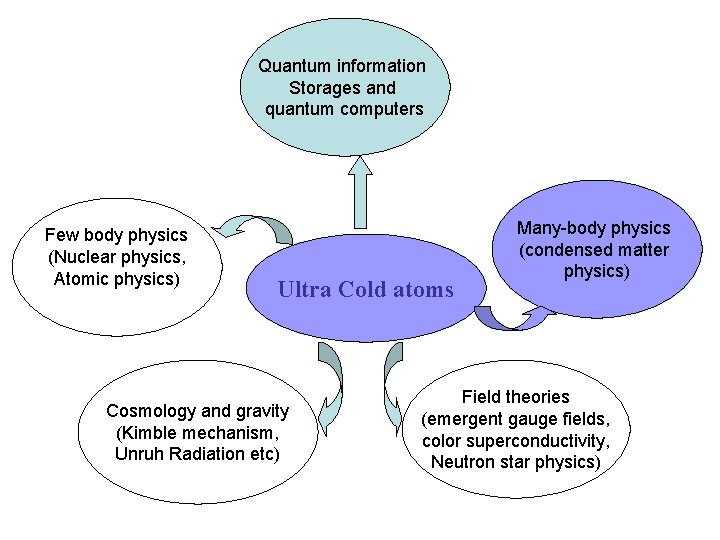
Quantum information Storages and quantum computers Few body physics (Nuclear physics, Atomic physics) Ultra Cold atoms Cosmology and gravity (Kimble mechanism, Unruh Radiation etc) Many-body physics (condensed matter physics) Field theories (emergent gauge fields, color superconductivity, Neutron star physics)
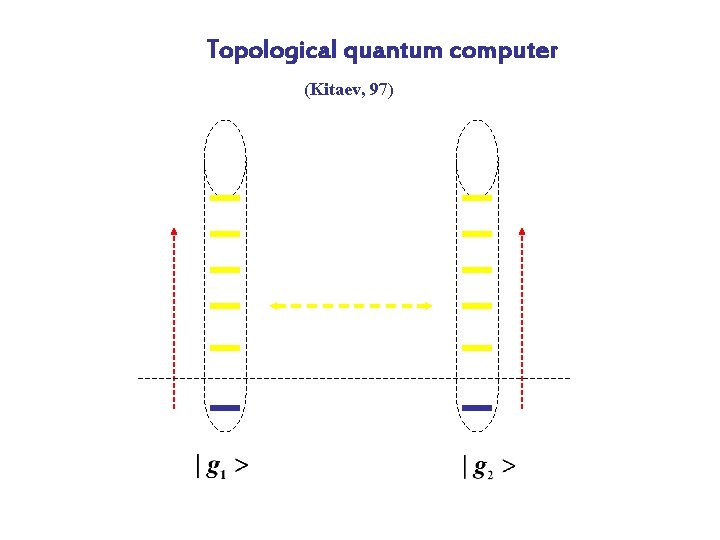
Topological quantum computer (Kitaev, 97)
Bosons in optical lattices • S=0 bosons • S=1 bosons
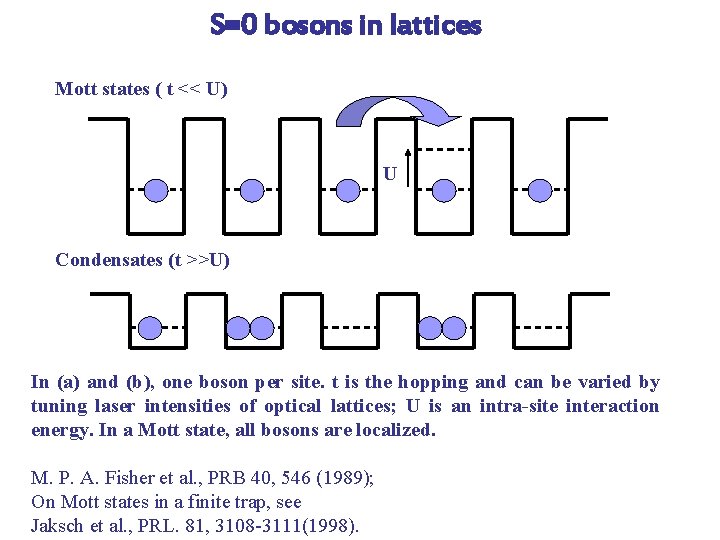
S=0 bosons in lattices Mott states ( t << U) U Condensates (t >>U) In (a) and (b), one boson per site. t is the hopping and can be varied by tuning laser intensities of optical lattices; U is an intra-site interaction energy. In a Mott state, all bosons are localized. M. P. A. Fisher et al. , PRB 40, 546 (1989); On Mott states in a finite trap, see Jaksch et al. , PRL. 81, 3108 -3111(1998).
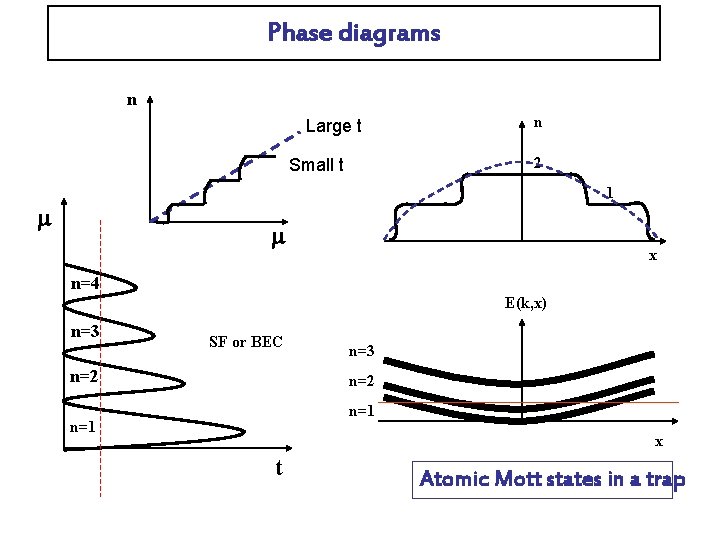
Phase diagrams n Large t n 2 Small t 1 m m x n=4 E(k, x) n=3 SF or BEC n=2 n=3 n=2 n=1 x t Atomic Mott states in a trap
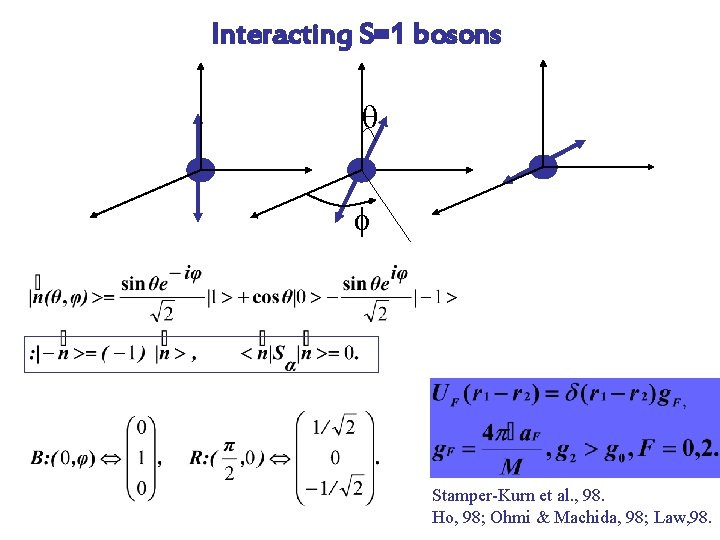
Interacting S=1 bosons q f Stamper-Kurn et al. , 98. Ho, 98; Ohmi & Machida, 98; Law, 98.
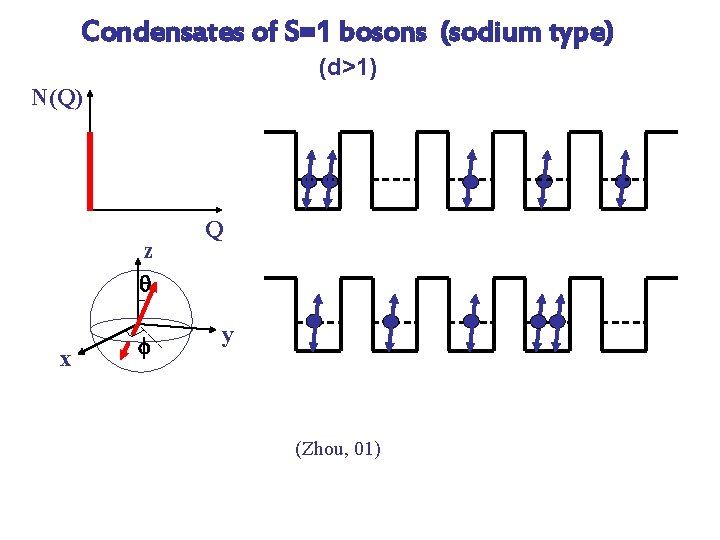
Condensates of S=1 bosons (sodium type) (d>1) N(Q) z q x f Q y (Zhou, 01)
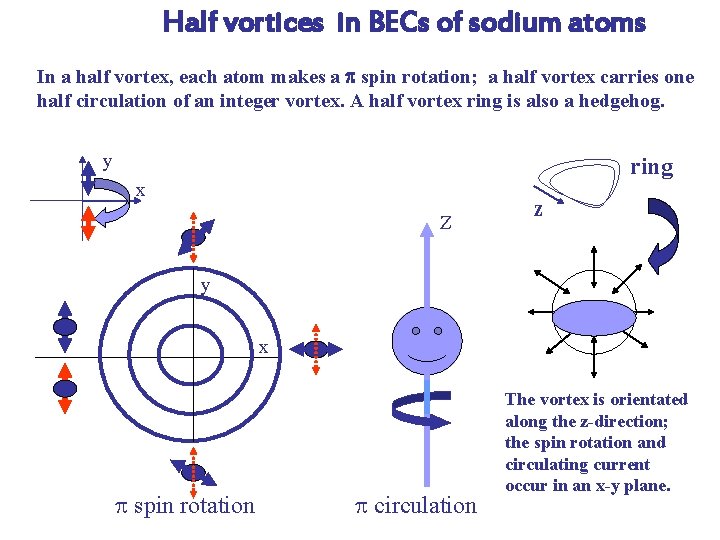
Half vortices in BECs of sodium atoms In a half vortex, each atom makes a p spin rotation; a half vortex carries one half circulation of an integer vortex. A half vortex ring is also a hedgehog. y ring x Z z y x p spin rotation p circulation The vortex is orientated along the z-direction; the spin rotation and circulating current occur in an x-y plane.
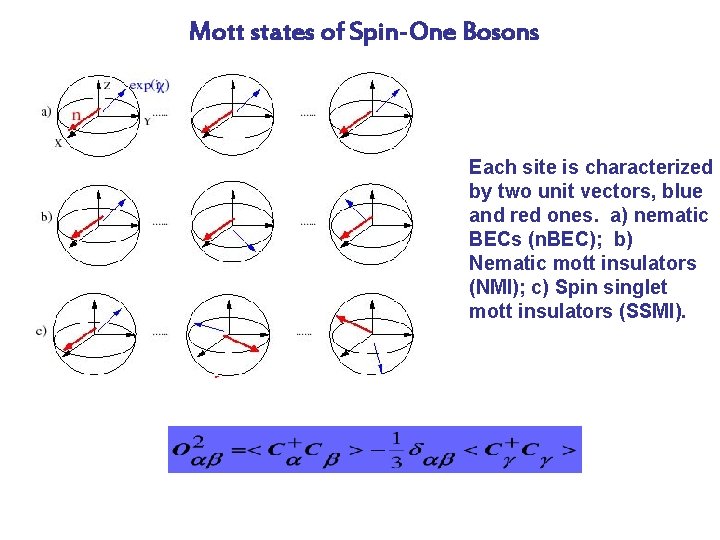
Mott states of Spin-One Bosons Each site is characterized by two unit vectors, blue and red ones. a) nematic BECs (n. BEC); b) Nematic mott insulators (NMI); c) Spin singlet mott insulators (SSMI).
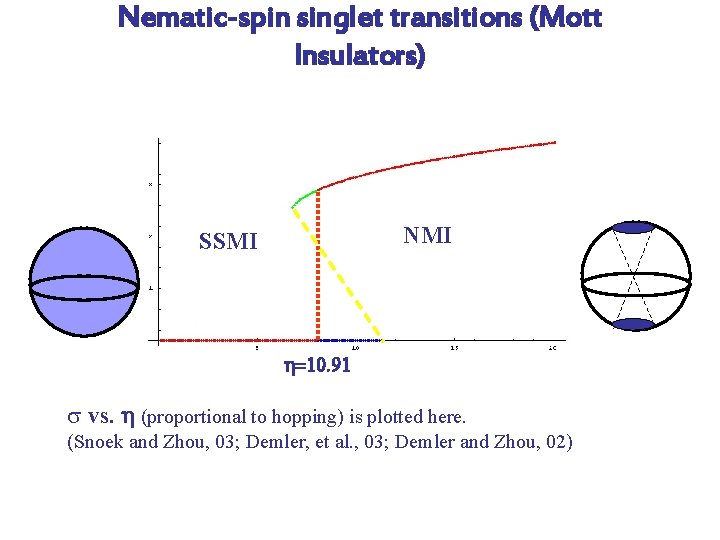
Nematic-spin singlet transitions (Mott Insulators) NMI SSMI h=10. 91 s vs. h (proportional to hopping) is plotted here. (Snoek and Zhou, 03; Demler, et al. , 03; Demler and Zhou, 02)
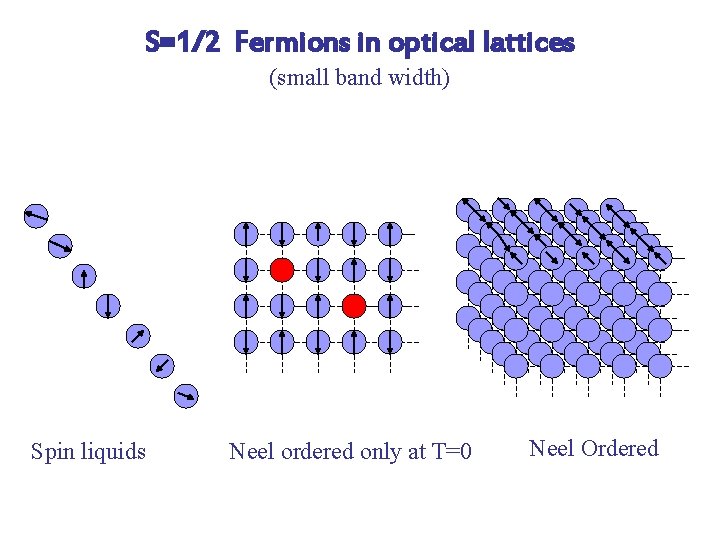
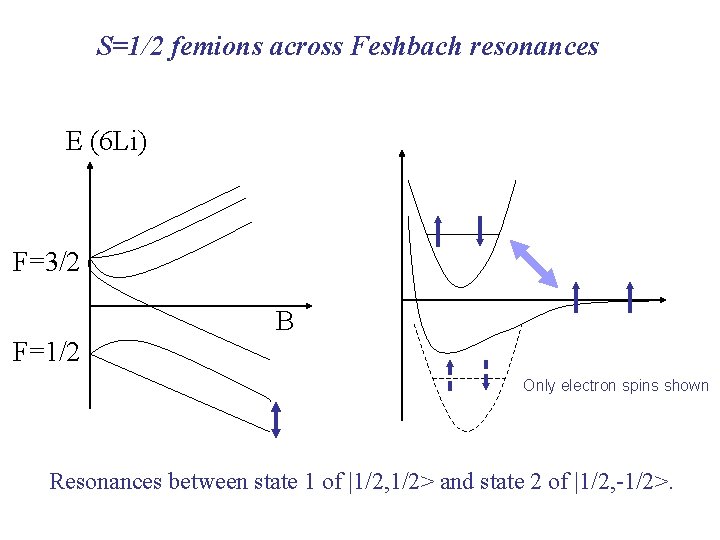
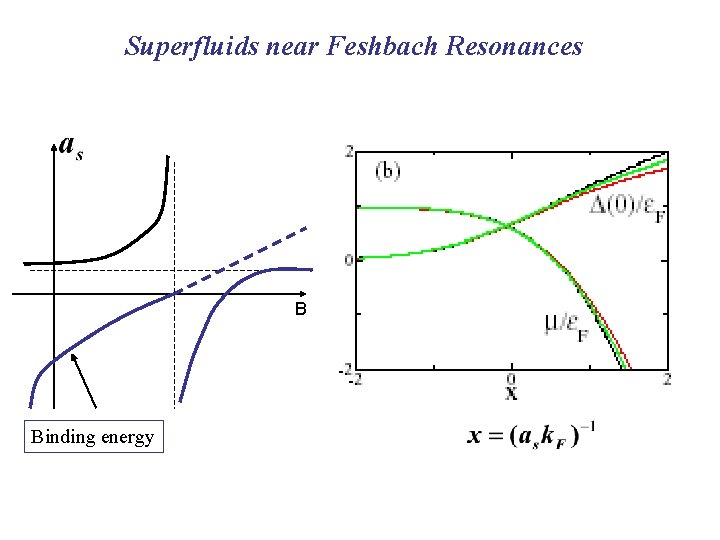
Fermions • S=1/2 fermions in Optical Lattices • S=3/2 fermions, quintet pairing, exotic vortices studied (Wu, Hu and Zhang, 2003 -2006). • Feshbach resonances with population difference (Experiments: MIT group, the Rice University’s Group and JILA group; Theory effeorts: Son and Stephanov, 2005; Pao et al. , 2005; Sheehy and Radzihovsky; Gu, Warner and Zhou; ……. ) • Lattice Feshbach resonances (Stability of Mott states and invasion of superfluidity, factorized superfluids in 1 D; Wu, Gu and Zhou, 2005 -2006) And more…. . .
S=1/2 Fermions in optical lattices (small band width) Spin liquids Neel ordered only at T=0 Neel Ordered
S=1/2 femions across Feshbach resonances E (6 Li) F=3/2 F=1/2 B Only electron spins shown Resonances between state 1 of |1/2, 1/2> and state 2 of |1/2, -1/2>.
Superfluids near Feshbach Resonances B Binding energy
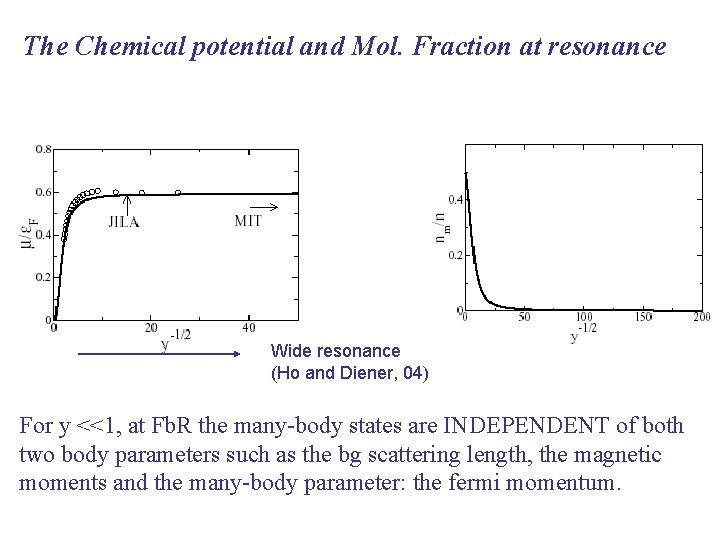
The Chemical potential and Mol. Fraction at resonance Wide resonance (Ho and Diener, 04) For y <<1, at Fb. R the many-body states are INDEPENDENT of both two body parameters such as the bg scattering length, the magnetic moments and the many-body parameter: the fermi momentum.
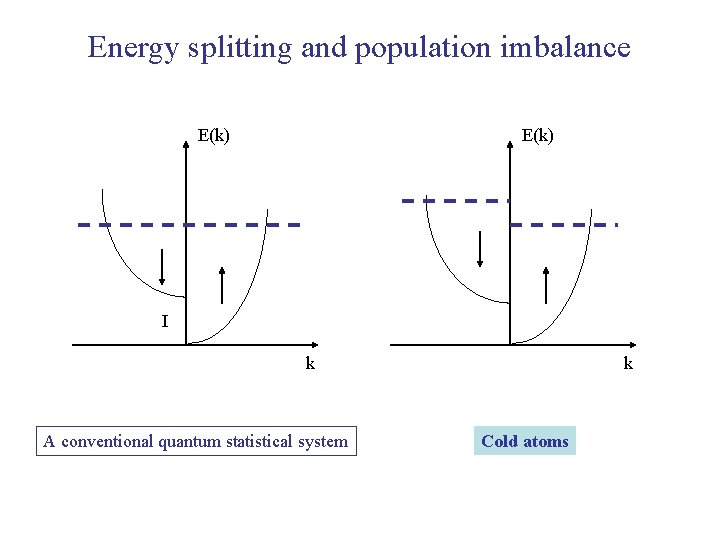
Energy splitting and population imbalance E(k) I k A conventional quantum statistical system k Cold atoms
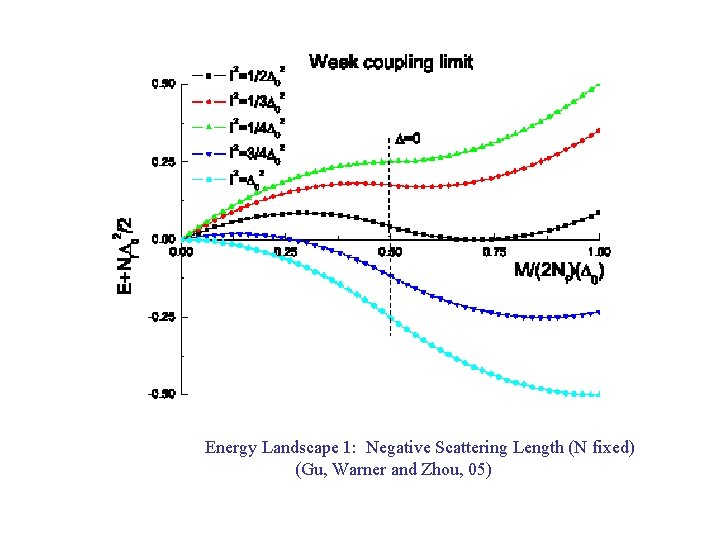
Energy Landscape 1: Negative Scattering Length (N fixed) (Gu, Warner and Zhou, 05)
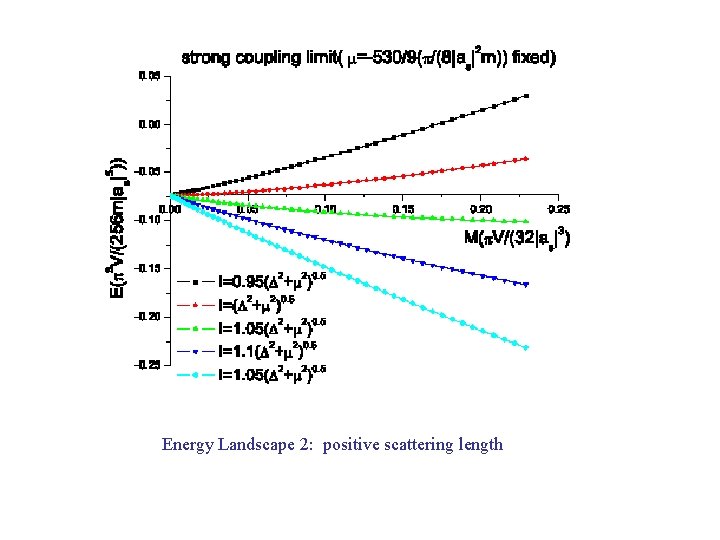
Energy Landscape 2: positive scattering length
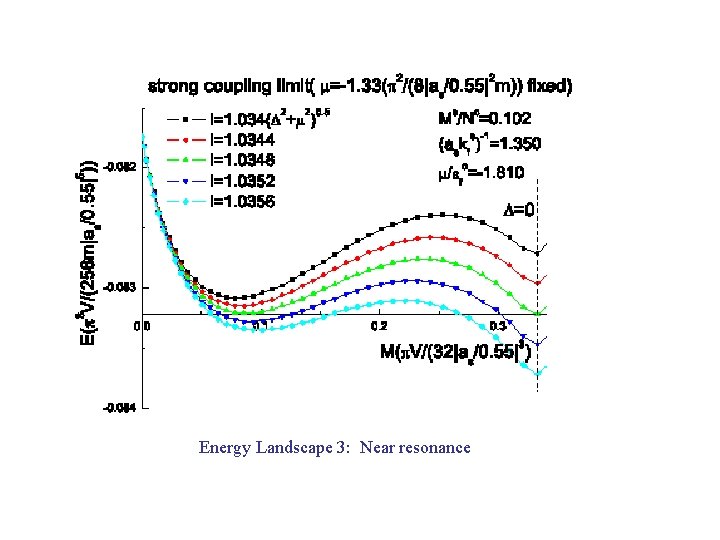
Energy Landscape 3: Near resonance
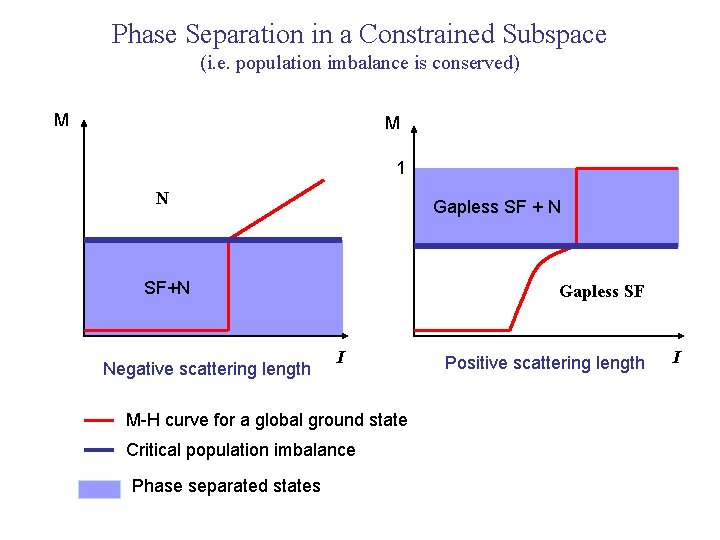
Phase Separation in a Constrained Subspace (i. e. population imbalance is conserved) M M 1 N Gapless SF + N SF+N Negative scattering length Gapless SF I M-H curve for a global ground state Critical population imbalance Phase separated states Positive scattering length I
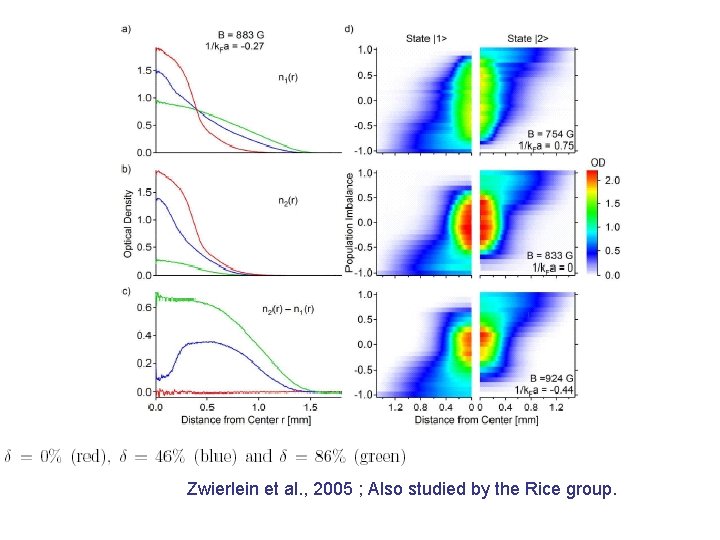
Zwierlein et al. , 2005 ; Also studied by the Rice group.
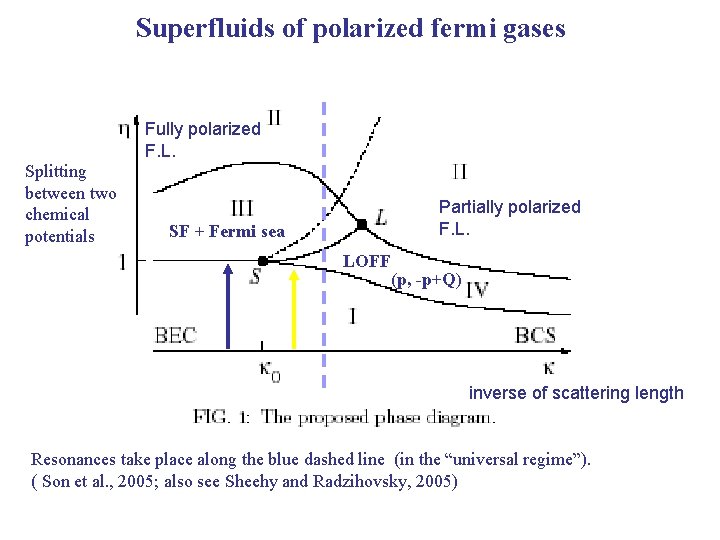
Superfluids of polarized fermi gases Fully polarized F. L. Splitting between two chemical potentials Partially polarized F. L. SF + Fermi sea LOFF (p, -p+Q) inverse of scattering length Resonances take place along the blue dashed line (in the “universal regime”). ( Son et al. , 2005; also see Sheehy and Radzihovsky, 2005)
Summary • many important and exciting new issues in many-body cold atomic matter (magnetic superfluids & Mott states, topological phases, superfluids with population imbalance etc). • Cold atomic matter might also be applied to understand various fundamental concepts/issues in other fields. • There a lot we can learn about/from cold atoms.
- Slides: 24