
Intensive robotassisted rehabilitation improves motor function in children
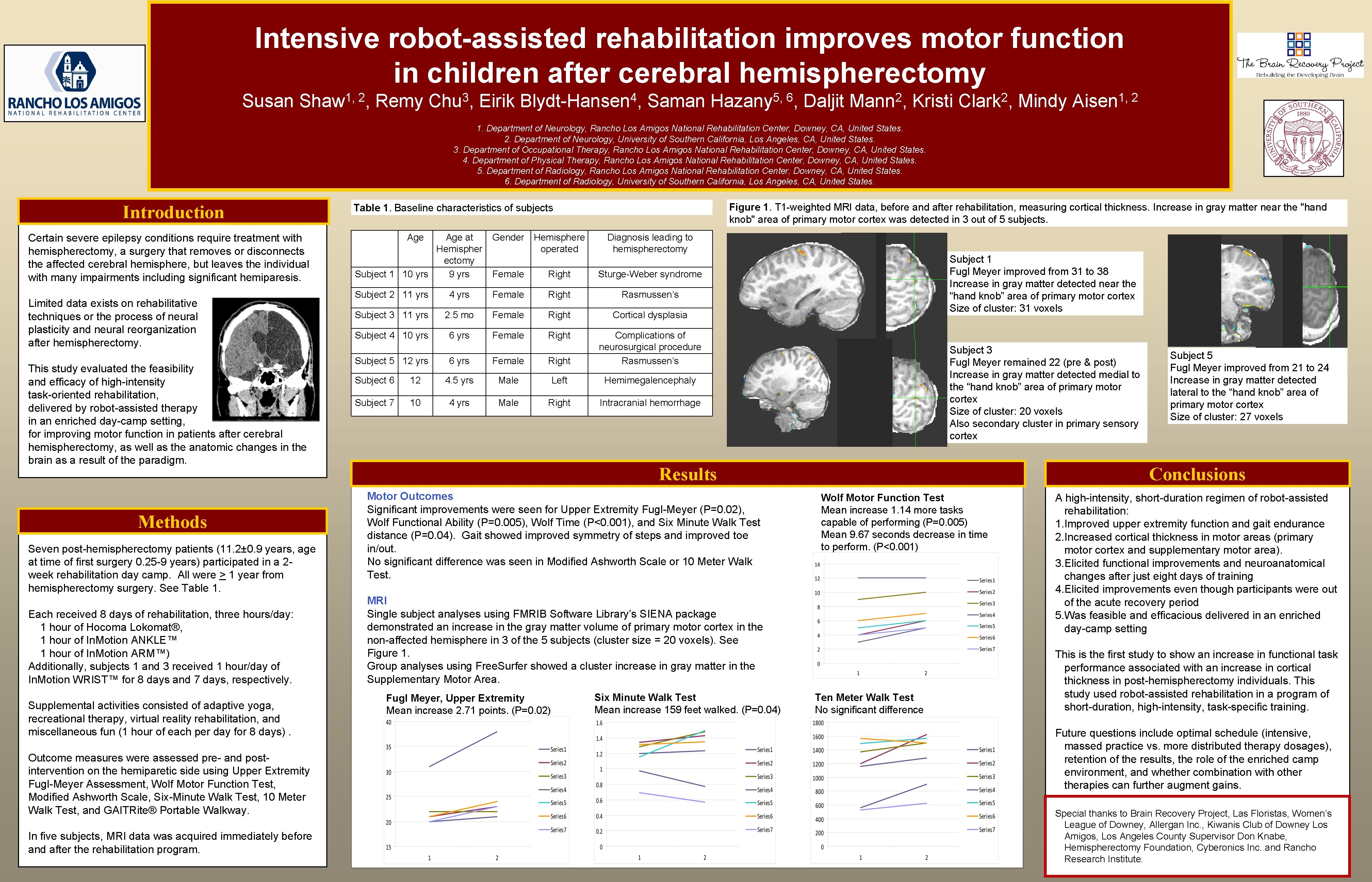
Intensive robot-assisted rehabilitation improves motor function in children after cerebral hemispherectomy Susan 1, 2 Shaw , Remy 3 Chu , Eirik 4 Blydt-Hansen , Saman 5, 6 Hazany , Daljit 2 Mann , Kristi 2 Clark , Mindy 1, 2 Aisen 1. Department of Neurology, Rancho Los Amigos National Rehabilitation Center, Downey, CA, United States. 2. Department of Neurology, University of Southern California, Los Angeles, CA, United States. 3. Department of Occupational Therapy, Rancho Los Amigos National Rehabilitation Center, Downey, CA, United States. 4. Department of Physical Therapy, Rancho Los Amigos National Rehabilitation Center, Downey, CA, United States. 5. Department of Radiology, Rancho Los Amigos National Rehabilitation Center, Downey, CA, United States. 6. Department of Radiology, University of Southern California, Los Angeles, CA, United States. Introduction Depression in epilepsy correlates with lower health. Certain severe epilepsy conditions require treatment with related quality of life, more antiepileptic drug (AED) hemispherectomy, a surgery that removes or disconnects adverse events, and poorer pharmacologic and surgical the affected cerebral hemisphere, but leaves the individual response. Given health care disparities indigent with many impairments including significant among hemiparesis. Hispanics, we postulated a high prevalence of depression cognitive impairment exists among Limited dataand exists on rehabilitative techniquesepilepsy or the process of neural intractable patients within a Los Angeles plasticity and neuralhospital. reorganization County safety-net after hemispherectomy. This study evaluated the feasibility and efficacy of high-intensity task-oriented rehabilitation, delivered by robot-assisted therapy in an enriched day-camp setting, for improving motor function in patients after cerebral hemispherectomy, as well as the anatomic changes in the brain as a result of the paradigm. Methods Seven post-hemispherectomy patients (11. 2± 0. 9 years, age at time of first surgery 0. 25 -9 years) participated in a 2 week rehabilitation day camp. All were > 1 year from hemispherectomy surgery. See Table 1. Each received 8 days of rehabilitation, three hours/day: 1 hour of Hocoma Lokomat®, 1 hour of In. Motion ANKLE™ 1 hour of In. Motion ARM™) Additionally, subjects 1 and 3 received 1 hour/day of In. Motion WRIST™ for 8 days and 7 days, respectively. Supplemental activities consisted of adaptive yoga, recreational therapy, virtual reality rehabilitation, and miscellaneous fun (1 hour of each per day for 8 days). Outcome measures were assessed pre- and postintervention on the hemiparetic side using Upper Extremity Fugl-Meyer Assessment, Wolf Motor Function Test, Modified Ashworth Scale, Six-Minute Walk Test, 10 Meter Walk Test, and GAITRite® Portable Walkway. In five subjects, MRI data was acquired immediately before and after the rehabilitation program. Figure 1. T 1 -weighted MRI data, before and after rehabilitation, measuring cortical thickness. Increase in gray matter near the "hand knob" area of primary motor cortex was detected in 3 out of 5 subjects. Table 1. Baseline characteristics of subjects Age at Hemispher ectomy Subject 1 10 yrs 9 yrs Gender Hemisphere operated Female Right Sturge-Weber syndrome Subject 2 11 yrs 4 yrs Female Right Rasmussen’s Subject 3 11 yrs 2. 5 mo Female Right Cortical dysplasia Subject 4 10 yrs 6 yrs Female Right Subject 5 12 yrs Diagnosis leading to hemispherectomy 6 yrs Female Right Complications of neurosurgical procedure Rasmussen’s Subject 6 12 4. 5 yrs Male Left Hemimegalencephaly Subject 7 10 4 yrs Male Right Intracranial hemorrhage Subject 1 Fugl Meyer improved from 31 to 38 Increase in gray matter detected near the “hand knob” area of primary motor cortex Size of cluster: 31 voxels Subject 3 Fugl Meyer remained 22 (pre & post) Increase in gray matter detected medial to the “hand knob” area of primary motor cortex Size of cluster: 20 voxels Also secondary cluster in primary sensory cortex Results Motor Outcomes Significant improvements were seen for Upper Extremity Fugl-Meyer (P=0. 02), Wolf Functional Ability (P=0. 005), Wolf Time (P<0. 001), and Six Minute Walk Test distance (P=0. 04). Gait showed improved symmetry of steps and improved toe in/out. No significant difference was seen in Modified Ashworth Scale or 10 Meter Walk Test. Conclusions Wolf Motor Function Test Mean increase 1. 14 more tasks capable of performing (P=0. 005) Mean 9. 67 seconds decrease in time to perform. (P<0. 001) MRI Single subject analyses using FMRIB Software Library’s SIENA package demonstrated an increase in the gray matter volume of primary motor cortex in the non-affected hemisphere in 3 of the 5 subjects (cluster size = 20 voxels). See Figure 1. Group analyses using Free. Surfer showed a cluster increase in gray matter in the Supplementary Motor Area. Fugl Meyer, Upper Extremity Mean increase 2. 71 points. (P=0. 02) Six Minute Walk Test Mean increase 159 feet walked. (P=0. 04) Subject 5 Fugl Meyer improved from 21 to 24 Increase in gray matter detected lateral to the “hand knob” area of primary motor cortex Size of cluster: 27 voxels Ten Meter Walk Test No significant difference A high-intensity, short-duration regimen of robot-assisted rehabilitation: 1. Improved upper extremity function and gait endurance 2. Increased cortical thickness in motor areas (primary motor cortex and supplementary motor area). 3. Elicited functional improvements and neuroanatomical changes after just eight days of training 4. Elicited improvements even though participants were out of the acute recovery period 5. Was feasible and efficacious delivered in an enriched day-camp setting This is the first study to show an increase in functional task performance associated with an increase in cortical thickness in post-hemispherectomy individuals. This study used robot-assisted rehabilitation in a program of short-duration, high-intensity, task-specific training. Future questions include optimal schedule (intensive, massed practice vs. more distributed therapy dosages), retention of the results, the role of the enriched camp environment, and whether combination with otherapies can further augment gains. Special thanks to Brain Recovery Project, Las Floristas, Women’s League of Downey, Allergan Inc. , Kiwanis Club of Downey Los Amigos, Los Angeles County Supervisor Don Knabe, Hemispherectomy Foundation, Cyberonics Inc. and Rancho Research Institute.
- Slides: 1