
Intensive First Year American Sign Language ASL 134

- Slides: 35
Intensive First Year American Sign Language (ASL 134) class Summer 2016 INSTRUCTOR: KRISTI WINTER, MA UNIVERSITY OF WASHINGTON DEPT. OF LINGUISTICS ASL PROGRAM
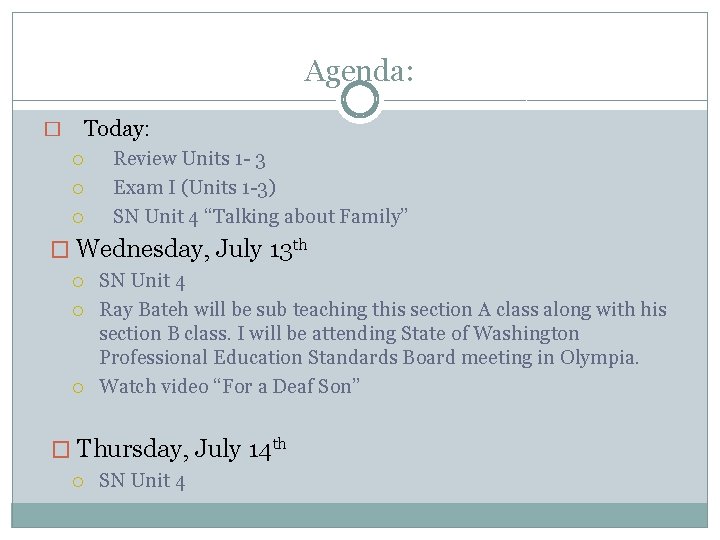
Agenda: � Today: Review Units 1 - 3 Exam I (Units 1 -3) SN Unit 4 “Talking about Family” � Wednesday, July 13 th SN Unit 4 Ray Bateh will be sub teaching this section A class along with his section B class. I will be attending State of Washington Professional Education Standards Board meeting in Olympia. Watch video “For a Deaf Son” � Thursday, July 14 th SN Unit 4
Unit 3 Discussing Living Situation
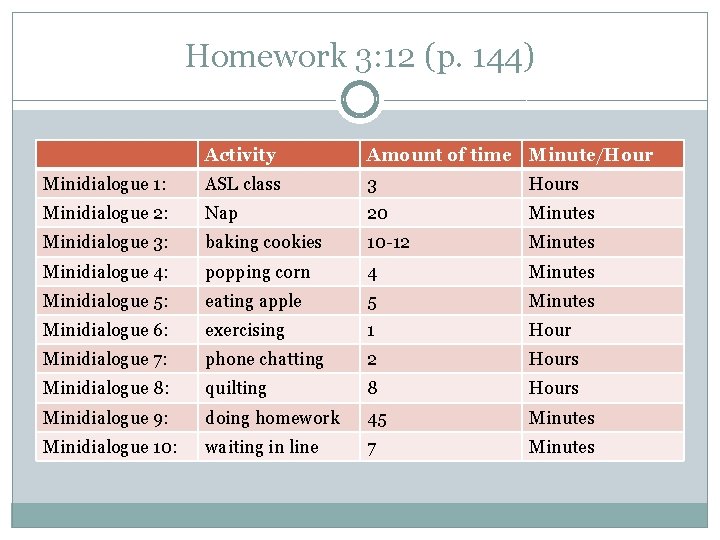
Homework 3: 12 (p. 144) Activity Amount of time Minute/Hour Minidialogue 1: ASL class 3 Hours Minidialogue 2: Nap 20 Minutes Minidialogue 3: baking cookies 10 -12 Minutes Minidialogue 4: popping corn 4 Minutes Minidialogue 5: eating apple 5 Minutes Minidialogue 6: exercising 1 Hour Minidialogue 7: phone chatting 2 Hours Minidialogue 8: quilting 8 Hours Minidialogue 9: doing homework 45 Minutes Minidialogue 10: waiting in line 7 Minutes
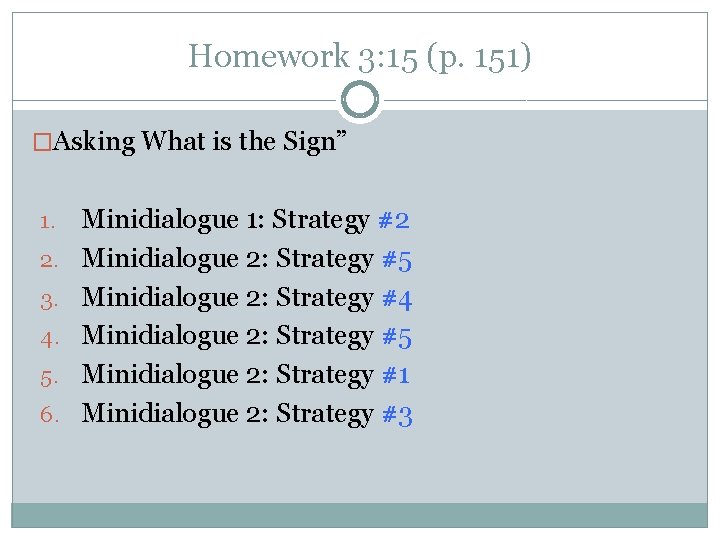
Homework 3: 15 (p. 151) �Asking What is the Sign” 1. 2. 3. 4. 5. 6. Minidialogue 1: Strategy #2 Minidialogue 2: Strategy #5 Minidialogue 2: Strategy #4 Minidialogue 2: Strategy #5 Minidialogue 2: Strategy #1 Minidialogue 2: Strategy #3
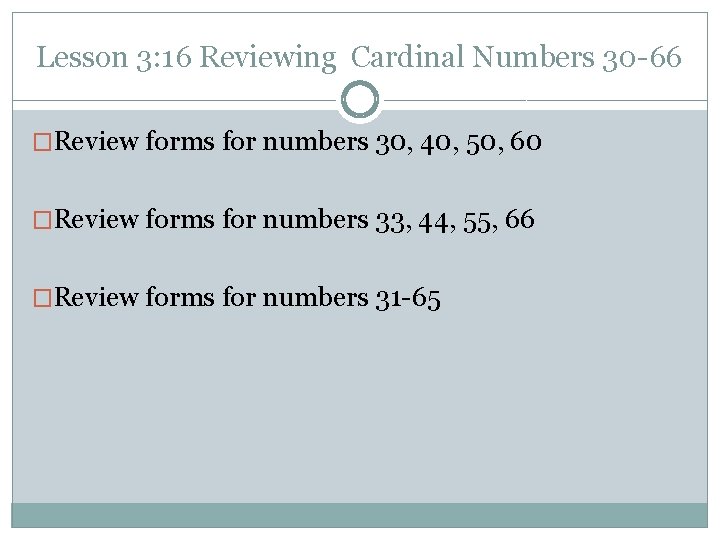
Lesson 3: 16 Reviewing Cardinal Numbers 30 -66 �Review forms for numbers 30, 40, 50, 60 �Review forms for numbers 33, 44, 55, 66 �Review forms for numbers 31 -65
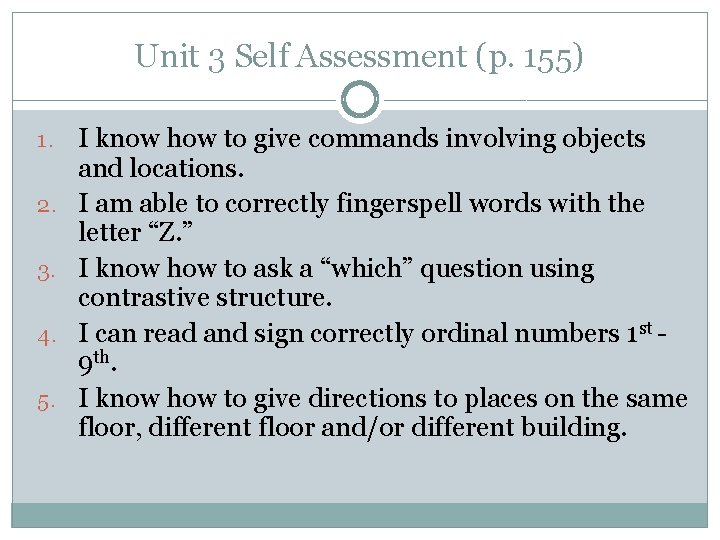
Unit 3 Self Assessment (p. 155) 1. 2. 3. 4. 5. I know how to give commands involving objects and locations. I am able to correctly fingerspell words with the letter “Z. ” I know how to ask a “which” question using contrastive structure. I can read and sign correctly ordinal numbers 1 st 9 th. I know how to give directions to places on the same floor, different floor and/or different building.
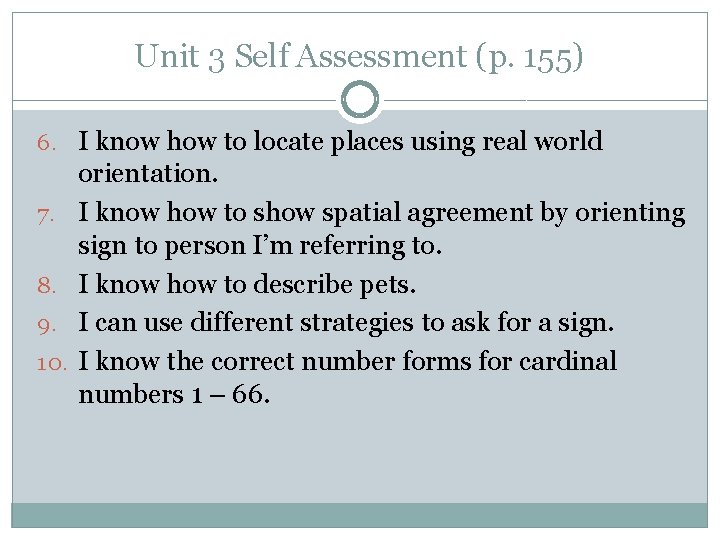
Unit 3 Self Assessment (p. 155) 6. I know how to locate places using real world 7. 8. 9. 10. orientation. I know how to show spatial agreement by orienting sign to person I’m referring to. I know how to describe pets. I can use different strategies to ask for a sign. I know the correct number forms for cardinal numbers 1 – 66.
Unit 3 Self Assessment (p. 155) 11. I know how to ask/tell how long something takes in minutes and hours. 12. I know how to respond to “thank you. ” 13. I am able to correctly fingerspell words with the letters “Y, ” “Q, ” and “P. ” 14. I know how to modify verbs to show agreement with established locations.
�Exam I
A Day Through a Deaf Person’s Eyes �https: //www. youtube. com/watch? v=ecm. CHXZk. TGI
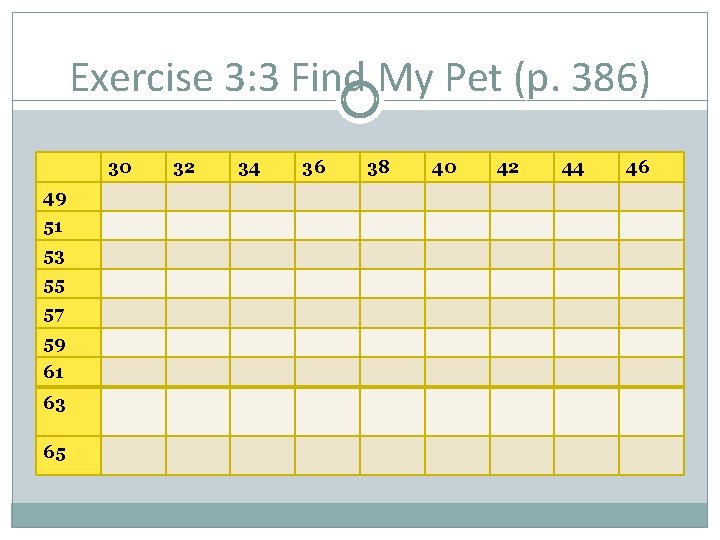
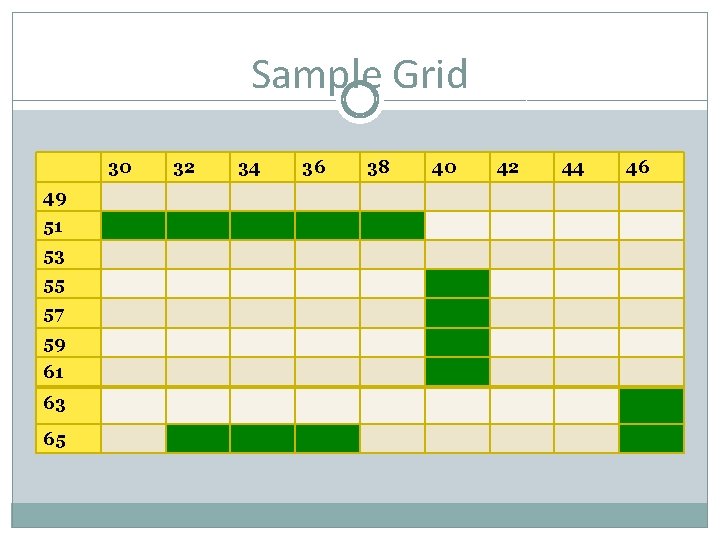
Exercise 3: 3 Find My Pet (p. 384) �How to Begin You and your partner decide who will take grid “Blue” and who will take grid “Green” Then, shade the squares inside your grid to represent each of these four pets. You can fill in the squares vertically or horizontally, but not diagonally. Shade five squares to represent the dog Shade four squares to represent the cat Shade three squares to represent the bird Shade two squares to represent the fish
Exercise 3: 3 Find My Pet (p. 386) 30 49 51 53 55 57 59 61 63 65 32 34 36 38 40 42 44 46
Sample Grid 30 49 51 53 55 57 59 61 63 65 32 34 36 38 40 42 44 46
Exercise 3: 3 Find My Pet (p. 384) �How to Play The objective is to locate all your partner’s pets before they find yours Begin by choosing two numbers form your partner’s grid-one from the top row and one from the column to the left, and ask if that square is a “hit. ” Your opponent will check the point where your numbers intersect and tell you if you hit or missed a pet. If you make a “hit, ” shade in the square on your grid so you can keep track of where the pets are located. If you miss, mark the square with an “x” so you don’t repeat those numbers the next time.
Exercise 3: 3 Find My Pet (p. 384) �How to Play Continue the game, taking turns signing out numbers until you have discovered all of the pets and can identify which pet is located where. The only way to know what pet is located where is by the number of shade squares it occupies. The first person to identify where all of the pets are located is the winner. ASL signs for “hit” and “missed”
Exercise 3: 3 Find My Pet (pages 384 -386) Signer A: Give a number from the column and a number from the top row, ask if you’ve got a “hit” B: Respond A: When you’ve figured out which pet, name the pet.
What signs have you learned so far?
Unit 4 “Talking about family”
Unit 4 Talking about Family �Basic Family Vocabulary
Lesson 4: 1 Talking about Immediate Family �Performance Scene 1 Scene 2 Scene 3
Unit 4 Talking about Family �Basic Family Vocabulary
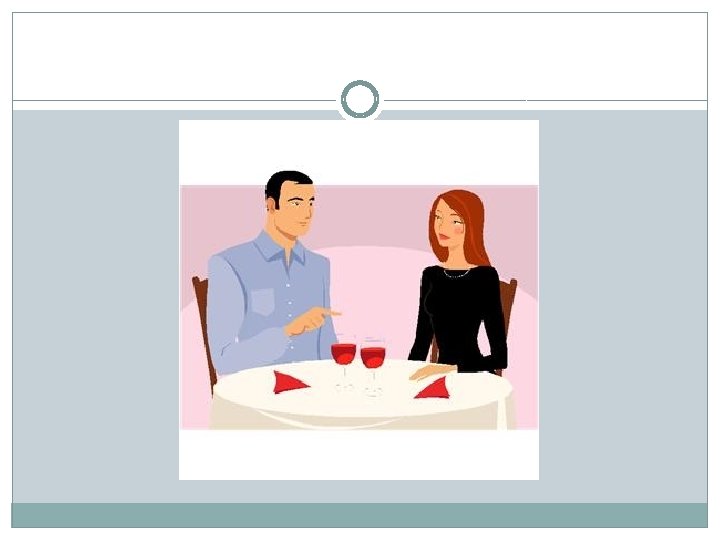
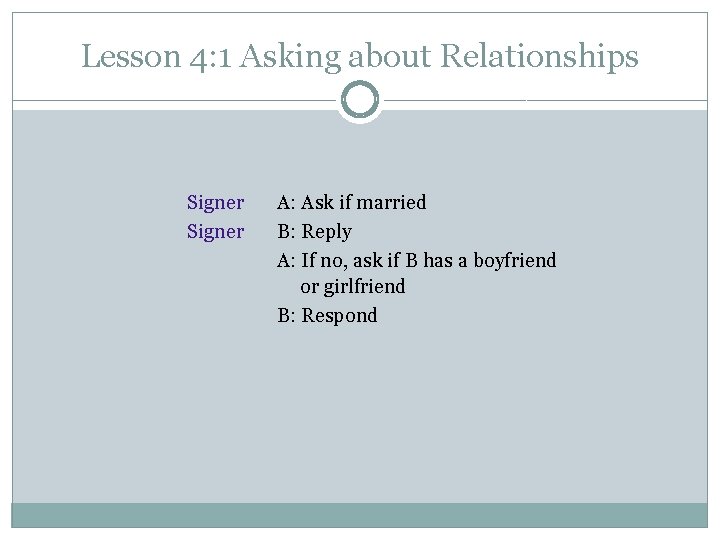
Lesson 4: 1 Asking about Relationships Signer A: Ask if married B: Reply A: If no, ask if B has a boyfriend or girlfriend B: Respond
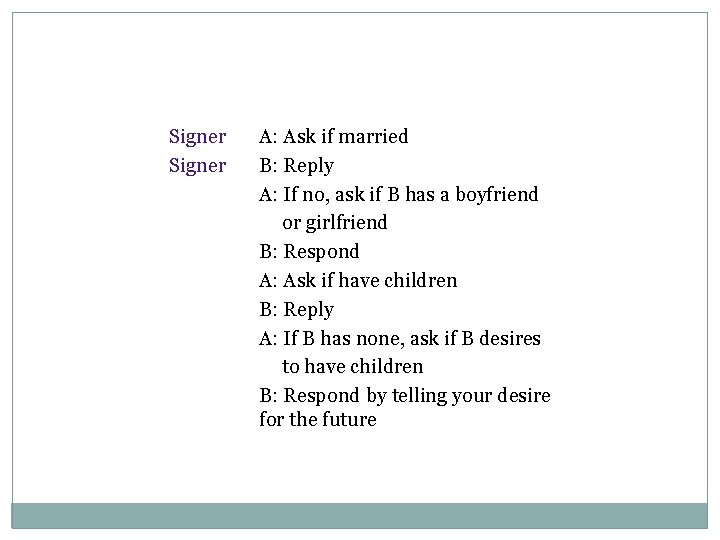
Signer A: Ask if married B: Reply A: If no, ask if B has a boyfriend or girlfriend B: Respond A: Ask if have children B: Reply A: If B has none, ask if B desires to have children B: Respond by telling your desire for the future
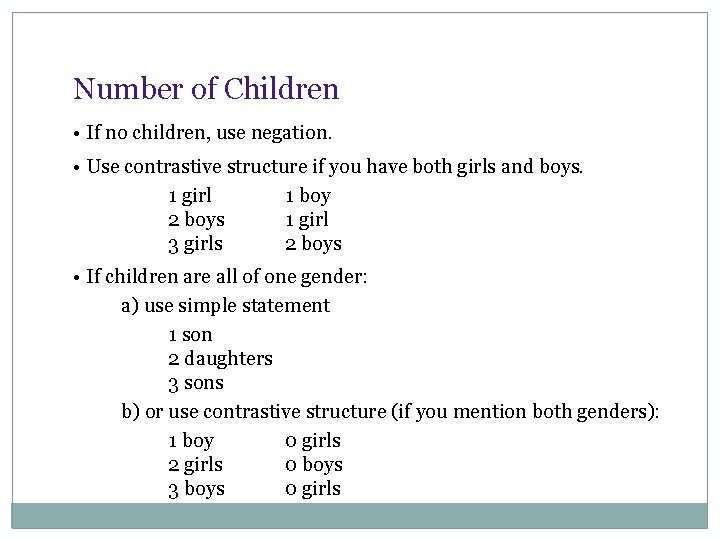
Number of Children • If no children, use negation. • Use contrastive structure if you have both girls and boys. 1 girl 1 boy 2 boys 1 girl 3 girls 2 boys • If children are all of one gender: a) use simple statement 1 son 2 daughters 3 sons b) or use contrastive structure (if you mention both genders): 1 boy 0 girls 2 girls 0 boys 3 boys 0 girls
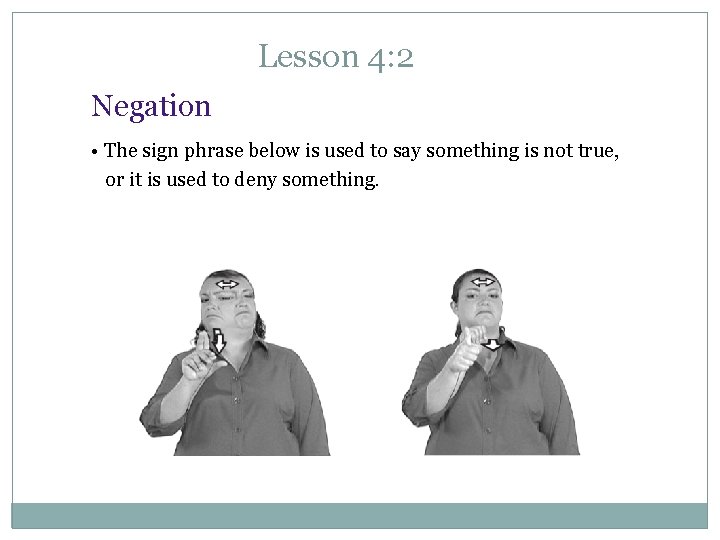
Lesson 4: 2 Negation • The sign phrase below is used to say something is not true, or it is used to deny something.
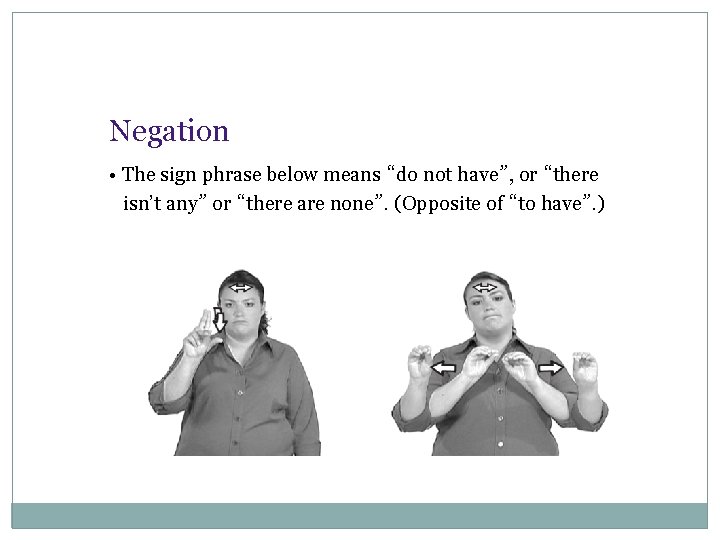
Negation • The sign phrase below means “do not have”, or “there isn’t any” or “there are none”. (Opposite of “to have”. )
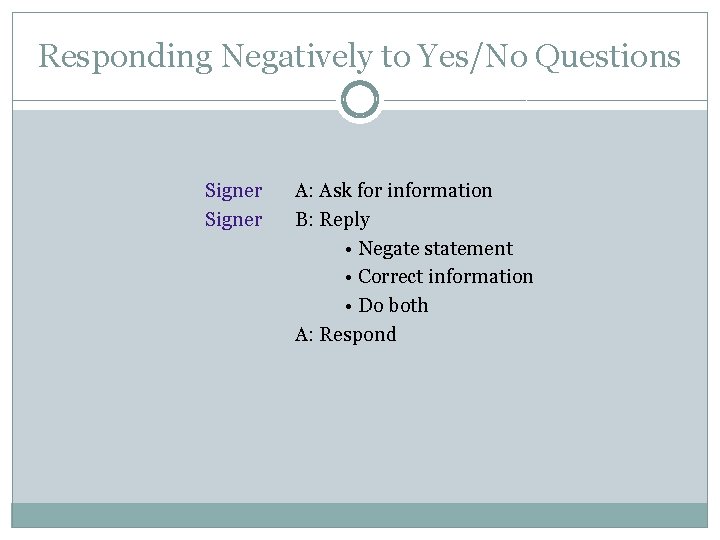
Responding Negatively to Yes/No Questions Signer A: Ask for information B: Reply • Negate statement • Correct information • Do both A: Respond
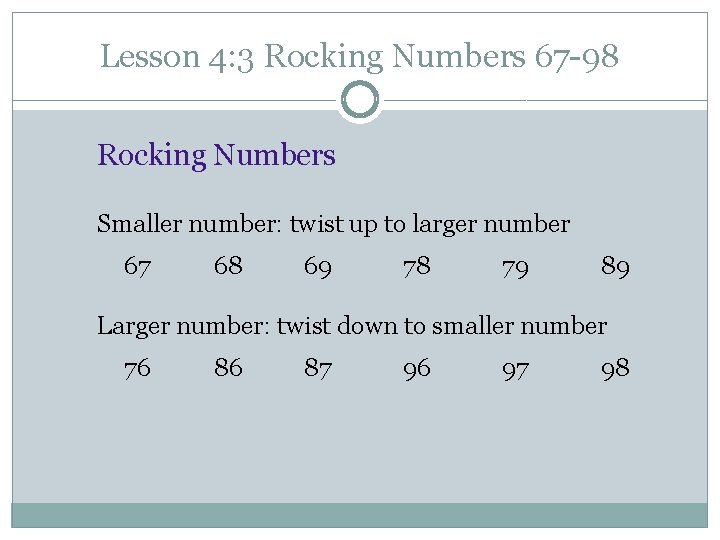
Lesson 4: 3 Rocking Numbers 67 -98 Rocking Numbers Smaller number: twist up to larger number 67 68 69 78 79 89 Larger number: twist down to smaller number 76 86 87 96 97 98
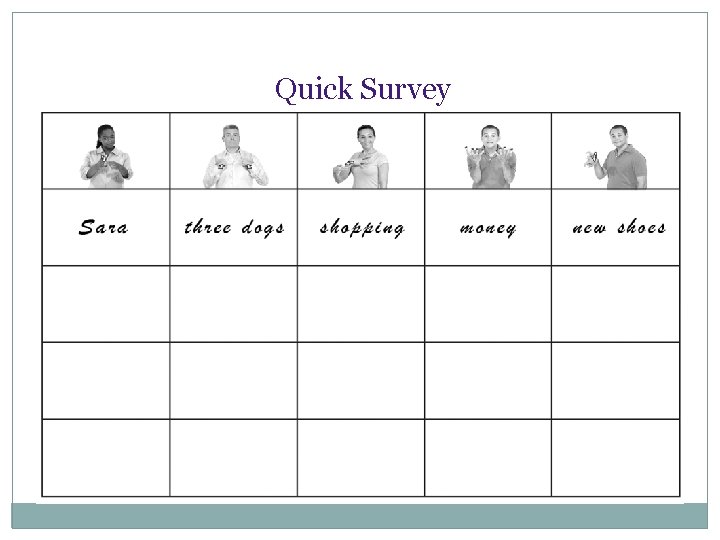
Lesson 4: 4 Have, Like, Want, and Need HAVE 2. LIKE 3. WANT 4. NEED �Exercise 4: 1 – Quick Survey (Student Workbook, page 388) 1. �use Wh-Word Questions
Quick Survey
Sources: �Smith, C. , Lentz, E. & Mikos, K. (1988)Signing Naturally Student Workbook Level 1. Dawn. Sign. Press. San Diego, CA �Smith, C. , Lentz, E. , Mikos, K. (2008) Signing Naturally Units 1 -6. Dawn Sign Press. San Diego, CA. �Zinza, Jason E. (2006) Master ASL! Sign Media, Inc. Burtonsville, MD. �Eastman, G. (1989) From Mime to Sign. T. J. Publishers, Inc. Silver Spring, MD. �Pictures from Microsoft Clip Arts