
Intensive English Courses KMUTTs Innovative English Programme Wichai





























- Slides: 54
Intensive English Courses KMUTT’s Innovative English Programme Wichai Kritprayoch Saowaluck Tepsuriwong School of Liberal Arts King Mongkut’s University of Technology Thonburi
Outline What & Why Intensive English Courses KMUTT’s Intensive English Courses Research Studies: Programme evaluation by using questionnaires Students Teachers Findings & Discussion Conclusion & Suggestions
What is an intensive course? “Intensive”: )adjective( involving a lot of activity, effort, or careful attention in a short period of time e. g. a one-week intensive course in English (Longman Dictionary of Contemporary English)
Why Intensive English? Learning English is like the practice / art of boiling water! We need to keep heating the water until it reaches the required temperature.
Why Intensive English? Traditional system two 15 -week semesters English = 1 -3 credits / course 1 session = 45 -60 minutes 1 week = 1 -2 sessions Drip-feed method of learning (Lightbown and Spada, 1989)
Why Intensive English? Problems occurred in a traditional system - Insufficient time for activities - Not enough time to use the language - Learning time is reduced to sacrifice for a review. - “A lesson is hardly begun when it is time to end. ” (Netten & Germain, 2004)
Why Intensive English? “Students need a concentrated period of second language study to be able to use the language spontaneously and with ease. ” (Netten and Germain, 2004)
Why Intensive English? Advantages - allow a concentrated period of time for second language study - maintain student’s focus on English - enrich student-student & studentteacher relationships - school-designed course can be tailored to suit target students and curriculum needs
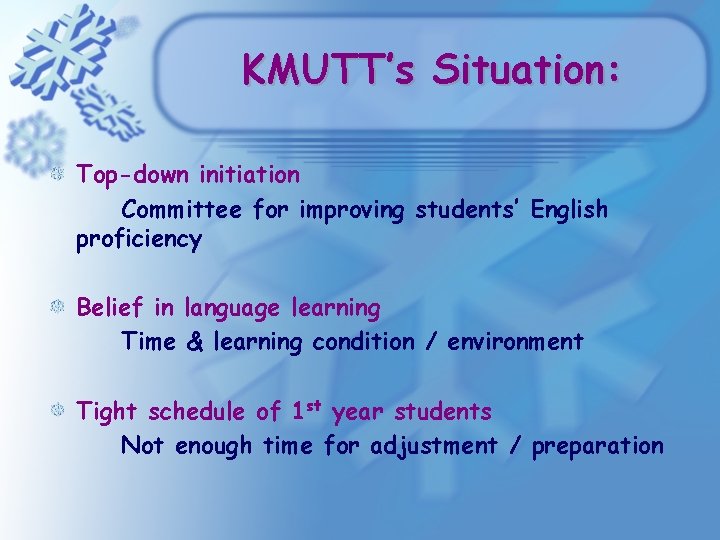
KMUTT’s Situation: Top-down initiation Committee for improving students’ English proficiency Belief in language learning Time & learning condition / environment Tight schedule of 1 st year students Not enough time for adjustment / preparation
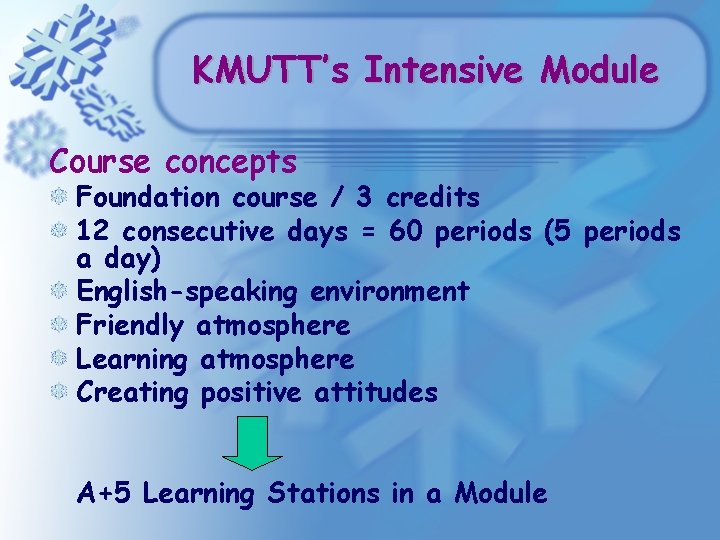
KMUTT’s Intensive Module Course concepts Foundation course / 3 credits 12 consecutive days = 60 periods (5 periods a day) English-speaking environment Friendly atmosphere Learning atmosphere Creating positive attitudes A+5 Learning Stations in a Module
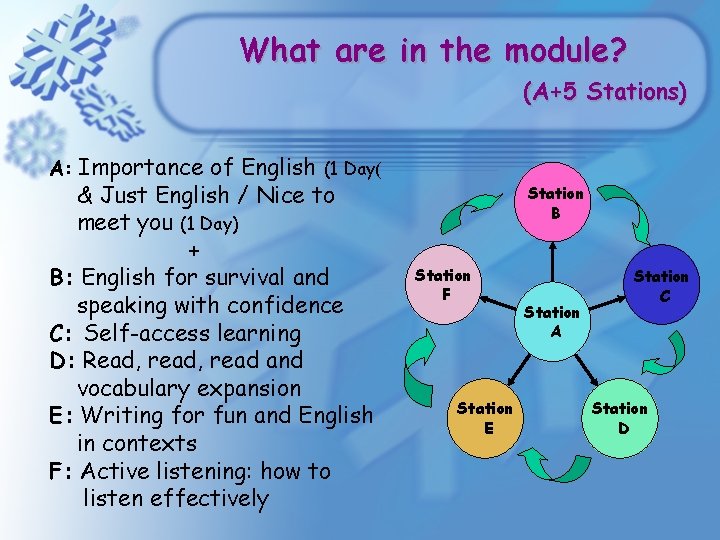
What are in the module? (A+5 Stations) A: Importance of English (1 Day( & Just English / Nice to meet you (1 Day) + B: English for survival and speaking with confidence C: Self-access learning D: Read, read and vocabulary expansion E: Writing for fun and English in contexts F: Active listening: how to listen effectively Station B Station F Station E Station A Station C Station D
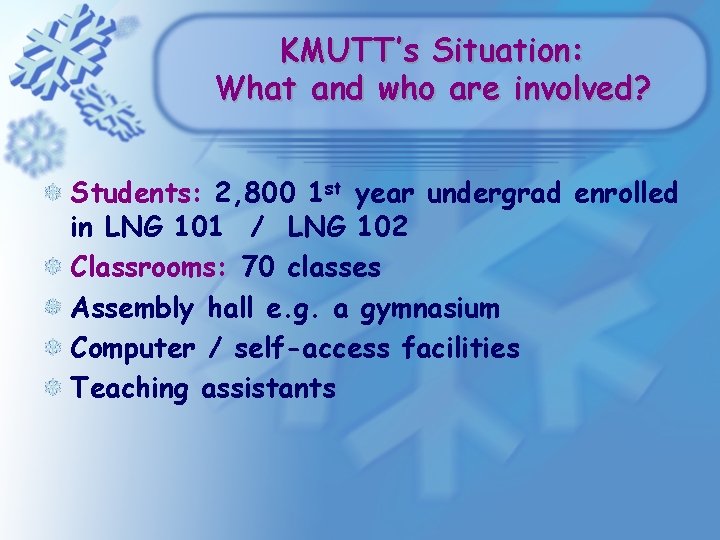
KMUTT’s Situation: What and who are involved? Students: 2, 800 1 st year undergrad enrolled in LNG 101 / LNG 102 Classrooms: 70 classes Assembly hall e. g. a gymnasium Computer / self-access facilities Teaching assistants
KMUTT’s Situation & Preparation: What and who are involved? Design new materials & evaluation schemes Recruit teaching staff: native & non-native Ask for co-operation from other sectors: - Budget - Staff (70 teachers & 32 TAs & Admin. ) - Student grouping (40 ss/class = 70 classes = 2, 800 ss = 14 modules) - Assembly hall / Computer rooms / SALC / Classrooms - O-net scores / Placement test - Facilities e. g. OHT, LCD, N/B, Multimedia Classrooms - Stationary / Posters - Delay term-time
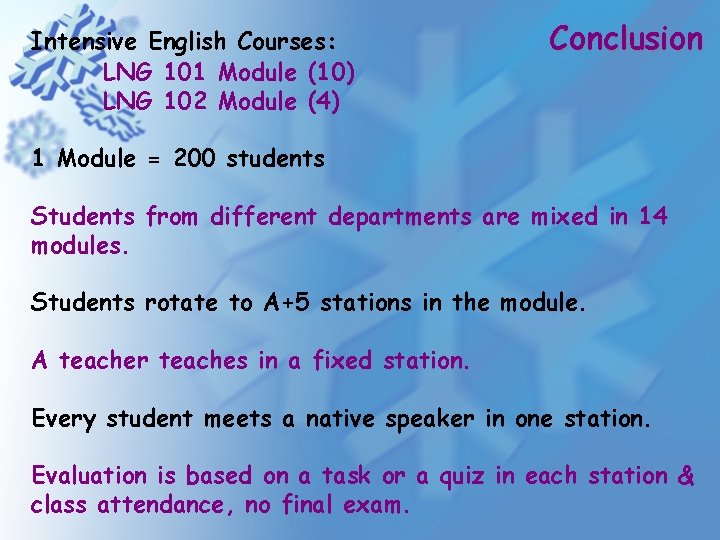
Intensive English Courses: LNG 101 Module (10) LNG 102 Module (4) Conclusion 1 Module = 200 students Students from different departments are mixed in 14 modules. Students rotate to A+5 stations in the module. A teacher teaches in a fixed station. Every student meets a native speaker in one station. Evaluation is based on a task or a quiz in each station & class attendance, no final exam.
Research Studies Programme evaluated by using questionnaires (about attitudes and perceptions on language improvement) 158 Students (Enrolled either in LNG 101 or 102) 53 Teachers (21 KMUTT Staff and 32 Non-KMUTT Part-time Teachers)
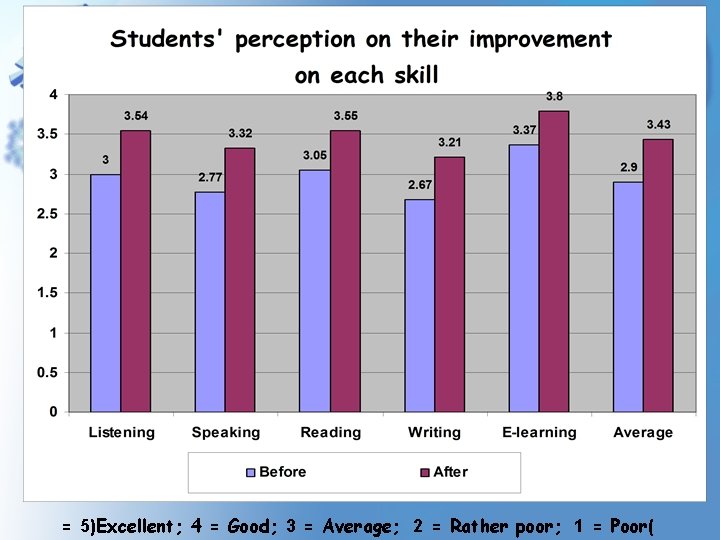
Questionnaire on KMUTT Students' Attitudes towards the Intensive English Courses 1. Students’ perception on English language skill improvement 2. Students’ perception on overall English proficiency 3. Effects of intensive English courses on students’ attitudes towards English language learning 4. Three most important factors which affect students’ learning in class
= 5)Excellent; 4 = Good; 3 = Average; 2 = Rather poor; 1 = Poor(
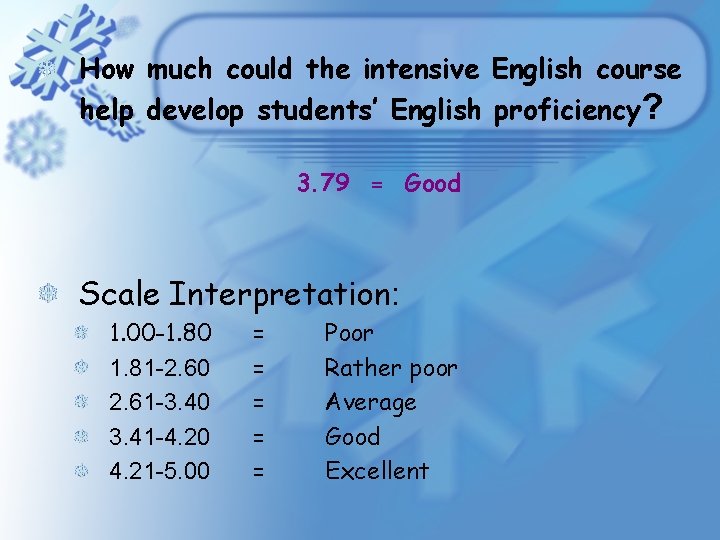
How much could the intensive English course help develop students’ English proficiency? 3. 79 = Good Scale Interpretation: 1. 00 -1. 80 1. 81 -2. 60 2. 61 -3. 40 3. 41 -4. 20 4. 21 -5. 00 = = = Poor Rather poor Average Good Excellent
Did the intensive English course positively change students’ attitudes towards English language learning?
Yes, because… They prefer learning English more than before. They think that English is an enjoyable subject because of good teaching techniques and a variety of activities conducted in class. They feel that English is not so difficult as they thought.
No, because… They have already had a positive attitude towards English language learning, so this was still the same. They do not like learning English as usual.
What were three most important factors which made students be more active in learning in class? Teachers Classmates Grade
Questions for Teaching Staff 1. Whether the intensive courses can replace normal English courses 2. Teachers’ expectations on the programme 3. Teachers’ attitudes towards the intensive English courses 4. Factors affected quality of teaching in the intensive English courses
Question 1 In previous years, we have taught LNG 101 or LNG 102 in the first semester. This year, these courses have been replaced by the intensive course. Do you think the intensive course is an appropriate replacement for the traditional LNG 101 or LNG 102? Give reasons for your opinion. Subjects = 21 KMUTT staff
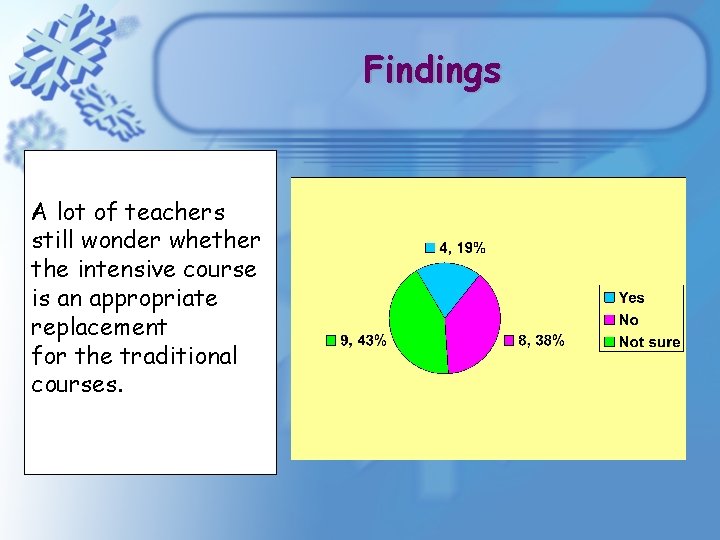
Findings A lot of teachers still wonder whether the intensive course is an appropriate replacement for the traditional courses.
Main factors / reasons 10 -day time Better-preparation for learners Teacher’s and students’ devotion Research Time for consolidation Time for regular / continuous practice Teacher’s and students’ devotion Evaluation
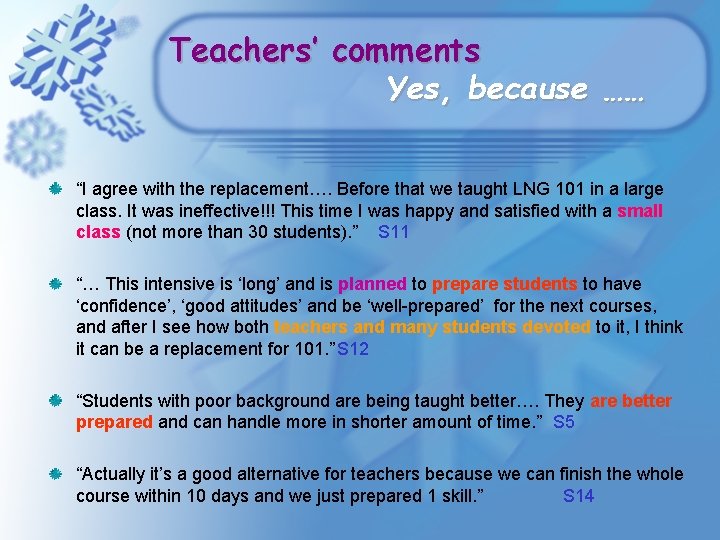
Teachers’ comments Yes, because …… “I agree with the replacement…. Before that we taught LNG 101 in a large class. It was ineffective!!! This time I was happy and satisfied with a small class (not more than 30 students). ” S 11 “… This intensive is ‘long’ and is planned to prepare students to have ‘confidence’, ‘good attitudes’ and be ‘well-prepared’ for the next courses, and after I see how both teachers and many students devoted to it, I think it can be a replacement for 101. ” S 12 “Students with poor background are being taught better…. They are better prepared and can handle more in shorter amount of time. ” S 5 “Actually it’s a good alternative for teachers because we can finish the whole course within 10 days and we just prepared 1 skill. ” S 14
Teachers’ comments No, because …… “No! The intensive is ‘an immersion’ experience, and probably very good for students, but it should be a supplement, not a replacement. They have no time to consolidate their learning; they have no homework, . . … That is not a bad thing, but it is not sufficient. ” S 1 “…The main problem is the short-term nature of learning. While students may have learnt a lot quickly, they may also forget quickly. With no continuation of English learning! This is a potential worry. ” S 6 “I’m afraid that during the semester, they won’t have any English at all, so they don’t have continuity in learning and later forget what they’ve got from the intensive course. Hopefully, they keep learning by self-access and e-learning on their own if the session on ‘Good language learner and e-learning’ has been successfully established. ” S 9
Teachers’ comments No, because …… “Absolutely not! English is not a program that can be downloaded to students. It needs time to practice. If it is a normal class, teachers can assign students to do their self-study e. g. reading graded readers but it’s impossible in an intensive course like this” S 15 “…it’s very short time to evaluate them. Some students may think it’s unfair because they hurry to learn and hurry to test…” S 16 “It’s too rush. Students didn’t have time to ‘digest’ what they learned. Furthermore, teachers worked very hard. ” S 21
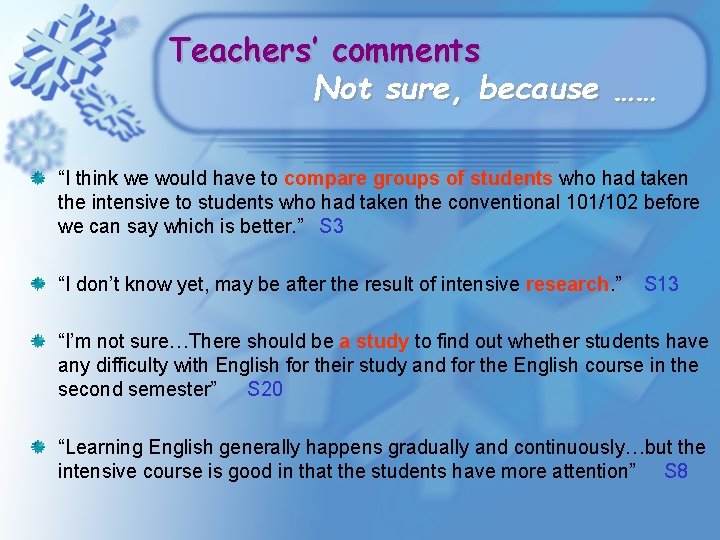
Teachers’ comments Not sure, because …… “I think we would have to compare groups of students who had taken the intensive to students who had taken the conventional 101/102 before we can say which is better. ” S 3 “I don’t know yet, may be after the result of intensive research. ” S 13 “I’m not sure…There should be a study to find out whether students have any difficulty with English for their study and for the English course in the second semester” S 20 “Learning English generally happens gradually and continuously…but the intensive course is good in that the students have more attention” S 8
Question 2 What expectations did you have (negative and/or positive) before the intensive course started? In what ways were these expectations met or not met? Subjects = 21 KMUTT staff
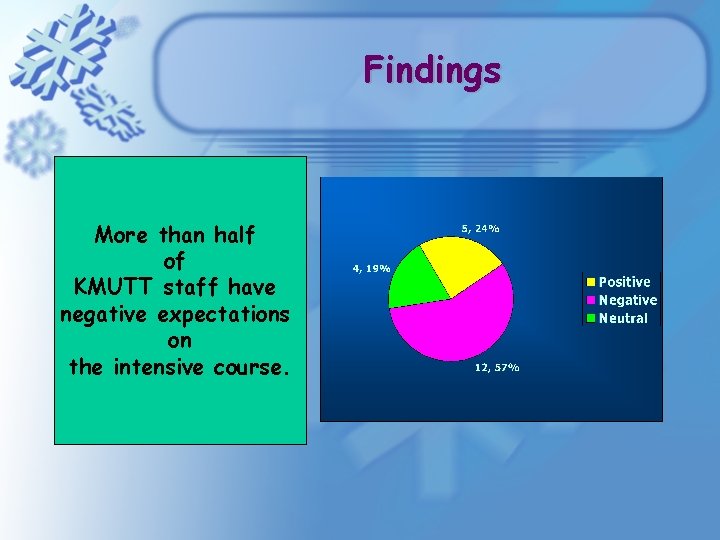
Findings More than half of KMUTT staff have negative expectations on the intensive course.
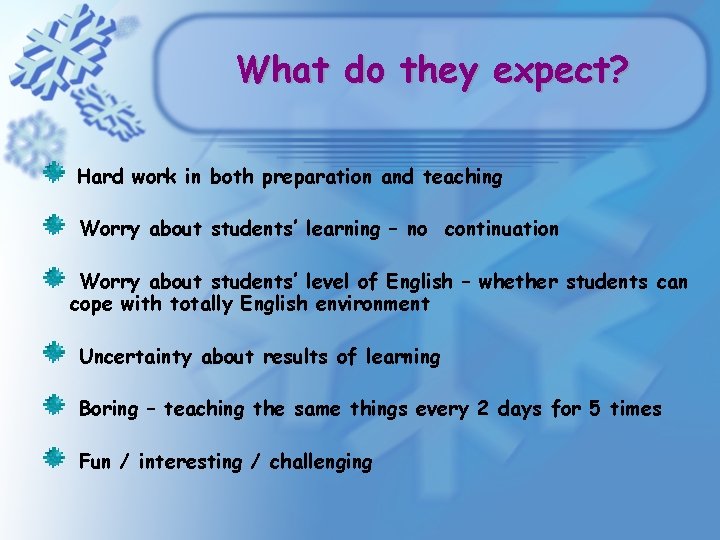
What do they expect? Hard work in both preparation and teaching Worry about students’ learning – no continuation Worry about students’ level of English – whether students can cope with totally English environment Uncertainty about results of learning Boring – teaching the same things every 2 days for 5 times Fun / interesting / challenging
In what ways were these expectations met or not met? Before Hard work After Yes – It’s really hard. Worry about continuation of students’ learning Still worry – No English course that term Whether students can cope with totally English environment Students could cope with the course Uncertainty about results of learning Wait and see Boring – teaching the same things Not too bad / not that bad Fun / interesting / challenging
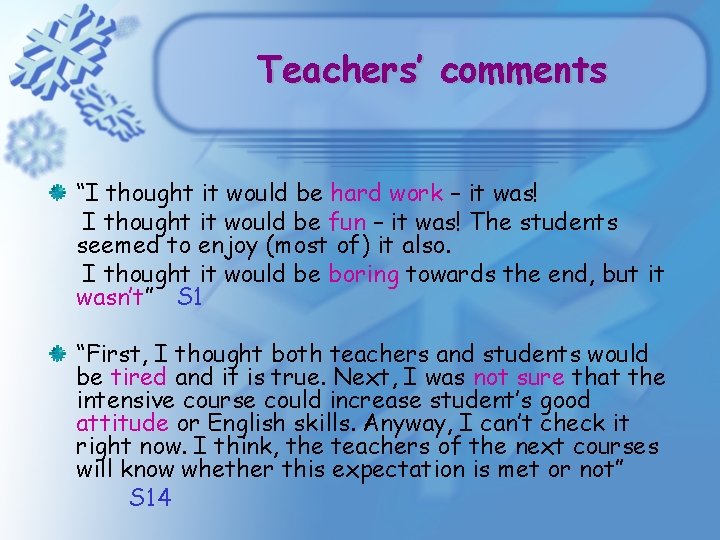
Teachers’ comments “I thought it would be hard work – it was! I thought it would be fun – it was! The students seemed to enjoy (most of) it also. I thought it would be boring towards the end, but it wasn’t” S 1 “First, I thought both teachers and students would be tired and it is true. Next, I was not sure that the intensive course could increase student’s good attitude or English skills. Anyway, I can’t check it right now. I think, the teachers of the next courses will know whether this expectation is met or not” S 14
Teachers’ comments “I had negative expectations whereas the reality for me wasn’t quite bad. ” S 7 “ I was rather negative because I knew that it meant a lot of work and vast investment in terms of money, staff and management. But nobody know its result; whether it’s worth the investment and devotion. During the intensive course, I experienced hard work that I expected; positive thinking from many students and negative responses from some of them; a lot for management problems e. g. late coming teachers; teachers who were not available on some days; students who did not realize that this is a course and they could not miss it, etc. I still cannot answer anyway whether the result is better than the former courses. ” S 12
Teachers’ comments “Before teaching, I imagined that it must be very busy during the course and there might be million administration problems. However, it wasn’t like my imagination. Everything was smoother than expected. ” S 13 “Before the course started, I was worried about being bored with teaching and not having time to build a relationship with students. Surprisingly, neither of these happened although I still don’t know any student names. ” S 5 “I expected students to have good attitude towards English. For this point, it’s o. k. because most students liked this course. ” S 21
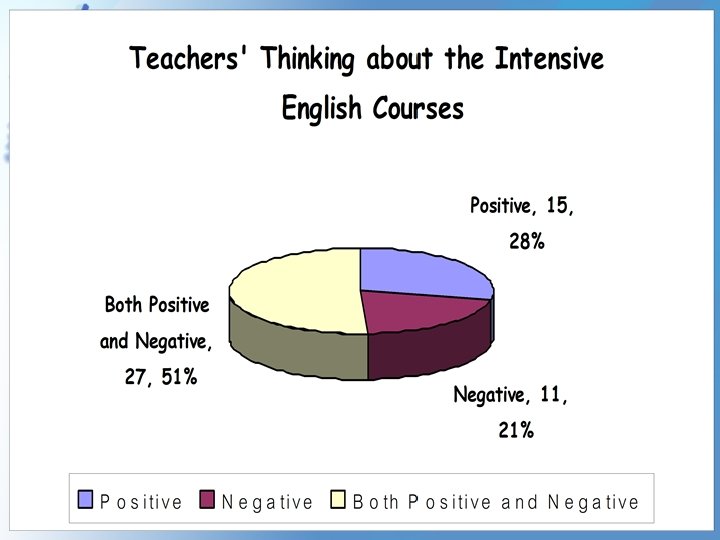
Question 3 What do you think and how do you feel about the intensive English courses? Please feel free to mention anything, such as your attitudes, students' reactions, workload, organisational issues, motivational issues etc. 53 Subjects
Teachers’ Thinking about the Intensive English Courses
Positive “The good part is that once you decide on your plan for the two days, you don't have to worry about that part every night. Plus, in our section we did not have the additional burden of testing and marking. ” “Before teaching, I was worried about being able to motivate myself, but this has proved easier than I expected. However, I think 5 times is the maximum. For students, I think changing teachers regularly may be more interesting although it reduces continuity. For workload, teaching the same thing 5 times reduces the need for planning which is helpful. ”
Positive “I think it's OK for the students. They may get things intensively. The students still pay attention in my class, even though it is their fifth class. As a whole, I like to do this although I get bored sometimes. I have to control myself not to teach fast in the later group. I can remember things in the materials. ” “I enjoyed it overall and think it was well-organised considering the number of students involved. I couldn't imagine doing it another way. ”
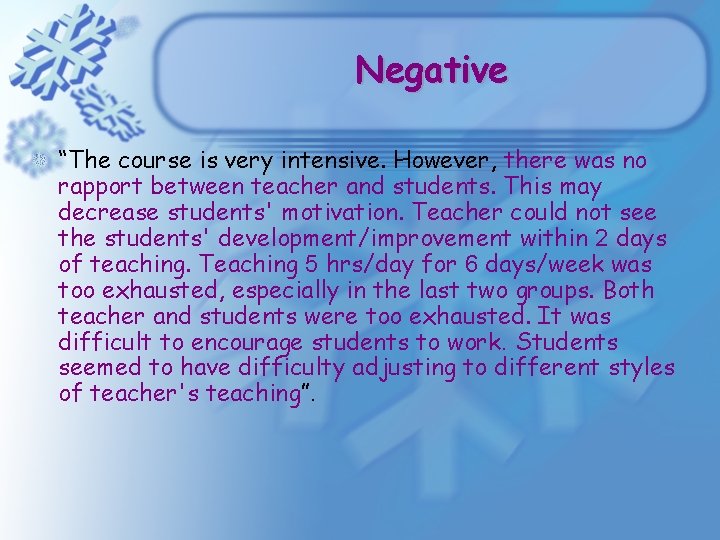
Negative “The course is very intensive. However, there was no rapport between teacher and students. This may decrease students' motivation. Teacher could not see the students' development/improvement within 2 days of teaching. Teaching 5 hrs/day for 6 days/week was too exhausted, especially in the last two groups. Both teacher and students were too exhausted. It was difficult to encourage students to work. Students seemed to have difficulty adjusting to different styles of teacher's teaching”.
Negative “As I was responsible for writing course, I think it is too short to make student good at writing in two days. Writing is a hard skill and writing workload takes time. Anyway, the course organization or skill division is OK as students would be made focus on each skill particularly. My students appeared that they needed more time to practice writing or to rewrite until they felt their English improved as the course is entitled 'writing'. And they needed that I corrected their works thoroughly. This is really a hard job to complete within two days. ”
Both Positive and Negative “I think it's good for the students. They can meet with more than 1 teacher but this system is good for the station-based program only. As for me myself, I think my relationship with the students is very surface. I couldn't bother to remember any name. Marking students' writing every 2 days is also laborious. I felt very tired at the end of the day and it's difficult to find time to adjust the material or prepare for the next class when finding that the material is not that suitable for students' level”.
Both Positive and Negative “If we focus only on the teaching part, I think this system is quite good because the teachers can improve their own teaching every 2 days. This is a good chance to learn from mistakes and try new things in class. However, it is a bit boring during the end of the course, especially the last 2 days”. “Teachers don't have to spend too much time on preparing, and if anything goes wrong in the first or second time, teachers can improve their teaching techniques in the other groups. To repeat the same things 5 times might be boring, esp. the students in the last 3 -5 groups are less motivated”.
Both Positive and Negative “I was so tired, teaching consecutively for ten days. I think students seemed to be tired as well. However, some students have got positive attitudes towards English (for those who can understand how to be a good language learner and e-learning). Some students speak more and try to communicate in English. ” “It's a bit boring to teach the same thing 5 times, but it's a very good way to reduce teacher's workload, including teaching preparation. The teaching became routine and it is no need to prepare new materials. Although it was tough during the 10 days, it's acceptable as we have fewer courses during the first semester. ”
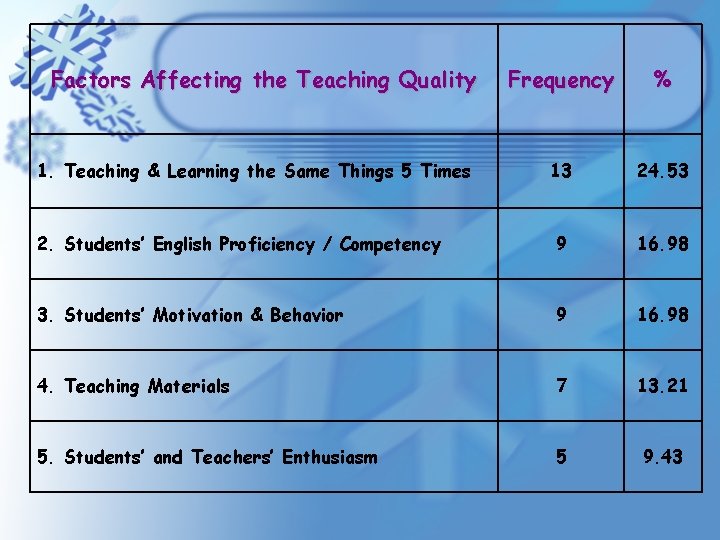
Question 4 Could you please give any reasons which affected the quality of your teaching in the intensive English courses? 53 Subjects
Factors Affecting the Teaching Quality Frequency % 13 24. 53 2. Students’ English Proficiency / Competency 9 16. 98 3. Students’ Motivation & Behavior 9 16. 98 4. Teaching Materials 7 13. 21 5. Students’ and Teachers’ Enthusiasm 5 9. 43 1. Teaching & Learning the Same Things 5 Times
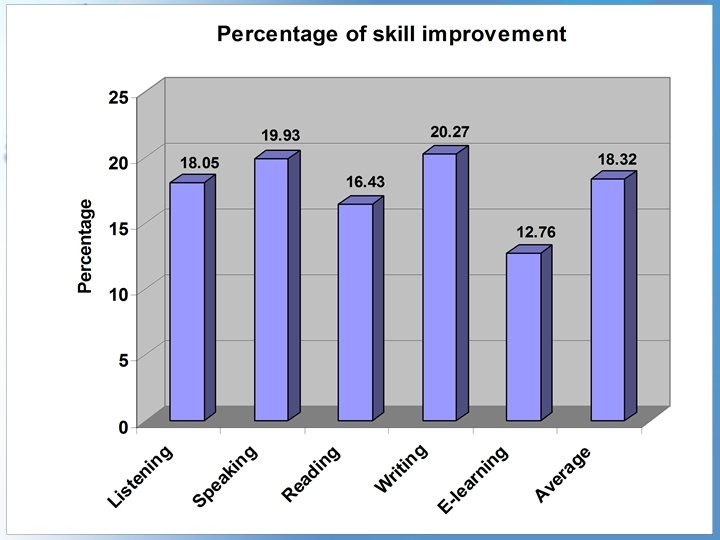
Summary of findings 1. Most students had positive attitudes towards English and learning. 2. Most students felt that the intensive courses helped improve their language and learning skills, especially the productive ones. 3. Most teachers still wonder whether the intensive courses can be a replacement for the traditional courses.
Summary of findings 4. It seems that most teachers are still pondering and trying to balance both the positive and negative aspects concerning the intensive programme. 5. The most important factors that affect learning, from both teachers’ and students’ views seem to be teachers and students themselves.
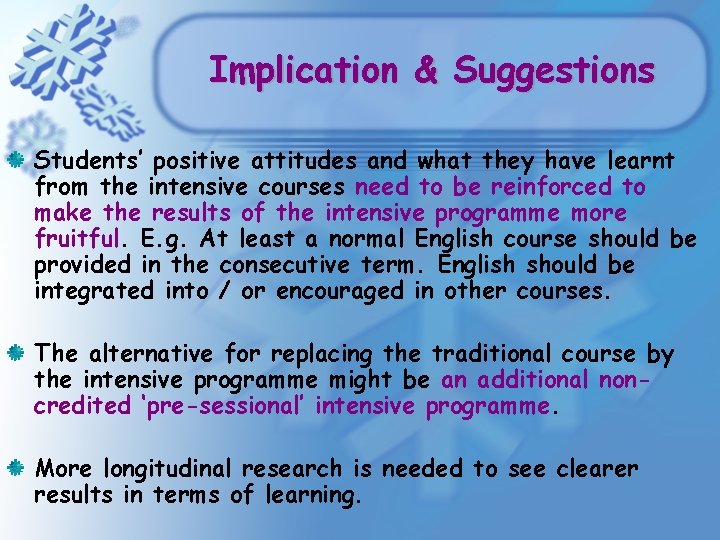
Implication & Suggestions Students’ positive attitudes and what they have learnt from the intensive courses need to be reinforced to make the results of the intensive programme more fruitful. E. g. At least a normal English course should be provided in the consecutive term. English should be integrated into / or encouraged in other courses. The alternative for replacing the traditional course by the intensive programme might be an additional noncredited ‘pre-sessional’ intensive programme. More longitudinal research is needed to see clearer results in terms of learning.
Conclusion The intensive course is regarded as an innovative English programme. KMUTT has experienced difficulties and hard work in managing this innovation. However, the results are quite satisfactory in terms of students’ attitudes and perceptions on their language improvement especially on productive skills. Issues on whether it could replace the conventional course are still controversial. The programme is, thus, challenging and worth further investigation.
Thank You