
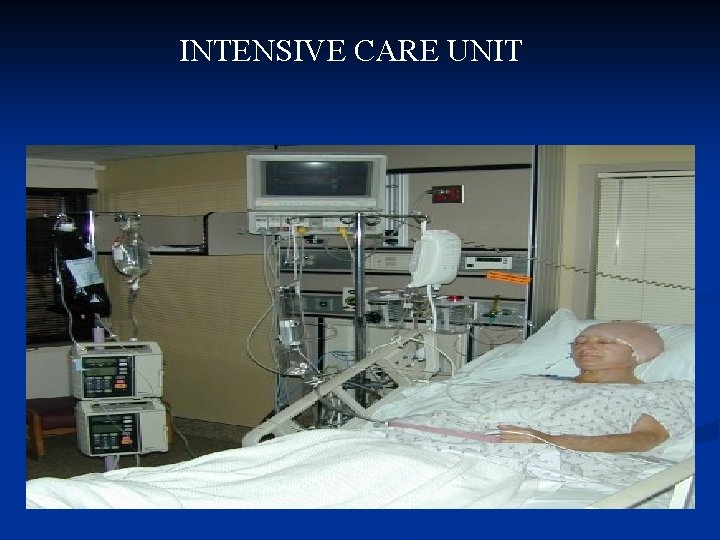
INTENSIVE CARE UNIT Definition An intensive care unit
- Slides: 7
INTENSIVE CARE UNIT
Definition An intensive care unit, or ICU, is a specialized section of a hospital that provides comprehensive and continuous care for persons who are critically ill and who can benefit from treatment. approximately 8% of all licensed hospital beds were designated for intensive care.
Who should be admitted to I. C. U. ? n Although the criteria for admission to an ICU are somewhat controversial—excluding n patients who are either too well or too sick to benefit from intensive care—there are four recommended priorities that intensivists (specialists in critical care medicine) use to decide this question. These priorities include: 1 - Critically ill patients in a medically unstable state who require an intensive level of care (monitoring and treatment). 2 - Patients requiring intensive monitoring who may also require emergency interventions. 3 - Patients who are medically unstable or critically ill and who do not have much chance for recovery due to the severity of their illness or traumatic injury. 4 - Patients who are generally not eligible for ICU admission because they are not expected to survive. Patients in this fourth category require the approval of the director of the ICU program before admission. WHICH SYSTEM FAILURE IS COMMON TO ALL PATIENTS IN I. C. U. ? Though a wide range of pathological conditions required intensive therapy but almost all involve failure of respiratory &/or circulation. Therefore, the treatment of acute respiratory insufficiency represent a major area in ICU. T
Respiratory indication for admission to ICU 1 - Damage of inspiratory center : e. g, drug intoxication , status epilepticus , eclampsia. 2 -Upper motor neuron lesion : high cervical spinal lesion. 3 - Lower motor neuron lesion : poliomylitis. 4 - Peripheral nerves diseases : Guillian Barre syndrome , Tetanus. 5 - Neuromuscular junction diseases : Myasthenia gravis. 6 - Stractural impairment of chest wall : Flial chest. 7 - Upper respiratory tract lesion : epiglotitis , vocal cord paralysis , croup ( laryngotracheobronchitis ). 8 - Lower respiratory tract disease : status asthmaticus , acute on chronic lung disease (COPD) , aspiration ( gastric content , mecunium , foreign body ). 9 - Aleveolar disorders (paranchymal dis. ) : pulm. oedema , near drowning , ARDS.
Indications For IPPV( intermittent positive pressure ventilation) : 1 - During clinical anaesthesia , when drugs causing neuromuscular block or profound respiratory depression have been used deliberately as part of anaesthetic technique. 2 - When hypoxia and hypercapnia might be hazardous : after neurosurgery or cardiac surgery, or during the immediate treatment of head injuries. 3 - in primary ventilatory failure where there is interference with the nervous , muscular or skeletal mechanisms of normal breathing: poliomylitis , myasthenia gravis , Guillian Barre syndrome and drug overdose. 4 - Acute lung conditions which call for a great increase in respiratory work to maintain normal gas exchange: ARDS , cardiac pulmonary oedema , status asthmaticus and acute respiratory failure in COPD.
Respiratory Failure Defined as : inability of the lung to maintain arterial oxygen tension with or without acceptable elimination of CO 2 adequets for the patients metabolic requirement Diagnosis : 1/ Clinically A-The disease itself may direct the attention for the diagnosis, e. g. Guillian Barre syndrom, myasthenia gravis , etc. B-The effect of hypoxaemia on CNS , CVS , RS. : On CNS: ranging from restlessness to coma. On CVS: dusky colouration of the skin and mucous memb, cyanosis or pallor(due to overactivity of sympathetic system). On Respiratory system: Rapid shallow or irregular and grunting Note: - restlessness may be the only obvious sign of hypoxaemia, and if such patient is misdiagnosed and restlessness is treated by sedative drugs, this may leads to rapidly progressive respiratory failure. 2/ Blood Gas Analysis : -low Pa. O 2 with ( low , normal or increased Pa. CO 2 according to the type of respiratory failure) 3/pulm. function test : decrease in vital capacity , maximum inspiratory force. n FEV 1 TYPES OF RESP. FAILURE: Type 1 : low Pa. O 2 with low or normal Pa. CO 2. Type 2 : low Pa. O 2 with high Pa. CO 2.
TREATMENT OF ACUTE RESPIRATORY FAILURE: 1 - Supplemental oxygen (maintain Pa. O 2 60 – 80 mm. Hg). 2 -Intubation of the trachea. 3 -mechanical support of ventilation( adjust the ventilator setting according to arterial blood gas analysis i. e, Pa. O 2, Pa. CO 2 and PH ). 4 - Diuretics: in some cases. 5 - Optimize intravascular fluid volume (guidelines include CVP , bl. pr. , Urine output and body weight). 6 - Inotropic support of cardiac function ( to offsets the adverse of IPPV on CVS ). 7 - Removal of secretions 8 - Control of infection. 9 -Nutritional support. 10 - Prophylactic antiacids and /or H 2 antagonist